
The Art of Working With People By Gigi
The Art of Working With People By Gigi K. Bohm Based on The Art of Thinking Styles and Coping With Difficult People by Robert M. Bramson, PH. D. and course at Mc. Pherson College by Mary Thomas, Ph. D
How Are Thinking Styles Formed? n n n Our style is determined from genetics and environment. As we grow, we choose what works for us. Over time, the tendency to do what works for you helps to form your thinking style. Over time, the style you have seems to be the same as it was in young adulthood. The trend for tendency stays the same, unless there is a traumatic event or instruction which alters your thinking. Parental styles do not influence. Each individual has their own set of variables in life that they deal with.
Goals n n n Identify your thinking styles. Learn the five types of thinking styles. Communicate better and understand where another person is “coming from” – their world or life philosophy.
What we are praised for we are also condemned for.
Taking the in. Q n n Follow the directions of the in. Q Total the SIPAR scores
Thinking Style Preferences n n n > 72 Very Strong Preference > 66 Strong Preference > 60 Moderate Preference < 48 Moderate Low < 42 Low Preference < 36 Very Low Preference
Influencing Others n Superimpose your scores on the Influencing Others chart.
Thinking Styles in the Population n n 50% of the population is a 1 way thinker. Scores 60 or above in an area. 35% of the population is combo. Scores of 60+ in two areas. 2% of the population is a 3 area combo. Scores of 60+ in three areas. 13% Scores range in the 50’s - Flat = many different styles, people may not be sure of your personality. No scores in 40’s.
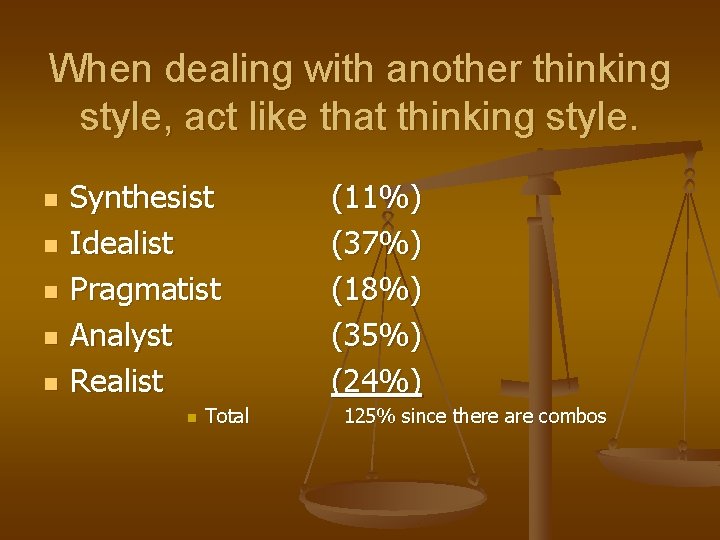
When dealing with another thinking style, act like that thinking style. n n n Synthesist Idealist Pragmatist Analyst Realist n Total (11%) (37%) (18%) (35%) (24%) 125% since there are combos
Synthesist (11% of population) “The Different Drummer” Reality is what you make it, since for every truth there is a counter truth. n n Creativity from connecting ideas – Opposites and Contradictions “No facts, please!”, concepts rather than specifics. Articulate, Abstract, and Argumentative The Distanced View
Techniques for Working With Synthesist n n n n Appeal to their ego. Conflict is good for progress. Ask for their advice – You will have to pick from their advice and make it happen, carry it through for them. They will offer ideas that you’ll need to make more concrete. Ask “Give me an example how this would work in my life. ” (Barney Brigade) Adopt an argumentative stance – enjoy the debate. Be playful, banter back and forth. Participate in brainstorming, they will not have an action plan or know how to execute. (Synthesist Example #6 pg. 27) Set limits and guidelines – Have a timekeeper who brings the agenda back to task. Timekeeper says “Now it is time to move to action. ” Note: This will hinder some of the ideas and creative thinking, but keep things timely.
Idealist ( 37% of the Population) “The most popular style” The world is one! n n Argument Defines Reality We’re all in this together High standards and deep disappointments Concern for the long range
Techniques for Working with an Idealist n n n Appeal to high ideals. Ask the question “ I have a problem with. . . and I really need some help. I know you can help me out. Will you help me? ” Do your homework. They expect you to know. Incorporate “Keep in touch. ” strategy Pull out what is wrong, by asking the question and not being really nice “I’ve heard you have this problem, can you discuss it with me? ” Let them go on, just nod, and say ok. Probe gently to help an idealist express their concerns. Ask the question “I’m not fully clear, can you help me understand this better? ”
Pragmatist (18% of the population) The contingency approach. n n Take the First Step and the Long Run Will Take Care of Itself Resourcefully Run Around Obstacles Bite-Size the Big Ones From Flexible to Phony
Techniques for Working With a Pragmatist n n They are the easiest to influence. Point out you win a few, you lose a few. They like humor and social interplay. Be incremental. One step of a project at a time. Be ready to bargain and trade off.
Analyst (35% of the Population) Search for the one best way. n n The one Best Way Ordered Rationality Power through Prediction If It’s Not Rational, It’s Not Real
Techniques for Working With an Analyst n n n n Meet them on their own grounds. Approach them as if world was populated by only sane rational people. Have facts, statistics, evidence. Know they are listening, but will show an emotionless face. They are still processing the data. They need more process/ think time. Ask, “Does that sound reasonable to you? ” They react better to things that are written. Leave nothing out. Use patience and listen because they have put a lot of time and energy into what they are going to say.
Realist (24% of the Population) Most teachers are idealists, not realists. Discover through empirical observation. n n “Facts” Not Data Let’s Go “That – A – Way” Fix it Fast and Forget It “What Do You Mean, You Don’t Agree? ”
Techniques for Working With a Realist n n Getting their attention. Get to the point, get there quickly. Be concise. Summarize. Say less than you think is absolutely necessary. Encourage appropriation. If you have a good idea, plant the seed and let the realist take credit for it. . . let it go. Because they need to feel in control, give them limited choices. Limit the alternatives, but give them control to make the choice.
We all have some of these styles in us. n The style you rely on most often.
Try this. . . n n n Synthesist – Live by the bell. Idealists – Say I hear you, but I disagree. Principals - Because they deal with so many people – Be a Sybil. They need to have all these strategies. (per instructor) Scoring flat. Teachers - Adopt a pragmatist approach for differentiated learning: flexible, multi simultaneous activities. (per an administrator who is a classmate. ) Trust has to be built, “brick by brick. ” Take down the wall with kindness. (per a classmate who is a teacher)
Latter 70’s Study Results n n n Manual Laborers – Analyst Small/ Medium Executives – Pragmatist Financial Managers – Pragmatist/Analyst Fiscal Accounting – Pragmatist/Analyst Computer Programmers – Analyst/Realist Sales –Pragmatist/Realist Engineers – Analyst Natural Sciences – Very High Synthesis/ Very Low Pragmatist Physical Science/ Math –High Analyst/ Low Pragmatist Federal Government /Middle Management – Almost flat highest in pragmatist Teachers – Very High in Idealist, High Pragmatist/ Low in Analyst Administrators – Flat, but higher in Pragmatist, lower in Analyst Insurance Sales
- Slides: 22