
The Art of Strategic Conversation Testing strategies via
- Slides: 37
The Art of Strategic Conversation Testing strategies via Scenario Planning Adrian Said
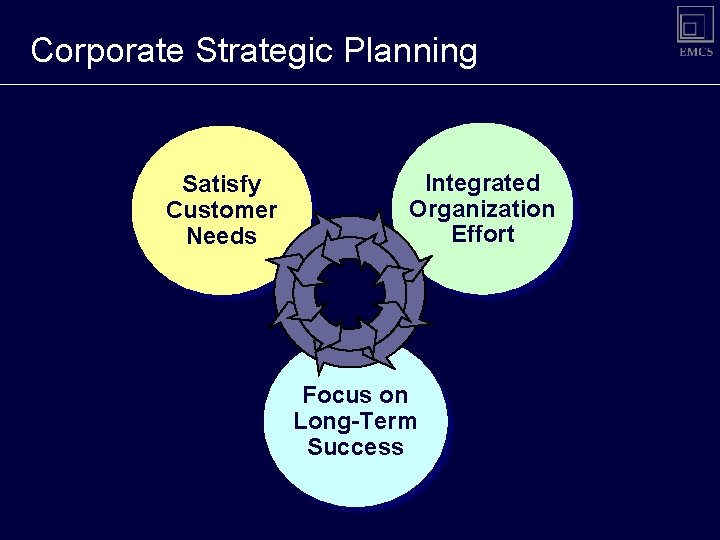
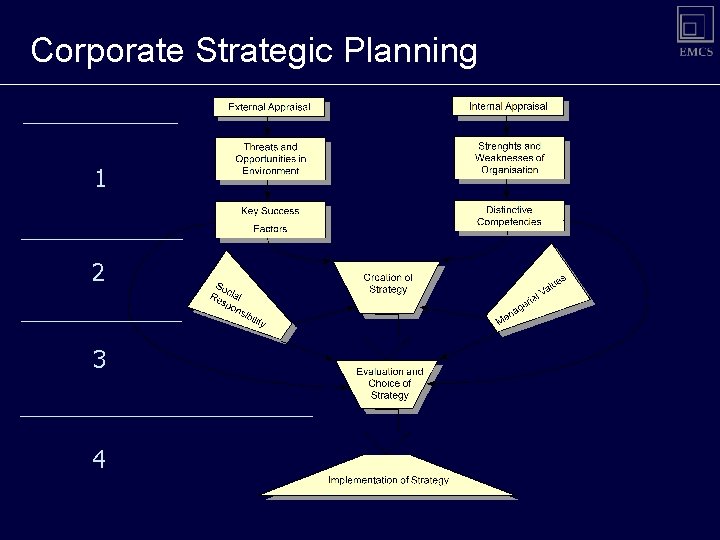
Corporate Strategic Planning Satisfy Customer Needs Integrated Organization Effort Focus on Long-Term Success
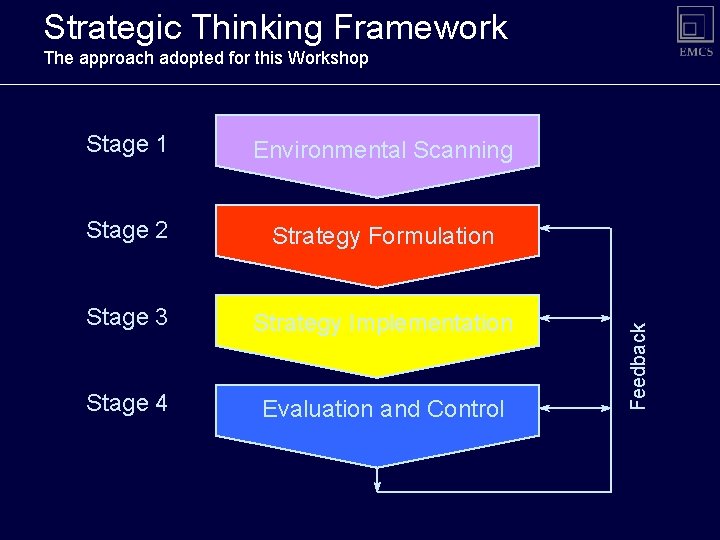
Strategic Thinking Framework Stage 1 Environmental Scanning Stage 2 Strategy Formulation Stage 3 Strategy Implementation Stage 4 Evaluation and Control Feedback The approach adopted for this Workshop
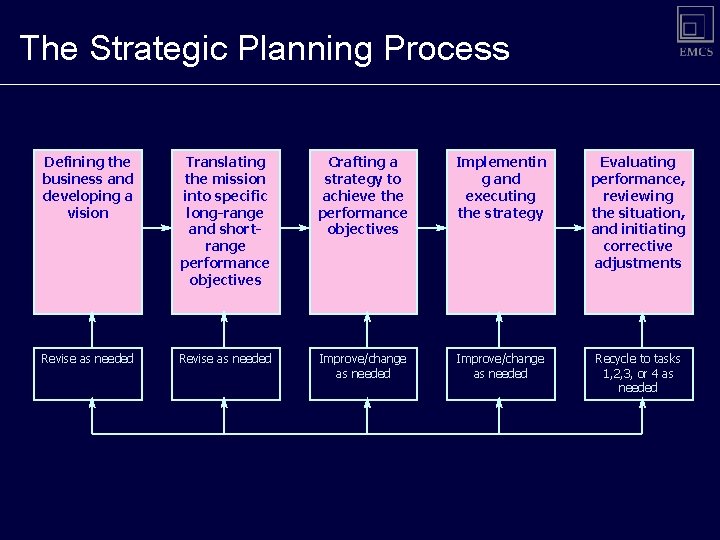
The Strategic Planning Process Defining the business and developing a vision Translating the mission into specific long-range and shortrange performance objectives Crafting a strategy to achieve the performance objectives Implementin g and executing the strategy Evaluating performance, reviewing the situation, and initiating corrective adjustments Revise as needed Improve/change as needed Recycle to tasks 1, 2, 3, or 4 as needed
Corporate Strategic Planning 1 2 3 4
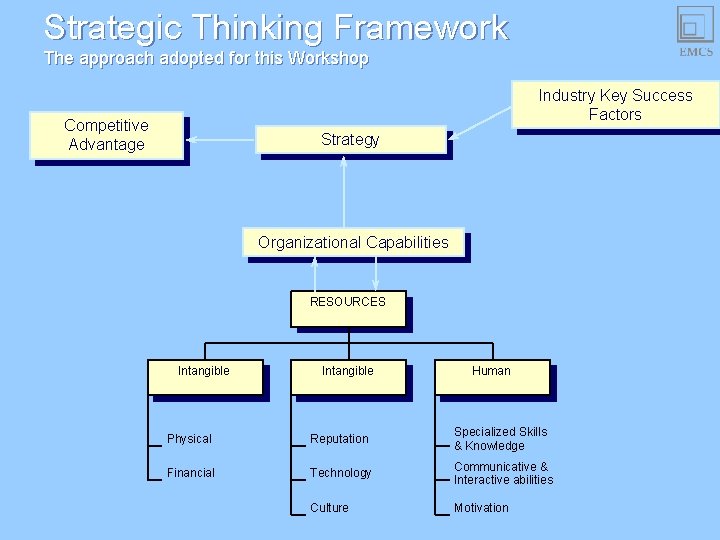
Strategic Thinking Framework The approach adopted for this Workshop Industry Key Success Factors Competitive Advantage Strategy Organizational Capabilities RESOURCES Intangible Human Physical Reputation Specialized Skills & Knowledge Financial Technology Communicative & Interactive abilities Culture Motivation
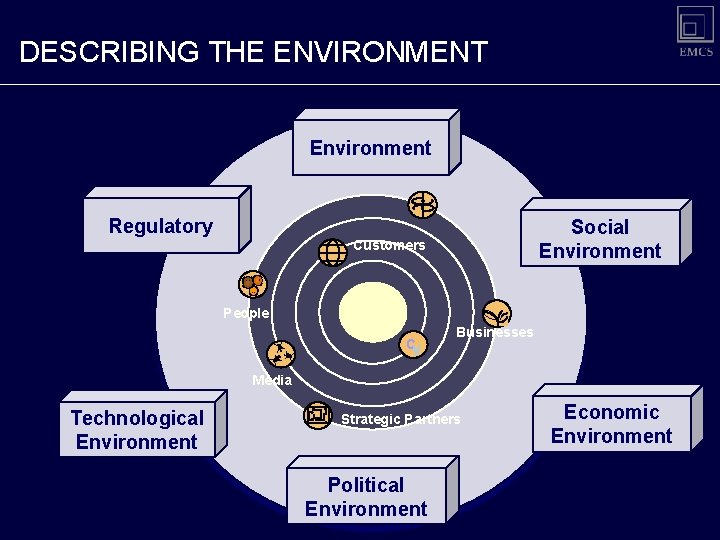
DESCRIBING THE ENVIRONMENT Environment Regulatory Social Environment Customers People CV Businesses Media Technological Environment Strategic Partners Political Environment Economic Environment
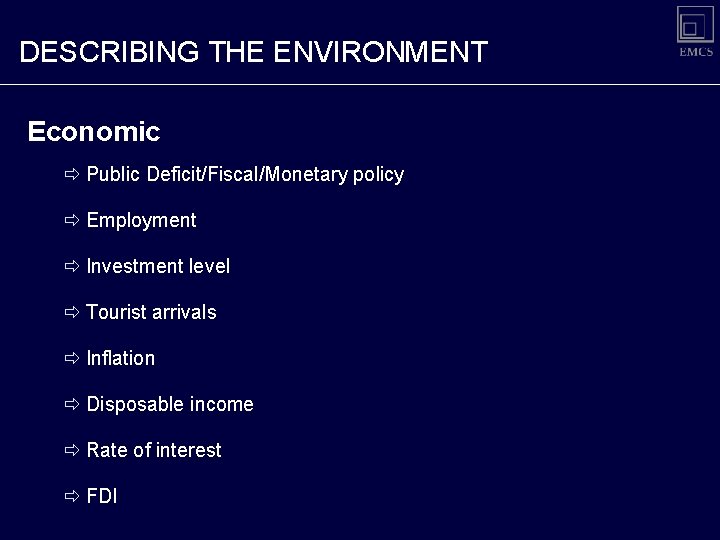
DESCRIBING THE ENVIRONMENT Economic ð Public Deficit/Fiscal/Monetary policy ð Employment ð Investment level ð Tourist arrivals ð Inflation ð Disposable income ð Rate of interest ð FDI
DESCRIBING THE ENVIRONMENT Political ðEU ðDirection/Stability = VISION ðGovernment fees ðPrivatisation ðIndustrial Policy ðWelfare State ðEducation
DESCRIBING THE ENVIRONMENT Social ðWorking mothers ðIncreased female participation ðAgeing population ðShorter working weeks ðUniversity student intake
DESCRIBING THE ENVIRONMENT Technology ðWorking from home (remote technology) ðE-commerce/M-commerce ðSubstitutes ðConvergence of technologies
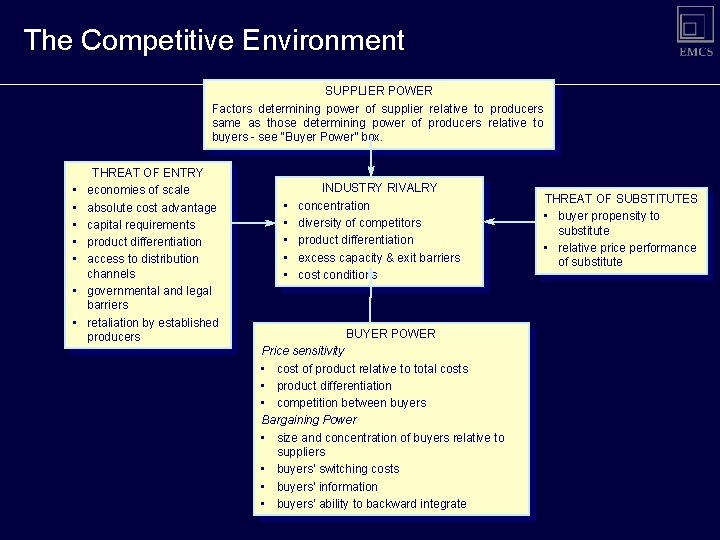
The Competitive Environment SUPPLIER POWER Factors determining power of supplier relative to producers same as those determining power of producers relative to buyers - see “Buyer Power” box. • • THREAT OF ENTRY economies of scale absolute cost advantage capital requirements product differentiation access to distribution channels governmental and legal barriers retaliation by established producers • • • INDUSTRY RIVALRY concentration diversity of competitors product differentiation excess capacity & exit barriers cost conditions BUYER POWER Price sensitivity • cost of product relative to total costs • product differentiation • competition between buyers Bargaining Power • size and concentration of buyers relative to suppliers • buyers’ switching costs • buyers’ information • buyers’ ability to backward integrate THREAT OF SUBSTITUTES • buyer propensity to substitute • relative price performance of substitute
The Competitive Environment SUPPLIER POWER Factors determining power of supplier relative to producers same as those determining power of producers relative to buyers RANKING: HIGH MEDIUM LOW THREAT OF SUBSTITUTES RANKING: HIGH MEDIUM LOW
The Competitive Environment BUYER POWER Is the buyer in a position to dictate? RANKING: HIGH MEDIUM LOW THREAT OF ENTRY RANKING: RIVALRY RANKING:
Overall Industry Competitiveness Low/Medium/High
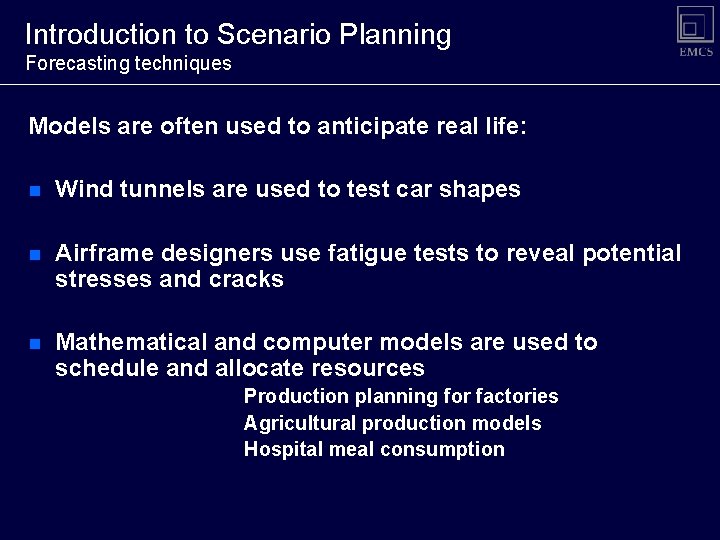
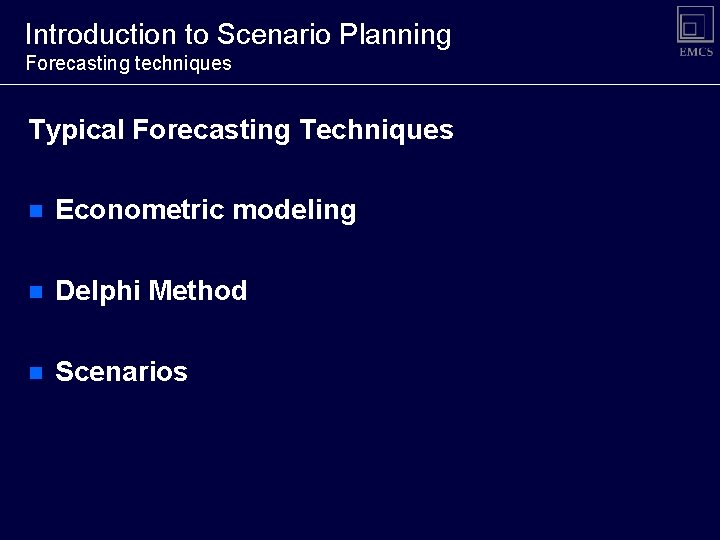
Introduction to Scenario Planning Forecasting techniques Models are often used to anticipate real life: n Wind tunnels are used to test car shapes n Airframe designers use fatigue tests to reveal potential stresses and cracks n Mathematical and computer models are used to schedule and allocate resources Production planning for factories Agricultural production models Hospital meal consumption
Introduction to Scenario Planning Forecasting techniques Typical Forecasting Techniques n Econometric modeling n Delphi Method n Scenarios
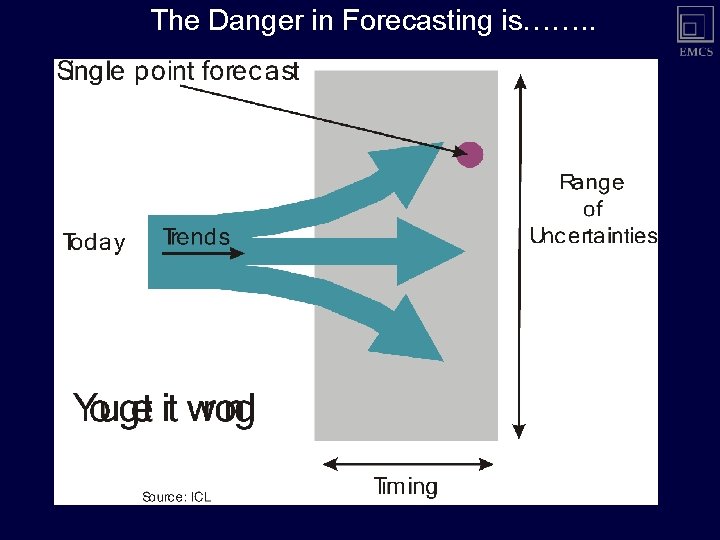
The Danger in Forecasting is……. .
Introduction to Scenario Planning Forecasts based on current trends or estimated based on history are dangerous if the environment is changing rapidly The emphasis has moved from forecasting to foresight
What is Scenario Planning? Scenario planning is a particular methodology that allows organizations, and individual units, to develop a clearer understanding of what the future strategic environment might be like. Scenario planning focuses on key drivers of change which are critical to the future of an organization. The scenario development process allows staff to explore how those drivers might affect the organization, and to make better informed decisions about how to position the organization for the future
Scenario Utilization n n Method of studying the most important driving forces affecting our futures. A team process that encourages exchange of knowledge and issues important to the future Purpose: To devise strategies to counter adversities and anticipate potential opportunities Deliverables: A set of scenarios and a set of strategies for each scenario Examples: Military, business, environmental study, politics
Scenarios – A Case Study “In times of rapid change, an inability to see an emergent novel reality by being locked inside obsolete assumptions often causes strategic failure, particularly in large, well-run companies. ” (Pierre Wack, HBR 1980)
Scenarios – A Case Study Delta case study A company involved in the blending, bottling, and distribution of alcoholic spirits Set in a historic context of long periods of incremental change in the business environment
Scenarios – A Case Study Prior to the scenario intervention, the risks were seen as not serious if the company kept to its original strategy
Scenarios – A Case Study “Most of our clients come to us for mainly historical reasons. In this business, the crux is ‘word of mouth’. People need to know who you are. ” “Our investment is geared towards our existing business, both quality and throughput. It is not intended to serve major new business opportunities. ” “The main constraint to expanding our business is the demand for the type of services we offer. ” “Our facilities are the key. We must continue to spend on them. ”
Scenarios – A Case Study And the risks of continuing with the current strategy were minimised.
Scenarios – A Case Study “The wider industry is looking for ways to reduce stocks and working capital, but at the same time to increase variety and choice to the market. If we find some magic formula here we have got it made. ” “Although we are not any longer a cost centre, we will continue to live with the dilemma that if we improve our efficiency our customers will expect a lower price. There is no other price standard to look at than our cost. There is no ‘going market rate for the job’. Also we are very close to our customers. We will therefore never be extraordinary profitable. And we can prosper only under the protective arm of the Group. ”
Scenarios – A Case Study “In the 70’s the parent Group bought a food company. This proved a disaster. The company has been disposed of. But the memory lingers on. This is one thing we will never do again. It is unlikely that the Group will diversify from spirits. ”
Scenarios – A Case Study The organizational “jolt” invoked by the intervention provided a new understanding.
Scenarios – A Case Study The management team came to the realization that the current configuration of operational activities resulted in the company absorbing suppliers’ and customers’ risk Supplier risk arose from Delta Co. holding, and paying for, large stocks of empty bottles, labels, packages and bottle caps. Customer risk revolved around the fact that customers were requesting orders at short notice and, to accommodate these, Delta Co. had to regularly amend production schedules, significantly increasing their operating costs.
Scenarios – A Case Study I never thought about this before … I am depressed, we are being stuffed by our customers, we are locked into the risk of customers. Delta Co. gives value, creates value for others, why? Delta takes a worthless product and creates value in the process, for little reward. [Here the participants were reflecting on their experience and considering the lack of scope Delta Co. had to plan production - due to short lead-time demands from customers]
Further insights from the workshops There was a realization within the team that the industry structure had moved from three tiers (raw materials, blending and bottling, and brand management) to two tiers (production and customer relationships). Delta Co. had almost no involvement with external customers and therefore no intelligence about market demand. This lack of involvement resulted in little internal understanding of the relationship between the brand customers, and Delta’s role in that relationship
Further insights from the workshops The outcome of the scenario intervention was to introduce challenge or “jolt” to business-as-usual thinking at Delta Co, causing a re-conceptualisation of Delta’s business idea
Further insights from the workshops Prior to the intervention, Delta had not explicitly articulated any major concern(s) regarding the contextual environment and had indicated that the key managerial issue was simply the desire for a growth in bottling of 25% (to reduce unit cost of production). .
Further insights from the workshops At the conclusion of the intervention, the response being formulated had moved from a situation of reactive production systems, to cope with uneven demands. The new focus was in managing the overall supply chain through partnerships with customers and suppliers. Delta’s new business idea achieved: evenness / predictability in both supply and customer demands lower unit cost of production. .
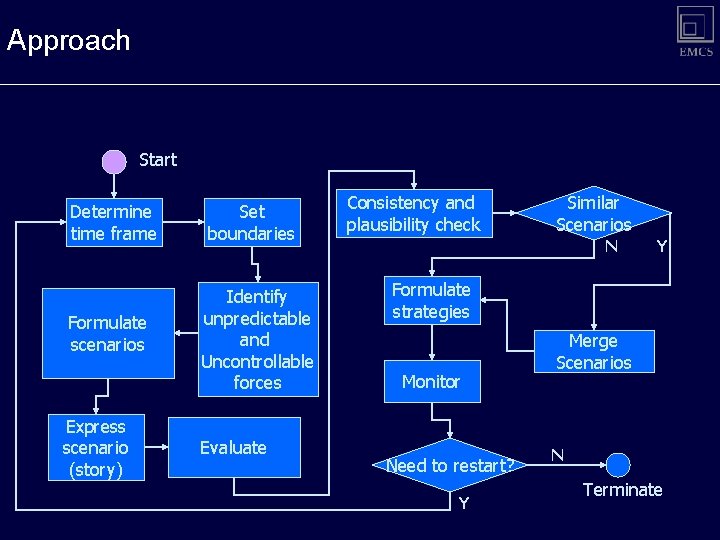
Approach Start Determine time frame Formulate scenarios Express scenario (story) Set boundaries Identify unpredictable and Uncontrollable forces Evaluate Consistency and plausibility check Similar Scenarios N Y Formulate strategies Monitor Need to restart? Y Merge Scenarios N Terminate
Conclusion What are scenarios? What we ARE NOT trying to do is: • predict the future What we ARE trying to do is: • engage in an interesting conversation about the future • explore what might happen and why • challenge some individual and shared mental models