
The Art of Regulation A case of the

- Slides: 27
The Art of Regulation: A case of the Fundamental Review of the Trading Book revisited Alexey Lobanov, Ph. D. , FRM Deputy Director Banking Regulation Department Bank of Russia Perm Winter School Perm, 4 th February, 2016 The views and opinions expressed herein are those of the author and do not necessarily reflect the official position of the Bank of Russia
Outline 1. Art, science and financial regulation. 2. Fundamental review of the trading book accomplished: a piece of art? 3. Quantitative impact study and calibration of the revised market risk capital rules: putting the cart before the horse? 4. Q&A Alexey Lobanov 2 Perm Winter School, 2016
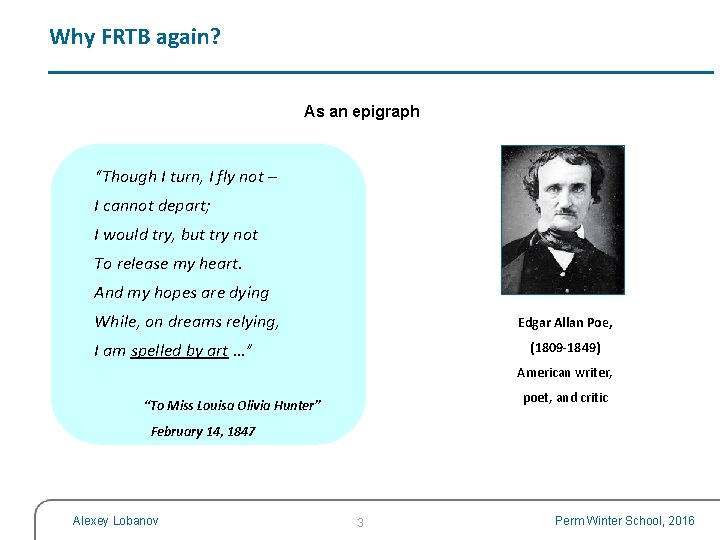
Why FRTB again? As an epigraph “Though I turn, I fly not – I cannot depart; I would try, but try not To release my heart. And my hopes are dying While, on dreams relying, Edgar Allan Poe, (1809 -1849) I am spelled by art …” American writer, poet, and critic “To Miss Louisa Olivia Hunter” February 14, 1847 Alexey Lobanov 3 Perm Winter School, 2016
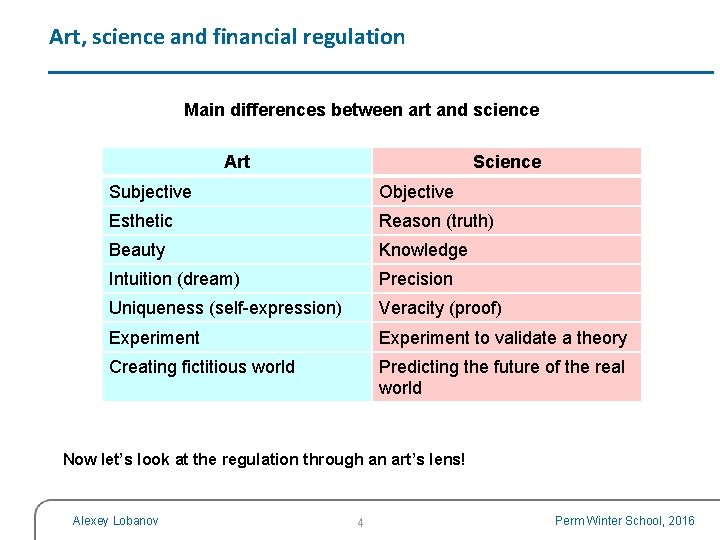
Art, science and financial regulation Main differences between art and science Art Science Subjective Objective Esthetic Reason (truth) Beauty Knowledge Intuition (dream) Precision Uniqueness (self-expression) Veracity (proof) Experiment to validate a theory Creating fictitious world Predicting the future of the real world Now let’s look at the regulation through an art’s lens! Alexey Lobanov 4 Perm Winter School, 2016
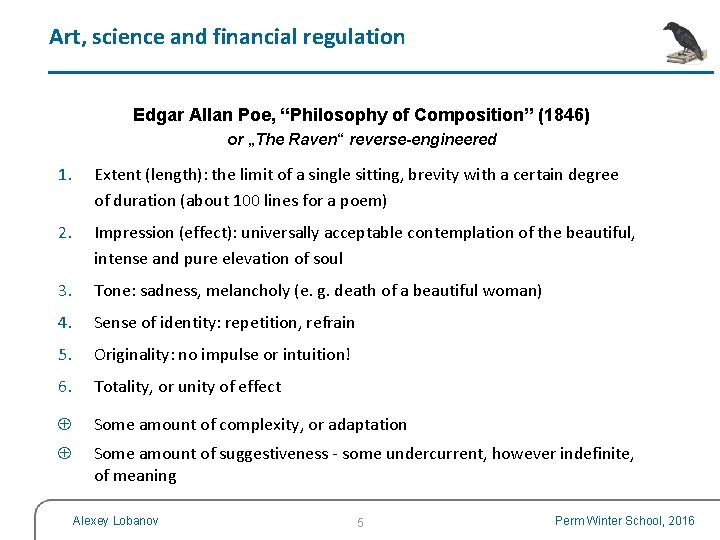
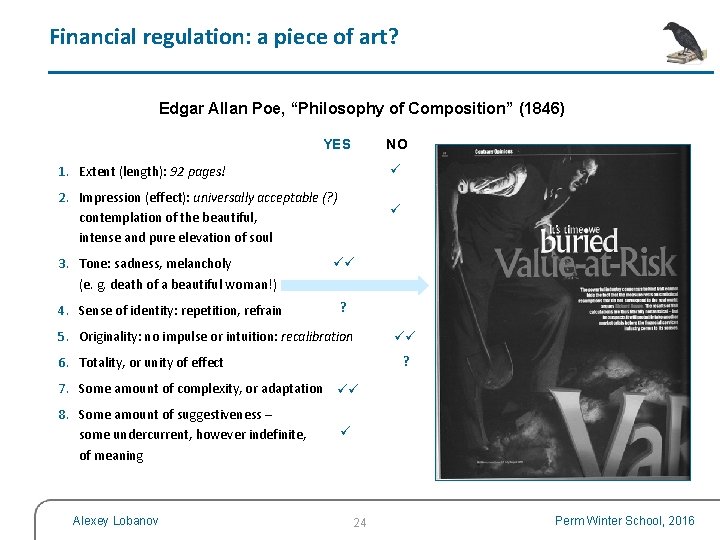
Art, science and financial regulation Edgar Allan Poe, “Philosophy of Composition” (1846) or „The Raven“ reverse-engineered 1. Extent (length): the limit of a single sitting, brevity with a certain degree of duration (about 100 lines for a poem) 2. Impression (effect): universally acceptable contemplation of the beautiful, intense and pure elevation of soul 3. Tone: sadness, melancholy (e. g. death of a beautiful woman) 4. Sense of identity: repetition, refrain 5. Originality: no impulse or intuition! 6. Totality, or unity of effect Some amount of complexity, or adaptation Some amount of suggestiveness - some undercurrent, however indefinite, of meaning Alexey Lobanov 5 Perm Winter School, 2016
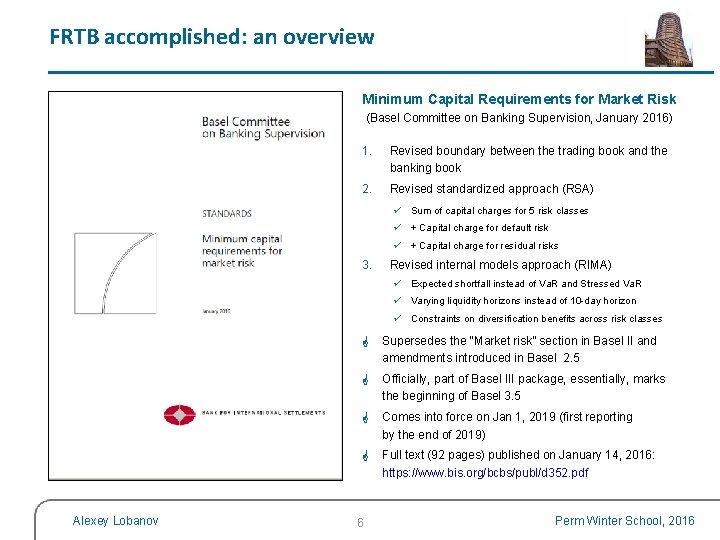
FRTB accomplished: an overview Minimum Capital Requirements for Market Risk (Basel Committee on Banking Supervision, January 2016) 1. Revised boundary between the trading book and the banking book 2. Revised standardized approach (RSA) Sum of capital charges for 5 risk classes + Capital charge for default risk + Capital charge for residual risks 3. Revised internal models approach (RIMA) Expected shortfall instead of Va. R and Stressed Va. R Varying liquidity horizons instead of 10 -day horizon Constraints on diversification benefits across risk classes Alexey Lobanov G Supersedes the “Market risk” section in Basel II and amendments introduced in Basel 2. 5 G Officially, part of Basel III package, essentially, marks the beginning of Basel 3. 5 G Comes into force on Jan 1, 2019 (first reporting by the end of 2019) G Full text (92 pages) published on January 14, 2016: https: //www. bis. org/bcbs/publ/d 352. pdf 6 Perm Winter School, 2016
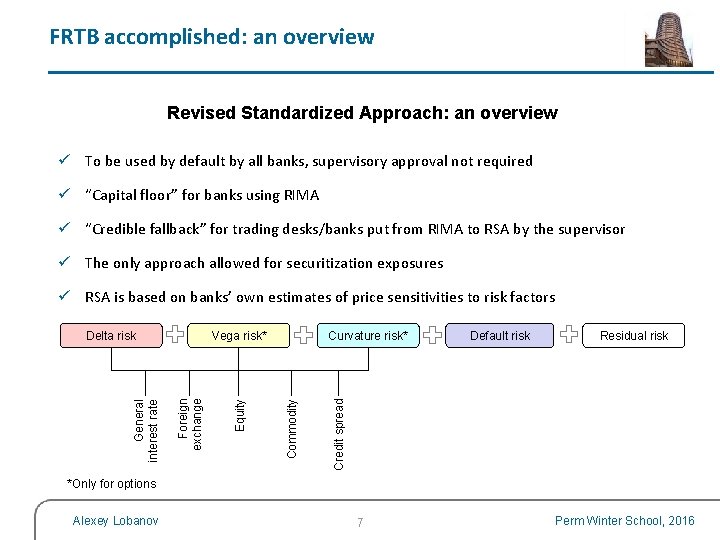
FRTB accomplished: an overview Revised Standardized Approach: an overview To be used by default by all banks, supervisory approval not required “Capital floor” for banks using RIMA “Credible fallback” for trading desks/banks put from RIMA to RSA by the supervisor The only approach allowed for securitization exposures RSA is based on banks’ own estimates of price sensitivities to risk factors Default risk Residual risk Credit spread Curvature risk* Commodity Equity Vega risk* Foreign exchange General interest rate Delta risk *Only for options Alexey Lobanov 7 Perm Winter School, 2016
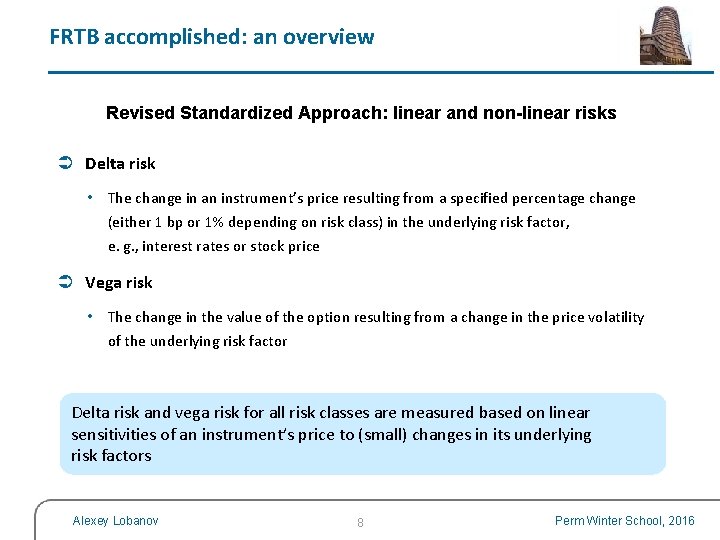
FRTB accomplished: an overview Revised Standardized Approach: linear and non-linear risks Delta risk • The change in an instrument’s price resulting from a specified percentage change (either 1 bp or 1% depending on risk class) in the underlying risk factor, e. g. , interest rates or stock price Vega risk • The change in the value of the option resulting from a change in the price volatility of the underlying risk factor Delta risk and vega risk for all risk classes are measured based on linear sensitivities of an instrument’s price to (small) changes in its underlying risk factors Alexey Lobanov 8 Perm Winter School, 2016
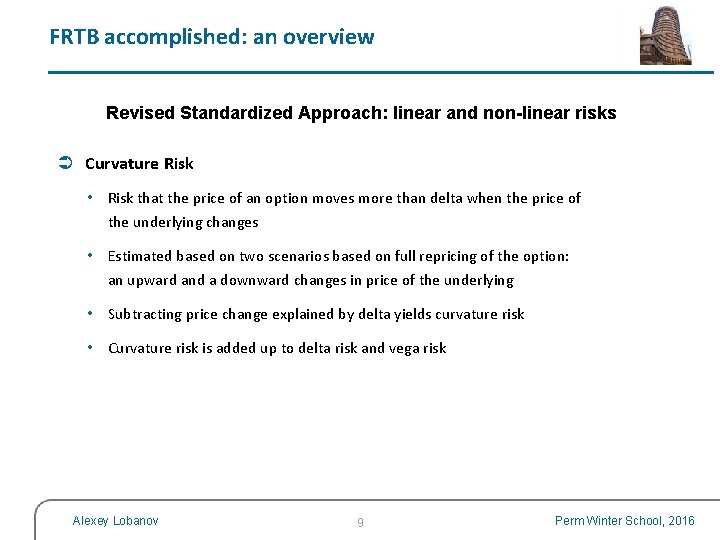
FRTB accomplished: an overview Revised Standardized Approach: linear and non-linear risks Curvature Risk • Risk that the price of an option moves more than delta when the price of the underlying changes • Estimated based on two scenarios based on full repricing of the option: an upward and a downward changes in price of the underlying • Subtracting price change explained by delta yields curvature risk • Curvature risk is added up to delta risk and vega risk Alexey Lobanov 9 Perm Winter School, 2016
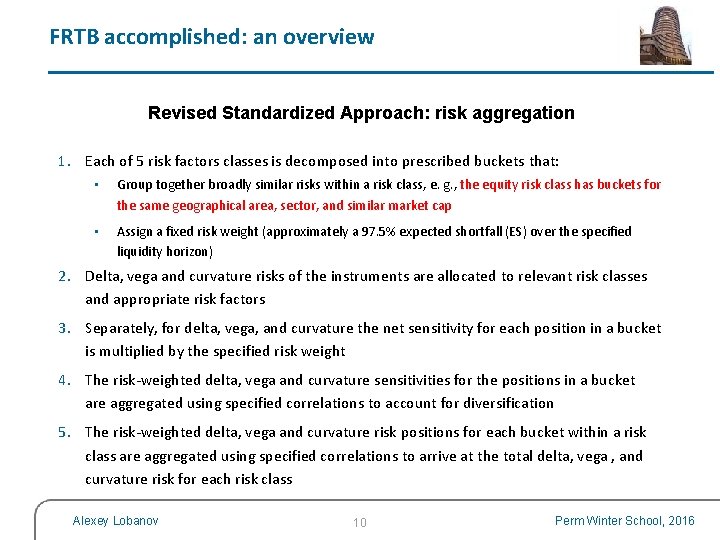
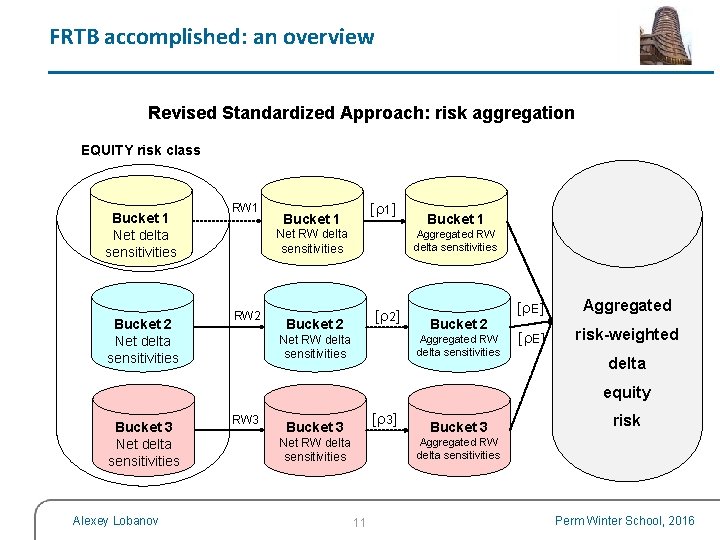
FRTB accomplished: an overview Revised Standardized Approach: risk aggregation 1. Each of 5 risk factors classes is decomposed into prescribed buckets that: • Group together broadly similar risks within a risk class, e. g. , the equity risk class has buckets for the same geographical area, sector, and similar market cap • Assign a fixed risk weight (approximately a 97. 5% expected shortfall (ES) over the specified liquidity horizon) 2. Delta, vega and curvature risks of the instruments are allocated to relevant risk classes and appropriate risk factors 3. Separately, for delta, vega, and curvature the net sensitivity for each position in a bucket is multiplied by the specified risk weight 4. The risk-weighted delta, vega and curvature sensitivities for the positions in a bucket are aggregated using specified correlations to account for diversification 5. The risk-weighted delta, vega and curvature risk positions for each bucket within a risk class are aggregated using specified correlations to arrive at the total delta, vega , and curvature risk for each risk class Alexey Lobanov 10 Perm Winter School, 2016
FRTB accomplished: an overview Revised Standardized Approach: risk aggregation EQUITY risk class Bucket 1 Net delta sensitivities Bucket 2 Net delta sensitivities RW 1 [r 1] Bucket 1 Net RW delta sensitivities RW 2 Bucket 1 Aggregated RW delta sensitivities [r 2] Bucket 2 Net RW delta sensitivities Bucket 2 Aggregated RW delta sensitivities [r. E] Aggregated [r. E] risk-weighted delta equity Bucket 3 Net delta sensitivities Alexey Lobanov RW 3 [r 3] Bucket 3 Net RW delta sensitivities Bucket 3 risk Aggregated RW delta sensitivities 11 Perm Winter School, 2016
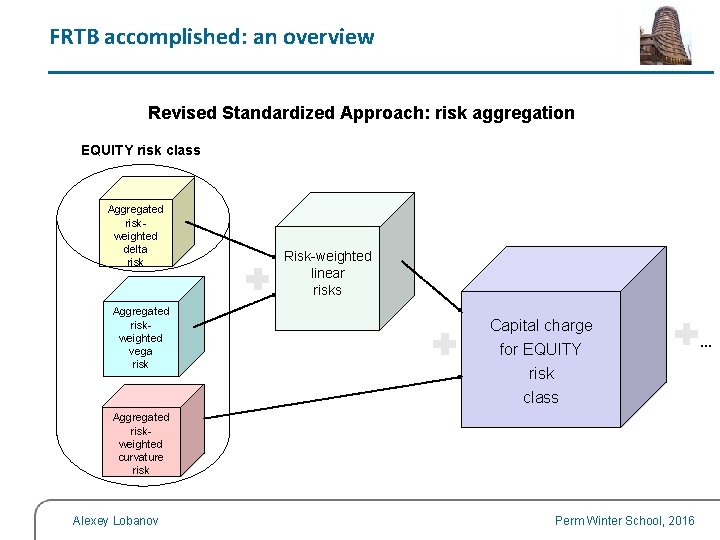
FRTB accomplished: an overview Revised Standardized Approach: risk aggregation EQUITY risk class Aggregated riskweighted delta risk Aggregated riskweighted vega risk Risk-weighted linear risks Capital charge for EQUITY risk class Aggregated riskweighted curvature risk Alexey Lobanov Perm Winter School, 2016 . . .
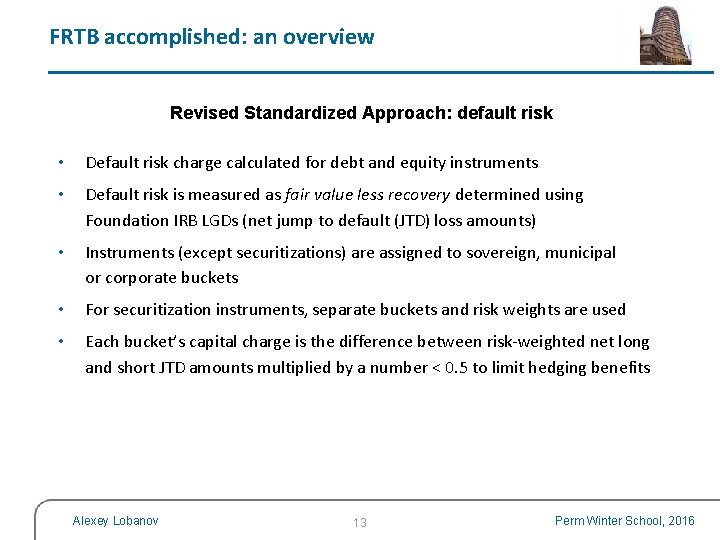
FRTB accomplished: an overview Revised Standardized Approach: default risk • Default risk charge calculated for debt and equity instruments • Default risk is measured as fair value less recovery determined using Foundation IRB LGDs (net jump to default (JTD) loss amounts) • Instruments (except securitizations) are assigned to sovereign, municipal or corporate buckets • For securitization instruments, separate buckets and risk weights are used • Each bucket’s capital charge is the difference between risk-weighted net long and short JTD amounts multiplied by a number < 0. 5 to limit hedging benefits Alexey Lobanov 13 Perm Winter School, 2016
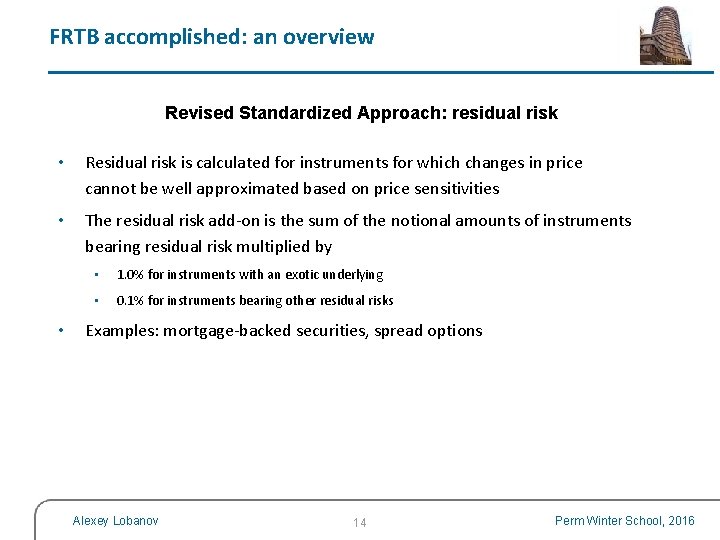
FRTB accomplished: an overview Revised Standardized Approach: residual risk • Residual risk is calculated for instruments for which changes in price cannot be well approximated based on price sensitivities • The residual risk add-on is the sum of the notional amounts of instruments bearing residual risk multiplied by • • 1. 0% for instruments with an exotic underlying • 0. 1% for instruments bearing other residual risks Examples: mortgage-backed securities, spread options Alexey Lobanov 14 Perm Winter School, 2016
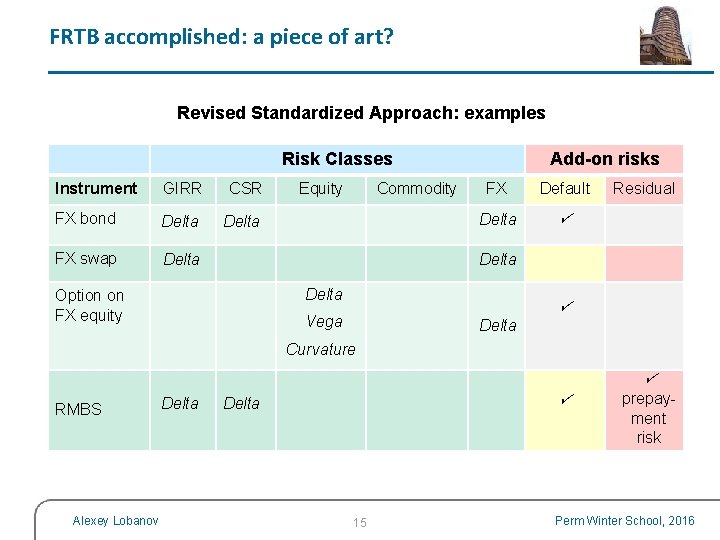
FRTB accomplished: a piece of art? Revised Standardized Approach: examples Risk Classes Instrument GIRR CSR FX bond Delta FX swap Delta Equity Commodity Add-on risks FX Default Delta Residual Delta Option on FX equity Vega Delta Curvature RMBS Alexey Lobanov Delta 15 prepayment risk Perm Winter School, 2016
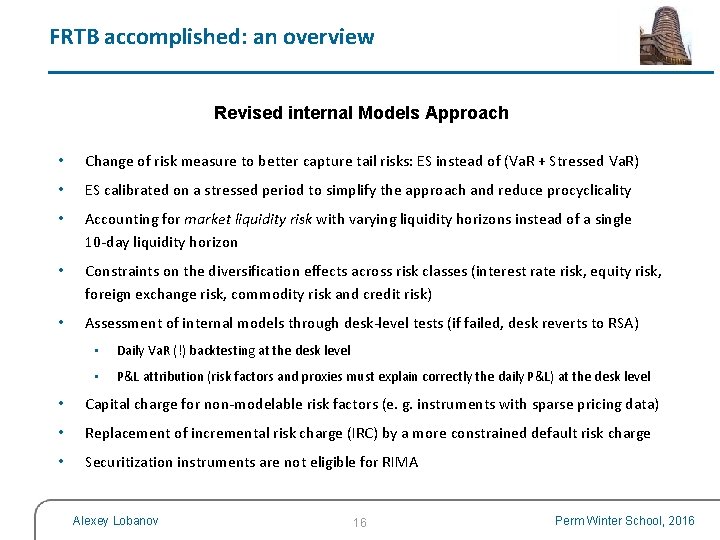
FRTB accomplished: an overview Revised internal Models Approach • Change of risk measure to better capture tail risks: ES instead of (Va. R + Stressed Va. R) • ES calibrated on a stressed period to simplify the approach and reduce procyclicality • Accounting for market liquidity risk with varying liquidity horizons instead of a single 10 -day liquidity horizon • Constraints on the diversification effects across risk classes (interest rate risk, equity risk, foreign exchange risk, commodity risk and credit risk) • Assessment of internal models through desk-level tests (if failed, desk reverts to RSA) • Daily Va. R (!) backtesting at the desk level • P&L attribution (risk factors and proxies must explain correctly the daily P&L) at the desk level • Capital charge for non-modelable risk factors (e. g. instruments with sparse pricing data) • Replacement of incremental risk charge (IRC) by a more constrained default risk charge • Securitization instruments are not eligible for RIMA Alexey Lobanov 16 Perm Winter School, 2016
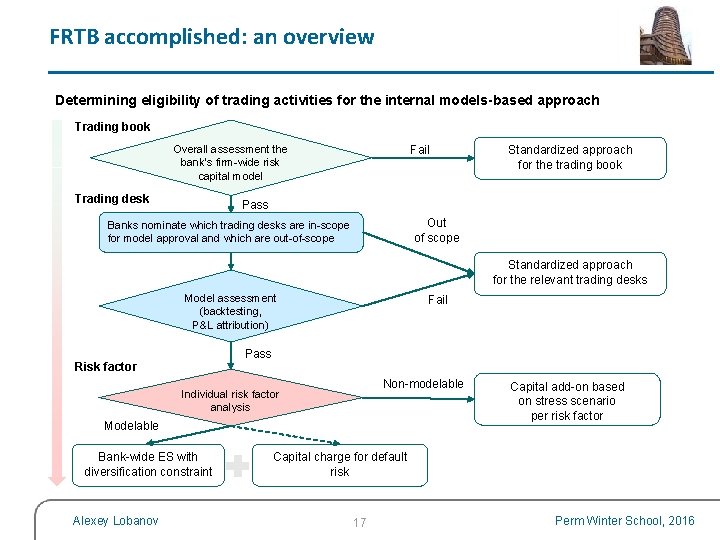
FRTB accomplished: an overview Determining eligibility of trading activities for the internal models-based approach Trading book Overall assessment the bank’s firm-wide risk capital model Trading desk Fail Standardized approach for the trading book Pass Out of scope Banks nominate which trading desks are in-scope for model approval and which. Yes are out-of-scope Standardized approach for the relevant trading desks Model assessment (backtesting, P&L attribution) Fail Pass Risk factor Non-modelable Individual risk factor analysis Modelable Bank-wide ES with diversification constraint Alexey Lobanov Capital add-on based on stress scenario per risk factor Capital charge for default risk 17 Perm Winter School, 2016
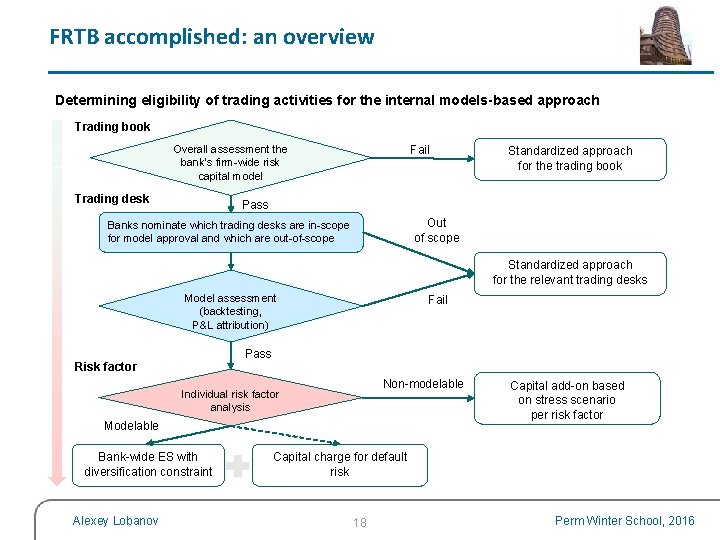
FRTB accomplished: an overview Determining eligibility of trading activities for the internal models-based approach Trading book Overall assessment the bank’s firm-wide risk capital model Trading desk Fail Standardized approach for the trading book Pass Out of scope Banks nominate which trading desks are in-scope for model approval and which. Yes are out-of-scope Standardized approach for the relevant trading desks Model assessment (backtesting, P&L attribution) Fail Pass Risk factor Non-modelable Individual risk factor analysis Modelable Bank-wide ES with diversification constraint Alexey Lobanov Capital add-on based on stress scenario per risk factor Capital charge for default risk 18 Perm Winter School, 2016
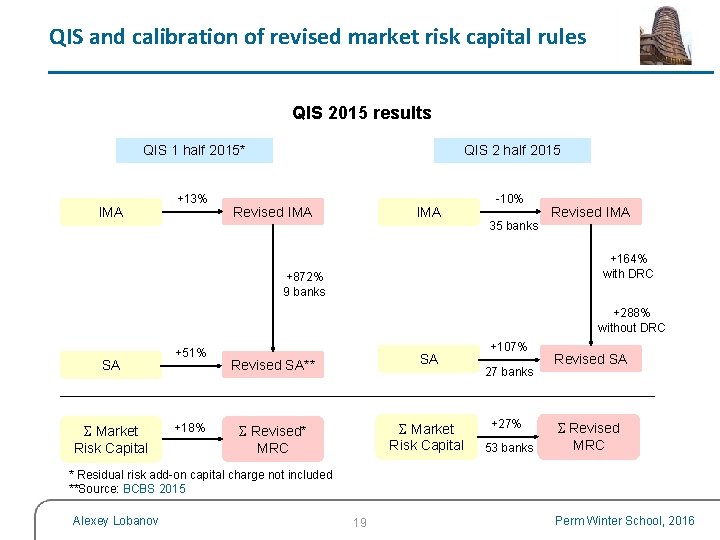
QIS and calibration of revised market risk capital rules QIS 2015 results QIS 1 half 2015* QIS 2 half 2015 +13% -10% IMA Revised IMA 35 banks Revised IMA +164% with DRC +872% 9 banks +288% without DRC SA S Market Risk Capital +51% +18% Revised SA** SA S Revised* MRC S Market Risk Capital +107% 27 banks +27% 53 banks Revised SA S Revised MRC * Residual risk add-on capital charge not included **Source: BCBS 2015 Alexey Lobanov 19 Perm Winter School, 2016
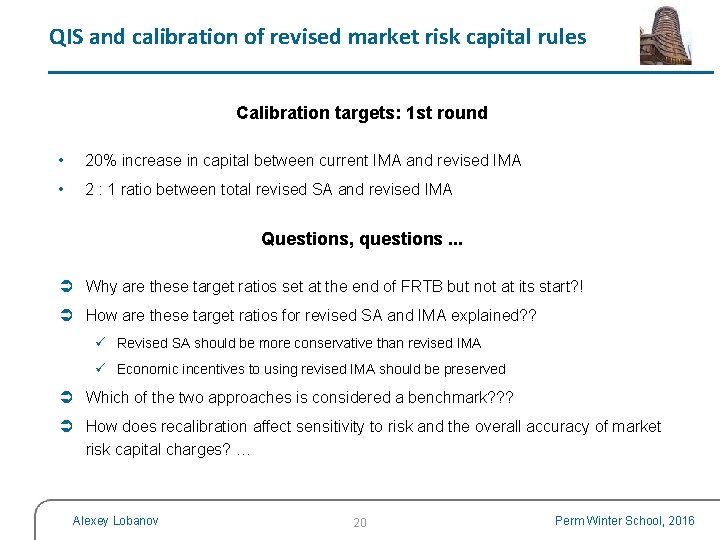
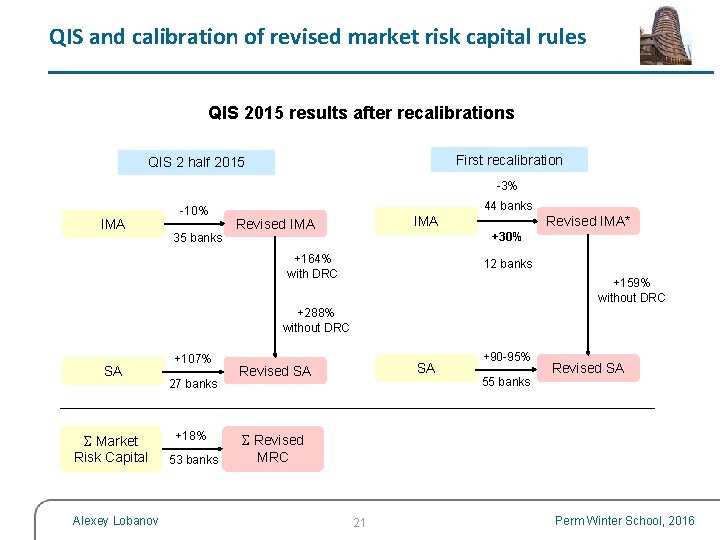
QIS and calibration of revised market risk capital rules Calibration targets: 1 st round • 20% increase in capital between current IMA and revised IMA • 2 : 1 ratio between total revised SA and revised IMA Questions, questions. . . Why are these target ratios set at the end of FRTB but not at its start? ! How are these target ratios for revised SA and IMA explained? ? Revised SA should be more conservative than revised IMA Economic incentives to using revised IMA should be preserved Which of the two approaches is considered a benchmark? ? ? How does recalibration affect sensitivity to risk and the overall accuracy of market risk capital charges? … Alexey Lobanov 20 Perm Winter School, 2016
QIS and calibration of revised market risk capital rules QIS 2015 results after recalibrations First recalibration QIS 2 half 2015 -3% IMA -10% 35 banks 44 banks Revised IMA* IMA Revised IMA +30% +164% with DRC 12 banks +159% without DRC +288% without DRC SA S Market Risk Capital Alexey Lobanov +107% 27 banks +18% 53 banks SA Revised SA +90 -95% 55 banks Revised SA S Revised MRC 21 Perm Winter School, 2016
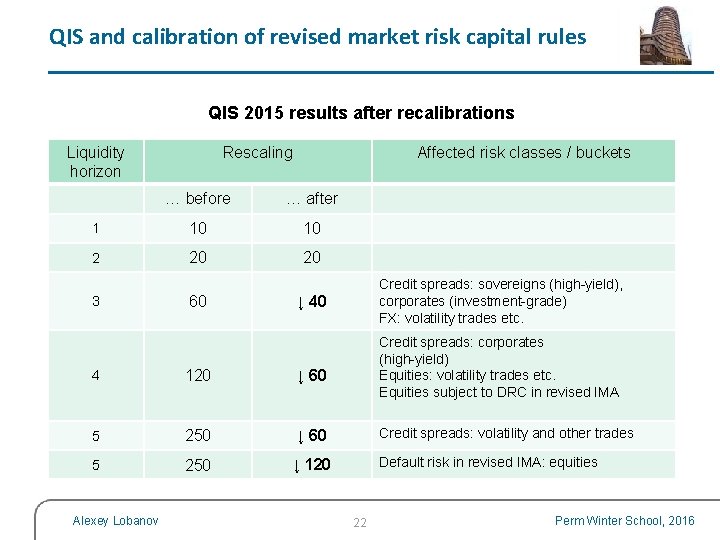
QIS and calibration of revised market risk capital rules QIS 2015 results after recalibrations Liquidity horizon Rescaling Affected risk classes / buckets … before … after 1 10 10 2 20 20 3 60 ↓ 40 4 120 ↓ 60 5 250 ↓ 120 Alexey Lobanov Credit spreads: sovereigns (high-yield), corporates (investment-grade) FX: volatility trades etc. Credit spreads: corporates (high-yield) Equities: volatility trades etc. Equities subject to DRC in revised IMA Credit spreads: volatility and other trades Default risk in revised IMA: equities 22 Perm Winter School, 2016
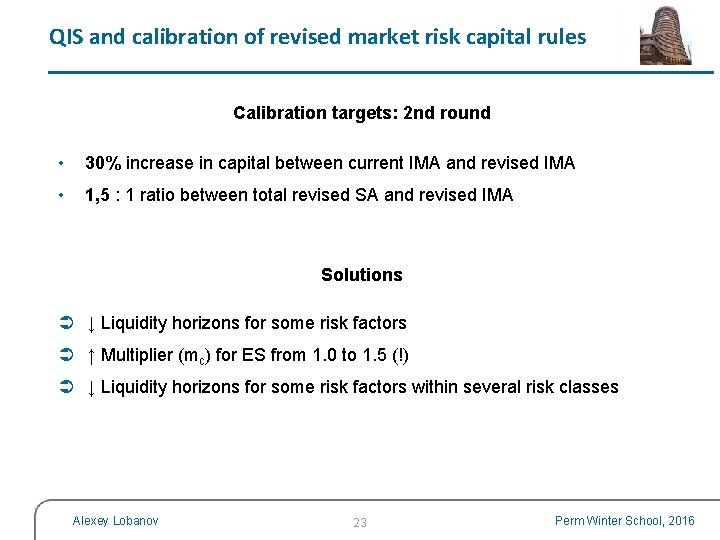
QIS and calibration of revised market risk capital rules Calibration targets: 2 nd round • 30% increase in capital between current IMA and revised IMA • 1, 5 : 1 ratio between total revised SA and revised IMA Solutions ↓ Liquidity horizons for some risk factors ↑ Multiplier (mc) for ES from 1. 0 to 1. 5 (!) ↓ Liquidity horizons for some risk factors within several risk classes Alexey Lobanov 23 Perm Winter School, 2016
Financial regulation: a pieсe of art? Edgar Allan Poe, “Philosophy of Composition” (1846) YES NO 1. Extent (length): 92 pages! 2. Impression (effect): universally acceptable (? ) contemplation of the beautiful, intense and pure elevation of soul 3. Tone: sadness, melancholy (e. g. death of a beautiful woman!) 4. Sense of identity: repetition, refrain ? 5. Originality: no impulse or intuition: recalibration ? 6. Totality, or unity of effect 7. Some amount of complexity, or adaptation 8. Some amount of suggestiveness – some undercurrent, however indefinite, of meaning Alexey Lobanov 24 Perm Winter School, 2016
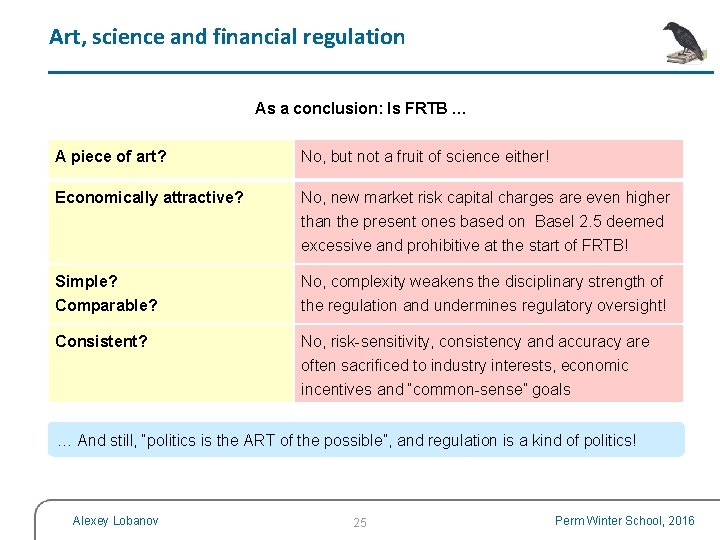
Art, science and financial regulation As a conclusion: Is FRTB … A piece of art? No, but not a fruit of science either! Economically attractive? No, new market risk capital charges are even higher than the present ones based on Basel 2. 5 deemed excessive and prohibitive at the start of FRTB! Simple? Comparable? No, complexity weakens the disciplinary strength of the regulation and undermines regulatory oversight! Consistent? No, risk-sensitivity, consistency and accuracy are often sacrificed to industry interests, economic incentives and “common-sense” goals … And still, “politics is the ART of the possible”, and regulation is a kind of politics! Alexey Lobanov 25 Perm Winter School, 2016
References 1. Basel Committee on Banking Supervision (2012). “Fundamental Review of the Trading Book, ” Basel, May 2. Basel Committee on Banking Supervision (2013). “Fundamental review of the trading book: a revised market risk framework, ” Consultative document, October 3. Basel Committee on Banking Supervision (2014). “Fundamental review of the trading book: outstanding issues. Consultative document, ” December. 4. Basel Committee on Banking Supervision (2006). “International Convergence of Capital Measurement and Capital Standards: A Revised Framework. Comprehensive Version, ” June. 5. Basel Committee on Banking Supervision (2016). “Minimum capital requirements for market risk , ” Basel, January. 6. Basel Committee on Banking Supervision (2015), “Fundamental review of the trading book — interim impact analysis, ” November. 7. Basel Committee on Banking Supervision (2010), “Revisions to the Basel II market risk framework, ” December. 8. Lobanov, Alexey (2012), “Current trends in prudential regulation of market risk: From Basel I to Basel III”, In: Sornette, Didier; Ivliev, Sergey; Woodard, Hilary (eds. ) Market Risk and Financial Markets Modeling – Springer, pp. 129– 139 (http: //www. springer. com/economics/financial+economics/book/9783642279300) Alexey Lobanov 26 Perm Winter School, 2016
QUESTIONS? ? ? Alexey Lobanov 27 Perm Winter School, 2016