
The Art of Questionnaire Development Ensuring Accurate Data
- Slides: 41
The Art of Questionnaire Development (Ensuring Accurate Data With a Step by Step Process) Jim Cox… January 14, 2018 1 PRIMARY RESOURCE COX, J. & COX, K. YOUR OPINION, PLEASE! HOW TO BUILD THE BEST QUESTIONNAIRES IN THE FIELD OF EDUCATION. THOUSAND OAKS, CA: CORWIN PRESS. (2008).
A Caution 2 Our book was written and published 8 -9 years ago. Electronic surveying was not widely used at the time. Thus, aspects of survey development that are closely tied to the electronic arena suggested in the book are admittedly outdated. That having been said, understand that a vast majority of the development process remains independent of electronic surveying. During our time together I will bring to your attention when electronic surveying becomes an issue.
Remember this… 3 A well-constructed questionnaire is a good way to accurately obtain important information from a lot of people in a relatively short period of time. A poorly constructed questionnaire leads to inaccurate data that lead to erroneous conclusions that lead to poor decisions that can lead to a really bad school plan, a really bad marketing plan, and a really bad dissertation.
Remember This…. . 4 SERIOUS PROBLEM: Too many educators (and others) don’t know there is a difference between a good questionnaire and a bad one. Thus, the conclusion they typically draw is that all data collected are accurate. NO! Don’t be among them!!!
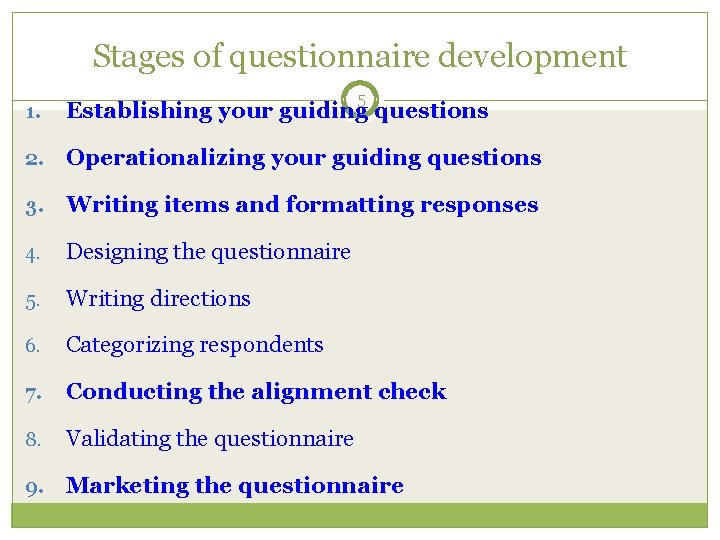
Stages of questionnaire development 5 1. Establishing your guiding questions 2. Operationalizing your guiding questions 3. Writing items and formatting responses 4. Designing the questionnaire 5. Writing directions 6. Categorizing respondents 7. Conducting the alignment check 8. Validating the questionnaire 9. Marketing the questionnaire
Your Guiding Questions 6
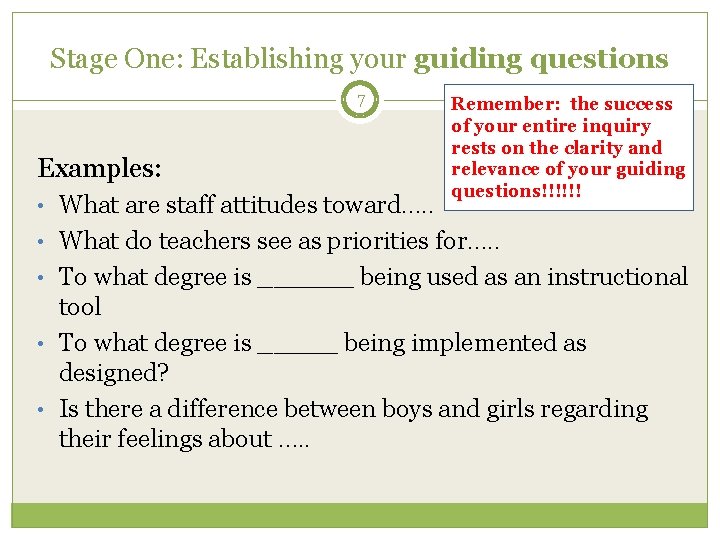
Stage One: Establishing your guiding questions 7 Examples: • What are staff attitudes toward…. . Remember: the success of your entire inquiry rests on the clarity and relevance of your guiding questions!!!!!! • What do teachers see as priorities for…. . • To what degree is ______ being used as an instructional tool • To what degree is _____ being implemented as designed? • Is there a difference between boys and girls regarding their feelings about …. .
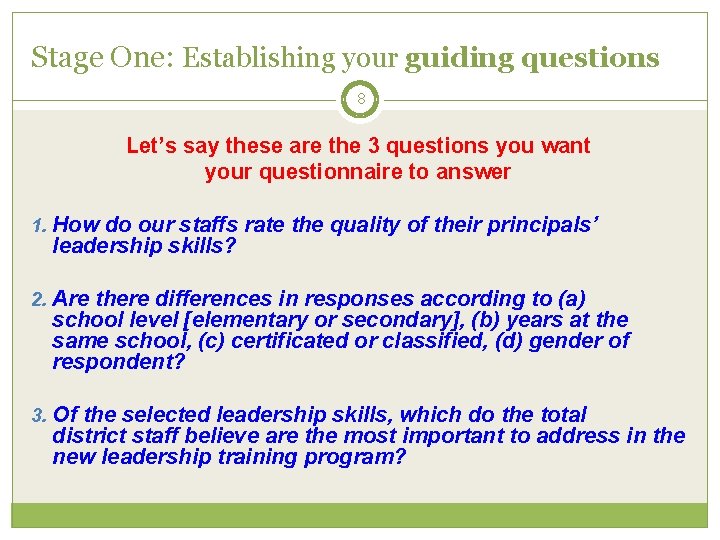
Stage One: Establishing your guiding questions 8 Let’s say these are the 3 questions you want your questionnaire to answer 1. How do our staffs rate the quality of their principals’ leadership skills? 2. Are there differences in responses according to (a) school level [elementary or secondary], (b) years at the same school, (c) certificated or classified, (d) gender of respondent? 3. Of the selected leadership skills, which do the total district staff believe are the most important to address in the new leadership training program?
9 Question: What’s the problem with guiding questions?
10 Answer: They use “fuzzy” words
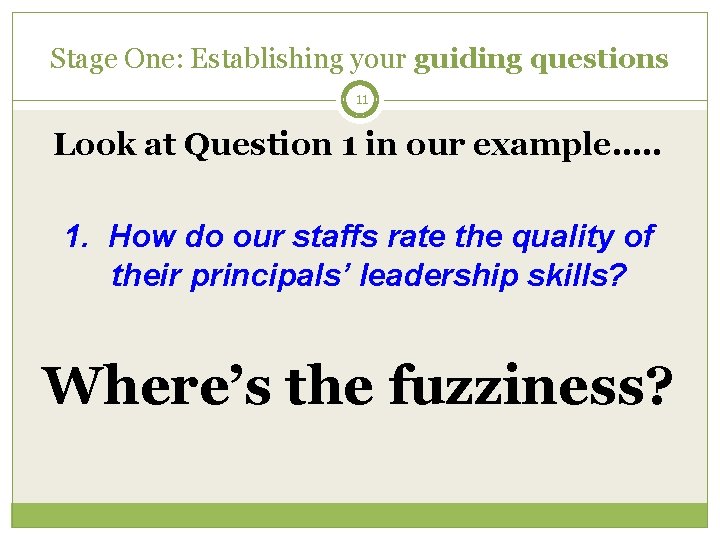
Stage One: Establishing your guiding questions 11 Look at Question 1 in our example…. . 1. How do our staffs rate the quality of their principals’ leadership skills? Where’s the fuzziness?
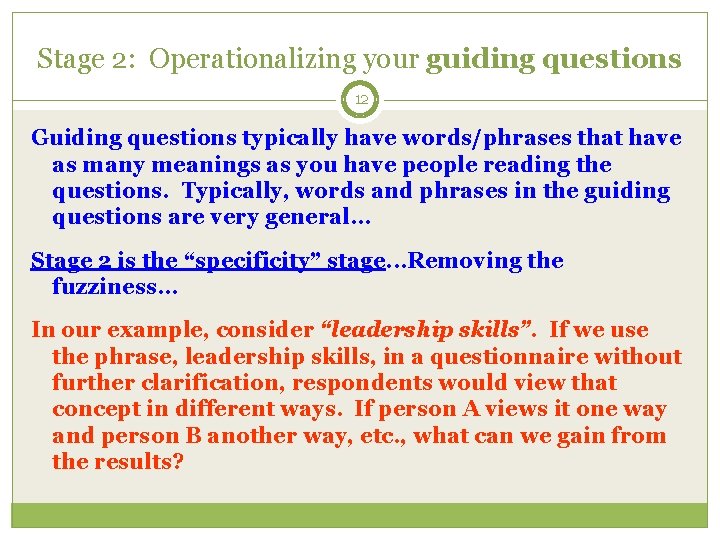
Stage 2: Operationalizing your guiding questions 12 Guiding questions typically have words/phrases that have as many meanings as you have people reading the questions. Typically, words and phrases in the guiding questions are very general… Stage 2 is the “specificity” stage. . . Removing the fuzziness… In our example, consider “leadership skills”. If we use the phrase, leadership skills, in a questionnaire without further clarification, respondents would view that concept in different ways. If person A views it one way and person B another way, etc. , what can we gain from the results?
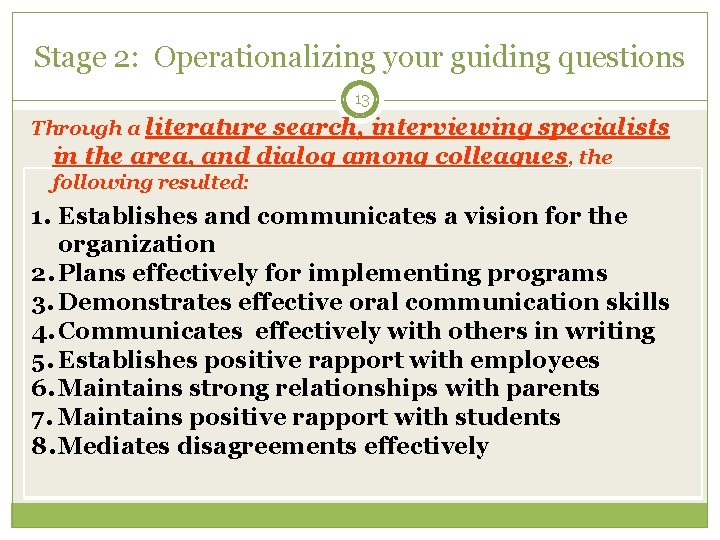
Stage 2: Operationalizing your guiding questions 13 Through a literature search, interviewing specialists in the area, and dialog among colleagues, the following resulted: 1. Establishes and communicates a vision for the organization 2. Plans effectively for implementing programs 3. Demonstrates effective oral communication skills 4. Communicates effectively with others in writing 5. Establishes positive rapport with employees 6. Maintains strong relationships with parents 7. Maintains positive rapport with students 8. Mediates disagreements effectively
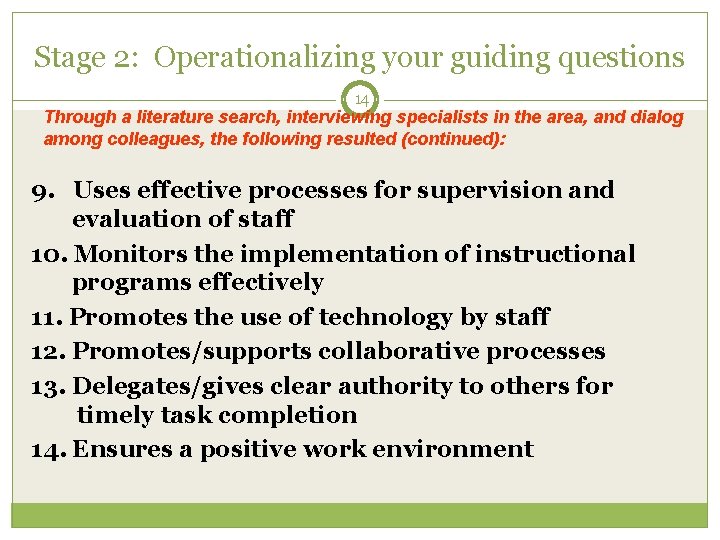
Stage 2: Operationalizing your guiding questions 14 Through a literature search, interviewing specialists in the area, and dialog among colleagues, the following resulted (continued): 9. Uses effective processes for supervision and evaluation of staff 10. Monitors the implementation of instructional programs effectively 11. Promotes the use of technology by staff 12. Promotes/supports collaborative processes 13. Delegates/gives clear authority to others for timely task completion 14. Ensures a positive work environment
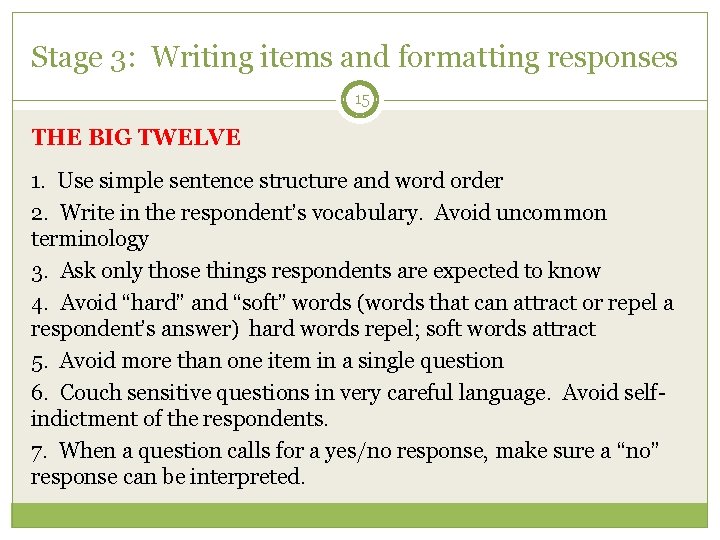
Stage 3: Writing items and formatting responses 15 THE BIG TWELVE 1. Use simple sentence structure and word order 2. Write in the respondent’s vocabulary. Avoid uncommon terminology 3. Ask only those things respondents are expected to know 4. Avoid “hard” and “soft” words (words that can attract or repel a respondent’s answer) hard words repel; soft words attract 5. Avoid more than one item in a single question 6. Couch sensitive questions in very careful language. Avoid selfindictment of the respondents. 7. When a question calls for a yes/no response, make sure a “no” response can be interpreted.
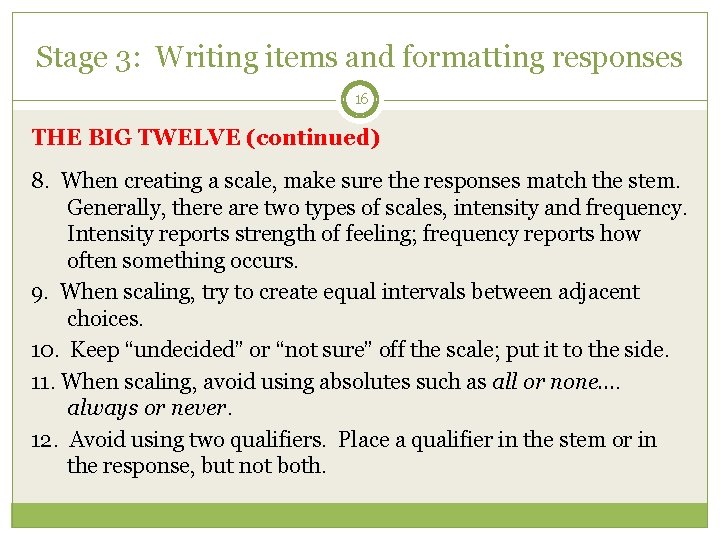
Stage 3: Writing items and formatting responses 16 THE BIG TWELVE (continued) 8. When creating a scale, make sure the responses match the stem. Generally, there are two types of scales, intensity and frequency. Intensity reports strength of feeling; frequency reports how often something occurs. 9. When scaling, try to create equal intervals between adjacent choices. 10. Keep “undecided” or “not sure” off the scale; put it to the side. 11. When scaling, avoid using absolutes such as all or none…. always or never. 12. Avoid using two qualifiers. Place a qualifier in the stem or in the response, but not both.
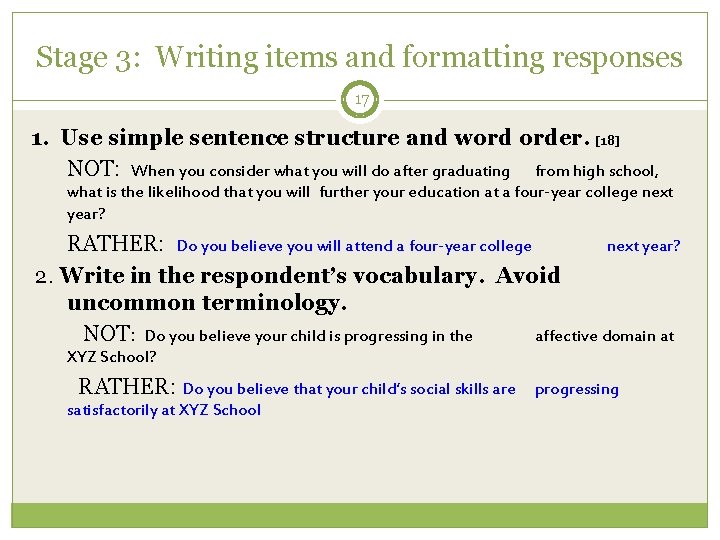
Stage 3: Writing items and formatting responses 17 1. Use simple sentence structure and word order. [18] NOT: When you consider what you will do after graduating from high school, what is the likelihood that you will further your education at a four-year college next year? RATHER: Do you believe you will attend a four-year college next year? 2. Write in the respondent’s vocabulary. Avoid uncommon terminology. NOT: Do you believe your child is progressing in the affective domain at XYZ School? RATHER: Do you believe that your child’s social skills are progressing satisfactorily at XYZ School
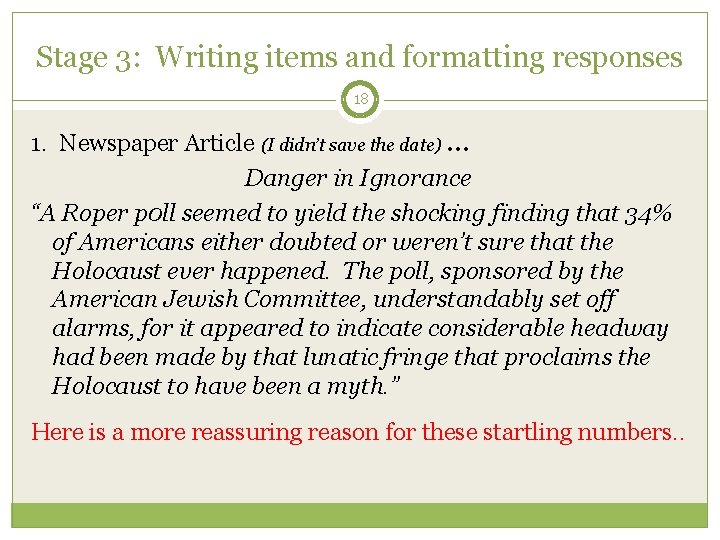
Stage 3: Writing items and formatting responses 18 1. Newspaper Article (I didn’t save the date) … Danger in Ignorance “A Roper p 0 ll seemed to yield the shocking finding that 34% of Americans either doubted or weren’t sure that the Holocaust ever happened. The poll, sponsored by the American Jewish Committee, understandably set off alarms, for it appeared to indicate considerable headway had been made by that lunatic fringe that proclaims the Holocaust to have been a myth. ” Here is a more reassuring reason for these startling numbers. .
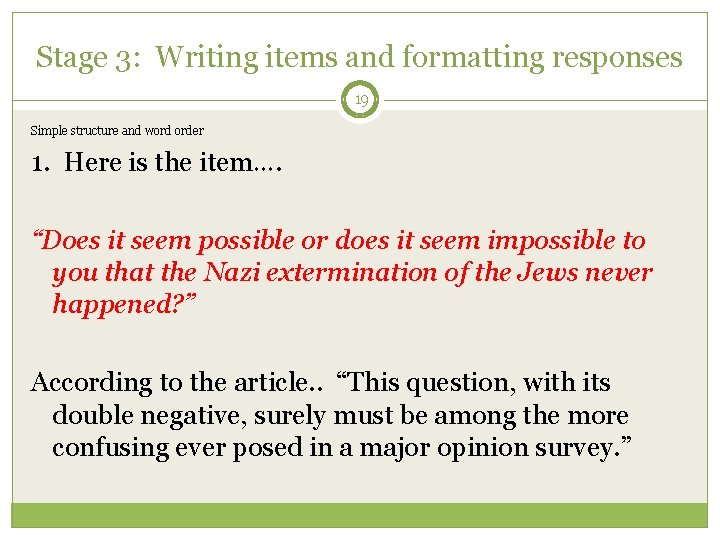
Stage 3: Writing items and formatting responses 19 Simple structure and word order 1. Here is the item…. “Does it seem possible or does it seem impossible to you that the Nazi extermination of the Jews never happened? ” According to the article. . “This question, with its double negative, surely must be among the more confusing ever posed in a major opinion survey. ”
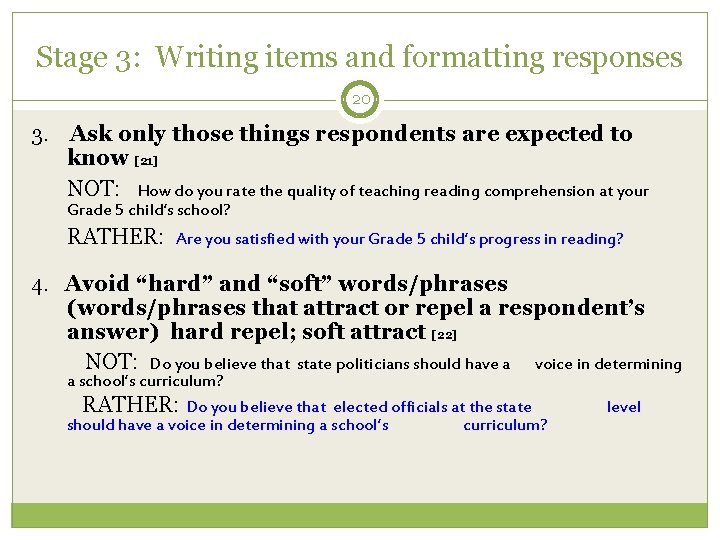
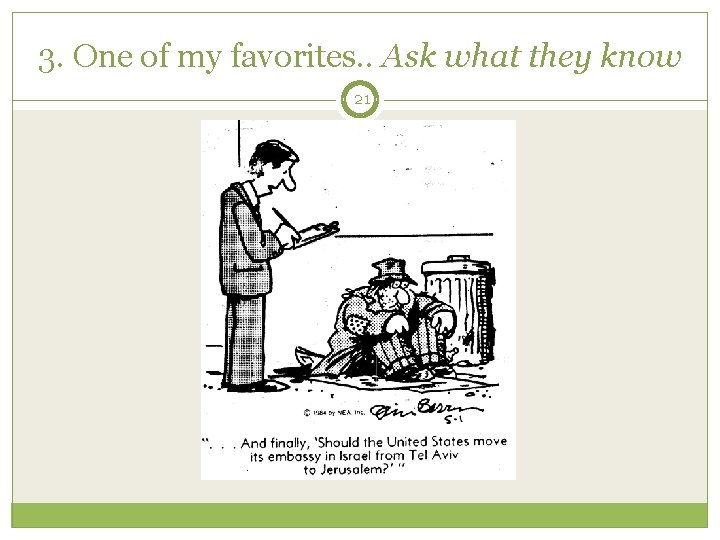
Stage 3: Writing items and formatting responses 20 3. Ask only those things respondents are expected to know [21] NOT: How do you rate the quality of teaching reading comprehension at your Grade 5 child’s school? RATHER: Are you satisfied with your Grade 5 child’s progress in reading? 4. Avoid “hard” and “soft” words/phrases (words/phrases that attract or repel a respondent’s answer) hard repel; soft attract [22] NOT: Do you believe that state politicians should have a voice in determining a school’s curriculum? RATHER: Do you believe that elected officials at the state should have a voice in determining a school’s curriculum? level
3. One of my favorites. . Ask what they know 21
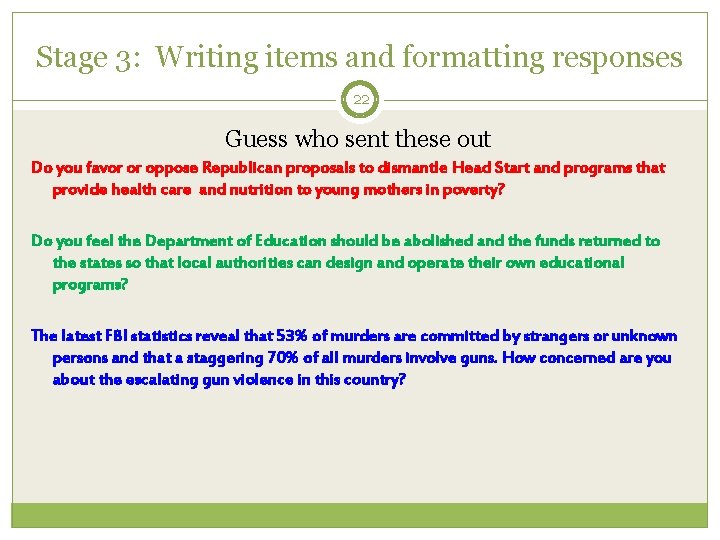
Stage 3: Writing items and formatting responses 22 Guess who sent these out Do you favor or oppose Republican proposals to dismantle Head Start and programs that provide health care and nutrition to young mothers in poverty? Do you feel the Department of Education should be abolished and the funds returned to the states so that local authorities can design and operate their own educational programs? The latest FBI statistics reveal that 53% of murders are committed by strangers or unknown persons and that a staggering 70% of all murders involve guns. How concerned are you about the escalating gun violence in this country?
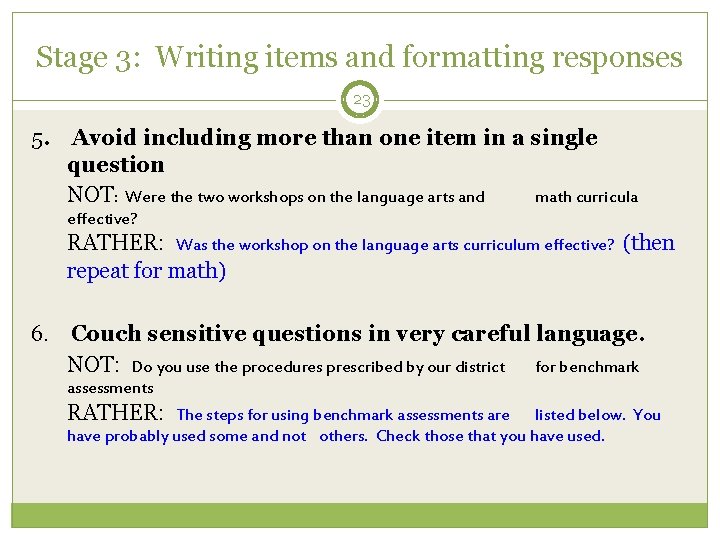
Stage 3: Writing items and formatting responses 23 5. Avoid including more than one item in a single question NOT: Were the two workshops on the language arts and math curricula effective? RATHER: Was the workshop on the language arts curriculum effective? (then repeat for math) 6. Couch sensitive questions in very careful language. NOT: Do you use the procedures prescribed by our district for benchmark assessments RATHER: The steps for using benchmark assessments are listed below. You have probably used some and not others. Check those that you have used.
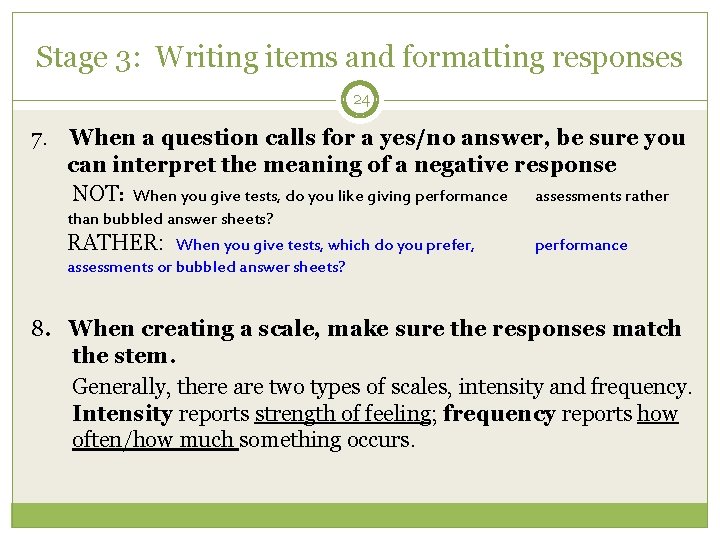
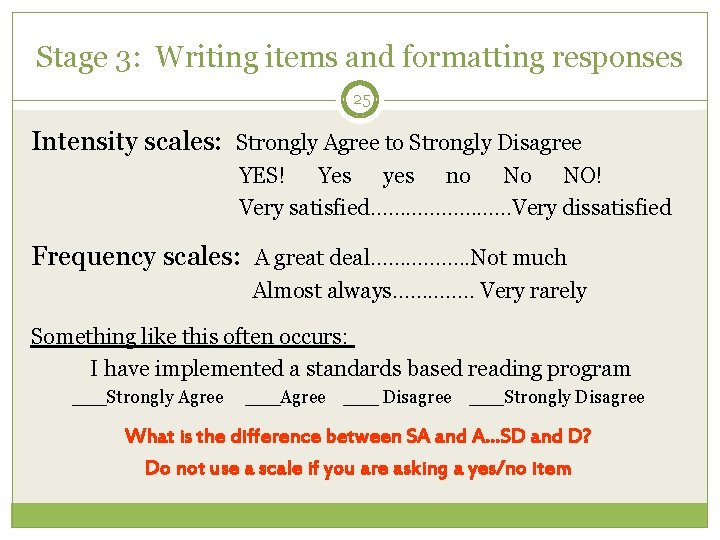
Stage 3: Writing items and formatting responses 24 7. When a question calls for a yes/no answer, be sure you can interpret the meaning of a negative response NOT: When you give tests, do you like giving performance assessments rather than bubbled answer sheets? RATHER: When you give tests, which do you prefer, assessments or bubbled answer sheets? performance 8. When creating a scale, make sure the responses match the stem. Generally, there are two types of scales, intensity and frequency. Intensity reports strength of feeling; frequency reports how often/how much something occurs.
Stage 3: Writing items and formatting responses 25 Intensity scales: Strongly Agree to Strongly Disagree YES! Yes yes no No NO! Very satisfied…………Very dissatisfied Frequency scales: A great deal……………. . Not much Almost always…………. . Very rarely Something like this often occurs: I have implemented a standards based reading program ___Strongly Agree ___ Disagree ___Strongly Disagree What is the difference between SA and A…SD and D? Do not use a scale if you are asking a yes/no item
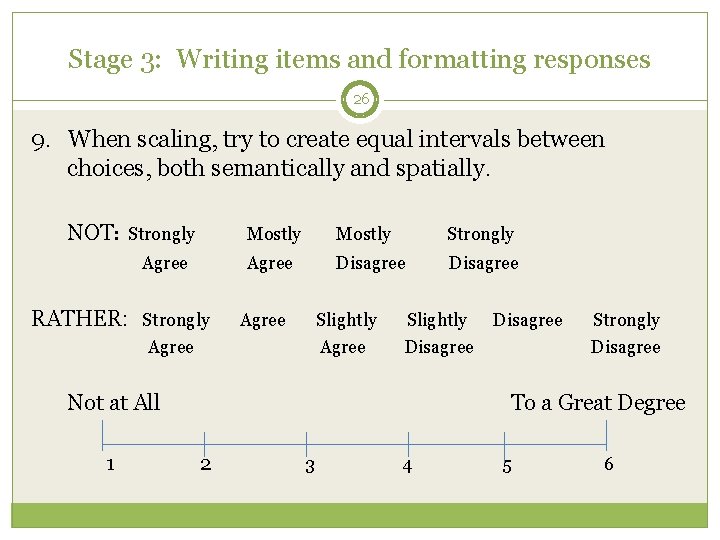
Stage 3: Writing items and formatting responses 26 9. When scaling, try to create equal intervals between choices, both semantically and spatially. NOT: Strongly Agree RATHER: Strongly Mostly Strongly Agree Disagree Agree Slightly Disagree Not at All 1 Disagree Strongly Disagree To a Great Degree 2 3 4 5 6
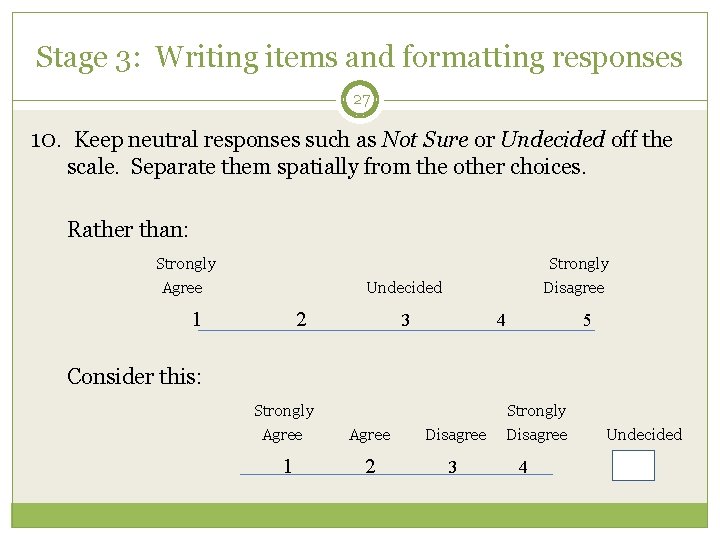
Stage 3: Writing items and formatting responses 27 10. Keep neutral responses such as Not Sure or Undecided off the scale. Separate them spatially from the other choices. Rather than: Strongly Agree Undecided 1 2 Disagree 3 4 5 Consider this: Strongly Agree 1 Strongly Agree Disagree 2 3 Disagree 4 Undecided
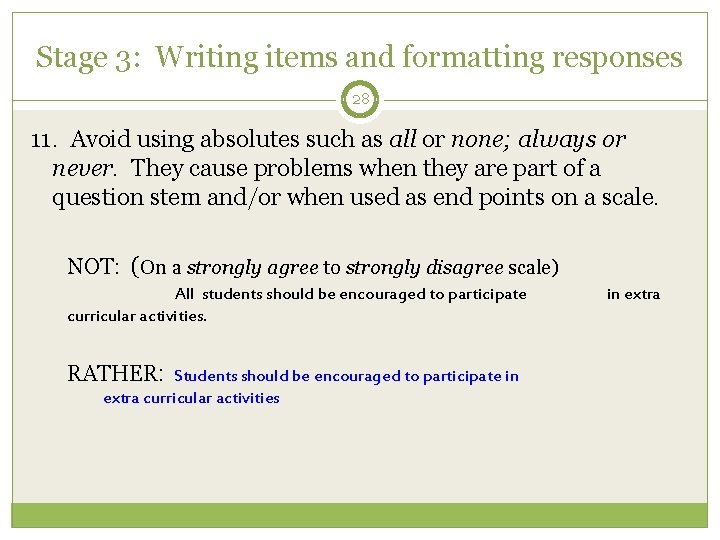
Stage 3: Writing items and formatting responses 28 11. Avoid using absolutes such as all or none; always or never. They cause problems when they are part of a question stem and/or when used as end points on a scale. NOT: (On a strongly agree to strongly disagree scale) All students should be encouraged to participate curricular activities. RATHER: Students should be encouraged to participate in extra curricular activities in extra
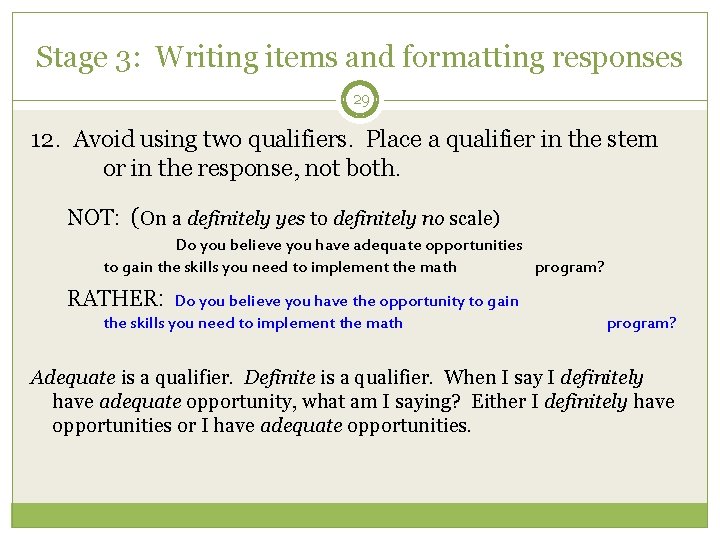
Stage 3: Writing items and formatting responses 29 12. Avoid using two qualifiers. Place a qualifier in the stem or in the response, not both. NOT: (On a definitely yes to definitely no scale) Do you believe you have adequate opportunities to gain the skills you need to implement the math program? RATHER: Do you believe you have the opportunity to gain the skills you need to implement the math program? Adequate is a qualifier. Definite is a qualifier. When I say I definitely have adequate opportunity, what am I saying? Either I definitely have opportunities or I have adequate opportunities.
Stage 3: Writing items and formatting responses 30 It is essential that you learn as much as you can about SCALING!
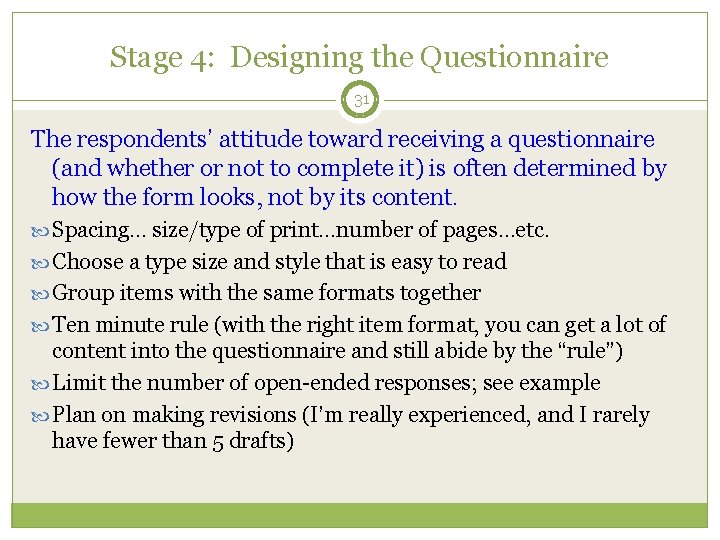
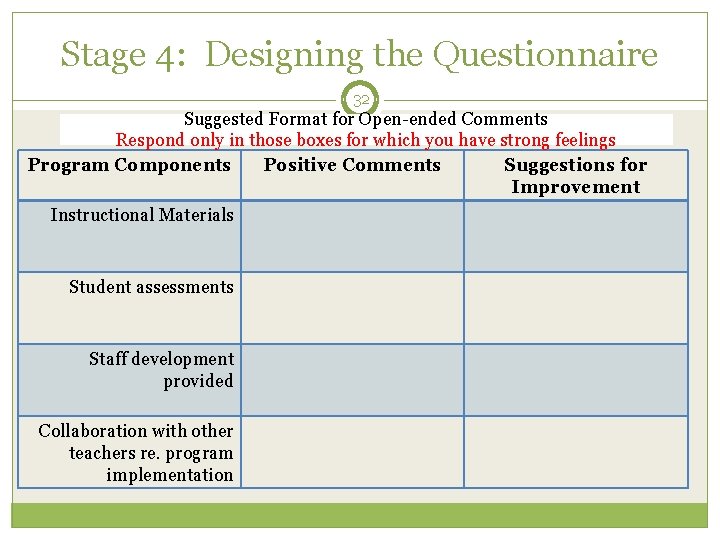
Stage 4: Designing the Questionnaire 31 The respondents’ attitude toward receiving a questionnaire (and whether or not to complete it) is often determined by how the form looks, not by its content. Spacing… size/type of print…number of pages…etc. Choose a type size and style that is easy to read Group items with the same formats together Ten minute rule (with the right item format, you can get a lot of content into the questionnaire and still abide by the “rule”) Limit the number of open-ended responses; see example Plan on making revisions (I’m really experienced, and I rarely have fewer than 5 drafts)
Stage 4: Designing the Questionnaire 32 Suggested Format for Open-ended Comments Respond only in those boxes for which you have strong feelings Program Components Positive Comments Suggestions for Improvement Instructional Materials Student assessments Staff development provided Collaboration with other teachers re. program implementation
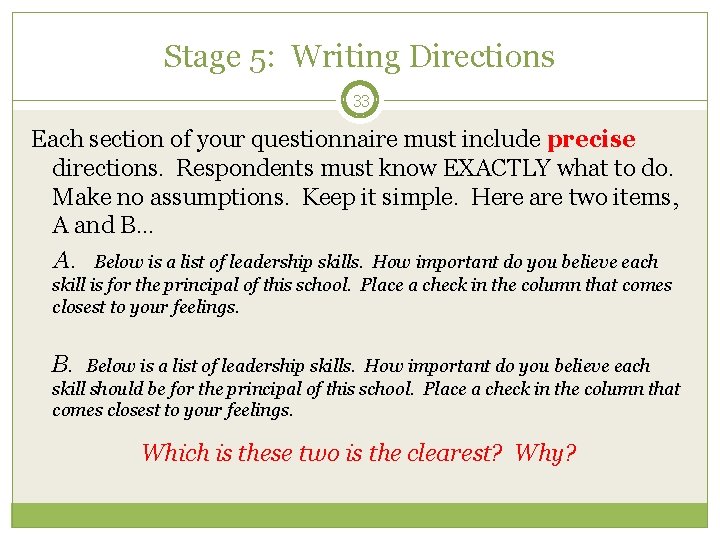
Stage 5: Writing Directions 33 Each section of your questionnaire must include precise directions. Respondents must know EXACTLY what to do. Make no assumptions. Keep it simple. Here are two items, A and B… A. Below is a list of leadership skills. How important do you believe each skill is for the principal of this school. Place a check in the column that comes closest to your feelings. Below is a list of leadership skills. How important do you believe each skill should be for the principal of this school. Place a check in the column that comes closest to your feelings. Which is these two is the clearest? Why?
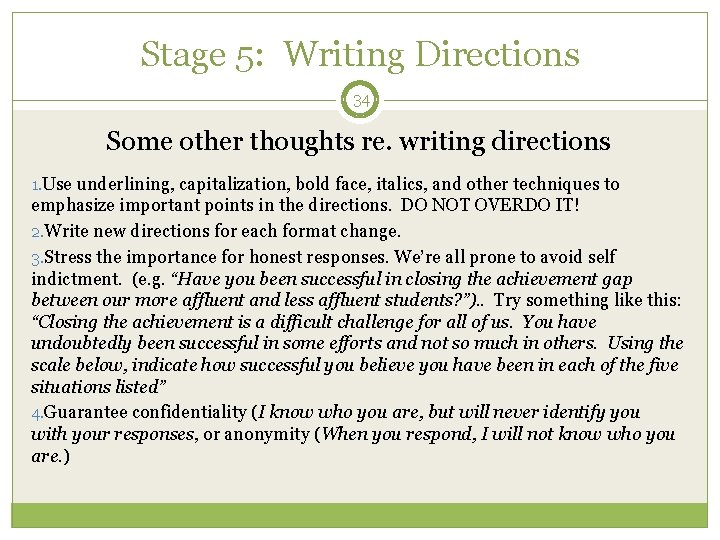
Stage 5: Writing Directions 34 Some other thoughts re. writing directions 1. Use underlining, capitalization, bold face, italics, and other techniques to emphasize important points in the directions. DO NOT OVERDO IT! 2. Write new directions for each format change. 3. Stress the importance for honest responses. We’re all prone to avoid self indictment. (e. g. “Have you been successful in closing the achievement gap between our more affluent and less affluent students? ”). . Try something like this: “Closing the achievement is a difficult challenge for all of us. You have undoubtedly been successful in some efforts and not so much in others. Using the scale below, indicate how successful you believe you have been in each of the five situations listed” 4. Guarantee confidentiality (I know who you are, but will never identify you with your responses, or anonymity (When you respond, I will not know who you are. )
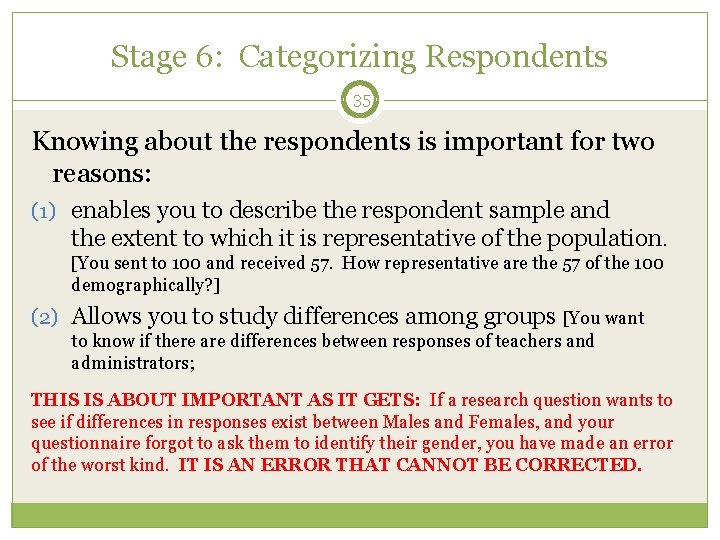
Stage 6: Categorizing Respondents 35 Knowing about the respondents is important for two reasons: (1) enables you to describe the respondent sample and the extent to which it is representative of the population. [You sent to 100 and received 57. How representative are the 57 of the 100 demographically? ] (2) Allows you to study differences among groups [You want to know if there are differences between responses of teachers and administrators; THIS IS ABOUT IMPORTANT AS IT GETS: If a research question wants to see if differences in responses exist between Males and Females, and your questionnaire forgot to ask them to identify their gender, you have made an error of the worst kind. IT IS AN ERROR THAT CANNOT BE CORRECTED.
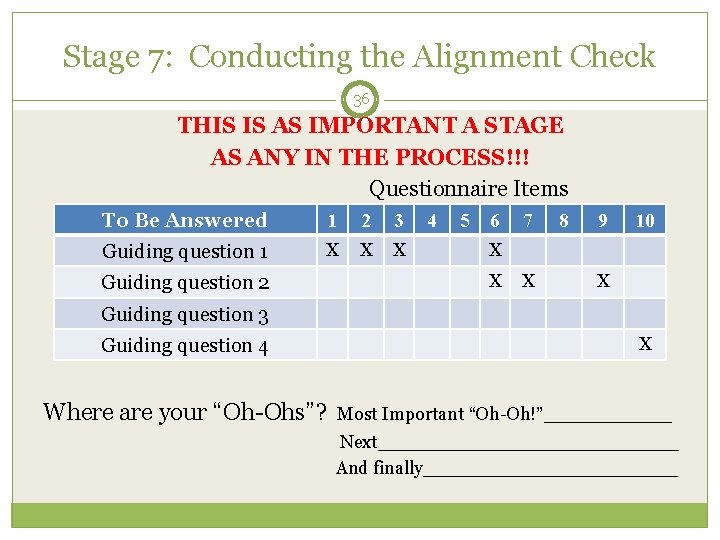
Stage 7: Conducting the Alignment Check 36 THIS IS AS IMPORTANT A STAGE AS ANY IN THE PROCESS!!! Questionnaire Items To Be Answered 1 2 3 Guiding question 1 X X X Guiding question 2 4 5 6 7 8 9 10 X X Guiding question 3 Guiding question 4 Where are your “Oh-Ohs”? X Most Important “Oh-Oh!”______ Next_____________ And finally___________
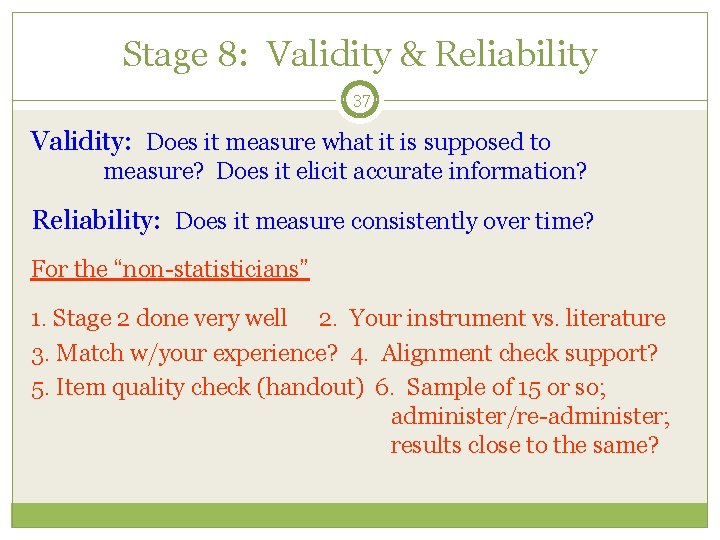
Stage 8: Validity & Reliability 37 Validity: Does it measure what it is supposed to measure? Does it elicit accurate information? Reliability: Does it measure consistently over time? For the “non-statisticians” 1. Stage 2 done very well 2. Your instrument vs. literature 3. Match w/your experience? 4. Alignment check support? 5. Item quality check (handout) 6. Sample of 15 or so; administer/re-administer; results close to the same?
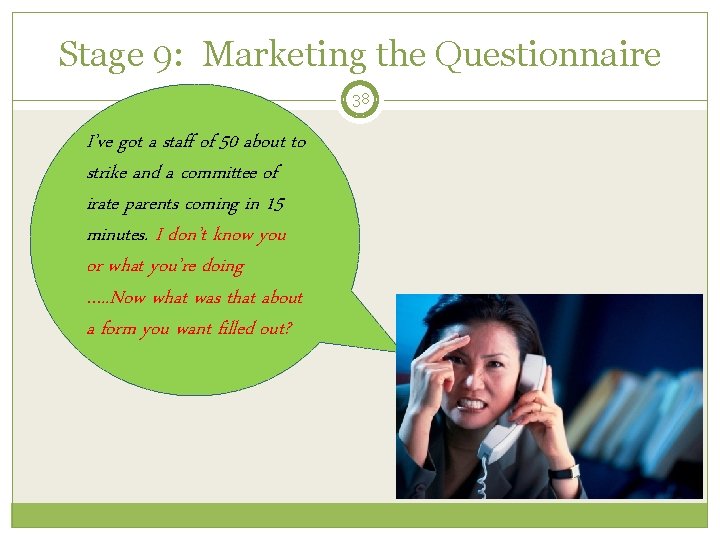
Stage 9: Marketing the Questionnaire 38 I’ve got a staff of 50 about to strike and a committee of irate parents coming in 15 minutes. I don’t know you or what you’re doing …. . Now what was that about a form you want filled out?
Stage 9: Marketing the Questionnaire 39 SITUATION: You have a beautifully constructed questionnaire; But very few folks choose to fill it out; YOU LOSE!!! (it’s an error that cannot be corrected) Sell, w/o bias What’s in it for them? Questionnaire must look good Introducing the activity must be professionally enticing Pre notify Follow up reminder a week later Use of incentives (must be thought out well; expensive? )
Closure 40 1. Establishing your guiding questions. 2. Operationalizing your guiding questions 3. Writing items and formatting responses 4. Designing the questionnaire 5. Writing directions 6. Categorizing respondents 7. Conducting the alignment check 8. Validating the questionnaire 9. Marketing the questionnaire
41 Your Opinion Please! (How to Build the Best Questionnaires in the Field of Education) Keni Cox; James Cox Corwin Press for about $30. 00