
The Art of Persuasion Whose Voice is Really

- Slides: 27
The Art of Persuasion Whose Voice is Really Guiding Your Choice? Propaganda Techniques in the Media
How do you decide who is the best candidate… or which is the best toothpaste?
Looking for facts to back up your choice is an excellent idea, but find out who is presenting those facts. Are they even facts at all…
…or is the advertiser using propaganda techniques to persuade you?
What is Propaganda? Propaganda is… • Designed to persuade, its purpose is to influence your opinions, emotions, attitudes, or behavior. • It seeks to “guide your choice. ”
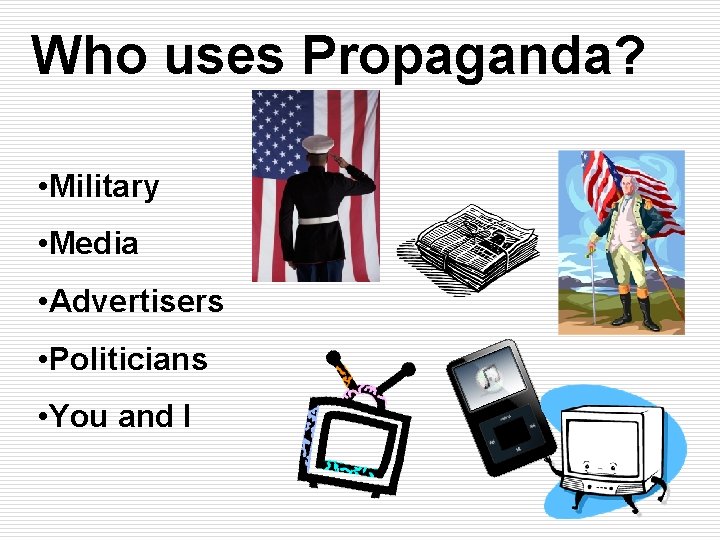
Who uses Propaganda? • Military • Media • Advertisers • Politicians • You and I
How can you persuade your audience? (Traditional Propaganda Techniques) - Bandwagon - Testimonial - Transfer - Plain Folk -Faulty Reasoning - Fear - Repetition - Name-Calling - Glittering Generality
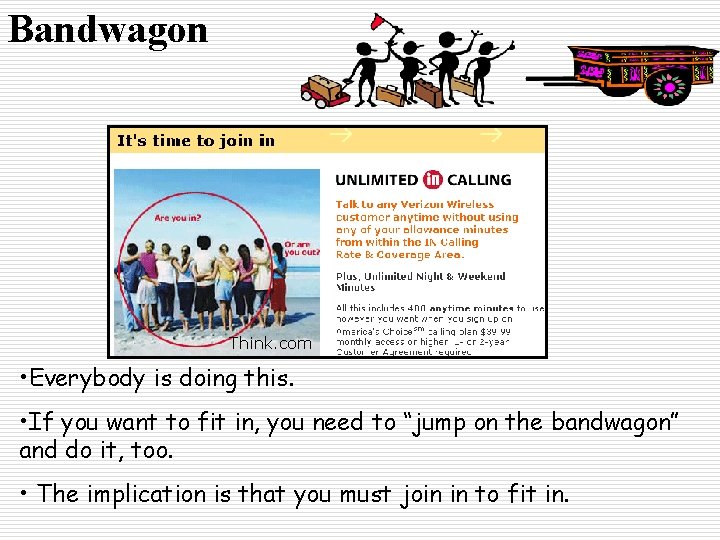
Bandwagon Think. com • Everybody is doing this. • If you want to fit in, you need to “jump on the bandwagon” and do it, too. • The implication is that you must join in to fit in.
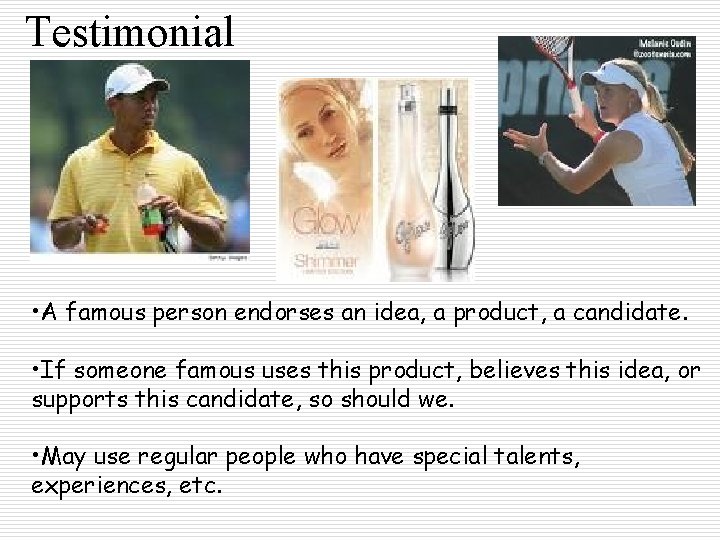
Testimonial • A famous person endorses an idea, a product, a candidate. • If someone famous uses this product, believes this idea, or supports this candidate, so should we. • May use regular people who have special talents, experiences, etc.
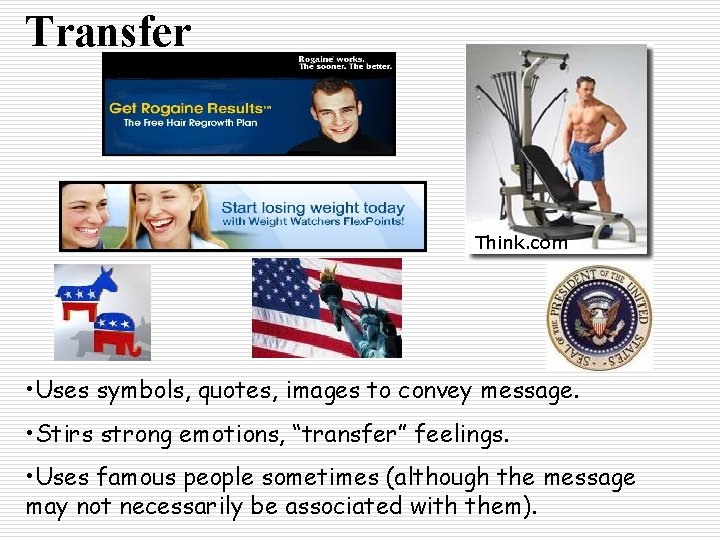
Transfer Think. com • Uses symbols, quotes, images to convey message. • Stirs strong emotions, “transfer” feelings. • Uses famous people sometimes (although the message may not necessarily be associated with them).
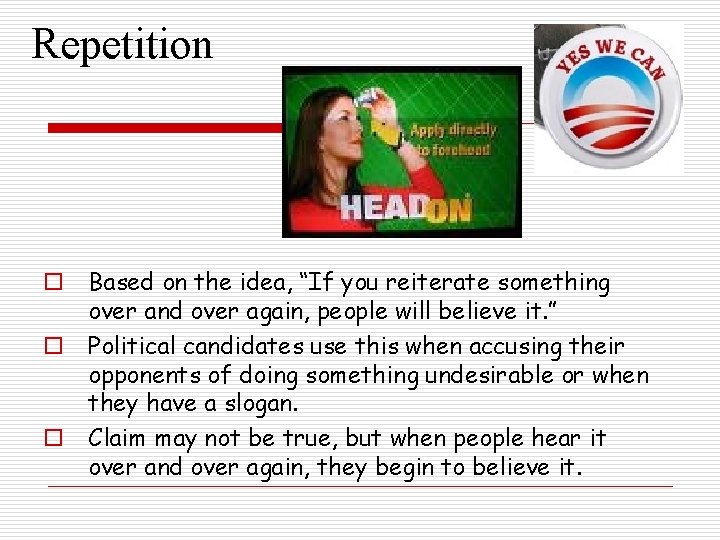
Repetition o Based on the idea, “If you reiterate something over and over again, people will believe it. ” o Political candidates use this when accusing their opponents of doing something undesirable or when they have a slogan. o Claim may not be true, but when people hear it over and over again, they begin to believe it.
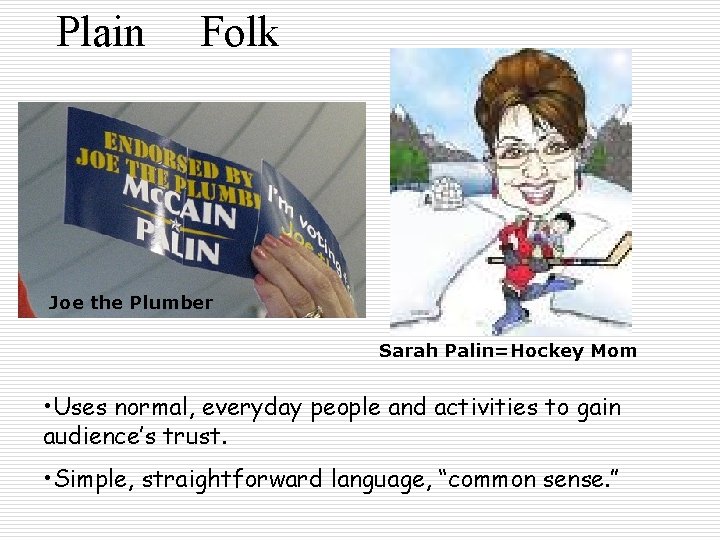
Plain Folk Joe the Plumber Sarah Palin=Hockey Mom • Uses normal, everyday people and activities to gain audience’s trust. • Simple, straightforward language, “common sense. ”
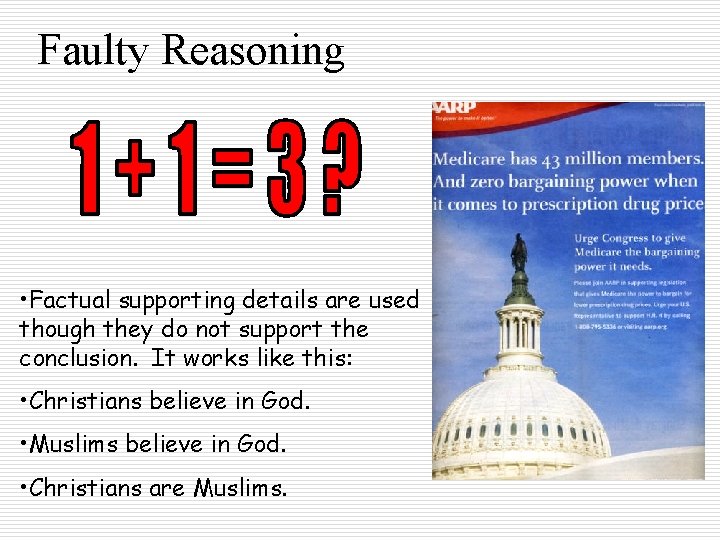
Faulty Reasoning • Factual supporting details are used though they do not support the conclusion. It works like this: • Christians believe in God. • Muslims believe in God. • Christians are Muslims.
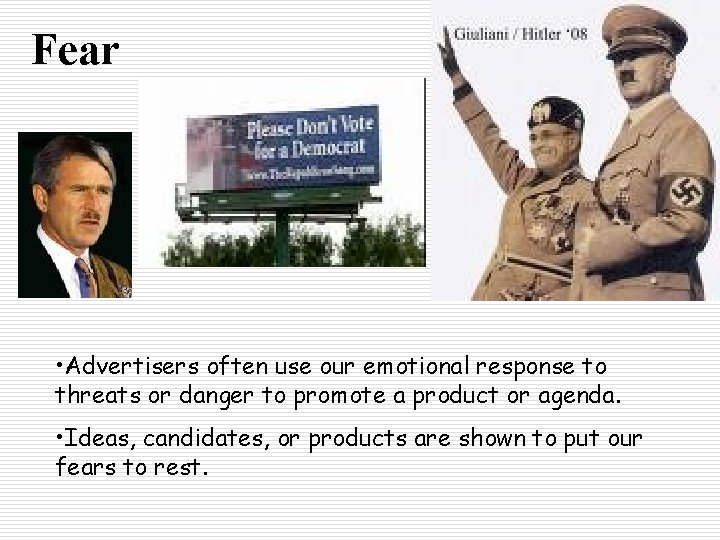
Fear • Advertisers often use our emotional response to threats or danger to promote a product or agenda. • Ideas, candidates, or products are shown to put our fears to rest.
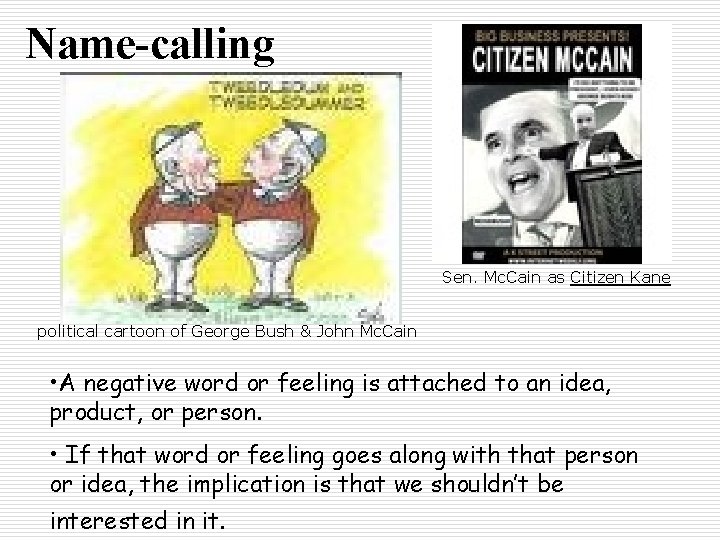
Name-calling Sen. Mc. Cain as Citizen Kane political cartoon of George Bush & John Mc. Cain • A negative word or feeling is attached to an idea, product, or person. • If that word or feeling goes along with that person or idea, the implication is that we shouldn’t be interested in it.
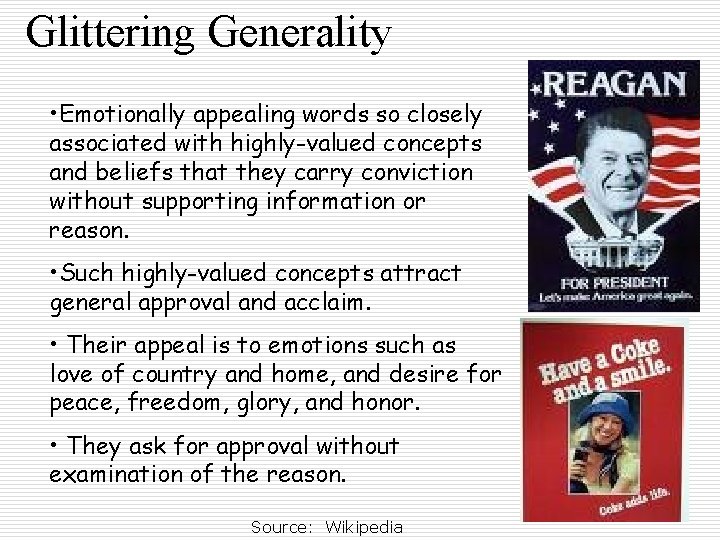
Glittering Generality • Emotionally appealing words so closely associated with highly-valued concepts and beliefs that they carry conviction without supporting information or reason. • Such highly-valued concepts attract general approval and acclaim. • Their appeal is to emotions such as love of country and home, and desire for peace, freedom, glory, and honor. • They ask for approval without examination of the reason. Source: Wikipedia
New Propaganda • - Otherness • - Mass Marketing to a Subculture • - Collective Memories • - Humanizing Technology • - Strong Women
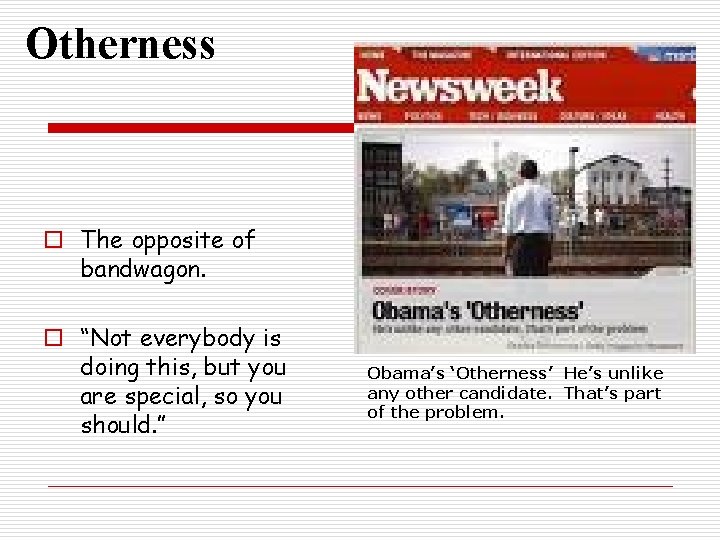
Otherness o The opposite of bandwagon. o “Not everybody is doing this, but you are special, so you should. ” Obama’s ‘Otherness’ He’s unlike any other candidate. That’s part of the problem.
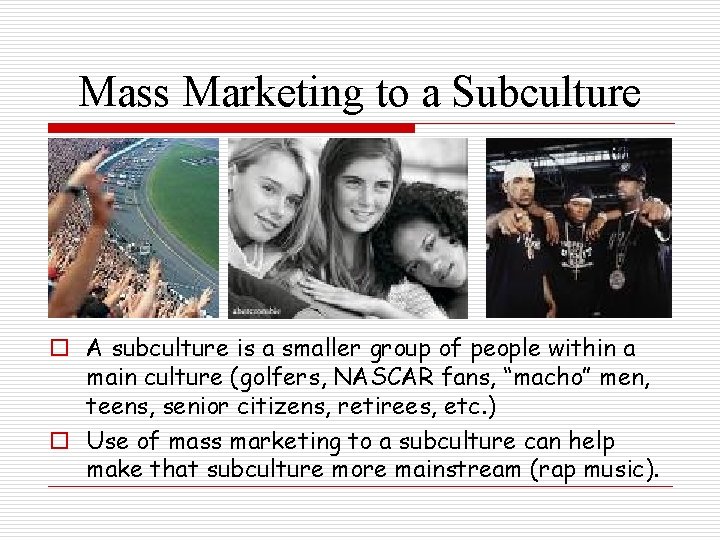
Mass Marketing to a Subculture o A subculture is a smaller group of people within a main culture (golfers, NASCAR fans, “macho” men, teens, senior citizens, retirees, etc. ) o Use of mass marketing to a subculture can help make that subculture more mainstream (rap music).
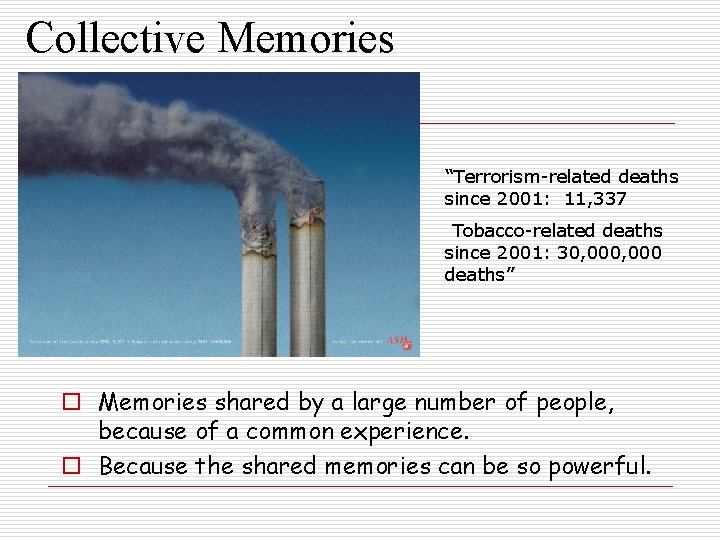
Collective Memories “Terrorism-related deaths since 2001: 11, 337 Tobacco-related deaths since 2001: 30, 000 deaths” o Memories shared by a large number of people, because of a common experience. o Because the shared memories can be so powerful.
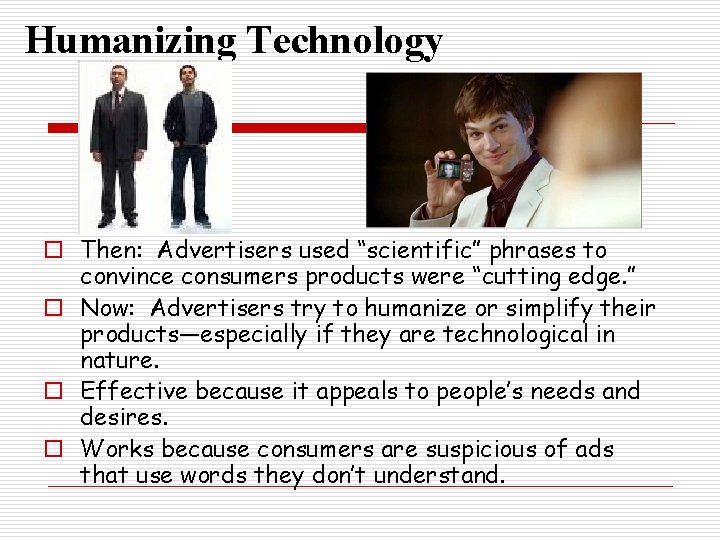
Humanizing Technology o Then: Advertisers used “scientific” phrases to convince consumers products were “cutting edge. ” o Now: Advertisers try to humanize or simplify their products—especially if they are technological in nature. o Effective because it appeals to people’s needs and desires. o Works because consumers are suspicious of ads that use words they don’t understand.
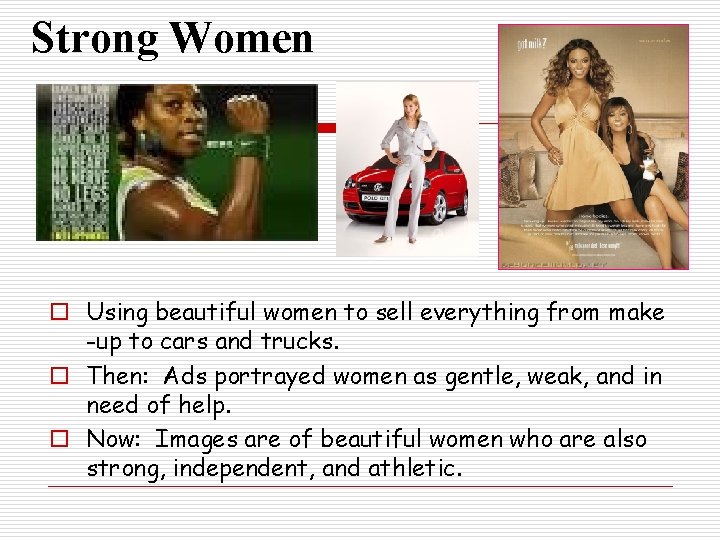
Strong Women o Using beautiful women to sell everything from make -up to cars and trucks. o Then: Ads portrayed women as gentle, weak, and in need of help. o Now: Images are of beautiful women who are also strong, independent, and athletic.
How do we make sure that we are making informed choices… …instead of letting others play on our emotions to persuade us?
To make our own choices We must: • Read and listen to reliable sources. • Watch for combinations of truths & lies. • Check for hidden messages. • Watch for propaganda techniques…
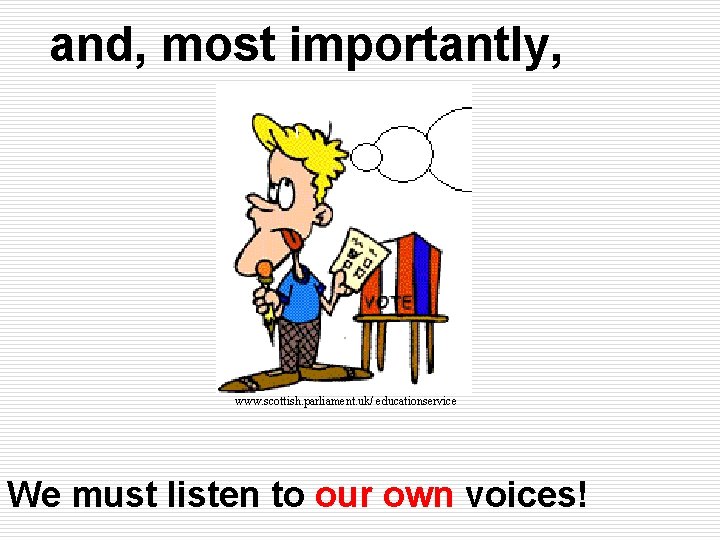
and, most importantly, www. scottish. parliament. uk/ educationservice We must listen to our own voices!
Bibliography o Twisting Arms o <http: //www. think. com/iste/market/docs/pr opaganda. ppt>. o <http: //wikipedia. org> o Microsoft Office XP Clip Art 2002