
THE ART OF COOKING Introduction to Cooking in


- Slides: 31
THE ART OF COOKING Introduction to Cooking in Class
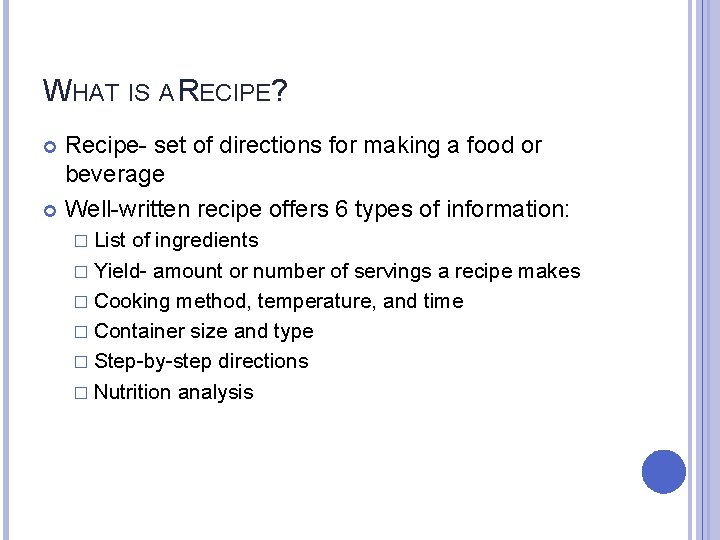
WHAT IS A RECIPE? Recipe- set of directions for making a food or beverage Well-written recipe offers 6 types of information: � List of ingredients � Yield- amount or number of servings a recipe makes � Cooking method, temperature, and time � Container size and type � Step-by-step directions � Nutrition analysis
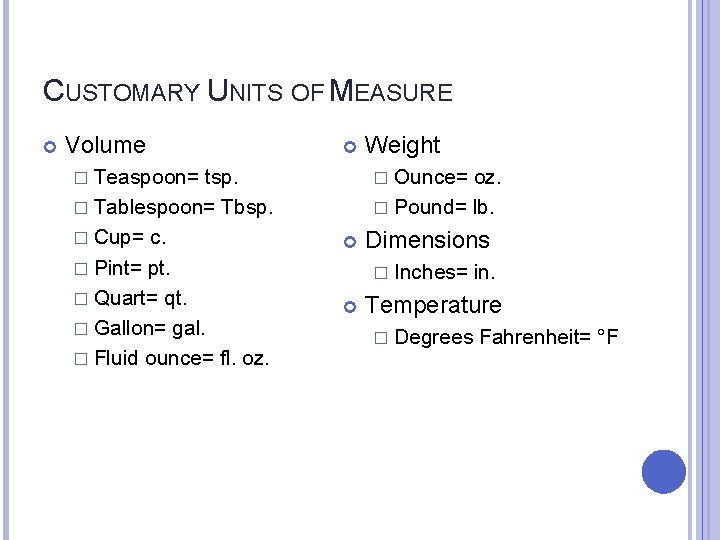
CUSTOMARY UNITS OF MEASURE Volume tsp. � Tablespoon= Tbsp. � Cup= c. � Pint= pt. � Quart= qt. � Gallon= gal. � Fluid ounce= fl. oz. � Teaspoon= Weight � Ounce= oz. � Pound= lb. Dimensions � Inches= in. Temperature � Degrees Fahrenheit= °F
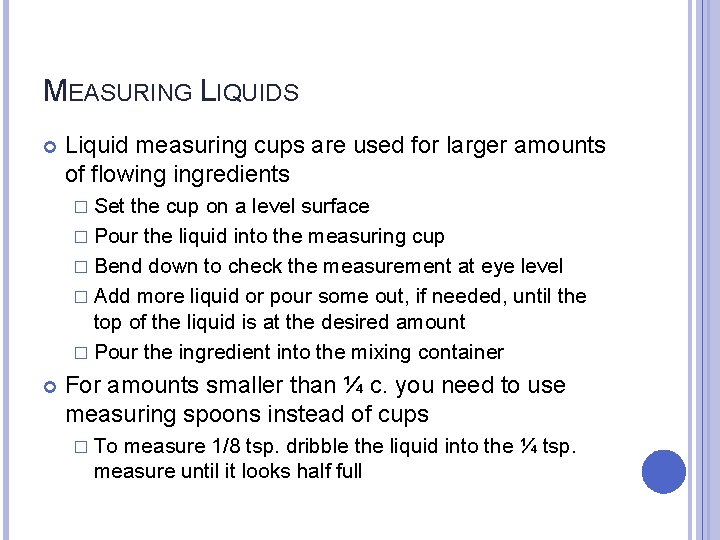
MEASURING LIQUIDS Liquid measuring cups are used for larger amounts of flowing ingredients � Set the cup on a level surface � Pour the liquid into the measuring cup � Bend down to check the measurement at eye level � Add more liquid or pour some out, if needed, until the top of the liquid is at the desired amount � Pour the ingredient into the mixing container For amounts smaller than ¼ c. you need to use measuring spoons instead of cups � To measure 1/8 tsp. dribble the liquid into the ¼ tsp. measure until it looks half full
YOU DO IT! Table 1 - measure ¾ c. water Table 2 - measure 4 oz. water Table 3 - measure 1 Tbsp. water Table 4 - measure 1/8 tsp. water
MEASURING DRY INGREDIENTS Dry measuring cups are used for larger amounts of dry ingredients � Also used for moist but not flowing ingredients, such as jam, yogurt, and peanut butter Before measuring dry ingredients, check whether you need to sift first � Flour, granulated sugar, and confectioners’ sugar are often sifted to add air and remove small lumps � Whole-grain flours are too coarse to go through the sifter- stir with a spoon before measuring
SIFTING DEMO
MEASURING DRY INGREDIENTS Set out the proper size measuring cup Fill the cup with the ingredient DO NOT pack down flour, granulated sugar, or confections’ sugar � DO pack down brown sugar- use the back of a spoon to pack it firmly into the cup � Level off the top of the cup using the straight edge of a knife or spatula unless the recipe calls for a “heaping, ” or rounded, measure Pour ingredient into the mixing containers � Moist foods can be spooned or scraped into and out of the cup Do not measure over the bowl in which you are mixing
USING MEASURING SPOONS FOR DRY INGREDIENTS To measure dry ingredients in amounts less than ¼ cup, you need measuring spoons instead of cups � Level dry ingredients in spoons unless recipe calls for a “heaping” measure � If you need 1/8 tsp. , fill the ¼ tsp. and level it off, then remove half the ingredient with the tip of a table knife Some recipes ask for a dash or a pinch of an ingredient, typically an herb, spice, or other seasoning � Measured as the amount that can be held between the thumb and finger
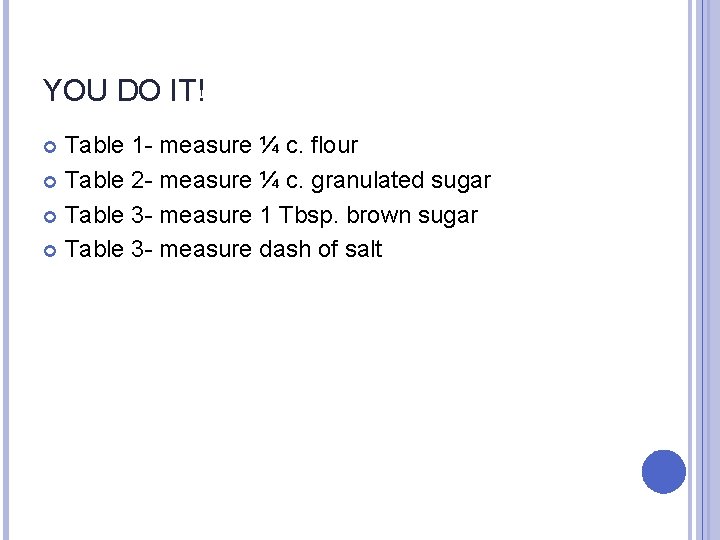
YOU DO IT! Table 1 - measure ¼ c. flour Table 2 - measure ¼ c. granulated sugar Table 3 - measure 1 Tbsp. brown sugar Table 3 - measure dash of salt
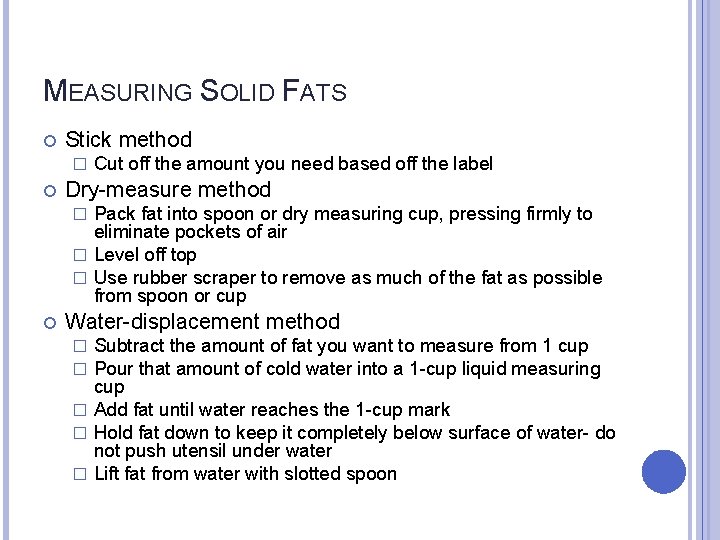
MEASURING SOLID FATS Stick method � Cut off the amount you need based off the label Dry-measure method Pack fat into spoon or dry measuring cup, pressing firmly to eliminate pockets of air � Level off top � Use rubber scraper to remove as much of the fat as possible from spoon or cup � Water-displacement method Subtract the amount of fat you want to measure from 1 cup Pour that amount of cold water into a 1 -cup liquid measuring cup � Add fat until water reaches the 1 -cup mark � Hold fat down to keep it completely below surface of water- do not push utensil under water � Lift fat from water with slotted spoon � �
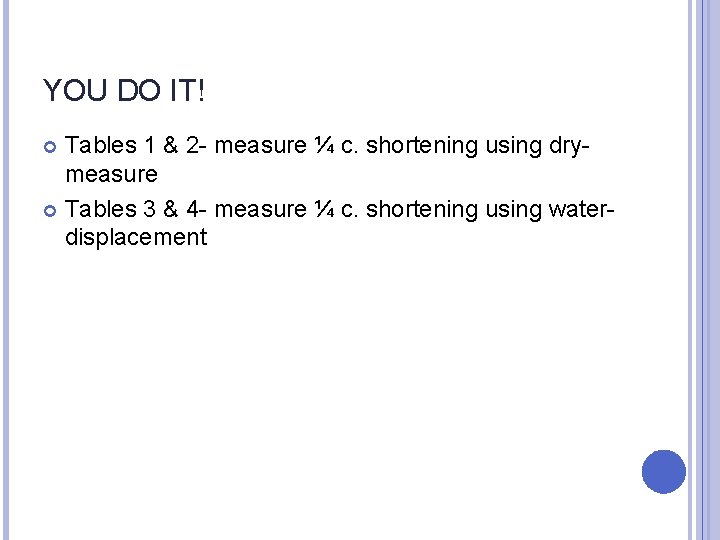
YOU DO IT! Tables 1 & 2 - measure ¼ c. shortening using drymeasure Tables 3 & 4 - measure ¼ c. shortening using waterdisplacement
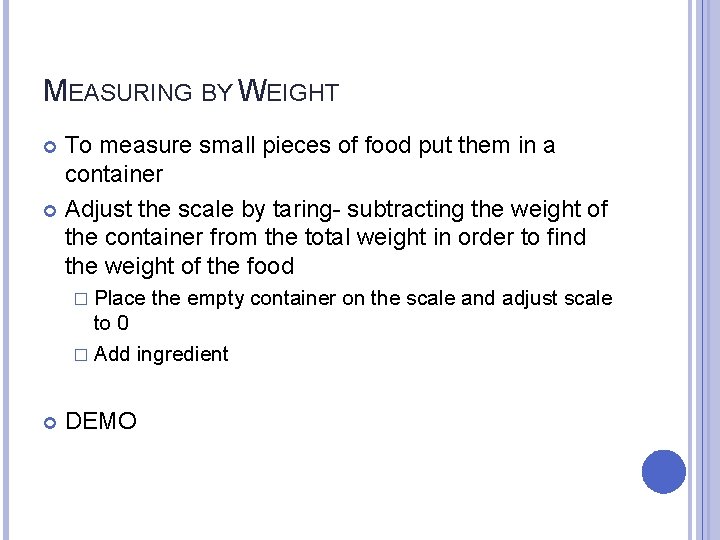
MEASURING BY WEIGHT To measure small pieces of food put them in a container Adjust the scale by taring- subtracting the weight of the container from the total weight in order to find the weight of the food � Place the empty container on the scale and adjust scale to 0 � Add ingredient DEMO
CUTTING FOODS Cutting- dividing a food into smaller parts by using a tool with a sharp blade Safety first Use a sharpened knife to prevent accidents and make work easier � Use cutting board to protect countertop and hands � Place a wet paper towel or dishcloth under board to prevent from slipping � Hold food firmly on board with your hand but not in your hand Curl fingertips away from blade Grasp knife securely by handle with other hand, avoiding sharp edge � Face blade away from your body � For rounded foods, cut a thin slice from the bottom first so the food sits flat on the board � �
KNIFE CUTTING TECHNIQUES Chop, mince� Chop- cut food into small, irregular pieces � Mince- chop finely � Use chef’s knife for both � Hold knife with one hand, pressing tip against the cutting board � Guide the blade by resting other hand lightly on the back of the blade near the tip � Rock or pump the knife handle up and down carefully, keeping the tip of the blade on the board as the blade chops the food
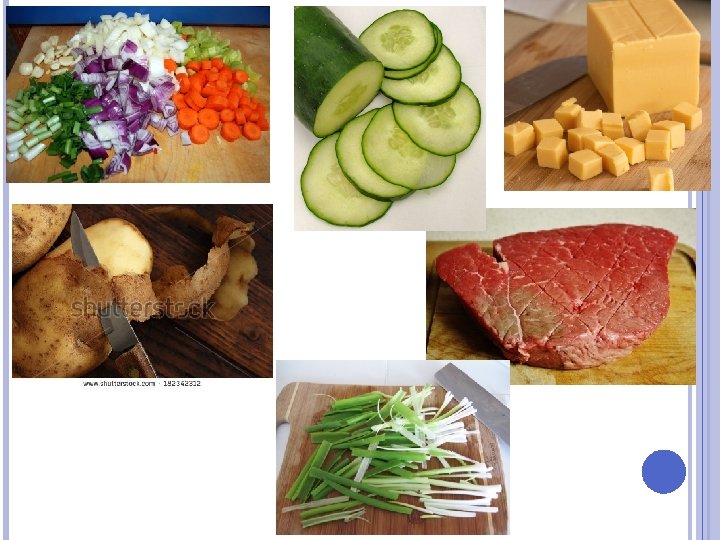
KNIFE CUTTING TECHNIQUES Cube, dice Cube- cut food into square pieces about ½ in. on a side � Dice- cut food into square pieces about 1/8 -1/4 in. on a side � Pare- cut off very thin layer of peel with paring knife or peeler Score- make straight, shallow cuts with a slicing knife in the surface of a food � Slice- cut food into a large, thin piece with a slicing knife � Helps to tenderize meat and let sauces in Use a sawing motion while pressing knife down gently Sliver- cut a food, such as almonds, into very thin strips
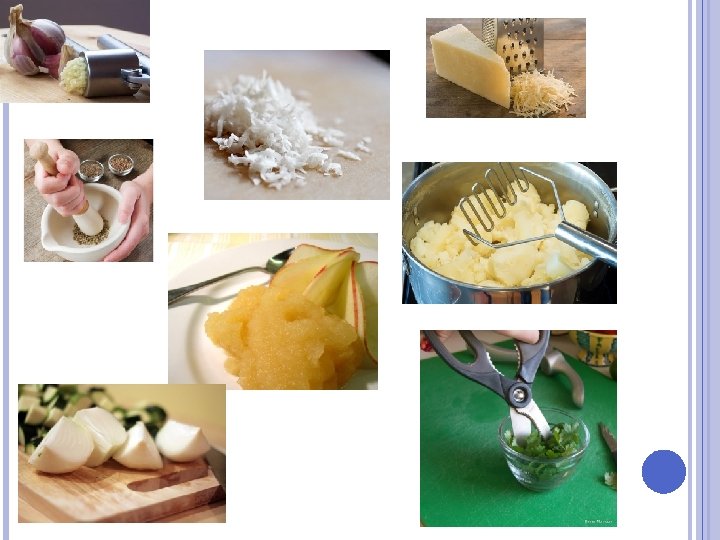
OTHER CUTTING TECHNIQUES Crush- pulverize food into crumbs, powder, or paste with a rolling pin, blender, or food processor Flake- break or tear off small layers of food with a fork Grate, shred- cut food into smaller pieces or shreds by rubbing the food against the rough surface of a grater Grind- use a grinder to break food into coarse, medium, or fine particles Mash- crush food into a smooth mixture with a masher or beater Puree- grind or mash cooked fruits or vegetables until smooth � Use blender, food processor, food mill, or sieve Quarter- divide food, usually by cutting it with a knife into 4 equal parts Snip- cut food into small pieces with kitchen shears
MIXING INGREDIENTS Mixing- combining 2 or more ingredients thoroughly so they blend Beat- mix thoroughly and add air to foods � Cream- beat ingredients, such as shortening and sugar, until soft and creamy Cut in- combine solid fats with dry ingredients such as flour to make small coarse pieces � Use a spoon and a vigorous over-and-over motion, or a mixer or food processor Use a knife or fork to mash the fat into the flour or pastry blender Fold- gently mix a light, fluffy mixture into a heavier one � Place light mixture on top of heavier one in a bowl, use rubber scraper or spoon, cut down through the mixture and move the tool across the top of the bowl to the side, and back up to the surface, along with some mixture from the bottom
MIXING INGREDIENTS Stir- mix with a spoon or wire whisk in a circular motion Toss- mix ingredients, such as salad greens and dressing, by tumbling with tongs or large spoon and fork Whip- beat quickly and vigorously to incorporate air into a mixture, making it light and fluffy Knead- work dough to blend ingredients and make it smooth and springy � Can knead by hand or with a mixer
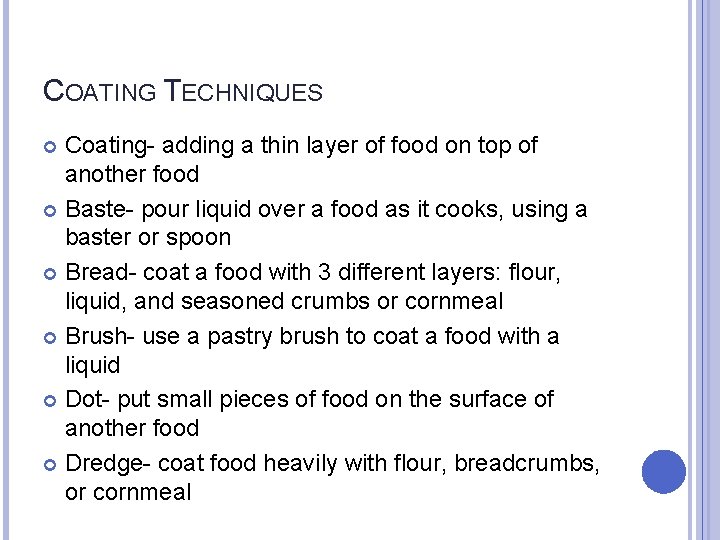
COATING TECHNIQUES Coating- adding a thin layer of food on top of another food Baste- pour liquid over a food as it cooks, using a baster or spoon Bread- coat a food with 3 different layers: flour, liquid, and seasoned crumbs or cornmeal Brush- use a pastry brush to coat a food with a liquid Dot- put small pieces of food on the surface of another food Dredge- coat food heavily with flour, breadcrumbs, or cornmeal
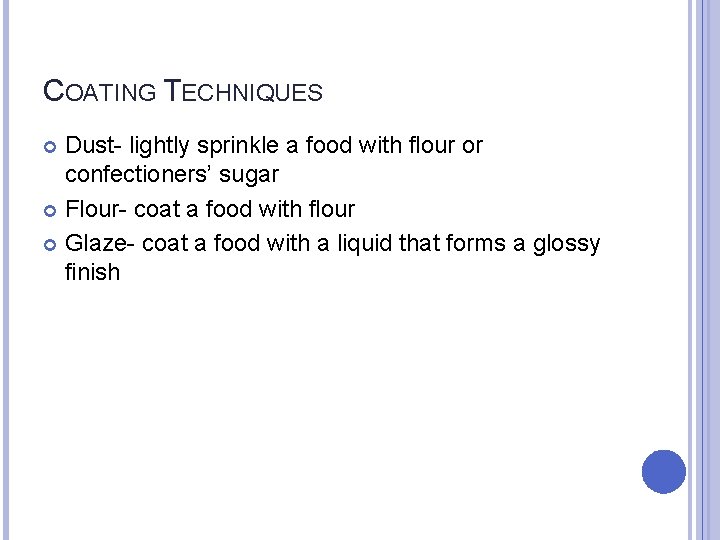
COATING TECHNIQUES Dust- lightly sprinkle a food with flour or confectioners’ sugar Flour- coat a food with flour Glaze- coat a food with a liquid that forms a glossy finish
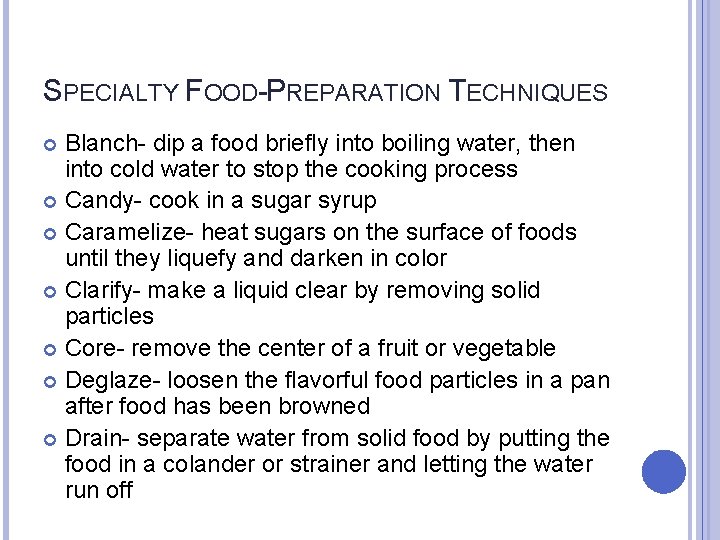
SPECIALTY FOOD-PREPARATION TECHNIQUES Blanch- dip a food briefly into boiling water, then into cold water to stop the cooking process Candy- cook in a sugar syrup Caramelize- heat sugars on the surface of foods until they liquefy and darken in color Clarify- make a liquid clear by removing solid particles Core- remove the center of a fruit or vegetable Deglaze- loosen the flavorful food particles in a pan after food has been browned Drain- separate water from solid food by putting the food in a colander or strainer and letting the water run off
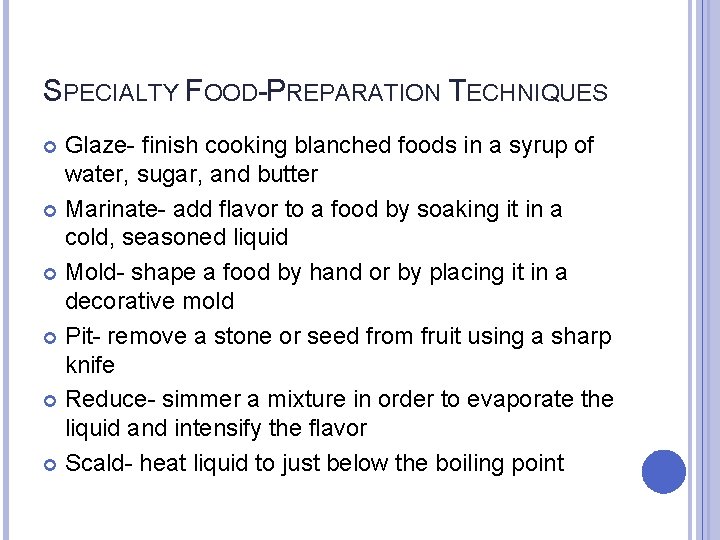
SPECIALTY FOOD-PREPARATION TECHNIQUES Glaze- finish cooking blanched foods in a syrup of water, sugar, and butter Marinate- add flavor to a food by soaking it in a cold, seasoned liquid Mold- shape a food by hand or by placing it in a decorative mold Pit- remove a stone or seed from fruit using a sharp knife Reduce- simmer a mixture in order to evaporate the liquid and intensify the flavor Scald- heat liquid to just below the boiling point
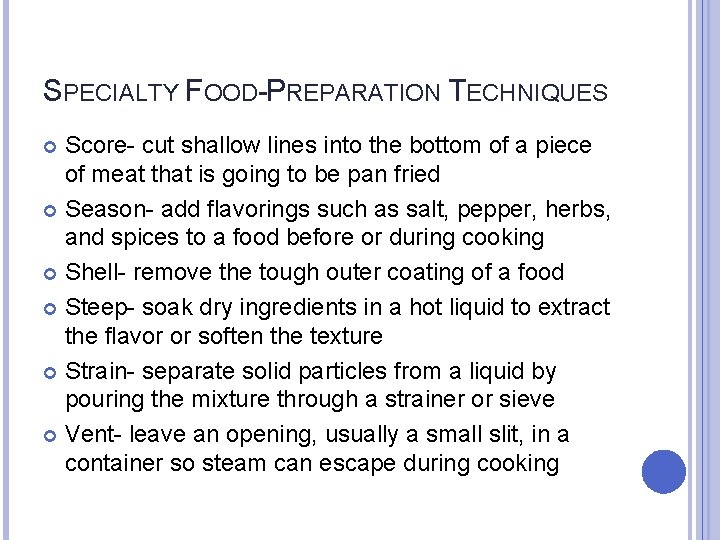
SPECIALTY FOOD-PREPARATION TECHNIQUES Score- cut shallow lines into the bottom of a piece of meat that is going to be pan fried Season- add flavorings such as salt, pepper, herbs, and spices to a food before or during cooking Shell- remove the tough outer coating of a food Steep- soak dry ingredients in a hot liquid to extract the flavor or soften the texture Strain- separate solid particles from a liquid by pouring the mixture through a strainer or sieve Vent- leave an opening, usually a small slit, in a container so steam can escape during cooking
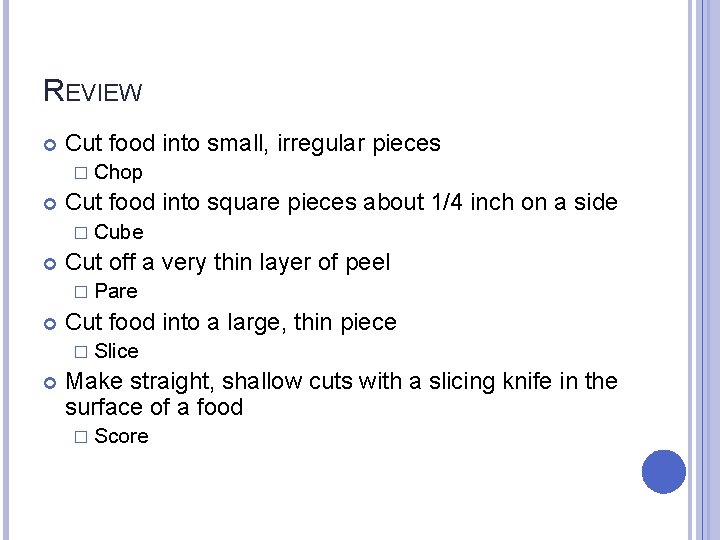
REVIEW Cut food into small, irregular pieces � Chop Cut food into square pieces about 1/4 inch on a side � Cube Cut off a very thin layer of peel � Pare Cut food into a large, thin piece � Slice Make straight, shallow cuts with a slicing knife in the surface of a food � Score
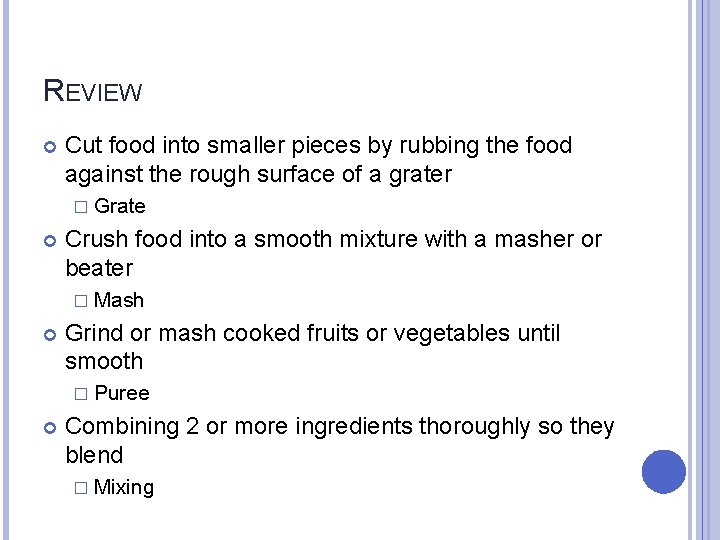
REVIEW Cut food into smaller pieces by rubbing the food against the rough surface of a grater � Grate Crush food into a smooth mixture with a masher or beater � Mash Grind or mash cooked fruits or vegetables until smooth � Puree Combining 2 or more ingredients thoroughly so they blend � Mixing
REVIEW Mix thoroughly and add air to foods � Beat Combine solid fats with dry ingredients such as flour to make small coarse pieces � Cut in Gently mix a light, fluffy mixture into a heavier one � Fold Mix with a spoon or wire whisk in a circular motion � Stir
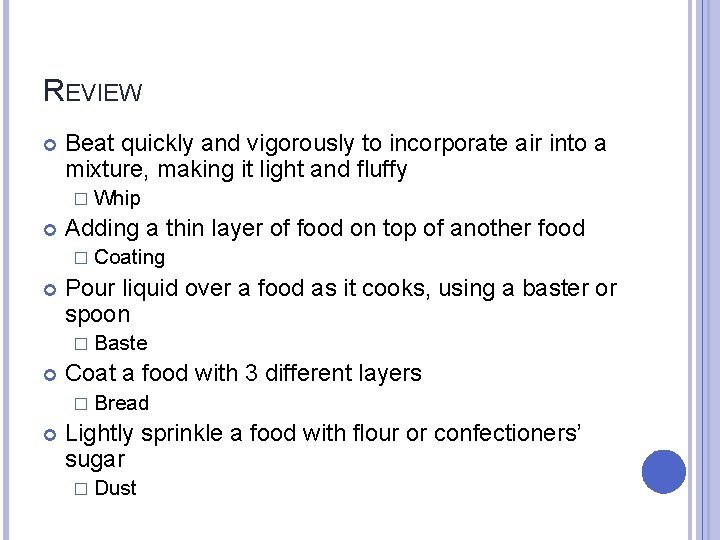
REVIEW Beat quickly and vigorously to incorporate air into a mixture, making it light and fluffy � Whip Adding a thin layer of food on top of another food � Coating Pour liquid over a food as it cooks, using a baster or spoon � Baste Coat a food with 3 different layers � Bread Lightly sprinkle a food with flour or confectioners’ sugar � Dust
REVIEW Separate water from solid food by putting the food in a colander or strainer and letting the water run off � Drain Finish cooking blanched foods in a syrup of water, sugar, and butter � Glaze Remove a stone or seed from fruit using a sharp knife � Pit Separate solid particles from a liquid by pouring the mixture through a strainer or sieve � Strain