
The art of case study research 1 ROBERT
The art of case study research 1 ROBERT E. STAKE (1995) Prepared by Pavan Soni (IIM Bangalore) 11/23/2020
Table of content 2 �Introduction �The unique case �The nature of qualitative research �Data gathering �Analysis and interpretation �Case research roles �Triangulation �Writing the report �Reflections �Harper school Prepared by Pavan Soni (IIM Bangalore) 11/23/2020
Introduction 3 �A case study is the study of the particularity and complexity of a single case, coming to understand its activity within important circumstances �Case as a Bounded system Integrated system �Types of cases Intrinsic (having an intrinsic interest in the case, here the case is dominant) Instrumental (interested in understanding something else, here the issue is dominant) Collective (several cases adopted) Prepared by Pavan Soni (IIM Bangalore) 11/23/2020
The unique case 4 �Selection of cases Case study research is not sampling research Case typically have petite generalization The real business of a case study is particularization, and not generalization �Emphasis on interpretation Progressive focusing by an observer, comprises of observation, renewed inquiry, and explanation (Parlett and Hamilton, 1976) More interpretation in qualitative research than quantitative Called as ‘assertions’ (Erickson) Assertions to be immediately written after observations An ethic of caution is not contrary to an ethic of interpretation Need to preserve ‘multiple realities’ of the case Prepared by Pavan Soni (IIM Bangalore) 11/23/2020
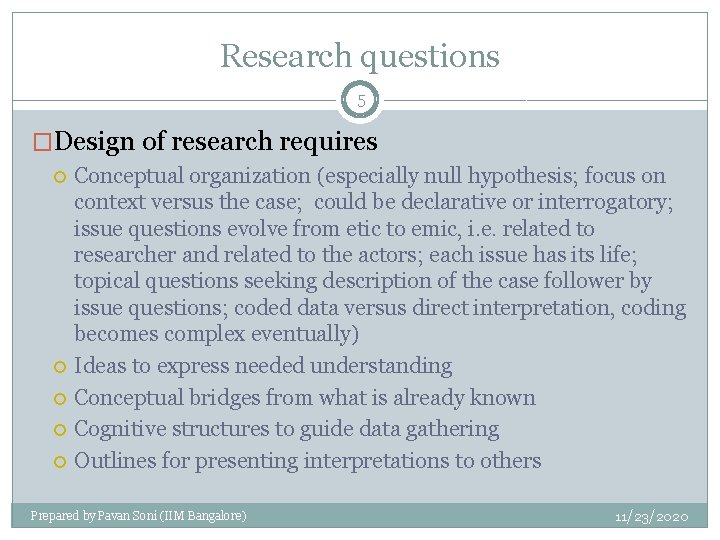
Research questions 5 �Design of research requires Conceptual organization (especially null hypothesis; focus on context versus the case; could be declarative or interrogatory; issue questions evolve from etic to emic, i. e. related to researcher and related to the actors; each issue has its life; topical questions seeking description of the case follower by issue questions; coded data versus direct interpretation, coding becomes complex eventually) Ideas to express needed understanding Conceptual bridges from what is already known Cognitive structures to guide data gathering Outlines for presenting interpretations to others Prepared by Pavan Soni (IIM Bangalore) 11/23/2020
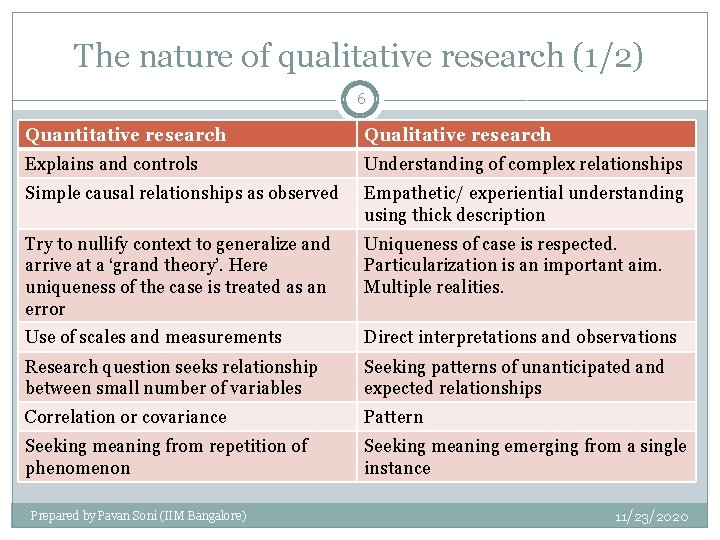
The nature of qualitative research (1/2) 6 Quantitative research Qualitative research Explains and controls Understanding of complex relationships Simple causal relationships as observed Empathetic/ experiential understanding using thick description Try to nullify context to generalize and arrive at a ‘grand theory’. Here uniqueness of the case is treated as an error Uniqueness of case is respected. Particularization is an important aim. Multiple realities. Use of scales and measurements Direct interpretations and observations Research question seeks relationship between small number of variables Seeking patterns of unanticipated and expected relationships Correlation or covariance Pattern Seeking meaning from repetition of phenomenon Seeking meaning emerging from a single instance Prepared by Pavan Soni (IIM Bangalore) 11/23/2020
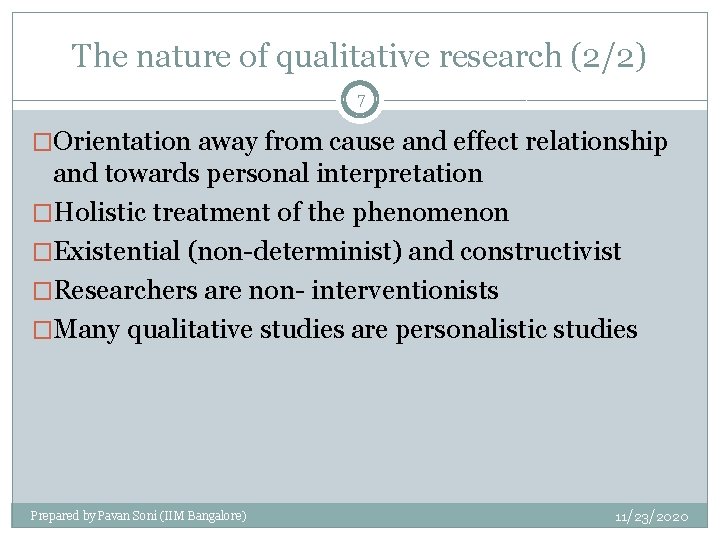
The nature of qualitative research (2/2) 7 �Orientation away from cause and effect relationship and towards personal interpretation �Holistic treatment of the phenomenon �Existential (non-determinist) and constructivist �Researchers are non- interventionists �Many qualitative studies are personalistic studies Prepared by Pavan Soni (IIM Bangalore) 11/23/2020
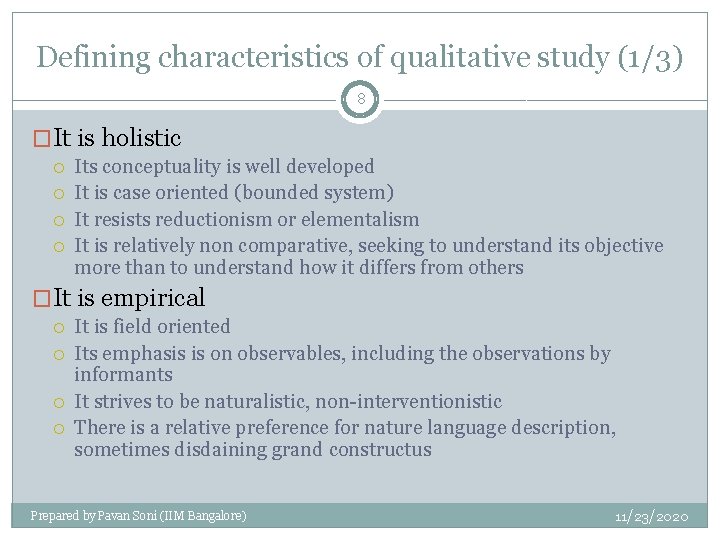
Defining characteristics of qualitative study (1/3) 8 �It is holistic Its conceptuality is well developed It is case oriented (bounded system) It resists reductionism or elementalism It is relatively non comparative, seeking to understand its objective more than to understand how it differs from others �It is empirical It is field oriented Its emphasis is on observables, including the observations by informants It strives to be naturalistic, non-interventionistic There is a relative preference for nature language description, sometimes disdaining grand constructus Prepared by Pavan Soni (IIM Bangalore) 11/23/2020
Defining characteristics of qualitative study (2/3) 9 �It is interpretive Its researchers rely more on intuition, with many important criteria not specified Its on- site observers work to keep attention free to recognize problem- relevant events Its attuned to the fact that research is a researcher- subject interaction �It is emphatic It attends to actors intentionality It seeks actor frames of reference, value commitments, although planned, its design is emergent, responsive, its issues are emic issues, progressively focused, and its reporting provides vicarious experiences Prepared by Pavan Soni (IIM Bangalore) 11/23/2020
Defining characteristics of qualitative study (3/3) 10 �Its observations and immediate interpretations are validated Triangulation of data is routine There is deliberate effort to disconfirm own interpretations Its reports assist readers to make their own interpretations Its reports assist readers in recognition of subjectivity �Its non-hortatory, resisting the exploitation of the specialist’s platform �It is sensitive to the risks of human subjects research �Its researchers are not just methodologically competent and versed in some substantive discipline but versed in the relevant discipline Prepared by Pavan Soni (IIM Bangalore) 11/23/2020
Data gathering 11 �Organizing the data gathering Data gathering plan � Definition of case � List of research questions � Identification of helpers � Data sources � Allocation of time, expenses � Intended reporting �Interview is the main road to multiple realities, discovering and portraying the multiple views of the case Prepared by Pavan Soni (IIM Bangalore) 11/23/2020
Analysis and interpretation 12 �Everlasting efforts to make sense of things �Categorical aggregation or direct interpretation Categorical aggregation more suitable for instrumental case Direct interpretation more suitable for intrinsic case �Search for meaning, analysis, is often a search for patterns or correspondence �Naturalistic generalizations as a result of thorough personal engagements in life or vicarious experience, as against explicated (propositional) generalization Prepared by Pavan Soni (IIM Bangalore) 11/23/2020
Case researcher roles 13 � Teacher (learn what the readers need to know) � Advocate (discover the best arguments against your assertions and provide data to counter them) � Evaluator (give careful attention to case merits and shortcomings) � Biographer � Theorist (use the uniqueness of the case to illustrate ways in which each case is likely to be complex, not what cases have in common) � Interpreter � Constructivist (nourishing the belief that knowledge is constructed rather than discovered) � Relativist (value of interpretations vary- relative to credibility and utility) Prepared by Pavan Soni (IIM Bangalore) 11/23/2020
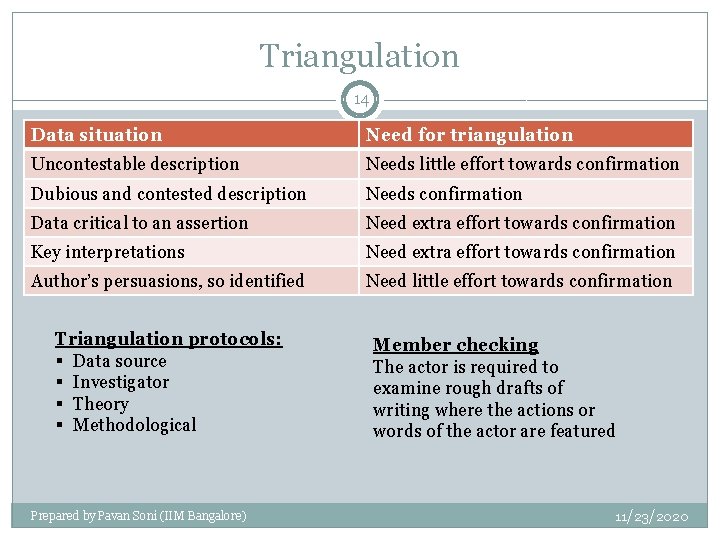
Triangulation 14 Data situation Need for triangulation Uncontestable description Needs little effort towards confirmation Dubious and contested description Needs confirmation Data critical to an assertion Need extra effort towards confirmation Key interpretations Need extra effort towards confirmation Author’s persuasions, so identified Need little effort towards confirmation Triangulation protocols: § Data source § Investigator § Theory § Methodological Prepared by Pavan Soni (IIM Bangalore) Member checking The actor is required to examine rough drafts of writing where the actions or words of the actor are featured 11/23/2020
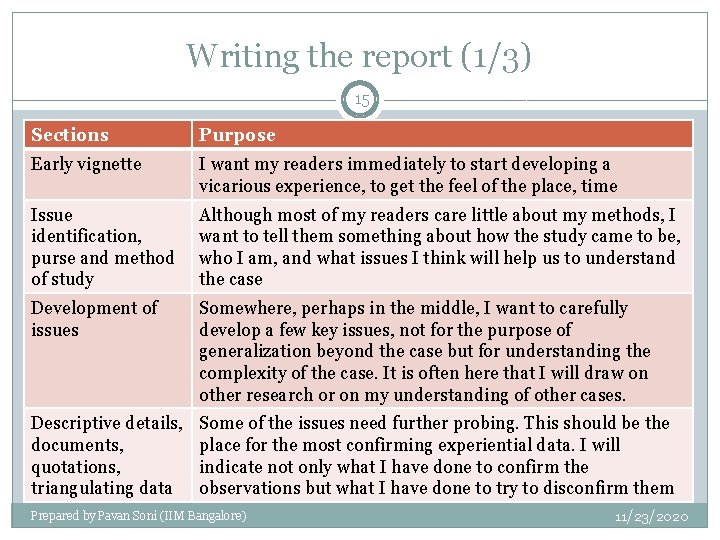
Writing the report (1/3) 15 Sections Purpose Early vignette I want my readers immediately to start developing a vicarious experience, to get the feel of the place, time Issue identification, purse and method of study Although most of my readers care little about my methods, I want to tell them something about how the study came to be, who I am, and what issues I think will help us to understand the case Development of issues Somewhere, perhaps in the middle, I want to carefully develop a few key issues, not for the purpose of generalization beyond the case but for understanding the complexity of the case. It is often here that I will draw on other research or on my understanding of other cases. Descriptive details, documents, quotations, triangulating data Some of the issues need further probing. This should be the place for the most confirming experiential data. I will indicate not only what I have done to confirm the observations but what I have done to try to disconfirm them Prepared by Pavan Soni (IIM Bangalore) 11/23/2020
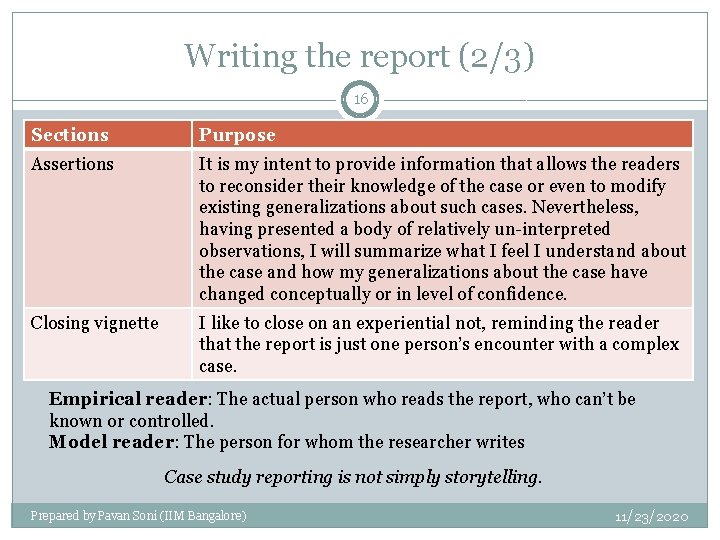
Writing the report (2/3) 16 Sections Purpose Assertions It is my intent to provide information that allows the readers to reconsider their knowledge of the case or even to modify existing generalizations about such cases. Nevertheless, having presented a body of relatively un-interpreted observations, I will summarize what I feel I understand about the case and how my generalizations about the case have changed conceptually or in level of confidence. Closing vignette I like to close on an experiential not, reminding the reader that the report is just one person’s encounter with a complex case. Empirical reader: The actual person who reads the report, who can’t be known or controlled. Model reader: The person for whom the researcher writes Case study reporting is not simply storytelling. Prepared by Pavan Soni (IIM Bangalore) 11/23/2020
Writing the report (3/3) 17 �Paths for writing a case Realist tales (provides a direct, matter-of-fact portrait) Confessional tales (focus far more on the field work, than on the case) Impressionist tales (personalized accounts of the fleeting moments of fieldwork case in dramatic form) �Vignettes Briefly describes the episodes to illustrate an aspect of he case, perhaps one of the issues. Prepared by Pavan Soni (IIM Bangalore) 11/23/2020
Critique checklist of a case study report 18 � Is the report easy to read? � Does it fit together, each sentence � Has the writer made sound � � � � � contributing to the whole? Does this report have a conceptual structure (i. e. theme or issue)? Are its issues developed in a serious and scholarly way? Is the case adequately defined? Is there a sense of story to the presentation? Is the reader provided some vicarious experience? Have quotations been used effectively? Are headings, figures, artifacts, appendixes, indexes effectively used? Was it edited well, then again with a list minute polish? Prepared by Pavan Soni (IIM Bangalore) � � � � assertions, neither over not underinterpreting? Had adequate attention being paid to various contexts? Were sufficient raw data presented? Were data sources well chosen and in sufficient number? Do observations and interpretations appear to have been triangulated? Is the role and point of view of researcher nicely apparent? Is the nature of intended audience apparent? Is empathy shown for all sides? Are personal intentions examined? Does it appear individuals were put at risk? 11/23/2020
Reflections 19 �Issues are problems about which people disagree, complicated problems within situations and contexts. �Case study work is said to be ‘progressively focused’ �Qualitative case study is highly personal research Prepared by Pavan Soni (IIM Bangalore) 11/23/2020
- Slides: 19