
The Art of Argumentation The process of reasoning

- Slides: 20
The Art of Argumentation The process of reasoning systematically in support of an idea.
Rhetoric = the art of persuasive speaking and writing where the speaker uses various tactics to effectively convince an audience. In rhetoric, an argument is a “course” of reasoning aimed to persuade an audience.
In rhetoric, argument. . . q is a course of reasoning aimed at demonstrating a truth or a falsehood. q uses of logic and reason to convince an audience q is structured to include a claim, reasoning, & evidence q utilizes persuasive strategies like emotional and ethical appeals.
The Argument Continuum Exploratory Essay: Examines many sides of an issue as researcher shares process of reaching understanding. Argument as inquiry, asking audience to think out issue with writer. Dialogic argument, problemsolving, seeking common ground with an opposed audience. Classic argument aimed at neutral or possibly skeptical audience. One-sided argument aimed at a friendly audience (often for fundraising or calls to action) Extremely biased onesided arguments where speaker is aggressive, defensive or rhetoric is charged. Outright propaganda; extremely biased, conspiratorial, misleading, or false to publicize a political cause.
Claim (thesis) • Is a speaker’s clear position on an issue or a problem. • It’s stating an assertion. • Claims are specific, precise If you have ever expressed your opinion with words like “people should not be allowed to, ” then you have stated a claim!
Claim usually contains 2 parts q Part 1 : the opinion q Part 2: the why Claim Writing Key words or phrases in a claim q Part 1: should, should not, needs to, must q Part 2: Because, since, due to Example Claim: The United States should colonize the moon, because we have technology to reach the moon and the ingenuity to make living in space a reality.
Building Support For a strong argument, claim must be supported by reasons and evidence. Support must be… q Logical: make sense q Relevant: related to claim q Sufficient: there is enough to prove point q Accuracy: correct and current
Types of Evidence q Facts: statements that can be proven; such as according to the Voting Rights Act of 1965, any competent person who has successfully completed 6 th grade has the right to vote. Historical and current events fall under facts. q Statistical data: facts stated as numbers. q Quotations of Expert testimony q Example: a particular case that represents the idea in question. q Anecdotal Evidence: brief story or account that proves a point within your argument. Prove it! Provide proof for your reasoning! “Everyone is entitled to their own opinion, you’re not entitled to your own facts. ” Andy Rosenthal NYTimes Editor
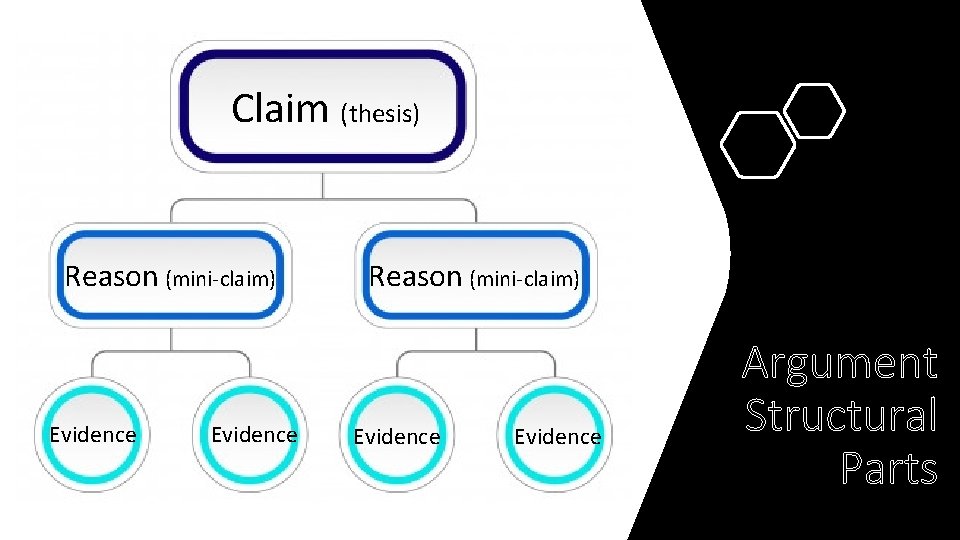
Claim (thesis) Reason (mini-claim) Evidence Argument Structural Parts
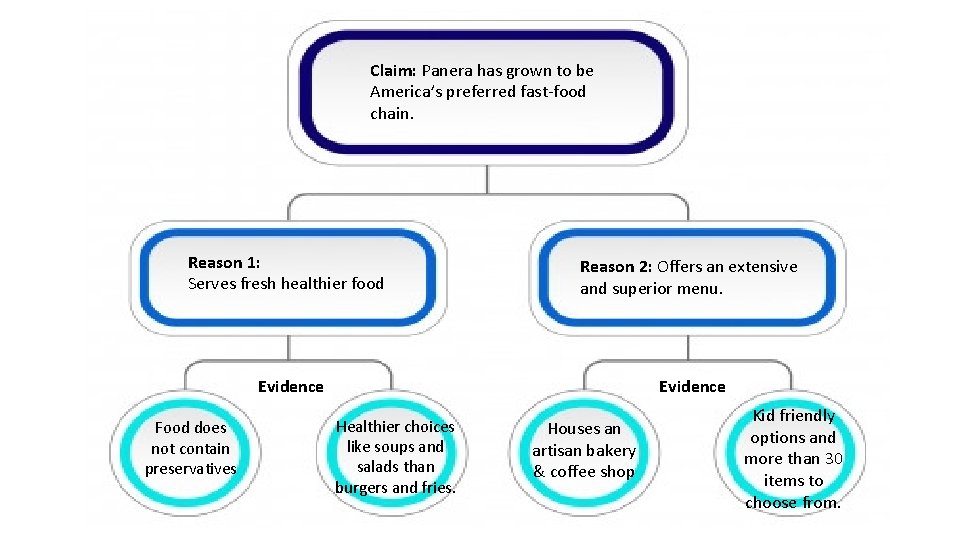
Claim: Panera has grown to be America’s preferred fast-food chain. Reason 1: Serves fresh healthier food Reason 2: Offers an extensive and superior menu. Evidence Food does not contain preservatives Healthier choices like soups and salads than burgers and fries. Houses an artisan bakery & coffee shop Kid friendly options and more than 30 items to choose from.
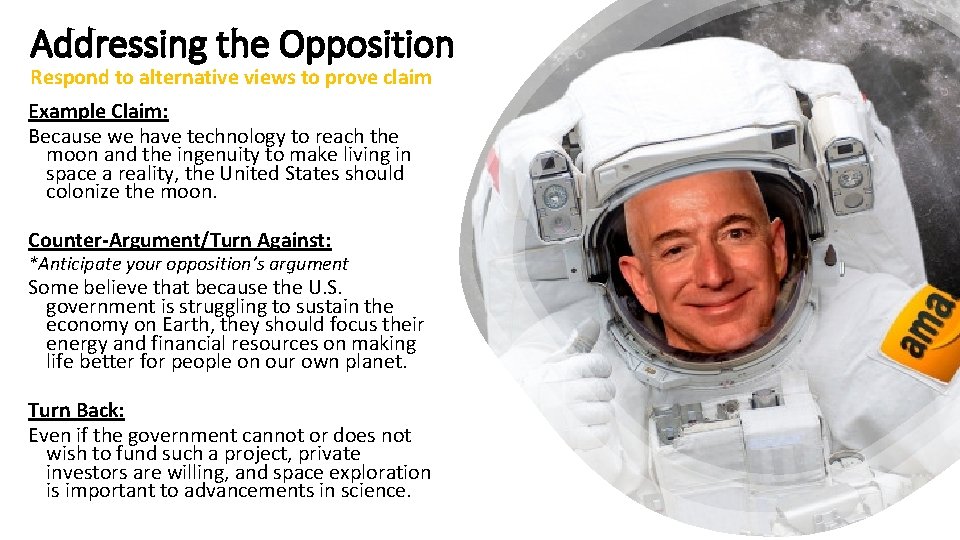
Addressing the Opposition Respond to alternative views to prove claim Example Claim: Because we have technology to reach the moon and the ingenuity to make living in space a reality, the United States should colonize the moon. Counter-Argument/Turn Against: *Anticipate your opposition’s argument Some believe that because the U. S. government is struggling to sustain the economy on Earth, they should focus their energy and financial resources on making life better for people on our own planet. Turn Back: Even if the government cannot or does not wish to fund such a project, private investors are willing, and space exploration is important to advancements in science.
Caution: Be Fair Be Reasonable Be Logical Fallacy is a flaw in reasoning. Ø These are ineffective tricks or errors in judgement that people resort to. Ø You may be tempted to use illogical reasoning because it sounds persuasive, but… Ø ultimately it will limit your argument.
Faulty reasoning • Oversimplification is a drastically simple solution to what is clearly a complex problem: “The U. S. has a problem with illegal immigration, so lets kick out the twelve million illegals that live in our country. ” • Hasty generalization is based on too little evidence or evidence that is not representative: “All undocumented immigrants are sponging off the U. S. government. ” • Faulty temporal sequence is applying cause and effect erroneously: “Crime has increased in the U. S. , so illegal immigrants are causing the crime. ”
Faulty reasoning • False analogy is making a misleading analogy between unconnected ideas: “If we can clone animals, then we should be able to find a cure for cancer. ” • Either/or thinking is seeing only two alternatives: “You are either an environmentalist or a polluter. ” • Non-sequitur is a conclusion that is clearly not related to the established premise or evidence (does not follow logically): “He sounds very sincere. He must know what he’s talking about. ”
Organizational Strategies Creating a Coherent Argument with a logical sequence Your ideas should go together in a way that your audience can follow.
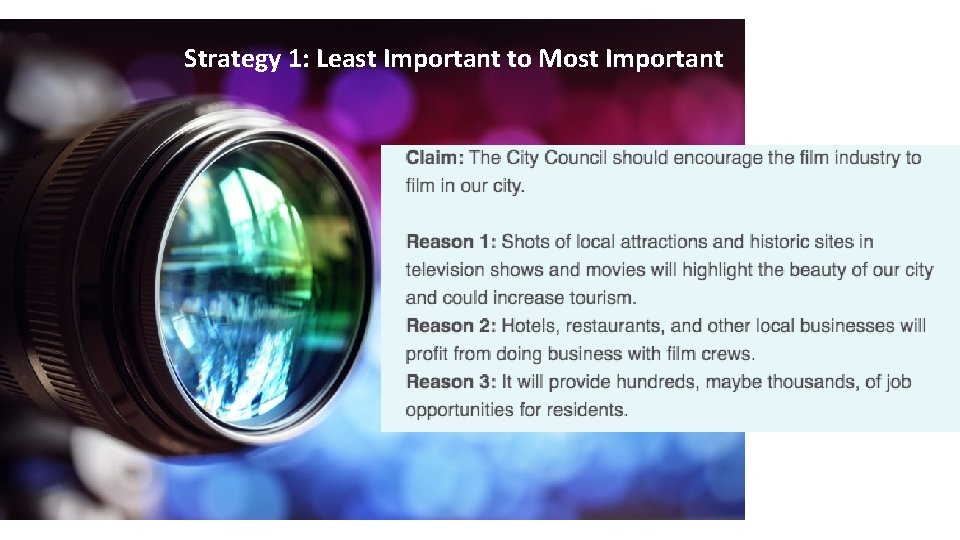
Strategy 1: Least Important to Most Important
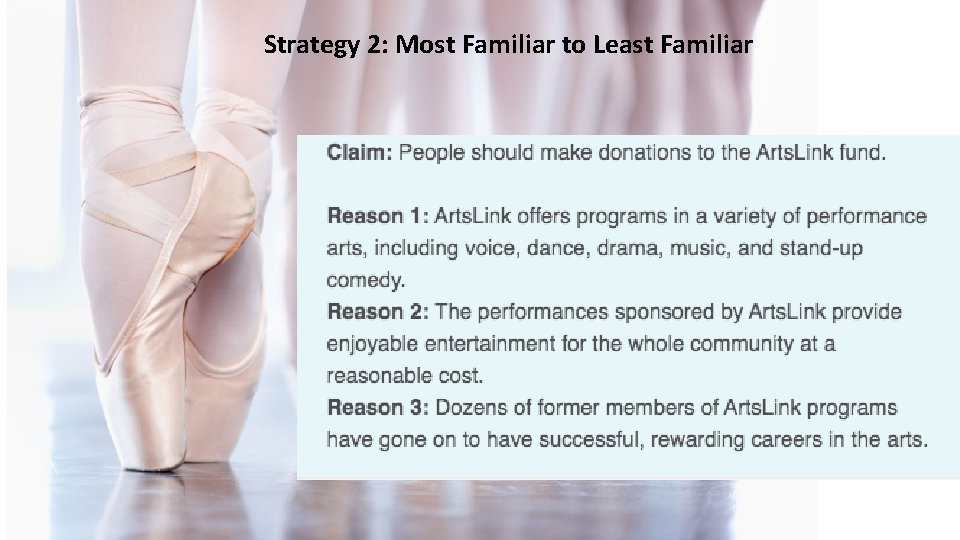
Strategy 2: Most Familiar to Least Familiar
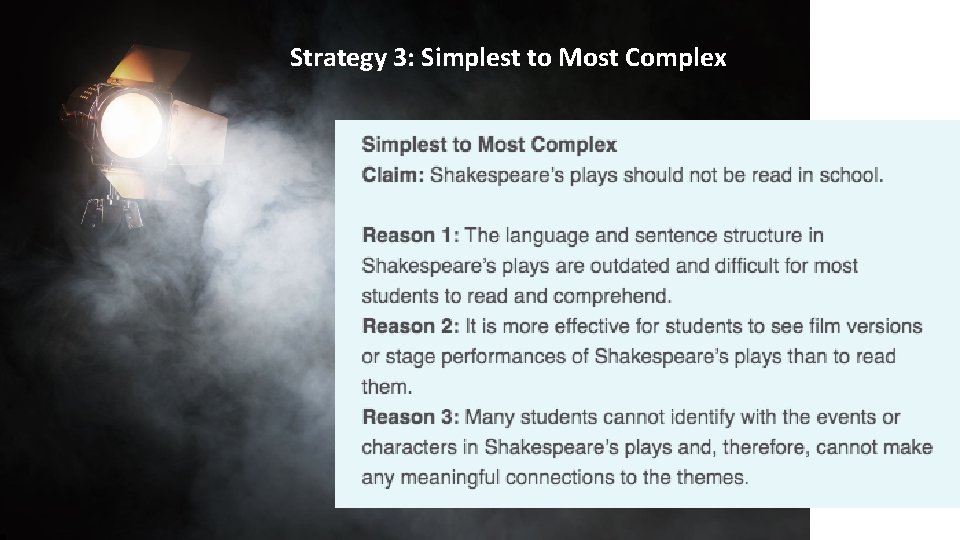
Strategy 3: Simplest to Most Complex
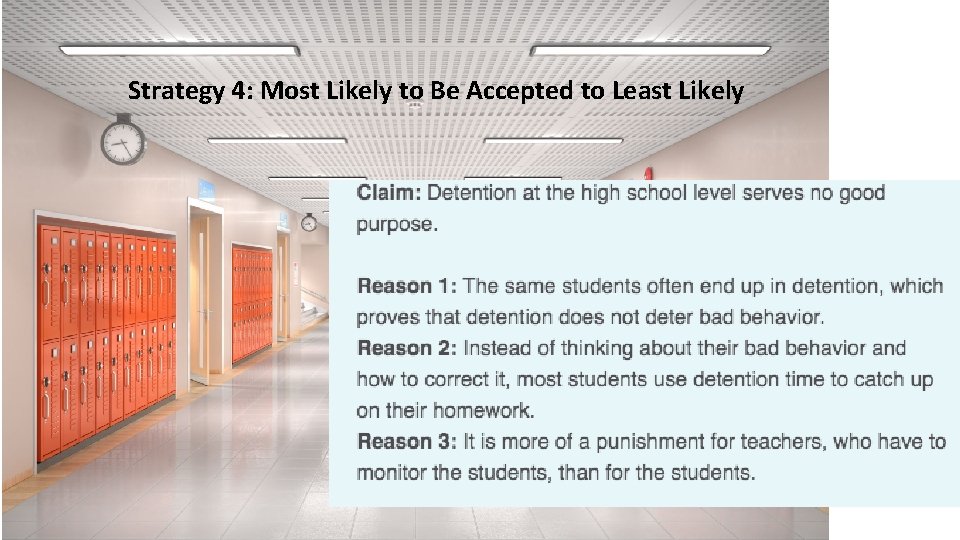
Strategy 4: Most Likely to Be Accepted to Least Likely