
The Art of Argument Inductive and Deductive Reasoning

- Slides: 53
The Art of Argument Inductive and Deductive Reasoning Logical Fallacy and False Premise
What is an Argument? Consists of three things: ◦ Premises ◦ Inferences ◦ Conclusions
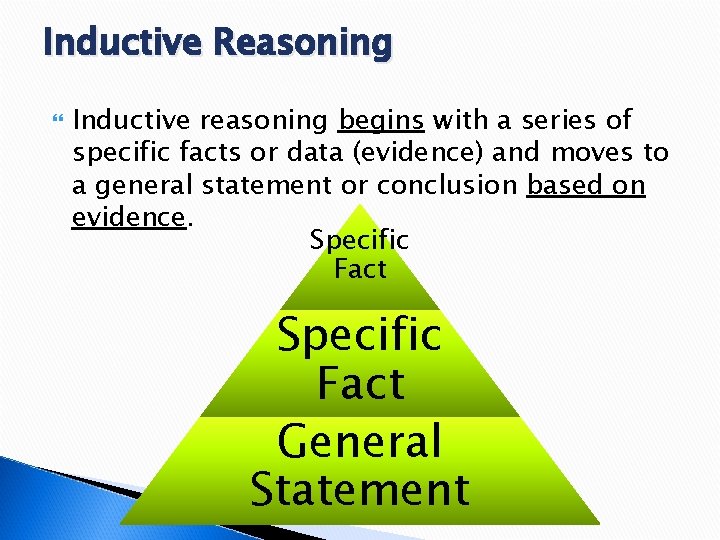
Inductive Reasoning Inductive reasoning begins with a series of specific facts or data (evidence) and moves to a general statement or conclusion based on evidence. Specific Fact General Statement
Inductive Reasoning In inductive reasoning, the specific facts or evidence can never absolutely prove that the conclusion is true. However, the facts/evidence can support the conclusion Strong evidence = a conclusion that is sound Weak evidence = a conclusion that is questionable or perhaps inaccurate
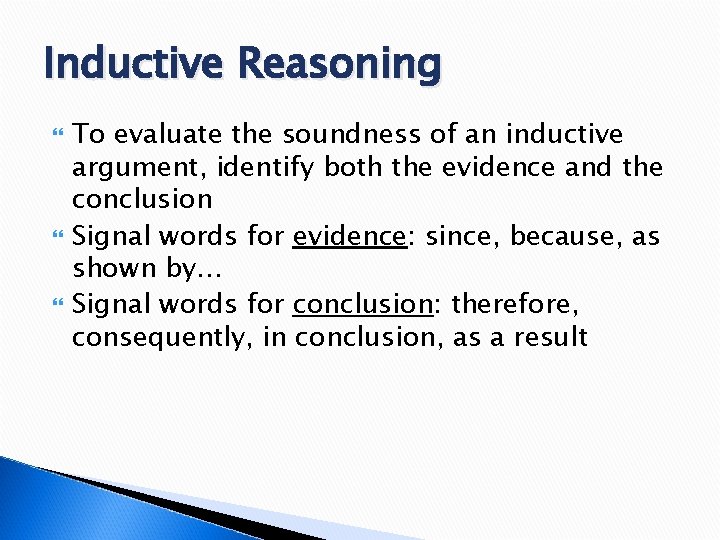
Inductive Reasoning To evaluate the soundness of an inductive argument, identify both the evidence and the conclusion Signal words for evidence: since, because, as shown by… Signal words for conclusion: therefore, consequently, in conclusion, as a result
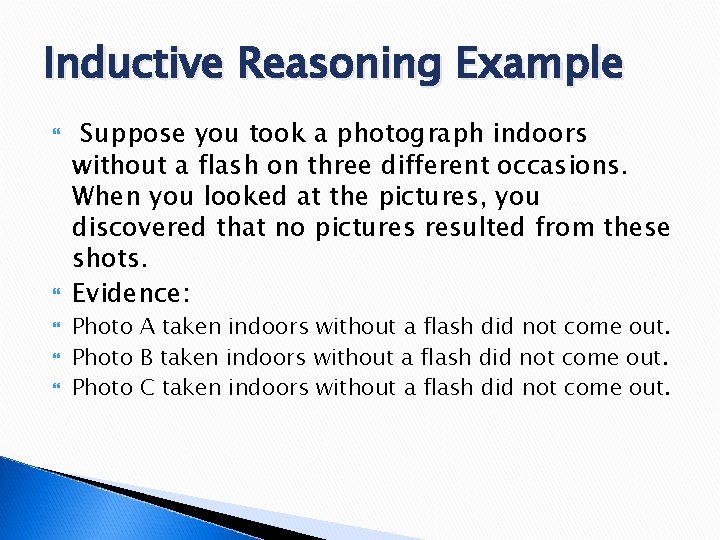
Inductive Reasoning Example Suppose you took a photograph indoors without a flash on three different occasions. When you looked at the pictures, you discovered that no pictures resulted from these shots. Evidence: Photo A taken indoors without a flash did not come out. Photo B taken indoors without a flash did not come out. Photo C taken indoors without a flash did not come out.
Inductive Reasoning Example Cont. You could continue to take photos indoors without a flash or you could form a conclusion based on evidence you have collected. Conclusion: ? ? ?
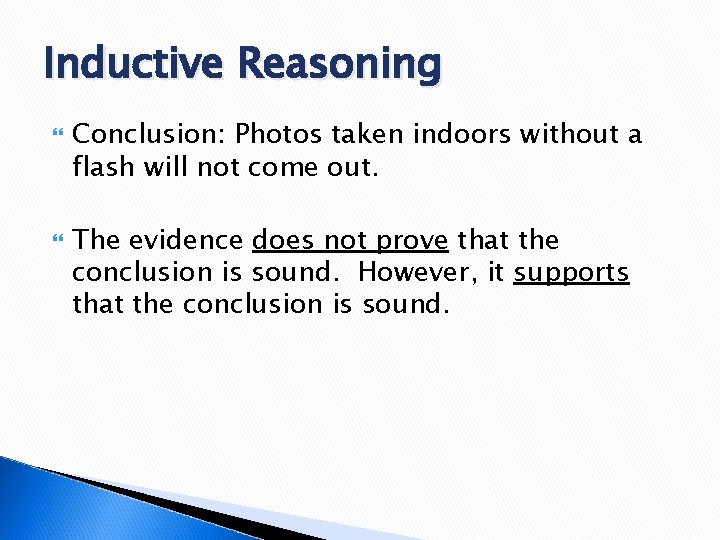
Inductive Reasoning Example Cont. You could continue to take photos indoors without a flash or you could form a conclusion based on evidence you have collected. Conclusion: Photos taken indoors without a flash will not come out.
Inductive Reasoning Conclusion: Photos taken indoors without a flash will not come out. The evidence does not prove that the conclusion is sound. However, it supports that the conclusion is sound.
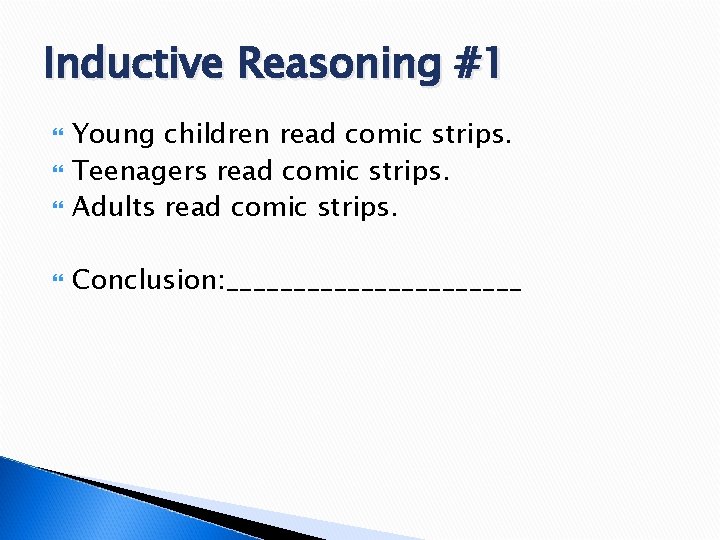
Inductive Reasoning #1 Young children read comic strips. Teenagers read comic strips. Adults read comic strips. Conclusion: ___________
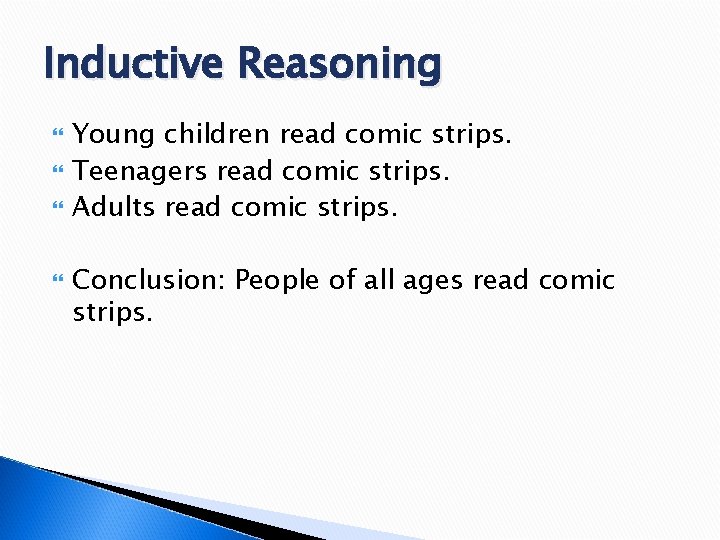
Inductive Reasoning Young children read comic strips. Teenagers read comic strips. Adults read comic strips. Conclusion: People of all ages read comic strips.
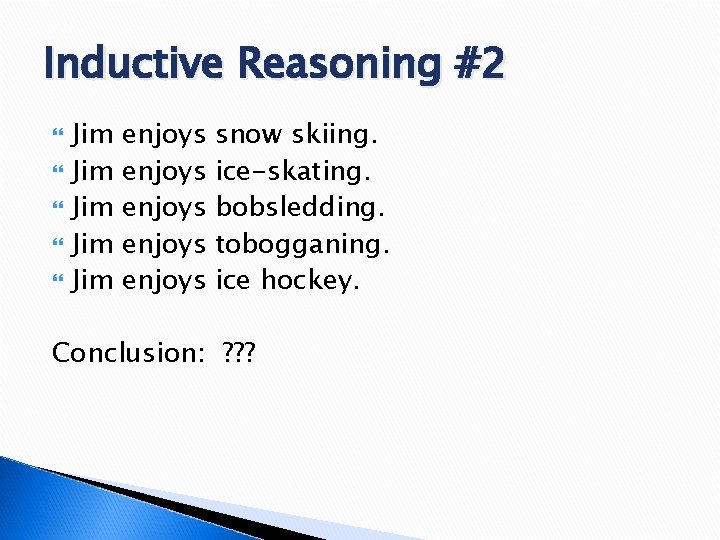
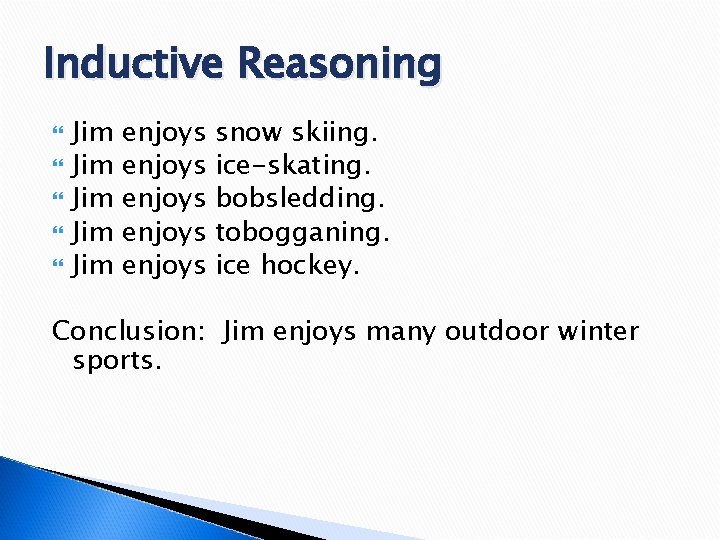
Inductive Reasoning #2 Jim Jim Jim enjoys enjoys snow skiing. ice-skating. bobsledding. tobogganing. ice hockey. Conclusion: ? ? ?
Inductive Reasoning Jim Jim Jim enjoys enjoys snow skiing. ice-skating. bobsledding. tobogganing. ice hockey. Conclusion: Jim enjoys many outdoor winter sports.
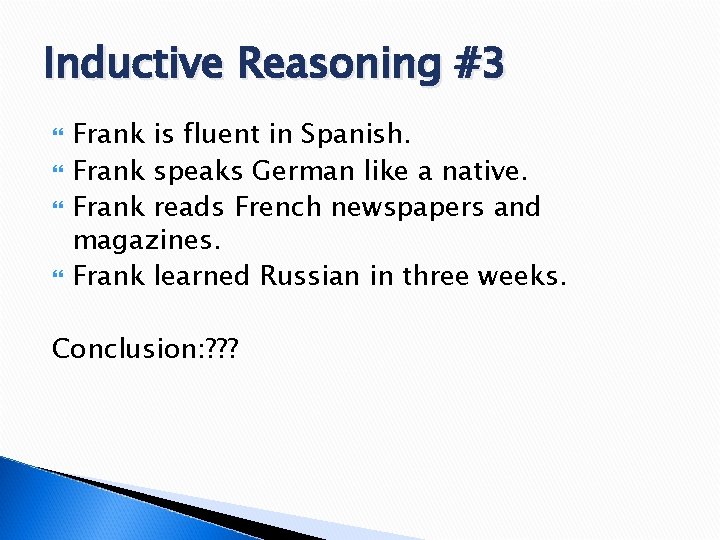
Inductive Reasoning #3 Frank is fluent in Spanish. Frank speaks German like a native. Frank reads French newspapers and magazines. Frank learned Russian in three weeks. Conclusion: ? ? ?
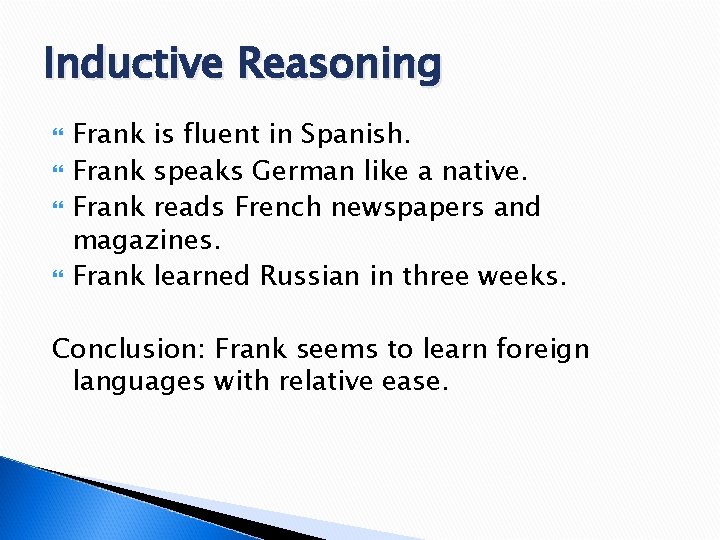
Inductive Reasoning Frank is fluent in Spanish. Frank speaks German like a native. Frank reads French newspapers and magazines. Frank learned Russian in three weeks. Conclusion: Frank seems to learn foreign languages with relative ease.
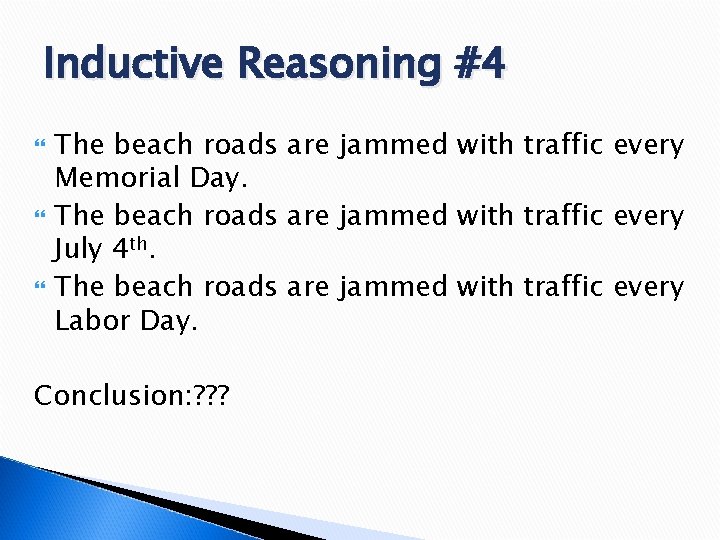
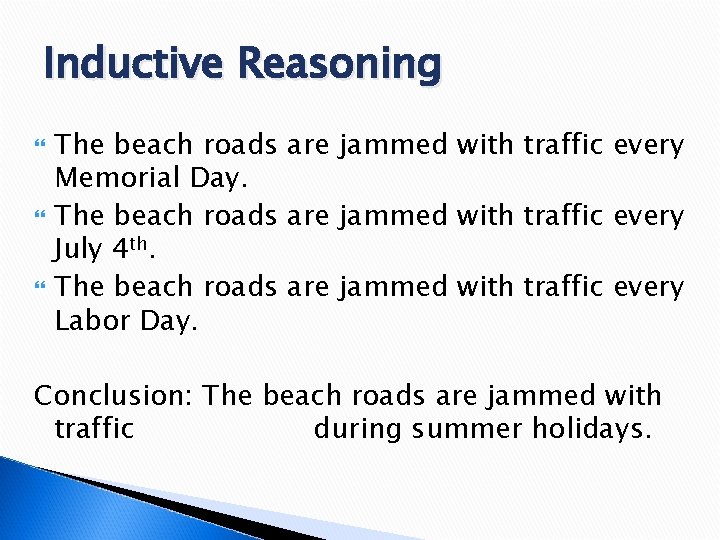
Inductive Reasoning #4 The beach roads are jammed with traffic every Memorial Day. The beach roads are jammed with traffic every July 4 th. The beach roads are jammed with traffic every Labor Day. Conclusion: ? ? ?
Inductive Reasoning The beach roads are jammed with traffic every Memorial Day. The beach roads are jammed with traffic every July 4 th. The beach roads are jammed with traffic every Labor Day. Conclusion: The beach roads are jammed with traffic during summer holidays.
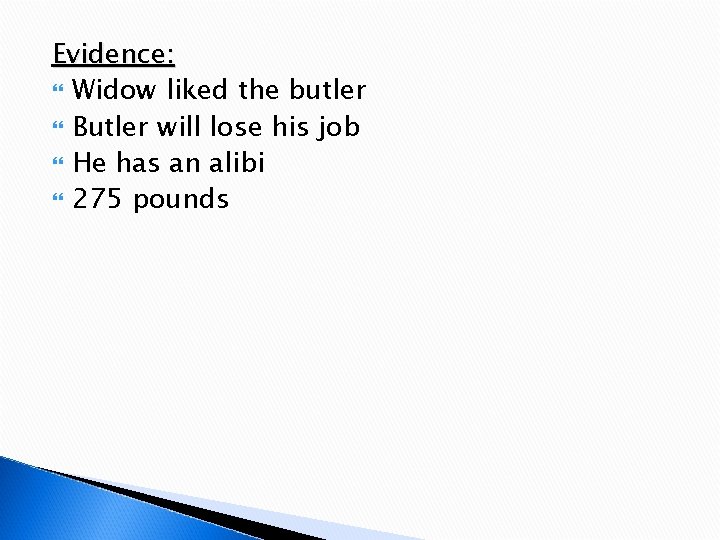
A wealthy widow with a reputation for being especially unpleasant has been found murdered on her estate. According to the CSI Investigative Team, the killer entered the house through a very narrow chimney. Detective Smart, the lead investigator on the case, suspects that the widow’s butler committed the crime. He discovers, however, that the butler was one of the few people that the widow seemed to like. He also learns that since the widow is dead the butler will almost certainly lose his job because the estate is going to be sold to a local art museum. Additionally, several villagers tell the detective that they and the butler were enjoying a night out at the local pub at the time when the murder occurred. Finally, Detective Smart learns that the butler weighs 275 pounds.
Evidence: Widow liked the butler Butler will lose his job He has an alibi 275 pounds
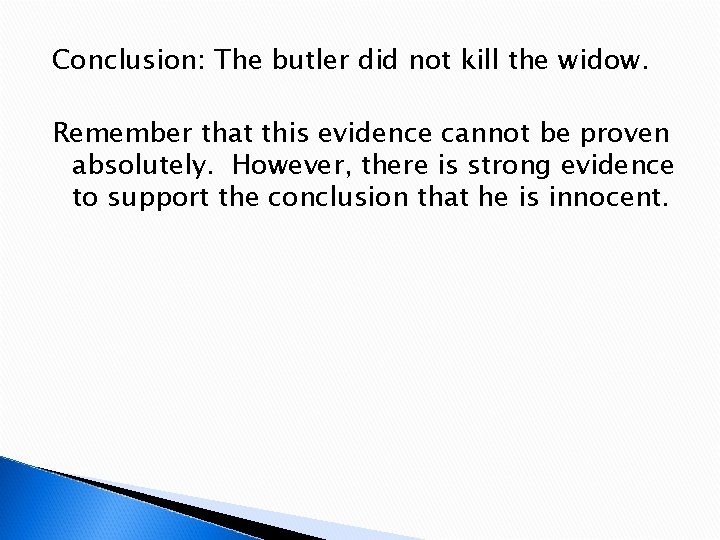
Conclusion: The butler did not kill the widow. Remember that this evidence cannot be proven absolutely. However, there is strong evidence to support the conclusion that he is innocent.
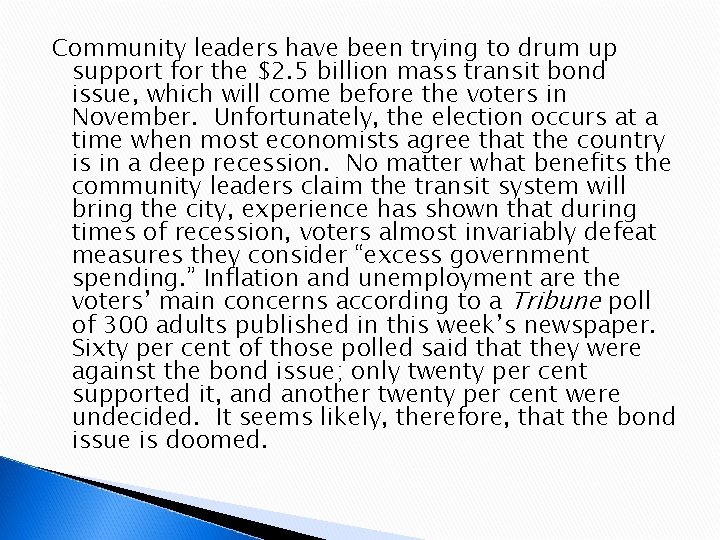
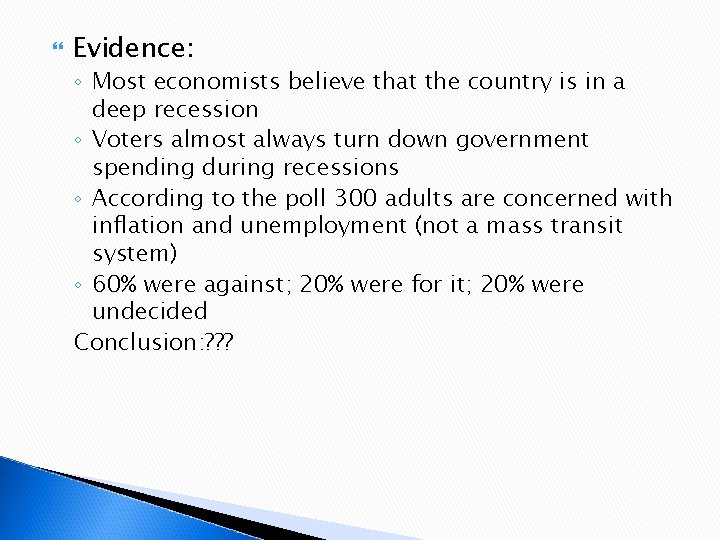
Community leaders have been trying to drum up support for the $2. 5 billion mass transit bond issue, which will come before the voters in November. Unfortunately, the election occurs at a time when most economists agree that the country is in a deep recession. No matter what benefits the community leaders claim the transit system will bring the city, experience has shown that during times of recession, voters almost invariably defeat measures they consider “excess government spending. ” Inflation and unemployment are the voters’ main concerns according to a Tribune poll of 300 adults published in this week’s newspaper. Sixty per cent of those polled said that they were against the bond issue; only twenty per cent supported it, and another twenty per cent were undecided. It seems likely, therefore, that the bond issue is doomed.
Evidence: ◦ Most economists believe that the country is in a deep recession ◦ Voters almost always turn down government spending during recessions ◦ According to the poll 300 adults are concerned with inflation and unemployment (not a mass transit system) ◦ 60% were against; 20% were for it; 20% were undecided Conclusion: ? ? ?
Conclusion: The bond issue will be defeated.
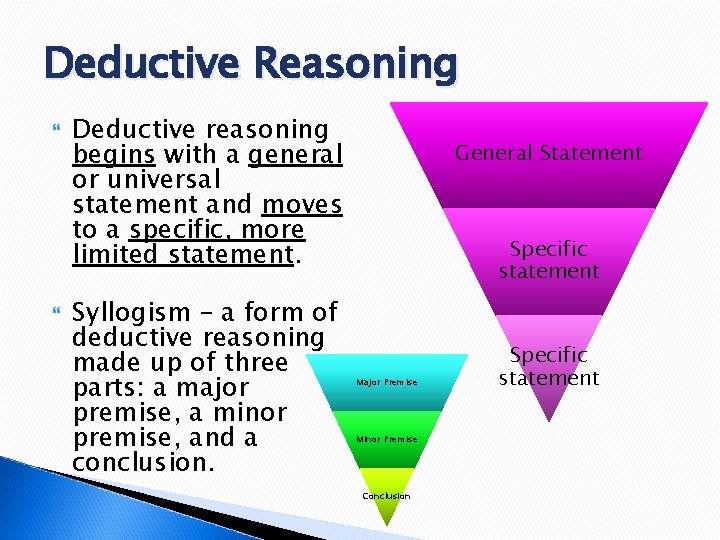
Deductive Reasoning Deductive reasoning begins with a general or universal statement and moves to a specific, more limited statement. Syllogism – a form of deductive reasoning made up of three parts: a major premise, a minor premise, and a conclusion. General Statement Specific statement Major Premise Minor Premise Conclusion Specific statement
Deductive Reasoning Premise = a general or universal statement which is said to be true. Major Premise = must make a universal statement. This means that it must be true or all, every, no, or none of the people, objects, or events that are the subject of the statement are true. A major premise can never contain a limiter, such as some, most, or many.
Deductive Reasoning Minor Premise = the fact or truth stated must be related to the major premise. For the conclusion of a deductive argument to be true, three conditions must be met: ◦ The major premise must make a universal statement ◦ Both of the premises must be true. ◦ The argument must be valid (follow the rules of reasoning) *The key to the credibility of a deductive conclusion lies in the premises.
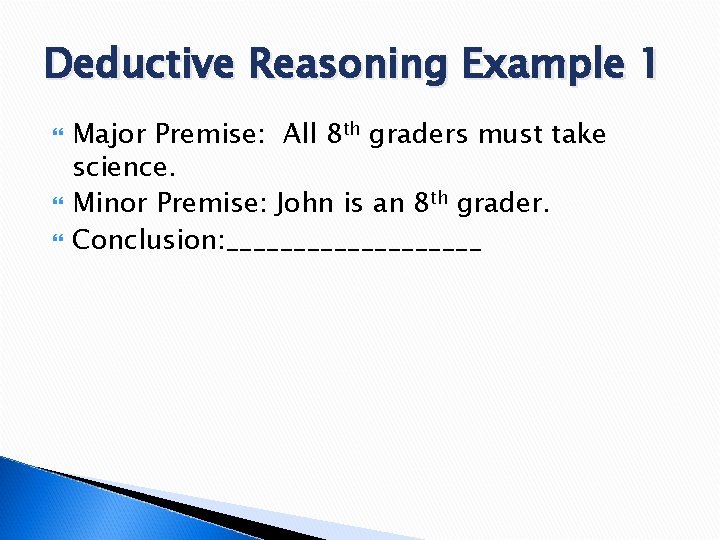
Deductive Reasoning Example 1 Major Premise: All 8 th graders must take science. Minor Premise: John is an 8 th grader. Conclusion: __________
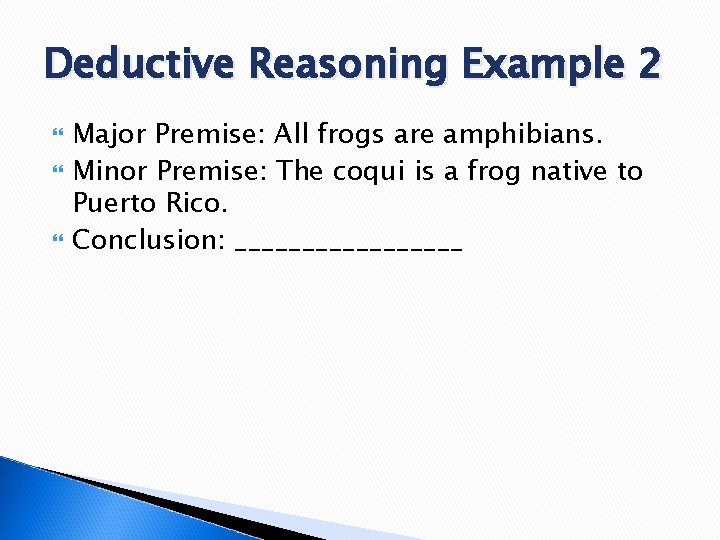
Deductive Reasoning Example 2 Major Premise: All frogs are amphibians. Minor Premise: The coqui is a frog native to Puerto Rico. Conclusion: _________
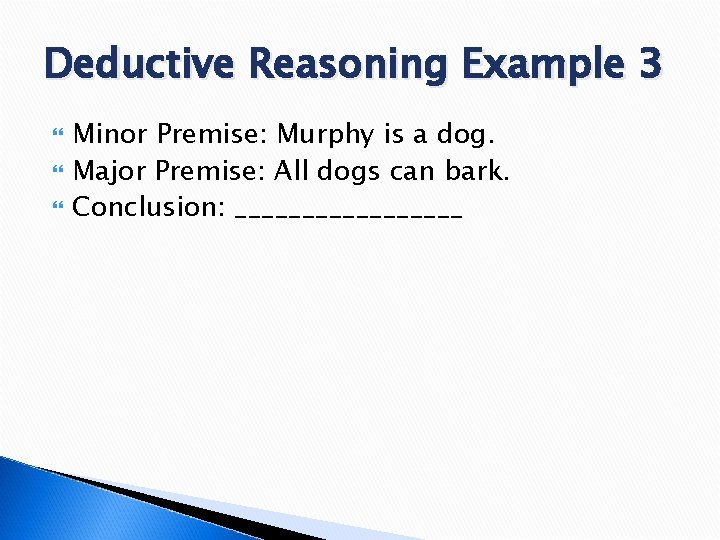
Deductive Reasoning Example 3 Minor Premise: Murphy is a dog. Major Premise: All dogs can bark. Conclusion: _________
Deductive Reasoning Example 4 All lawyers must pass a bar exam. Barbara Smith is a lawyer. Conclusion: ? ? ?
Deductive Reasoning Example Conclusion: Barbara Smith passed the bar exam.
Deductive Reasoning Example 5 Alan is allergic to all foods containing wheat. Spaghetti contains wheat. Conclusion: ? ? ?
Deductive Reasoning Example Conclusion: Alan is allergic to spaghetti.
Deductive Reasoning Example 6 Carey’s dog barks only when it’s hungry. Carey’s dog is barking. Conclusion: ? ? ?
Deductive Reasoning Example Conclusion: Carey’s dog is hungry.
Deductive Reasoning All of the previous examples contained a major and minor premise that were true. Now let’s look at some that are more difficult.
Deductive Reasoning Example 7 Five to ten percent of all men are color-blind. Jerry is a man. Conclusion: ? ? ?
Deductive Reasoning Example No conclusion can be made due to the limiter… 5 to 10%
Deductive Reasoning Example 8 The ancient Chinese believed that objects carved from jade had supernatural qualities. This ancient Chinese deer is carved from jade. Conclusion: ? ? ?
Deductive Reasoning Example Conclusion: The ancient Chinese believed that this ancient Chinese deer had supernatural qualities. You CANNOT say… This ancient Chinese deer had supernatural qualities…because we wouldn’t believe it.
Deductive Reasoning Example 9 All snakes are cold-blooded. All snails are snakes. Why is this invalid?
Deductive Reasoning Example Invalid: It has two major premises.
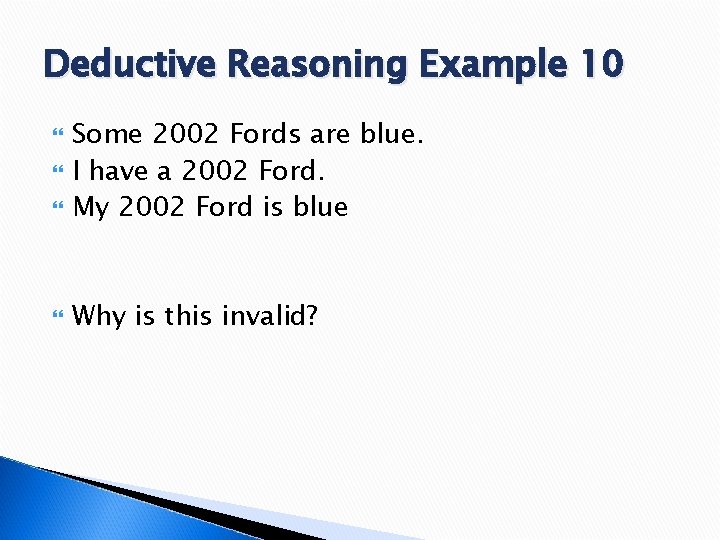
Deductive Reasoning Example 10 Some 2002 Fords are blue. I have a 2002 Ford. My 2002 Ford is blue Why is this invalid?
Deductive Reasoning Example It contains a limiter: SOME
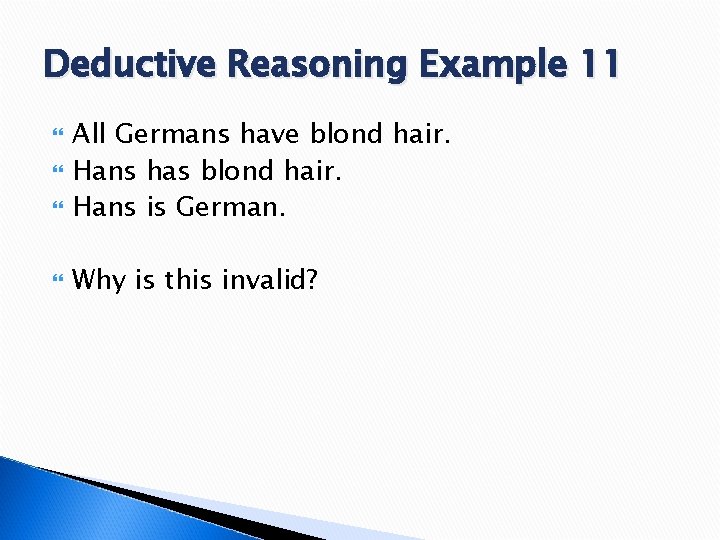
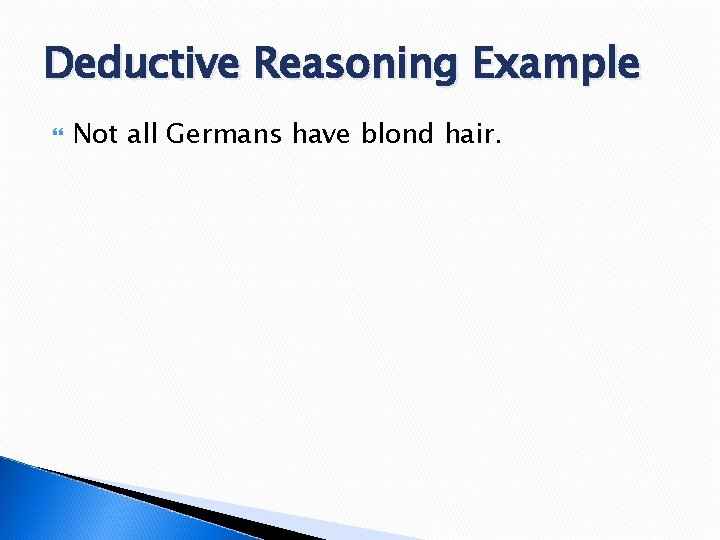
Deductive Reasoning Example 11 All Germans have blond hair. Hans has blond hair. Hans is German. Why is this invalid?
Deductive Reasoning Example Not all Germans have blond hair.
Logical Fallacies and False Premises Know how to determine if an argument is logical or illogical
Errors in Reasoning The ability to identify logical fallacies in the arguments of others, and to avoid them in one’s own arguments, is both valuable and increasingly rare. Fallacious reasoning keeps us from knowing the truth, and the inability to think critically makes us vulnerable to manipulation by those skilled in the art of rhetoric. A logical fallacy is an error in reasoning.
False Premise An incorrect or illogical premise that forms the basis of a syllogism. Why are these statements so difficult to notice? ◦ The premise itself may be true, just not valid. ◦ The conclusion of the syllogism may still be true or believable.
Types of False Premise: Appeal to fear Definition: Making a claim that is intended to produce fear. Also called: SCARE TACTICS and AD BACULUM Example: ◦ I don't think a Red Ryder BB rifle would make a good present for you. They are very dangerous and you'll put your eye out. Now, don't you agree that you should think of another gift idea?
Types of False Premise: Personal Attack Definition: When a person substitutes abusive remarks for evidence. Attack is directed at the opponent rather than the argument at hand. Also called: AD HOMINEM Example: ◦ Jane says that drug use is morally wrong, but she is just a goody-two shoes Christian, so we don't have to listen to her.
Types of False Premise: False Dilemma Definition: Only two options are presented, when there is at least one more available. Also called BIFURCATION Example: ◦ (1) Either a Creator brought the universe into existence, or the universe came into existence out of nothing. (2) The universe didn’t come into existence out of nothing (because nothing comes from nothing). Therefore: (3) A Creator brought the universe into existence. Problem with argument: It might be thought that the universe was neither brought into existence by a creator nor that it came from nothing because it existed from eternity.
Types of False Premise: False Analogy Definition: Two items are compared, but they do not share a strong relating factor. Also called WEAK ANALOGY Examples: ◦ (1) A and B are similar. (2) A has a certain characteristic. Therefore: (3) B must have that characteristic too. ◦ Students are like nails. Just as nails must be hit in the head in order to make them work, so must students.