
The Art and Craft of Autoethnography Ron Chenail
- Slides: 34
The Art and Craft of Autoethnography Ron Chenail, Sally St. George, Maureen Duffy, Robin Cooper, marcela polanco, Kenneth Carano, and TBD The Qualitative Report Fifth Annual Conference Qualitative Research Artistry and Craft Nova Southeastern University Fort Lauderdale, Florida USA January 18, 2014
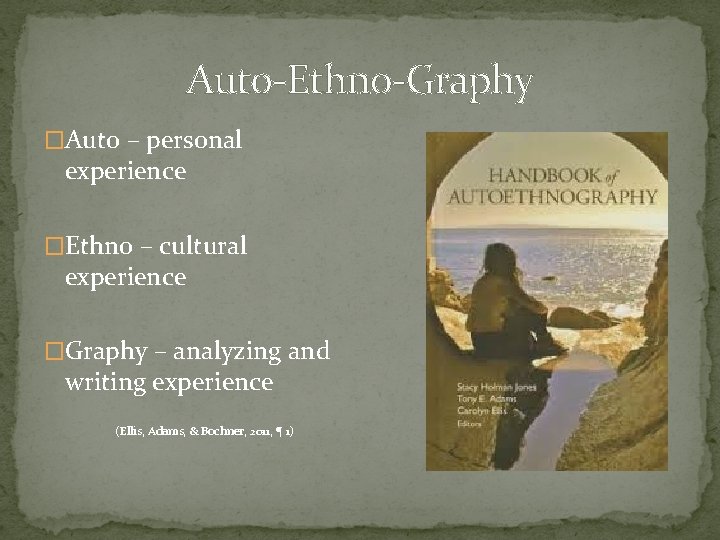
Auto-Ethno-Graphy �Auto – personal experience �Ethno – cultural experience �Graphy – analyzing and writing experience (Ellis, Adams, & Bochner, 2011, ¶ 1)
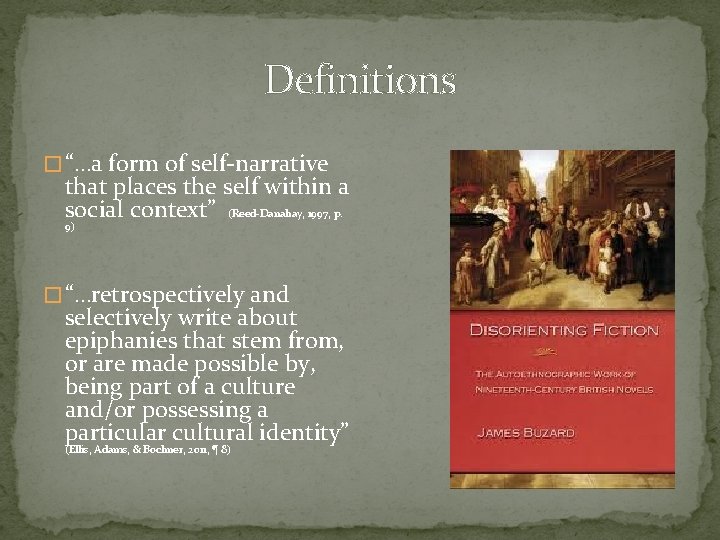
Definitions � “…a form of self-narrative that places the self within a social context” (Reed-Danahay, 1997, p. 9) � “…retrospectively and selectively write about epiphanies that stem from, or are made possible by, being part of a culture and/or possessing a particular cultural identity” (Ellis, Adams, & Bochner, 2011, ¶ 8)
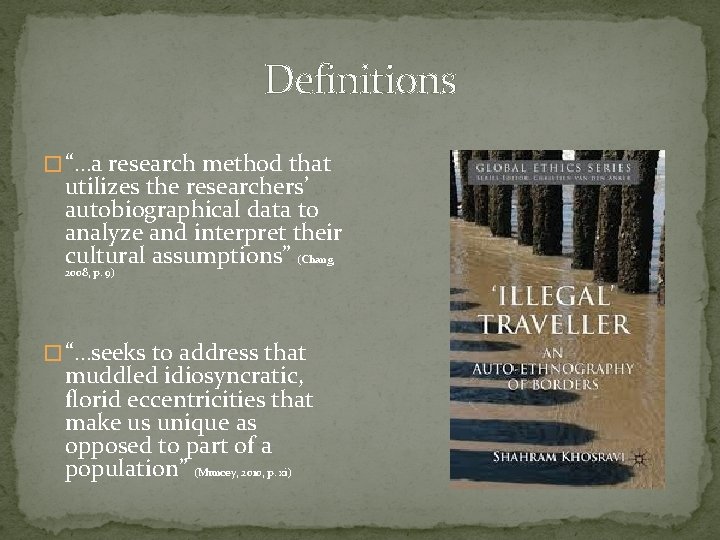
Definitions � “…a research method that utilizes the researchers’ autobiographical data to analyze and interpret their cultural assumptions” (Chang, 2008, p. 9) � “…seeks to address that muddled idiosyncratic, florid eccentricities that make us unique as opposed to part of a population” (Muncey, 2010, p. xi)
Autoethnography �Methodology �Product / Performance �Intervention
History and Contexts �Ethnography � Culture � Other � Objectivity �Autobiography � Narrative � Self � Subjective
Tensions � Native ethnography: Studying one’s own group � Ethnographic autobiography or Native autobiography: One’s life story has ethnographic interest � Ethnography becoming more biographical � Autobiography becoming more reflective of societal and cultural frames of reference (Reed-Danahay, 1997, pp. 8 -9)
Continuums �Biographical – Ethnographic �Self-Narrative – Culture �Insider – Outsider �Objective – Subjective �Personal memory data – Field data (observations, interviews, and artifacts) �Artistic – Scientific
Types �Individual / Collaborative �Evocative / Interpretive / Performance / Critical �Analytic
Evocative Autoethnography “Back and forth autoethnographers gaze, first through an ethnographic wide-angle lens, focusing outward on social and cultural aspects of their personal experience; then they look inward, exposing a vulnerable self that is moved by and may move through, refract, and resist cultural interpretations. ” (Ellis & Bochner, 2000, p. 739)
Evocative Autoethnography “As they zoom backward and forward, inward and outward, distinctions between the personal and cultural become blurred, sometimes beyond recognition. ” (Ellis & Bochner, 2000, p. 739) “The goal is to enter and document the moment-tomoment, concrete details of a life. That’s an important way of knowing as well. ” (Ellis & Bochner, 2000, p. 737)
Evocative Autoethnography � Start with your personal life � Pay attention to your physical feelings, thoughts, and emotions � Employ systematic sociological introspection and emotional recall to understand your experience � Explore your particular life to understand a way of life (Ellis & Bochner, 2000, p. 737)
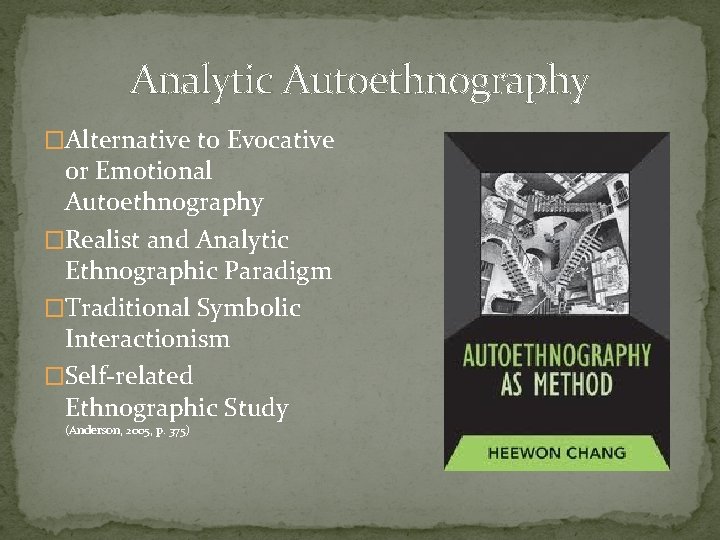
Analytic Autoethnography �Alternative to Evocative or Emotional Autoethnography �Realist and Analytic Ethnographic Paradigm �Traditional Symbolic Interactionism �Self-related Ethnographic Study (Anderson, 2005, p. 375)
Analytic Autoethnography: Key Features � Complete Member Researcher (CMR) Status in the Research Group or Setting � Analytic Reflexivity � Narrative Visibility of the Researcher’s Self � Dialogue with Informants Beyond the Self � Commitment to Theoretical Analysis Focused on Improving Theoretical Understandings of Broader Social Phenomenon (Anderson, 2005, pp. 375, 378)
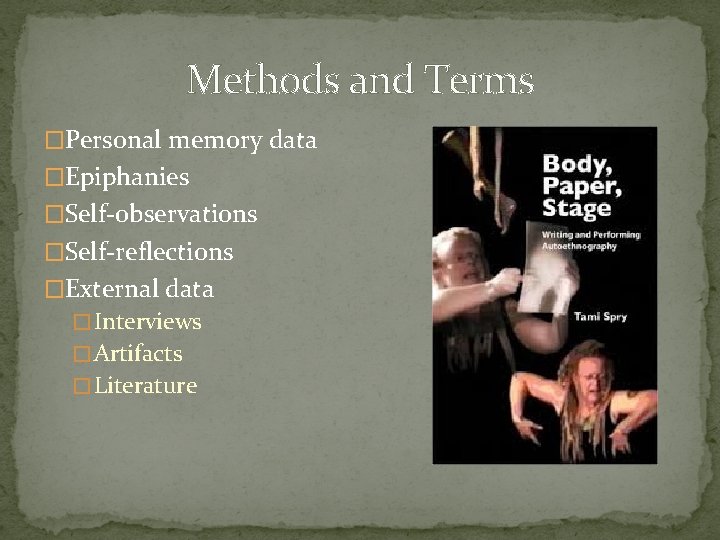
Methods and Terms �Personal memory data �Epiphanies �Self-observations �Self-reflections �External data � Interviews � Artifacts � Literature
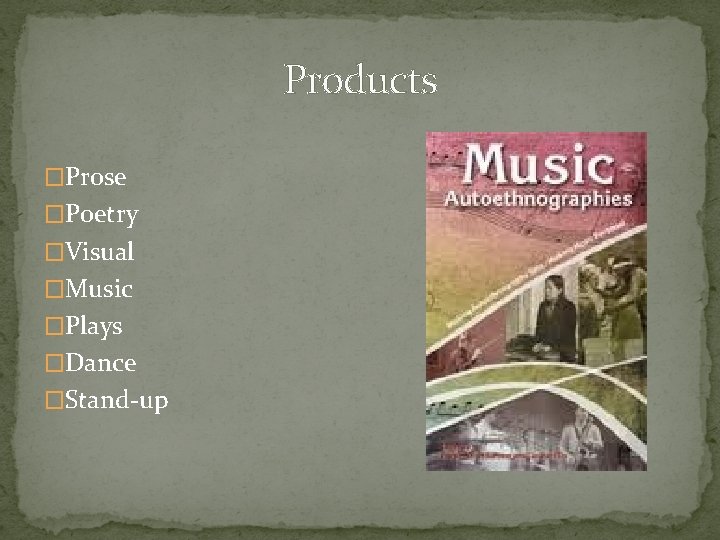
Products �Prose �Poetry �Visual �Music �Plays �Dance �Stand-up
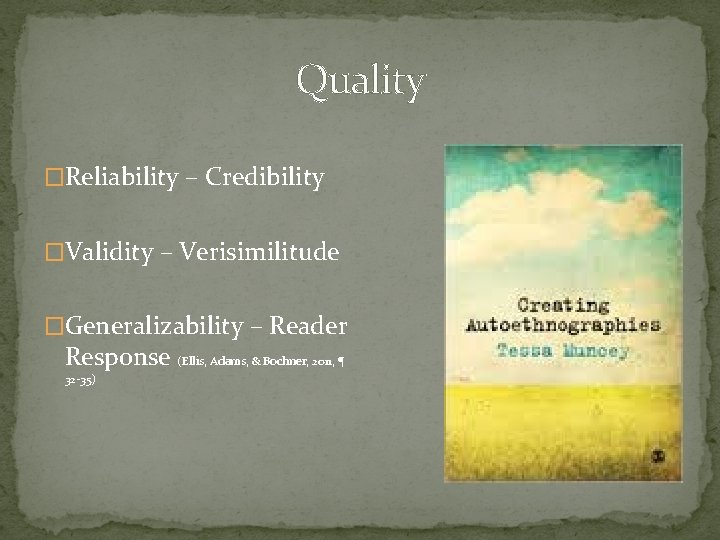
Quality �Reliability – Credibility �Validity – Verisimilitude �Generalizability – Reader Response (Ellis, Adams, & Bochner, 2011, ¶ 32 -35)
Ethical Concerns �Memory �Privacy, Confidentiality, and IRB’s (Chang, 2008, pp. 68 -69) �Relational ethics (Ellis, Adams, & Bochner, 2011, ¶ 28 -31) �Narrative responsibilities � Privilege � Media � Violence (Muncey, 2010, p. 105)
Producing Autoethnographies �Authors �Reviewers �Editors �Students �Faculty
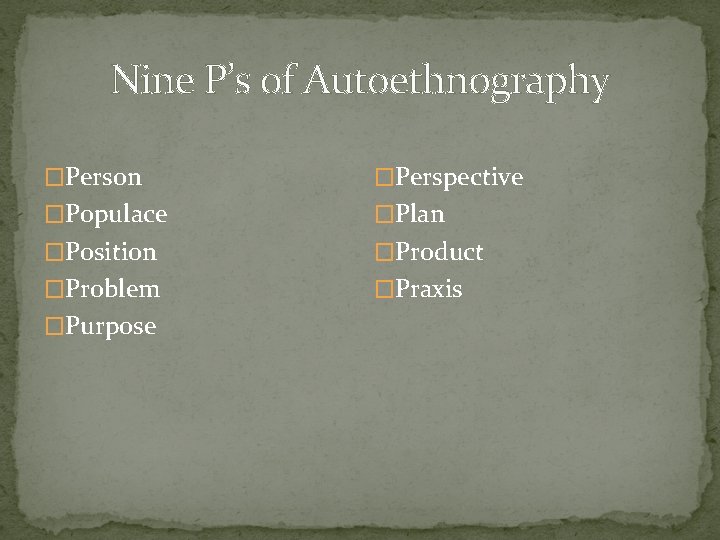
Questions To Ask �Person: Who is writing the autoethnography? �Populace: What is the social group to which the person is identifying? �Position: What is the person’s relationship to the populace?
Questions To Ask �Problem: What is the challenge experienced by the person/populace? �Purpose: Why is the person writing the autoethnography? �Perspective: What is the person’s lens?
Questions To Ask �Plan: How was the autoethnography created? �Product: What is the autoethnography? �Praxis: What are the implications of the inquiry?
Best Autoethnography of 2013
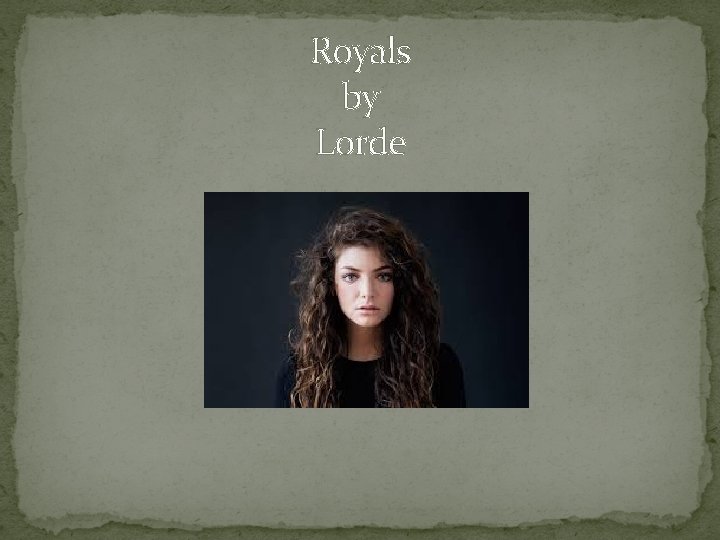
Royals by Lorde
Royals I've never seen a diamond in the flesh I cut my teeth on wedding rings in the movies And I'm not proud of my address In the torn up town, no post code envy But every song's like: Gold teeth Grey Goose Tripping in the bathroom Bloodstains Ball gowns Trashing the hotel room We don't care, we're driving Cadillacs in our dreams
Royals But everybody's like: Crystal Maybach Diamonds on your timepiece Jet planes Islands Tigers on a gold leash We don't care, we aren't caught up in your love affair And we'll never be royals (royals) It don't run in our blood That kind of lux just ain't for us, we crave a different kind of buzz Let me be your ruler (ruler) You can call me queen bee And baby I'll rule, I'll rule Let me live that fantasy
Royals My friends and I we've cracked the code We count our dollars on the train to the party And everyone who knows us knows That we're fine with this, we didn't come from money But every song's like: Gold teeth Grey Goose Tripping in the bathroom Bloodstains Ball gowns Trashing the hotel room We don't care, we're driving Cadillacs in our dreams
Royals But everybody's like: Crystal Maybach Diamonds on your timepiece Jet planes Islands Tigers on a gold leash We don't care, we aren't caught up in your love affair And we'll never be royals (royals) It don't run in our blood That kind of lux just ain't for us, we crave a different kind of buzz Let me be your ruler (ruler) You can call me queen bee And baby I'll rule, I'll rule Let me live that fantasy
Royals ooh oh ooh We're better than we've every dreamed And I'm in love with being queen ooh oh ooh Life is great without a care We aren't caught up in your love affair And we'll never be royals (royals) It don't run in our blood That kind of lux just ain't for us, we crave a different kind of buzz Let me be your ruler (ruler) You can call me queen bee And baby I'll rule, I'll rule Let me live that fantasy Songwriters: Little, Joel / Yelich-O'Connor, Ella Published by © EMI Music Publishing
Nine P’s of Autoethnography �Person �Perspective �Populace �Plan �Position �Product �Problem �Praxis �Purpose
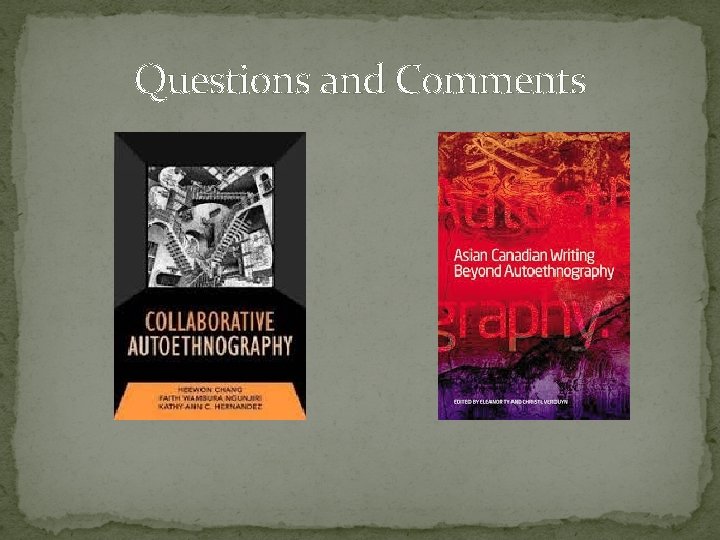
Questions and Comments
References �Anderson, L. (2006). Analytic autoethnography. Journal of Contemporary Ethnography, 35(4), 373395. �Chang, H. (2008). Autoethnography as method. Walnut Creek, CA: Left Coast. �Ellis, C. , Adams, T. E. , & Bochner, A. P. (2010). Autoethnography: An overview. Forum Qualitative Sozialforschung / Forum: Qualitative Social Research, 12(1), Art. 10, http: //nbnresolving. de/urn: nbn: de: 0114 -fqs 1101108
References �Ellis, C. , & Bochner, A. P. (2000). Autoethnography, personal narrative, reflexivity: Researcher as subject. In N. K. Denzin & Y. S. Lincoln (Eds. ), Handbook of qualitative research (2 nd ed. , pp. 733 -768). Thousand Oaks, CA: Sage. �Muncey, T. (2012). Creating autoethnographies. Los Angeles, CA: Sage. �Reed-Danahay, D. (1997). Introduction. In D. Reed. Danahay (Ed. ), Auto/ethnography: Rewriting the self and the social (pp. 1 -17). Oxford, UK: Berg.
Contact Information Ron Chenail, Ph. D The Qualitative Report Nova Southeastern University Graduate School of Humanities and Social Sciences 3301 College Avenue Fort Lauderdale, Florida USA 33314 Phone: 954. 262. 3019 Email: ron@nova. edu