
The Ariane 5 Launcher Failure June 4 th
- Slides: 12
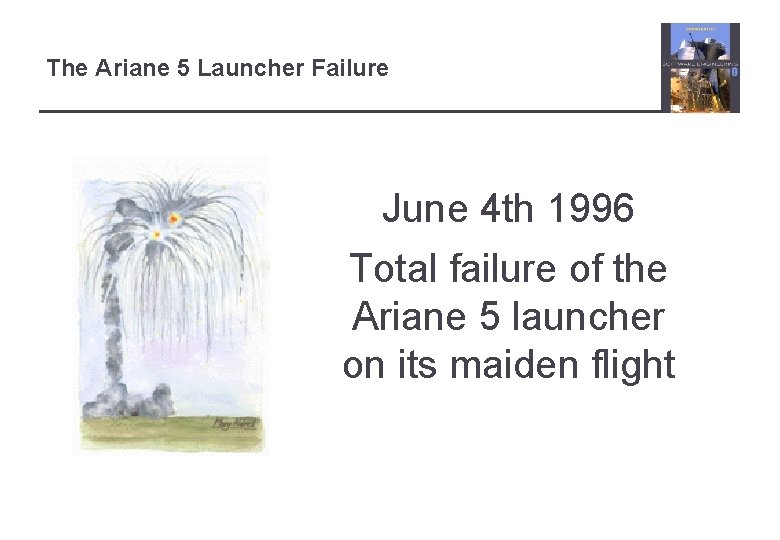
The Ariane 5 Launcher Failure June 4 th 1996 Total failure of the Ariane 5 launcher on its maiden flight
Ariane 5 ² A European rocket designed to launch commercial payloads (e. g. communications satellites, etc. ) into Earth orbit ² Successor to the successful Ariane 4 launchers ² Ariane 5 can carry a heavier payload than Ariane 4
Launcher failure ² Approximately 37 seconds after a successful lift-off, the Ariane 5 launcher lost control. ² Incorrect control signals were sent to the engines and these swivelled so that unsustainable stresses were imposed on the rocket. ² It started to break up and was destroyed by ground controllers. ² The system failure was a direct result of a software failure. However, it was symptomatic of a more general systems validation failure.
The problem ² The attitude and trajectory of the rocket are measured by a computer-based inertial reference system. This transmits commands to the engines to maintain attitude and direction. ² The software failed and this system and the backup system shut down. ² Diagnostic commands were transmitted to the engines which interpreted them as real data and which swivelled to an extreme position resulting in unforeseen stresses on the rocket.
Software failure ² Software failure occurred when an attempt to convert a 64 -bit floating point number to a signed 16 -bit integer caused the number to overflow. ² There was no exception handler associated with the conversion so the system exception management facilities were invoked. These shut down the software. ² The backup software was a copy and behaved in exactly the same way.
Avoidable failure? ² The software that failed was reused from the Ariane 4 launch vehicle. The computation that resulted in overflow was not used by Ariane 5. ² Decisions were made § Not to remove the facility as this could introduce new faults; § Not to test for overflow exceptions because the processor was heavily loaded. For dependability reasons, it was thought desirable to have some spare processor capacity.
Why not Ariane 4? ² The physical characteristics of Ariane 4 (A smaller vehicle) are such that it has a lower initial acceleration and build up of horizontal velocity than Ariane 5. ² The value of the variable on Ariane 4 could never reach a level that caused overflow during the launch period.
Validation failure ² As the facility that failed was not required for Ariane 5, there was no requirement associated with it. ² As there was no associated requirement, there were no tests of that part of the software and hence no possibility of discovering the problem. ² During system testing, simulators of the inertial reference system computers were used. These did not generate the error as there was no requirement!
Review failure ² The design and code of all software should be reviewed for problems during the development process ² Either § The inertial reference system software was not reviewed because it had been used in a previous version; § The review failed to expose the problem or that the test coverage would not reveal the problem; § The review failed to appreciate the consequences of system shutdown during a launch.
Lessons learned ² Don’t run software in critical systems unless it is actually needed. ² As well as testing for what the system should do, you may also have to test for what the system should not do. ² Do not have a default exception handling response which is system shut-down in systems that have no fail-safe state.
Lessons learned ² In critical computations, always return best effort values even if the absolutely correct values cannot be computed. ² Wherever possible, use real equipment and not simulations. ² Improve the review process to include external participants and review all assumptions made in the code.
Avoidable failure ² The designer’s of Ariane 5 made a critical and elementary error. ² They designed a system where a single component failure could cause the entire system to fail. ² As a general rule, critical systems should always be designed to avoid a single point of failure.