
The ARCS Model by John Keller EDTECH 503
The ARCS Model by John Keller EDTECH 503 Alicia Sewell Fall 2019
What is the ARCS model? The ARCS model is a problem-solving approach to designing the motivational facets of learning environments to stimulate and support students’ motivation to learn (Keller, 2017). It has two major parts: a set of categories that represents the components of motivation and a systematic design process that assists in creating motivational enhancements that are appropriate for a given set of learners (Keller, 2017).
01 Components of Motivation The categories that represent the components of motivation are the result of a synthesis of the research on human motivation.
02 Systematic Design The synthesis allows you to identify the various elements of student motivation, and the design process helps you profile the motivational attributes of students in a given learning environment and then design motivational strategies that are appropriate for them.
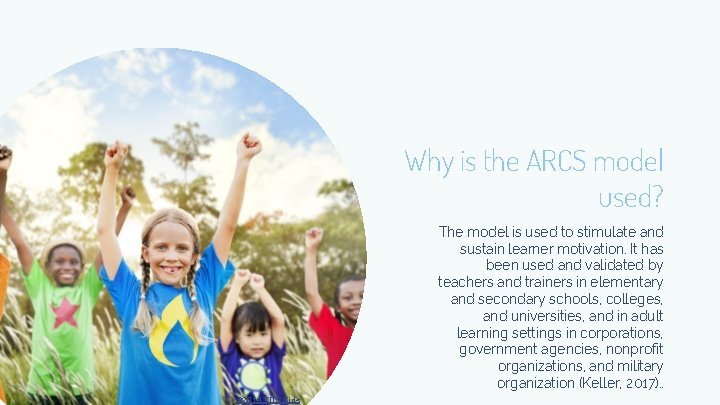
Why is the ARCS model used? The model is used to stimulate and sustain learner motivation. It has been used and validated by teachers and trainers in elementary and secondary schools, colleges, and universities, and in adult learning settings in corporations, government agencies, nonprofit organizations, and military organization (Keller, 2017). . © 2019 KITS Kids
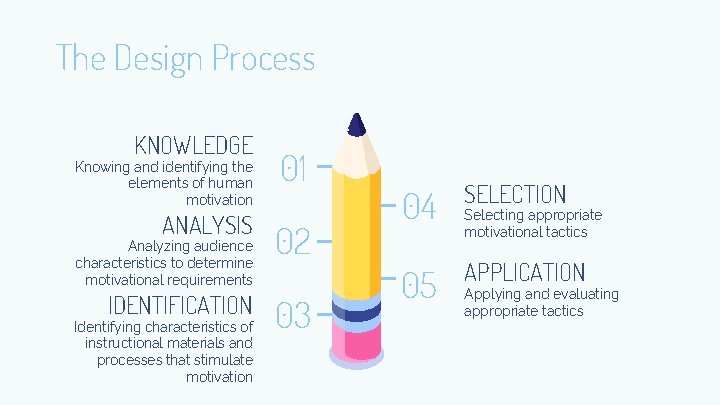
The Design Process KNOWLEDGE Knowing and identifying the elements of human motivation ANALYSIS Analyzing audience characteristics to determine motivational requirements IDENTIFICATION Identifying characteristics of instructional materials and processes that stimulate motivation 01 02 03 04 SELECTION 05 APPLICATION Selecting appropriate motivational tactics Applying and evaluating appropriate tactics
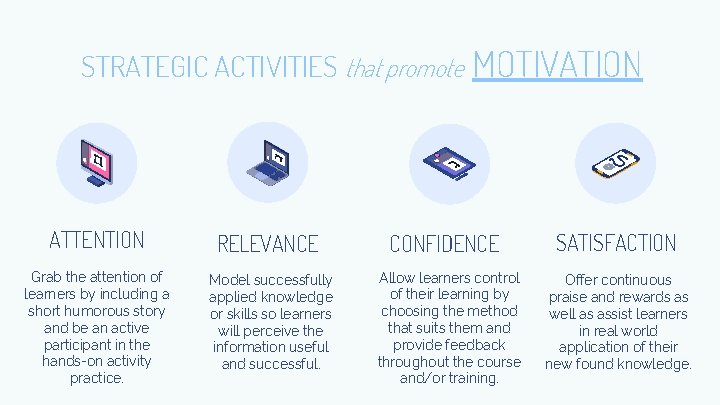
STRATEGIC ACTIVITIES that promote ATTENTION RELEVANCE Grab the attention of learners by including a short humorous story and be an active participant in the hands-on activity practice. Model successfully applied knowledge or skills so learners will perceive the information useful and successful. MOTIVATION CONFIDENCE Allow learners control of their learning by choosing the method that suits them and provide feedback throughout the course and/or training. SATISFACTION Offer continuous praise and rewards as well as assist learners in real world application of their new found knowledge.
G Suite ID Project The G Suite ID Project will allow teachers to collaborate, engage in discussions and planning with instructional technology coaches and coworkers, and create content they can use once they return to their students. Instructional coaches will provide humor and feedback, praise, choice, engage in hands on tasks with teachers, model PLC norms, and grab the attention of the teachers throughout training. The goal is for teachers to leave the training with the belief that they can slowly, but certainly instruct their students using at least one G Suite app.
RESOURCES Keller, J. (2017). ARCS explained. ARCSMODEL. com. Retrieved from https: //www. arcsmodel. com/motivational-designcyrv Keller, J. (2000). How to integrate learner motivation planning into lesson planning: The ARCS model approach. Retrieved from http: //apps. fischlerschool. nova. edu/toolbox/instructionalproducts/ITDE_8005/weeklys/2000 Keller-ARCSLesson. Planning. pdf Pappas, C. (2015). Instructional design models and theories: Keller’s ARCS model of motivation. Retrieved from https: //elearningindustry. com/arcs-model-of-motivation The ARCS model: Attention, relevance, confidence, and satisfaction. Retrieved from http: //sphweb. bumc. bu. edu/otlt/teaching. Library/Learning%20 Theory/ARCSintegrated_handout. pdf
- Slides: 9