
THE APUSH CURRICULUM FRAMEWORK HISTORICAL THINKING SKILLS Skill

- Slides: 14
THE APUSH CURRICULUM FRAMEWORK
HISTORICAL THINKING SKILLS • Skill Type I: Chronological Reasoning • Skill 1: Historical Causation • Compare causes/effects-short & long term • Analyze & evaluate interaction of multiple causes/effects • Critique existing interpretations (2 nd sources) of cause/effect • Skill 2: Patterns of Continuity and Change over Time (CCT) • Analyze & evaluate historical patterns of CCT • Connect patterns of CCT to larger historical themes
• Skill 3: Periodization • Explain ways that historical events and processes can be organized in blocks of time • Analyze & evaluate competing models of periodization of US History • Skill Type II: Comparison and Contextualization • Skill 4: Comparison • Compare related historical developments across place, time and/or different societies or within 1 society. • Explain & evaluate multiple and differing perspectives on a given historical phenomenon
• Skill 5: Contextualization • Explain & evaluate ways in which specific historical phenomena, events or processes connect to broader regional, national or global processes, occurring at the same time • Explain & evaluate ways in which a phenomenon, event or process connects to other, similar historical phenomena across time and place
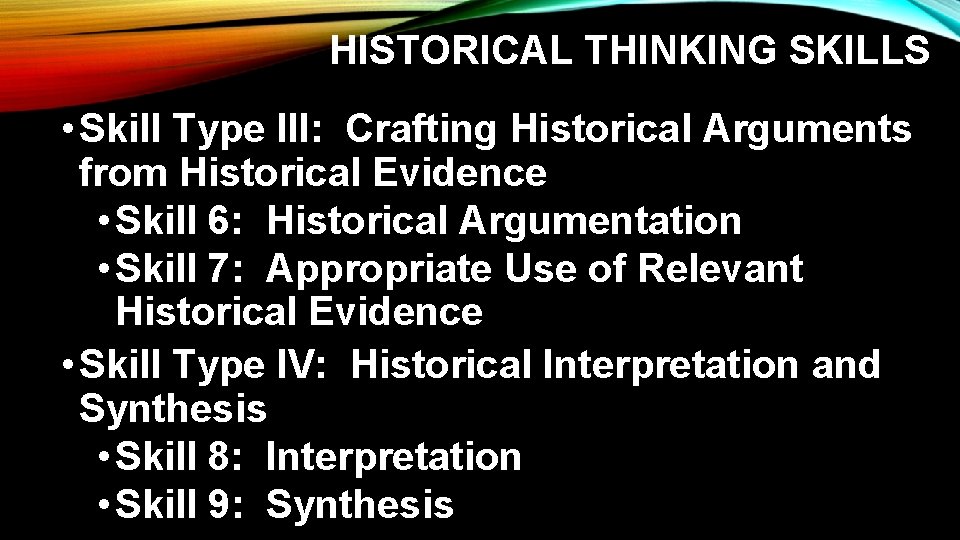
• Skill Type III: Crafting Historical Arguments from Historical Evidence • Skill 6: Historical Argumentation • Analyze commonly accepted historical arguments & explain how an argument has been constructed from historical evidence • Construct convincing interpretations through analysis of disparate, relevant historical evidence • Evaluate & synthesize conflicting historical evidence to construct persuasive historical arguments
• Skill 7: Appropriate Use of Relevant Historical Evidence • Analyze features of historical evidence such as audience, purpose, point of view, format, argument, limitations, and context germane to the evidence considered • Based on analysis & evaluation of historical evidence, make supportable inference and draw appropriate conclusions
• Skill Type IV: Historical Interpretation and Synthesis • Skill 8: Interpretation • Analyze diverse historical interpretations • Evaluate how historians’ perspectives influence their interpretations and how models of historical interpretation change over time • Skill 9: Synthesis • Combine disparate, sometimes contradictory evidence from primary sources, & secondary works in order to create a persuasive understanding of the past • Apply insights about the past to other historical contexts or circumstances, including the present
THEMATIC LEARNING OBJECTIVES • Identity • Work, exchange and technology • Peopling • Politics & Power • America in the World • Environment and geography-physical and human • Ideas, Beliefs & Culture
HISTORICAL THINKING SKILLS • Skill Type I: Chronological Reasoning • Skill 1: Historical Causation • Skill 2: Patterns of Continuity and Change over Time (CCT) • Skill 3: Periodization • Skill Type II: Comparison and Contextualization • Skill 4: Comparison • Skill 5: Contextualization
HISTORICAL THINKING SKILLS • Skill Type III: Crafting Historical Arguments from Historical Evidence • Skill 6: Historical Argumentation • Skill 7: Appropriate Use of Relevant Historical Evidence • Skill Type IV: Historical Interpretation and Synthesis • Skill 8: Interpretation • Skill 9: Synthesis
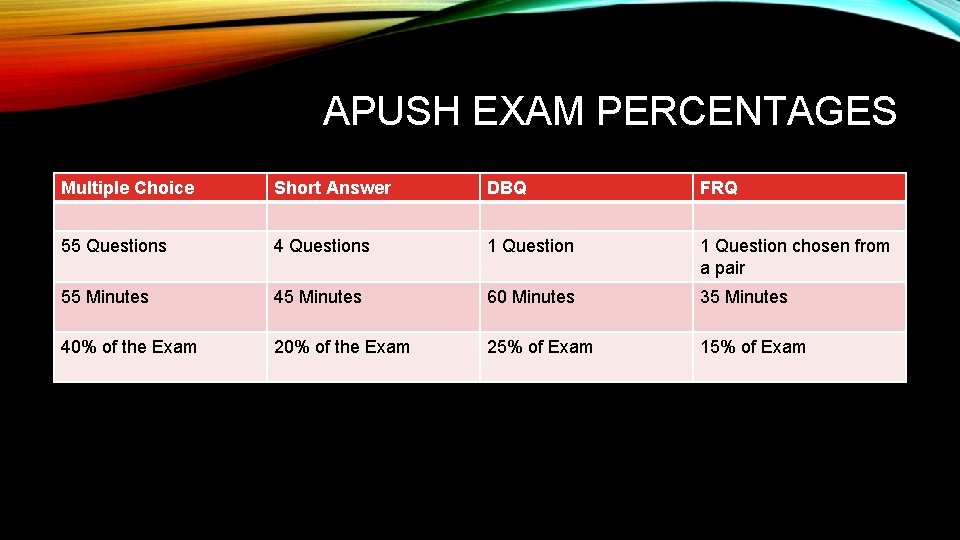
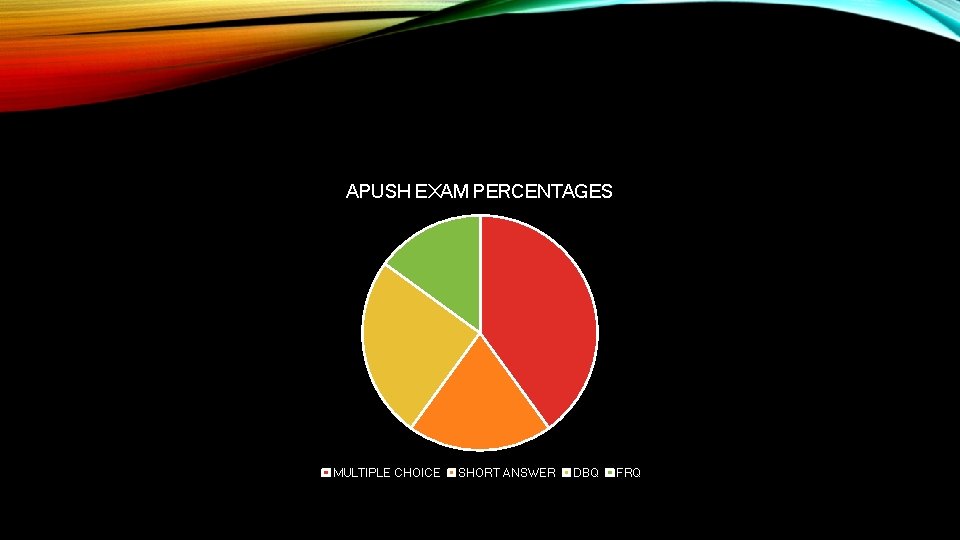
APUSH EXAM PERCENTAGES Multiple Choice Short Answer DBQ FRQ 55 Questions 4 Questions 1 Question chosen from a pair 55 Minutes 45 Minutes 60 Minutes 35 Minutes 40% of the Exam 25% of Exam 15% of Exam
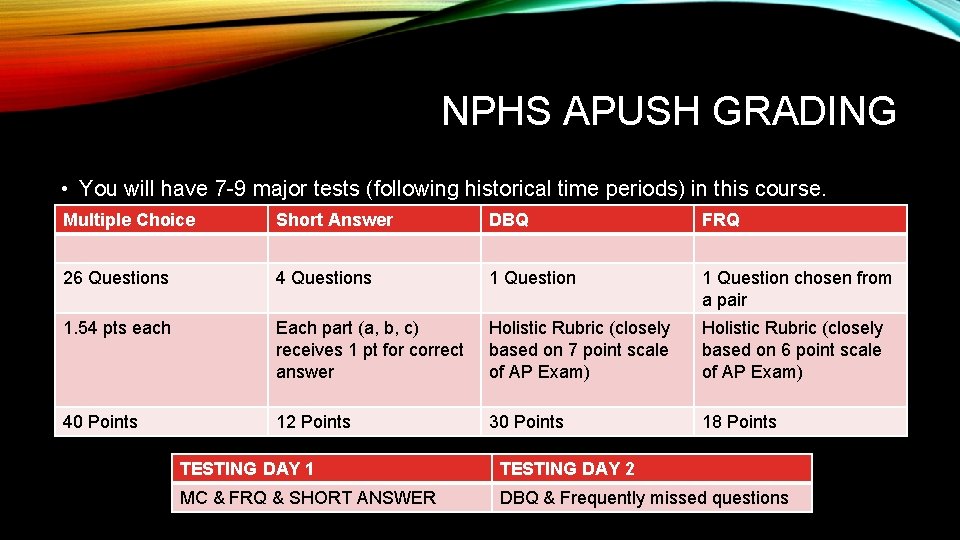
NPHS APUSH GRADING • You will have 7 -9 major tests (following historical time periods) in this course. Multiple Choice Short Answer DBQ FRQ 26 Questions 4 Questions 1 Question chosen from a pair 1. 54 pts each Each part (a, b, c) receives 1 pt for correct answer Holistic Rubric (closely based on 7 point scale of AP Exam) Holistic Rubric (closely based on 6 point scale of AP Exam) 40 Points 12 Points 30 Points 18 Points TESTING DAY 1 TESTING DAY 2 MC & FRQ & SHORT ANSWER DBQ & Frequently missed questions
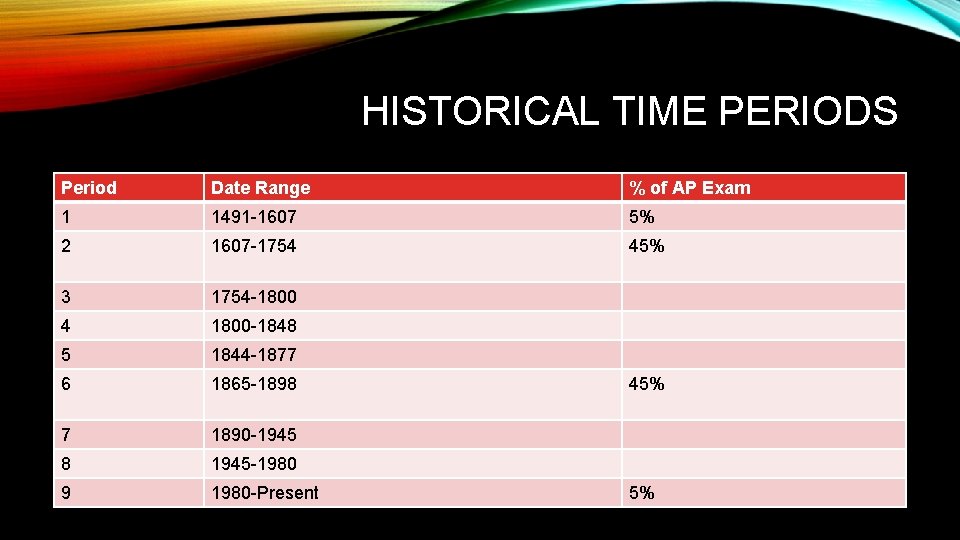
HISTORICAL TIME PERIODS Period Date Range % of AP Exam 1 1491 -1607 5% 2 1607 -1754 45% 3 1754 -1800 4 1800 -1848 5 1844 -1877 6 1865 -1898 7 1890 -1945 8 1945 -1980 9 1980 -Present 45% 5%
APUSH EXAM PERCENTAGES MULTIPLE CHOICE SHORT ANSWER DBQ FRQ