
The Application of Inverse Gas Chromatography in Formulation


- Slides: 21
The Application of Inverse Gas Chromatography in Formulation Characterisation Dr Michael James Davies
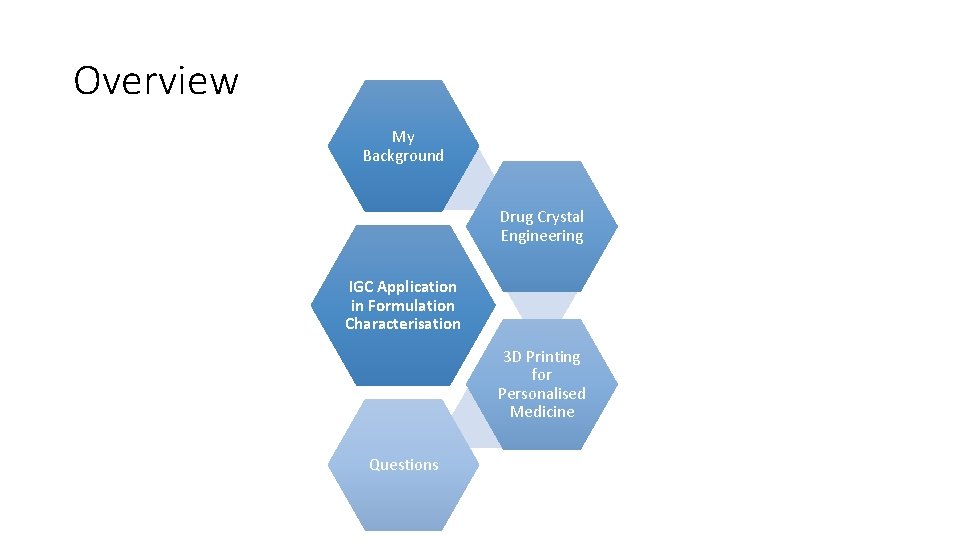
Overview My Background Drug Crystal Engineering IGC Application in Formulation Characterisation 3 D Printing for Personalised Medicine Questions
MY BACKGROUND
My Background • Completed my Master of Pharmacy degree at the Uo. N: 1997 - 2001 • Undertook an industrial pharmacy pre-registration placement at BMS: 2001 - 2002 • Returned to Uo. N to complete my doctoral studies with AZ: 2002 - 2005 • Worked as a LOCUM PHARMACIST in North West England: 2005 - 2007 • Acquired my Lectureship in Pharmacy Practice and Pharmaceutics at LJMU: 2007 • Scientific Director of my spin-out company PULMORPHIX LTD: 2014
DRUG CRYSTAL ENGINEERING Michael J. Davies, Thomas D. Kerry, Linda Seton, Mark Murphy, Paul Gibbons, Jiyi Khoo & Majid Naderi. The crystal engineering of salbutamol sulphate via simulated pulmonary surfactant monolayers. 2013. International Journal of Pharmaceutics, vol. 446(1 -2): 34 -45.
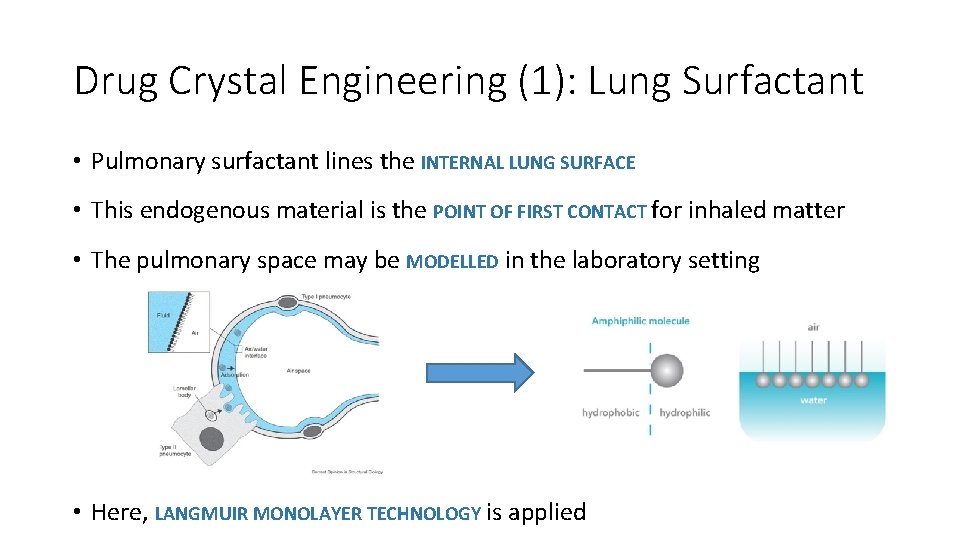
Drug Crystal Engineering (1): Lung Surfactant • Pulmonary surfactant lines the INTERNAL LUNG SURFACE • This endogenous material is the POINT OF FIRST CONTACT for inhaled matter • The pulmonary space may be MODELLED in the laboratory setting • Here, LANGMUIR MONOLAYER TECHNOLOGY is applied
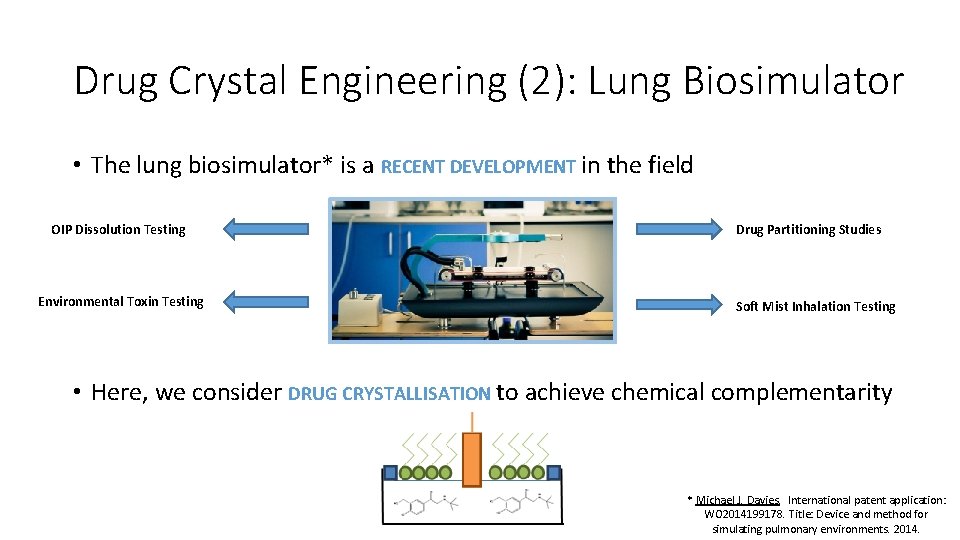
Drug Crystal Engineering (2): Lung Biosimulator • The lung biosimulator* is a RECENT DEVELOPMENT in the field OIP Dissolution Testing Environmental Toxin Testing Drug Partitioning Studies Soft Mist Inhalation Testing • Here, we consider DRUG CRYSTALLISATION to achieve chemical complementarity * Michael J. Davies. International patent application: WO 2014199178. Title: Device and method for simulating pulmonary environments. 2014.
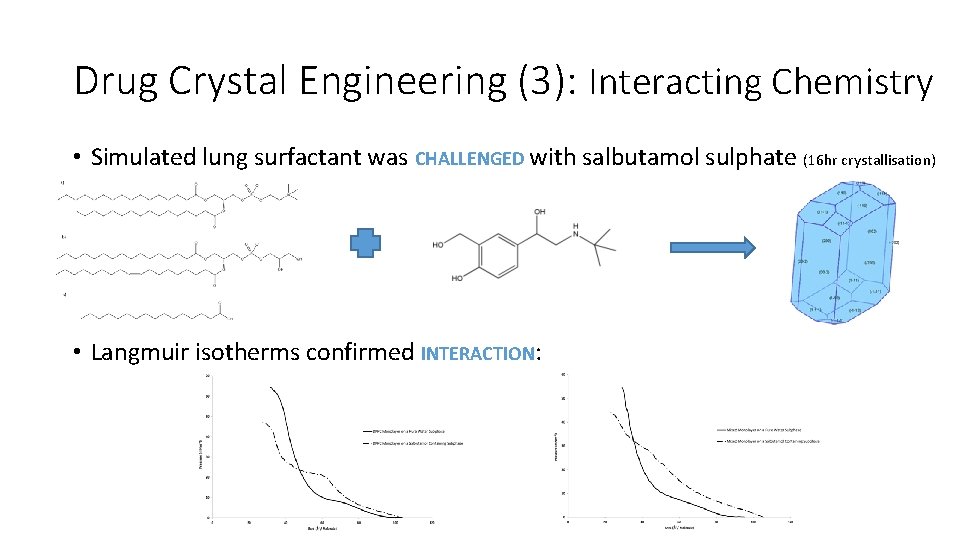
Drug Crystal Engineering (3): Interacting Chemistry • Simulated lung surfactant was CHALLENGED with salbutamol sulphate (16 hr crystallisation) • Langmuir isotherms confirmed INTERACTION:
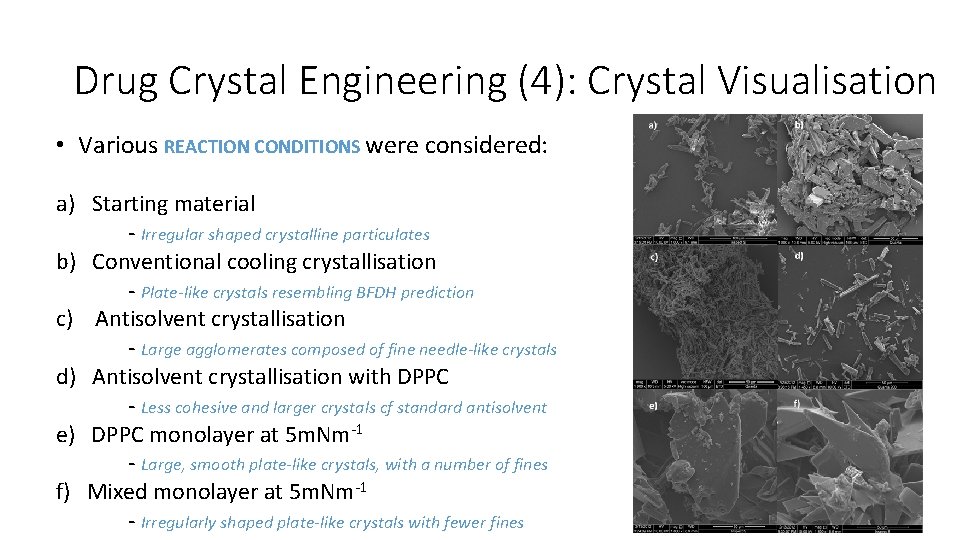
Drug Crystal Engineering (4): Crystal Visualisation • Various REACTION CONDITIONS were considered: a) Starting material - Irregular shaped crystalline particulates b) Conventional cooling crystallisation - Plate-like crystals resembling BFDH prediction c) Antisolvent crystallisation - Large agglomerates composed of fine needle-like crystals d) Antisolvent crystallisation with DPPC - Less cohesive and larger crystals cf standard antisolvent e) DPPC monolayer at 5 m. Nm-1 - Large, smooth plate-like crystals, with a number of fines f) Mixed monolayer at 5 m. Nm-1 - Irregularly shaped plate-like crystals with fewer fines
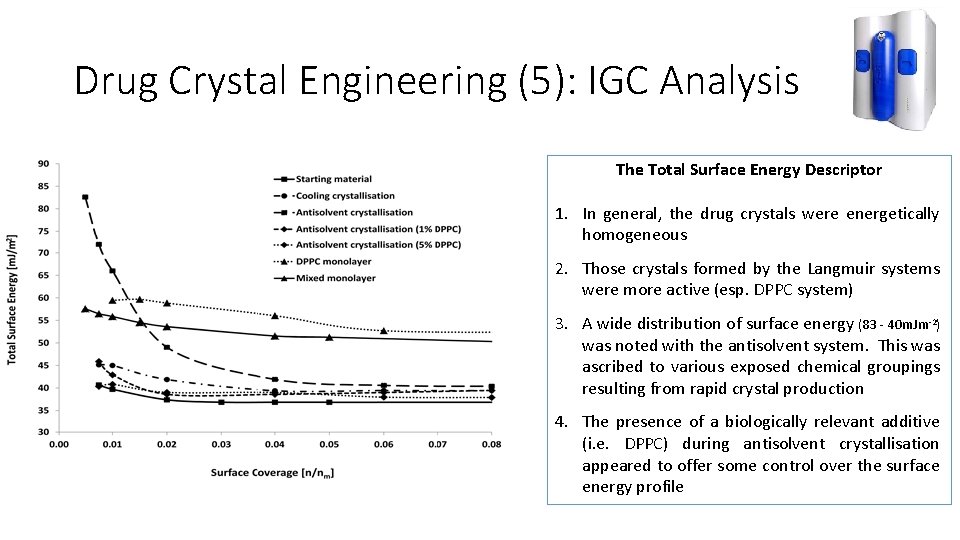
Drug Crystal Engineering (5): IGC Analysis The Total Surface Energy Descriptor 1. In general, the drug crystals were energetically homogeneous 2. Those crystals formed by the Langmuir systems were more active (esp. DPPC system) 3. A wide distribution of surface energy (83 - 40 m. Jm-2) was noted with the antisolvent system. This was ascribed to various exposed chemical groupings resulting from rapid crystal production 4. The presence of a biologically relevant additive (i. e. DPPC) during antisolvent crystallisation appeared to offer some control over the surface energy profile
Drug Crystal Engineering (6): Considerations • Simulated lung surfactant monolayers can DIRECT drug crystallisation • However, large particle size and low yield preclude practical use • Unrelated techniques are essential (i. e. antisolvent crystallisation with additives*) • Drug crystals demonstrating COMPATIBILITY to the lung interface may be generated • Complementarity may support effective formulation – surfactant INTERACTION • IGC can assess material energetics impacting upon processing and end-use *Michael J. Davies, Zoe Taylor, Andrew G. Leach, James Ren and Paul Gibbons. Crystallisation of aspirin via simulated pulmonary surfactant monolayers and lung-specific additives. 2017. Surface and Interface Analysis. DOI: 10. 1002/sia. 6234.
3 D PRINTING: PERSONALISED MEDICINE Michael J. Davies, Emily Costley, James Ren, Paul Gibbons, Anett Kondor & Majid Naderi. On drug-base incompatibilities during extrudate manufacture and fused deposition 3 D printing. 2016. Journal of 3 D Printing in Medicine, vol. 1(1): 1 -17.
3 D Printing for PM: Background • PM is now gaining INCREASED PROMINENCE in the healthcare field • Scope exists to TUNE TREATMENT REGIMENS direct to patient requirements • Point-of-care treatment is becoming an increasingly likely prospect: a) Hospital wards b) Out-patient dispensaries c) Community pharmacy setting • 3 D printing offers potential to produce PATIENT SPECIFIC dosage forms
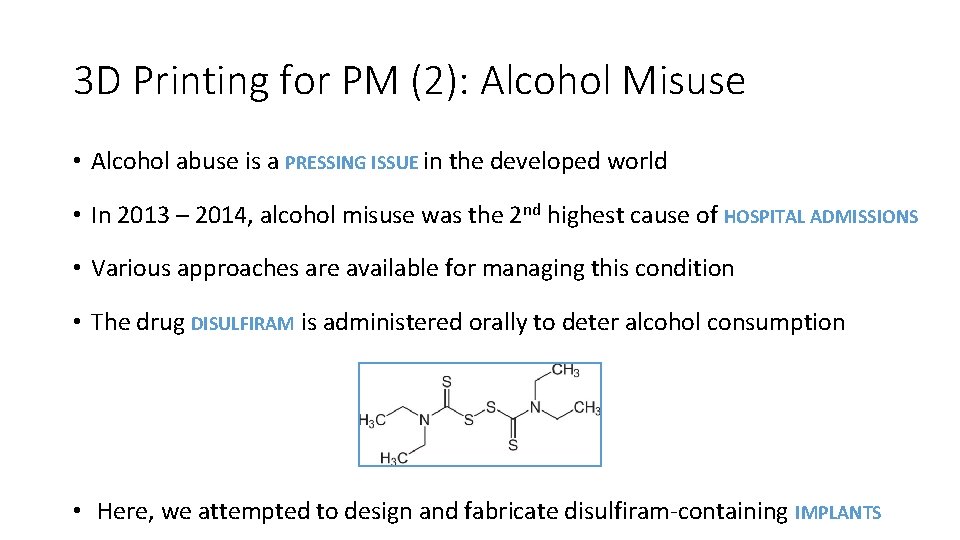
3 D Printing for PM (2): Alcohol Misuse • Alcohol abuse is a PRESSING ISSUE in the developed world • In 2013 – 2014, alcohol misuse was the 2 nd highest cause of HOSPITAL ADMISSIONS • Various approaches are available for managing this condition • The drug DISULFIRAM is administered orally to deter alcohol consumption • Here, we attempted to design and fabricate disulfiram-containing IMPLANTS
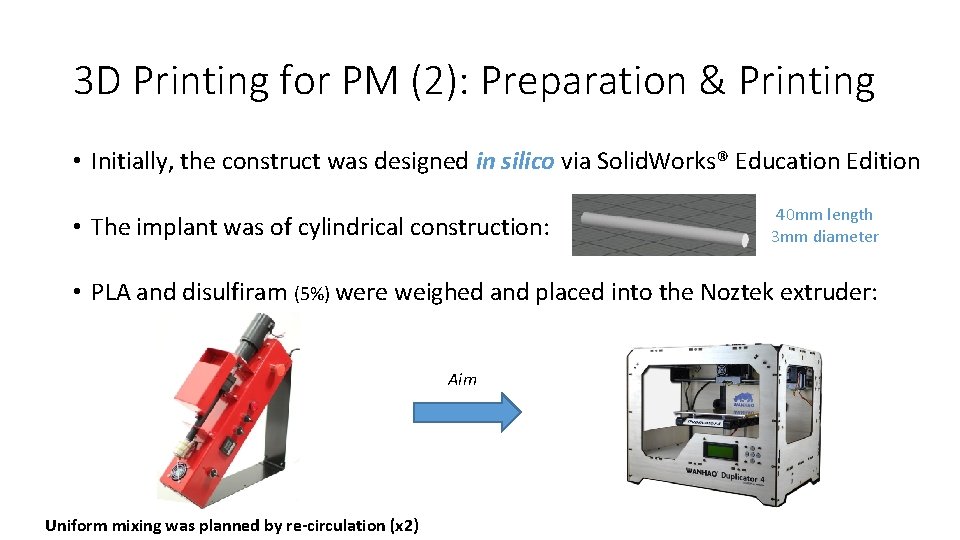
3 D Printing for PM (2): Preparation & Printing • Initially, the construct was designed in silico via Solid. Works® Education Edition • The implant was of cylindrical construction: 40 mm length 3 mm diameter • PLA and disulfiram (5%) were weighed and placed into the Noztek extruder: Aim Uniform mixing was planned by re-circulation (x 2)
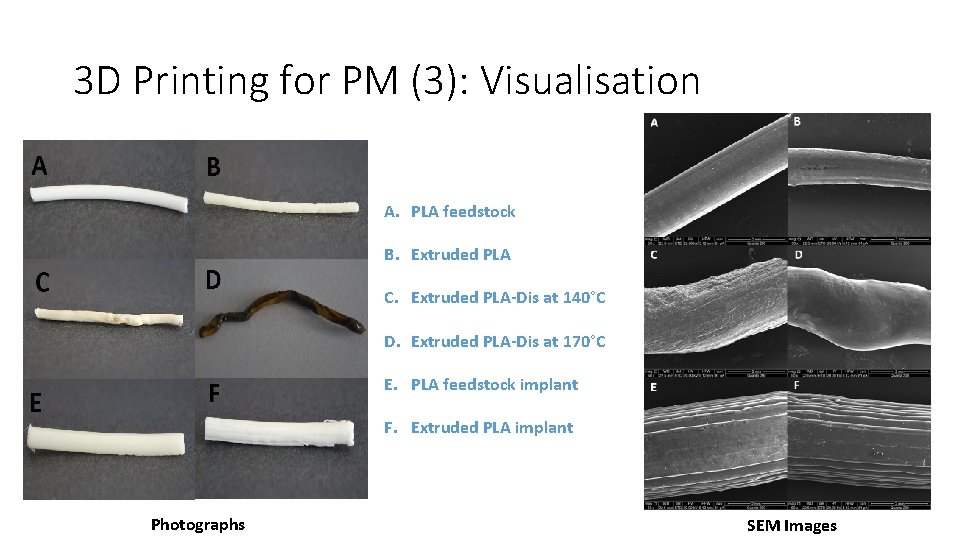
3 D Printing for PM (3): Visualisation A. PLA feedstock B. Extruded PLA C. Extruded PLA-Dis at 140°C D. Extruded PLA-Dis at 170°C E. PLA feedstock implant F. Extruded PLA implant Photographs SEM Images
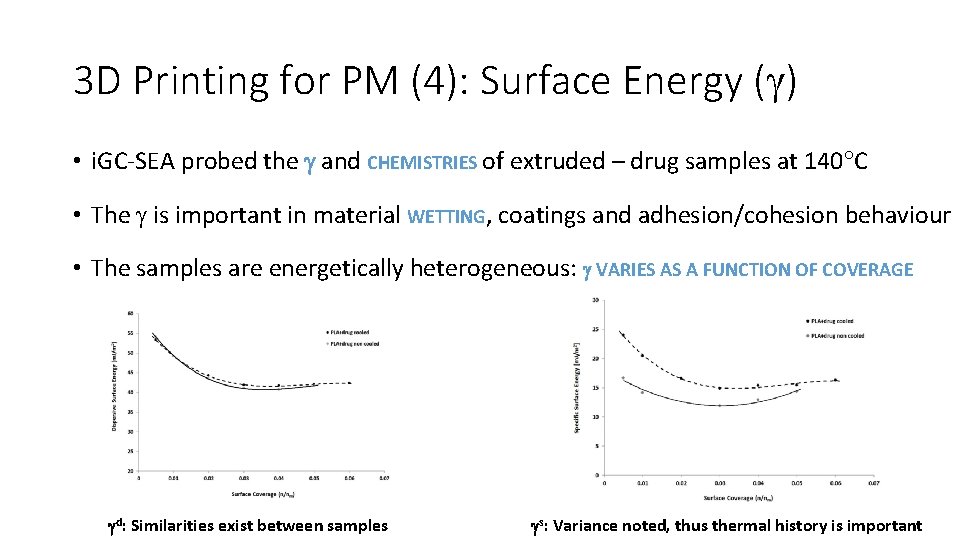
3 D Printing for PM (4): Surface Energy ( ) • i. GC-SEA probed the and CHEMISTRIES of extruded – drug samples at 140 C • The is important in material WETTING, coatings and adhesion/cohesion behaviour • The samples are energetically heterogeneous: VARIES AS A FUNCTION OF COVERAGE d: Similarities exist between samples s: Variance noted, thus thermal history is important
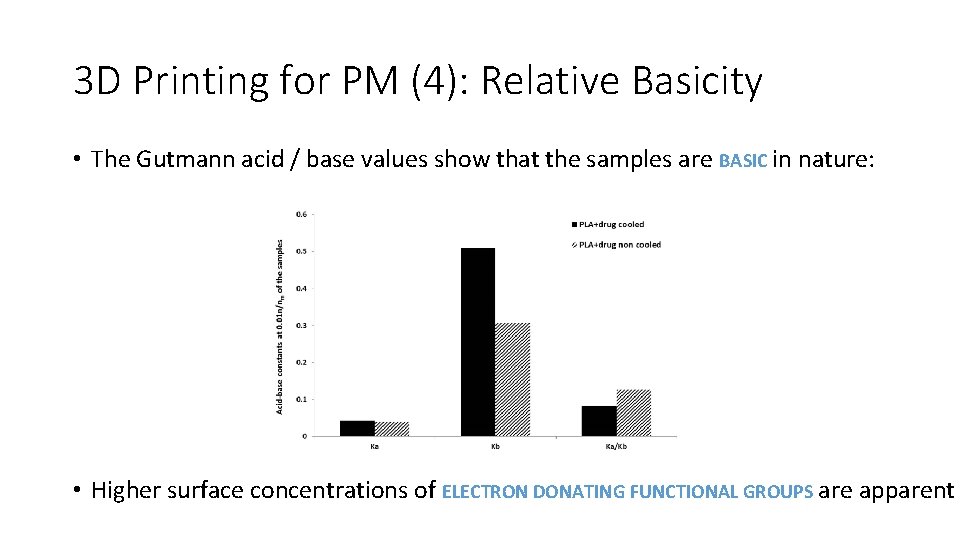
3 D Printing for PM (4): Relative Basicity • The Gutmann acid / base values show that the samples are BASIC in nature: • Higher surface concentrations of ELECTRON DONATING FUNCTIONAL GROUPS are apparent
3 D Printing for PM (5): Considerations • 3 D printing is becoming increasingly important in the delivery of PRECISION MEDICINE • Whilst the outcome of this project was not ideal, important points were noted • Unrelated characterisation techniques provided an INSIGHT into material properties • Here, the i. GC-SEA COMPLEMENTED various analytical techniques (i. e. DSC) • The i. GC-SEA platform offered ACCURATE and ROBUST data sets • i. GC-SEA was able to ascertain MATERIAL PROPERTIES influencing processing / end-use
QUESTIONS
Questions