
The Application of a Graded Approach in the
- Slides: 26
The Application of a Graded Approach in the Regulation of Research Reactors at the U. S. Nuclear Regulatory Commission November 19, 2015 Alexander Adams, Jr. Chief Research and Test Reactors Licensing Branch
Overview • • Introduction Reactor categorization Atomic Energy Act Graded approach in the licensing process Graded approach in technical requirements Graded approach in security Graded approach in inspection Graded approach in other aspects of regulation 2
Graded Approach Equate degree of scrutiny in the regulatory process to the safety significance of the reactor design As risk increases the regulatory process becomes more stringent IAEA SSG-22, “Use of a Graded Approach in the Application of the Safety Requirements for Research Reactors” contains specific details 3
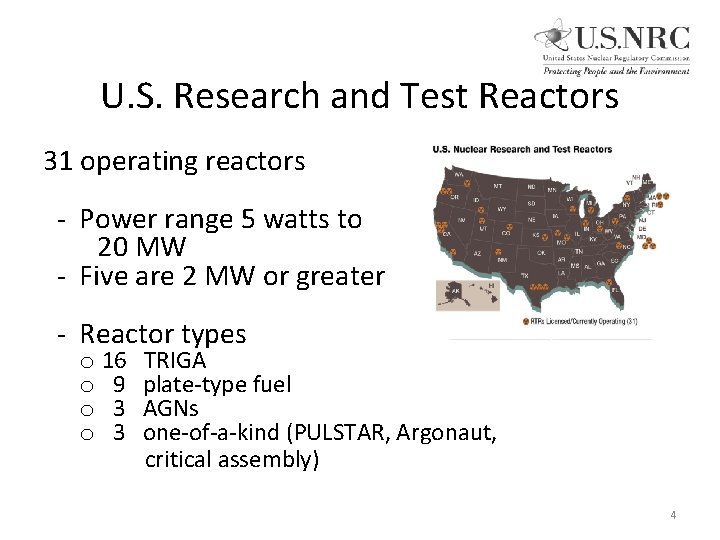
U. S. Research and Test Reactors 31 operating reactors - Power range 5 watts to 20 MW - Five are 2 MW or greater - Reactor types o 16 o 9 o 3 TRIGA plate-type fuel AGNs one-of-a-kind (PULSTAR, Argonaut, critical assembly) 4
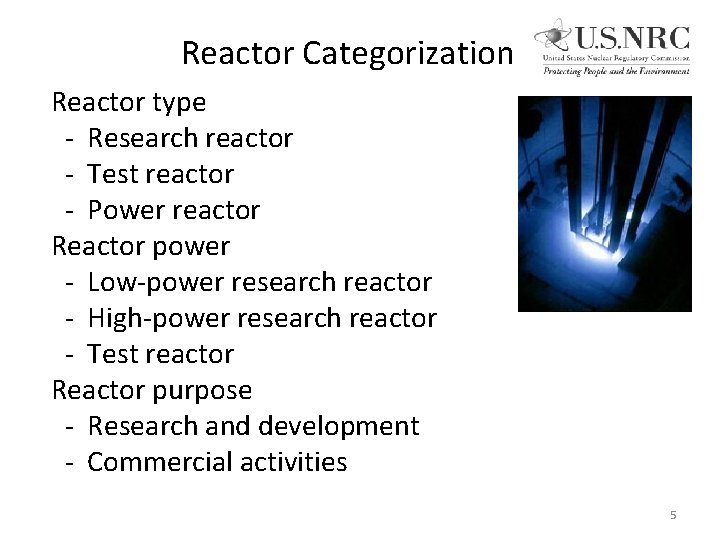
Reactor Categorization Reactor type - Research reactor - Test reactor - Power reactor Reactor power - Low-power research reactor - High-power research reactor - Test reactor Reactor purpose - Research and development - Commercial activities 5
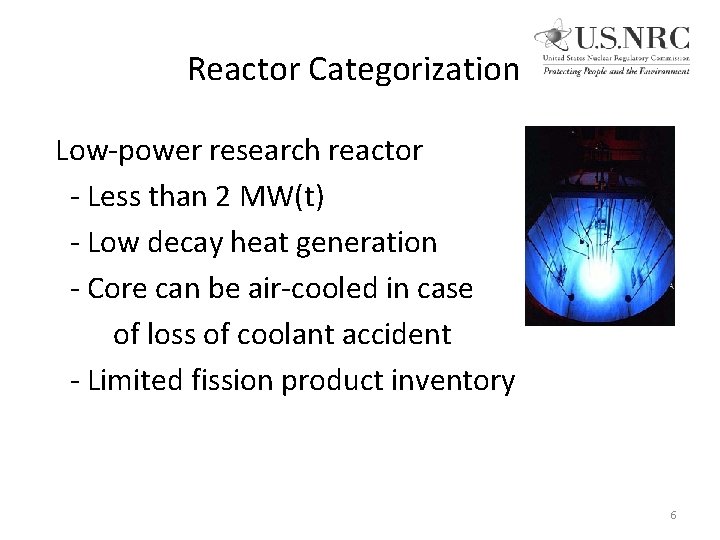
Reactor Categorization Low-power research reactor - Less than 2 MW(t) - Low decay heat generation - Core can be air-cooled in case of loss of coolant accident - Limited fission product inventory 6
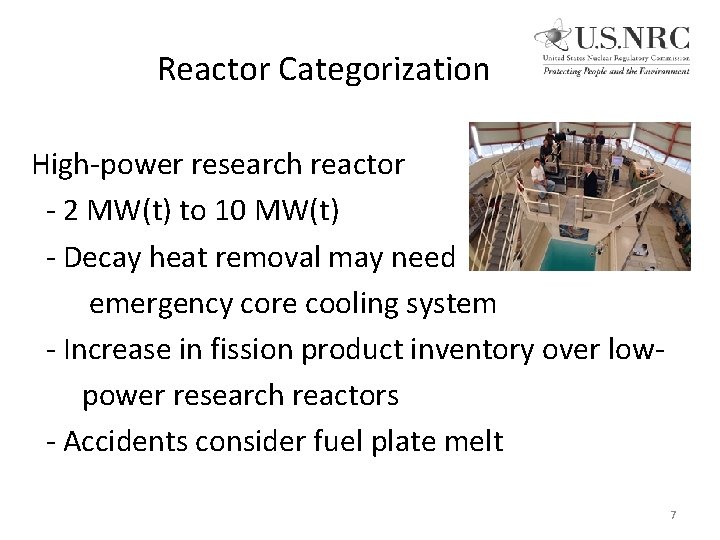
Reactor Categorization High-power research reactor - 2 MW(t) to 10 MW(t) - Decay heat removal may need emergency core cooling system - Increase in fission product inventory over lowpower research reactors - Accidents consider fuel plate melt 7
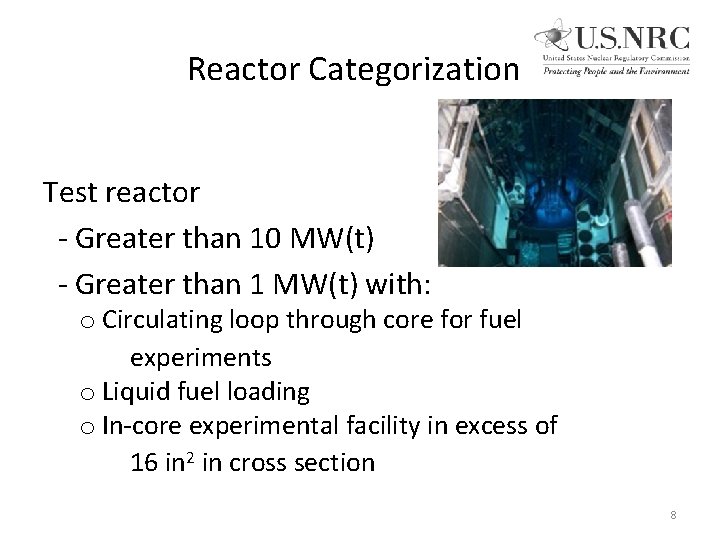
Reactor Categorization Test reactor - Greater than 10 MW(t) - Greater than 1 MW(t) with: o Circulating loop through core for fuel experiments o Liquid fuel loading o In-core experimental facility in excess of 16 in 2 in cross section 8
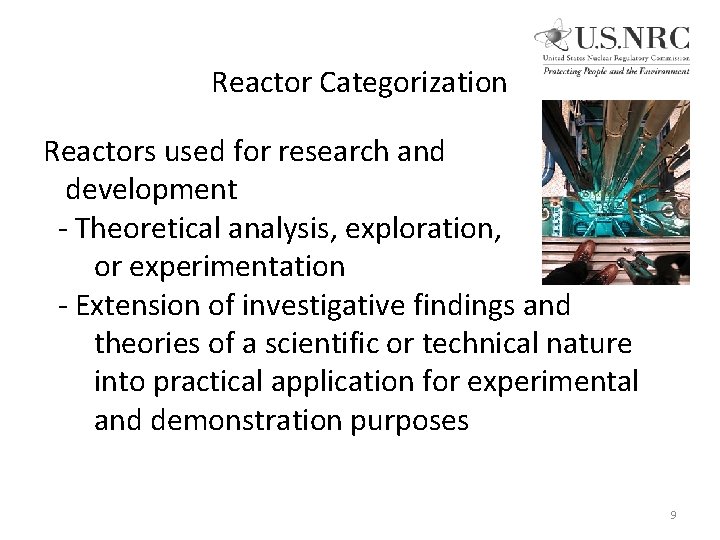
Reactor Categorization Reactors used for research and development - Theoretical analysis, exploration, or experimentation - Extension of investigative findings and theories of a scientific or technical nature into practical application for experimental and demonstration purposes 9
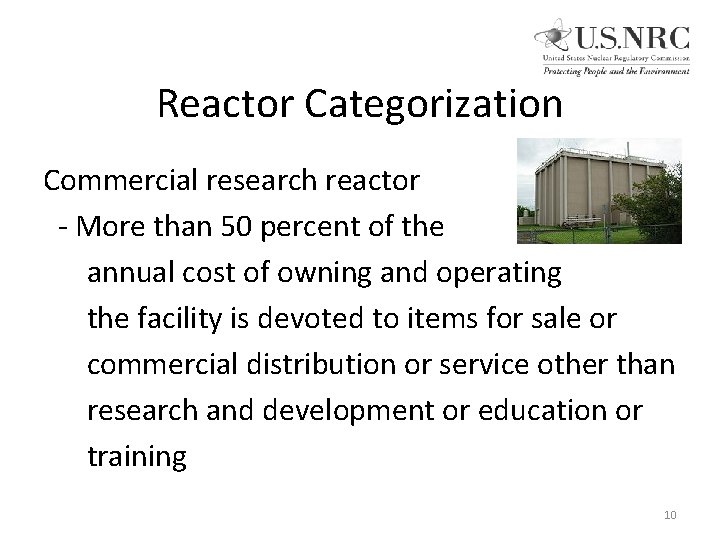
Reactor Categorization Commercial research reactor - More than 50 percent of the annual cost of owning and operating the facility is devoted to items for sale or commercial distribution or service other than research and development or education or training 10
Atomic Energy Act Commission is directed to impose only such minimum amount of regulation of the licensee as the Commission finds will permit the Commission to fulfill its obligations under this Act to promote the common defense and security and to protect the health and safety of the public and will permit the conduct of widespread and diverse research and development 11
Graded Approach in the Licensing Process The licensing process gets more complex as the risk of a facility increases - Mandatory hearings for test reactor and commercial facility construction permits - Advisory Committee on Reactor Safeguards review for construction permits and operating licenses for test reactor and commercial facilities 12
Graded Approach in the Licensing Process License renewal process gets more rigorous as facility risk increases - 2 MW and greater or facilities seeking a power increase undergo full review using NUREG-1537 - Less than 2 MW undergo streamlined review than focuses on reactor, radiation protection, accidents and technical specifications 13
Graded Approach in the Licensing Process Future license renewal proposed rule - Non-expiring license for non-commercial research reactors (SAR update every five years) - Streamlined review for commercial facilities and test reactors (review of changes to facility) 14
Graded Approach in Technical Requirements Technical requirements increase as the risk of a facility increases - Design criteria - Bounding fission product release - Emergency planning - Reactor siting - Environmental requirements 15
Graded Approach in Technical Requirements Design requirements - Power reactors – General Design Requirements for Nuclear Power Plants - Research and test reactors – Maintaining radiation doses within acceptable limits - Guidance in NUREG-1537 – Guidelines for Preparing and Reviewing Applications for the Licensing of Non-Power Reactors 16
Graded Approach in Technical Requirements Bounding fission product release – maximum hypothetical accident - low-power plate reactors – strip plate from specified fraction of fuel plates - high-power plate reactors – melt a specified fraction of fuel plates - TRIGA – loss of clad in air of maximum fission inventory fuel pin 17
Graded Approach in Technical Requirements Emergency planning regulations – potential radiological hazards associated with research reactors different than power reactors - Emergency planning zone power level dependent - Categorization by power level - up to 100 W, 100 W to less than 100 k. W, 100 k. W to less than 2 MW, greater than 2 MW - 100 W reactors do not need emergency organization that can operate around the clock for a long time 18
Graded Approach in Technical Requirements Reactor siting - Power reactors and test reactors 10 CFR Part 100 – specific siting regulations - Research reactors – no specific siting regulations – currently no accident release limits, doses limited to 10 CFR Part 20 19
Graded Approach in Technical Requirements Environmental regulations - Test reactors – environmental impact statement for construction permit, operating license, or renewal - Research reactors – environmental assessment 20
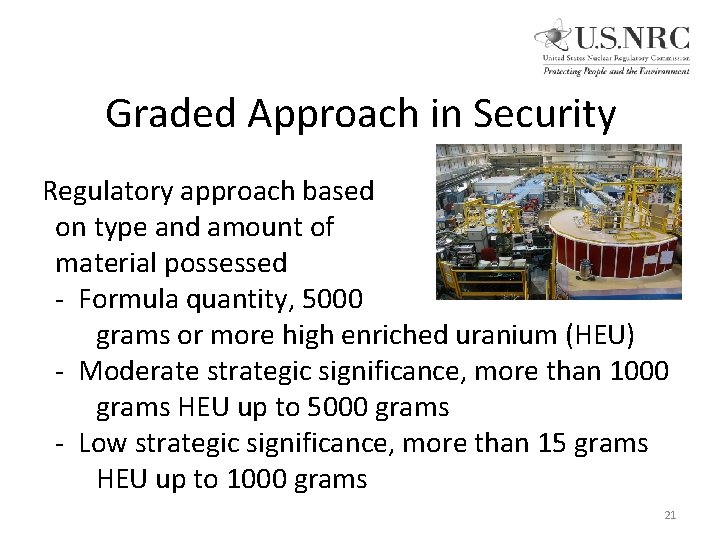
Graded Approach in Security Regulatory approach based on type and amount of material possessed - Formula quantity, 5000 grams or more high enriched uranium (HEU) - Moderate strategic significance, more than 1000 grams HEU up to 5000 grams - Low strategic significance, more than 15 grams HEU up to 1000 grams 21
Graded Approach in Inspection effort increases with increasing risk - Reactors are divided into 3 classes for inspections: o Class 1 – 2 MW and greater o Class 2 – less then 2 MW o Class 3 – permanently shut down 22
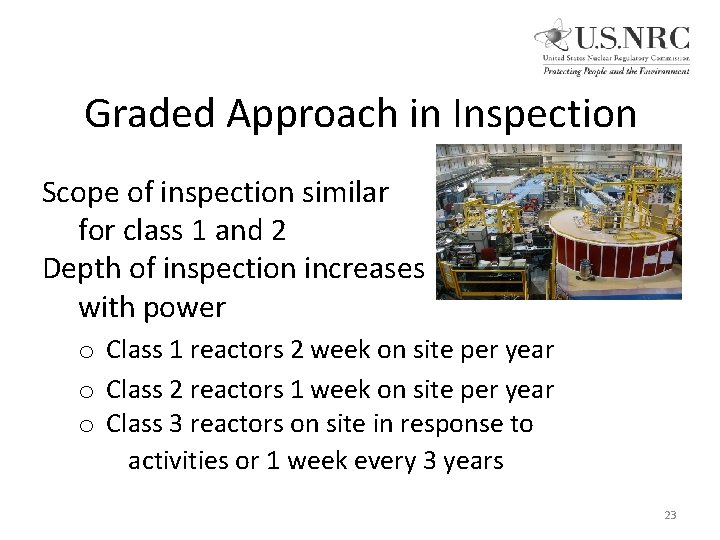
Graded Approach in Inspection Scope of inspection similar for class 1 and 2 Depth of inspection increases with power o Class 1 reactors 2 week on site per year o Class 2 reactors 1 week on site per year o Class 3 reactors on site in response to activities or 1 week every 3 years 23
Other Applications of a Graded Approach Financial protection - 10 k. W or less, $1 M - 10 k. W to 1 MW, $1. 5 M - More than 1 MW to 10 MW (research reactors only), $2. 5 M 24
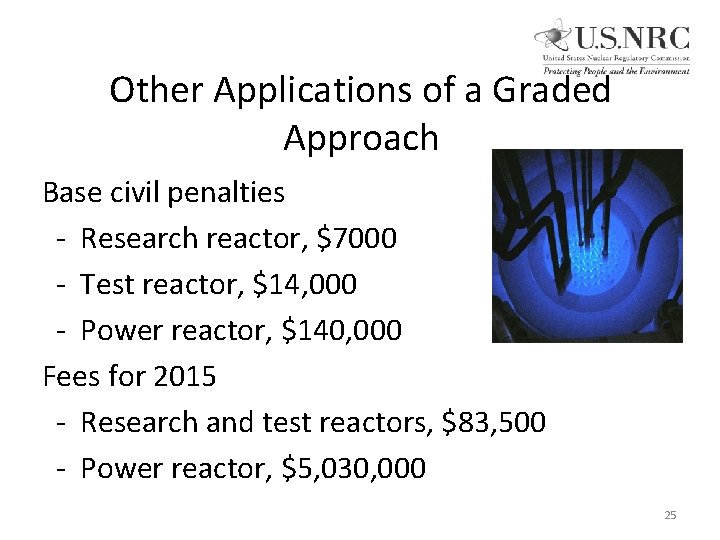
Other Applications of a Graded Approach Base civil penalties - Research reactor, $7000 - Test reactor, $14, 000 - Power reactor, $140, 000 Fees for 2015 - Research and test reactors, $83, 500 - Power reactor, $5, 030, 000 25
Conclusions Graded approach starts with the Atomic Energy Act Graded approach has been used from the earliest days of reactor regulation A graded approach is used in all aspects of NRC regulation 26