
The APEX North Star Artificial Plasma Jet Experiment
- Slides: 18
The APEX North Star Artificial Plasma Jet Experiment R. E. Erlandson, P. K. Swaminathan, C. K. Kumar (JHU/APL), B. G. Gavrilov, Y. Kiselev, J. I. Zetzer (Institute for Dynamics of Geospheres) H. Stenbaek-Nielsen (University of Alaska/Geophysical Institute) K. A Lynch (Dartmouth College) R. F. Pfaff, Jr. (NASA/GSFC) P. A. Delamere (LASP) S. Bounds (University of Iowa) N. A. Gatsonis (Worcester Polytechnic Institute) 12 Sept 2017 Active Experiments in Space: Past, Present and Future Santa Fe, New Mexico
APEX North Star Science Goals • Interaction of a high speed plasma jet with the atmosphere – Ionization Mechanisms: • CIV – Neutral Ion Chemistry – Excitation of Artificial Aurora • Interaction of a high speed plasma jet with the ionospheric plasma – Jet Propagation & Neutralization – Plasma Wave Generation – Ion Heating & Acceleration
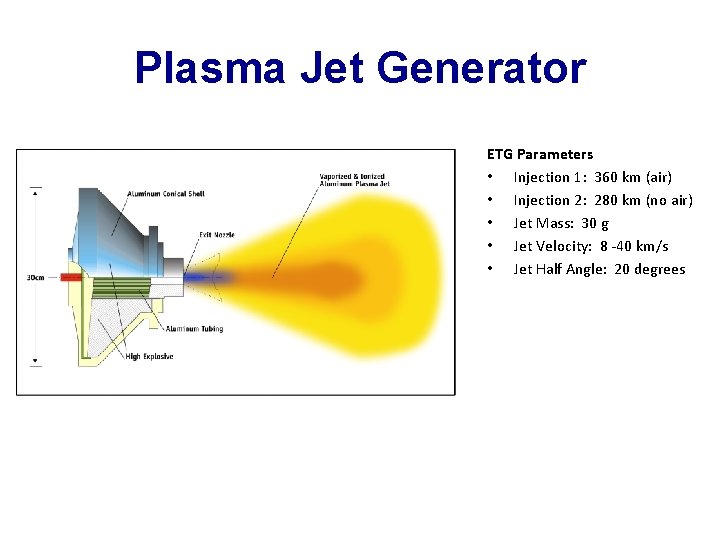
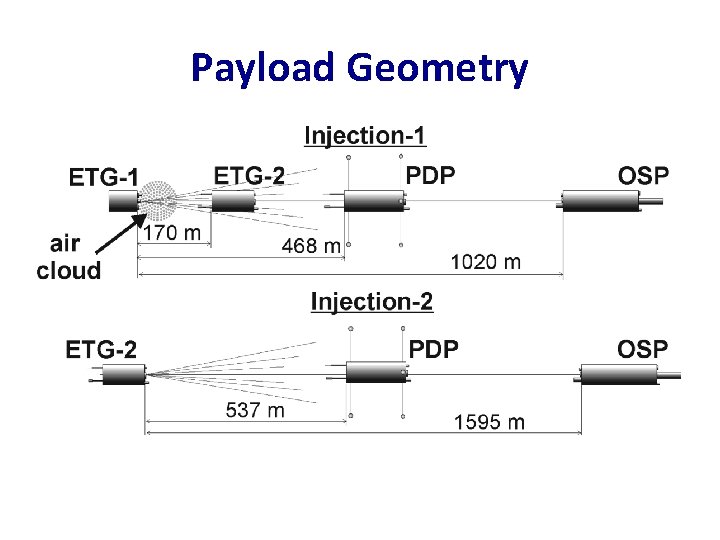
Plasma Jet Generator ETG Parameters • Injection 1: 360 km (air) • Injection 2: 280 km (no air) • Jet Mass: 30 g • Jet Velocity: 8 -40 km/s • Jet Half Angle: 20 degrees
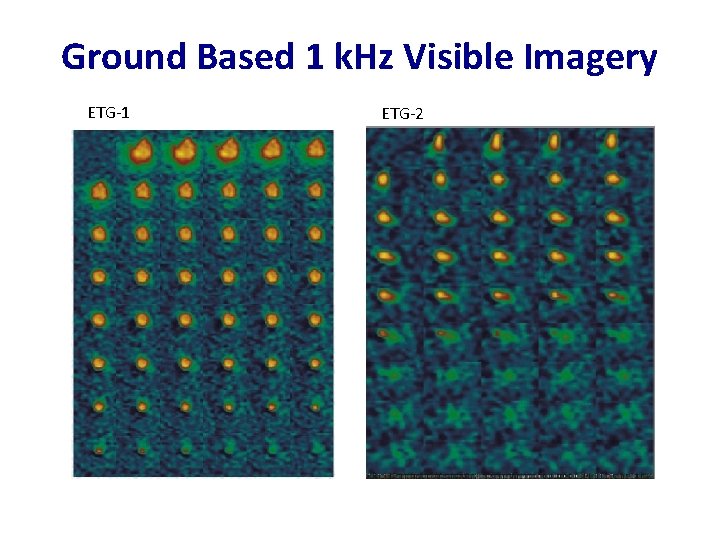
Ground Based 1 k. Hz Visible Imagery ETG-1 ETG-2
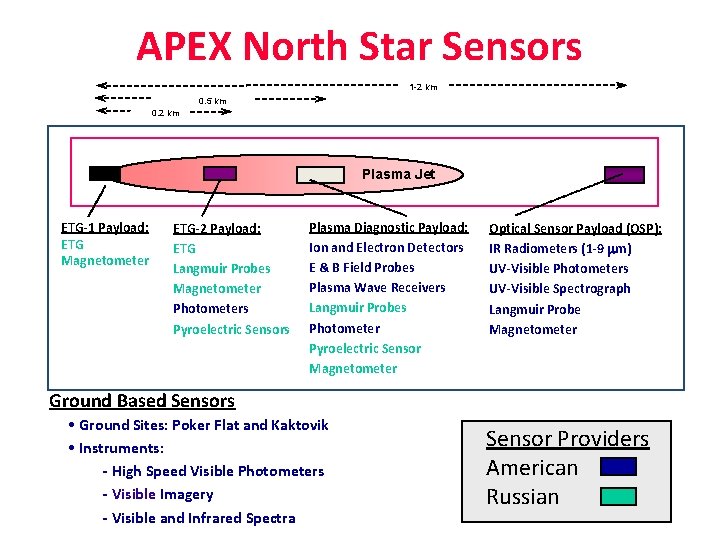
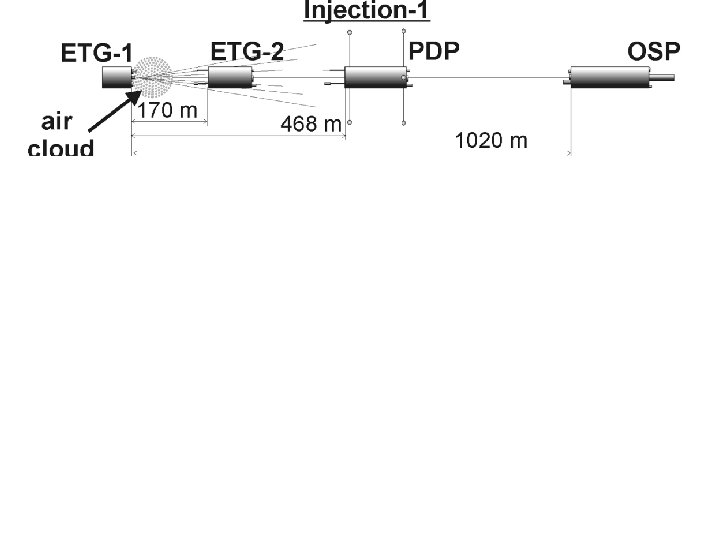
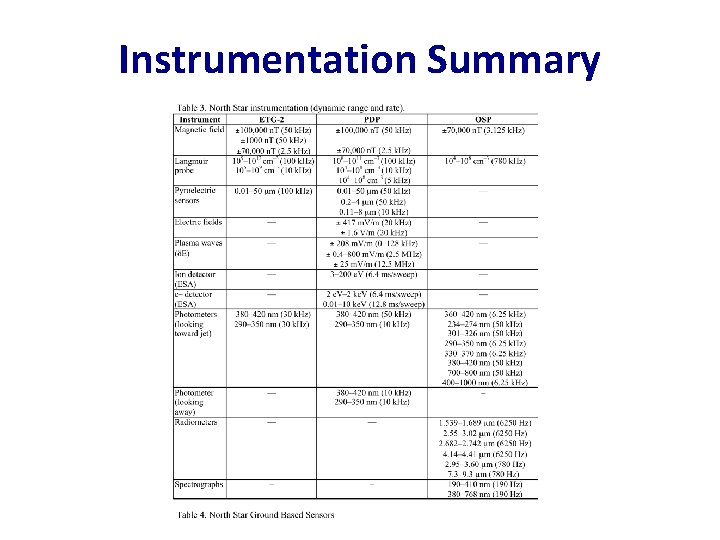
APEX North Star Sensors 1 -2 km 0. 5 km 0. 2 km Plasma Jet ETG-1 Payload: ETG Magnetometer ETG-2 Payload: ETG Langmuir Probes Magnetometer Photometers Pyroelectric Sensors Plasma Diagnostic Payload: Ion and Electron Detectors E & B Field Probes Plasma Wave Receivers Langmuir Probes Photometer Pyroelectric Sensor Magnetometer Optical Sensor Payload (OSP): IR Radiometers (1 -9 mm) UV-Visible Photometers UV-Visible Spectrograph Langmuir Probe Magnetometer Ground Based Sensors • Ground Sites: Poker Flat and Kaktovik • Instruments: - High Speed Visible Photometers - Visible Imagery - Visible and Infrared Spectra Sensor Providers American Russian
Payload Geometry
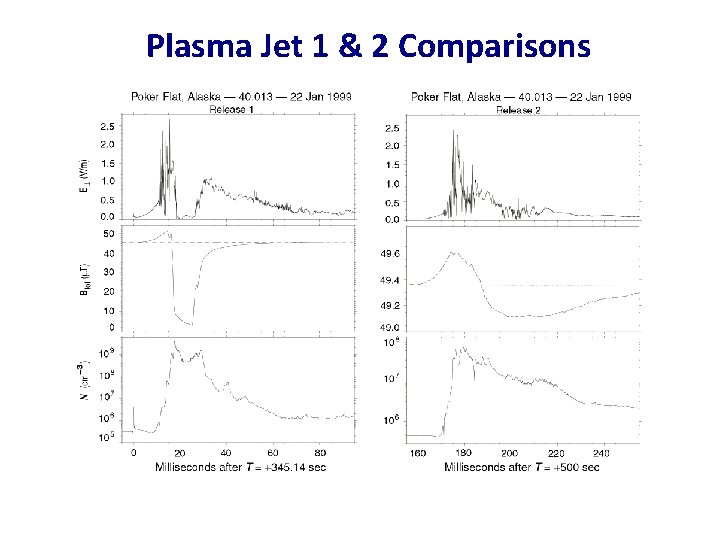
Plasma Jet 1 & 2 Comparisons
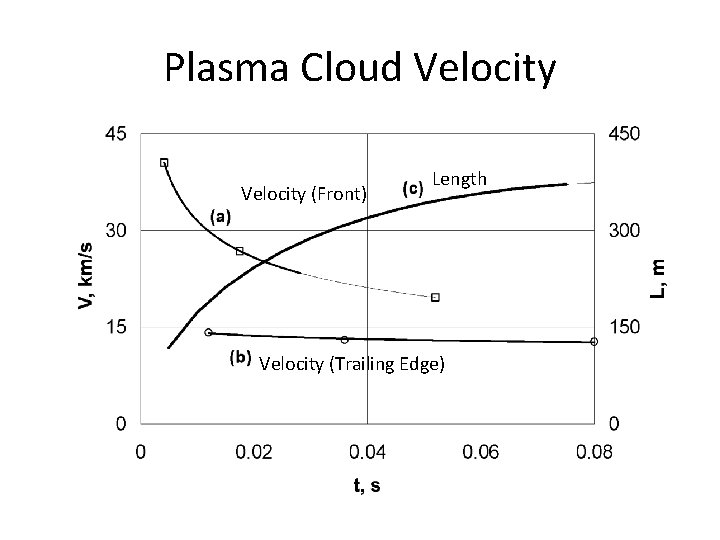
Plasma Cloud Velocity (Front) Length Velocity (Trailing Edge)
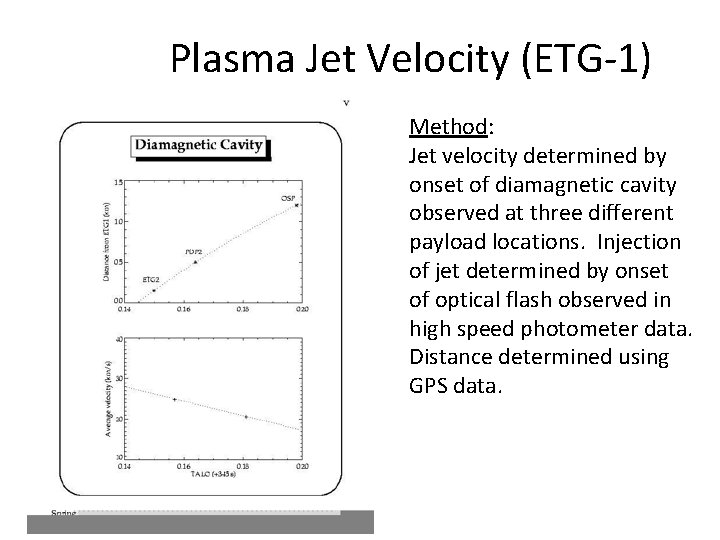
Plasma Jet Velocity (ETG-1) Method: Jet velocity determined by onset of diamagnetic cavity observed at three different payload locations. Injection of jet determined by onset of optical flash observed in high speed photometer data. Distance determined using GPS data.
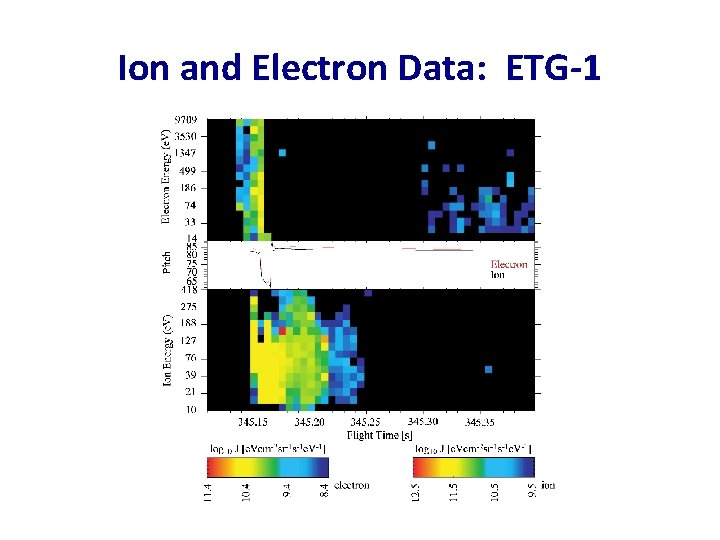
Ion and Electron Data: ETG-1
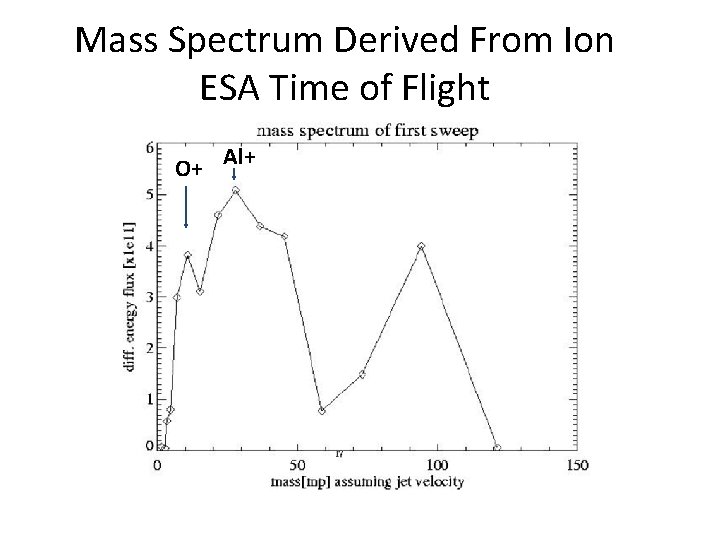
Mass Spectrum Derived From Ion ESA Time of Flight O+ Al+
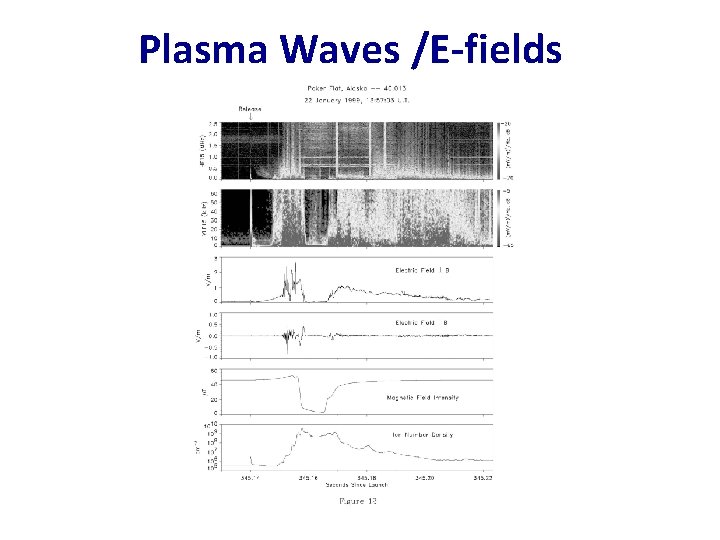
Plasma Waves /E-fields
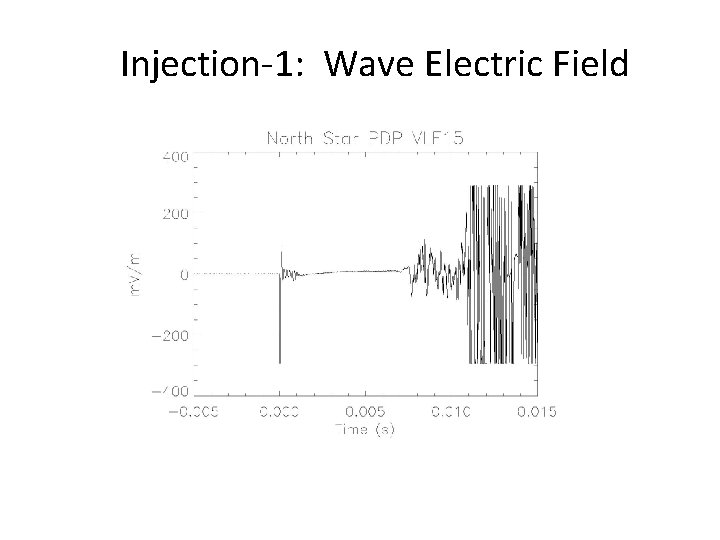
Injection-1: Wave Electric Field
Summary • APEX North Star Observations Contrast Jet Ionization in the presence of an “artificial air cloud” and in ambient conditions (280 km altitude). • Multi-Point Measurements Acquired That Document Jet Velocity Slow Down as a function of time (distance), allowing for detailed comparisons with model calculations • Spectral and High-Speed Optical Data Acquired, allowing investigation of neutral-ion chemistry of plasma jet - environment interactions.
Instrumentation Summary
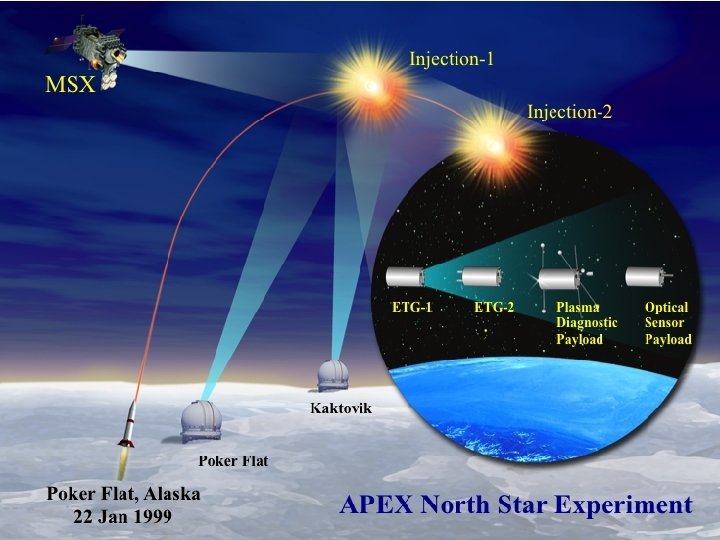
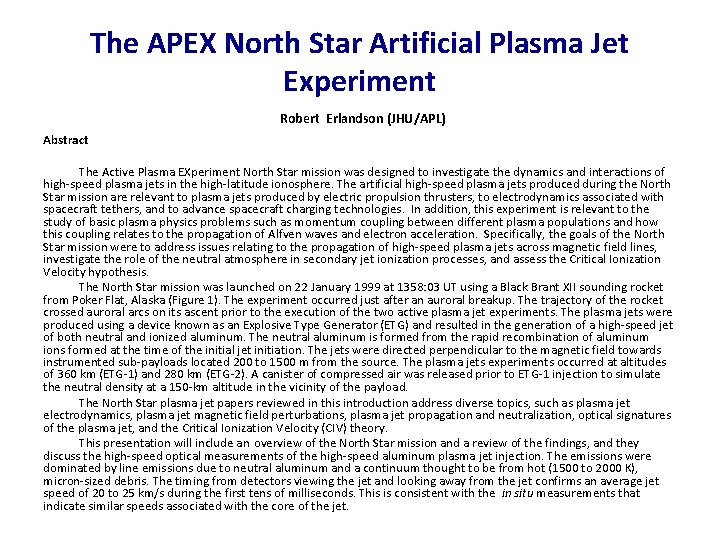
The APEX North Star Artificial Plasma Jet Experiment Robert Erlandson (JHU/APL) Abstract The Active Plasma EXperiment North Star mission was designed to investigate the dynamics and interactions of high-speed plasma jets in the high-latitude ionosphere. The artificial high-speed plasma jets produced during the North Star mission are relevant to plasma jets produced by electric propulsion thrusters, to electrodynamics associated with spacecraft tethers, and to advance spacecraft charging technologies. In addition, this experiment is relevant to the study of basic plasma physics problems such as momentum coupling between different plasma populations and how this coupling relates to the propagation of Alfven waves and electron acceleration. Specifically, the goals of the North Star mission were to address issues relating to the propagation of high-speed plasma jets across magnetic field lines, investigate the role of the neutral atmosphere in secondary jet ionization processes, and assess the Critical Ionization Velocity hypothesis. The North Star mission was launched on 22 January 1999 at 1358: 03 UT using a Black Brant XII sounding rocket from Poker Flat, Alaska (Figure 1). The experiment occurred just after an auroral breakup. The trajectory of the rocket crossed auroral arcs on its ascent prior to the execution of the two active plasma jet experiments. The plasma jets were produced using a device known as an Explosive Type Generator (ETG) and resulted in the generation of a high-speed jet of both neutral and ionized aluminum. The neutral aluminum is formed from the rapid recombination of aluminum ions formed at the time of the initial jet initiation. The jets were directed perpendicular to the magnetic field towards instrumented sub-payloads located 200 to 1500 m from the source. The plasma jets experiments occurred at altitudes of 360 km (ETG-1) and 280 km (ETG-2). A canister of compressed air was released prior to ETG-1 injection to simulate the neutral density at a 150 -km altitude in the vicinity of the payload. The North Star plasma jet papers reviewed in this introduction address diverse topics, such as plasma jet electrodynamics, plasma jet magnetic field perturbations, plasma jet propagation and neutralization, optical signatures of the plasma jet, and the Critical Ionization Velocity (CIV) theory. This presentation will include an overview of the North Star mission and a review of the findings, and they discuss the high-speed optical measurements of the high-speed aluminum plasma jet injection. The emissions were dominated by line emissions due to neutral aluminum and a continuum thought to be from hot (1500 to 2000 K), micron-sized debris. The timing from detectors viewing the jet and looking away from the jet confirms an average jet speed of 20 to 25 km/s during the first tens of milliseconds. This is consistent with the in situ measurements that indicate similar speeds associated with the core of the jet.