
The APC tumor suppressor counteracts bcatenin activation and
The APC tumor suppressor counteracts b-catenin activation and H 3 K 4 methylation at Wnt target genes Sierra et al. , Genes & Dev. , 2006
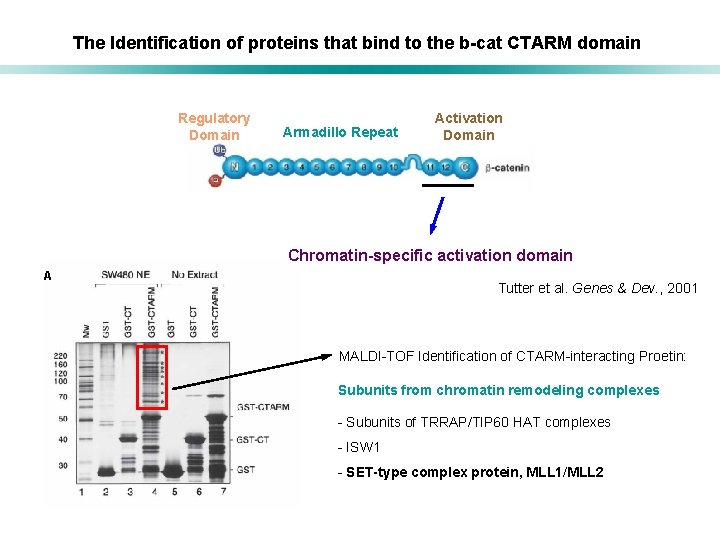
The Identification of proteins that bind to the b-cat CTARM domain Regulatory Domain Armadillo Repeat Activation Domain Chromatin-specific activation domain A Tutter et al. Genes & Dev. , 2001 MALDI-TOF Identification of CTARM-interacting Proetin: Subunits from chromatin remodeling complexes - Subunits of TRRAP/TIP 60 HAT complexes - ISW 1 - SET-type complex protein, MLL 1/MLL 2
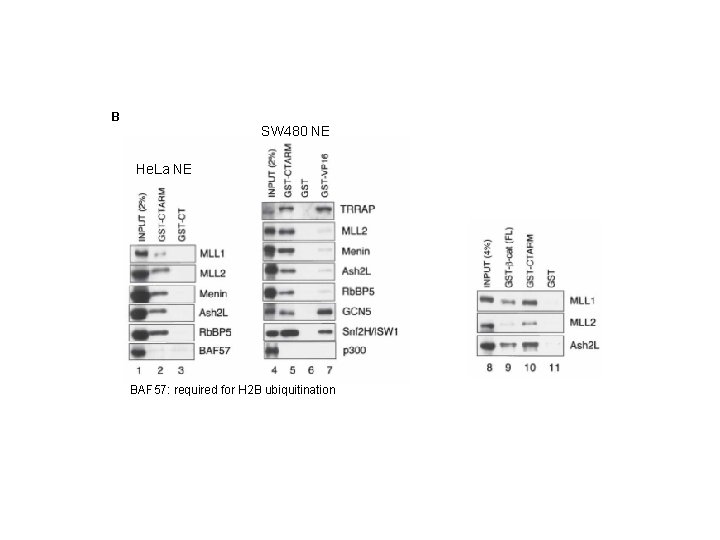
B SW 480 NE He. La NE BAF 57: required for H 2 B ubiquitination
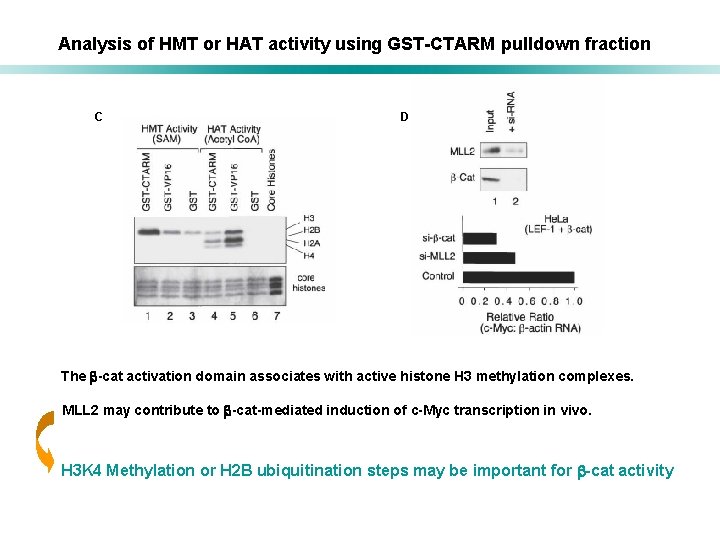
Analysis of HMT or HAT activity using GST-CTARM pulldown fraction C D The b-cat activation domain associates with active histone H 3 methylation complexes. MLL 2 may contribute to b-cat-mediated induction of c-Myc transcription in vivo. H 3 K 4 Methylation or H 2 B ubiquitination steps may be important for b-cat activity
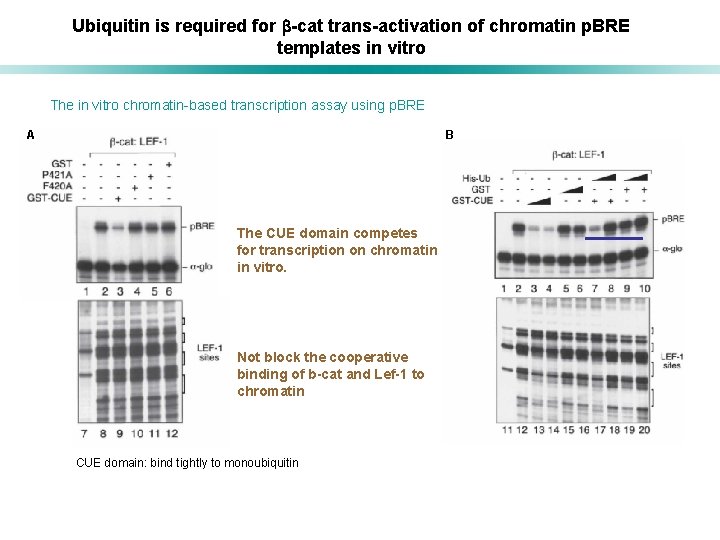
Ubiquitin is required for b-cat trans-activation of chromatin p. BRE templates in vitro The in vitro chromatin-based transcription assay using p. BRE A B The CUE domain competes for transcription on chromatin in vitro. Not block the cooperative binding of b-cat and Lef-1 to chromatin CUE domain: bind tightly to monoubiquitin
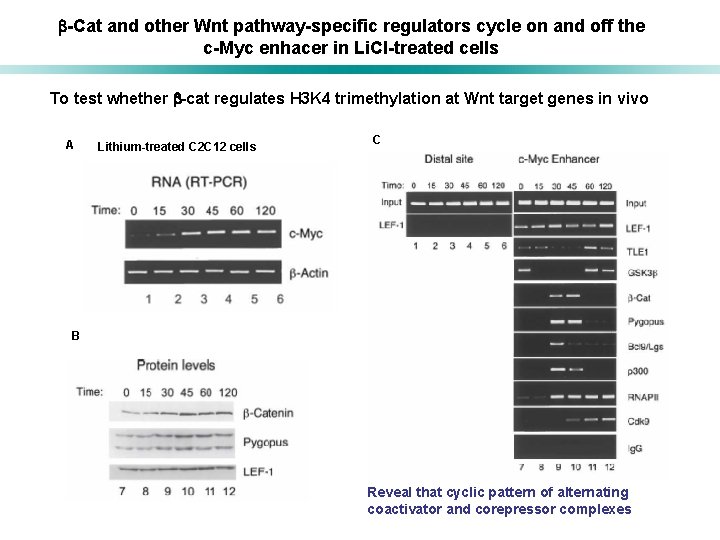
b-Cat and other Wnt pathway-specific regulators cycle on and off the c-Myc enhacer in Li. Cl-treated cells To test whether b-cat regulates H 3 K 4 trimethylation at Wnt target genes in vivo A Lithium-treated C 2 C 12 cells C B Reveal that cyclic pattern of alternating coactivator and corepressor complexes
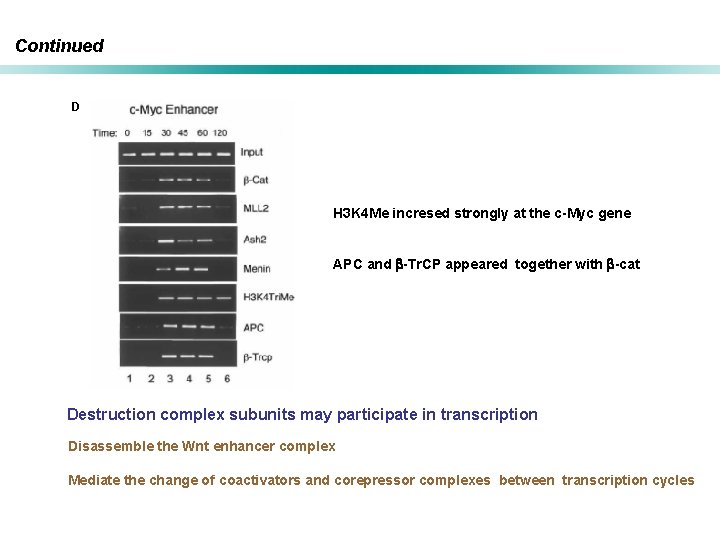
Continued D H 3 K 4 Me incresed strongly at the c-Myc gene APC and b-Tr. CP appeared together with b-cat Destruction complex subunits may participate in transcription Disassemble the Wnt enhancer complex Mediate the change of coactivators and corepressor complexes between transcription cycles
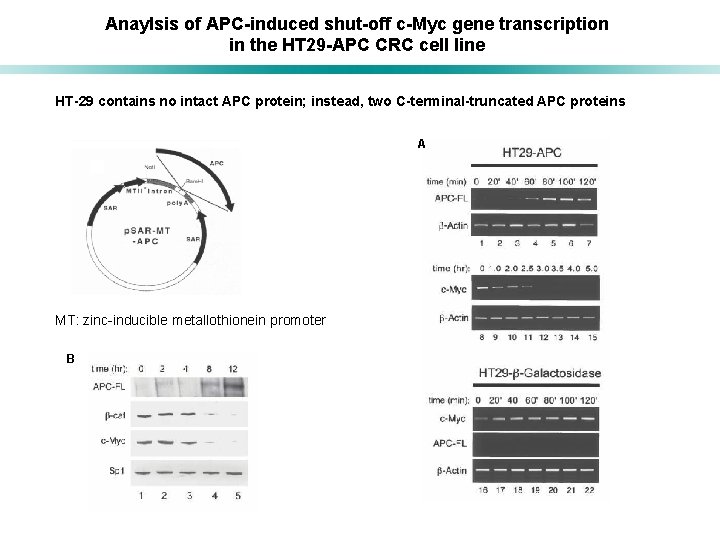
Anaylsis of APC-induced shut-off c-Myc gene transcription in the HT 29 -APC CRC cell line HT-29 contains no intact APC protein; instead, two C-terminal-truncated APC proteins A MT: zinc-inducible metallothionein promoter B
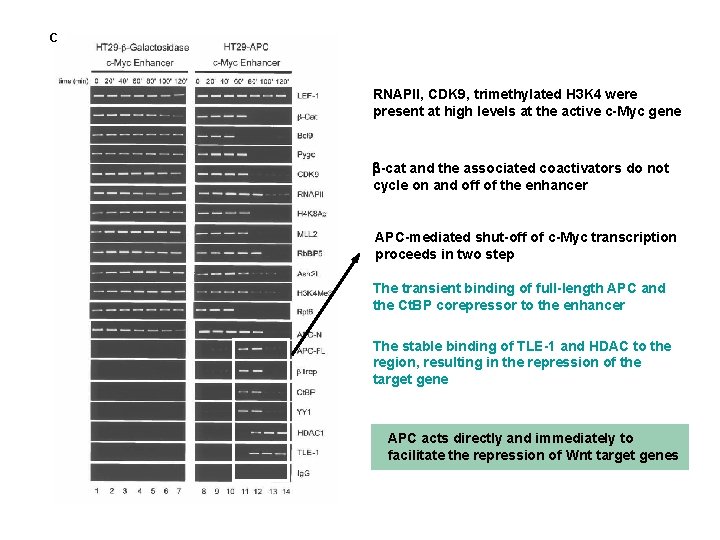
C RNAPII, CDK 9, trimethylated H 3 K 4 were present at high levels at the active c-Myc gene b-cat and the associated coactivators do not cycle on and off of the enhancer APC-mediated shut-off of c-Myc transcription proceeds in two step The transient binding of full-length APC and the Ct. BP corepressor to the enhancer The stable binding of TLE-1 and HDAC to the region, resulting in the repression of the target gene APC acts directly and immediately to facilitate the repression of Wnt target genes
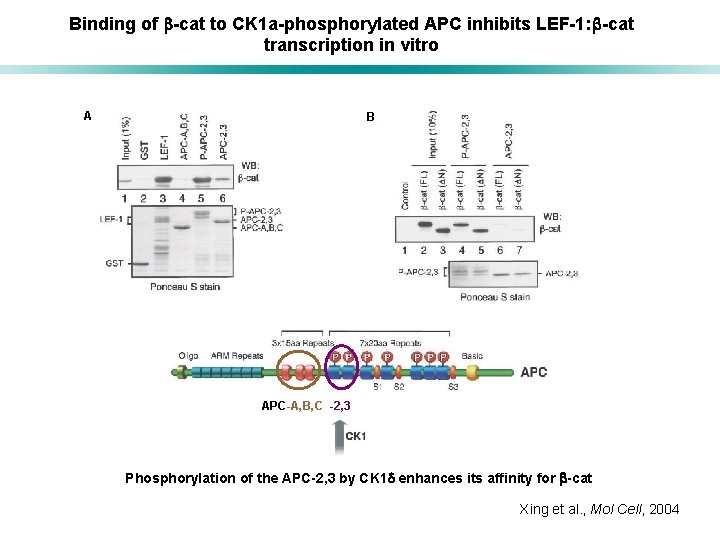
Binding of b-cat to CK 1 a-phosphorylated APC inhibits LEF-1: b-cat transcription in vitro A B APC-A, B, C -2, 3 Phosphorylation of the APC-2, 3 by CK 1 d enhances its affinity for b-cat Xing et al. , Mol Cell, 2004
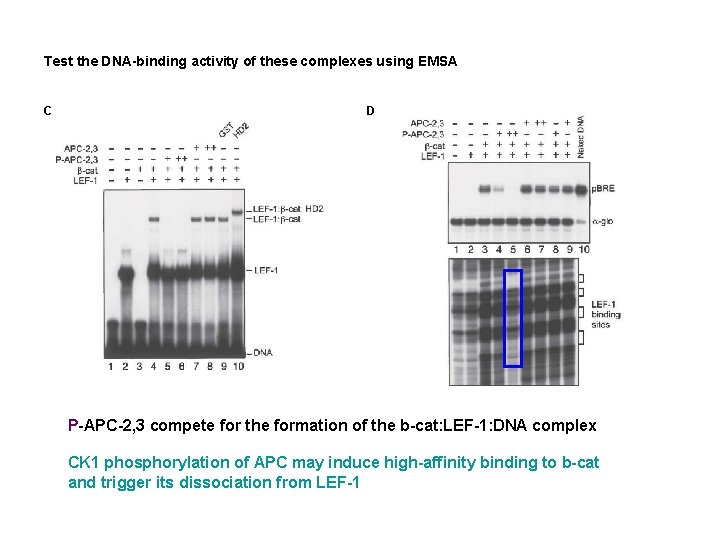
Test the DNA-binding activity of these complexes using EMSA C D P-APC-2, 3 compete for the formation of the b-cat: LEF-1: DNA complex CK 1 phosphorylation of APC may induce high-affinity binding to b-cat and trigger its dissociation from LEF-1
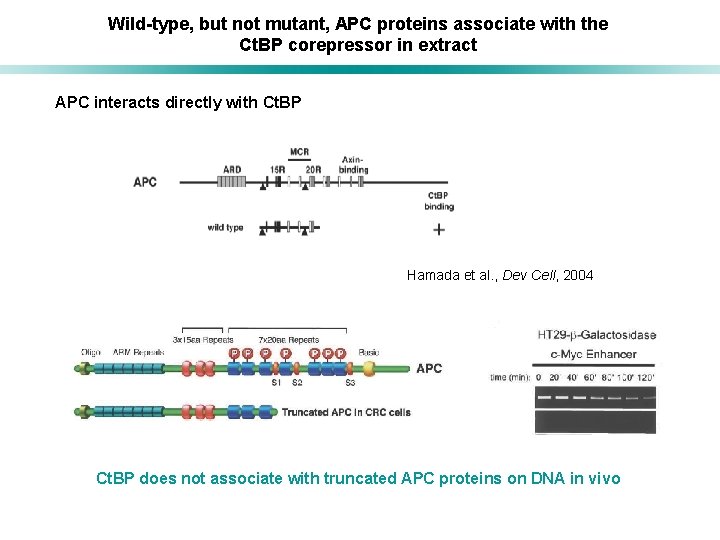
Wild-type, but not mutant, APC proteins associate with the Ct. BP corepressor in extract APC interacts directly with Ct. BP Hamada et al. , Dev Cell, 2004 Ct. BP does not associate with truncated APC proteins on DNA in vivo
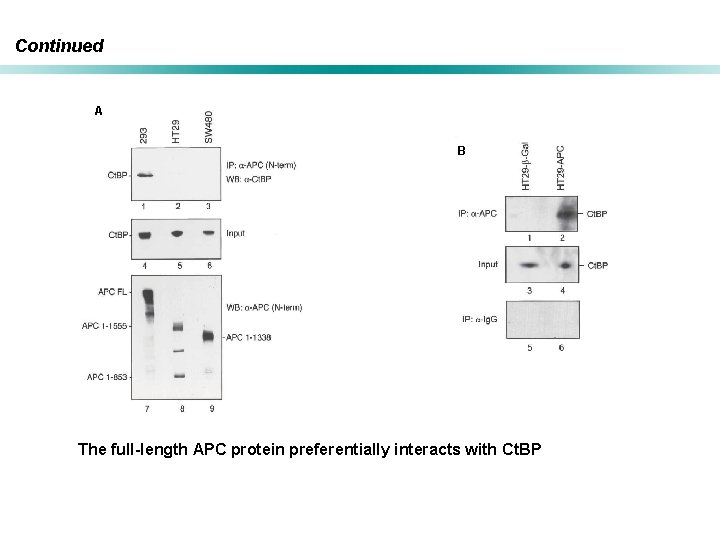
Continued A B The full-length APC protein preferentially interacts with Ct. BP
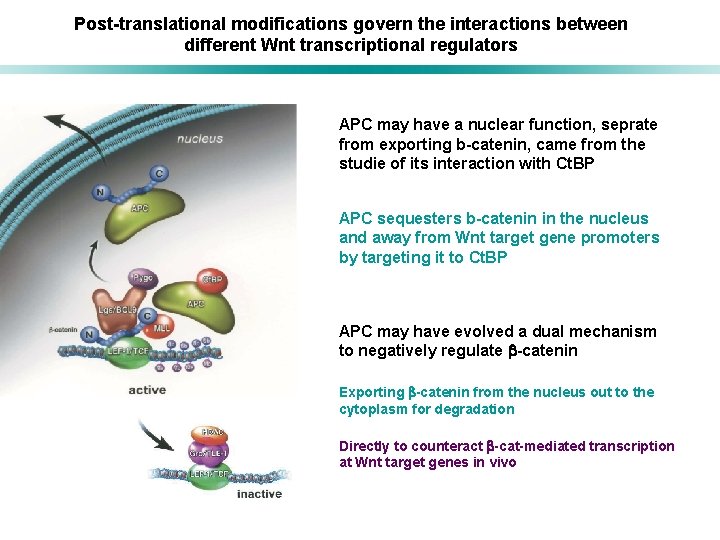
Post-translational modifications govern the interactions between different Wnt transcriptional regulators APC may have a nuclear function, seprate from exporting b-catenin, came from the studie of its interaction with Ct. BP APC sequesters b-catenin in the nucleus and away from Wnt target gene promoters by targeting it to Ct. BP APC may have evolved a dual mechanism to negatively regulate b-catenin Exporting b-catenin from the nucleus out to the cytoplasm for degradation Directly to counteract b-cat-mediated transcription at Wnt target genes in vivo
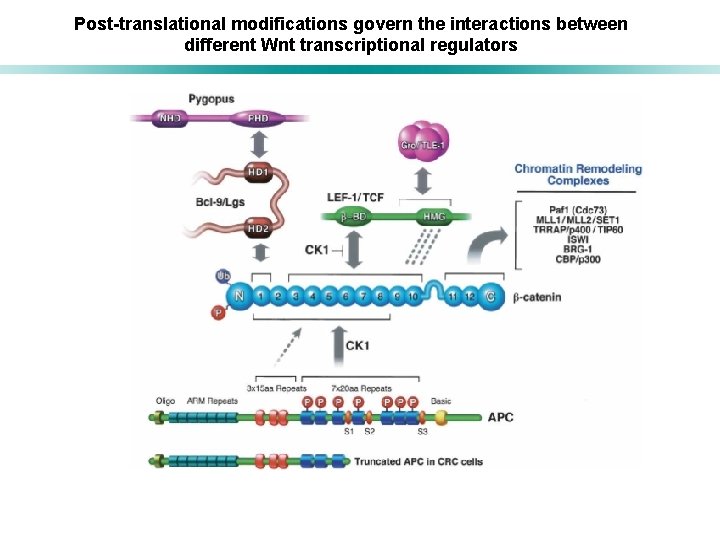
Post-translational modifications govern the interactions between different Wnt transcriptional regulators
- Slides: 15