
The Anomeric Effect Organic Pedagogical Electronic Network Cody
- Slides: 10
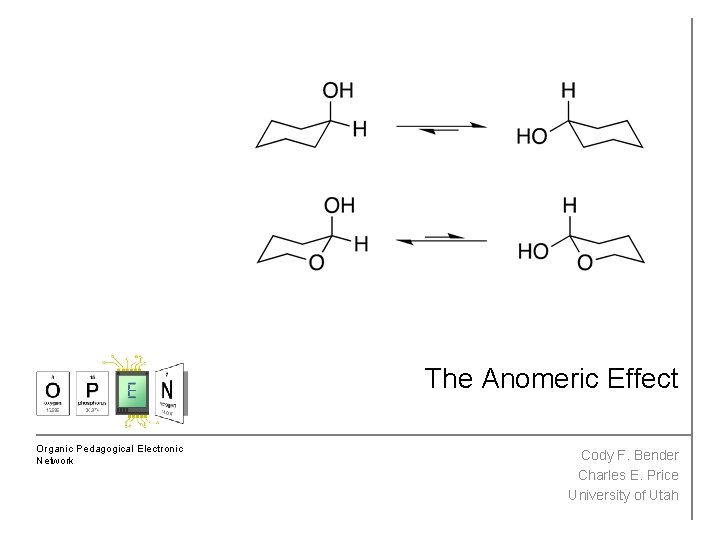
The Anomeric Effect Organic Pedagogical Electronic Network Cody F. Bender Charles E. Price University of Utah
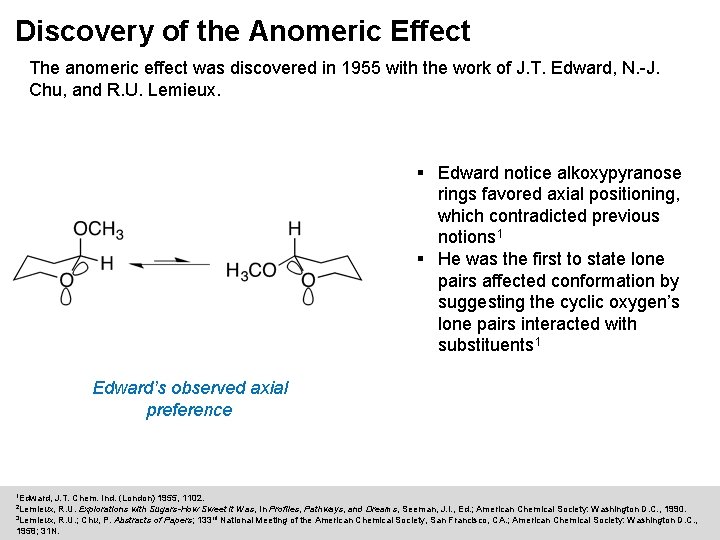
Discovery of the Anomeric Effect The anomeric effect was discovered in 1955 with the work of J. T. Edward, N. -J. Chu, and R. U. Lemieux. § Edward notice alkoxypyranose rings favored axial positioning, which contradicted previous notions 1 § He was the first to state lone pairs affected conformation by suggesting the cyclic oxygen’s lone pairs interacted with substituents 1 Edward’s observed axial preference 1 Edward, J. T. Chem. Ind. (London) 1955, 1102. R. U. Explorations with Sugars-How Sweet It Was, In Profiles, Pathways, and Dreams, Seeman, J. I. , Ed. ; American Chemical Society: Washington D. C. , 1990. 3 Lemieux, R. U. ; Chu, P. Abstracts of Papers; 133 rd National Meeting of the American Chemical Society, San Francisco, CA. ; American Chemical Society: Washington D. C. , 1958; 31 N. 2 Lemieux,
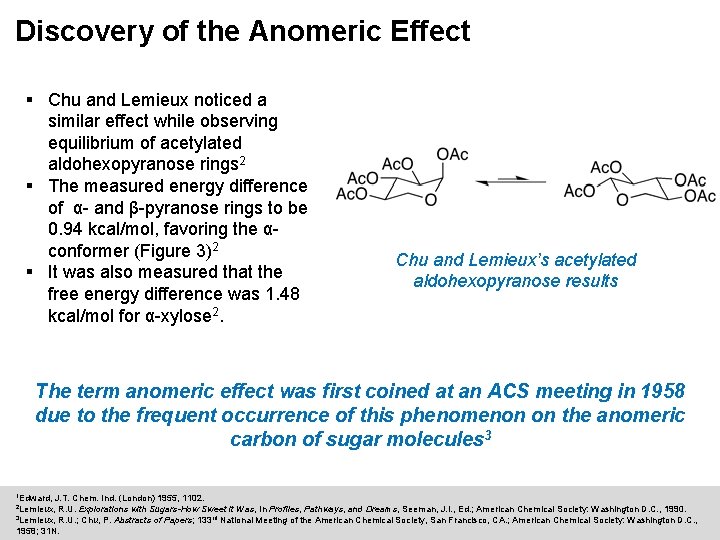
Discovery of the Anomeric Effect § Chu and Lemieux noticed a similar effect while observing equilibrium of acetylated aldohexopyranose rings 2 § The measured energy difference of α- and β-pyranose rings to be 0. 94 kcal/mol, favoring the αconformer (Figure 3)2 § It was also measured that the free energy difference was 1. 48 kcal/mol for α-xylose 2. Chu and Lemieux’s acetylated aldohexopyranose results The term anomeric effect was first coined at an ACS meeting in 1958 due to the frequent occurrence of this phenomenon on the anomeric carbon of sugar molecules 3 1 Edward, J. T. Chem. Ind. (London) 1955, 1102. R. U. Explorations with Sugars-How Sweet It Was, In Profiles, Pathways, and Dreams, Seeman, J. I. , Ed. ; American Chemical Society: Washington D. C. , 1990. 3 Lemieux, R. U. ; Chu, P. Abstracts of Papers; 133 rd National Meeting of the American Chemical Society, San Francisco, CA. ; American Chemical Society: Washington D. C. , 1958; 31 N. 2 Lemieux,
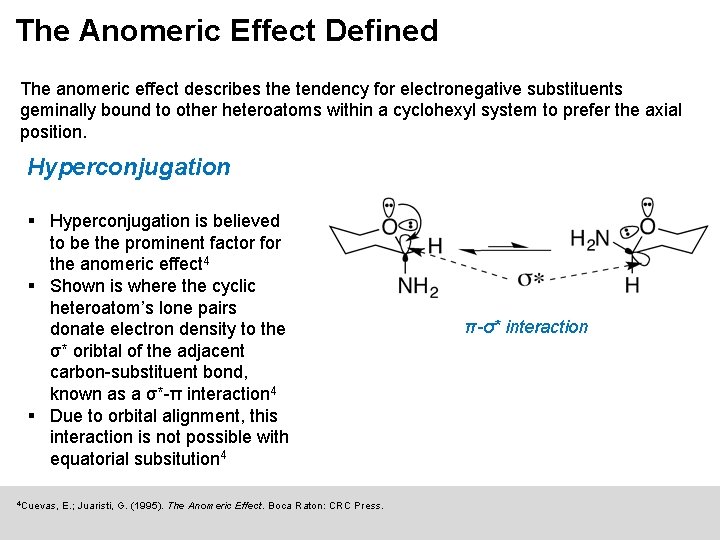
The Anomeric Effect Defined The anomeric effect describes the tendency for electronegative substituents geminally bound to other heteroatoms within a cyclohexyl system to prefer the axial position. Hyperconjugation § Hyperconjugation is believed to be the prominent factor for the anomeric effect 4 § Shown is where the cyclic heteroatom’s lone pairs donate electron density to the σ* oribtal of the adjacent carbon-substituent bond, known as a σ*-π interaction 4 § Due to orbital alignment, this interaction is not possible with equatorial subsitution 4 4 Cuevas, E. ; Juaristi, G. (1995). The Anomeric Effect. Boca Raton: CRC Press. π-σ* interaction
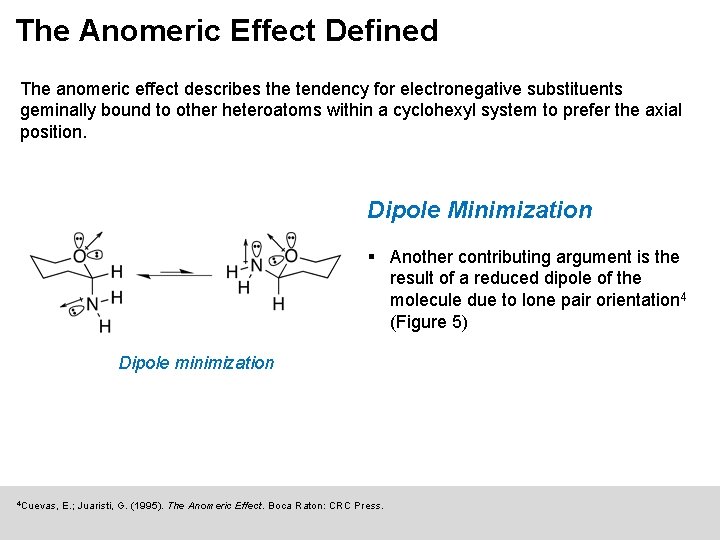
The Anomeric Effect Defined The anomeric effect describes the tendency for electronegative substituents geminally bound to other heteroatoms within a cyclohexyl system to prefer the axial position. Dipole Minimization § Another contributing argument is the result of a reduced dipole of the molecule due to lone pair orientation 4 (Figure 5) Dipole minimization 4 Cuevas, E. ; Juaristi, G. (1995). The Anomeric Effect. Boca Raton: CRC Press.
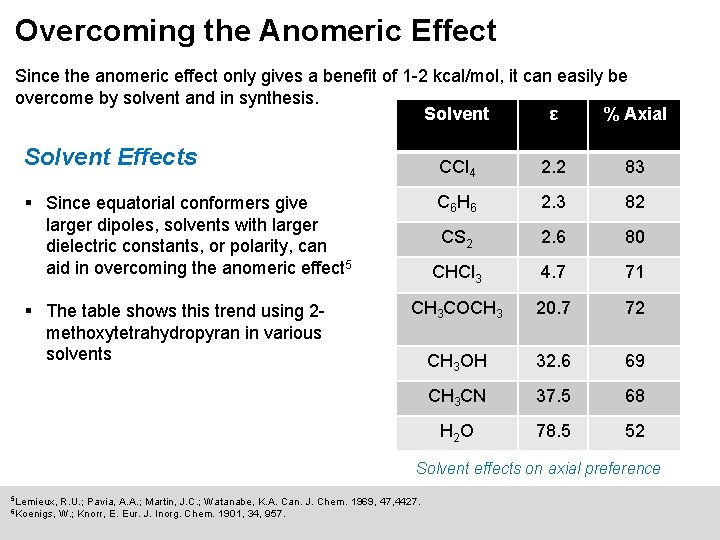
Overcoming the Anomeric Effect Since the anomeric effect only gives a benefit of 1 -2 kcal/mol, it can easily be overcome by solvent and in synthesis. Solvent ε % Axial Solvent Effects CCl 4 2. 2 83 C 6 H 6 2. 3 82 CS 2 2. 6 80 CHCl 3 4. 7 71 CH 3 COCH 3 20. 7 72 CH 3 OH 32. 6 69 CH 3 CN 37. 5 68 H 2 O 78. 5 52 § Since equatorial conformers give larger dipoles, solvents with larger dielectric constants, or polarity, can aid in overcoming the anomeric effect 5 § The table shows this trend using 2 methoxytetrahydropyran in various solvents Solvent effects on axial preference 5 Lemieux, 6 Koenigs, R. U. ; Pavia, A. A. ; Martin, J. C. ; Watanabe, K. A. Can. J. Chem. 1969, 47, 4427. W. ; Knorr, E. Eur. J. Inorg. Chem. 1901, 34, 957.
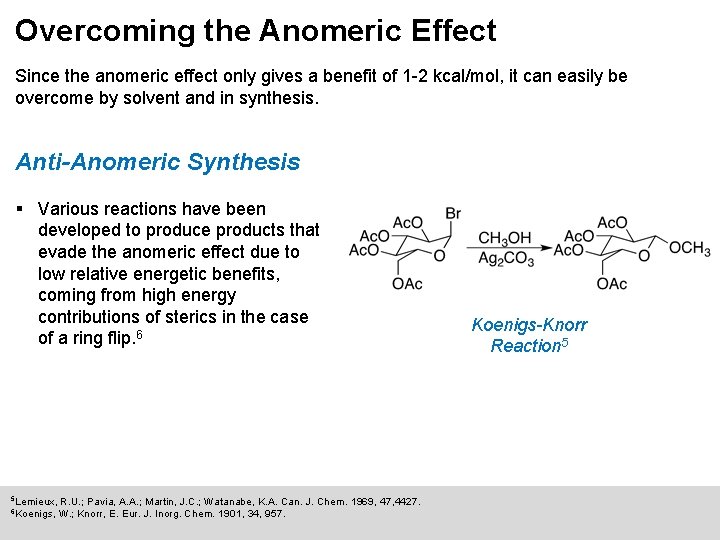
Overcoming the Anomeric Effect Since the anomeric effect only gives a benefit of 1 -2 kcal/mol, it can easily be overcome by solvent and in synthesis. Anti-Anomeric Synthesis § Various reactions have been developed to produce products that evade the anomeric effect due to low relative energetic benefits, coming from high energy contributions of sterics in the case of a ring flip. 6 5 Lemieux, 6 Koenigs, R. U. ; Pavia, A. A. ; Martin, J. C. ; Watanabe, K. A. Can. J. Chem. 1969, 47, 4427. W. ; Knorr, E. Eur. J. Inorg. Chem. 1901, 34, 957. Koenigs-Knorr Reaction 5
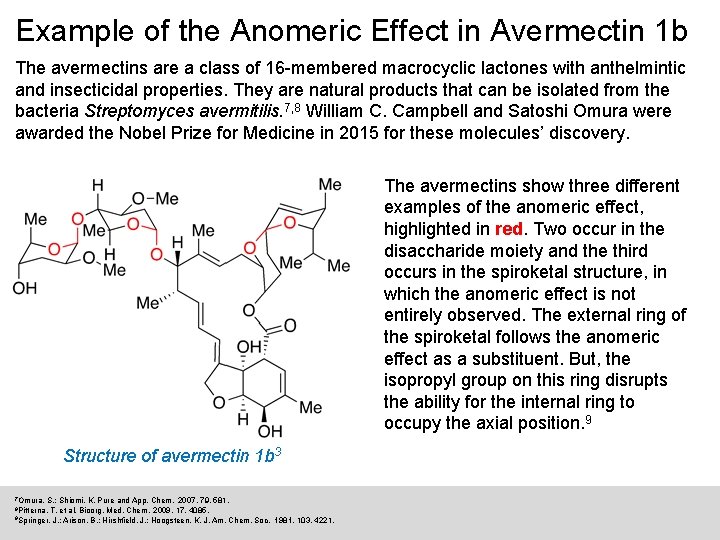
Example of the Anomeric Effect in Avermectin 1 b The avermectins are a class of 16 -membered macrocyclic lactones with anthelmintic and insecticidal properties. They are natural products that can be isolated from the bacteria Streptomyces avermitilis. 7, 8 William C. Campbell and Satoshi Omura were awarded the Nobel Prize for Medicine in 2015 for these molecules’ discovery. The avermectins show three different examples of the anomeric effect, highlighted in red. Two occur in the disaccharide moiety and the third occurs in the spiroketal structure, in which the anomeric effect is not entirely observed. The external ring of the spiroketal follows the anomeric effect as a substituent. But, the isopropyl group on this ring disrupts the ability for the internal ring to occupy the axial position. 9 Structure of avermectin 1 b 3 7 Omura, S. ; Shiomi, K. Pure and App. Chem. 2007. 79. 581. T. et al. Bioorg. Med. Chem. 2009. 17. 4085. 9 Springer, J. ; Arison, B. ; Hirshfield, J. ; Hoogsteen, K. J. Am. Chem. Soc. 1981. 103. 4221. 8 Pitterna,
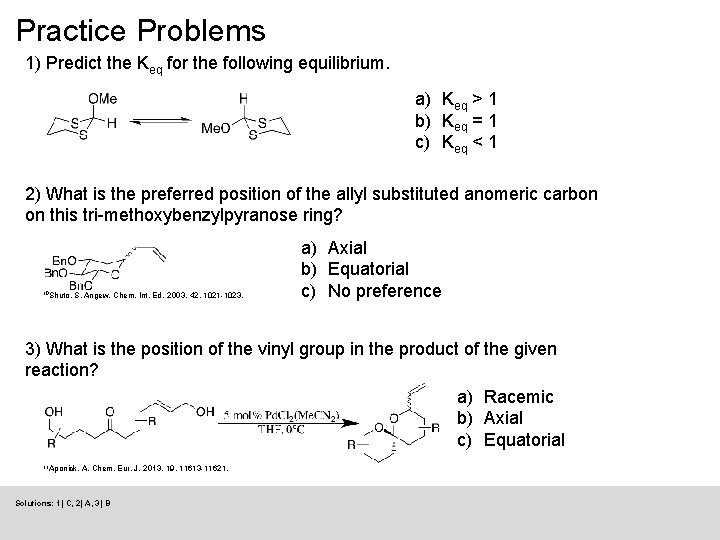
Practice Problems 1) Predict the Keq for the following equilibrium. a) Keq > 1 b) Keq = 1 c) Keq < 1 2) What is the preferred position of the allyl substituted anomeric carbon on this tri-methoxybenzylpyranose ring? 10 Shuto, S. Angew. Chem. Int. Ed. 2003. 42. 1021 -1023. a) Axial b) Equatorial c) No preference 3) What is the position of the vinyl group in the product of the given reaction? a) Racemic b) Axial c) Equatorial 11 Aponick, A. Chem. Eur. J. 2013. 19. 11613 -11621. Solutions: 1) C, 2) A, 3) B
Contributed by: Cody F. Bender, Charles E. Price (Undergraduates) University of Utah, 2016 This work is licensed under a Creative Commons Attribution. Share. Alike 4. 0 International License.