
The Ankle Bones Tibia Fibula Talus Movements Dorsal
The Ankle

Bones �Tibia �Fibula �Talus
Movements �Dorsal Flexion- most stable position �Plantar Flexion- Most unstable �Eversion �Inversion
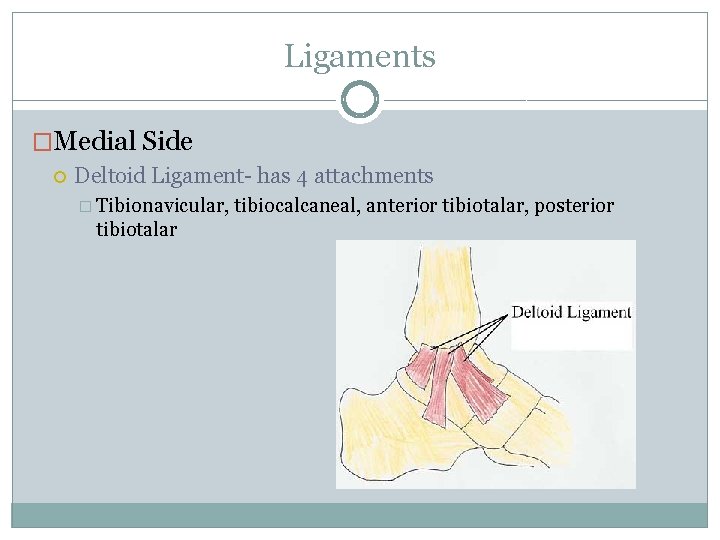
Ligaments �Medial Side Deltoid Ligament- has 4 attachments � Tibionavicular, tibiotalar tibiocalcaneal, anterior tibiotalar, posterior

�Lateral Side �Anterior talofibular (most commonly sprained) � Calcaneofibular �Posterior talofibular �Anterior tibiofibular �Posterior talocalcaneal �Lateral talocalcaneal
Muscles, Arteries, Nerves �See foot notes
Ankle Landmark Test �Start Posterior then medial lateral last Achilles Tendon Medial Mallious Deltoid Ligament Lateral Mallious Posterior Talofibular Calcanealofibular Anterior Talofibular Base of the 5 th MUST COMPLETE IN THIS ORDER FOR 4.
Sprains - 85% of injuries sprains - 90% of sprains are inversion
The Ankle Story �Trainer focus on lower body movement during play �When player goes down trainer trot to athlete �Keep athlete down �Look for abnormal angles
The Ankle Story cont. �Ask questions- feel anything tear, pop, pain or discomfort, shooting pain �If no deformity- ask if they can stand two man walk with leg up. If they cant stand two man carry
The ankle story cont �Bare ankle Look for swelling, discoloration Find point tender spot palpate � Start posterior, Achilles, deltoid ligaments, navicular, base of 5 th, posterior Talofibular, calcaneofibular, anterior talofibular Fracture Test � s/sx- vertical shooting pain, heel tap, mallelous tap lower leg squeeze
The Ankle Story Cont. �Ligament stress test Drawer stress- tear of anterior talofibular � Hand on top of leg other on heel pull up hard Invesion stress- tear calcaneofibular � Turn heel in

The Ankle Story Cont. �Range of Motion (ROM) Passive and Active- DF, PF, IV, EV �Manuel muscle Test- Tell athlete to not let you move foot in all ROM
The Ankle Story �Bare Foot Test Stand on toes of both feet Jump with both feet- watch for double slap Hop on injury Walk forward and backward Put Maximum Tape support � Have athlete run forward and backwards, figure 8, grapevine, slides, skip. � If pain stop
The ankle story cont. If unable to return RICE. If able to pass bare foot test return to play as tolerated.
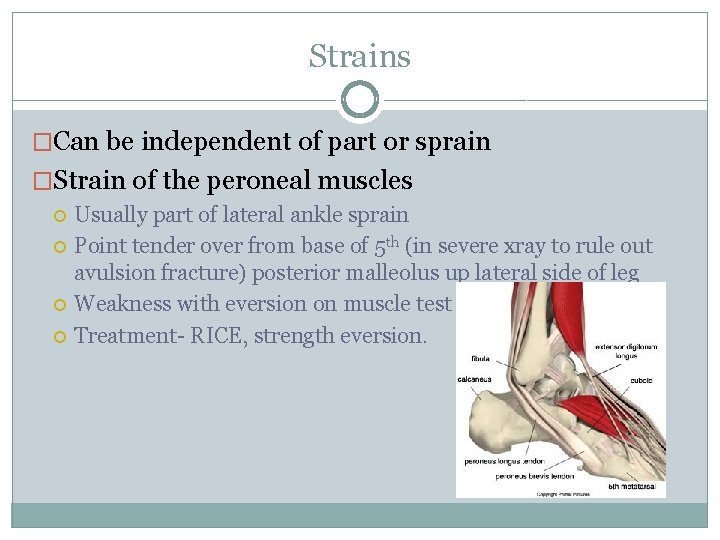
Strains �Can be independent of part or sprain �Strain of the peroneal muscles Usually part of lateral ankle sprain Point tender over from base of 5 th (in severe xray to rule out avulsion fracture) posterior malleolus up lateral side of leg Weakness with eversion on muscle test Treatment- RICE, strength eversion.
Strains �Anterior and dorsum muscle strains- extensor �Cause by forced into extreme dorsal flexion, running backwards �Point tenderness over nails of toes
Strains �Achilles Tendinitis Causes- overuse or acute, tight Achilles or part of ankle sprain, or independent S/sx- point tenderness over achilles, pain with dorsal flexion, weakness with plantar flexion Tx- Stretch achilles, strengthen plantar flexion, RICE, tape to play Can lead to achilles tendon rupture.
Strains
- Slides: 19