
The Animal Body Introduction to Structure and Function
The Animal Body: Introduction to Structure and Function Achadiah Rachmawati
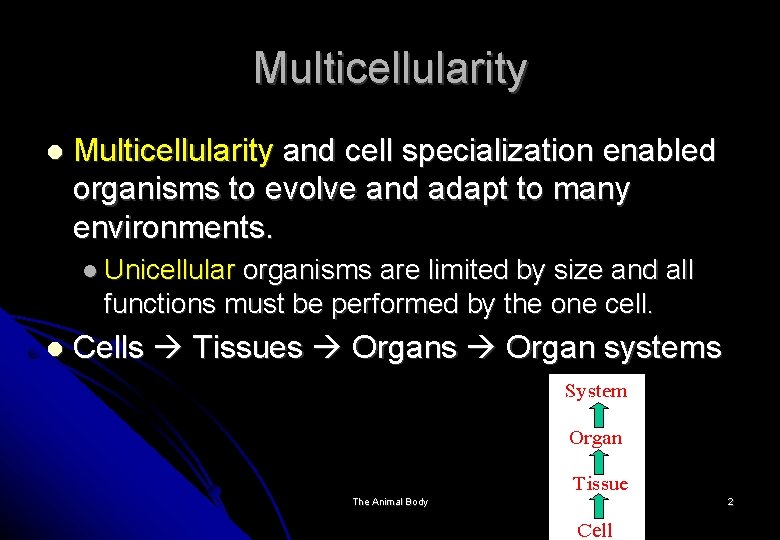
Multicellularity and cell specialization enabled organisms to evolve and adapt to many environments. Unicellular organisms are limited by size and all functions must be performed by the one cell. Cells Tissues Organ systems The Animal Body 2
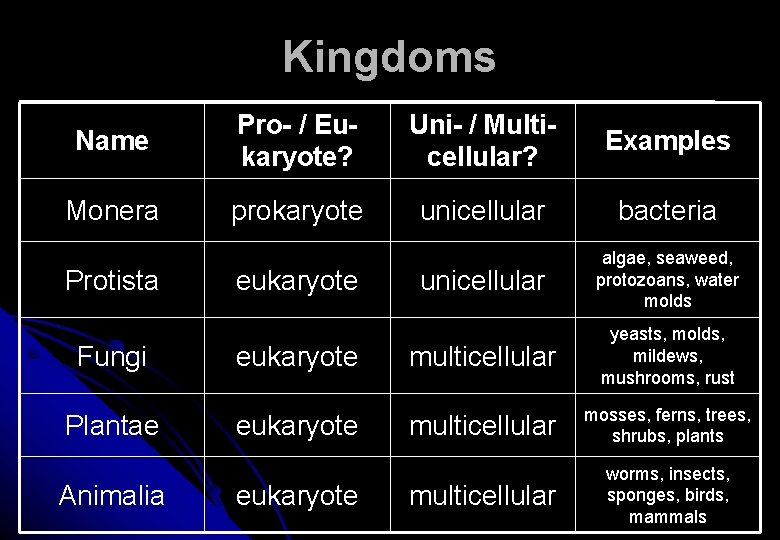
Kingdoms Name Pro- / Eukaryote? Uni- / Multicellular? Examples Monera prokaryote unicellular bacteria unicellular algae, seaweed, protozoans, water molds Protista eukaryote Fungi eukaryote multicellular yeasts, molds, mildews, mushrooms, rust Plantae eukaryote multicellular mosses, ferns, trees, shrubs, plants multicellular worms, insects, sponges, birds, mammals Animalia eukaryote
Organization of the Body Bodies of all vertebrates are basically a tube within a tube. all vertebrate bodies supported by internal skeleton Four levels of organization: cells tissues organ systems The Animal Body 4
Organization of the Body Tissues Groups of cells similar in structure and function are organized into tissues. Early in development, embryo cells differentiate into three germ layers. endoderm mesoderm ectoderm The Animal Body 5
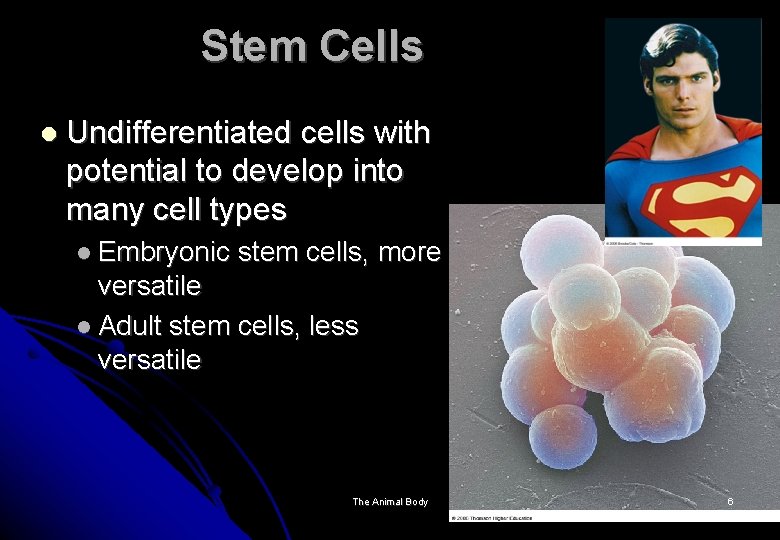
Stem Cells Undifferentiated cells with potential to develop into many cell types Embryonic stem cells, more versatile Adult stem cells, less versatile The Animal Body 6

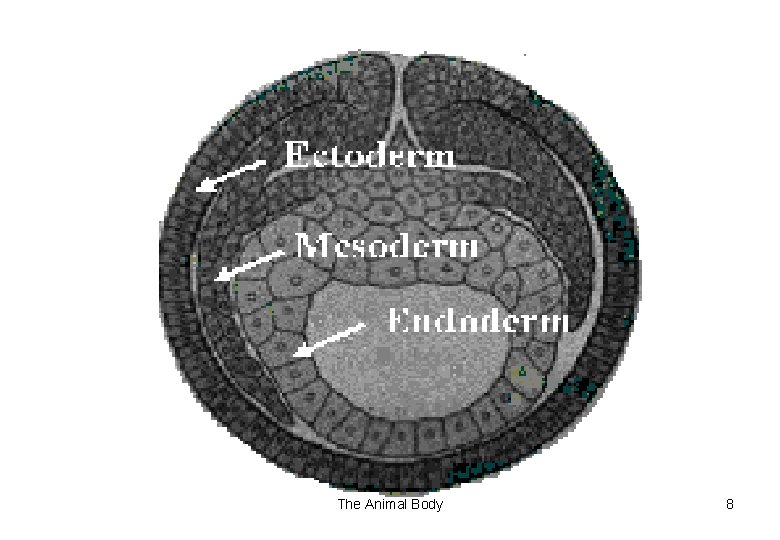
Embryonic Tissues – all adult tissues are derived from one of three embryonic tissues Ectoderm = “outside skin” gut Mesoderm = “middle skin” Animal embryo Endoderm = “inside skin” The Animal Body Cross section through embryo 7
The Animal Body 8
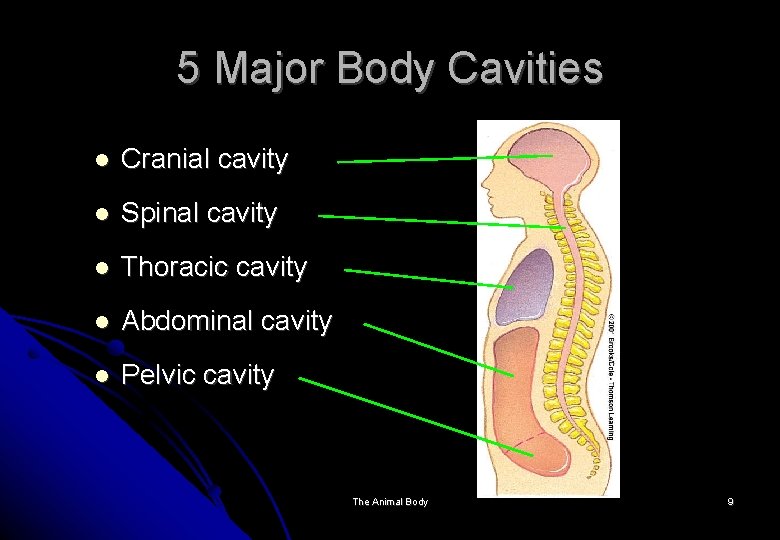
5 Major Body Cavities Cranial cavity Spinal cavity Thoracic cavity Abdominal cavity Pelvic cavity The Animal Body 9
Fate of Embryonic Tissues Ectoderm will become the outer covering of the body and the nervous system Mesoderm will become the muscles and internal skeletons Endoderm will become the lining of the gastrointestinal tract, lungs, vessels and ducts The Animal Body 10
Organization of the Body Tissues Tissue consists of a group of closely associated, similar cells that carry out specific functions Tissues associate to form organs, such as the heart Groups of tissues and organs form organ systems The Animal Body 11
Organization of the Body Organs and organ systems Organs are body structures composed of several different tissues that form a structural and functional unit. An organ system is a group of organs that operate to perform the major activities of the body. The Animal Body 12
Tissues Main types of animal tissue (adult vertebrates) Epithelial Connective Muscle Nervous Classification depends on structure and origin The Animal Body 13
Characteristics of Epithelial Tissue Epithelium tissue forms a continuous layer or sheet covering a body surface or lining a body cavity or every major surface of the vertebrate body derived from all three germ layers Protection Absorption Secretion Sensation The Animal Body 14
Characteristics of Epithelial Tissue Types of epithelial tissues simple - one layer thick squamous - lining of lungs cuboidal - lining of kidney tubules columnar - lining of stomach stratified - several cell layers thick and named according to features of their uppermost layers pseudostratified The Animal Body 15
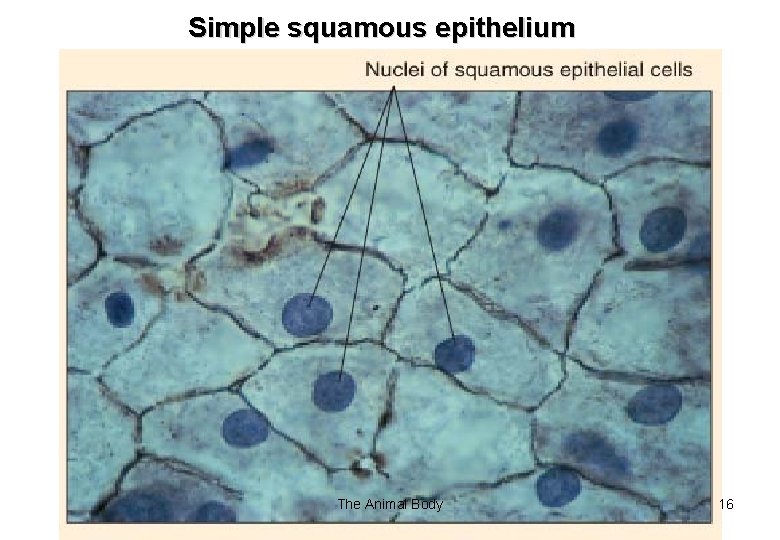
Simple squamous epithelium The Animal Body 16
Characteristics of Epithelial Tissue Simple squamous epithelium Lines blood vessels and air sacs in the lungs Exchange of materials by diffusion The Animal Body 17
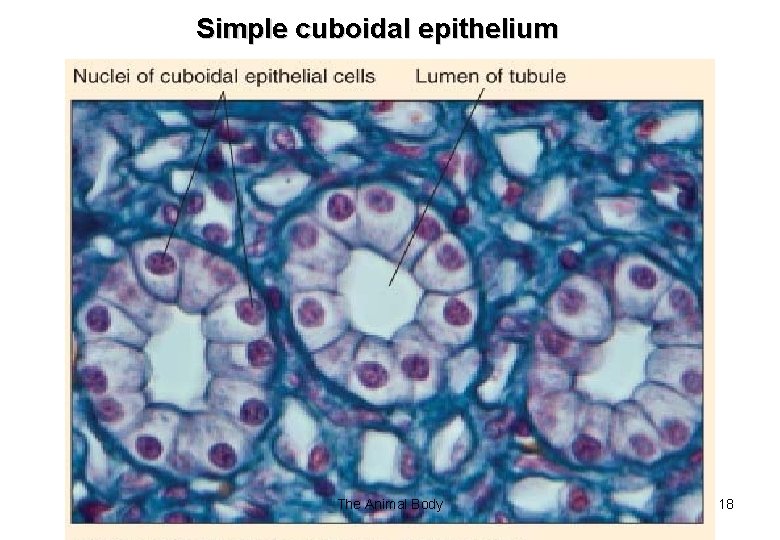
Simple cuboidal epithelium The Animal Body 18
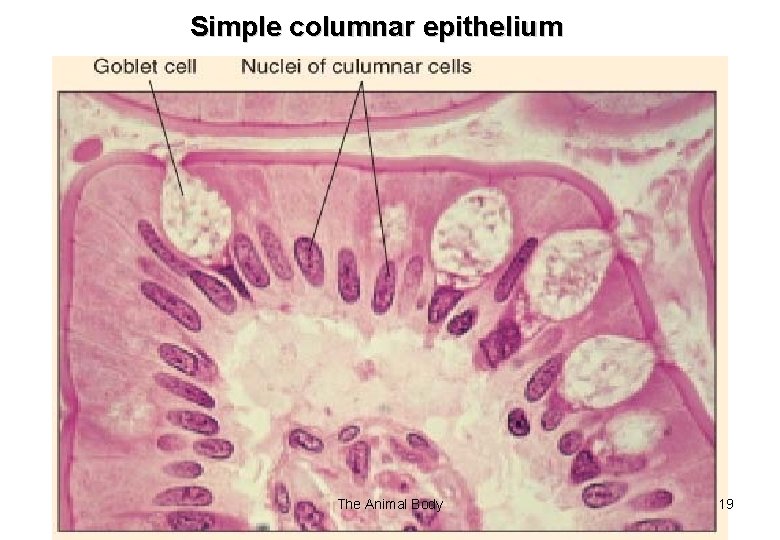
Simple columnar epithelium The Animal Body 19
Characteristics of Epithelial Tissue Simple cuboidal and columnar epithelium Lines passageways Specialized for secretion and absorption The Animal Body 20
Characteristics of Epithelial Tissue Stratified squamous epithelium Outer layer of skin Lines passageways into the body Provides protection Pseudostratified epithelium Lines passageways Protects underlying tissue The Animal Body 21
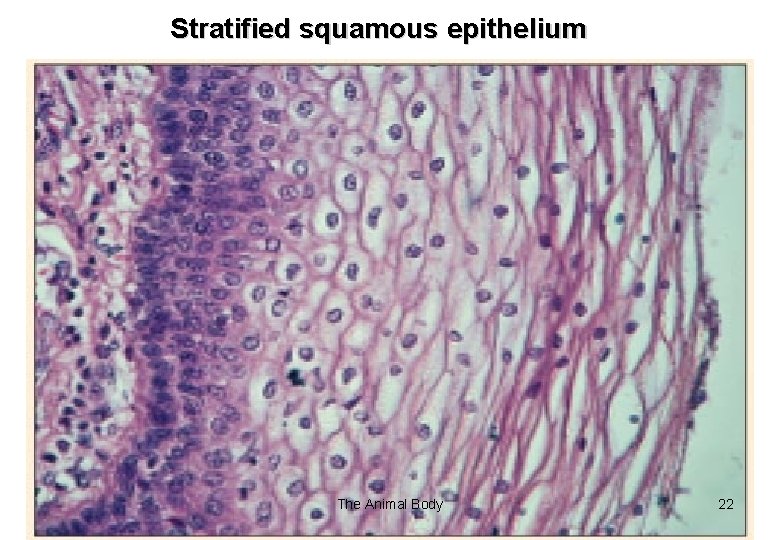
Stratified squamous epithelium The Animal Body 22
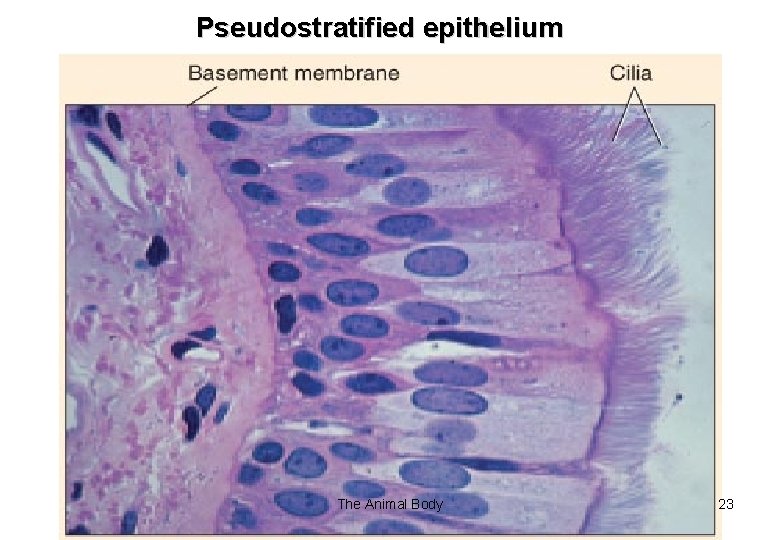
Pseudostratified epithelium The Animal Body 23
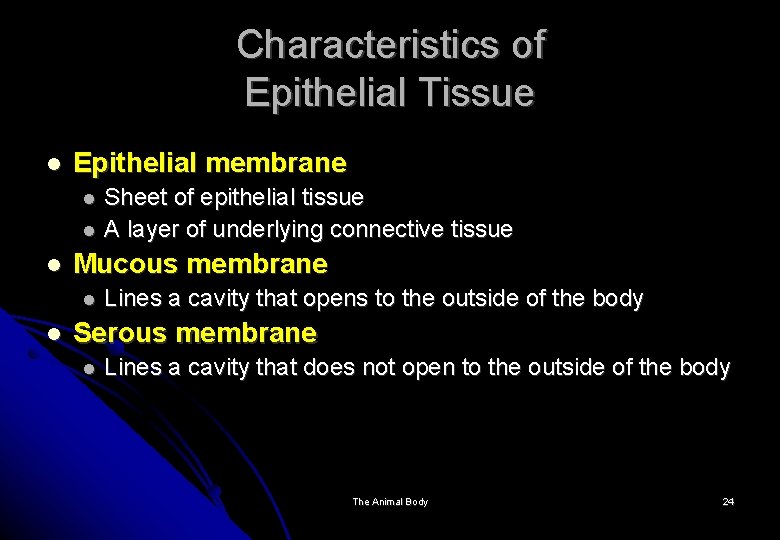
Characteristics of Epithelial Tissue Epithelial membrane Mucous membrane Sheet of epithelial tissue A layer of underlying connective tissue Lines a cavity that opens to the outside of the body Serous membrane Lines a cavity that does not open to the outside of the body The Animal Body 24
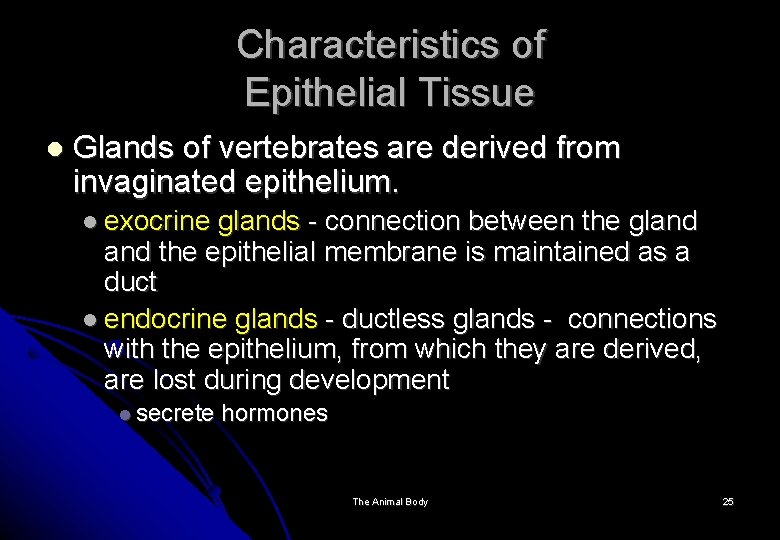
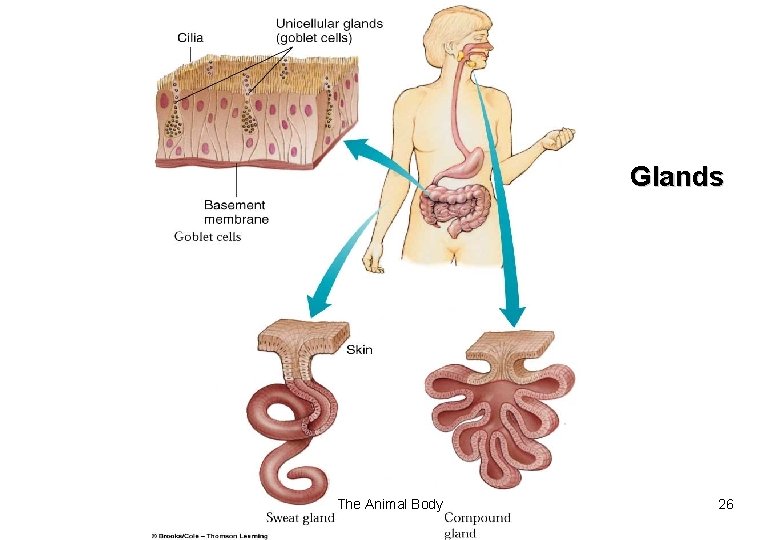
Characteristics of Epithelial Tissue Glands of vertebrates are derived from invaginated epithelium. exocrine glands - connection between the gland the epithelial membrane is maintained as a duct endocrine glands - ductless glands - connections with the epithelium, from which they are derived, are lost during development secrete hormones The Animal Body 25
Glands The Animal Body 26
Connective Tissue Proper Connective tissues are divided into: connective divided special tissue into loose and dense connective tissues include cartilage, bone, and blood extracellular material generically known as matrix The Animal Body 27
Connective Tissue Proper Connective tissue consists of fewer cells separated by intercellular substance, fibers in a matrix Collagen fibers Elastic fibers Reticular fibers The Animal Body 28
Connective Tissue Proper Connective tissue contains specialized cells Fibroblasts Macrophages Functions of connective tissue Joins other tissues Supports the body and its organs Protects underlying organs The Animal Body 29
Connective Tissue Proper Loose connective tissue cells scattered within amorphous mass of proteins that form a ground substance strengthened by collagen, elastin and reticulin - secreted by fibroblasts adipose cells found in loose connective tissue in the subcutaneous tissue between many body parts fibers in a semifluid matrix The Animal Body 30
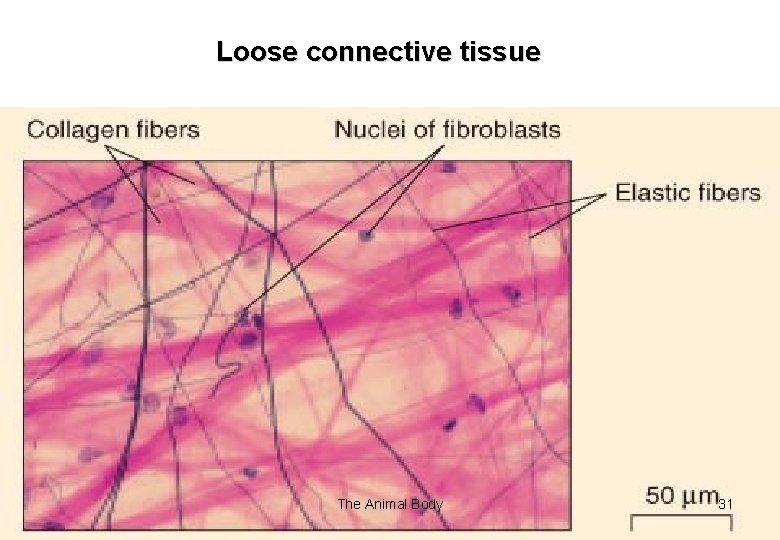
Loose connective tissue The Animal Body 31
Connective Tissue Proper Dense connective tissue regular collagen fibers lined up in parallel tendons and ligaments irregular collagen fibers have many orientations organ coverings - capsules muscle coverings - epimysium nerve coverings - perineurium bone covering - periosteum The Animal Body 32
Special Connective Tissues Bone Many bones are first modeled in cartilage. The cartilage matrix calcifies at particular locations, thus chondrocytes are no longer able to obtain oxygen and nutrients through diffusion. The Animal Body 33
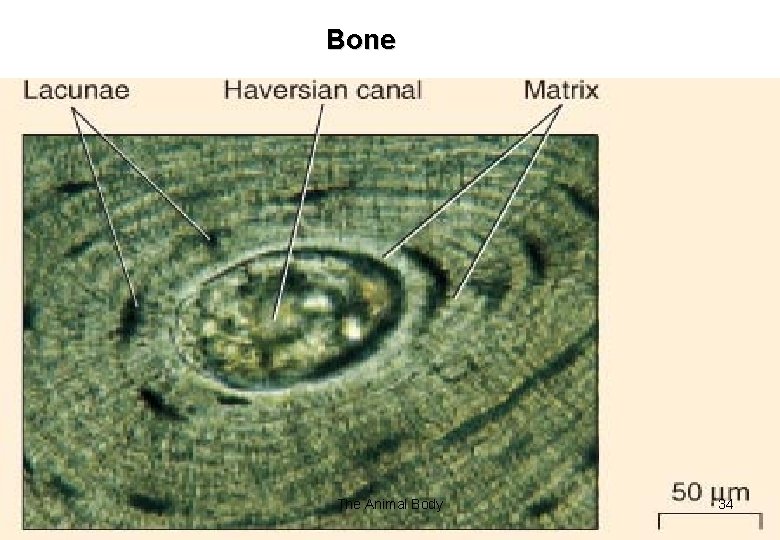
Bone The Animal Body 34
The Structure of Bone New bone is formed by osteoblasts that secrete collagen organic matrix in which calcium phosphate is later deposited. cells then encased in spaces called lacunae in the calcified matrix Bone is constructed in thin, concentric layers or lamellae, laid down around Haversian canals that run parallel to the length of the bone. contain nerve fibers and blood vessels The Animal Body 35
The Structure of Bone formation flat bones - Osteoblasts located in a web of dense connective tissue produce bone within that tissue. long bones - bone first “modeled” in cartilage ends and interior composed of spongy bone The Animal Body 36
Osteocytes Secrete and maintain the matrix of bone Compact bone consists of spindle-shaped units called osteons Central blood vessel through a Haversian canal surrounded by lamellae The Animal Body 37
Special Connective Tissues Cartilage specialized connective tissue in which fibers are laid down along the lines of stress in long, parallel arrays firm and flexible chondrocytes - cartilage cells that live within spaces (lacunae) within cartilage matrix The Animal Body 38
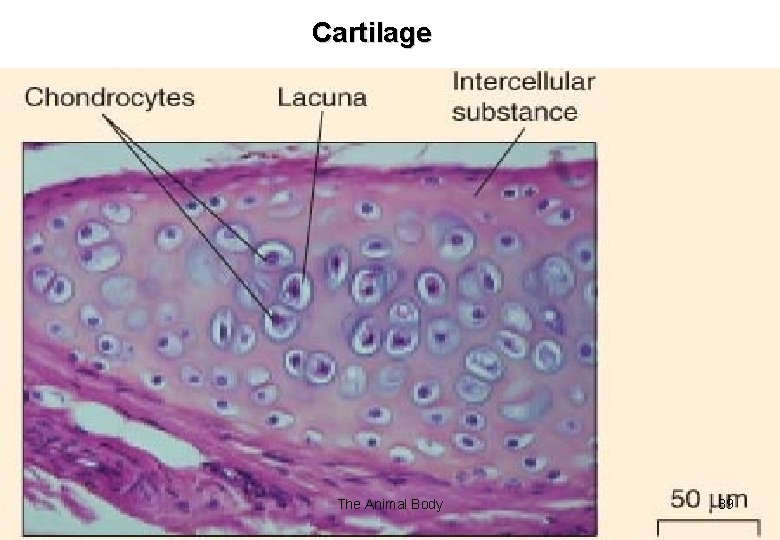
Cartilage The Animal Body 39
Special Connective Tissues Blood classified as connective tissue because it contains plasma and platelets erythrocytes - contain hemoglobin leukocytes - have nuclei and mitochondria, but lack hemoglobin neutrophils, eosinophils, and basophils lymphocytes and monocytes The Animal Body 40
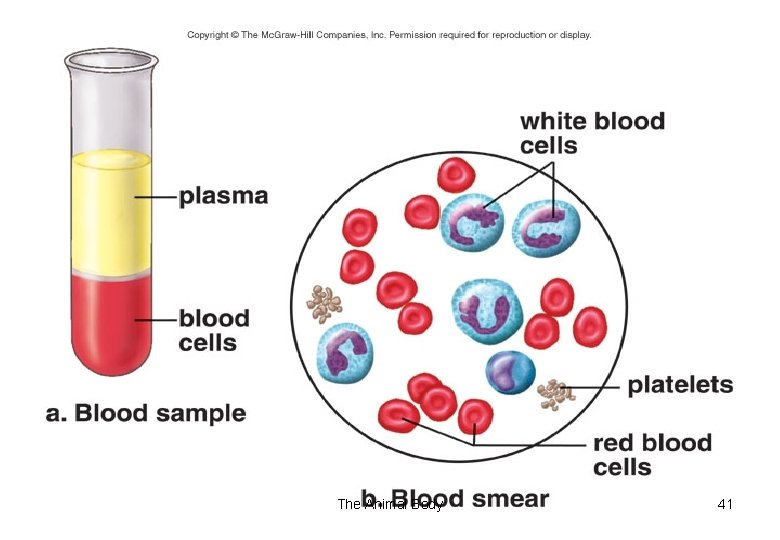
(Matrix) The Animal Body 41
Muscle Tissue Muscle cells are the motors of the vertebrate body. three types: smooth - skeletal - cardiac Skeletal and cardiac muscles are striated because their cells have transverse stripes when viewed in longitudinal section. Contraction of skeletal muscle is under voluntary control, whereas contraction in cardiac and smooth muscle is generally involuntary. The Animal Body 42
Muscle Tissue Muscle tissue consists of cells specialized to contract Each cell is an elongated muscle fiber containing contractile units called myofibrils The Animal Body 43
Muscle Tissue Smooth muscle - found in organs of internal environment (viscera) Contracts involuntarily Elongated, spindle-shaped fibers lack striation Each fiber has a central nucleus Responsible for movement of food through the digestive tract The Animal Body 44
Muscle Tissue Skeletal muscle - usually attached to tendons or bones, so when muscles contract causes bones to move at joints made up of long muscle fibers that contract by myofibrils made up of highly ordered arrays of actin and myosin filaments The Animal Body 45
Muscle Tissue Cardiac muscles composed of smaller, interconnected cells, each with a single nucleus interconnections appear as dark lines called intercalated disks enable cardiac muscles to form single functioning unit - myocardium The Animal Body 46
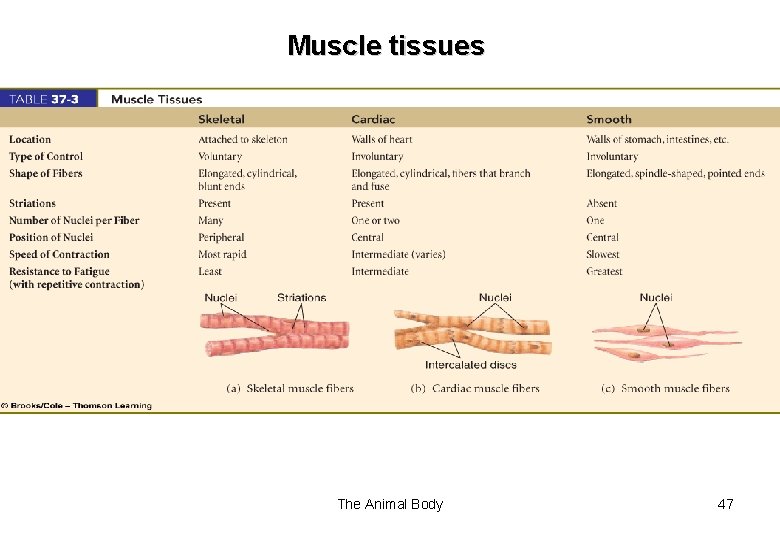
Muscle tissues The Animal Body 47
Types of Skeletons Hydrostatic skeletons - fluid-filled cavity encircled by muscle fibers As the muscles contract, fluid in the cavity moves and changes cavity shape. Exoskeletons - surround the body as a rigid, hard case must be periodically shed limits body size as exoskeleton has to grow increasingly thicker and heavier The Animal Body 48
Types of Skeletons Endoskeletons - rigid internal skeleton to which muscles are attached composed of cartilage or bone vertebrate skeleton axial skeleton - forms axis of body and supports organs of the head, neck, and chest appendicular skeleton - includes bones of the limbs, pectoral and pelvic girdles The Animal Body 49
Actions of Skeletal Muscles Skeletal muscles produce movement of the skeleton when they contract. attachment to bones made by tendons origin remains stationary during contraction insertion attached to bone that moves during contraction The Animal Body 50
Actions of Skeletal Muscles Synergists - muscles that cause same action at a joint Antagonists - muscles that produce opposing actions Isotonic contraction - muscle and all fibers shorten in length thus force of contraction remains relatively constant Isometric contraction - tension is absorbed by tendons and other elastic tissue, and muscle does not change in length The Animal Body 51
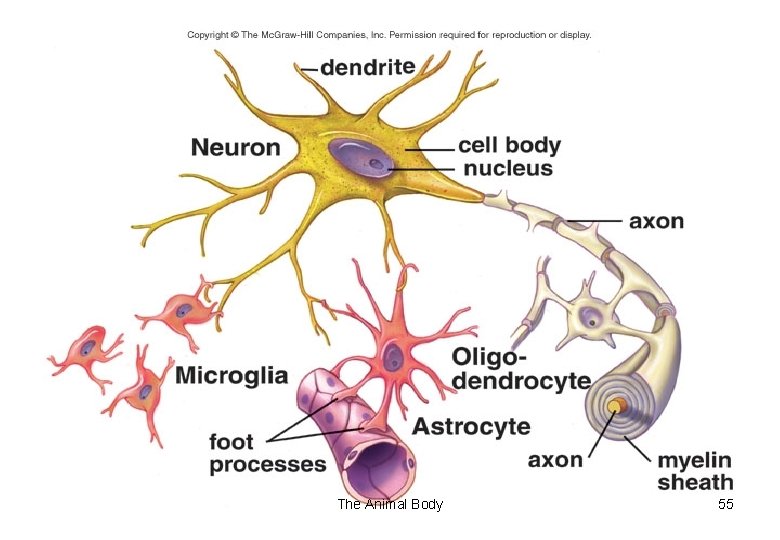
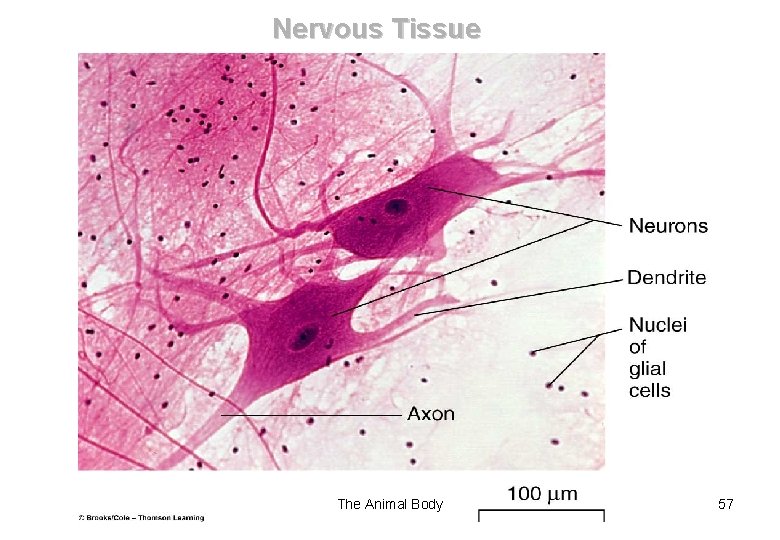
Nerve Tissue Cells include neurons and neuroglia (supporting cells) Neurons are specialized to produce and conduct electrochemical impulses. The Animal Body 52
Nerve Tissue Neuroglia do not conduct electrical impulses but instead support and insulate neurons and eliminate foreign materials in and around neurons. myelin sheath - insulating covering of neuroglia cells wrapped around axons nodes of Ranvier separate adjacent neuroglia cells The Animal Body 53
Nerve Tissue Nervous system is divided in the central nervous system (CNS) which includes the brain and spinal cord, and the peripheral nervous system (PNS) which includes nerves and ganglia. Nerves consist of axons in the PNS bundled together. Ganglia are collections of neuron cell bodies. The Animal Body 54
The Animal Body 55
Nerve Tissue Elongated neurons receive and transmit information Dendrites receive signals and transmit them to the cell body Axon transmits signal to other neurons, a muscle, or a gland Synapse is a junction between neurons The Animal Body 56
Nervous Tissue The Animal Body 57
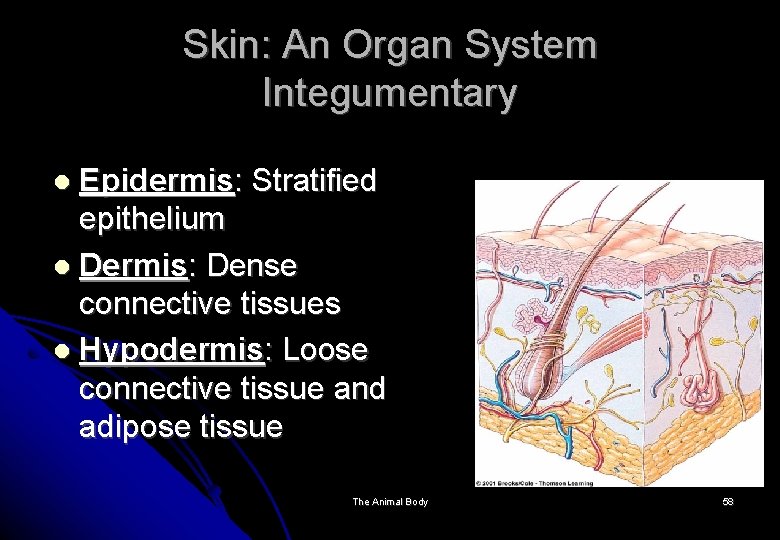
Skin: An Organ System Integumentary Epidermis: Stratified epithelium Dermis: Dense connective tissues Hypodermis: Loose connective tissue and adipose tissue The Animal Body 58
Functions of Human Skin Protects body from injury, dehydration, UV radiation, and some pathogens Helps control temperature Receives external stimuli Involved in vitamin D production Important stuff, this The Animal Body 59
Sun Damages Skin UV light stimulates melanin production tans skin Tan protects inner layers against UV damage UV exposure causes elastin fibers to clump skin to age prematurely skin cancer The Animal Body 60
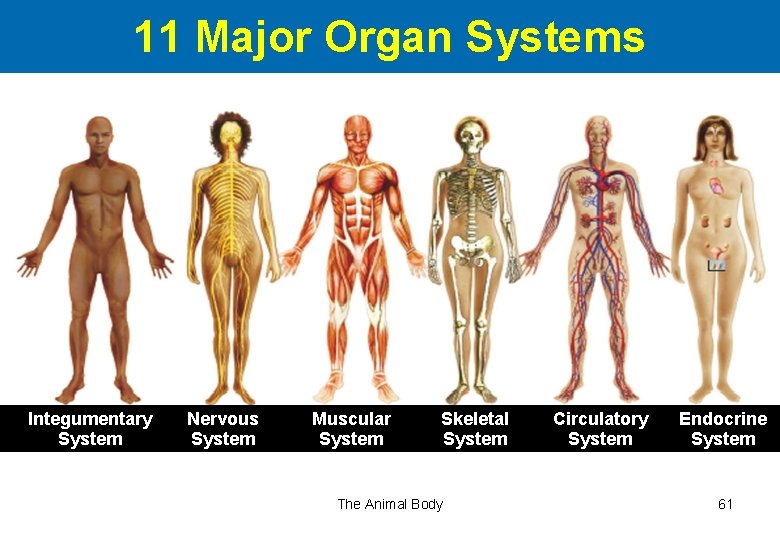
11 Major Organ Systems Integumentary System Nervous System Muscular System Skeletal System The Animal Body Circulatory System Endocrine System 61
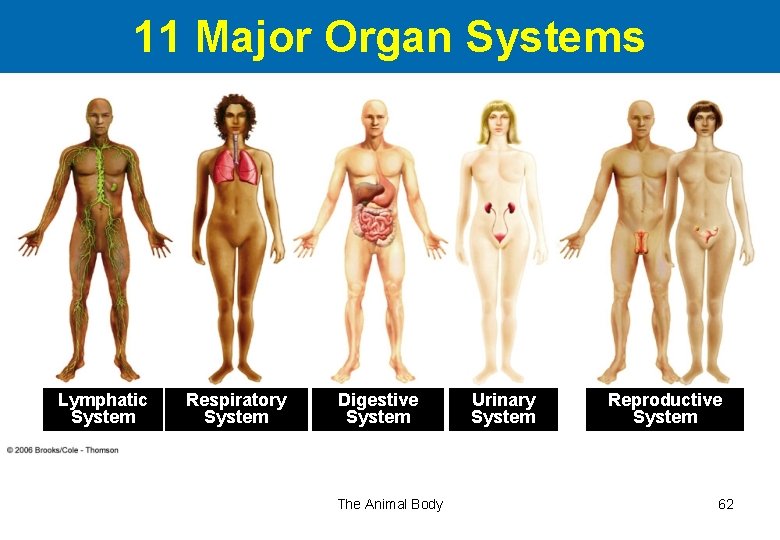
11 Major Organ Systems Lymphatic System Respiratory System Digestive System The Animal Body Urinary System Reproductive System 62
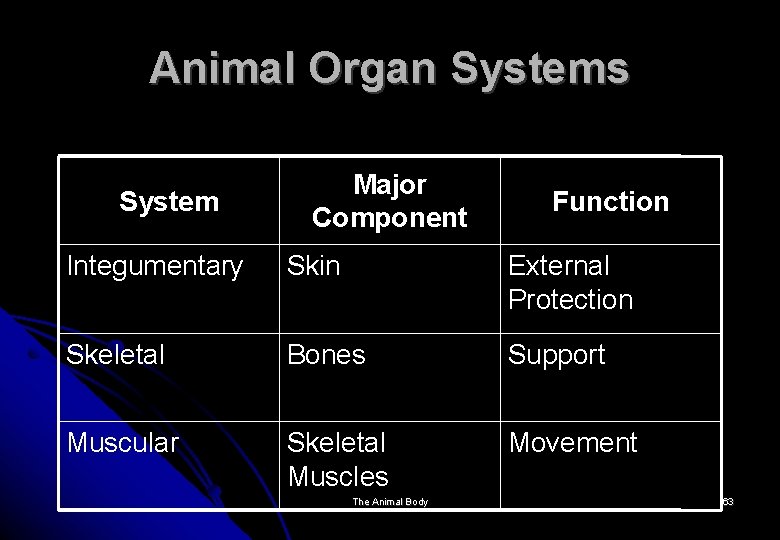
Animal Organ Systems System Major Component Function Integumentary Skin External Protection Skeletal Bones Support Muscular Skeletal Muscles Movement The Animal Body 63
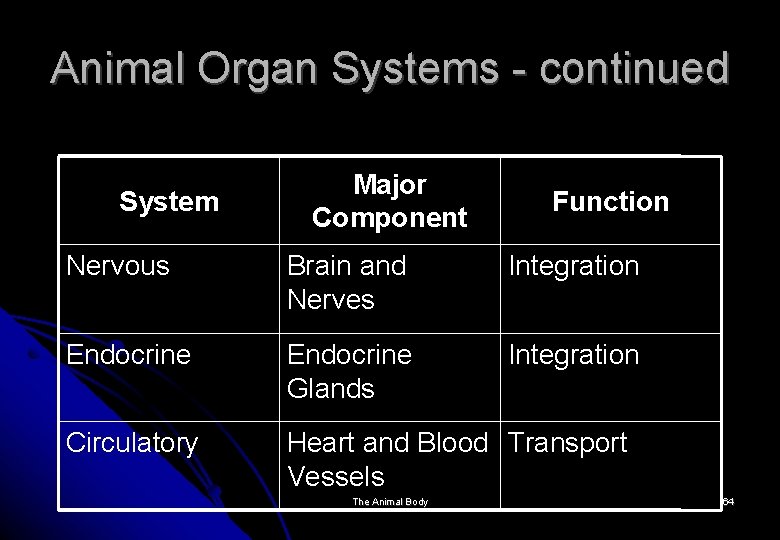
Animal Organ Systems - continued System Major Component Function Nervous Brain and Nerves Integration Endocrine Glands Integration Circulatory Heart and Blood Transport Vessels The Animal Body 64
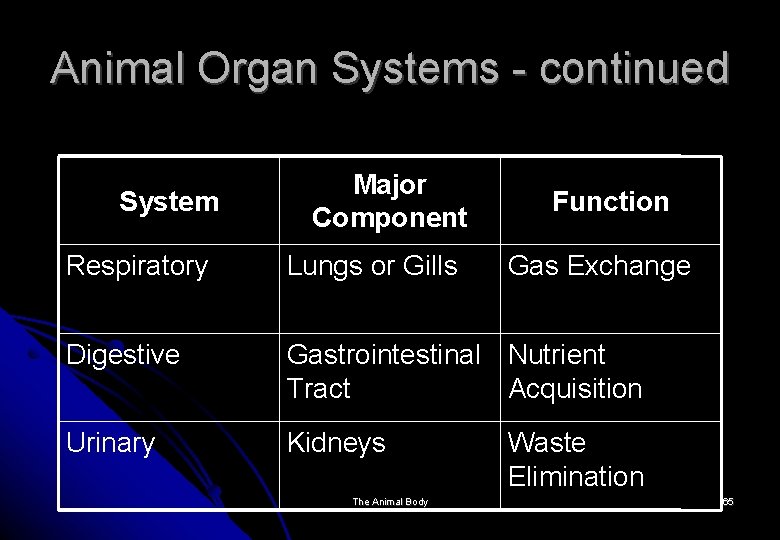
Animal Organ Systems - continued System Major Component Function Respiratory Lungs or Gills Digestive Gastrointestinal Nutrient Tract Acquisition Urinary Kidneys The Animal Body Gas Exchange Waste Elimination 65
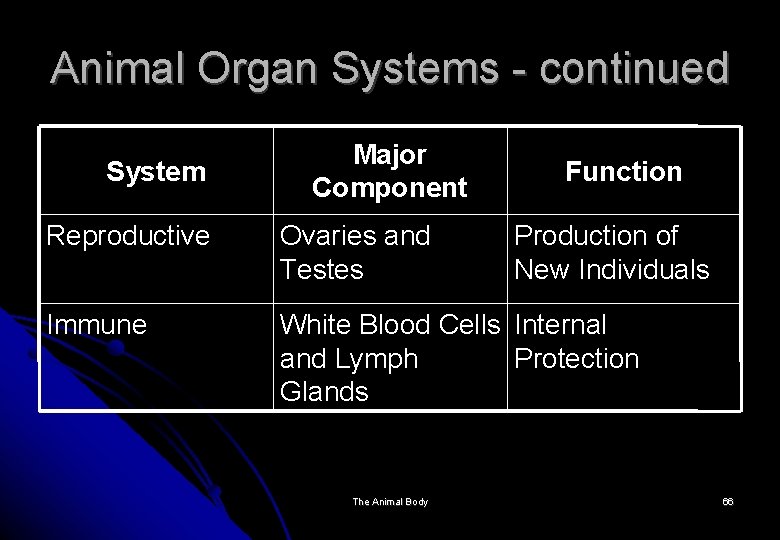
Animal Organ Systems - continued System Major Component Function Reproductive Ovaries and Testes Immune White Blood Cells Internal and Lymph Protection Glands The Animal Body Production of New Individuals 66
The Animal Body 67
- Slides: 67