
The Angola Current and its seasonal variability as
![The Angola Current and its seasonal variability as observed at 11°S Robert Kopte[1], Peter](https://slidetodoc.com/presentation_image_h/00b58b36b72273f695839b5f6d06d808/image-1.jpg "The Angola Current and its seasonal variability as observed at 11°S Robert Kopte[1], Peter")
The Angola Current and its seasonal variability as observed at 11°S Robert Kopte[1], Peter Brandt[1, 2], Marcus Dengler[1], Martin Claus[1], Richard J. Greatbatch[1, 2] [1] GEOMAR Helmholtz Centre for Ocean Research Kiel, Germany [2] Kiel University, Kiel, Germany EGU General Assembly 2016 Vienna, Austria April 18, 2016
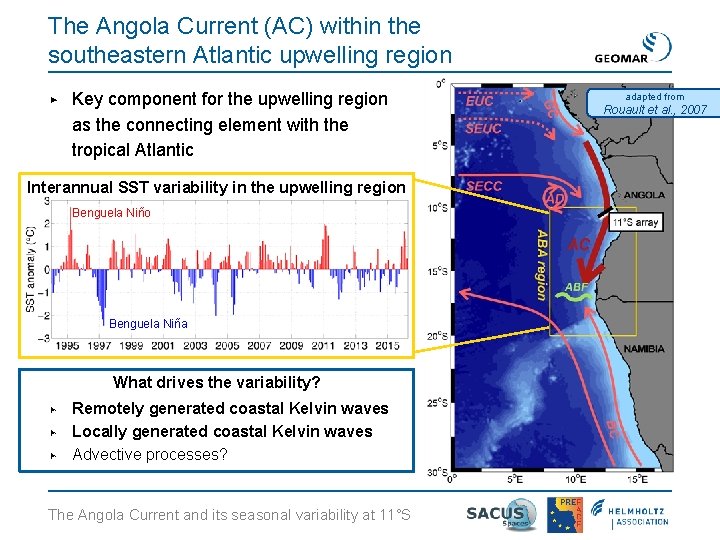
The Angola Current (AC) within the southeastern Atlantic upwelling region ▶ Key component for the upwelling region as the connecting element with the tropical Atlantic Interannual SST variability in the upwelling region Benguela Niño Benguela Niña What drives the variability? ▶ ▶ ▶ Remotely generated coastal Kelvin waves Locally generated coastal Kelvin waves Advective processes? The Angola Current and its seasonal variability at 11°S adapted from Rouault et al. , 2007
![Remotely forced semi-annual waves Wind stress [N/m 2] (zonal along equator, meridional along coast)](http://slidetodoc.com/presentation_image_h/00b58b36b72273f695839b5f6d06d808/image-3.jpg "Remotely forced semi-annual waves Wind stress [N/m 2] (zonal along equator, meridional along coast)")
Remotely forced semi-annual waves Wind stress [N/m 2] (zonal along equator, meridional along coast) Rouault, 2012 SLA (cm) along the equator (left) and the southwest African coast (right) ▶ Bi-annual intrusion of warm tropical water into the northern Benguela upwelling region, quasi-synchronized to the seasonal cycle in sea level anomaly (SLA) ▶ What is the associated variability of the Angola Current? The Angola Current and its seasonal variability at 11°S
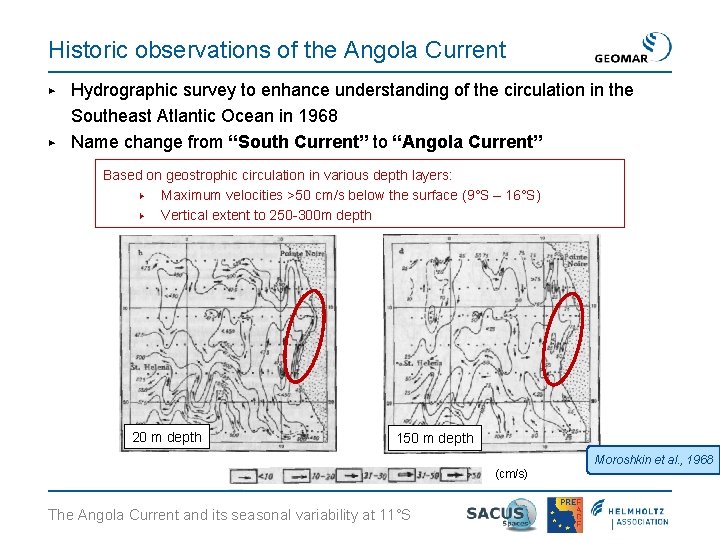
Historic observations of the Angola Current ▶ ▶ Hydrographic survey to enhance understanding of the circulation in the Southeast Atlantic Ocean in 1968 Name change from “South Current” to “Angola Current” Based on geostrophic circulation in various depth layers: ▶ Maximum velocities >50 cm/s below the surface (9°S – 16°S) ▶ Vertical extent to 250 -300 m depth 20 m depth 150 m depth Moroshkin et al. , 1968 (cm/s) The Angola Current and its seasonal variability at 11°S
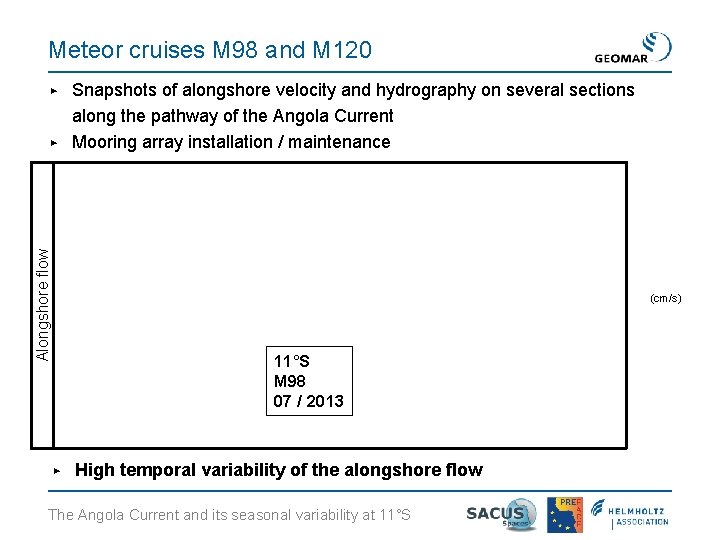
Meteor cruises M 98 and M 120 ▶ Alongshore flow ▶ Snapshots of alongshore velocity and hydrography on several sections along the pathway of the Angola Current Mooring array installation / maintenance (cm/s) 11°S M 98 07 / 2013 ▶ High temporal variability of the alongshore flow The Angola Current and its seasonal variability at 11°S M 120 10 / 2015
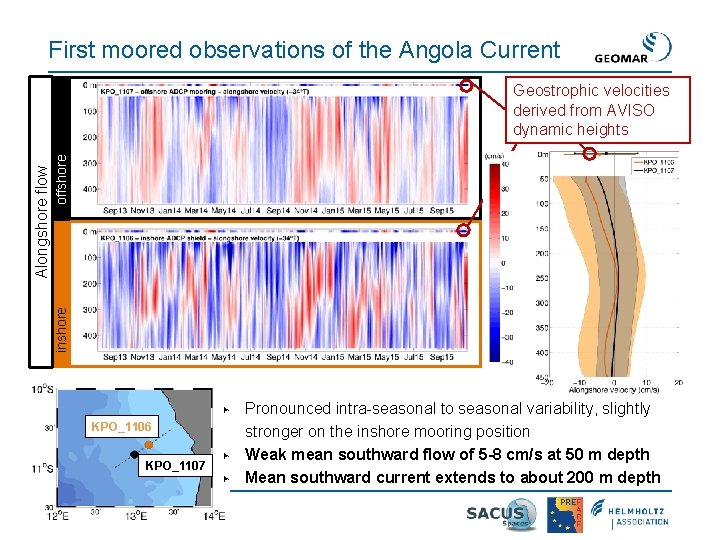
First moored observations of the Angola Current offshore inshore Alongshore flow Geostrophic velocities derived from AVISO dynamic heights ▶ KPO_1106 KPO_1107 ▶ ▶ Pronounced intra-seasonal to seasonal variability, slightly stronger on the inshore mooring position Weak mean southward flow of 5 -8 cm/s at 50 m depth Mean southward current extends to about 200 m depth
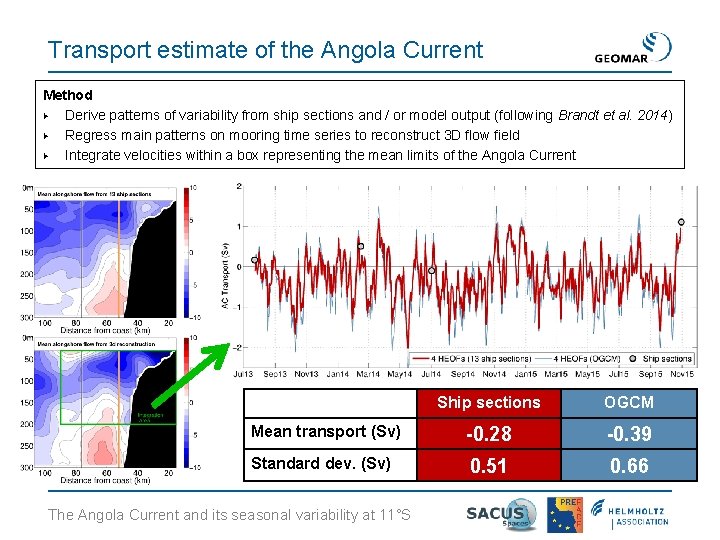
Transport estimate of the Angola Current Method ▶ Derive patterns of variability from ship sections and / or model output (following Brandt et al. 2014) ▶ Regress main patterns on mooring time series to reconstruct 3 D flow field ▶ Integrate velocities within a box representing the mean limits of the Angola Current Ship sections OGCM Mean transport (Sv) -0. 28 -0. 39 Standard dev. (Sv) 0. 51 0. 66 The Angola Current and its seasonal variability at 11°S
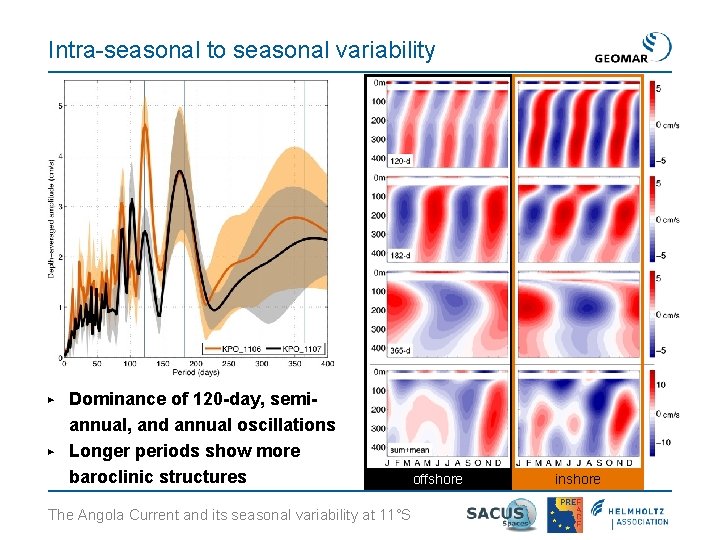
Intra-seasonal to seasonal variability ▶ ▶ Dominance of 120 -day, semiannual, and annual oscillations Longer periods show more baroclinic structures The Angola Current and its seasonal variability at 11°S offshore inshore
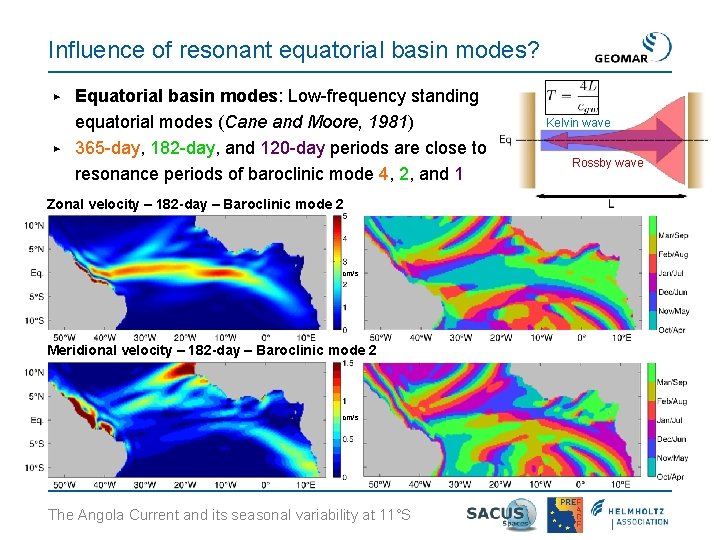
Influence of resonant equatorial basin modes? ▶ ▶ Equatorial basin modes: Low-frequency standing equatorial modes (Cane and Moore, 1981) 365 -day, 182 -day, and 120 -day periods are close to resonance periods of baroclinic mode 4, 2, and 1 Zonal velocity – 182 -day – Baroclinic mode 2 cm/s Meridional velocity – 182 -day – Baroclinic mode 2 cm/s The Angola Current and its seasonal variability at 11°S Kelvin wave Rossby wave
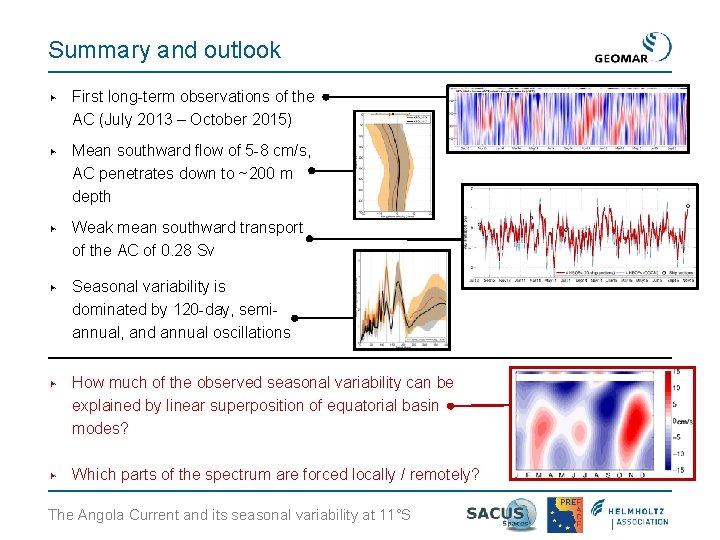
Summary and outlook ▶ First long-term observations of the AC (July 2013 – October 2015) ▶ Mean southward flow of 5 -8 cm/s, AC penetrates down to ~200 m depth ▶ Weak mean southward transport of the AC of 0. 28 Sv ▶ Seasonal variability is dominated by 120 -day, semiannual, and annual oscillations ▶ How much of the observed seasonal variability can be explained by linear superposition of equatorial basin modes? ▶ Which parts of the spectrum are forced locally / remotely? The Angola Current and its seasonal variability at 11°S
- Slides: 10