
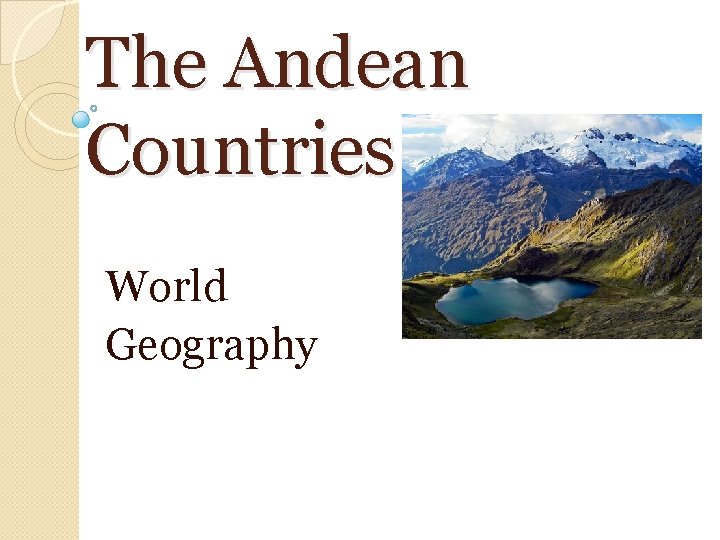
The Andean Countries World Geography The Andes Form
- Slides: 19
The Andean Countries World Geography
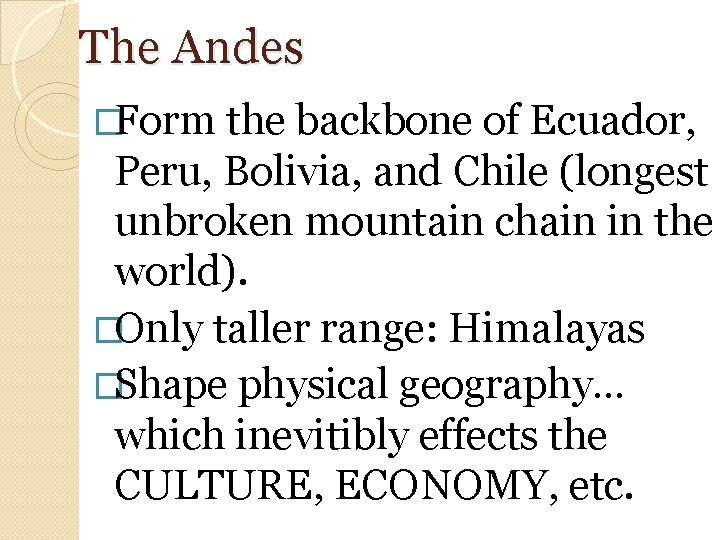
The Andes �Form the backbone of Ecuador, Peru, Bolivia, and Chile (longest unbroken mountain chain in the world). �Only taller range: Himalayas �Shape physical geography… which inevitibly effects the CULTURE, ECONOMY, etc.
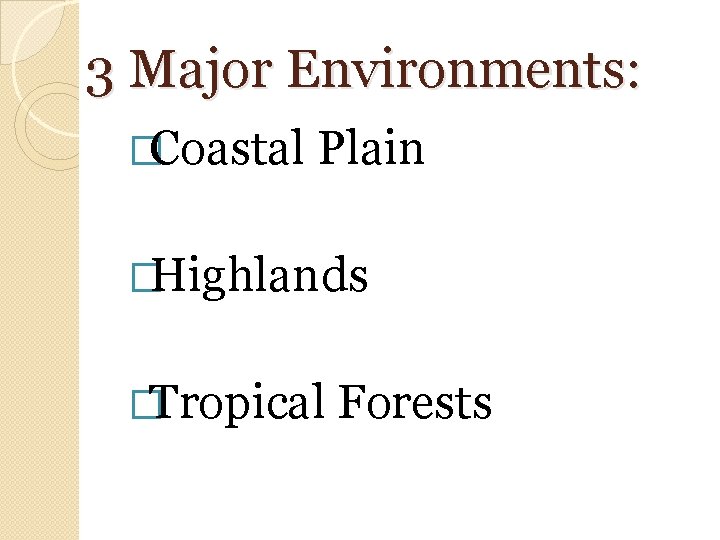
3 Major Environments: �Coastal Plain �Highlands �Tropical Forests
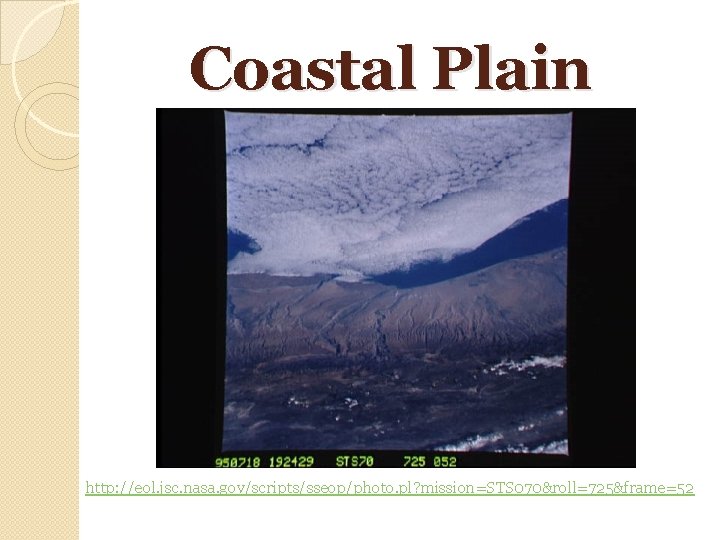
Coastal Plain http: //eol. jsc. nasa. gov/scripts/sseop/photo. pl? mission=STS 070&roll=725&frame=52
Coastal Plain Characteristics: �Flat (ish) area between the mountains and the sea. �At points it is very small (where the mountains reach almost to the sea), while at others it is almost 100 miles inland.
Atacama Desert �Coastal Plain in Northern Chile �So dry it has preserved relics from ancient times such as textiles (woven hundreds of years ago) and mud¿brick buildings.
Highlands �Range from 6, 500 to 16, 000 feet above sea level �Altiplano = highlands in Peru & Bolivia �Páramos = highlands in Ecuador
Highlands cont. �Climate varies with elevation �Alpine Tundra: vegetation at high altitudes (above the TIMBER LINE, boundary above which continuous forest vegetation cannot grow)
Tropical Forests �Selva: name for the forested regions in Ecuador, Peru, and Bolivia ◦ Rain forests of the Amazon River begin here ◦ Jaguars, hummingbirds, monkeys, and toucans live here, but few people
Economics and Culture: �Vertical trade: crops grown in higher elevations (potatoes, cabbages) traded for lower elevations (bananas, sugar cane) � 25 -55% of the population of Bolivia, Ecuador and Peru are Native Americans
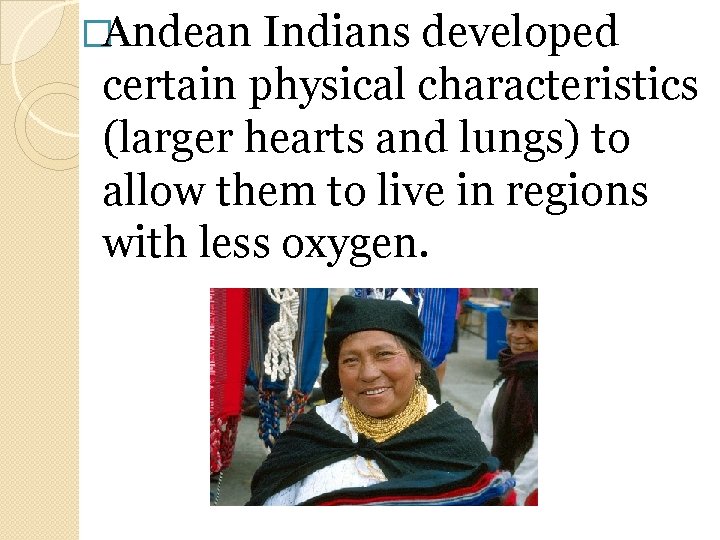
�Andean Indians developed certain physical characteristics (larger hearts and lungs) to allow them to live in regions with less oxygen.
Ecuador �From “equator” �¼ of 12, 900, 000 people are from Indian descent �Quechua (KECH wah) = language, from Incas �Subsistence agriculture � 10 % of population has European background… but they own most of the large farms and factories (thus have substantial influence)
1960 s �Oil discovered in the selva lowlands �Challenge to transfer from mountains to the coast (pipelines built) �Petroleum became important export
Peru �Former heart of the Inca Empire �Fell to Spaniards in early 1500 s � 45% of population are Native Americans and speak Quechua or Aymara �Subsistence farming, herding alpacas or llamas are main economic activities
�Mestizos constitute the other majority of the population �Live in urban areas or on the coastal plain �Work for low wages in factories producing fish meal (for animal feed) or on plnatations (cotton, sugar cane, rice) �Poverty and unemployment are major issues
�Asian immigration to Peru: ◦ 1990 election of first Peruvian president of Japanese ancestry ◦ Improved economy and suppressed guerrilla rebellion ◦ Allegations of corruption led him to resign
Bolivia �Landlocked: lacks profitable coastal ports �Many minerals, but the best have been removed �Most Bolivians are Indians, mostly subsistence farmers living in the highlands �Climate varies from humid and tropical to cold and semiarid
Chile �“End of the land” � 2, 700 miles long, but only averages 100 miles wide � 2/3 of the population (15, 000) are mestizos �¼ of the population is of European descent (mostly Spanish, British, German) �Relatively few Indians
�Santiago: the capital, is home to about 1/3 of the country's population �High unemployment, unskilled, illiterate workers from the countryside �About 3 million people (or 1/5) live below the poverty line