
The ancient Greeks tried to explain matter but
The ancient Greeks tried to explain matter, but the scientific study of the atom began with John Dalton in the early 1800's.
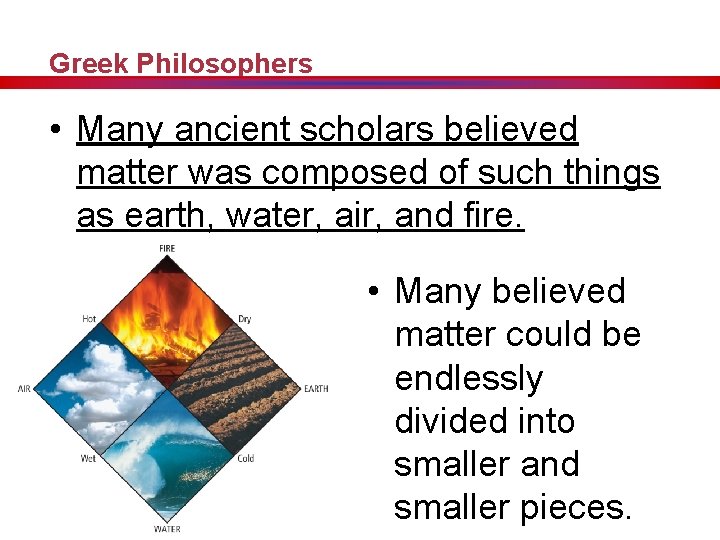
Greek Philosophers • Many ancient scholars believed matter was composed of such things as earth, water, air, and fire. • Many believed matter could be endlessly divided into smaller and smaller pieces.
Greek Philosophers (cont. ) • Democritus (460– 370 B. C. ) was the first person to propose the idea that matter was made up of atoms, which move through empty space. • Aristotle (484– 322 B. C. ) disagreed with Democritus because he did not believe empty space could exist (reverted to 4 elements). • Aristotle’s views went unchallenged for 2, 000 years until science developed methods to test the validity of his ideas.
Greek Philosophers (cont. ) • John Dalton revived the idea of the atom in the early 1800 s based on numerous chemical reactions. • Dalton’s atomic theory: explained conservation of mass in a reaction as the result of the combination, separation, or rearrangement of atoms.
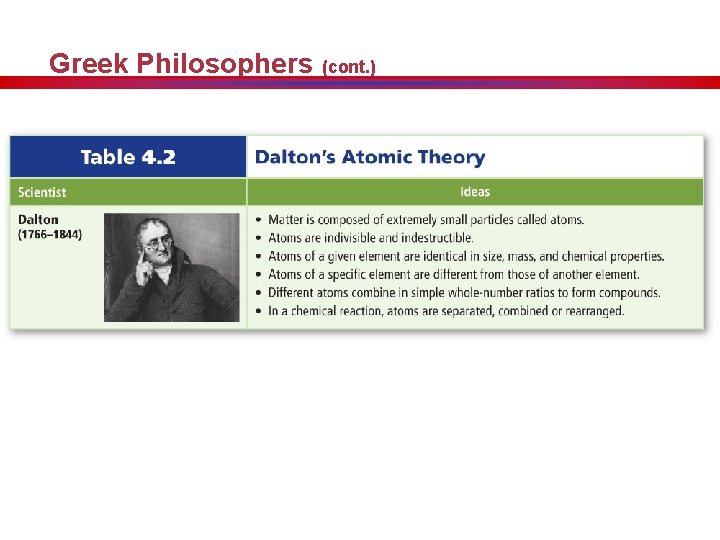
Greek Philosophers (cont. )
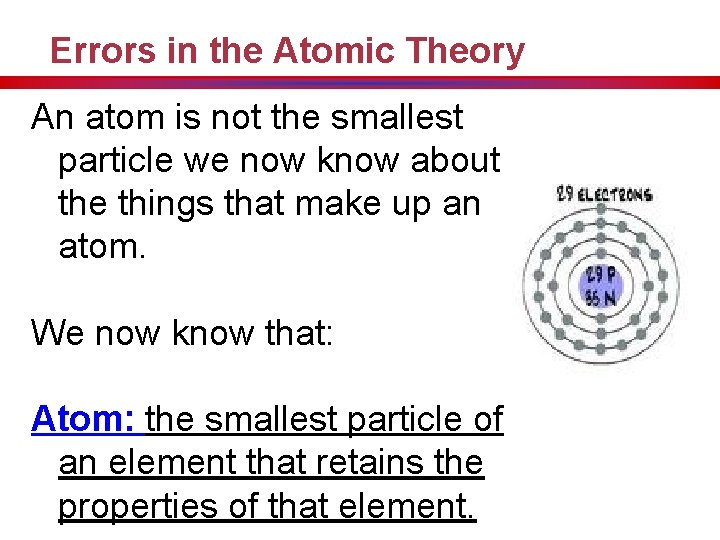
Errors in the Atomic Theory An atom is not the smallest particle we now know about the things that make up an atom. We now know that: Atom: the smallest particle of an element that retains the properties of that element.
The Atom • Once scientist were convinced of the existence of an atom, a new set of question emerged. • What is an atom like? • Although many scientist researched an atom in the 1800’s, it was not until almost 1900 that some of these questions were answered.
Historical Scientists Project • It is now your turn to do some research… • You will be in groups of 3 -4 and assigned a historical scientist to research • This scientist had an impact on the historical development of the atom • YOUR JOB: give a creative, informative presentation on your scientist and how they influenced the historical development of the atom
Historical Scientists Project cont. • You MUST be creative…use props, lab equipment, dress up, etc. • It is a ~5 minute presentation and you will be graded using a rubric; you will have Wednesday. Friday to research and prepare. • Your classmates are relying on you to provide them with accurate, memorable information from which to study from for the test. Due Date: Monday 12/9/19
Timeline of the Atom
An atom is made of a nucleus containing protons and neutrons; electrons move around the nucleus.
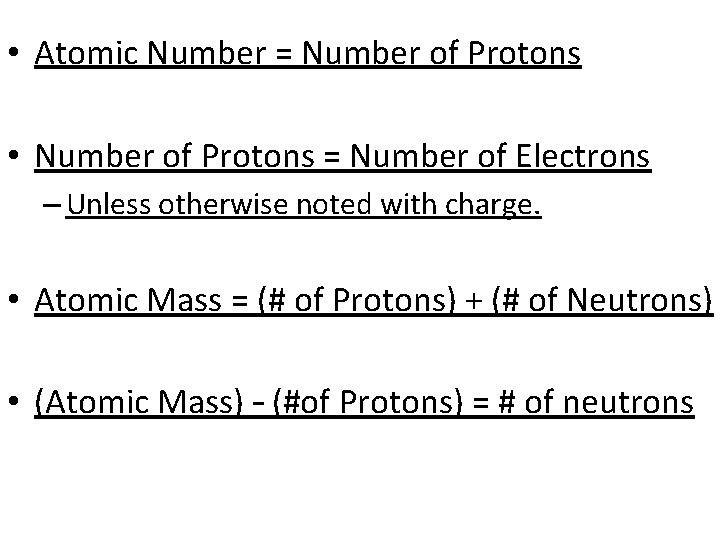
• Atomic Number = Number of Protons • Number of Protons = Number of Electrons – Unless otherwise noted with charge. • Atomic Mass = (# of Protons) + (# of Neutrons) • (Atomic Mass) – (#of Protons) = # of neutrons
- Slides: 12