
The Anatomy of an ER2 Aircraft Instrumentation Observation

The Anatomy of an ER-2 Aircraft • Instrumentation • Observation • Experimentation By Cerese Albers
The ER-2 helps with the TCSP missions objectives: TCSP research will address the following topical areas: 1) tropical cyclone structure, genesis, intensity change, moisture fields and rainfall; 2) satellite and aircraft remote sensor data assimilation and validation studies pertaining to development of tropical cyclones; and 3) the role of upper tropospheric/lower stratospheric processes governing tropical cyclone outflow, the response of wave disturbances to deep convection and the evolution of the upper level warm core.
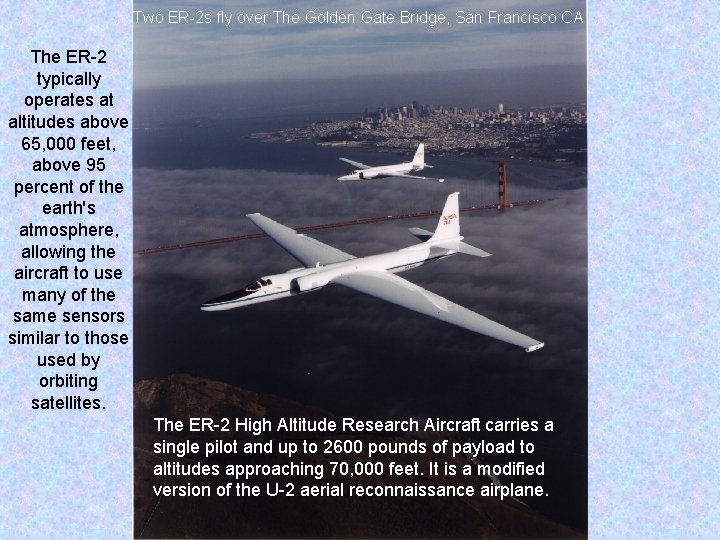
Two ER-2 s fly over The Golden Gate Bridge, San Francisco CA The ER-2 typically operates at altitudes above 65, 000 feet, above 95 percent of the earth's atmosphere, allowing the aircraft to use many of the same sensors similar to those used by orbiting satellites. The ER-2 High Altitude Research Aircraft carries a single pilot and up to 2600 pounds of payload to altitudes approaching 70, 000 feet. It is a modified version of the U-2 aerial reconnaissance airplane.
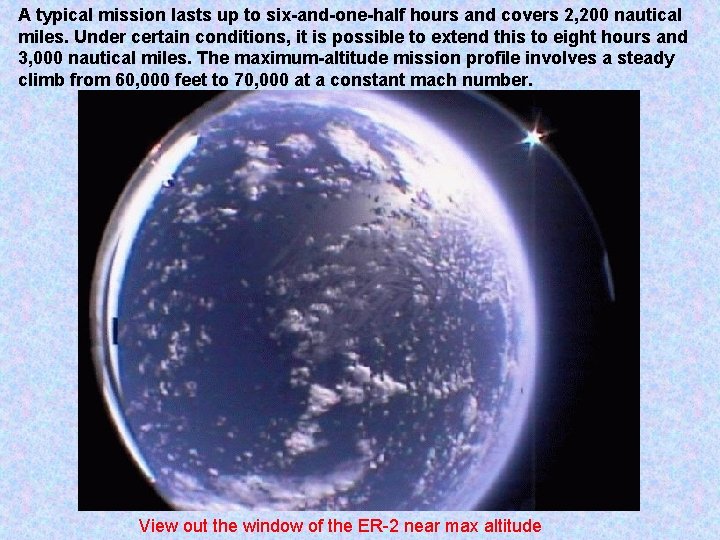
A typical mission lasts up to six-and-one-half hours and covers 2, 200 nautical miles. Under certain conditions, it is possible to extend this to eight hours and 3, 000 nautical miles. The maximum-altitude mission profile involves a steady climb from 60, 000 feet to 70, 000 at a constant mach number. View out the window of the ER-2 near max altitude
The ER-2 is equipped with an Inertial Navigation System that can get position updates from an on-board GPS receiver. It also has a data recording and distribution system that records aircraft performance and navigation data and distributes it to each of the payload areas. The ER-2 core instruments include: • Daedalus multi-spectral scanners with the following configurations: • Thematic Mapper Simulator • Multi-spectral Airborne Mapping System • Airborne Ocean Color Imager • MODIS Airborne Simulator • Three types of aerial cameras that provide high-resolution photography at several scales and resolutions • A video imaging system.
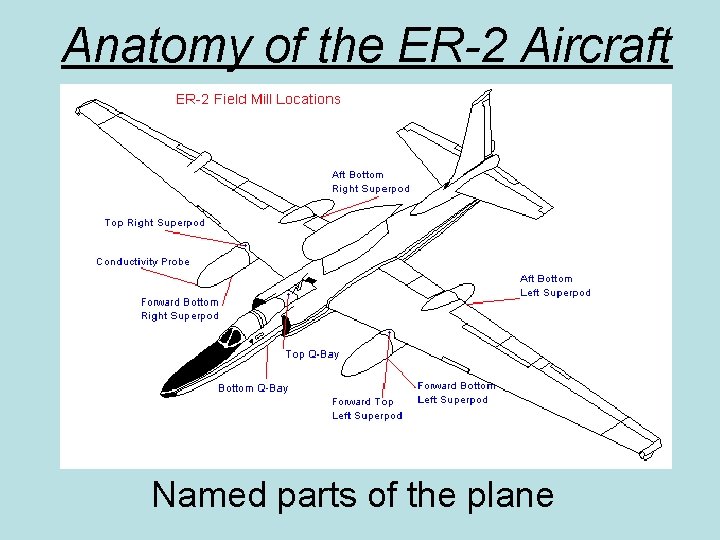
Anatomy of the ER-2 Aircraft Named parts of the plane

The ER-2 is equipped with UHF, VHF, and HF radio systems for two-way voice communication. An Air Traffic Control (ATC) transponder enables surveillance radar to identify the aircraft via coded transmissions. The ER-2 can navigate with respect to ground based radio beacons, as selected by the pilot. Navigation aids used for this include: low-frequency Automatic Direction Finding (ADF), Tactical Air Navigation (TACAN) for bearing and range information, and a VHF Omnidirectional Range/Instrument Landing System (VOR/ILS). Inertial Navigation Systems The Inertial Navigation System (INS) on the ER-2 operates by sensing accelerations from a gyro-stabilized, all-attitude platform. This information is integrated by a digital computer to provide an indication of present position (latitude and longitude), attitude data (pitch and roll), and course line computation referenced to great circle routes. A control display unit in the cockpit allows the pilot to store navigation way points and to change the flight track enroute. A self-contained system, the INS offers world-wide navigation capability. An update function allows for GPS updating of the INS to provide navigation independent of the drift errors.

Anatomy of the ER-2 Aircraft
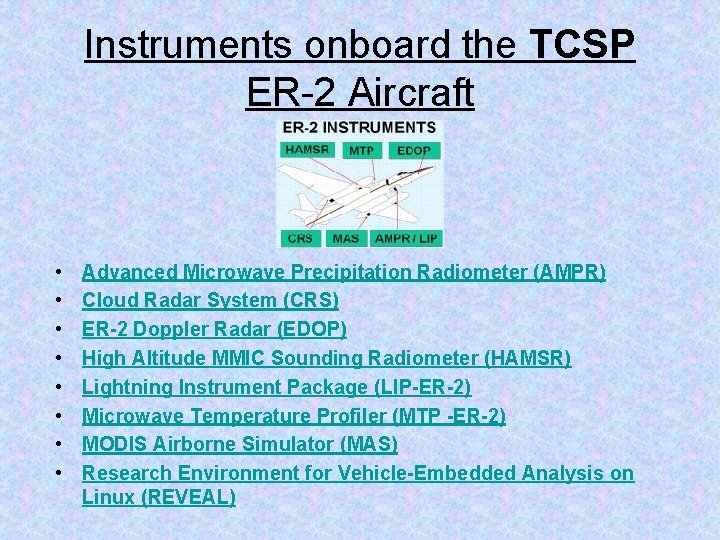
Instruments onboard the TCSP ER-2 Aircraft • • Advanced Microwave Precipitation Radiometer (AMPR) Cloud Radar System (CRS) ER-2 Doppler Radar (EDOP) High Altitude MMIC Sounding Radiometer (HAMSR) Lightning Instrument Package (LIP-ER-2) Microwave Temperature Profiler (MTP -ER-2) MODIS Airborne Simulator (MAS) Research Environment for Vehicle-Embedded Analysis on Linux (REVEAL)

INTRODUCTION TO THE INSTRUMENTS ONBOARD THE ER-2 Undercarriage of an ER-2 in flight
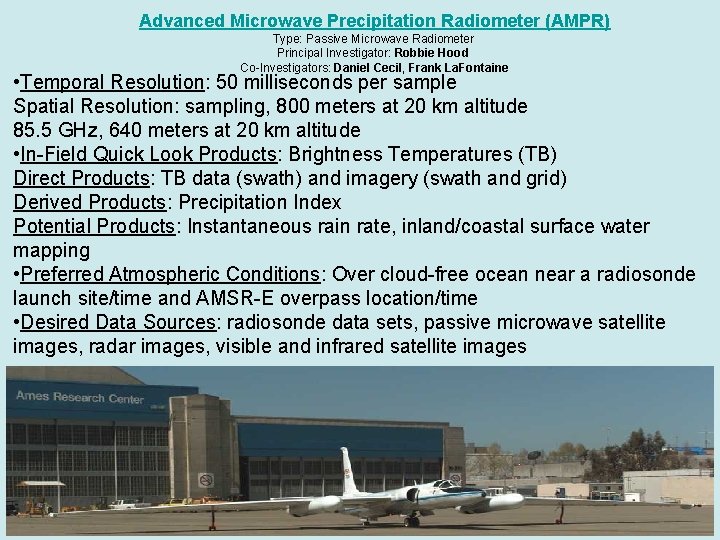
Advanced Microwave Precipitation Radiometer (AMPR) Type: Passive Microwave Radiometer Principal Investigator: Robbie Hood Co-Investigators: Daniel Cecil, Frank La. Fontaine • Temporal Resolution: 50 milliseconds per sample Spatial Resolution: sampling, 800 meters at 20 km altitude 85. 5 GHz, 640 meters at 20 km altitude • In-Field Quick Look Products: Brightness Temperatures (TB) Direct Products: TB data (swath) and imagery (swath and grid) Derived Products: Precipitation Index Potential Products: Instantaneous rain rate, inland/coastal surface water mapping • Preferred Atmospheric Conditions: Over cloud-free ocean near a radiosonde launch site/time and AMSR-E overpass location/time • Desired Data Sources: radiosonde data sets, passive microwave satellite images, radar images, visible and infrared satellite images
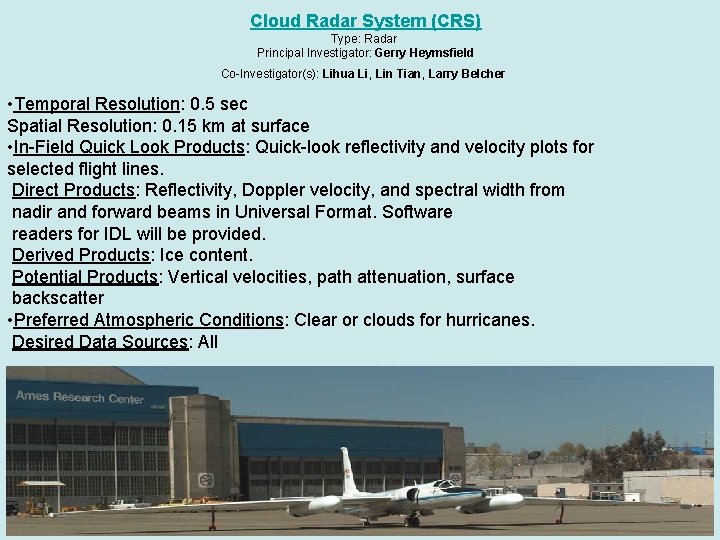
Cloud Radar System (CRS) Type: Radar Principal Investigator: Gerry Heymsfield Co-Investigator(s): Lihua Li, Lin Tian, Larry Belcher • Temporal Resolution: 0. 5 sec Spatial Resolution: 0. 15 km at surface • In-Field Quick Look Products: Quick-look reflectivity and velocity plots for selected flight lines. Direct Products: Reflectivity, Doppler velocity, and spectral width from nadir and forward beams in Universal Format. Software readers for IDL will be provided. Derived Products: Ice content. Potential Products: Vertical velocities, path attenuation, surface backscatter • Preferred Atmospheric Conditions: Clear or clouds for hurricanes. Desired Data Sources: All
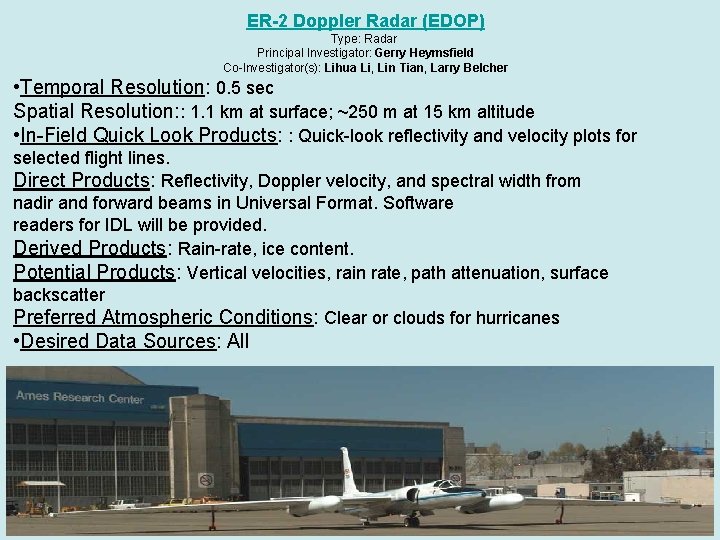
ER-2 Doppler Radar (EDOP) Type: Radar Principal Investigator: Gerry Heymsfield Co-Investigator(s): Lihua Li, Lin Tian, Larry Belcher • Temporal Resolution: 0. 5 sec Spatial Resolution: : 1. 1 km at surface; ~250 m at 15 km altitude • In-Field Quick Look Products: : Quick-look reflectivity and velocity plots for selected flight lines. Direct Products: Reflectivity, Doppler velocity, and spectral width from nadir and forward beams in Universal Format. Software readers for IDL will be provided. Derived Products: Rain-rate, ice content. Potential Products: Vertical velocities, rain rate, path attenuation, surface backscatter Preferred Atmospheric Conditions: Clear or clouds for hurricanes • Desired Data Sources: All
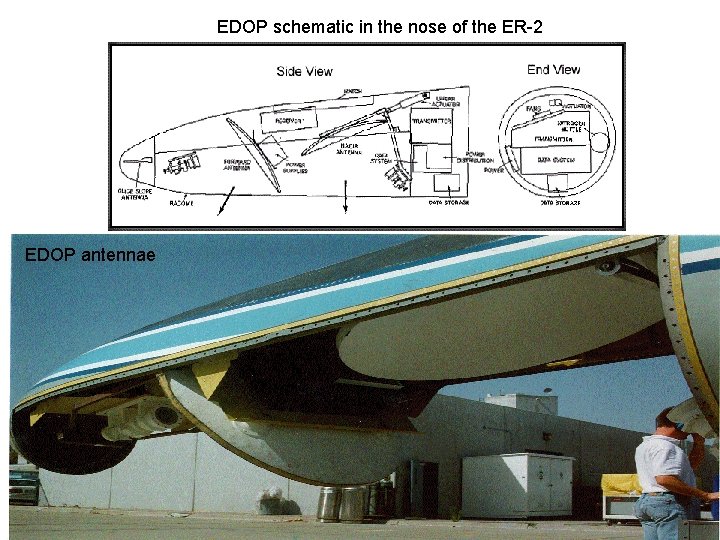
EDOP schematic in the nose of the ER-2 EDOP antennae
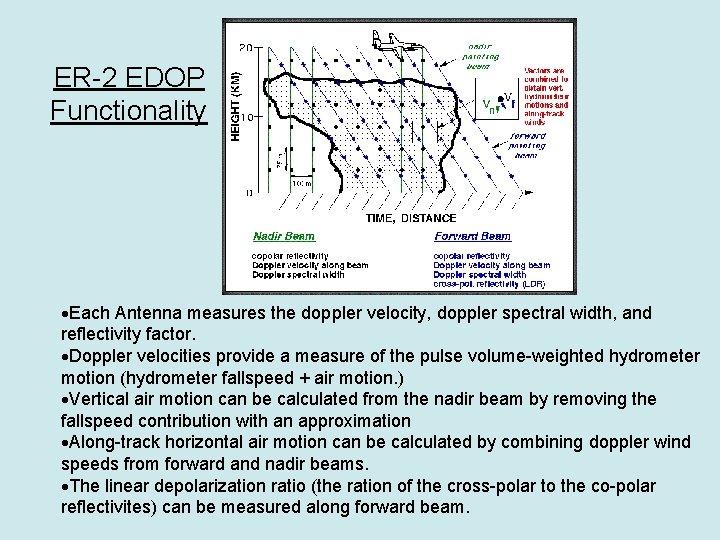
ER-2 EDOP Functionality Each Antenna measures the doppler velocity, doppler spectral width, and reflectivity factor. Doppler velocities provide a measure of the pulse volume-weighted hydrometer motion (hydrometer fallspeed + air motion. ) Vertical air motion can be calculated from the nadir beam by removing the fallspeed contribution with an approximation Along-track horizontal air motion can be calculated by combining doppler wind speeds from forward and nadir beams. The linear depolarization ratio (the ration of the cross-polar to the co-polar reflectivites) can be measured along forward beam.
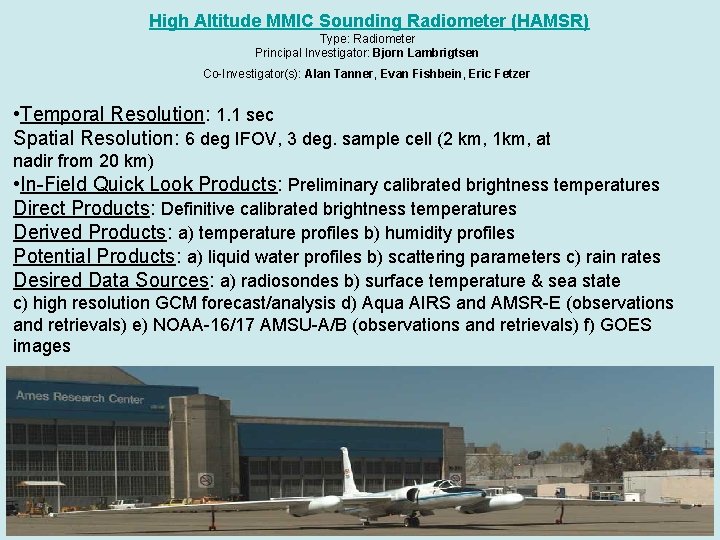
High Altitude MMIC Sounding Radiometer (HAMSR) Type: Radiometer Principal Investigator: Bjorn Lambrigtsen Co-Investigator(s): Alan Tanner, Evan Fishbein, Eric Fetzer • Temporal Resolution: 1. 1 sec Spatial Resolution: 6 deg IFOV, 3 deg. sample cell (2 km, 1 km, at nadir from 20 km) • In-Field Quick Look Products: Preliminary calibrated brightness temperatures Direct Products: Definitive calibrated brightness temperatures Derived Products: a) temperature profiles b) humidity profiles Potential Products: a) liquid water profiles b) scattering parameters c) rain rates Desired Data Sources: a) radiosondes b) surface temperature & sea state c) high resolution GCM forecast/analysis d) Aqua AIRS and AMSR-E (observations and retrievals) e) NOAA-16/17 AMSU-A/B (observations and retrievals) f) GOES images
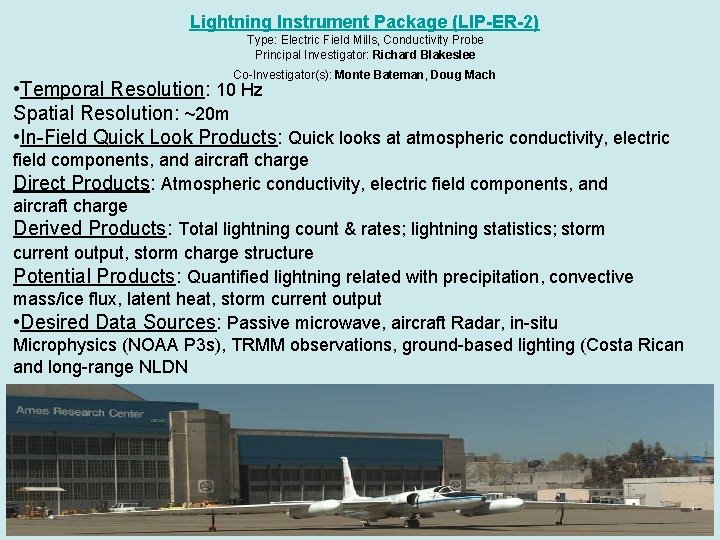
Lightning Instrument Package (LIP-ER-2) Type: Electric Field Mills, Conductivity Probe Principal Investigator: Richard Blakeslee Co-Investigator(s): Monte Bateman, Doug Mach • Temporal Resolution: 10 Hz Spatial Resolution: ~20 m • In-Field Quick Look Products: Quick looks at atmospheric conductivity, electric field components, and aircraft charge Direct Products: Atmospheric conductivity, electric field components, and aircraft charge Derived Products: Total lightning count & rates; lightning statistics; storm current output, storm charge structure Potential Products: Quantified lightning related with precipitation, convective mass/ice flux, latent heat, storm current output • Desired Data Sources: Passive microwave, aircraft Radar, in-situ Microphysics (NOAA P 3 s), TRMM observations, ground-based lighting (Costa Rican and long-range NLDN
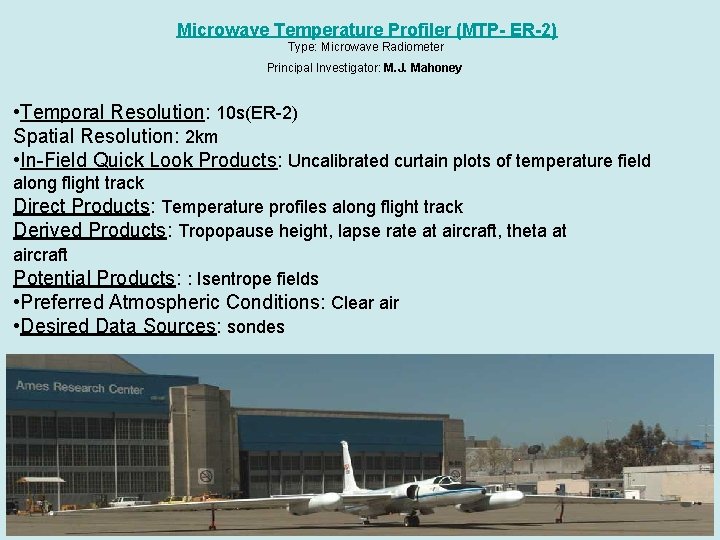
Microwave Temperature Profiler (MTP- ER-2) Type: Microwave Radiometer Principal Investigator: M. J. Mahoney • Temporal Resolution: 10 s(ER-2) Spatial Resolution: 2 km • In-Field Quick Look Products: Uncalibrated curtain plots of temperature field along flight track Direct Products: Temperature profiles along flight track Derived Products: Tropopause height, lapse rate at aircraft, theta at aircraft Potential Products: : Isentrope fields • Preferred Atmospheric Conditions: Clear air • Desired Data Sources: sondes
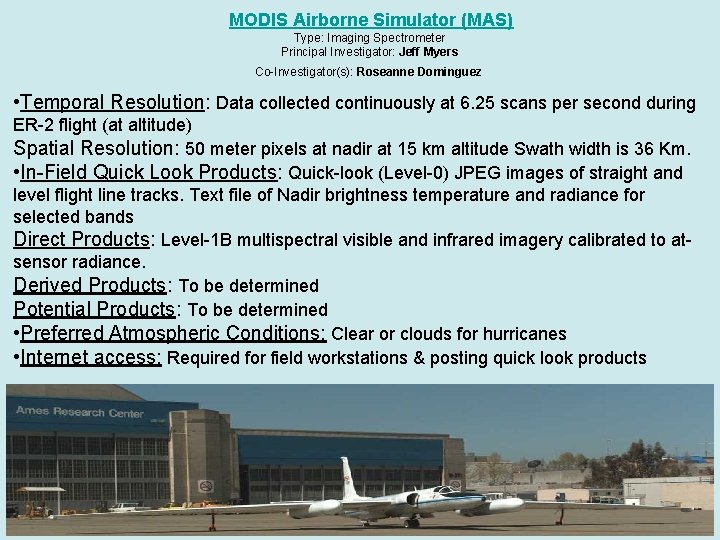
MODIS Airborne Simulator (MAS) Type: Imaging Spectrometer Principal Investigator: Jeff Myers Co-Investigator(s): Roseanne Dominguez • Temporal Resolution: Data collected continuously at 6. 25 scans per second during ER-2 flight (at altitude) Spatial Resolution: 50 meter pixels at nadir at 15 km altitude Swath width is 36 Km. • In-Field Quick Look Products: Quick-look (Level-0) JPEG images of straight and level flight line tracks. Text file of Nadir brightness temperature and radiance for selected bands Direct Products: Level-1 B multispectral visible and infrared imagery calibrated to atsensor radiance. Derived Products: To be determined Potential Products: To be determined • Preferred Atmospheric Conditions: Clear or clouds for hurricanes • Internet access: Required for field workstations & posting quick look products
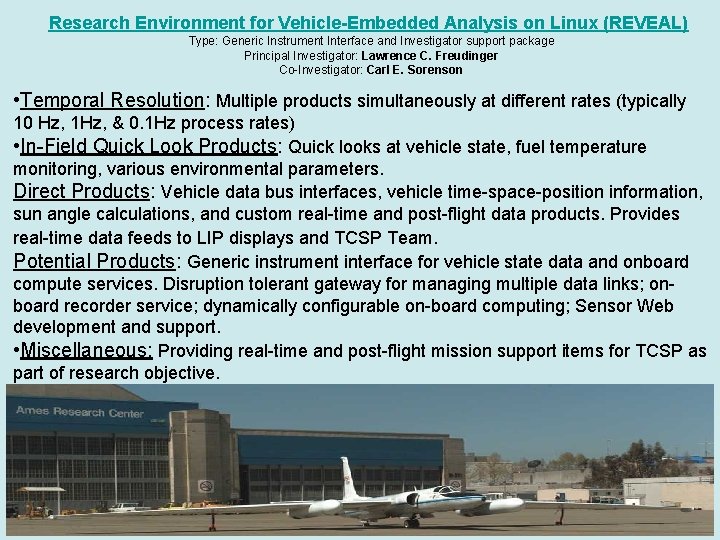
Research Environment for Vehicle-Embedded Analysis on Linux (REVEAL) Type: Generic Instrument Interface and Investigator support package Principal Investigator: Lawrence C. Freudinger Co-Investigator: Carl E. Sorenson • Temporal Resolution: Multiple products simultaneously at different rates (typically 10 Hz, 1 Hz, & 0. 1 Hz process rates) • In-Field Quick Look Products: Quick looks at vehicle state, fuel temperature monitoring, various environmental parameters. Direct Products: Vehicle data bus interfaces, vehicle time-space-position information, sun angle calculations, and custom real-time and post-flight data products. Provides real-time data feeds to LIP displays and TCSP Team. Potential Products: Generic instrument interface for vehicle state data and onboard compute services. Disruption tolerant gateway for managing multiple data links; onboard recorder service; dynamically configurable on-board computing; Sensor Web development and support. • Miscellaneous: Providing real-time and post-flight mission support items for TCSP as part of research objective.
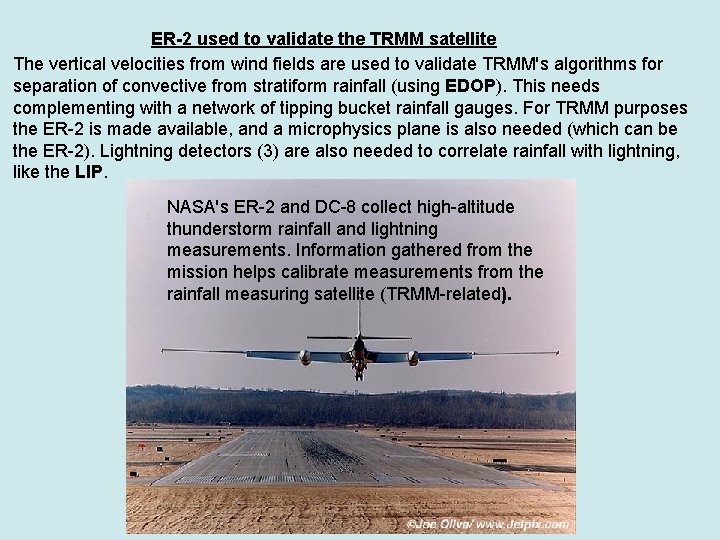
ER-2 used to validate the TRMM satellite The vertical velocities from wind fields are used to validate TRMM's algorithms for separation of convective from stratiform rainfall (using EDOP). This needs complementing with a network of tipping bucket rainfall gauges. For TRMM purposes the ER-2 is made available, and a microphysics plane is also needed (which can be the ER-2). Lightning detectors (3) are also needed to correlate rainfall with lightning, like the LIP. NASA's ER-2 and DC-8 collect high-altitude thunderstorm rainfall and lightning measurements. Information gathered from the mission helps calibrate measurements from the rainfall measuring satellite (TRMM-related).
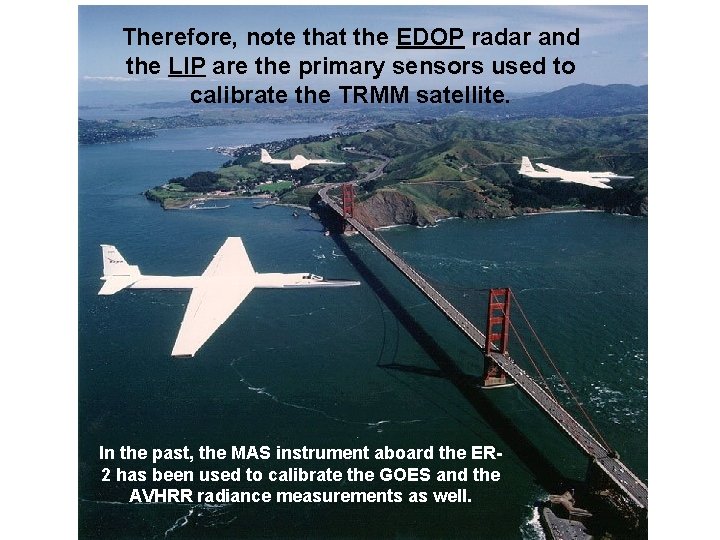
Therefore, note that the EDOP radar and the LIP are the primary sensors used to calibrate the TRMM satellite. In the past, the MAS instrument aboard the ER 2 has been used to calibrate the GOES and the AVHRR radiance measurements as well.

- Slides: 23