
The Anatomic Basis of Echocardiography Krishna Kumar AIMS
The Anatomic Basis of Echocardiography Krishna Kumar AIMS, Cochin 1

The Anatomic Basis of Echocardiography Ensuring Reliability in Echocardiography for CHD Echo is a observer dependent investigation. For accurate echocardiography the “observer” should: • Have an excellent understanding of normal and abnormal cardiac anatomy and physiology • Follow a thorough and systematic approach 2
The Anatomic Basis of Echocardiography Why Is It Necessary to Follow a Systematic and a Uniform Approach for CHD? • Allows a more thorough evaluation: minimizes chances of error • Uniformity of approach allows easier understanding of images • Allows easier review images (one person can more easily review another person’s study) 3

The Anatomic Basis of Echocardiography Echo for CHD Vs. Acquired Heart Disease • Children allow a clearer view of their hearts than adults! – More windows are available for imaging • The focus is on sweeping across all planes in a view rather than getting a few representative images in a view • Correct anatomical display helps 4
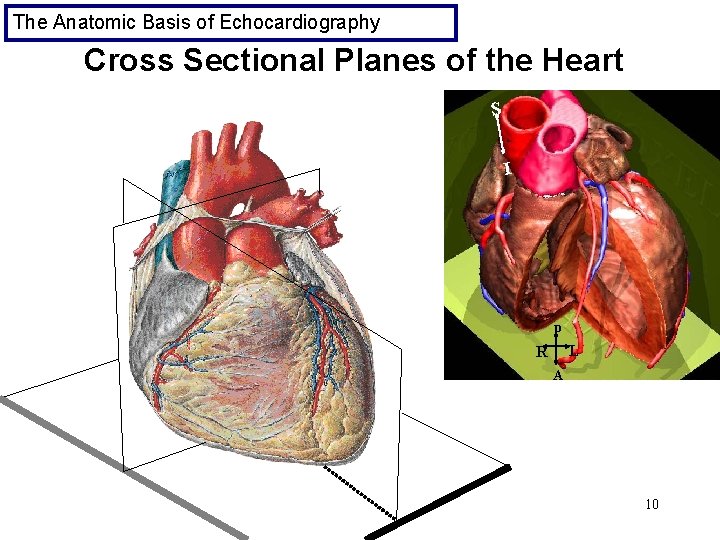
The Anatomic Basis of Echocardiography Imaging (USG/CT/MR) • Essentially involves obtaining cross sections in different planes • For the human body the planes are – Coronal – Sagittal – Axial 5
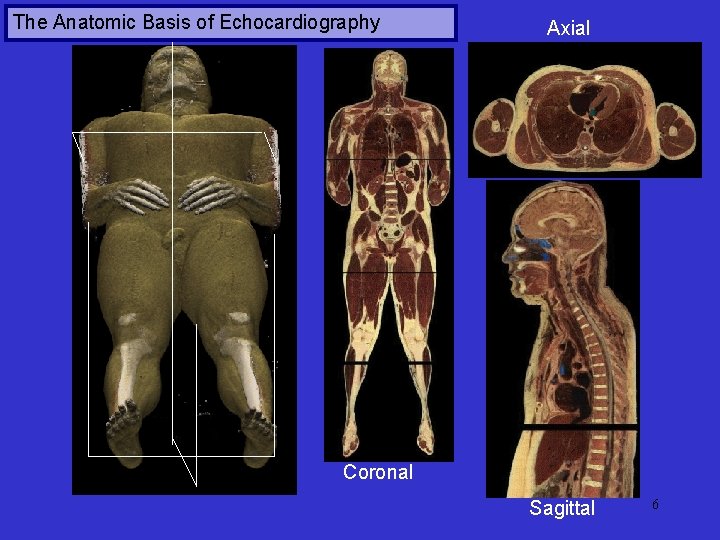
The Anatomic Basis of Echocardiography Axial Coronal Sagittal 6
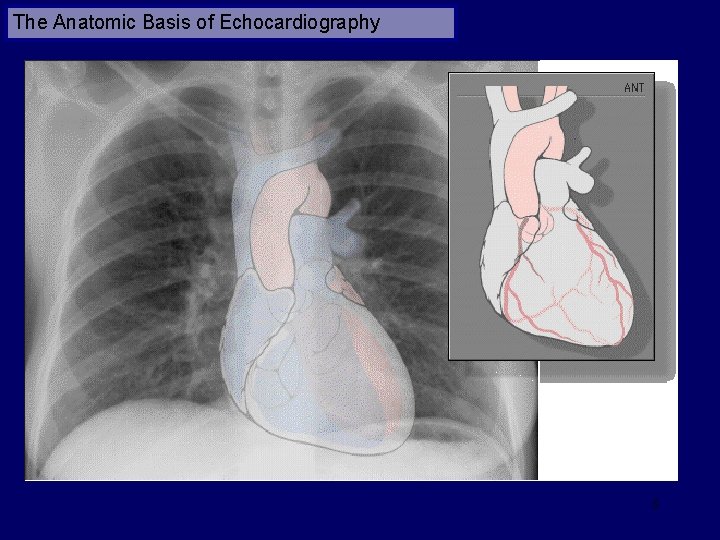
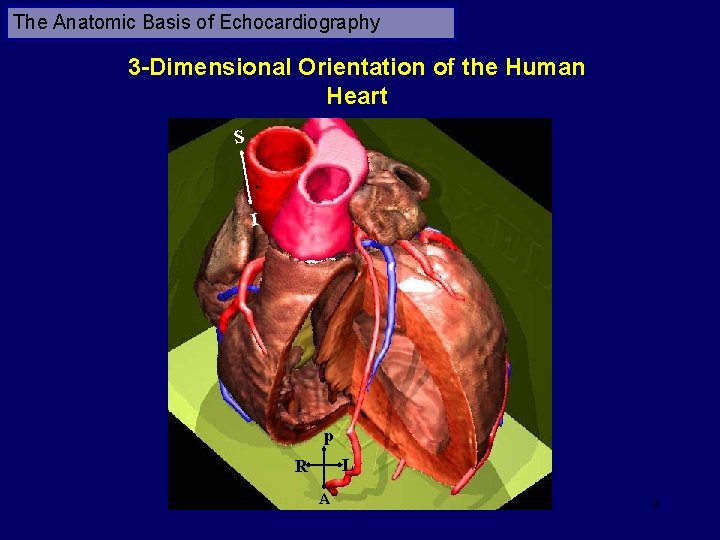
The Anatomic Basis of Echocardiography Why Conventional Imaging Planes Are Not Useful for the Heart? • The heart is asymmetrically located • The heart itself is largely asymmetric except for the great vessels, and semilunar valves that have some radial symmetry 7
The Anatomic Basis of Echocardiography 8
The Anatomic Basis of Echocardiography 3 -Dimensional Orientation of the Human Heart S I p L R A 9
The Anatomic Basis of Echocardiography Cross Sectional Planes of the Heart S I p L R A 10
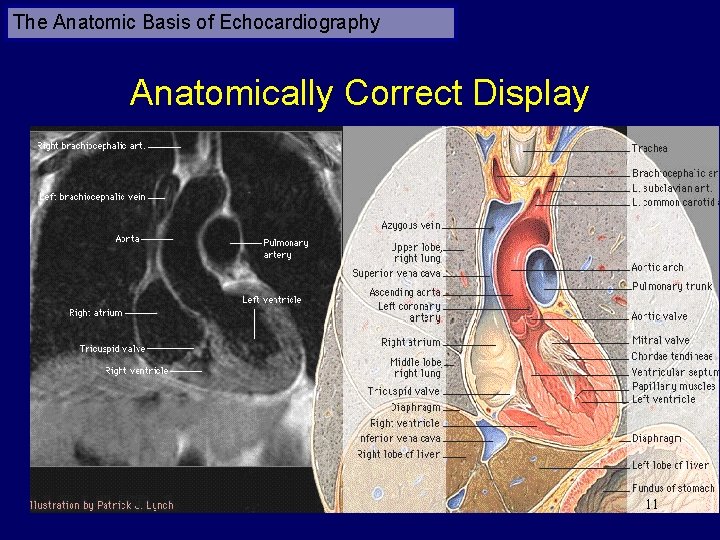
The Anatomic Basis of Echocardiography Anatomically Correct Display 11
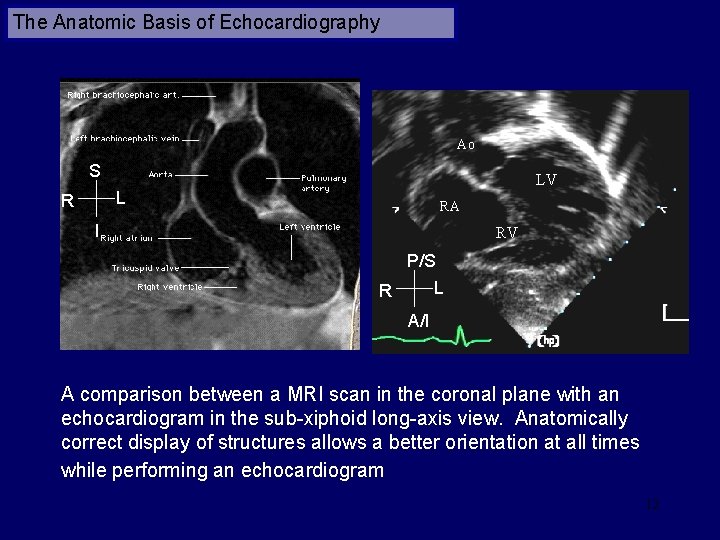
The Anatomic Basis of Echocardiography Ao S LV L R RA I RV P/S L R A/I A comparison between a MRI scan in the coronal plane with an echocardiogram in the sub-xiphoid long-axis view. Anatomically correct display of structures allows a better orientation at all times while performing an echocardiogram 12
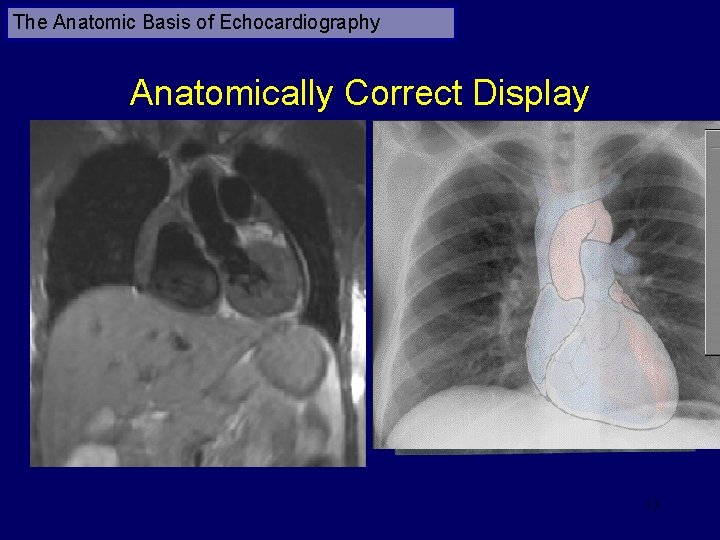
The Anatomic Basis of Echocardiography Anatomically Correct Display 13
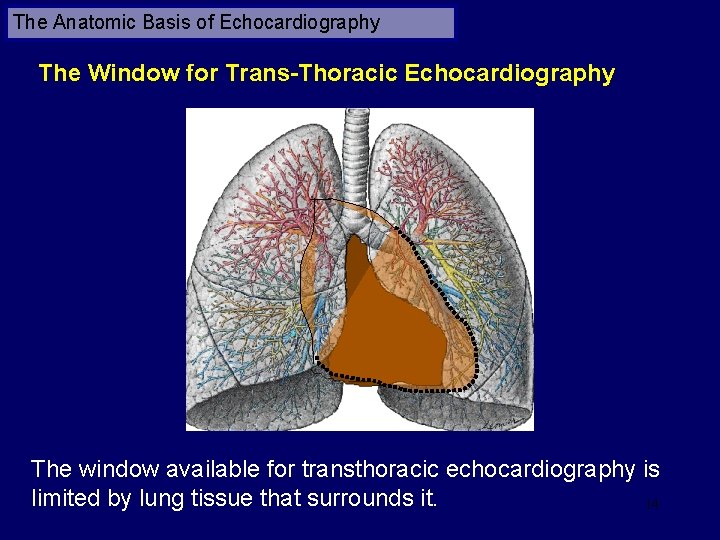
The Anatomic Basis of Echocardiography The Window for Trans-Thoracic Echocardiography The window available for transthoracic echocardiography is limited by lung tissue that surrounds it. 14
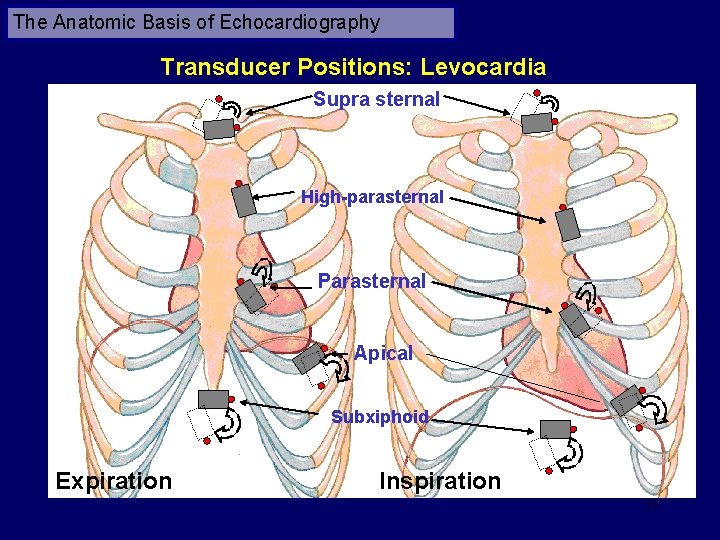
The Anatomic Basis of Echocardiography Transducer Positions: Levocardia Supra sternal High-parasternal Parasternal Apical Subxiphoid Expiration Inspiration 15
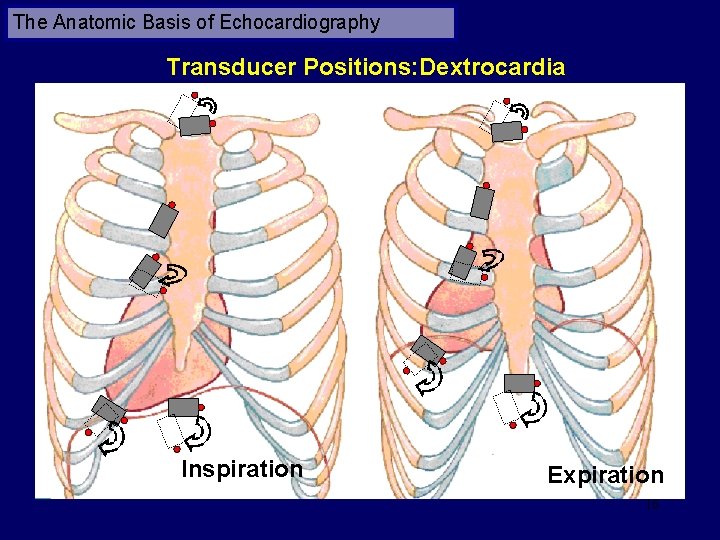
The Anatomic Basis of Echocardiography Transducer Positions: Dextrocardia Inspiration Expiration 16
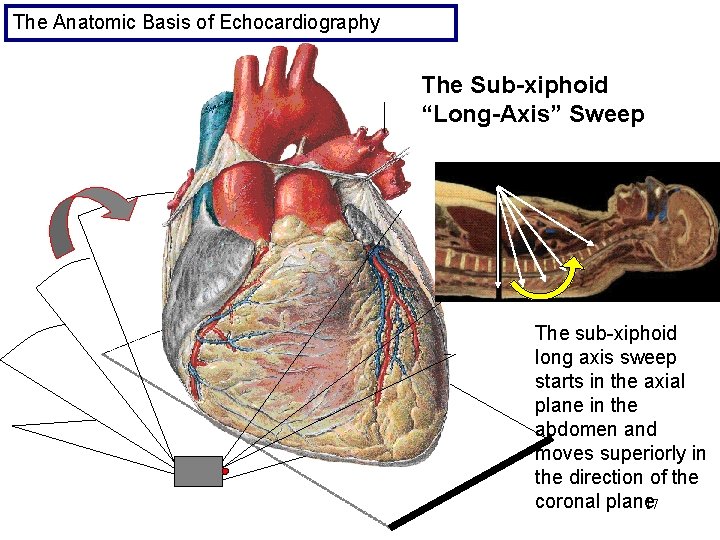
The Anatomic Basis of Echocardiography The Sub-xiphoid “Long-Axis” Sweep The sub-xiphoid long axis sweep starts in the axial plane in the abdomen and moves superiorly in the direction of the coronal plane 17
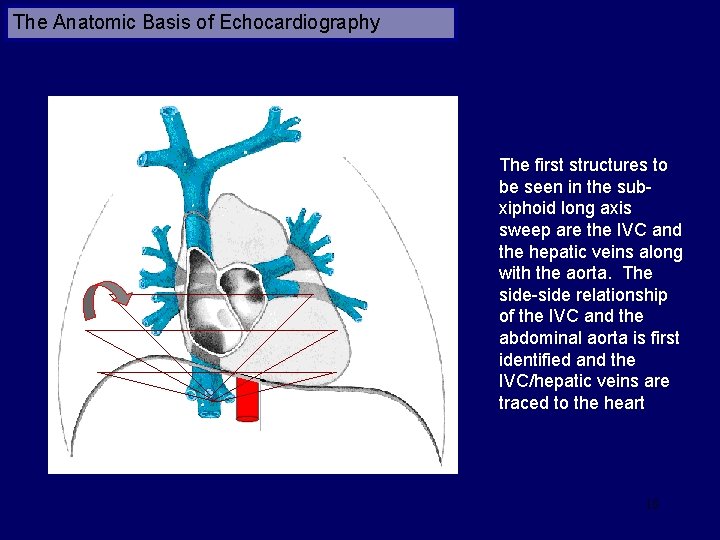
The Anatomic Basis of Echocardiography The first structures to be seen in the subxiphoid long axis sweep are the IVC and the hepatic veins along with the aorta. The side-side relationship of the IVC and the abdominal aorta is first identified and the IVC/hepatic veins are traced to the heart 18
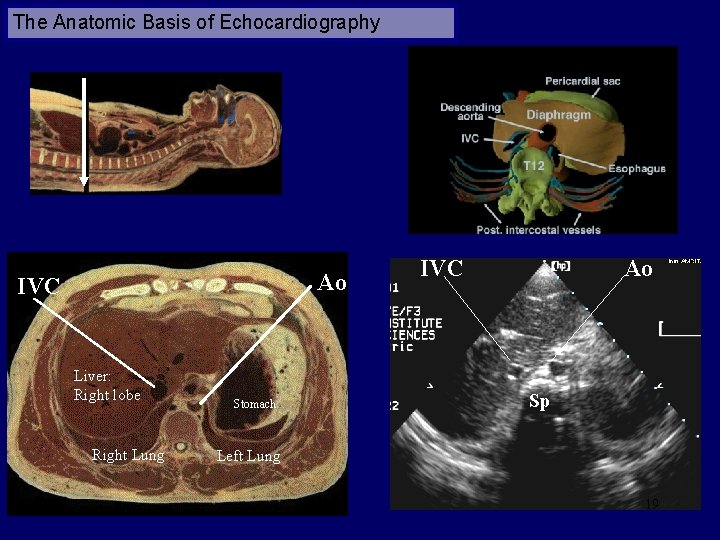
The Anatomic Basis of Echocardiography Ao IVC Liver: Right lobe Right Lung Stomach IVC Ao Sp Left Lung 19
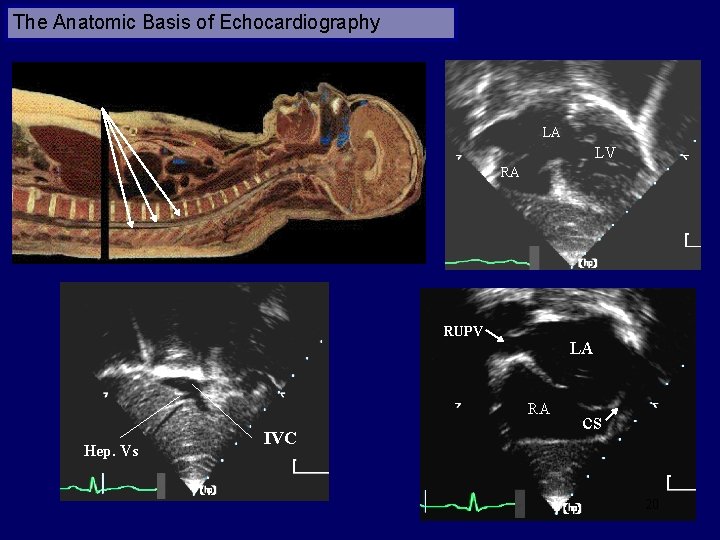
The Anatomic Basis of Echocardiography LA LV RA RUPV LA RA Hep. Vs IVC cs 20
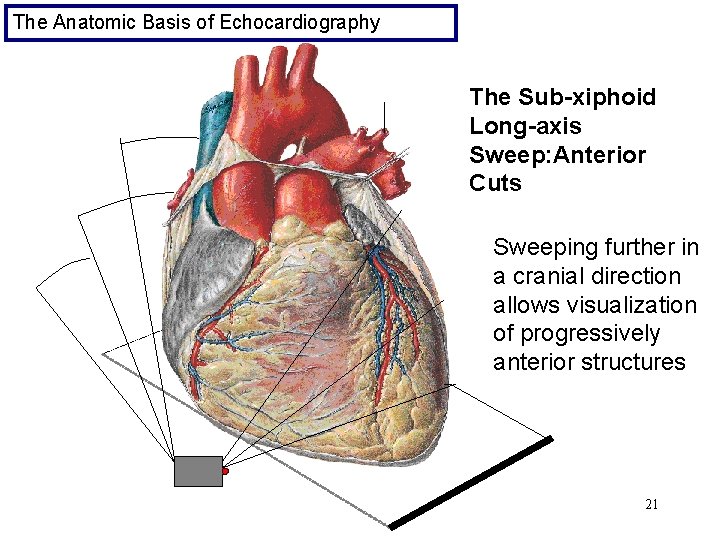
The Anatomic Basis of Echocardiography The Sub-xiphoid Long-axis Sweep: Anterior Cuts Sweeping further in a cranial direction allows visualization of progressively anterior structures 21
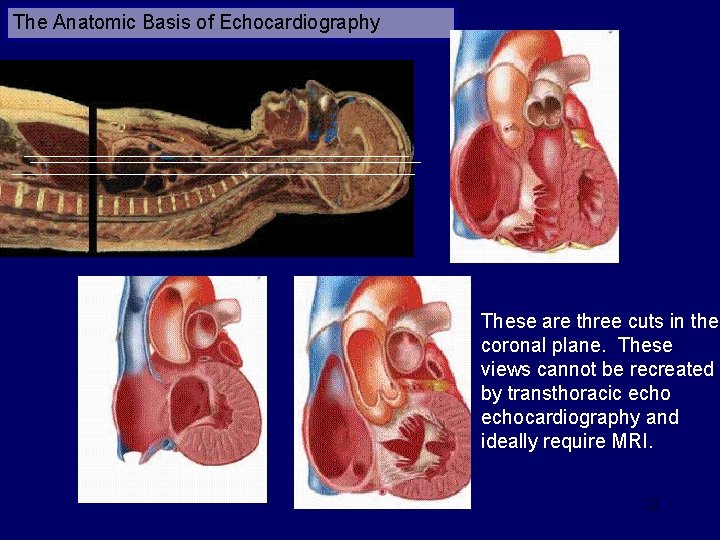
The Anatomic Basis of Echocardiography These are three cuts in the coronal plane. These views cannot be recreated by transthoracic echocardiography and ideally require MRI. 22
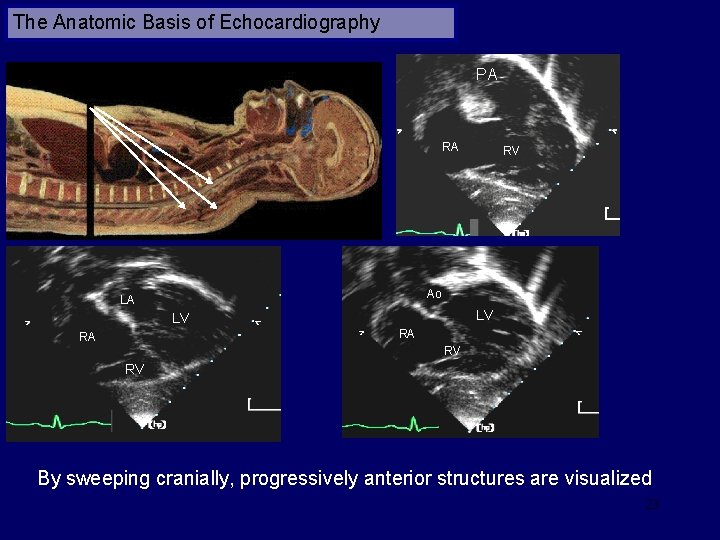
The Anatomic Basis of Echocardiography PA RA RV Ao LA LV LV RA RA RV RV By sweeping cranially, progressively anterior structures are visualized 23
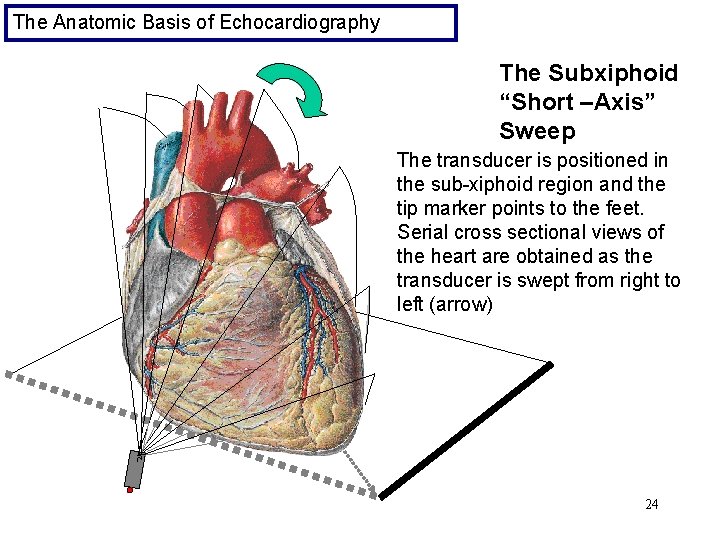
The Anatomic Basis of Echocardiography The Subxiphoid “Short –Axis” Sweep The transducer is positioned in the sub-xiphoid region and the tip marker points to the feet. Serial cross sectional views of the heart are obtained as the transducer is swept from right to left (arrow) 24
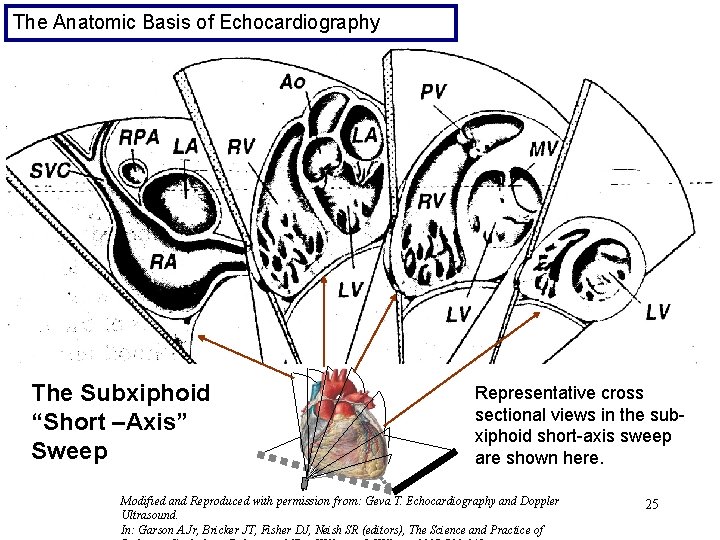
The Anatomic Basis of Echocardiography The Subxiphoid “Short –Axis” Sweep Representative cross sectional views in the subxiphoid short-axis sweep are shown here. Modified and Reproduced with permission from: Geva T. Echocardiography and Doppler Ultrasound. In: Garson A. Jr, Bricker JT, Fisher DJ, Neish SR (editors), The Science and Practice of 25
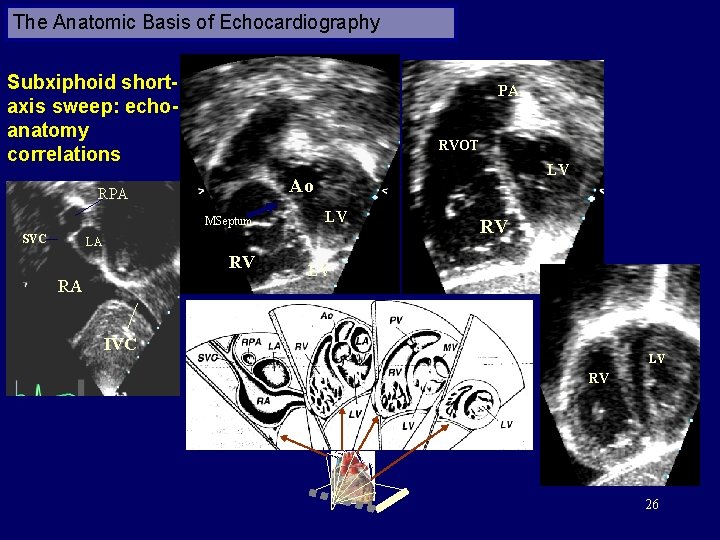
The Anatomic Basis of Echocardiography Subxiphoid shortaxis sweep: echoanatomy correlations PA RVOT Ao RPA MSeptum SVC LV LV LA RV RA RV LV IVC LV RV 26
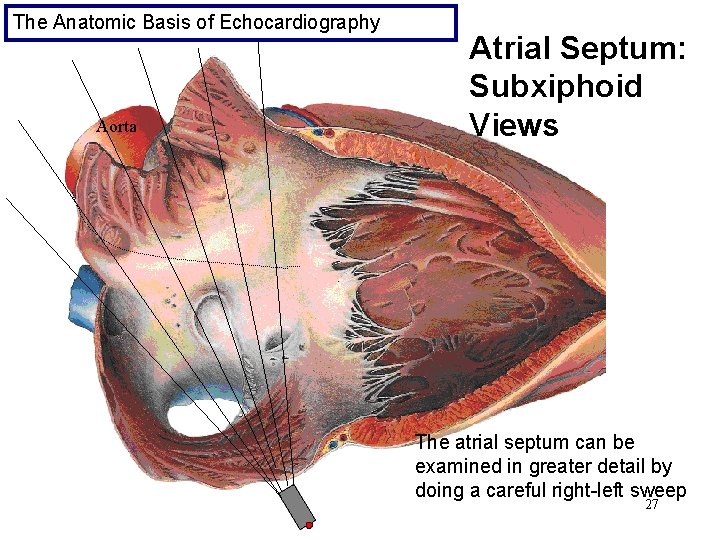
The Anatomic Basis of Echocardiography Aorta Atrial Septum: Subxiphoid Views The atrial septum can be examined in greater detail by doing a careful right-left sweep 27
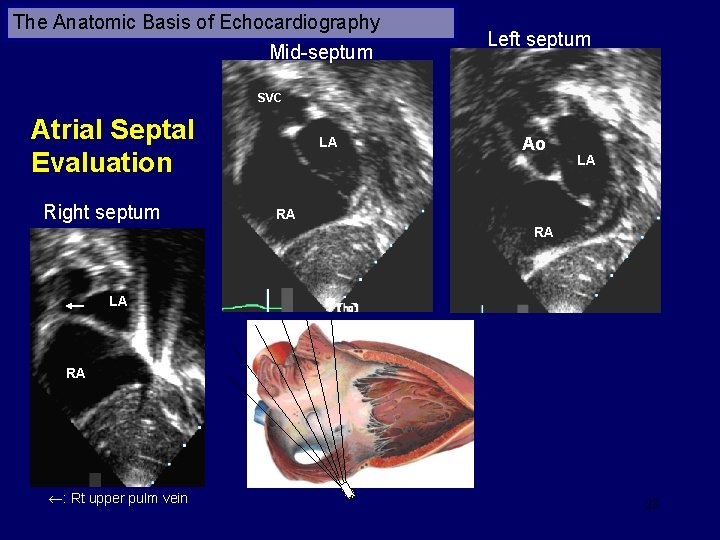
The Anatomic Basis of Echocardiography Mid-septum Left septum SVC Atrial Septal Evaluation Right septum LA Ao LA RA RA LA RA : Rt upper pulm vein 28
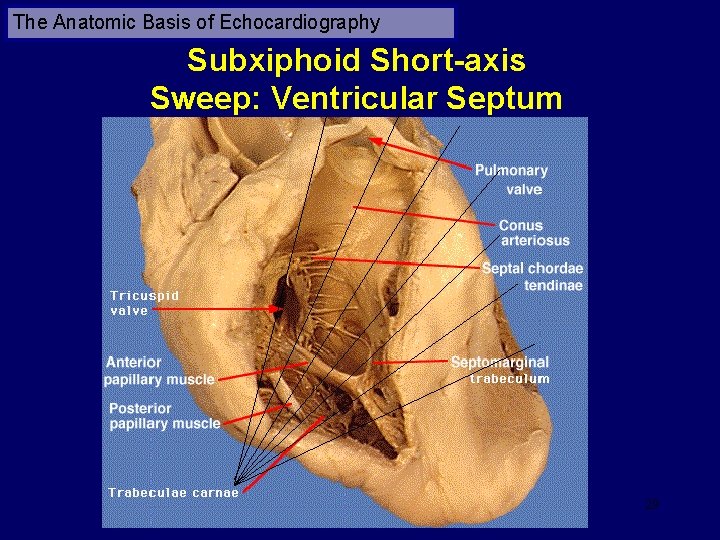
The Anatomic Basis of Echocardiography Subxiphoid Short-axis Sweep: Ventricular Septum 29
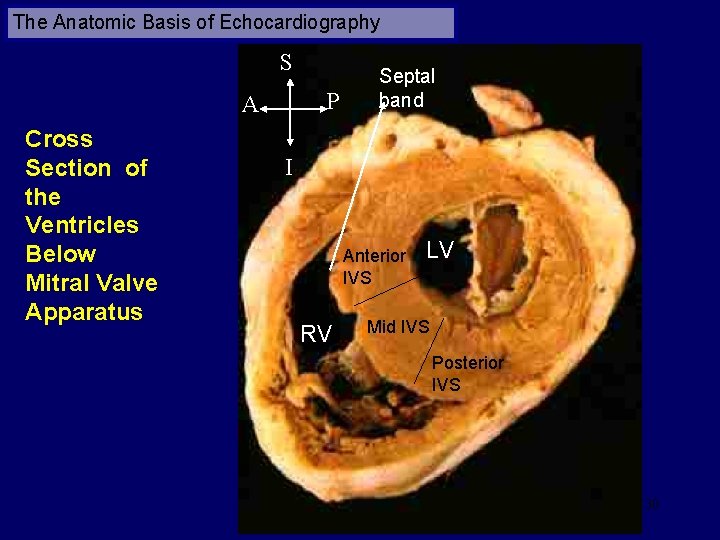
The Anatomic Basis of Echocardiography S P A Cross Section of the Ventricles Below Mitral Valve Apparatus Septal band I Anterior IVS RV LV Mid IVS Posterior IVS 30
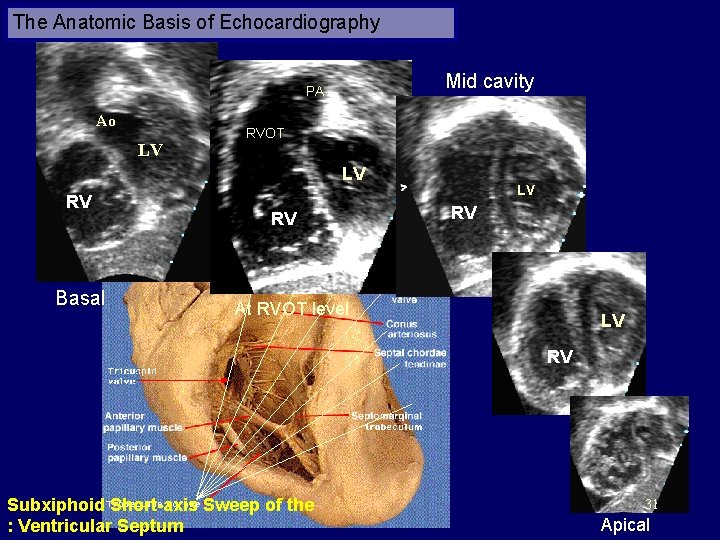
The Anatomic Basis of Echocardiography Mid cavity PA Ao LV RVOT LV RV Basal RV LV RV At RVOT level LV RV Subxiphoid Short-axis Sweep of the : Ventricular Septum 31 Apical
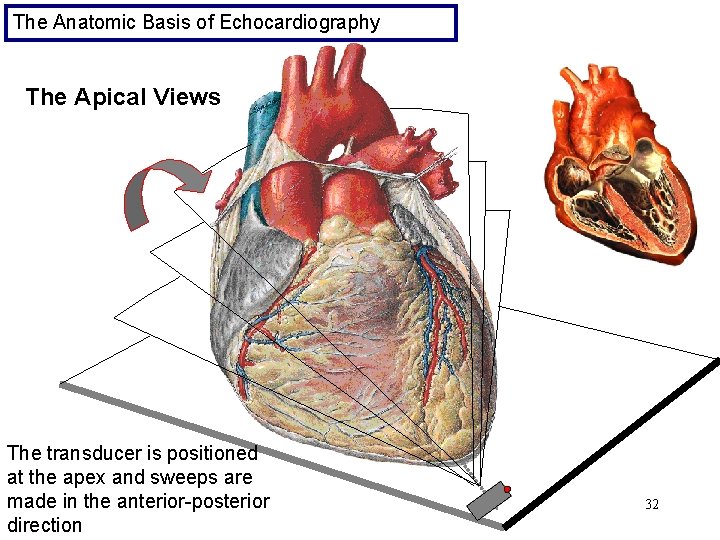
The Anatomic Basis of Echocardiography The Apical Views The transducer is positioned at the apex and sweeps are made in the anterior-posterior direction 32
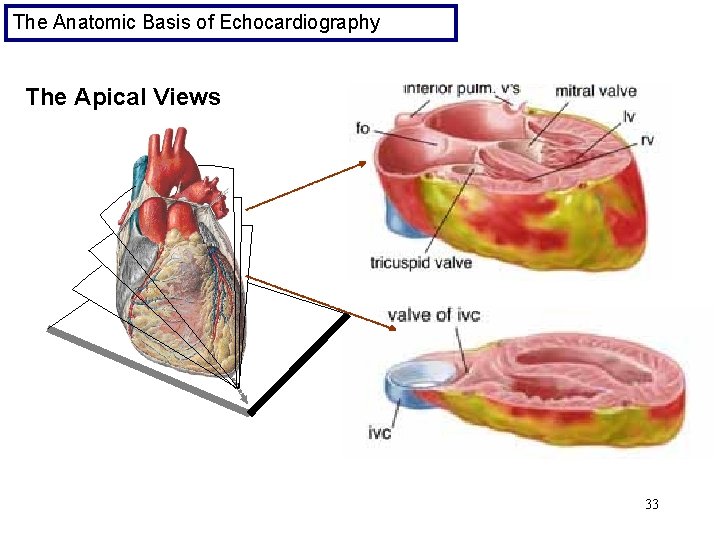
The Anatomic Basis of Echocardiography The Apical Views 33
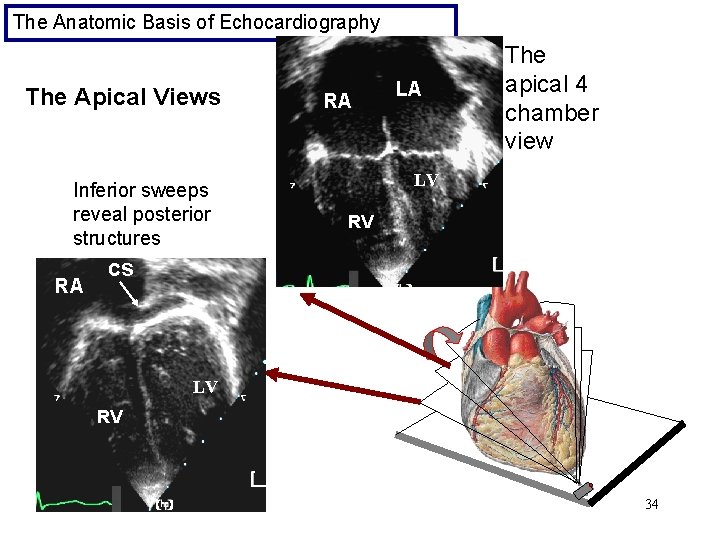
The Anatomic Basis of Echocardiography The Apical Views Inferior sweeps reveal posterior structures RA RA LA The apical 4 chamber view LV RV cs LV RV 34
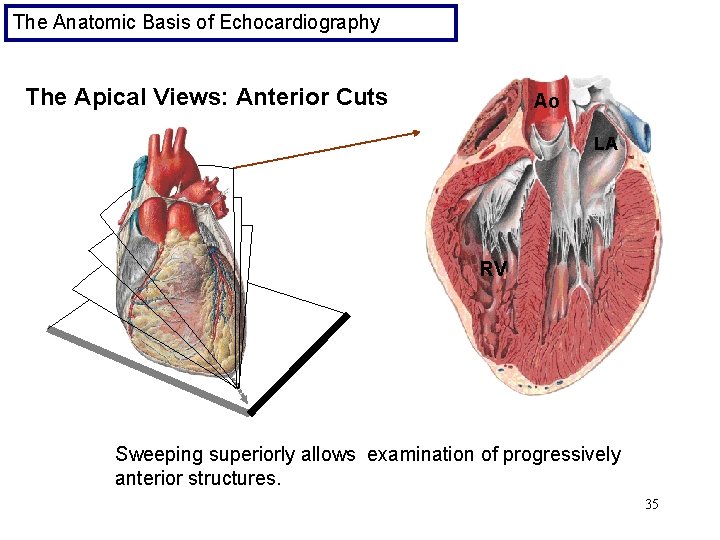
The Anatomic Basis of Echocardiography The Apical Views: Anterior Cuts Ao LA RV Sweeping superiorly allows examination of progressively anterior structures. 35
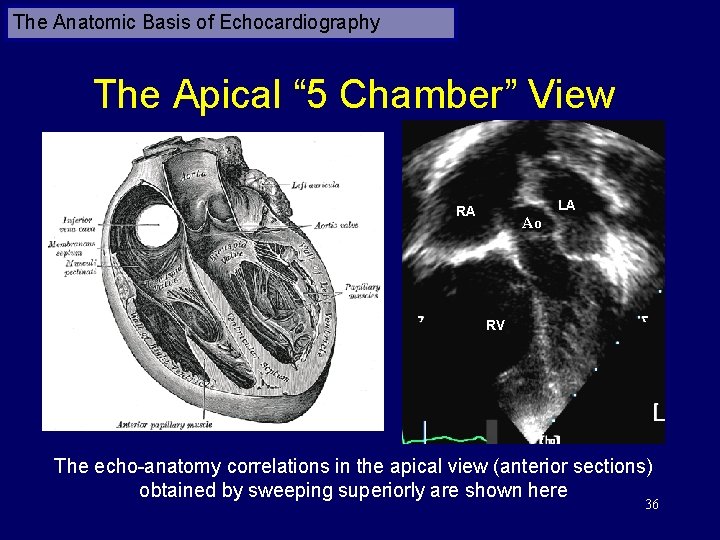
The Anatomic Basis of Echocardiography The Apical “ 5 Chamber” View LA RA Ao RV The echo-anatomy correlations in the apical view (anterior sections) obtained by sweeping superiorly are shown here 36
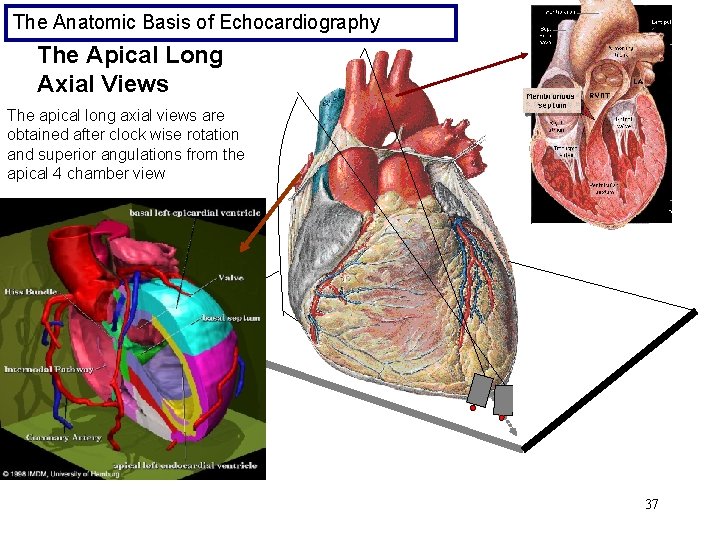
The Anatomic Basis of Echocardiography The Apical Long Axial Views The apical long axial views are obtained after clock wise rotation and superior angulations from the apical 4 chamber view 37
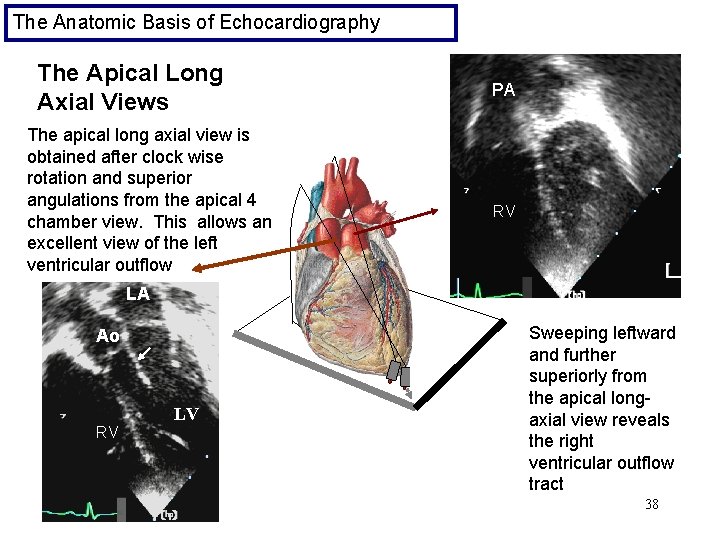
The Anatomic Basis of Echocardiography The Apical Long Axial Views The apical long axial view is obtained after clock wise rotation and superior angulations from the apical 4 chamber view. This allows an excellent view of the left ventricular outflow PA RV LA Ao Ao RV LA LV Sweeping leftward and further superiorly from the apical longaxial view reveals the right ventricular outflow tract 38
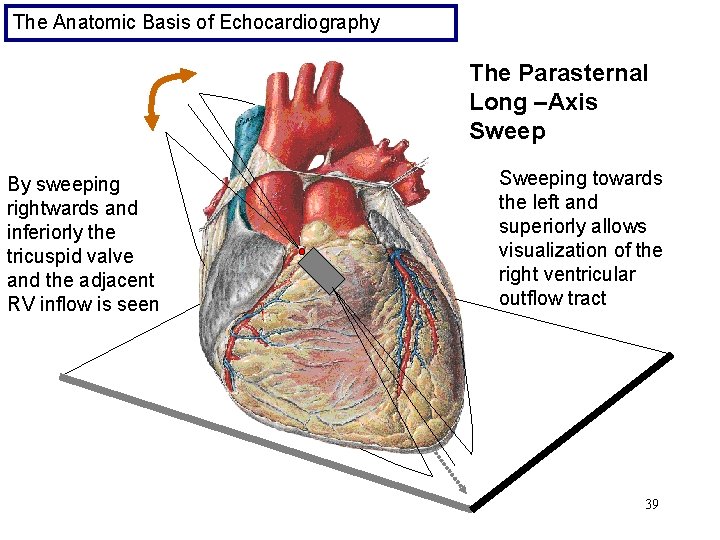
The Anatomic Basis of Echocardiography The Parasternal Long –Axis Sweep By sweeping rightwards and inferiorly the tricuspid valve and the adjacent RV inflow is seen Sweeping towards the left and superiorly allows visualization of the right ventricular outflow tract 39
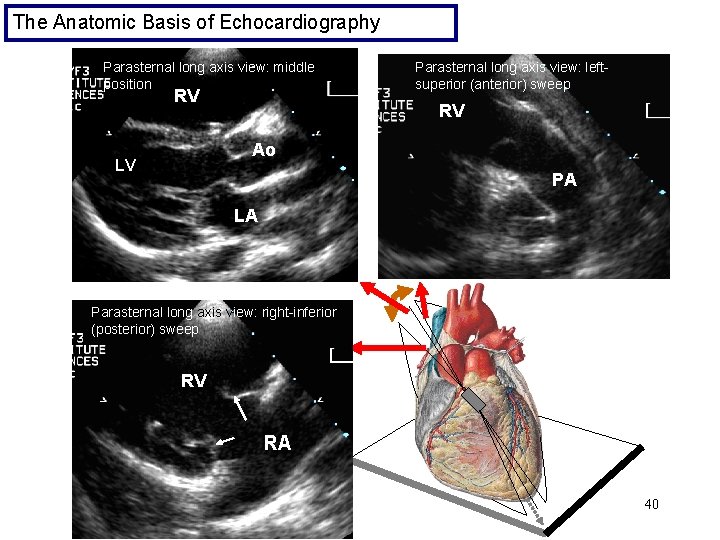
The Anatomic Basis of Echocardiography Parasternal long axis view: middle position RV Parasternal long axis view: leftsuperior (anterior) sweep RV Ao LV PA LA Parasternal long axis view: right-inferior (posterior) sweep RV RA 40
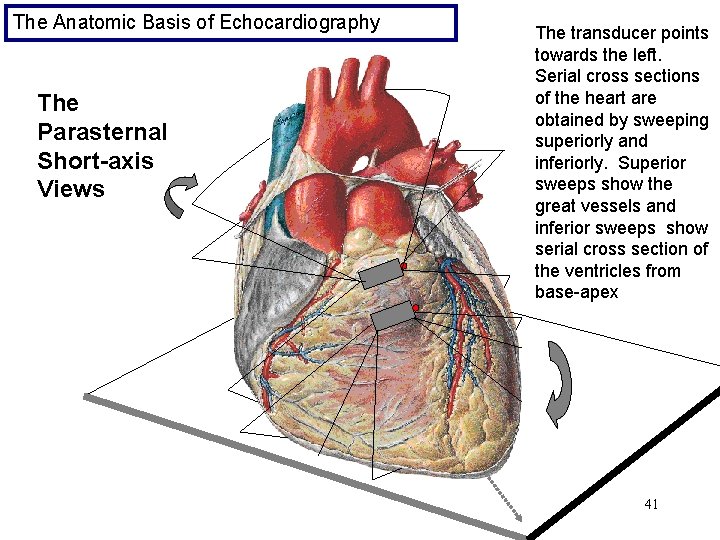
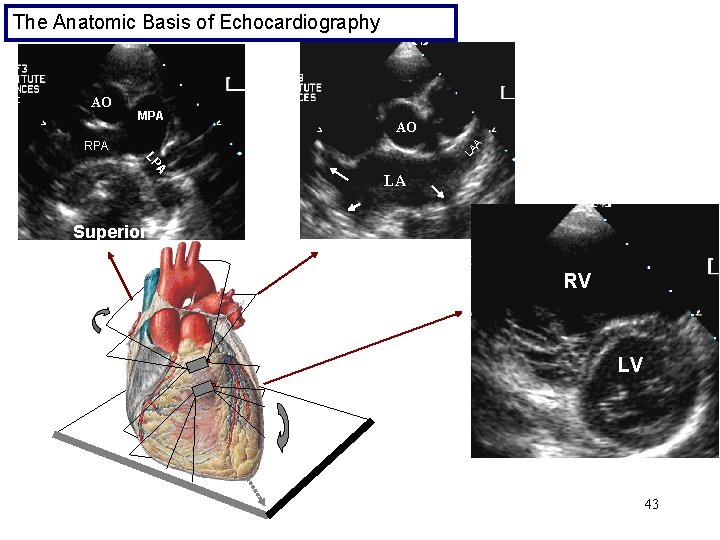
The Anatomic Basis of Echocardiography The Parasternal Short-axis Views The transducer points towards the left. Serial cross sections of the heart are obtained by sweeping superiorly and inferiorly. Superior sweeps show the great vessels and inferior sweeps show serial cross section of the ventricles from base-apex 41
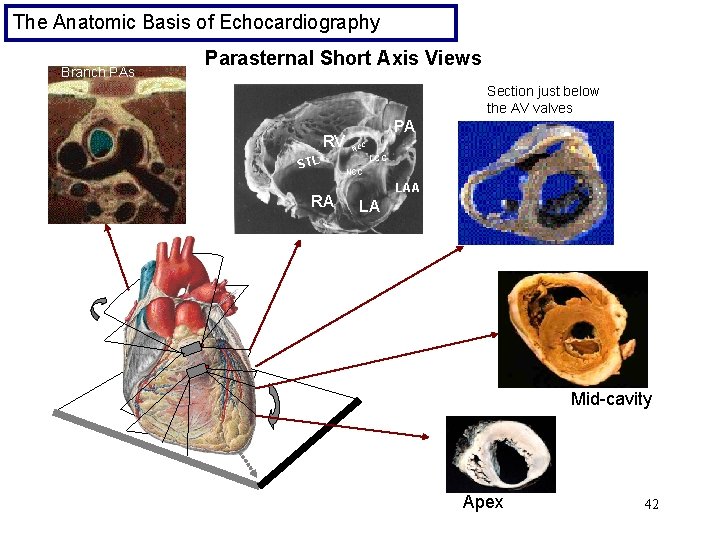
The Anatomic Basis of Echocardiography Branch PAs Parasternal Short Axis Views Section just below the AV valves RV STL RA PA RCC LCC NCC LAA LA Mid-cavity Apex 42
The Anatomic Basis of Echocardiography AO MPA AO LA A RPA A LP LA Superior RV LV 43
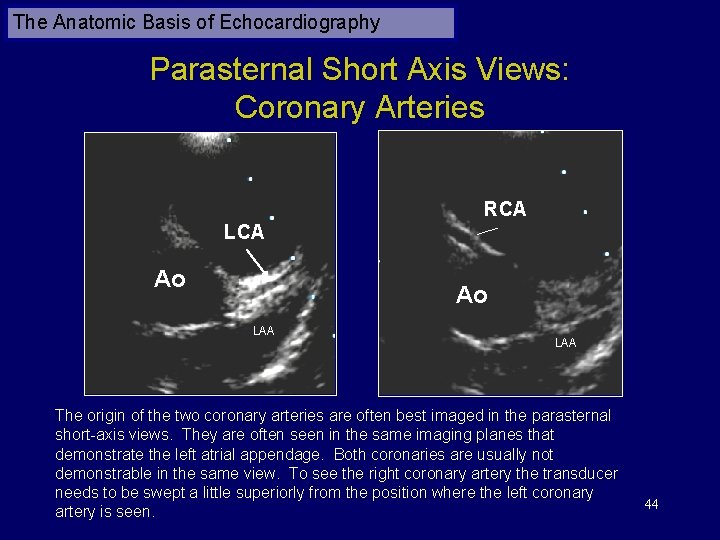
The Anatomic Basis of Echocardiography Parasternal Short Axis Views: Coronary Arteries RCA LCA Ao Ao LAA The origin of the two coronary arteries are often best imaged in the parasternal short-axis views. They are often seen in the same imaging planes that demonstrate the left atrial appendage. Both coronaries are usually not demonstrable in the same view. To see the right coronary artery the transducer needs to be swept a little superiorly from the position where the left coronary artery is seen. 44
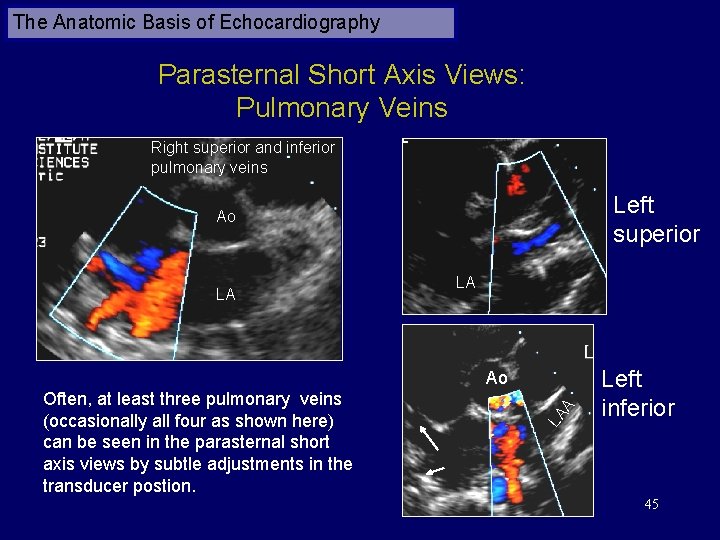
The Anatomic Basis of Echocardiography Parasternal Short Axis Views: Pulmonary Veins Right superior and inferior pulmonary veins Left superior Ao LA LA Often, at least three pulmonary veins (occasionally all four as shown here) can be seen in the parasternal short axis views by subtle adjustments in the transducer postion. LA A Ao Left inferior 45
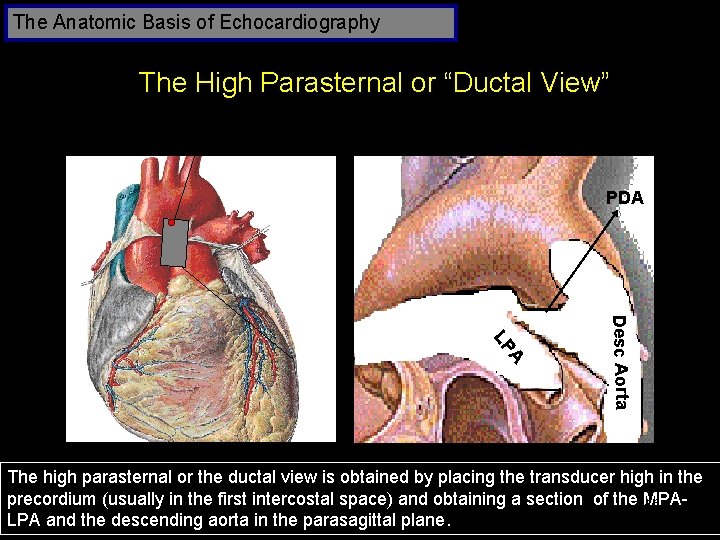
The Anatomic Basis of Echocardiography The High Parasternal or “Ductal View” PDA Asc Aorta A LP Desc Aorta MPA The high parasternal or the ductal view is obtained by placing the transducer high in the precordium (usually in the first intercostal space) and obtaining a section of the MPA 46 LPA and the descending aorta in the parasagittal plane.
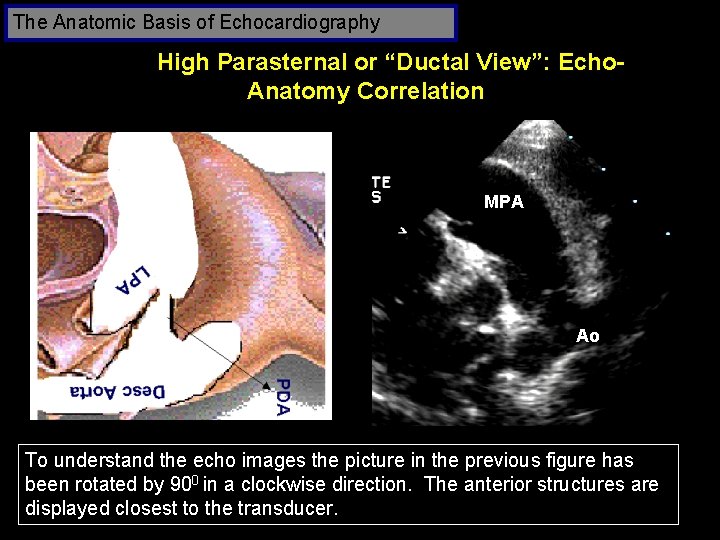
The Anatomic Basis of Echocardiography The High Parasternal or “Ductal View”: Echo. Anatomy Correlation MPA Ao To understand the echo images the picture in the previous figure has been rotated by 900 in a clockwise direction. The anterior structures are 47 displayed closest to the transducer.
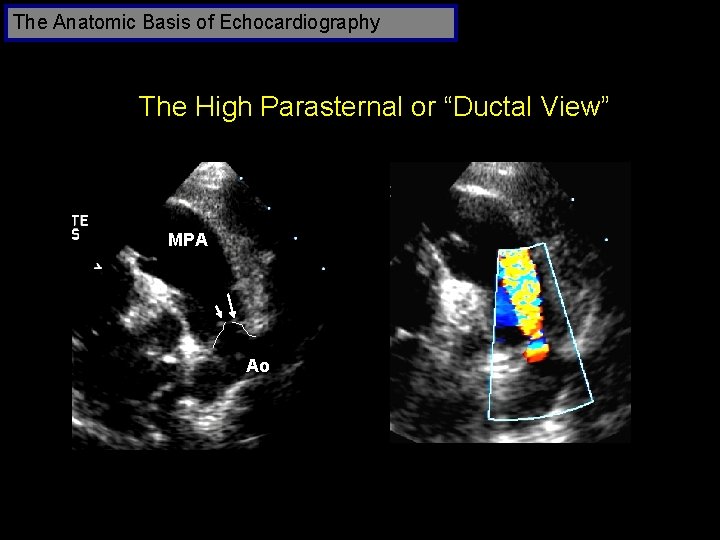
The Anatomic Basis of Echocardiography The High Parasternal or “Ductal View” MPA Ao 48
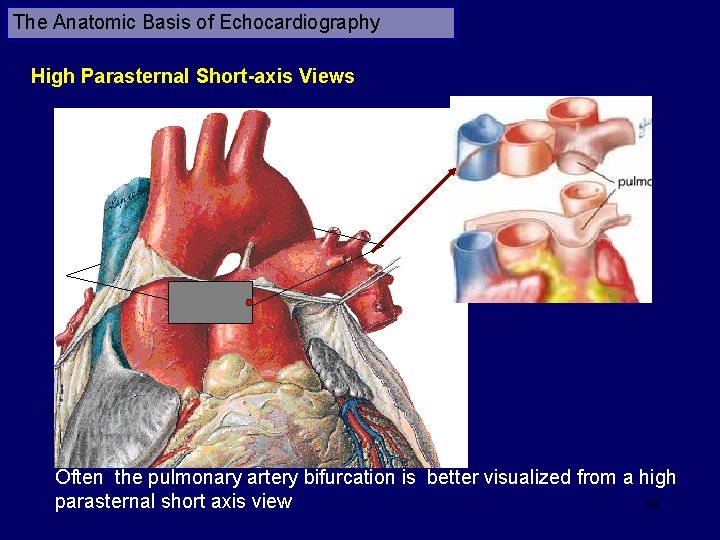
The Anatomic Basis of Echocardiography High Parasternal Short-axis Views Often the pulmonary artery bifurcation is better visualized from a high parasternal short axis view 49
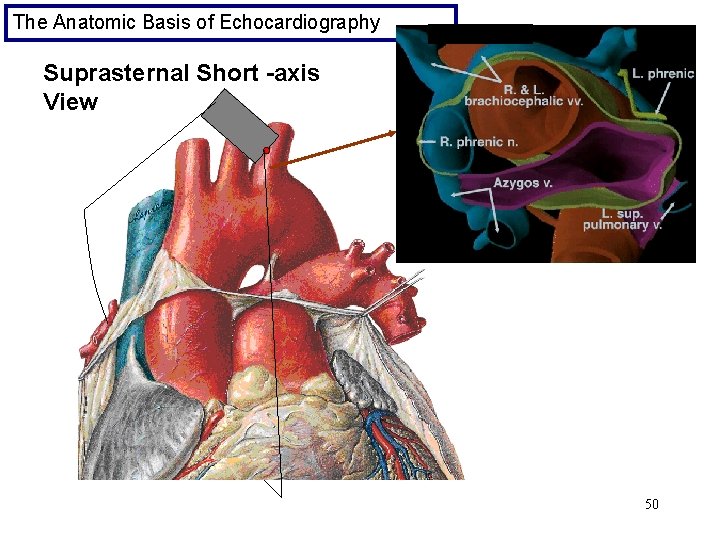
The Anatomic Basis of Echocardiography Suprasternal Short -axis View 50
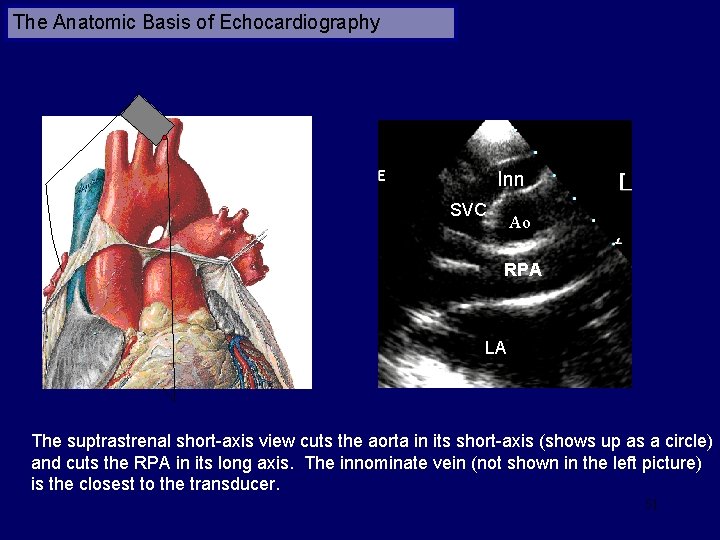
The Anatomic Basis of Echocardiography Inn SVC Ao RPA LA The suptrastrenal short-axis view cuts the aorta in its short-axis (shows up as a circle) and cuts the RPA in its long axis. The innominate vein (not shown in the left picture) is the closest to the transducer. 51
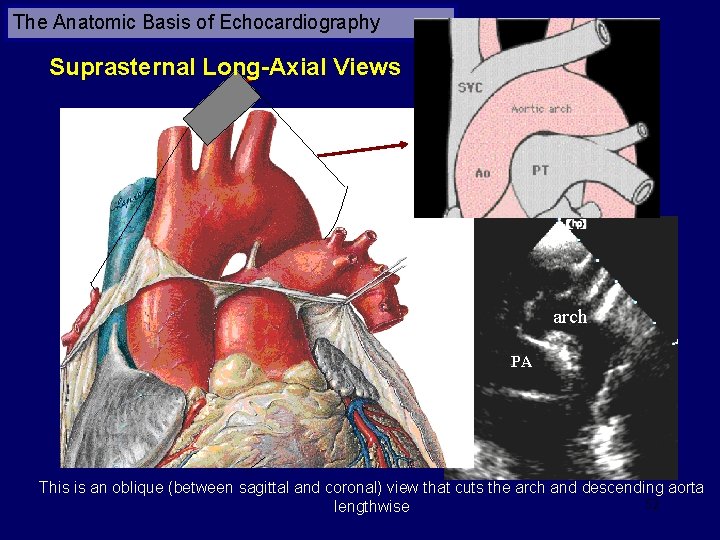
The Anatomic Basis of Echocardiography Suprasternal Long-Axial Views arch PA This is an oblique (between sagittal and coronal) view that cuts the arch and descending aorta 52 lengthwise
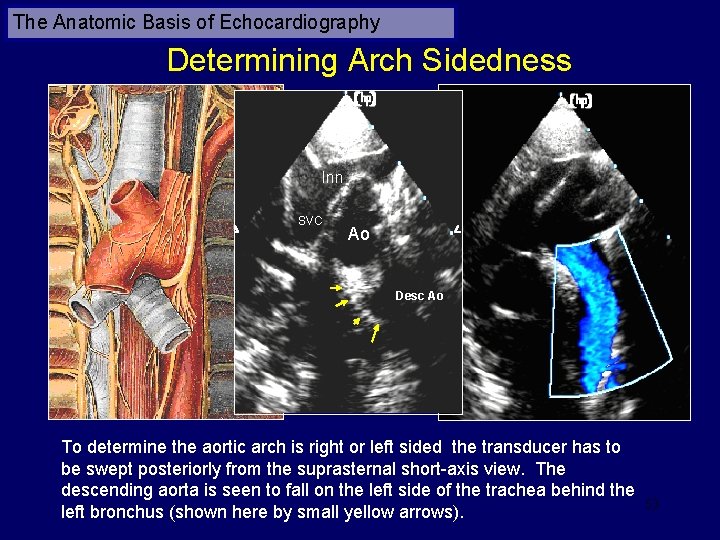
The Anatomic Basis of Echocardiography Determining Arch Sidedness Inn SVC Ao Desc Ao To determine the aortic arch is right or left sided the transducer has to be swept posteriorly from the suprasternal short-axis view. The descending aorta is seen to fall on the left side of the trachea behind the left bronchus (shown here by small yellow arrows). 53
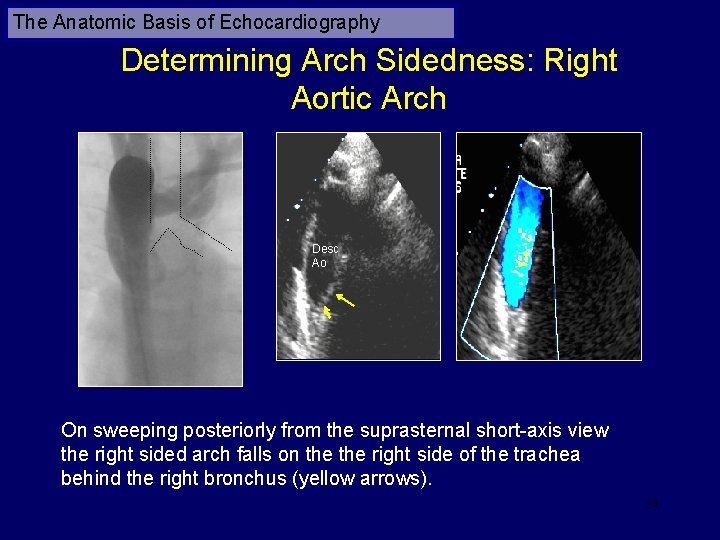
The Anatomic Basis of Echocardiography Determining Arch Sidedness: Right Aortic Arch Desc Ao On sweeping posteriorly from the suprasternal short-axis view the right sided arch falls on the right side of the trachea behind the right bronchus (yellow arrows). 54
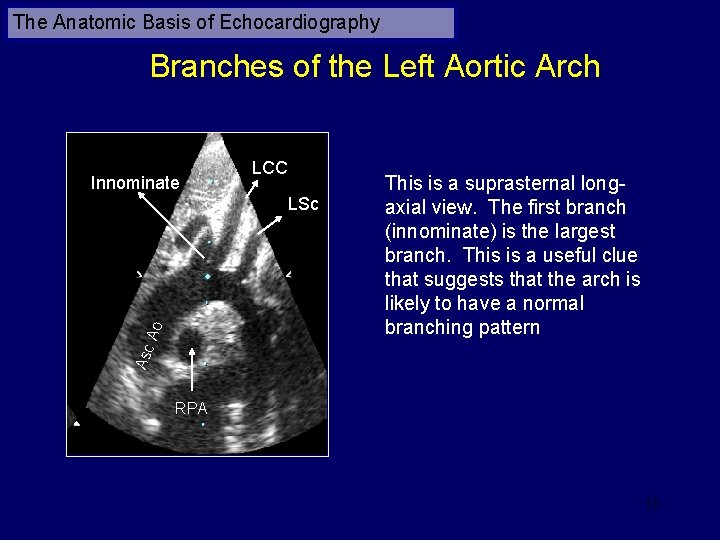
The Anatomic Basis of Echocardiography Branches of the Left Aortic Arch Innominate LCC Asc Ao LSc This is a suprasternal longaxial view. The first branch (innominate) is the largest branch. This is a useful clue that suggests that the arch is likely to have a normal branching pattern RPA 55
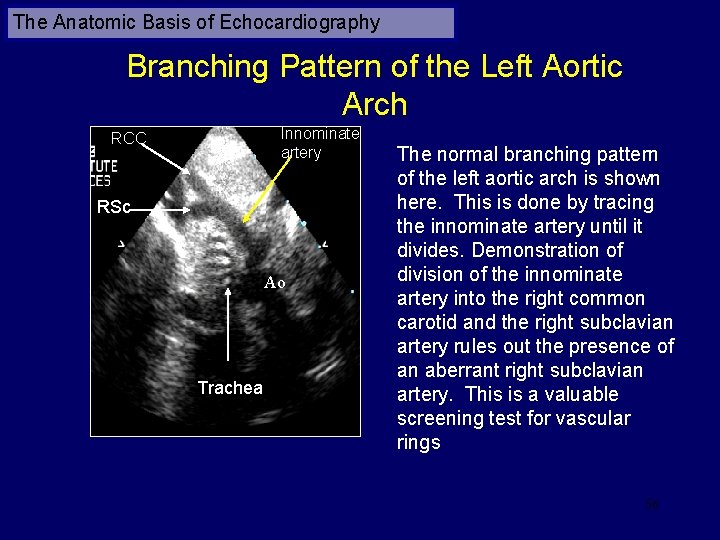
The Anatomic Basis of Echocardiography Branching Pattern of the Left Aortic Arch Innominate artery RCC RSc Ao Trachea The normal branching pattern of the left aortic arch is shown here. This is done by tracing the innominate artery until it divides. Demonstration of division of the innominate artery into the right common carotid and the right subclavian artery rules out the presence of an aberrant right subclavian artery. This is a valuable screening test for vascular rings 56
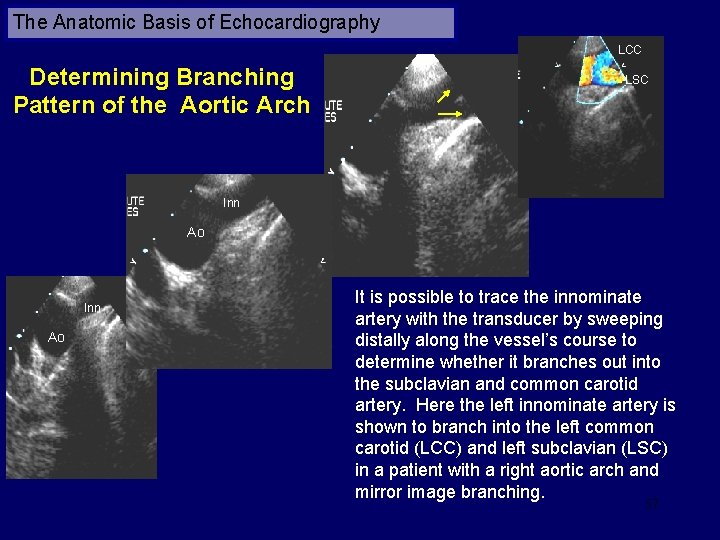
The Anatomic Basis of Echocardiography LCC Determining Branching Pattern of the Aortic Arch LSC Inn Ao It is possible to trace the innominate artery with the transducer by sweeping distally along the vessel’s course to determine whether it branches out into the subclavian and common carotid artery. Here the left innominate artery is shown to branch into the left common carotid (LCC) and left subclavian (LSC) in a patient with a right aortic arch and mirror image branching. 57
- Slides: 57