
The Anasazi Culture and History Who were the


- Slides: 20
The Anasazi Culture and History
Who were the Ancestral Pueblo People (Anasazi)? n n They are the ancestors of modern Pueblo Indians now living in New Mexico and Arizona. They settled and farmed in the Four Corners region between about AD 1 and AD 1300, producing fine baskets, pottery, cloth, ornaments and tools. Their architectural achievements included cliff dwellings and pueblos (apartment-house style villages). As the population grew and spread out, communities exchanged goods through an elaborate trade network. Regional differences developed as communities adapted to their surroundings in slightly different ways. We recognize several distinct branches of the culture, including Northern San Juan, Chaco, Kayenta, Virgin, and Rio Grande. Anasazi is a Navajo word meaning "the ancient ones" or "the ancient enemies. " Modern Pueblo people object to that name in reference to their ancestors. Their own languages do not share a common name for them, so the term "Ancestral Puebloans" is currently used when speaking English.
Time. Line The Time Period is 1000 -1300 CE
What happened to these people? n n n For hundreds of years, the first farmers were quite successful in the Four Corners area. But by AD 1300 they had left the entire region. Why? Research shows that people began settling the Dolores area in small numbers around AD 500. The settlements were heavily populated between AD 600 and 900 when conditions were most favorable for agriculture. The number of households, hamlets and villages increased as the population grew. Environmental conditions began to change around AD 900. Frequent droughts and killing frosts made farming unreliable. Families began leaving the Dolores area to pursue agriculture and community life elsewhere. Some use of the area continued, such as at Escalante Pueblo, during the 1100 s. The Ancestral Puebloans may have reached the limit of the natural resources available to them. When crops consistently failed, the people moved away or became more dependent on hunting and gathering. Archaeologists also see evidence of social changes over time, changes perhaps related to internal pressures or to outside competition from non-Pueblo groups. In southwestern Colorado, some areas were gradually abandoned over many generations. The movement was not as sudden as previously thought. While the Northern San Juan settlements declined, other areas began to develop and grow. For instance, evidence exists for population growth around the Homolovi area in Arizona, near Winslow. The Rio Grande pueblos and the pueblos of Acoma, Laguna and Zuni grew in numbers after AD 1300, perhaps including people from this region. The Hopi people of Arizona believe some of their clans came from the north. Environmental hardships in the Northern San Juan region probably made these areas in Arizona and New Mexico more attractive. A different climate and more reliable water sources offered hope of a better life.
How did the Ancestral Puebloans farm? n n The area's first inhabitants were originally hunters and gatherers. In time, agricultural knowledge came north from Mexico. Around AD 1, people we call the Basketmakers began dry farming (relying on water in the soil from melted snow, summer rainstorms and occasional springs). They farmed intensively, planting large and small patches of land— wherever there was sufficient water, warmth and light to support a few plants. Farming was the mainstay of the Ancestral Puebloan economy. Crops included corn, beans, and squash. Archaeologists' experiments indicate that the Dolores people could have produced up to 40 bushels of corn per acre. Modern dry farming (unirrigated fields) produces about 14 bushels per acre. Surplus corn was stored to last through risky years. Large storerooms became prominent features of communities. Each person needed about one acre of corn per year to have an adequate food supply. These farmers were able to support a large population. Although it is difficult to estimate accurately, the Montezuma County area may have been occupied by as many as 20, 000 people during the peak years between AD 1000 and 1300— roughly the same number as live there today. Drought and other climatic changes were constant threats. In some areas, community planning and labor went into water control projects such as reservoirs and small dams. Changing precipitation patterns, shortened growing seasons, and/or cool summers could, and probably did, spell disaster for many local settlements. Extended drought was one factor which caused the Puebloans to leave the Four Corners region.
How did the Ancestral Puebloans make their living besides farming? n n n Hunting and gathering, the primary food sources of the earliest people, were never totally eliminated. Meat remained the major source of protein. Piñon nuts, yucca fruit, berries and other wild plants were still part of the diet. The people also gathered plant materials to make baskets, clothing and tools. Garden plots actually made hunting easier by attracting rabbits, birds and mice. The people also hunted deer and elk in the mountains, and antelope and bighorn sheep at lower elevations. When corn crops were reduced by drought or cold weather, or as the population grew larger, communities were forced to rely more on game and wild plants to make up the difference.
How did the people prepare their food? n n n Corn was dried and stored on the cob. Strips of dried squash hung in the storage rooms. Wild plant foods were also stored and prepared for cooking. Piñon nuts, sunflower and other seeds had to be cracked, hulled, winnowed and parched before they could be cooked and eaten. Women spent hours each day grinding corn into flour with manos and metates. Beans were soaked and cooked in large jars. These jars were not placed directly over fires; instead, hot rocks were dropped into the contents for boiling. Corn was also parched in jars which lay on their sides near the fire. Large animals were butchered at the kill site. Back at home the pieces were prepared for cooking, bones were cracked to extract marrow, and hides were cured for other uses.
What did they wear? n n Little clothing has been found because it is so perishable. Some knowledge of early clothing comes from comparing archeological evidence to the traditional clothing of the historic Pueblo Indians. Robes for protection from the cold were made by intertwining yucca wrapped with strips of rabbit fur or turkey feathers. Animal hides provided material for blankets, breechcloths and aprons. Weaving on large looms was probably done mostly by men working in the kivas. They wove blankets, shirts, robes, aprons, kilts, breechcloths and belts from vegetal fibers, animal and human hair, and cotton obtained by trade from southern areas. Footwear included sandals, moccasins and possibly snowshoes. Sandals, usually made of plaited or woven yucca fibers, came in a variety of styles. Necklaces, earrings, bracelets, arm bands, hair combs and pins were made from wood, bone, shell and stones including turquoise. Some ornaments may have had ritual significance or use as badges of office. They probably helped define social status, especially in larger communities.
What was Ancestral Puebloan pottery like? n Some pottery made in this area carried bold black-on-white designs. These designs may represent family, clan or village affiliation, or simply the potter's imagination. Other kinds included plain and textured ("corrugated") cooking vessels. Black-on-red pottery from northern Arizona was traded throughout the Four Corners, as were Red-on-buff styles from Utah. Shapes included jars, bowls, pitchers, ladles, canteens, figurines and miniatures.
Why is pottery so important to archaeologists? n n n Pottery contains hidden clues about the people who made it. Temper (gritty binding material) in the clay may be traceable to a geologic source area where the pottery was made. Its surface may retain pollen from food plants or scrapings from a meal. Styles and designs changed through time and varied across regions. Consequently, ceramic fragments ("sherds") can indirectly show when a household or village was occupied. They reveal much about social groups and trade networks. Pottery can be sorted or "typed" into categories based on grouped traits such as color, texture, decoration and vessel shape. Archaeologists often name a ceramic type after the place where the pottery of that style was first identified--for example, Mancos Black- on-gray (from Mancos, Colorado) or Tin Cup Polychrome (from Tin Cup Mesa, Utah).
Did the Ancestral Puebloans communicate and trade with other groups? n n n These early people were not isolated from each other, or from other cultures in western North America. They participated in a far- reaching network of trade which brought exotic items from as far away as the Pacific coast and the Gulf of Mexico. These "exotics" probably traveled by passing from group to group. On a local level, a potter might find her wares in demand, as would a successful farmer with surplus corn. Marriage partners probably came from neighboring villages. Such activities kept open lines of communication between groups. Information exchange was an important by-product of trade. What were other communities doing? How was the climate in other areas? How did others irrigate? How did other people make kivas? Such communication was involved in learning to make pottery, farming, using the bow and arrow, and other important activities.
What were their religious activities like? n n Like today's Pueblo people, the Ancestral Puebloans probably held public and private ceremonies intended to benefit the group as a whole. Different segments of society may have been responsible for different events, each one important to the spiritual and material well-being of the community. Maintaining harmony with the natural world was the key to survival for early people. Careful observation of the sun, moon and stars was essential for planning activities such as when to start planting and when to prepare for winter. As in many other agricultural societies, rituals were keyed to annual events like the winter solstice or the beginning of the harvest season. Spring and summer were mostly devoted to farming and wild plant collecting; fall and winter to hunting. Important religious concepts and events were associated with these tasks.
What is the meaning of rock art? n n n Many prehistoric peoples pecked or painted images on the sandstone cliffs. Some might have been idle doodling. But based on information offered by Native people in the Southwest, most figures probably have deeper meaning. For instance, some spirals may signify the sun's movement, or the passage of time. In certain places, shafts of sunlight strike a spiral differently at the spring and autumn equinoxes, and the winter and summer solstices. These spirals probably served as part of a ritual calendar. Elsewhere, according to modern Pueblos, spirals are symbols of a group's migration from one locale to another. Other symbols may have acted as maps, pointing out the locations of villages and other features. Animal figures may have played roles in rituals or prayers for successful hunting. Corn plants might represent a successful harvest. Some symbols represent family, clan or ceremonial society affiliation. Many of these same designs appear in the decorations of early Puebloan pottery.
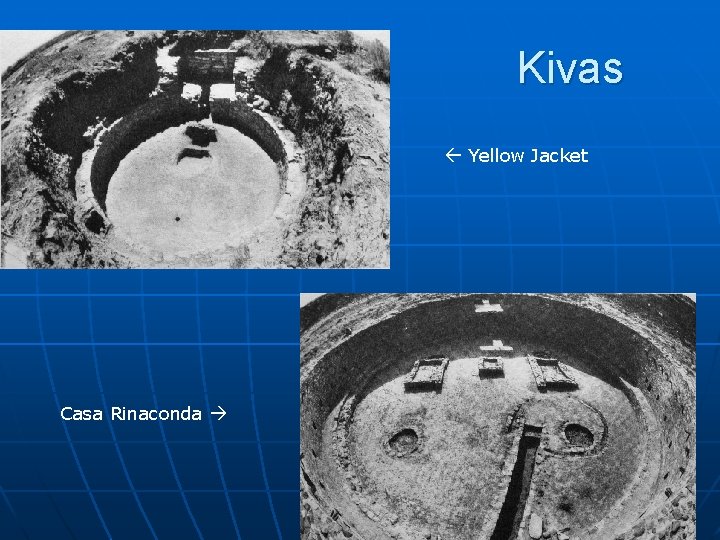
Kivas Yellow Jacket Casa Rinaconda
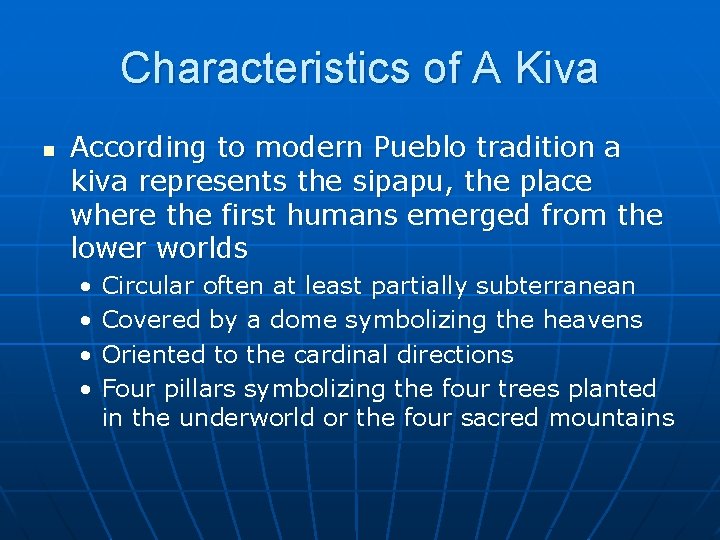
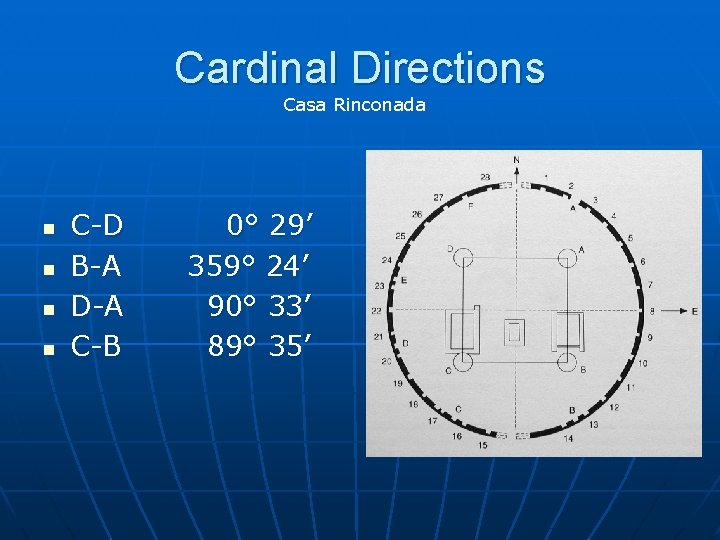
Characteristics of A Kiva n According to modern Pueblo tradition a kiva represents the sipapu, the place where the first humans emerged from the lower worlds • • Circular often at least partially subterranean Covered by a dome symbolizing the heavens Oriented to the cardinal directions Four pillars symbolizing the four trees planted in the underworld or the four sacred mountains
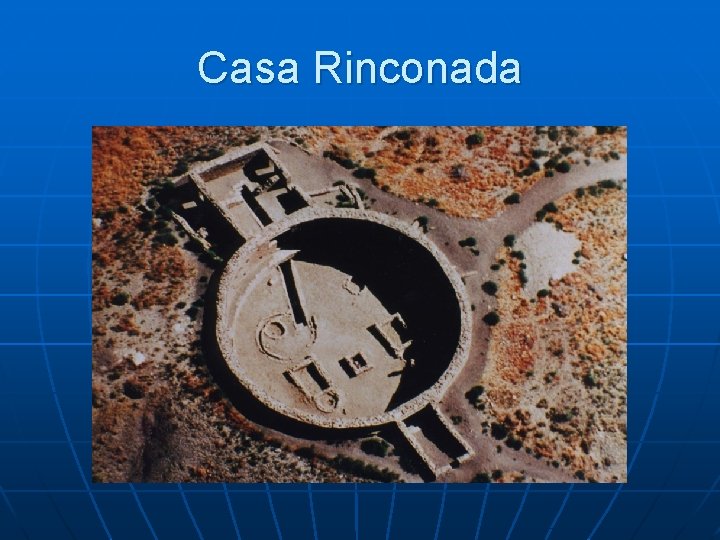
Casa Rinconada
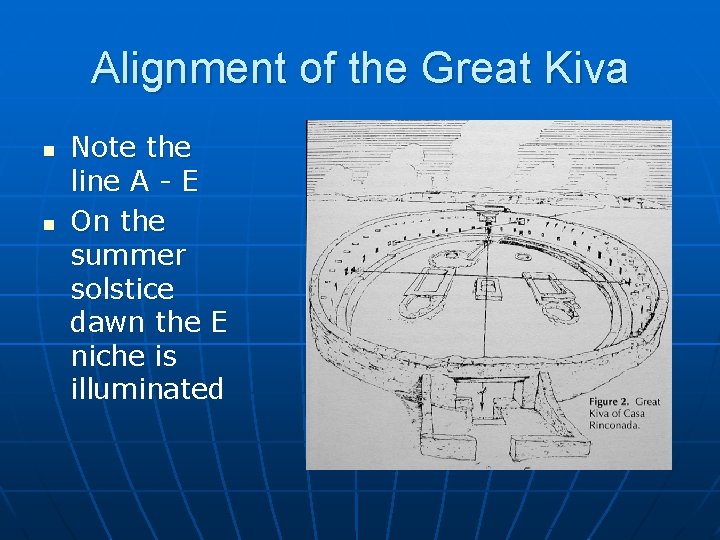
Alignment of the Great Kiva n n Note the line A - E On the summer solstice dawn the E niche is illuminated
Great Kiva Alignment n Casa Rinconada has also attracted ---and continues to attract--- attention due to a possible solstitial alignment. Shortly after sunrise on the summer solstice, as the Sun rises a beam of light shines through a lone window on the N -NE side of the kiva and moves downward and northward until it illuminates, on the interior West wall, one of the five larger, irregularly spaced niches in the kiva. This was hypothesized to be an intentional construct, aimed at marking and celebrating the summer solstice (possibly involving the placement of offerings in the niche). There are some difficulties with this interpretation, however. The upper portions of the kiva wall were reconstructed after excavation, and it is not clear if the window was reconstructed in its original location and shape. Furthermore, the NW roof post is positioned such that it would have blocked the light beam and shadowed the niche. Finally, at some time a small room was built along the outer wall, more or less where the window now exists. All this makes it rather unlikely that the now popular solstitial "light show" was purposefully built into Casa Rinconada.
Cardinal Directions Casa Rinconada n n C-D B-A D-A C-B 0° 29’ 359° 24’ 90° 33’ 89° 35’
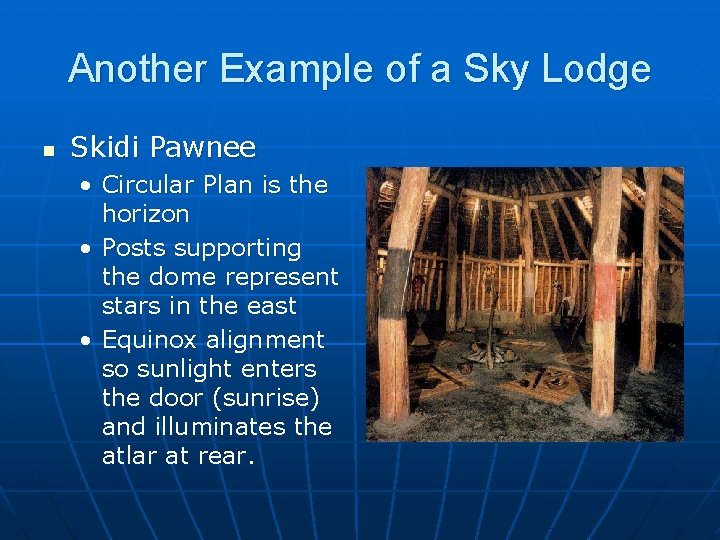
Another Example of a Sky Lodge n Skidi Pawnee • Circular Plan is the horizon • Posts supporting the dome represent stars in the east • Equinox alignment so sunlight enters the door (sunrise) and illuminates the atlar at rear.