
The Analytic Method of Addition Resolution of vectors
- Slides: 17
The Analytic Method of Addition Resolution of vectors into components: YOU MUST KNOW & UNDERSTAND TRIGONOMETERY TO UNDERSTAND THIS!!!!
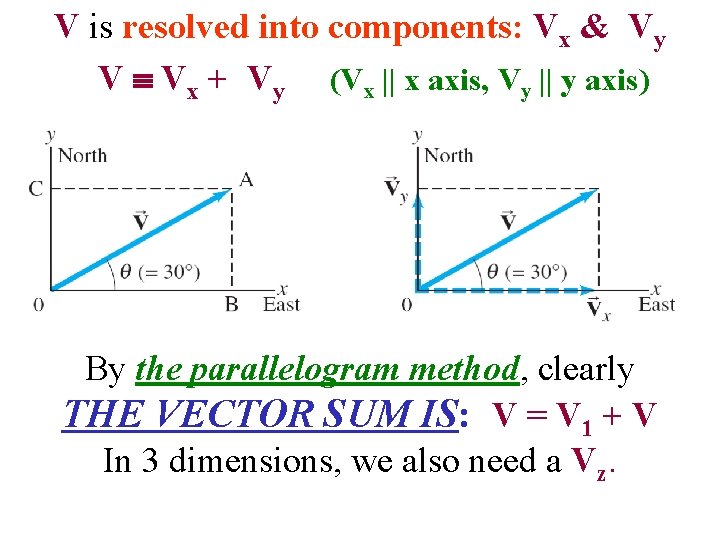
Vector Components • Any vector can be expressed as the sum of two other vectors, called its components. Usually, the other vectors are chosen so that they are perpendicular to each other. • Consider the vector V in a plane (say, the xy plane) • We can express V in terms of COMPONENTS Vx , Vy • Finding THE COMPONENTS Vx & Vy is EQUIVALENT to finding 2 mutually perpendicular vectors which, when added (with vector addition) will give V. • That is, find Vx & Vy such that V Vx + V y (Vx || x axis, Vy || y axis) Finding Components “Resolving into Components”
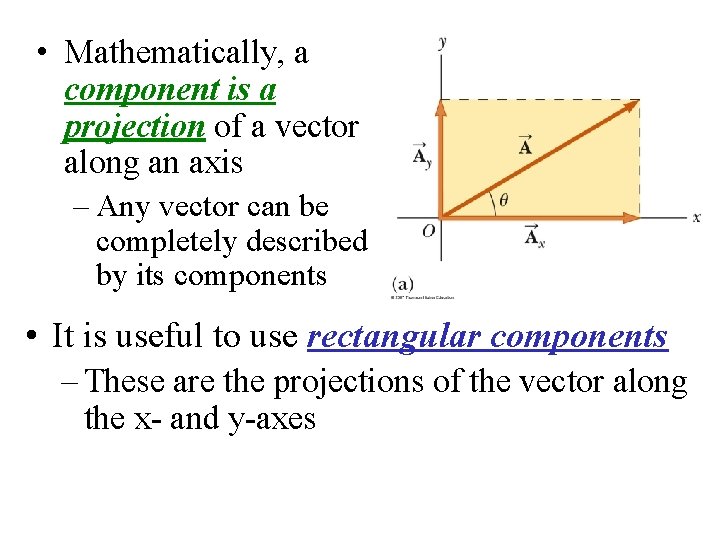
• Mathematically, a component is a projection of a vector along an axis – Any vector can be completely described by its components • It is useful to use rectangular components – These are the projections of the vector along the x- and y-axes
V is resolved into components: Vx & Vy V Vx + Vy (Vx || x axis, Vy || y axis) By the parallelogram method, clearly THE VECTOR SUM IS: V = V 1 + V In 3 dimensions, we also need a Vz.
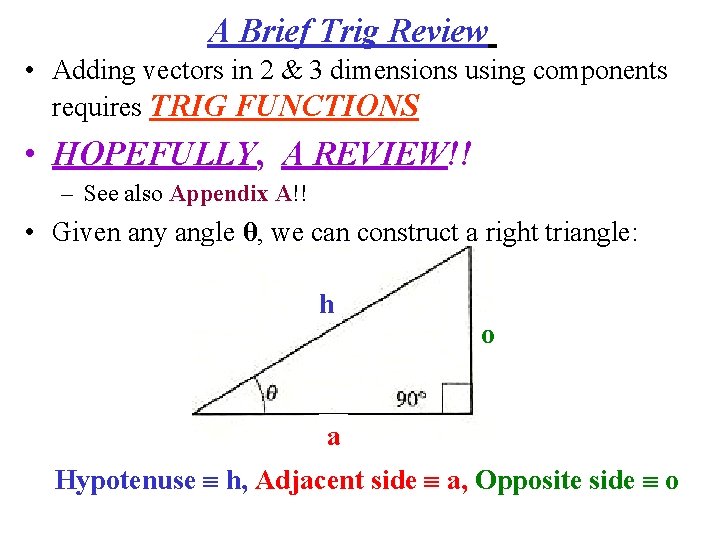
A Brief Trig Review • Adding vectors in 2 & 3 dimensions using components requires TRIG FUNCTIONS • HOPEFULLY, A REVIEW!! – See also Appendix A!! • Given any angle θ, we can construct a right triangle: h o a Hypotenuse h, Adjacent side a, Opposite side o
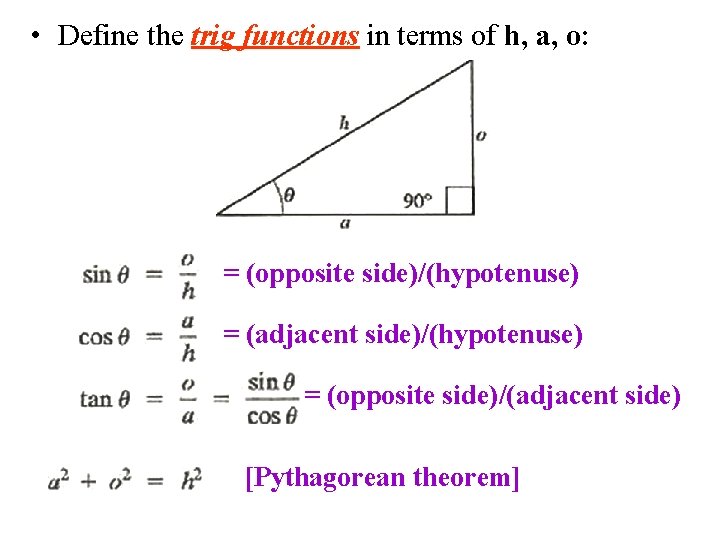
• Define the trig functions in terms of h, a, o: = (opposite side)/(hypotenuse) = (adjacent side)/(hypotenuse) = (opposite side)/(adjacent side) [Pythagorean theorem]
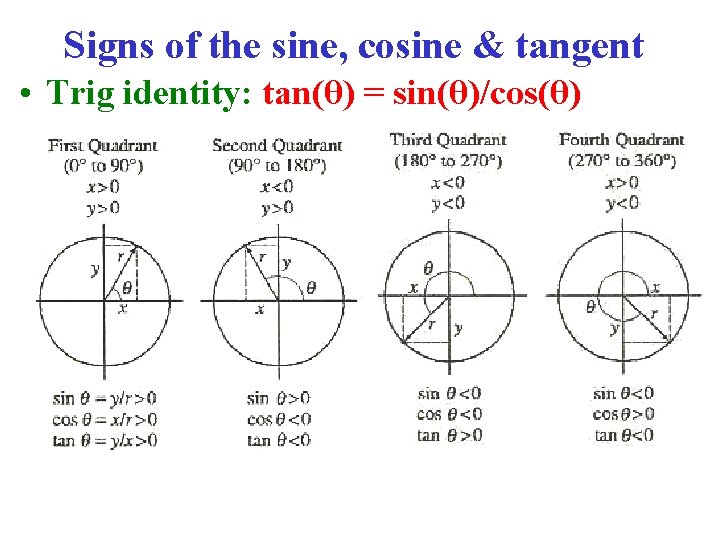
Signs of the sine, cosine & tangent • Trig identity: tan(θ) = sin(θ)/cos(θ)
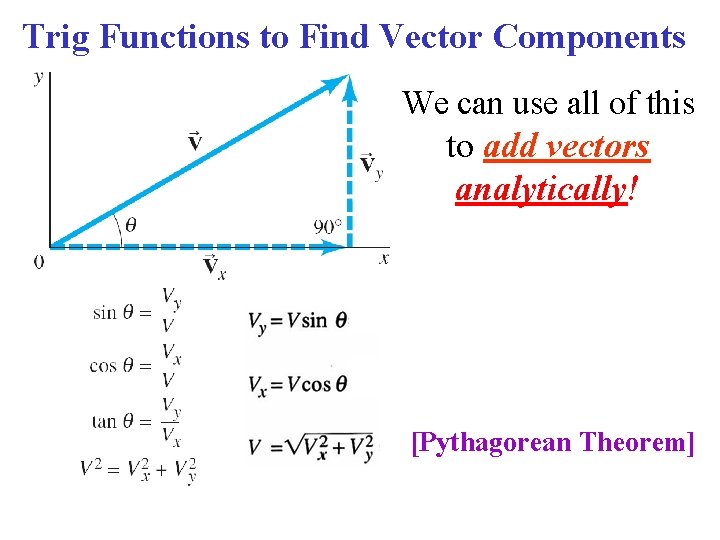
Trig Functions to Find Vector Components We can use all of this to add vectors analytically! [Pythagorean Theorem]
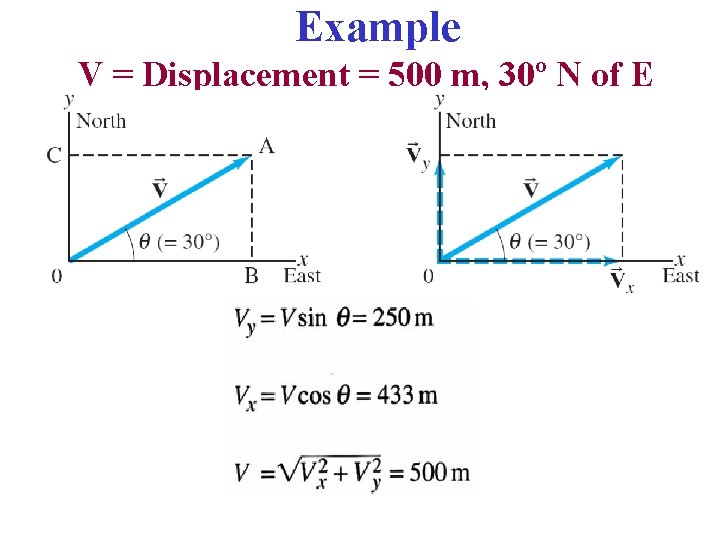
Example V = Displacement = 500 m, 30º N of E
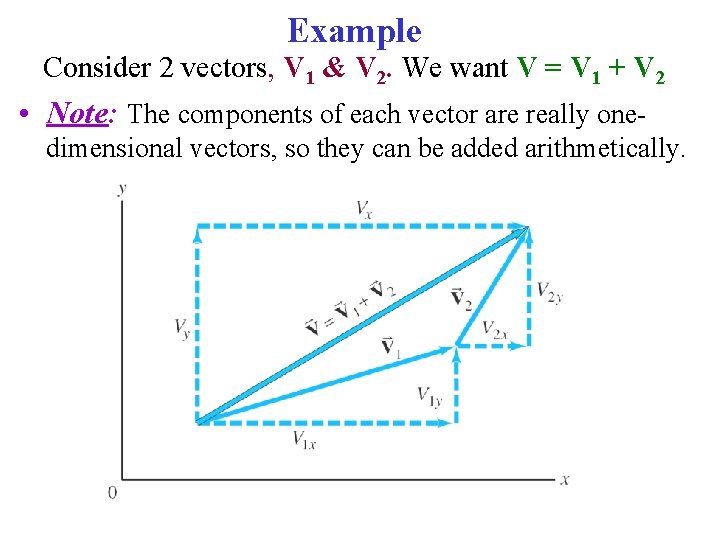
Example Consider 2 vectors, V 1 & V 2. We want V = V 1 + V 2 • Note: The components of each vector are really onedimensional vectors, so they can be added arithmetically.
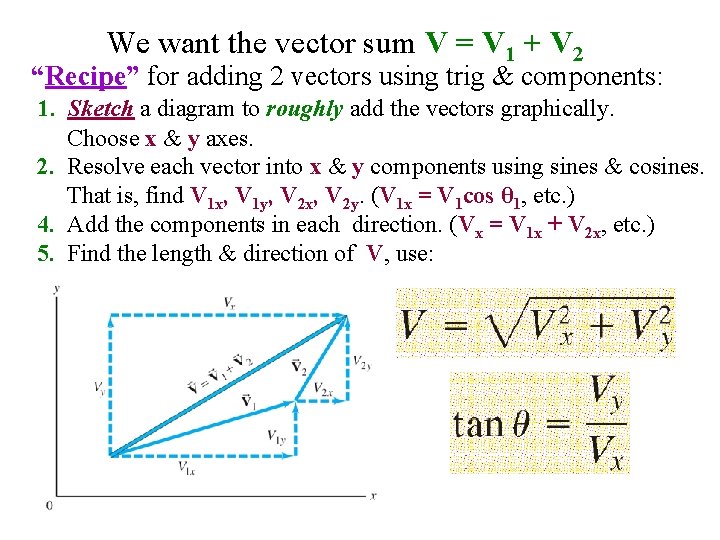
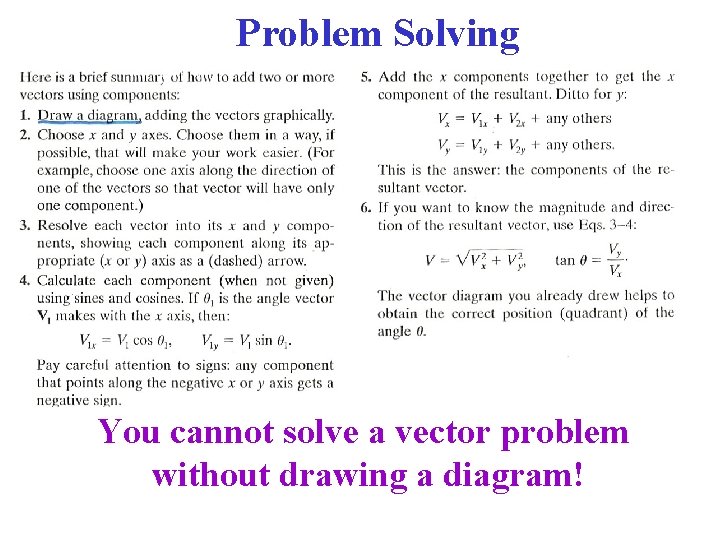
We want the vector sum V = V 1 + V 2 “Recipe” for adding 2 vectors using trig & components: 1. Sketch a diagram to roughly add the vectors graphically. Choose x & y axes. 2. Resolve each vector into x & y components using sines & cosines. That is, find V 1 x, V 1 y, V 2 x, V 2 y. (V 1 x = V 1 cos θ 1, etc. ) 4. Add the components in each direction. (Vx = V 1 x + V 2 x, etc. ) 5. Find the length & direction of V, use:
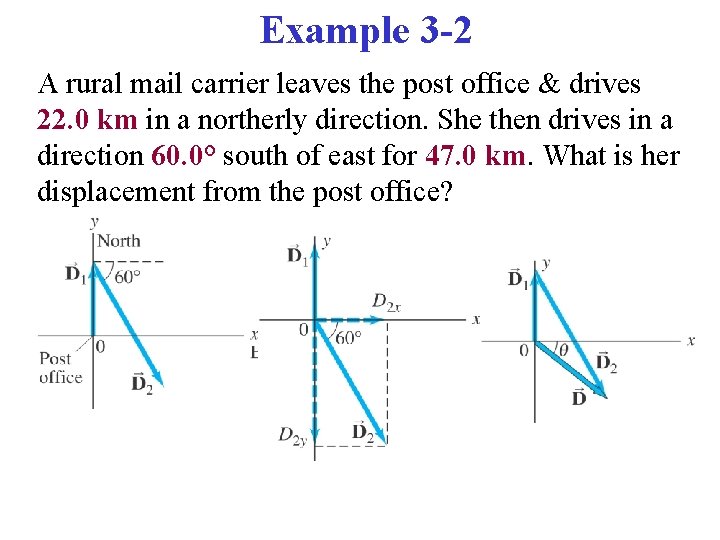
Example 3 -2 A rural mail carrier leaves the post office & drives 22. 0 km in a northerly direction. She then drives in a direction 60. 0° south of east for 47. 0 km. What is her displacement from the post office?
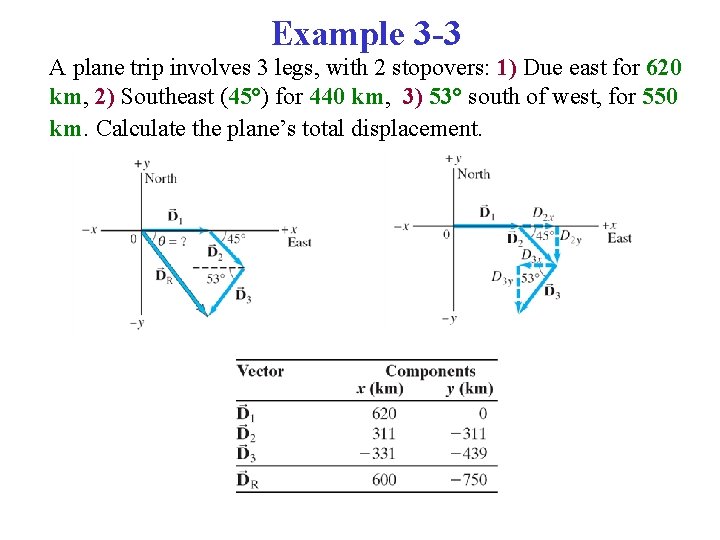
Example 3 -3 A plane trip involves 3 legs, with 2 stopovers: 1) Due east for 620 km, 2) Southeast (45°) for 440 km, 3) 53° south of west, for 550 km. Calculate the plane’s total displacement.
Problem Solving You cannot solve a vector problem without drawing a diagram!
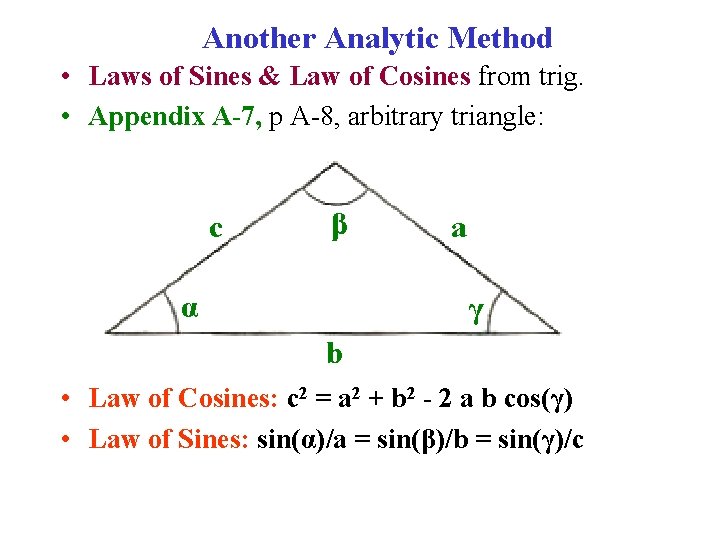
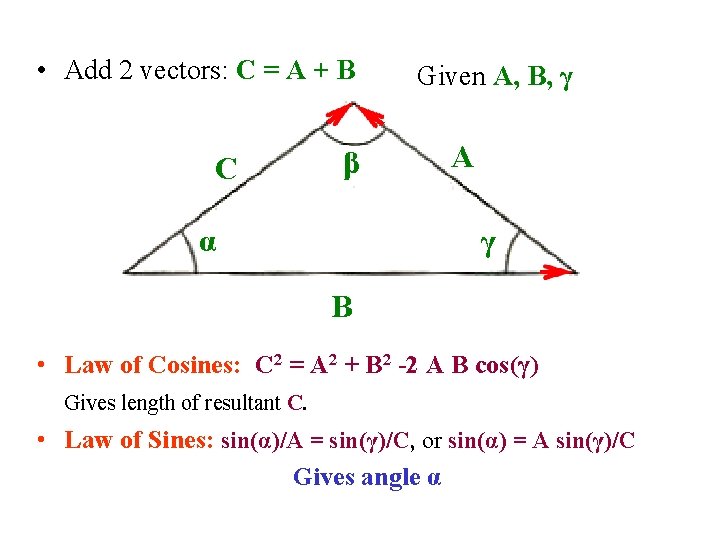
Another Analytic Method • Laws of Sines & Law of Cosines from trig. • Appendix A-7, p A-8, arbitrary triangle: c β α a γ b • Law of Cosines: c 2 = a 2 + b 2 - 2 a b cos(γ) • Law of Sines: sin(α)/a = sin(β)/b = sin(γ)/c
• Add 2 vectors: C = A + B C β α Given A, B, γ A B A γ B • Law of Cosines: C 2 = A 2 + B 2 -2 A B cos(γ) Gives length of resultant C. • Law of Sines: sin(α)/A = sin(γ)/C, or sin(α) = A sin(γ)/C Gives angle α