
The Analysis Essay AP English Language and Composition
- Slides: 8
The Analysis Essay AP English Language and Composition
What is the purpose? n To demonstrate your facility with reading, understanding, and analyzing challenging texts n To assess your ability to manipulate language to communicate your written analysis of a specific topic
What Kinds of Analysis Essays Can You Expect? n n n n An author’s view on a specific subject Rhetorical devices to achieve a purpose Stylistic elements and their effects Author’s tone & how it is conveyed Compare/contrast with regard to style, purpose, or tone Recreation of an experience Intended and/or probable effect of a passage
Planning the Analysis Essay n n n 1 -3 minutes deconstructing, reading and working the prompt 5 minutes reading and making marginal notes regarding the passage (SOAPStone) 10 minutes preparing to write n n Outline Key words 20 minutes writing 3 minutes proofreading
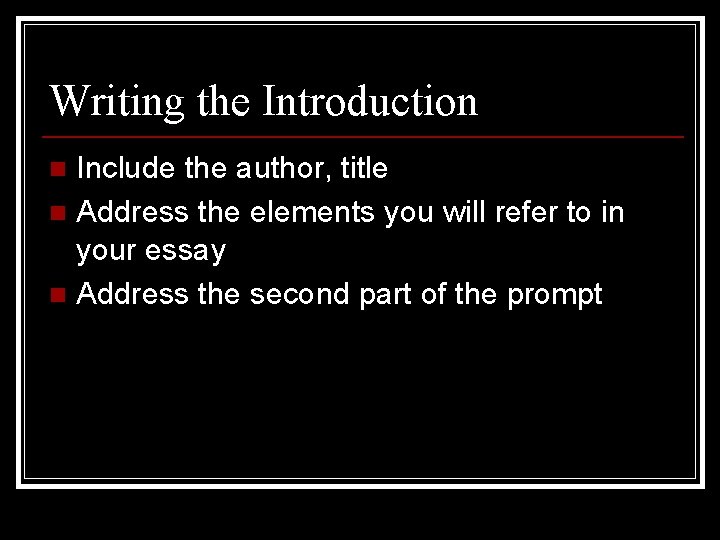
Writing the Introduction Include the author, title n Address the elements you will refer to in your essay n Address the second part of the prompt n
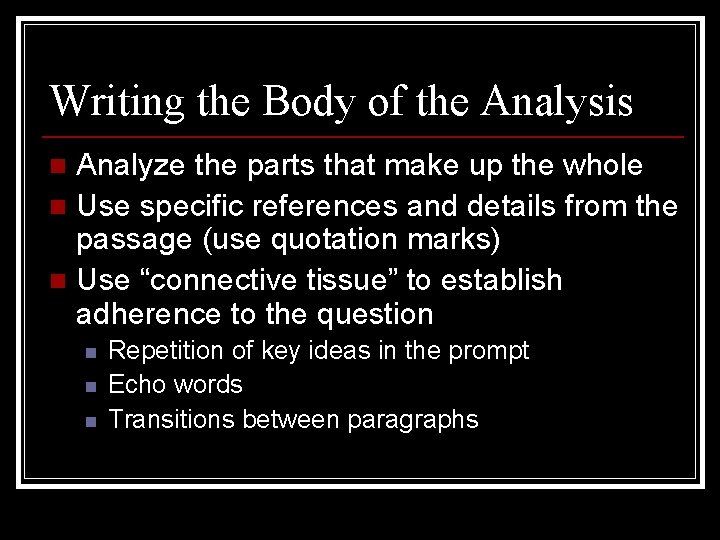
Writing the Body of the Analysis Analyze the parts that make up the whole n Use specific references and details from the passage (use quotation marks) n Use “connective tissue” to establish adherence to the question n n Repetition of key ideas in the prompt Echo words Transitions between paragraphs
Writing the Conclusion Be unique! n Offer insight: Answer the question, “So what? ” n
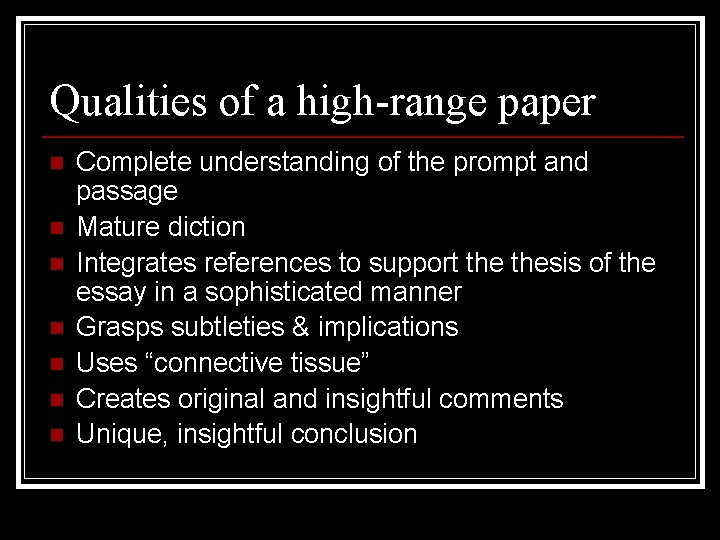
Qualities of a high-range paper n n n n Complete understanding of the prompt and passage Mature diction Integrates references to support thesis of the essay in a sophisticated manner Grasps subtleties & implications Uses “connective tissue” Creates original and insightful comments Unique, insightful conclusion