
The amplitude and period of the graph of


- Slides: 30
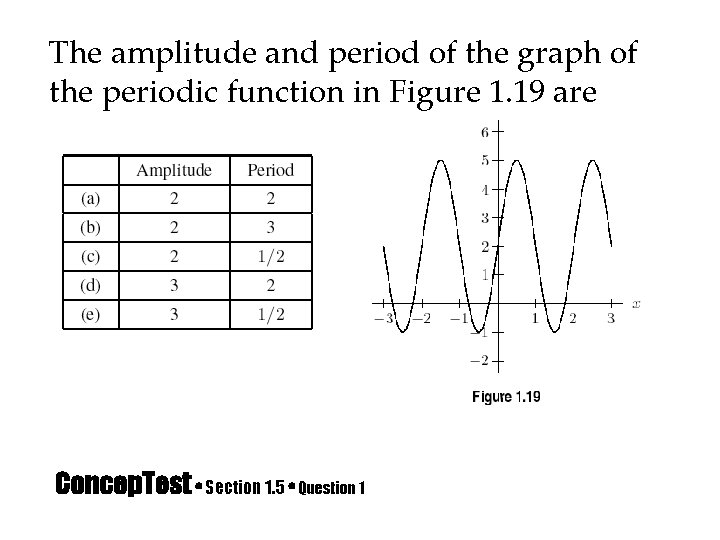
The amplitude and period of the graph of the periodic function in Figure 1. 19 are Concep. Test • Section 1. 5 • Question 1
ANSWER (d). The maximum value of the function is 5, and the minimum value is – 1, so the amplitude is = 3. The function repeats itself after 2 units, so the period is 2. COMMENT: Point out that the function is oscillating about the line y = 2. Have the students find a formula for the function shown in Figure 1. 19. Concep. Test • Section 1. 5 • Answer 1
The amplitude and period of the graph of the periodic function in Figure 1. 20 are Concep. Test • Section 1. 5 • Question 2
ANSWER (c). The maximum value of the function is 5, and the minimum 1, so the amplitude is = 2. The function repeats itself after ½ unit, so the period is ½. COMMENT: It is easiest to find the period using the extreme values of the function. Concep. Test • Section 1. 5 • Answer 2
Which of the following could describe the graph in Figure 1. 21. Concep. Test • Section 1. 5 • Question 3
ANSWER (a) and (d). Note that (b), (c) and (e) have period π, with the rest having period 4π. Answer (f) has y(0) = 0. (a) and (d) could describe the graph. COMMENT: The fact that the same graph may have more than one analytic representation could be emphasized here. Concep. Test • Section 1. 5 • Answer 3
Figure 1. 22 shows the graph of which of the following functions? Concep. Test • Section 1. 5 • Question 4
ANSWER (b) COMMENT: You could ask what the graphs of the other choices look like. Concep. Test • Section 1. 5 • Answer 4
Which of the graphs are those of sin(2 t) and sin(3 t)? (a) (b) (c) (d) (I) = sin(2 t) and (II) = sin(3 t) (I) = sin(2 t) and (III) = sin(3 t) (III) = sin(2 t) and (IV) = sin(3 t) Concep. Test • Section 1. 5 • Question 5
ANSWER (b). The period is the time needed for the function to execute one complete cycle. For sin(2 t), this will be π and for sin(3 t), this will be 2π/3. COMMENT: You could ask what equations describe the graphs of (II) and (IV). This question is the same as Question 5 in Section 1. 3. Concep. Test • Section 1. 5 • Answer 5
Consider a point on the unit circle (shown in Figure 1. 23) starting at an angle of zero and rotating counterclockwise at a constant rate. Which of the graphs represents the horizontal component of this point as a function of time. Concep. Test • Section 1. 5 • Question 6
ANSWER (b) COMMENT: Use this question to make the connection between the unit circle and the graphs of trigonometric functions stronger. Follow-up Question. Which of the graphs represents that of the vertical component of this point as a function of time? Answer. (c). Concep. Test • Section 1. 5 • Answer 6
Which of the following is the approximate value for the sine and cosine of angles A and B in Figure 1. 24? (a) (b) (c) (d) sin A ≈ 0. 5, cos A ≈ 0. 85, sin B ≈ – 0. 7, cos B ≈ 0. 7 sin A ≈ 0. 85, cos A ≈ 0. 5, sin B ≈ – 0. 7, cos B ≈ 0. 7 sin A ≈ 0. 5, cos A ≈ 0. 85, sin B ≈ 0. 7, cos B ≈ 0. 7 sin A ≈ 0. 85, cos A ≈ 0. 5, sin B ≈ – 0. 7, cos B ≈ 0. 7 Concep. Test • Section 1. 5 • Question 7
ANSWER (b) COMMENT: You could use this question to make the connection between the unit circle and the trigonometric functions stronger. You could also identify other points on the circle and ask for values of sine or cosine. Concep. Test • Section 1. 5 • Answer 7
Figure 1. 25 shows the graph of which of the following functions? Concep. Test • Section 1. 5 • Question 8
ANSWER (c) COMMENT: You could ask what the graphs of the other choices look like. Concep. Test • Section 1. 5 • Answer 8
(a) y(0) = 0 (b) Increasing everywhere (c) Concave down for x < 0 (d) Domain: [– 1, 1] (e) Range: (– ∞, ∞) Concep. Test • Section 1. 5 • Question 9
ANSWER (a), (b), and (c). The domain of is ( – 1, 1) and the range of arcsin x is [– π/2, π/2]. COMMENT: You may want to have the students sketch graphs of both functions. Follow-up Question. What is the concavity for each function when x > 0? Answer. Both functions are concave up when x > 0. Concep. Test • Section 1. 5 • Answer 9
Which of the following have the same domain? Concep. Test • Section 1. 5 • Question 10
ANSWER COMMENT: Students could be thinking of the range of sin x for (a) and the range of tan x for (b). Follow-up Question. Does changing (c) to ln |x| affect the answer? Answer. No, because the domain of ln |x| is all real numbers except x = 0. Concep. Test • Section 1. 5 • Answer 10
Which of the following have the same range? Concep. Test • Section 1. 5 • Question 11
ANSWER COMMENT: Follow-up Question. Does changing (c) to |ln x| affect the answer? Answer. No, the range of |ln x| is [0, ∞) while the range of ex is (0, ∞). Concep. Test • Section 1. 5 • Answer 11
If y = arcsin x, then cos y = Concep. Test • Section 1. 5 • Question 12
ANSWER COMMENT: You could also solve this problem by drawing a right triangle with hypotenuse of 1 and labeling the side opposite angle y as x. Concep. Test • Section 1. 5 • Answer 12
If y = arcsin x, then tan y = Concep. Test • Section 1. 5 • Question 13
ANSWER COMMENT: You could also solve this problem by drawing a right triangle with hypotenuse of 1 and labeling the side opposite angle y as x. Concep. Test • Section 1. 5 • Answer 13
If y = arctan x, then cos y = Concep. Test • Section 1. 5 • Question 14
ANSWER COMMENT: You could also solve this problem by drawing a right triangle with the side opposite angle y labeled as x and the side adjacent to angle y labeled as 1. Concep. Test • Section 1. 5 • Answer 14
If y = arctan x, then sin y = Concep. Test • Section 1. 5 • Question 15
ANSWER COMMENT: You could also solve this problem by drawing a right triangle with the side opposite angle y labeled as x and the side adjacent to angle y labeled as 1. Concep. Test • Section 1. 5 • Answer 15