
The Americas PrehistoryA D 1570 Lesson 1 Civilizations
- Slides: 25
The Americas (Prehistory-A. D. 1570) Lesson 1 Civilizations of Middle America • The Olmec • The Maya • The Aztec
The Americas (Prehistory-A. D. 1570) Lesson 1 Civilizations of Middle America Key Terms • Mesoamerica • maize • Olmec • stela • Valley of Mexico • Tenochtitlán • chinampas • Tribute • Teotihuacán Mexico and Central America civilizations Corn Earliest American Civilization Tall, commemorative monument Numerous Mesoamericans civs arose Aztec Capital Artificial islands Aztecs used for crops Conquered peoples payment City dominated the Valley of Mexico from 200 a. d. to 750 a. d.
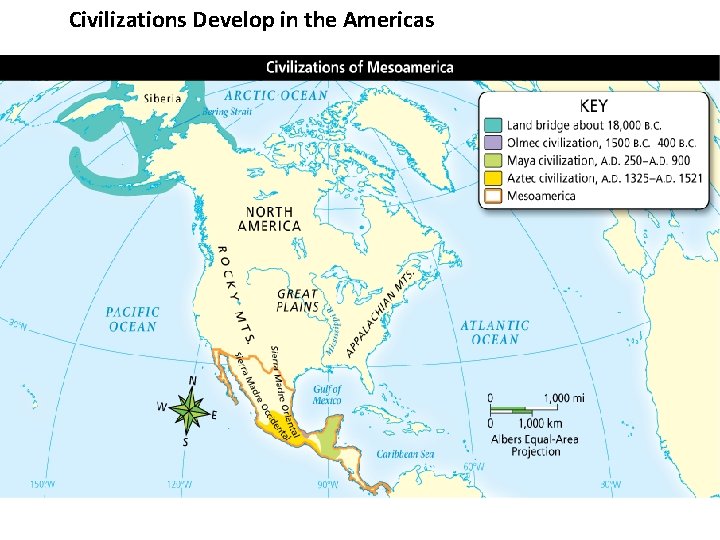
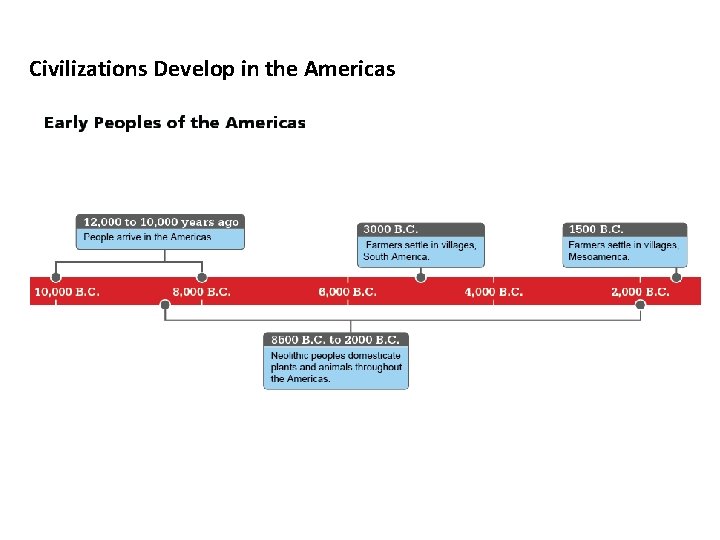
Civilizations Develop in the Americas • A common theory held Paleolithic people reached North America from Asia. • This migration took place during the last Ice Age, which lasted from 100, 000 years ago to about 10, 000 years ago. • Sea levels dropped, exposing a land bridge between Siberia and Alaska in the area that is now the Bering Strait. • Bands of hunter-gatherers followed herds of bison and mammoths across the land bridge between Siberia and Alaska.
Civilizations Develop in the Americas
Civilizations Develop in the Americas
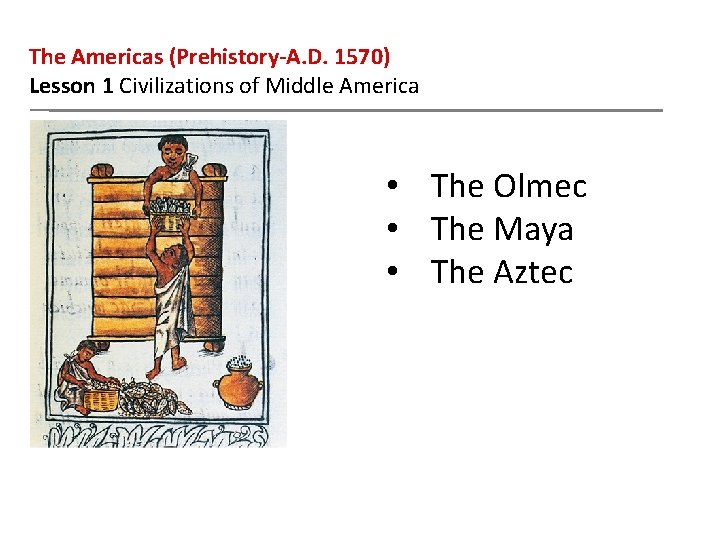
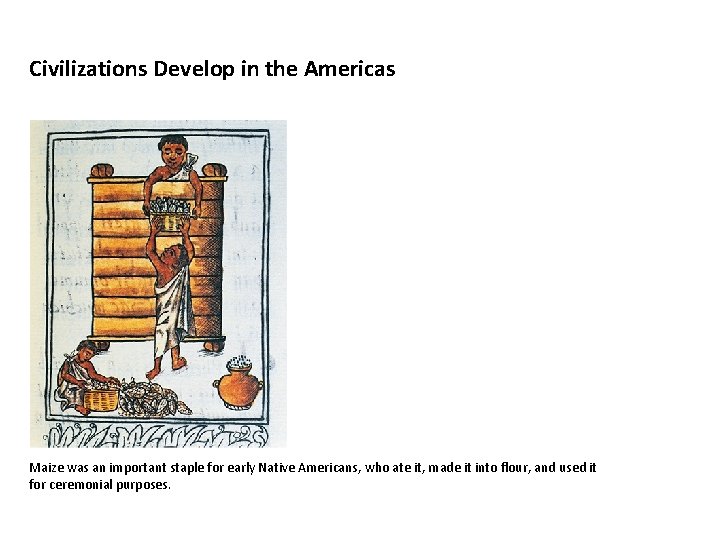
Civilizations Develop in the Americas Maize was an important staple for early Native Americans, who ate it, made it into flour, and used it for ceremonial purposes.
The Olmec Civilization Emerges • The Olmec were the first American civilization • Location: Fertile coastal areas along the Gulf of Mexico • When: 1200 BC to 400 BC • Compared to other civilizations such as the Maya, Aztec and Inca, archaeologists know little about the Olmec. • The Olmec did not build true cities, but rather priests and other leaders may have lived in ceremonial centers, while the common people lived in surrounding farming villages.
Culture and Trade • Ceremonial centers had large pyramid-shaped temples and other important buildings. • Much of Olmec art is carved stone. • The most dramatic remains are 14 giant stone heads found at the major ceremonial centers of San Lorenzo and La Venta. • The Olmec also engaged in trading jade, obsidian, serpentine, mica, rubber, feathers, and pottery; through such trade, they influenced a wide area. • The Olmec also invented a calendar, and they carved hieroglyphic writing into stone.
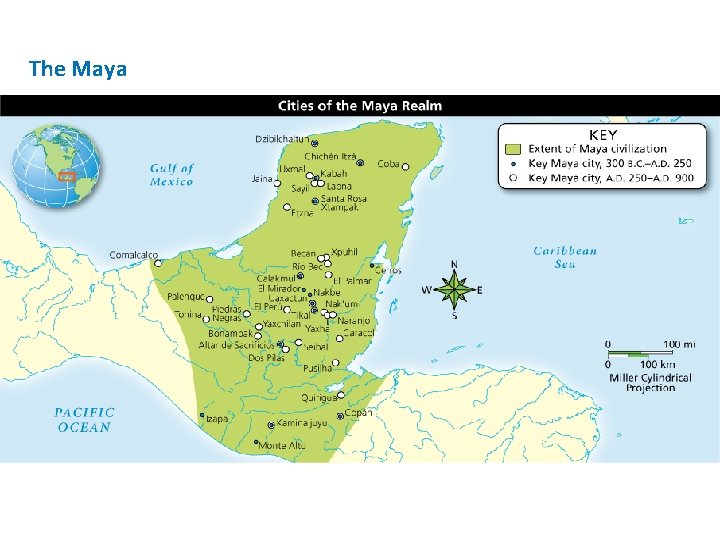
The Maya • Maya were influenced by Olmec’s. • The Maya may have developed ceremonial centers about the same time as the Olmec. • By 300 BC, the Maya were building large cities, such as El Mirador in Guatemala. • By about AD 250, the Maya golden age—known as the Classic Period—began, with city-states flourishing from the Yucatán Peninsula in southern Mexico through much of Central America. • They developed two farming methods that allowed them to thrive in the tropical environment. (Slash and Burn Technique)
The Maya • Individual and powerful city-states evolved. • The smaller city-states ruled over the people living directly within and near their borders. The largest ones reigned over neighboring areas as well—often requiring nearby cities to show allegiance to their kings and to participate in their ritual activities. • The largest and most supreme power resided in the rulers of Tikal and Calakmul.
The Maya
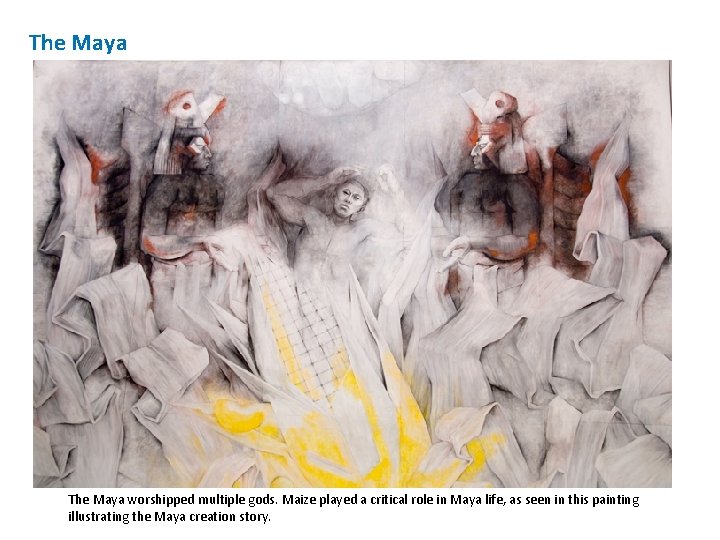
The Maya worshipped multiple gods. Maize played a critical role in Maya life, as seen in this painting illustrating the Maya creation story.
Social Hierarchy • Each Maya city had its own ruler, who was usually male. • Nobles served many functions in support of the ruler. Some were military leaders, while some collected taxes and enforced laws. • Others managed public works, similar to the way the Olmec used collective labor for monument and temple building. Scribes, painters, and sculptors were also very highly respected • Merchants may have formed a middle class in society. • The majority of the Maya were farmers. They grew maize, beans, and squash—the basic food crops of Mesomerica— as well as fruit trees, cotton, and brilliant tropical flowers. 1. Rulers 2. Nobles 3. Public Works officials 4. Merchants 5. Farmers 6. Slaves
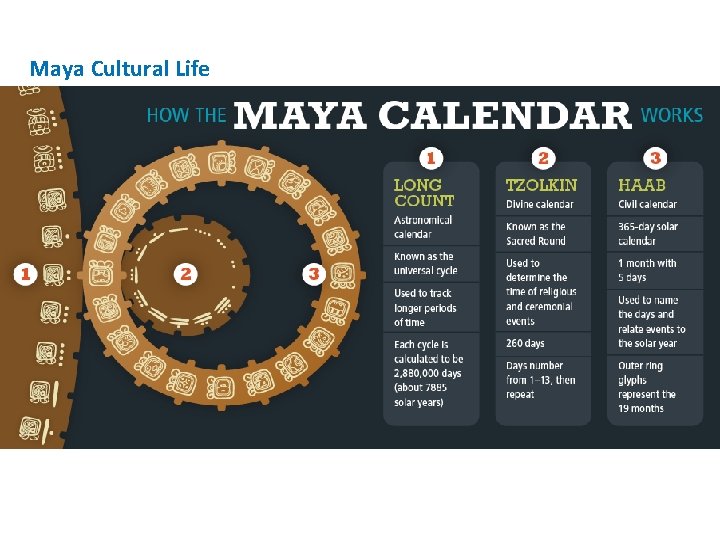
Maya Cultural Life • The Maya developed a complex polytheistic religion, perhaps inherited from the Olmec. • The Maya also developed a hieroglyphic writing system. a) They also wrote about astronomy, rituals, and other religious matters in books made of bark paper. • The cities of the Maya are known today for their towering temples and palaces built from stone. a) Atop the temples, priests performed rites and sacrifices, while the people watched from the plazas below. b) Some temples also served as burial places for rulers, nobles, and priests.
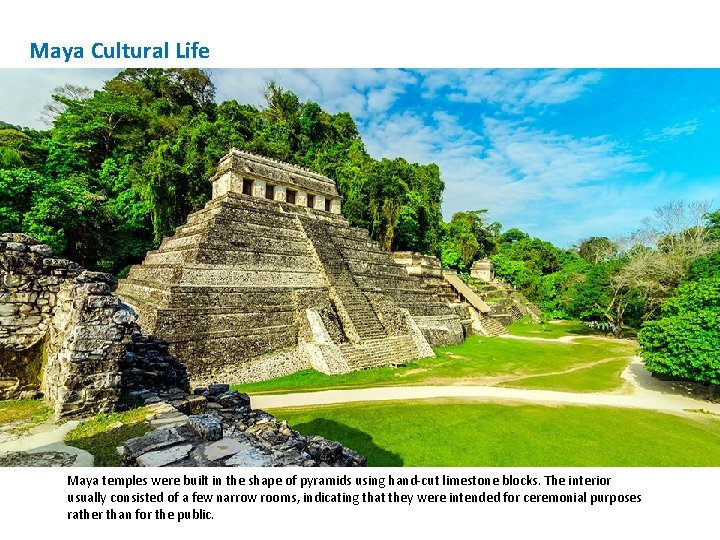
Maya Cultural Life Maya temples were built in the shape of pyramids using hand-cut limestone blocks. The interior usually consisted of a few narrow rooms, indicating that they were intended for ceremonial purposes rather than for the public.
Maya Accomplishments • They developed a 365 -day solar calendar as well as a 260 -day religious calendar, recording the correct timing for important ceremonies. • Maya priests also invented a counting system based on three symbols: a dot to represent one, a bar for five, and a shell for zero. • The Maya were one of the only early civilizations to understand the concept of zero.
Maya Cultural Life
The Aztec • After about AD 1200, bands of nomadic people from the north migrated into the Valley of Mexico. • These people identified themselves as separate tribes, such as the Mexica. • All the tribes spoke one language—Nahuatl—Together, these tribes are known as the Aztecs. • In AD 1325, the Aztecs founded their capital city, Tenochtitlán (teh nawch tee tlahn).
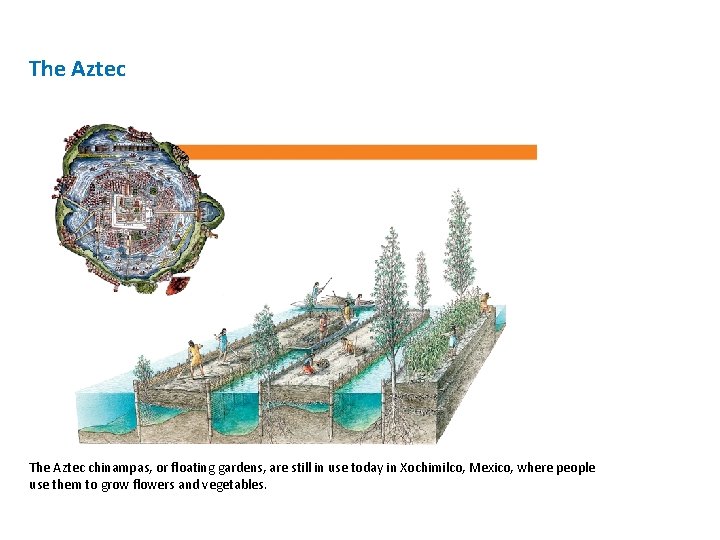
The Aztec • The Aztec built chinampas, artificial islands made of mud piled atop reed mats that were anchored to the shallow lake-bed with willow trees. • On these “floating gardens, ” the Aztecs raised maize, squash, and beans, the same crops grown by their predecessors the Maya.
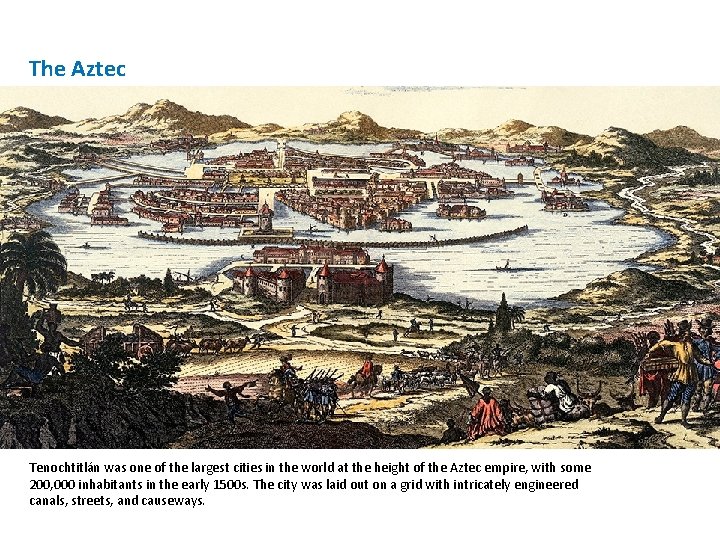
The Aztec Tenochtitlán was one of the largest cities in the world at the height of the Aztec empire, with some 200, 000 inhabitants in the early 1500 s. The city was laid out on a grid with intricately engineered canals, streets, and causeways.
The Aztec chinampas, or floating gardens, are still in use today in Xochimilco, Mexico, where people use them to grow flowers and vegetables.
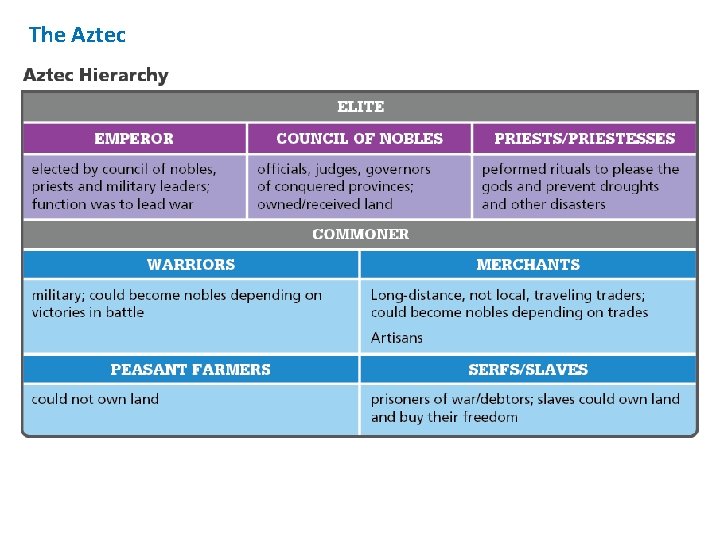
The Aztec Social Hierarchy • War brought immense wealth as well as power to the Aztec empire. Tribute, or payment from conquered peoples, helped the Aztecs turn their capital into a magnificent city. • The Aztec empire had a single ruler. However, like the Maya, the Aztecs had a clear social hierarchy. • Nobles served as officials, judges, and governors of conquered provinces. • Warriors, who could rise to noble status by performing well on the battlefield. • The priests performed rituals to please the gods and prevent droughts or other disasters. • Middle class consisted of traders and merchants • Majority of people were commoners who farmed the land • Lower class consisted of serfs and slaves
The Aztec
Aztec Religion and Mythology • The Aztecs believed in many gods (polytheisitic). They revered Huitzilopochtli (weets ee loh pohch tlee) as the patron god of their people. • The Aztecs also worshipped Quetzalcoatl (ket sahl koh aht el), which was akin to the Olmec snake god and the Maya god Kukulcan. • Teotihuacán had dominated life in the Valley of Mexico from about AD 200 to AD 750. • The city was well planned, with wide roads, massive temples, and large apartment buildings to house its population of perhaps 200, 000.
The Aztec Achievements • The Aztecs offered human sacrifices to their gods. Most of the victims were prisoners of war, who were plentiful because the Aztecs carried on almost continuous warfare. • Priests recorded laws and historical events in the Aztec hieroglyphic writing system. Some priests ran schools. • Astronomy led to the development of a 260 -day ritual calendar based on the movements of the sun. • One major idea was the development of a numbering system based on 20. • The Aztec civilization developed ideas about multiplication and division, as well as some principles of geometry.