
The American Revolution HIST 1004 21313 Enlightened Revolutions




- Slides: 20
The American Revolution HIST 1004 2/13/13
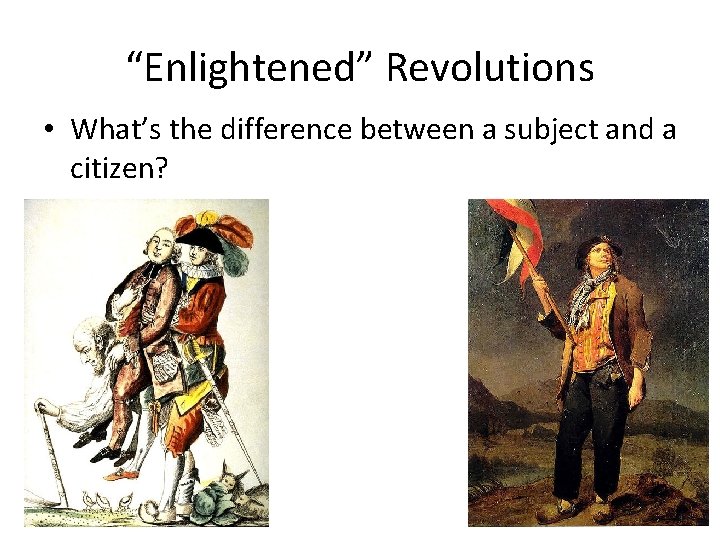
“Enlightened” Revolutions • What’s the difference between a subject and a citizen?
Subjects vs. Citizens • Subjects – Asymmetrical relationship(s) – Obligations to the sovereign, but little rights – Rights and obligations determined by royal privilege • Citizens – Exchange of rights and responsibilities – Rights and responsibilities codified and equally distributed, rule of law – Equality amongst citizens – Popular sovereignty
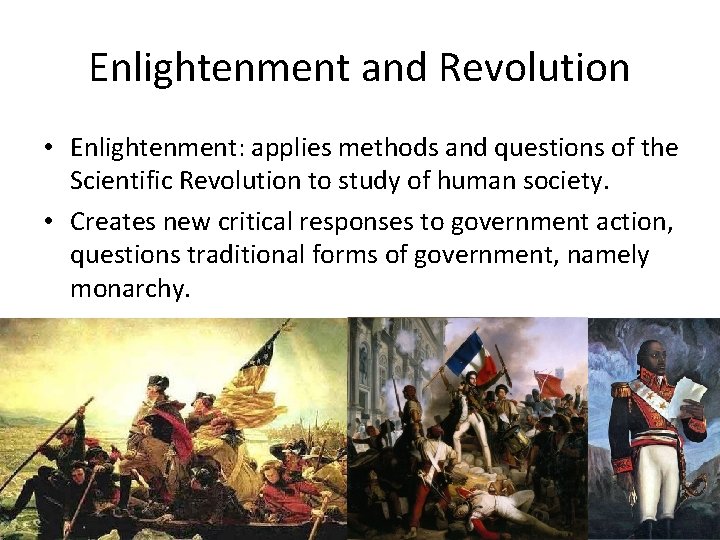
Enlightenment and Revolution • Enlightenment: applies methods and questions of the Scientific Revolution to study of human society. • Creates new critical responses to government action, questions traditional forms of government, namely monarchy.
Spread of Enlightenment Ideals • Growing educated middle class key to expansion of Enlightenment • Consumers of books, newspapers, and journals • Used urban gathering places to exchange and debate ideas… – Salons – Coffeehouses and teashops
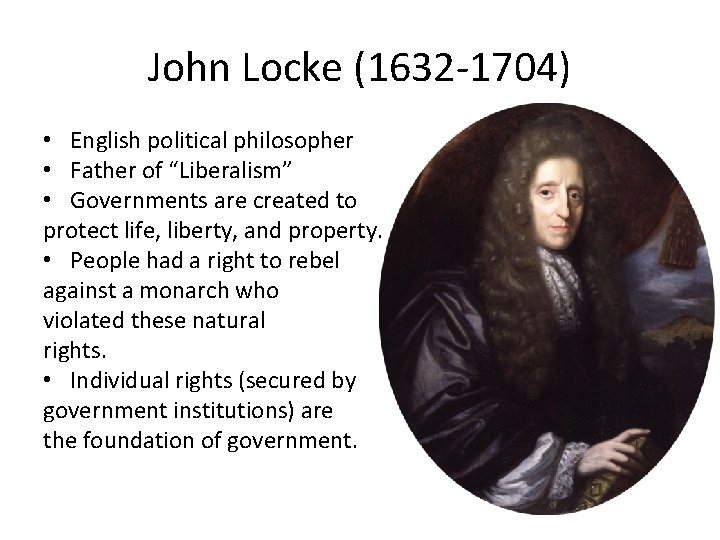
John Locke (1632 -1704) • English political philosopher • Father of “Liberalism” • Governments are created to protect life, liberty, and property. • People had a right to rebel against a monarch who violated these natural rights. • Individual rights (secured by government institutions) are the foundation of government.
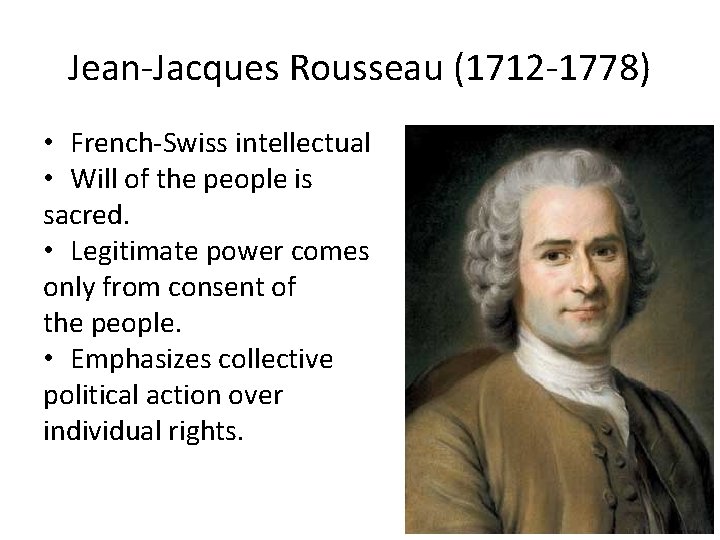
Jean-Jacques Rousseau (1712 -1778) • French-Swiss intellectual • Will of the people is sacred. • Legitimate power comes only from consent of the people. • Emphasizes collective political action over individual rights.
“Of the Social Contract, Or Principles of Political Right” • Rousseau, published in 1762 • Establish a political society in the face of inequality due to commercial economy. • Only the people, in the form of the sovereign have the right to legislate. – “Man is born free, and everywhere he is in chains. ” – “The Sovereign, having no force other than the legislative power, acts only by means of laws; and the laws being solely the authentic acts of the general will, the Sovereign cannot act save when the people is assembled. ” – “Every law the people have not ratified in person is null and void – is, in fact, not a law. ” – “The legislative power belongs to the people, and can belong to it alone. ”
Enlightened Monarchs • Patronized Enlightenment thinkers • Opportunity to expand authority at the expense of church, nobility, and regional autonomy. • Nationalize bureaucracy with meritocracy, legal system, and tax systems. • Developments in science and technology = growing treasuries Catherine the Great of Russia (r. 1762 -1796) and Frederick the Great of Prussia (r. 1740 -1786)
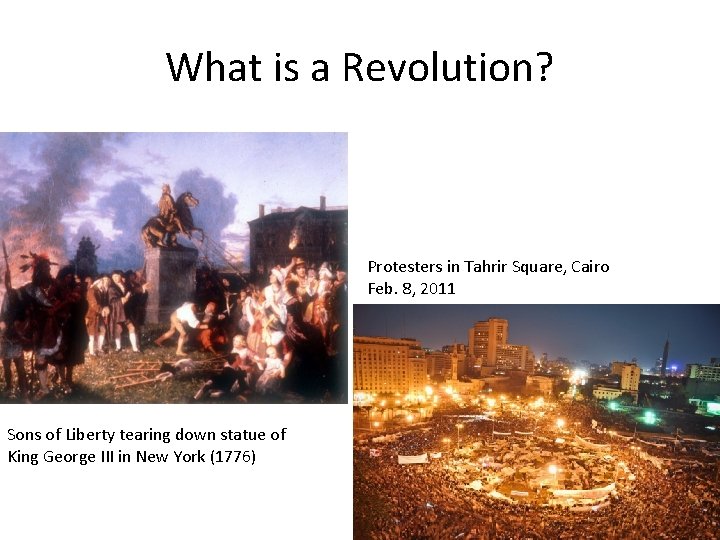
What is a Revolution? Protesters in Tahrir Square, Cairo Feb. 8, 2011 Sons of Liberty tearing down statue of King George III in New York (1776)
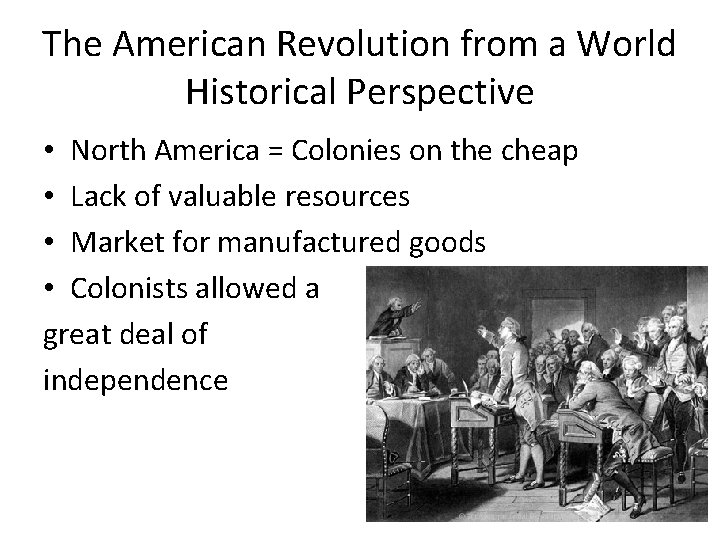
The American Revolution from a World Historical Perspective • North America = Colonies on the cheap • Lack of valuable resources • Market for manufactured goods • Colonists allowed a great deal of independence
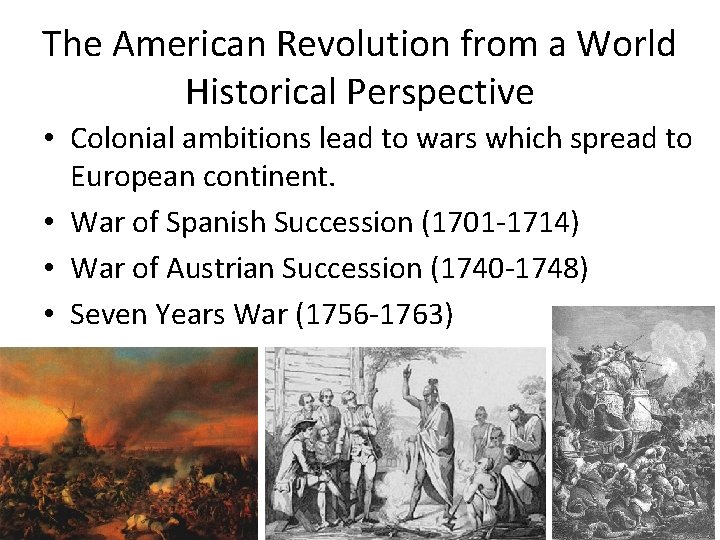
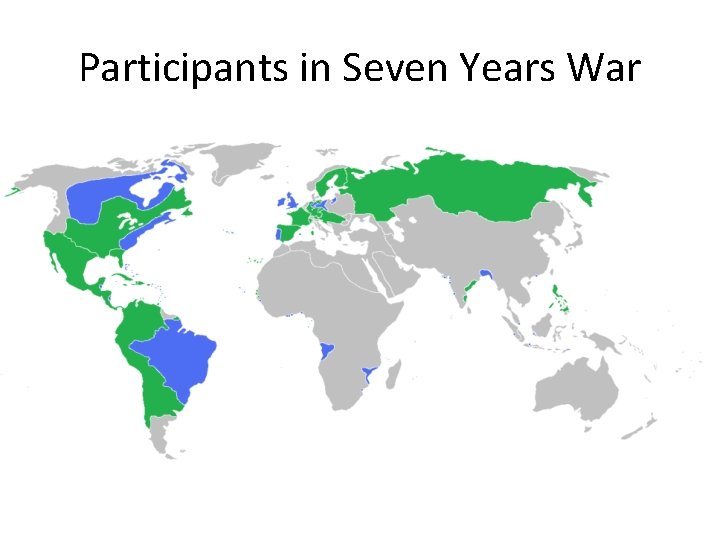
The American Revolution from a World Historical Perspective • Colonial ambitions lead to wars which spread to European continent. • War of Spanish Succession (1701 -1714) • War of Austrian Succession (1740 -1748) • Seven Years War (1756 -1763)
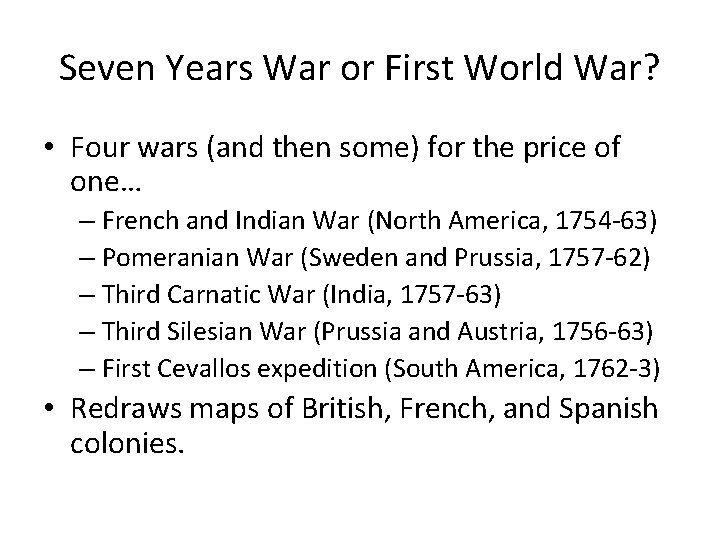
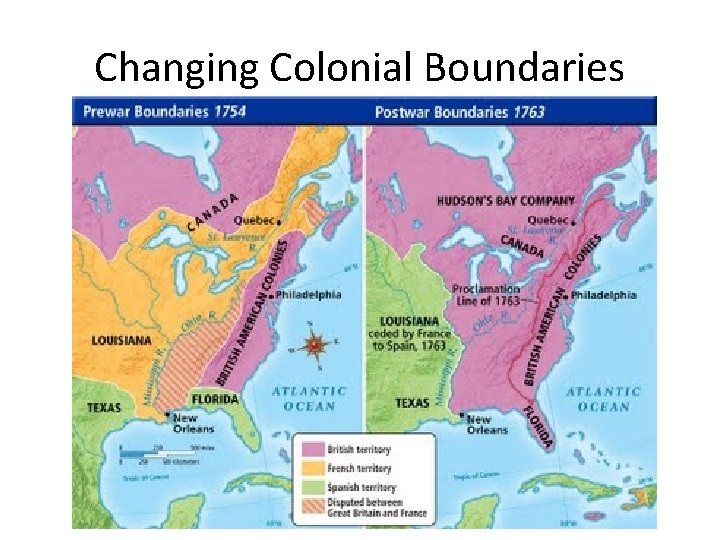
Seven Years War or First World War? • Four wars (and then some) for the price of one… – French and Indian War (North America, 1754 -63) – Pomeranian War (Sweden and Prussia, 1757 -62) – Third Carnatic War (India, 1757 -63) – Third Silesian War (Prussia and Austria, 1756 -63) – First Cevallos expedition (South America, 1762 -3) • Redraws maps of British, French, and Spanish colonies.
Participants in Seven Years War
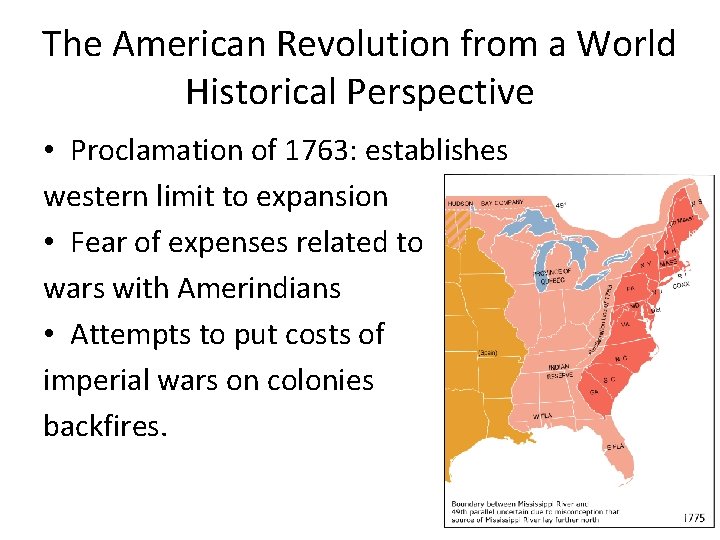
Changing Colonial Boundaries
The American Revolution from a World Historical Perspective • British face massive war debts (£ 137 million with £ 5 million interest payments) • Expectation that colonies should pay • British raise taxes and seek limits on colonial governments in Americas.
The American Revolution from a World Historical Perspective • Proclamation of 1763: establishes western limit to expansion • Fear of expenses related to wars with Amerindians • Attempts to put costs of imperial wars on colonies backfires.
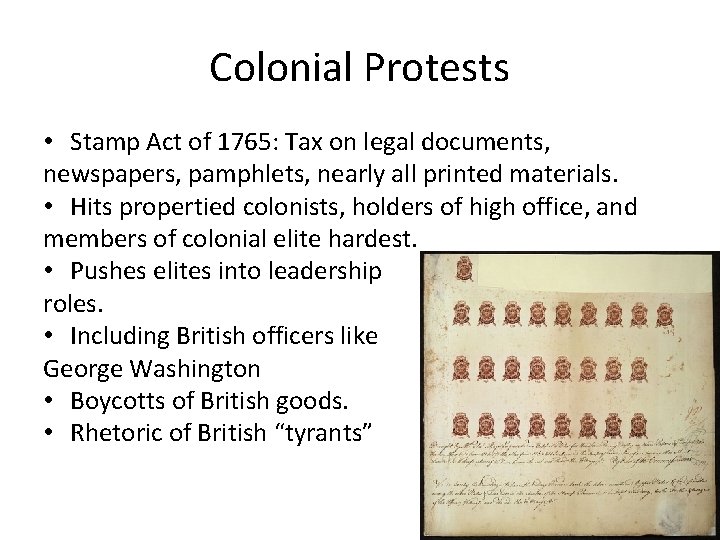
Colonial Protests • Stamp Act of 1765: Tax on legal documents, newspapers, pamphlets, nearly all printed materials. • Hits propertied colonists, holders of high office, and members of colonial elite hardest. • Pushes elites into leadership roles. • Including British officers like George Washington • Boycotts of British goods. • Rhetoric of British “tyrants”
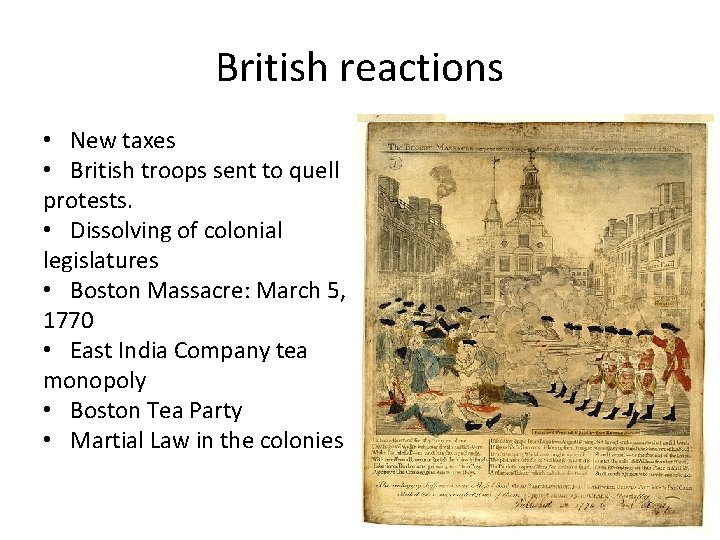
British reactions • New taxes • British troops sent to quell protests. • Dissolving of colonial legislatures • Boston Massacre: March 5, 1770 • East India Company tea monopoly • Boston Tea Party • Martial Law in the colonies
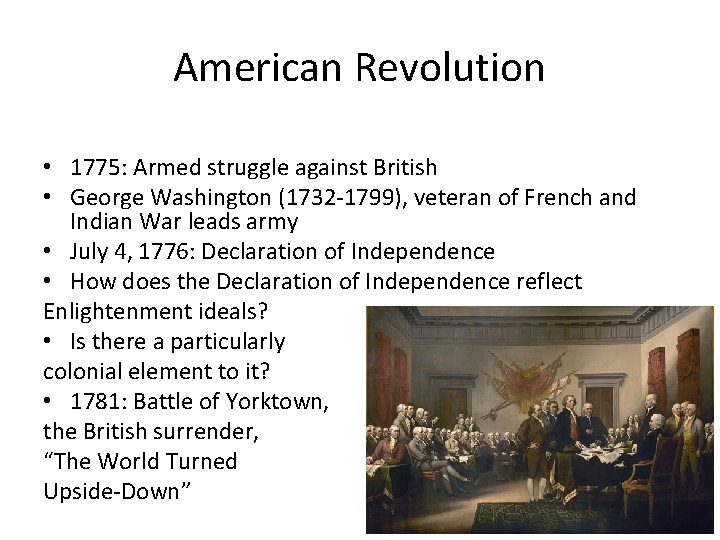
American Revolution • 1775: Armed struggle against British • George Washington (1732 -1799), veteran of French and Indian War leads army • July 4, 1776: Declaration of Independence • How does the Declaration of Independence reflect Enlightenment ideals? • Is there a particularly colonial element to it? • 1781: Battle of Yorktown, the British surrender, “The World Turned Upside-Down”