
The American Revolution Chapter 6 Section 4 Main
- Slides: 28
The American Revolution Chapter 6 Section 4
Main Ideas o Enlightenment ideas helped spur the American colonies to shed British rule and create a new nation. o The revolution created a republic, the United States of America, that became a model for many nations of the world.
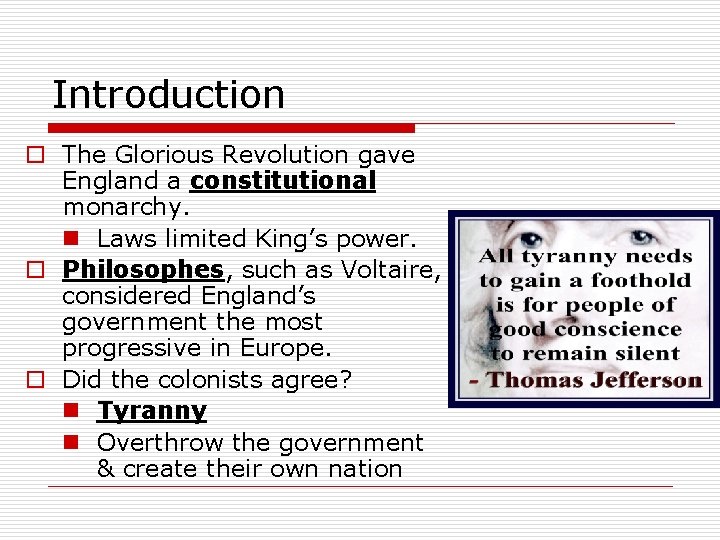
Introduction o The Glorious Revolution gave England a constitutional monarchy. n Laws limited King’s power. o Philosophes, such as Voltaire, considered England’s government the most progressive in Europe. o Did the colonists agree? n Tyranny n Overthrow the government & create their own nation
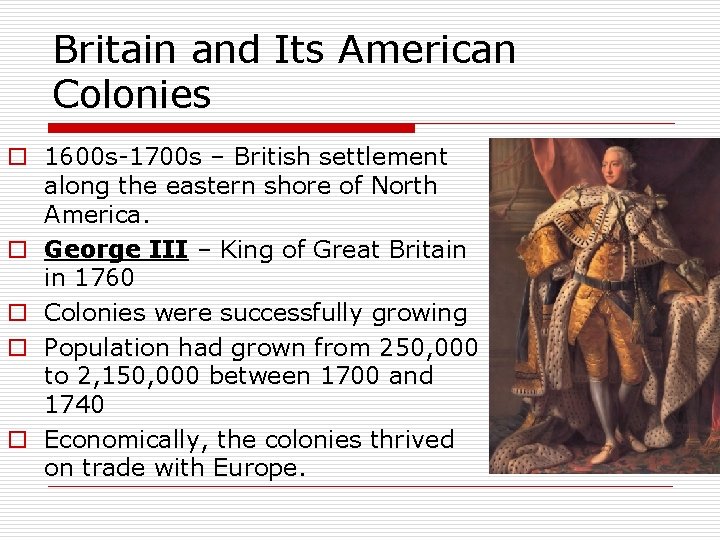
Britain and Its American Colonies o 1600 s-1700 s – British settlement along the eastern shore of North America. o George III – King of Great Britain in 1760 o Colonies were successfully growing o Population had grown from 250, 000 to 2, 150, 000 between 1700 and 1740 o Economically, the colonies thrived on trade with Europe.
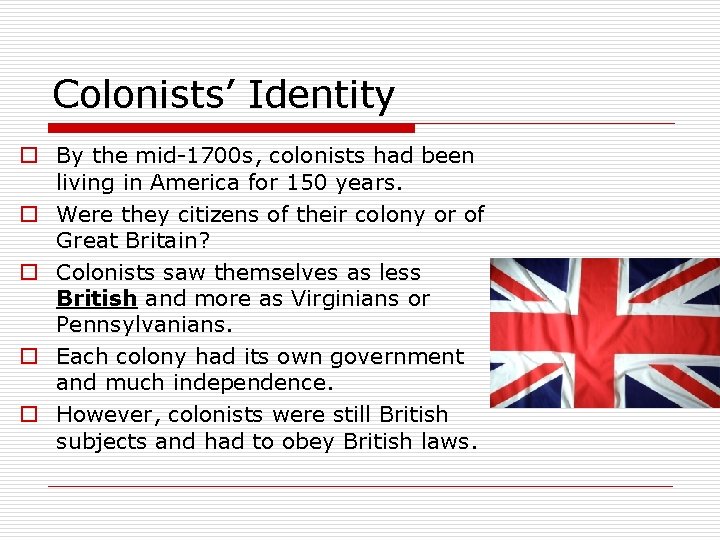
Colonists’ Identity o By the mid-1700 s, colonists had been living in America for 150 years. o Were they citizens of their colony or of Great Britain? o Colonists saw themselves as less British and more as Virginians or Pennsylvanians. o Each colony had its own government and much independence. o However, colonists were still British subjects and had to obey British laws.
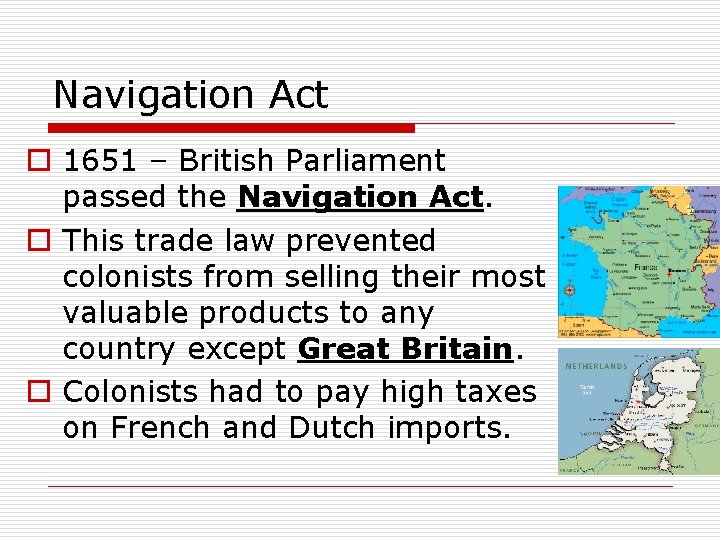
Navigation Act o 1651 – British Parliament passed the Navigation Act. o This trade law prevented colonists from selling their most valuable products to any country except Great Britain. o Colonists had to pay high taxes on French and Dutch imports.
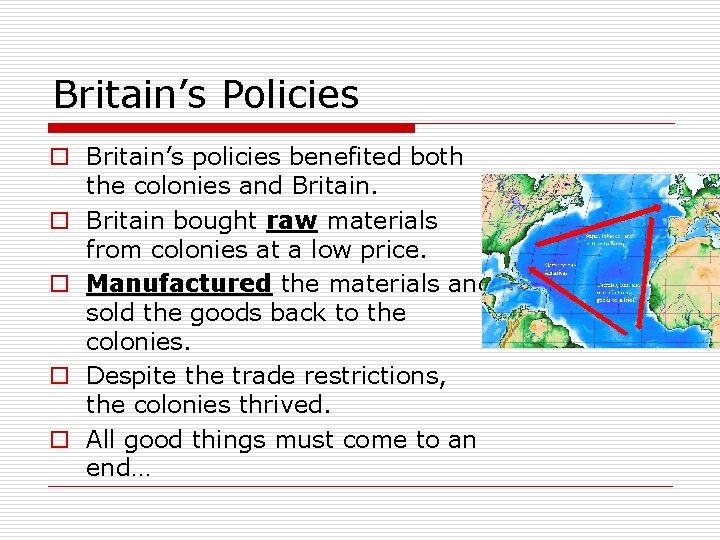
Britain’s Policies o Britain’s policies benefited both the colonies and Britain. o Britain bought raw materials from colonies at a low price. o Manufactured the materials and sold the goods back to the colonies. o Despite the trade restrictions, the colonies thrived. o All good things must come to an end…
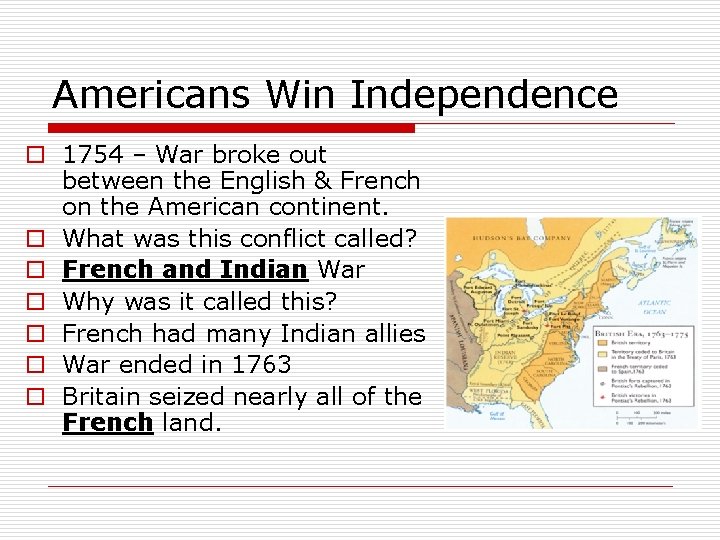
Americans Win Independence o 1754 – War broke out between the English & French on the American continent. o What was this conflict called? o French and Indian War o Why was it called this? o French had many Indian allies o War ended in 1763 o Britain seized nearly all of the French land.
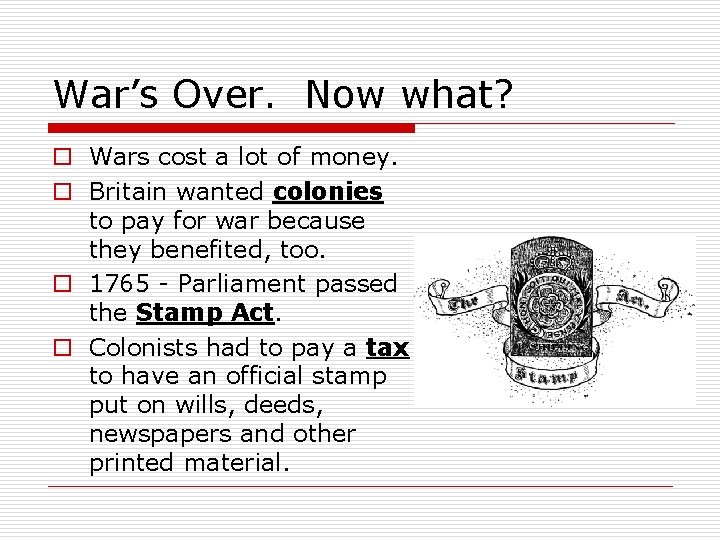
War’s Over. Now what? o Wars cost a lot of money. o Britain wanted colonies to pay for war because they benefited, too. o 1765 - Parliament passed the Stamp Act. o Colonists had to pay a tax to have an official stamp put on wills, deeds, newspapers and other printed material.
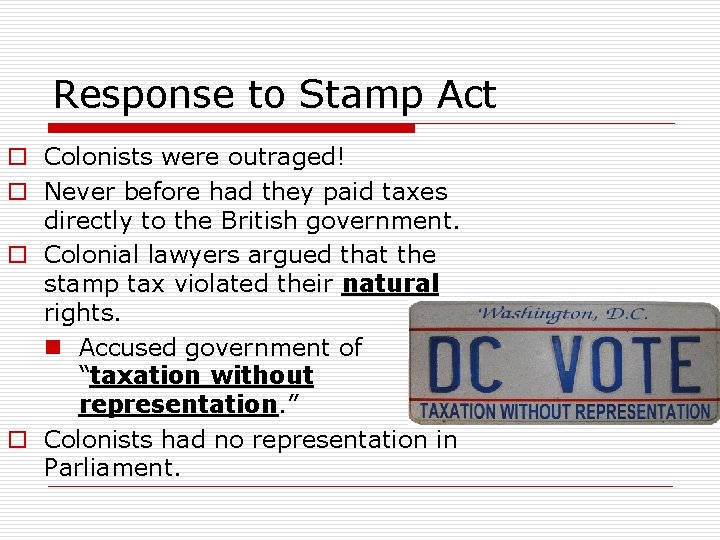
Response to Stamp Act o Colonists were outraged! o Never before had they paid taxes directly to the British government. o Colonial lawyers argued that the stamp tax violated their natural rights. n Accused government of “taxation without representation. ” o Colonists had no representation in Parliament.
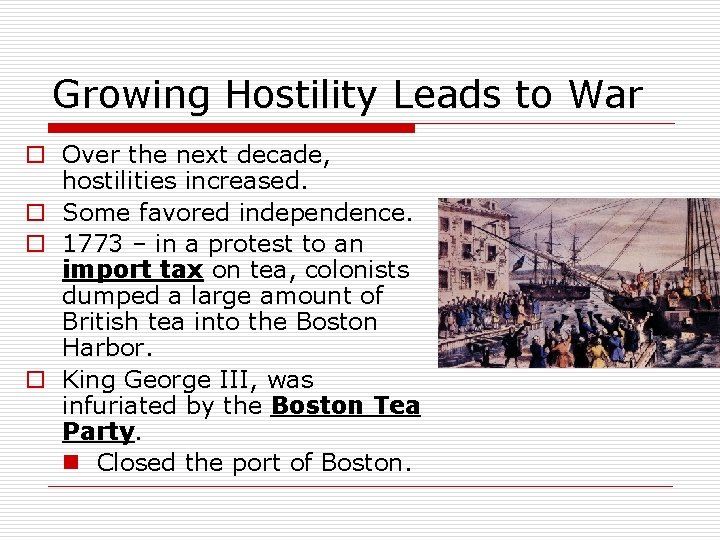
Growing Hostility Leads to War o Over the next decade, hostilities increased. o Some favored independence. o 1773 – in a protest to an import tax on tea, colonists dumped a large amount of British tea into the Boston Harbor. o King George III, was infuriated by the Boston Tea Party. n Closed the port of Boston.
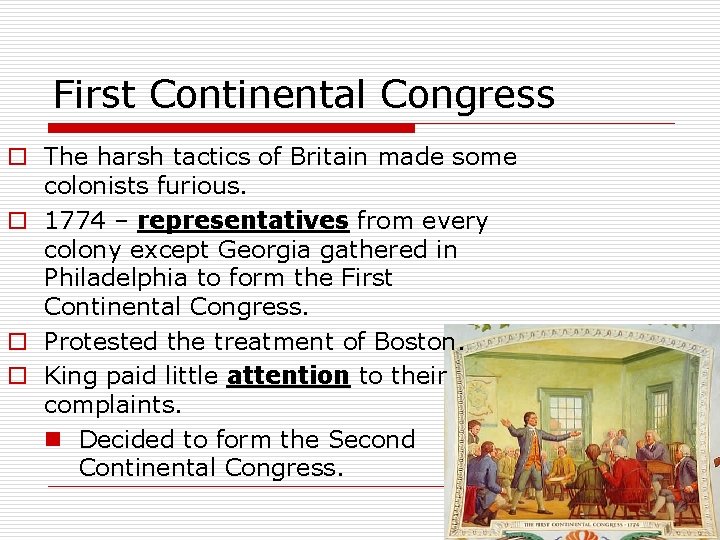
First Continental Congress o The harsh tactics of Britain made some colonists furious. o 1774 – representatives from every colony except Georgia gathered in Philadelphia to form the First Continental Congress. o Protested the treatment of Boston. o King paid little attention to their complaints. n Decided to form the Second Continental Congress.
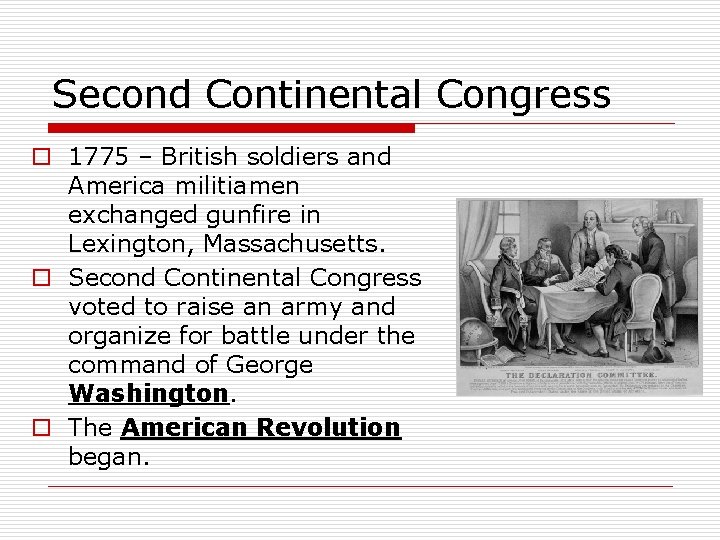
Second Continental Congress o 1775 – British soldiers and America militiamen exchanged gunfire in Lexington, Massachusetts. o Second Continental Congress voted to raise an army and organize for battle under the command of George Washington. o The American Revolution began.
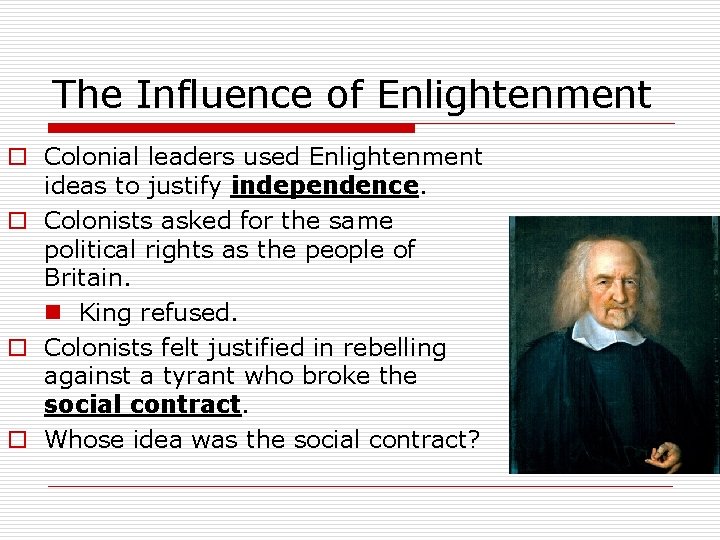
The Influence of Enlightenment o Colonial leaders used Enlightenment ideas to justify independence. o Colonists asked for the same political rights as the people of Britain. n King refused. o Colonists felt justified in rebelling against a tyrant who broke the social contract. o Whose idea was the social contract?
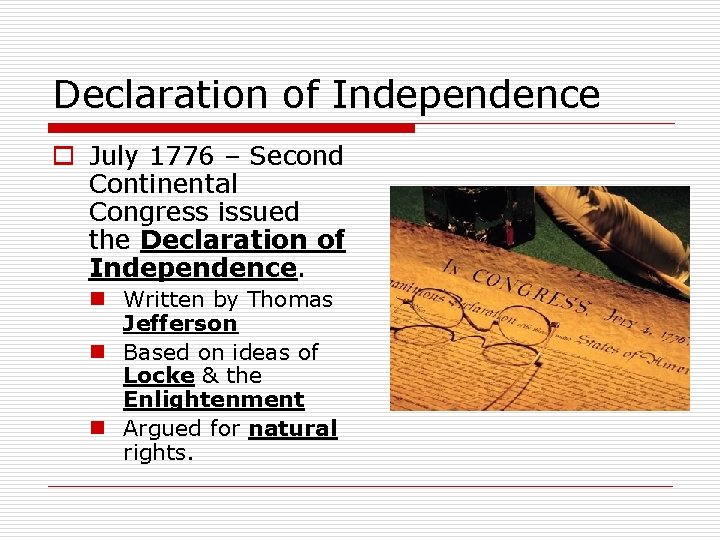
Declaration of Independence o July 1776 – Second Continental Congress issued the Declaration of Independence. n Written by Thomas Jefferson n Based on ideas of Locke & the Enlightenment n Argued for natural rights.
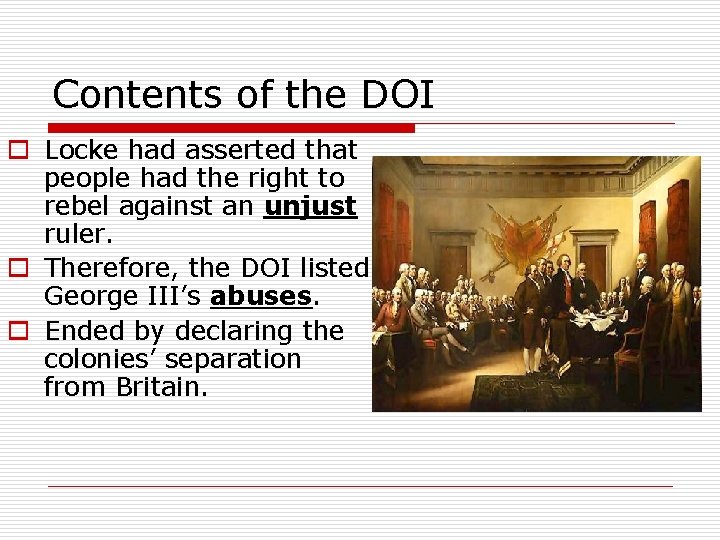
Contents of the DOI o Locke had asserted that people had the right to rebel against an unjust ruler. o Therefore, the DOI listed George III’s abuses. o Ended by declaring the colonies’ separation from Britain.
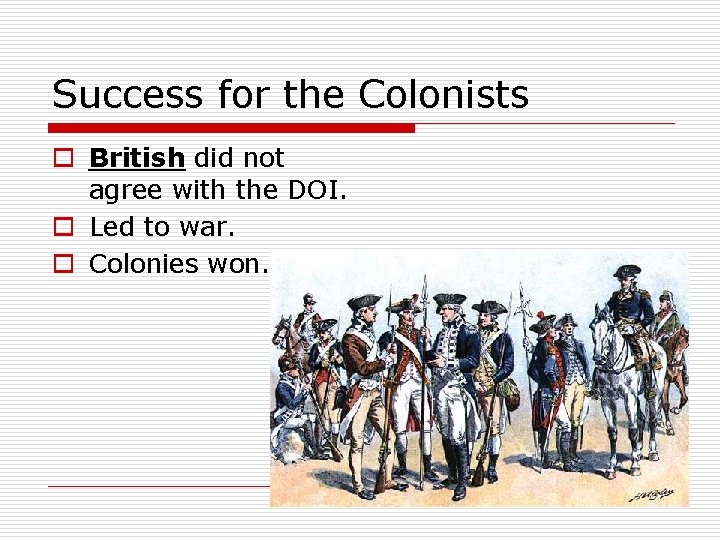
Success for the Colonists o British did not agree with the DOI. o Led to war. o Colonies won.
Reasons for Success o 1. Americans had a stronger motivation for fighting. o 2. Overconfident British generals made several mistakes. o 3. Americans had time on their side. n British were fighting an overseas war. o 3, 000 miles away from home o Very expensive o British finally called for peace.
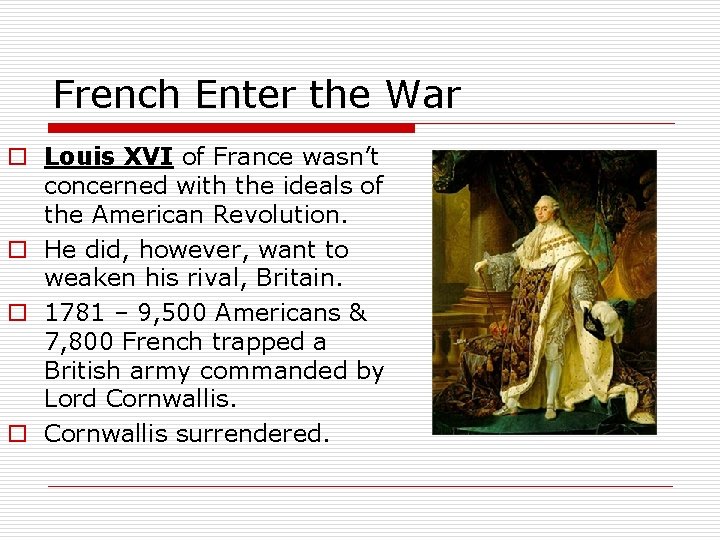
French Enter the War o Louis XVI of France wasn’t concerned with the ideals of the American Revolution. o He did, however, want to weaken his rival, Britain. o 1781 – 9, 500 Americans & 7, 800 French trapped a British army commanded by Lord Cornwallis. o Cornwallis surrendered.
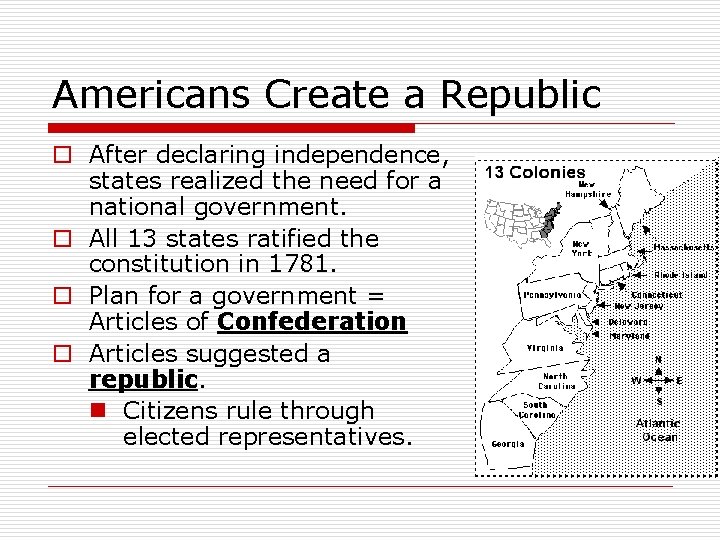
Americans Create a Republic o After declaring independence, states realized the need for a national government. o All 13 states ratified the constitution in 1781. o Plan for a government = Articles of Confederation o Articles suggested a republic. n Citizens rule through elected representatives.
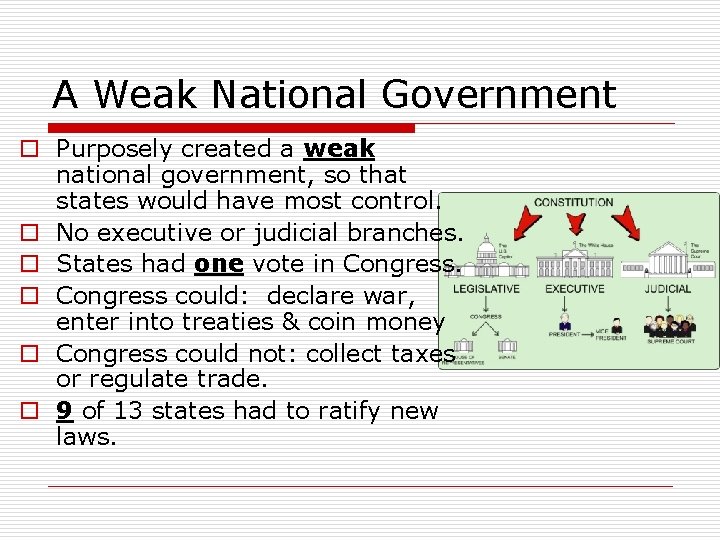
A Weak National Government o Purposely created a weak national government, so that states would have most control. o No executive or judicial branches. o States had one vote in Congress. o Congress could: declare war, enter into treaties & coin money o Congress could not: collect taxes or regulate trade. o 9 of 13 states had to ratify new laws.
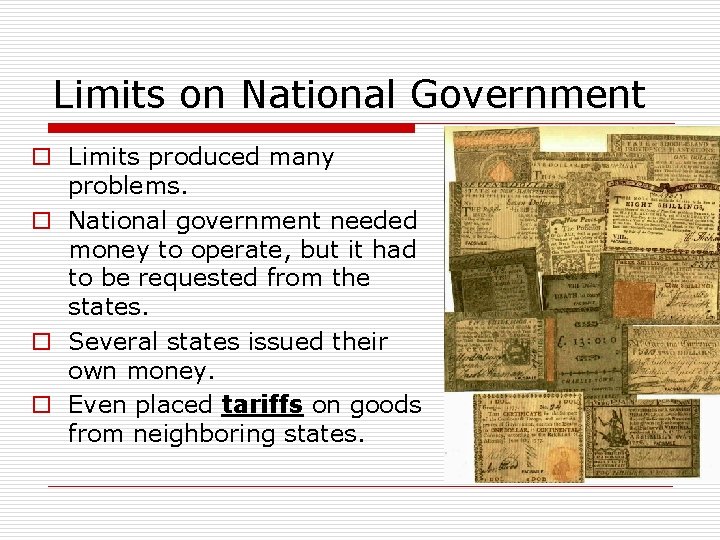
Limits on National Government o Limits produced many problems. o National government needed money to operate, but it had to be requested from the states. o Several states issued their own money. o Even placed tariffs on goods from neighboring states.
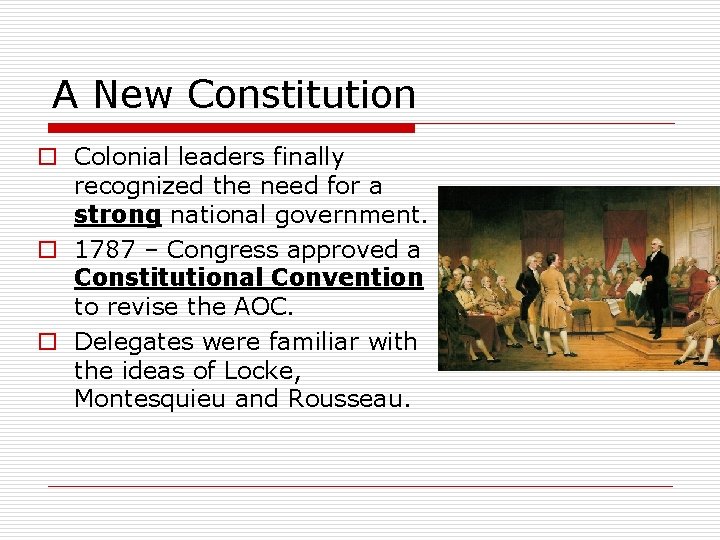
A New Constitution o Colonial leaders finally recognized the need for a strong national government. o 1787 – Congress approved a Constitutional Convention to revise the AOC. o Delegates were familiar with the ideas of Locke, Montesquieu and Rousseau.
Creating a New Government o Who should be represented in Congress? o How many representatives should each state have? o Some compromises, some new approaches to governing. o Used the ideas from the Enlightenment.
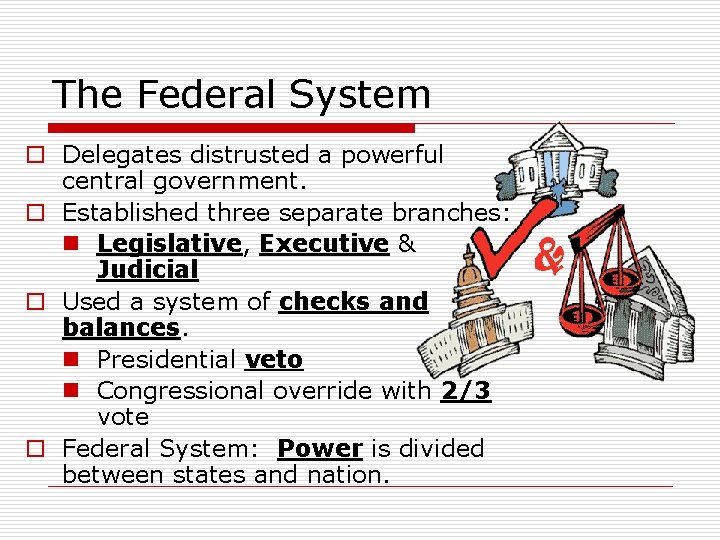
The Federal System o Delegates distrusted a powerful central government. o Established three separate branches: n Legislative, Executive & Judicial o Used a system of checks and balances. n Presidential veto n Congressional override with 2/3 vote o Federal System: Power is divided between states and nation.
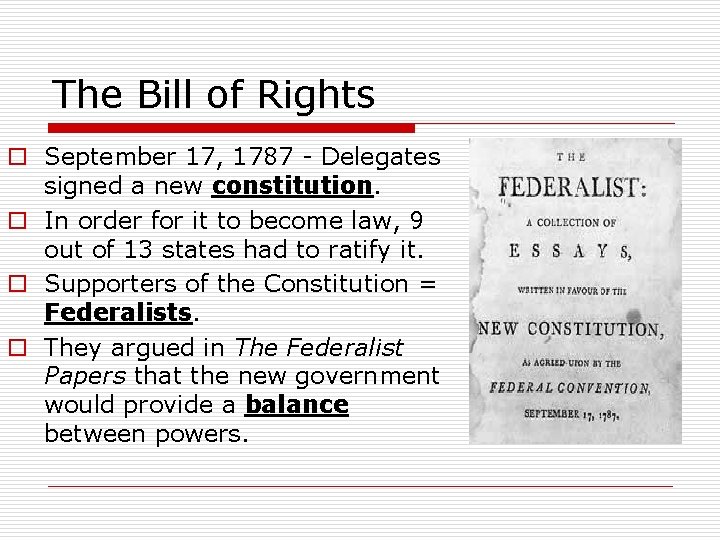
The Bill of Rights o September 17, 1787 - Delegates signed a new constitution. o In order for it to become law, 9 out of 13 states had to ratify it. o Supporters of the Constitution = Federalists. o They argued in The Federalist Papers that the new government would provide a balance between powers.
Anti-Federalists o Anti-Federalists did not support the Constitution. o They felt it gave the central government too much power. o They pushed for a bill of rights to protect citizens’ rights. o The Federalists agreed to adding a bill of rights, to get it approved.
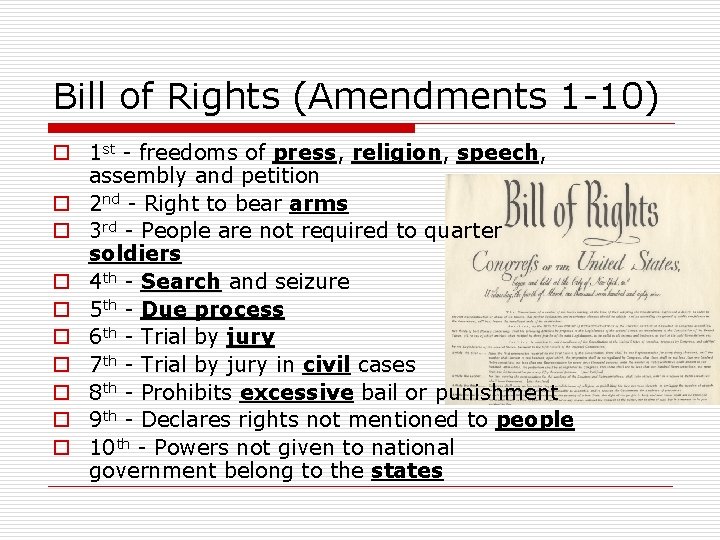
Bill of Rights (Amendments 1 -10) o 1 st - freedoms of press, religion, speech, assembly and petition o 2 nd - Right to bear arms o 3 rd - People are not required to quarter soldiers o 4 th - Search and seizure o 5 th - Due process o 6 th - Trial by jury o 7 th - Trial by jury in civil cases o 8 th - Prohibits excessive bail or punishment o 9 th - Declares rights not mentioned to people o 10 th - Powers not given to national government belong to the states