
THE AMERICAN CROW Corvus brachyrhynchos Classification Kingdom Animalia
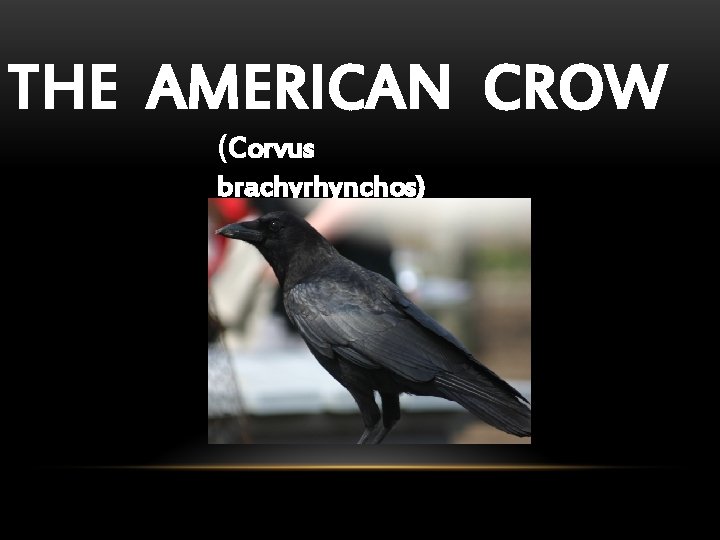
THE AMERICAN CROW (Corvus brachyrhynchos)
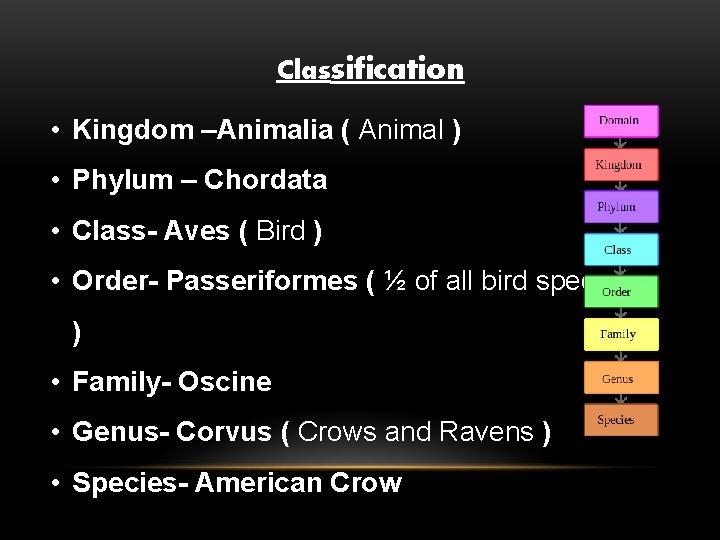
Classification • Kingdom –Animalia ( Animal ) • Phylum – Chordata • Class- Aves ( Bird ) • Order- Passeriformes ( ½ of all bird species ) • Family- Oscine • Genus- Corvus ( Crows and Ravens ) • Species- American Crow

Characteristics • Males and females are almost identical • Males are bigger then females • Weight – 1 pound or 16 ounces • Size – 17 -19 inches • Wingspan – Average of 33 -36 inches • Pelage – Feathers (black)

Distribution Crows live in almost all parts of the world except Antarctica, bottom part of South America and New Zealand.
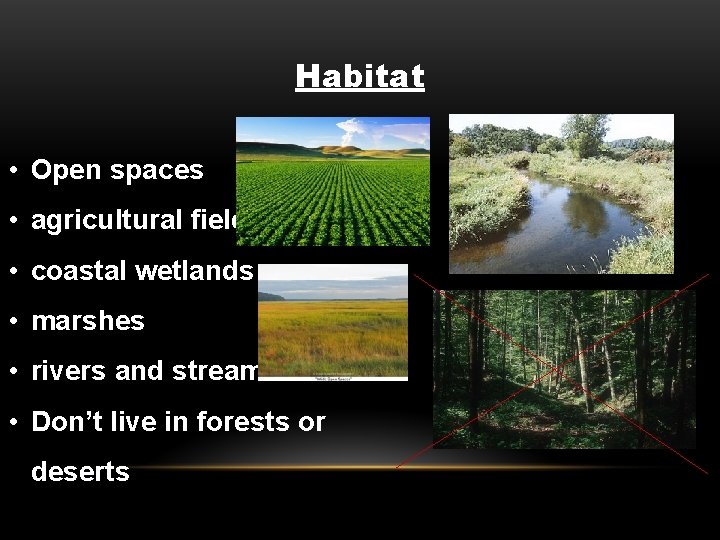
Habitat • Open spaces • agricultural fields • coastal wetlands • marshes • rivers and streams • Don’t live in forests or deserts
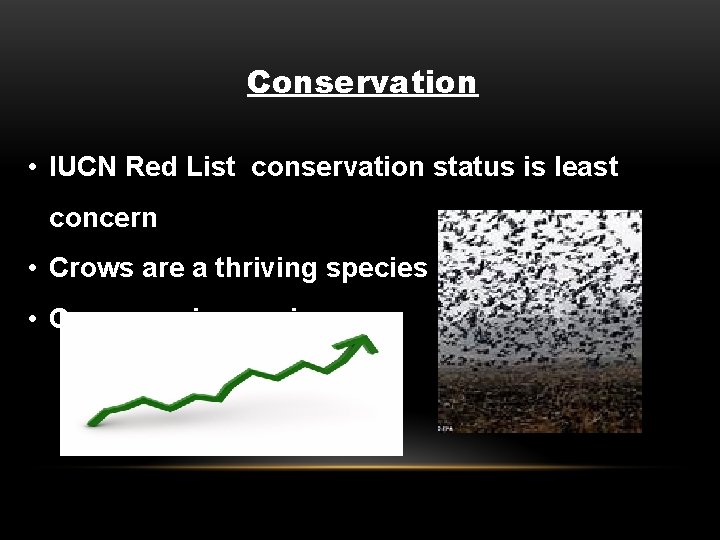
Conservation • IUCN Red List conservation status is least concern • Crows are a thriving species • Crows are increasing
Reproduction • The Mating system of crows are a rare sight • Female choses the mate • Male shows off his feathers to the female • The male bows and spreads his wings and tail while singing a short song for the female • They groom each others feathers and touch their beaks together • All of this is only preformed once prior to mating
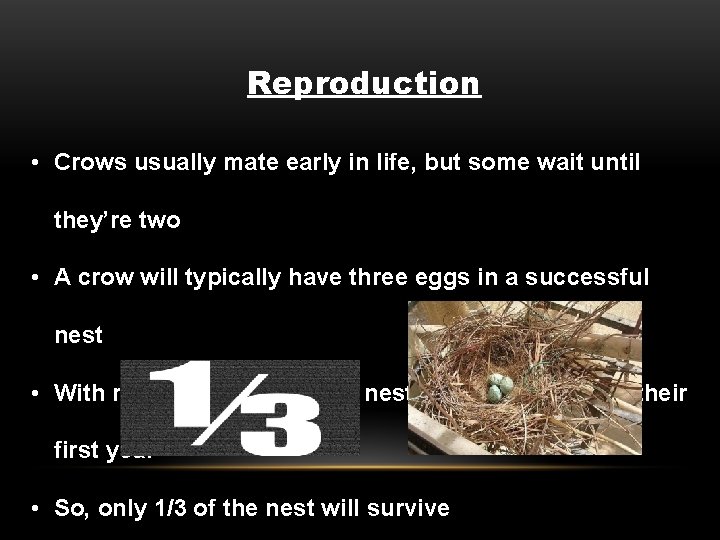
Reproduction • Crows usually mate early in life, but some wait until they’re two • A crow will typically have three eggs in a successful nest • With most nests, 2/3 of the nest won’t survive past their first year • So, only 1/3 of the nest will survive
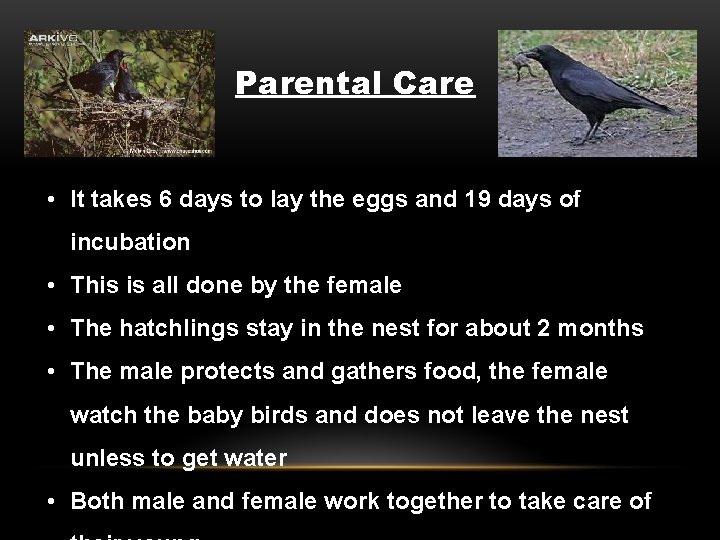
Parental Care • It takes 6 days to lay the eggs and 19 days of incubation • This is all done by the female • The hatchlings stay in the nest for about 2 months • The male protects and gathers food, the female watch the baby birds and does not leave the nest unless to get water • Both male and female work together to take care of
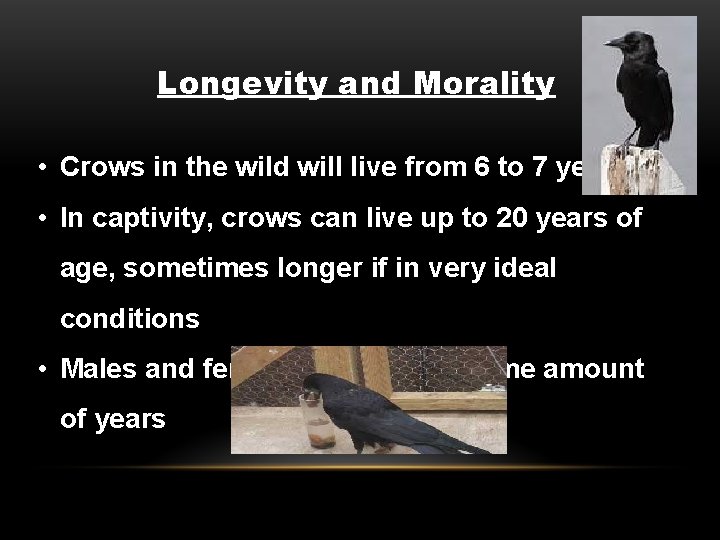
Longevity and Morality • Crows in the wild will live from 6 to 7 years • In captivity, crows can live up to 20 years of age, sometimes longer if in very ideal conditions • Males and females live for the same amount of years
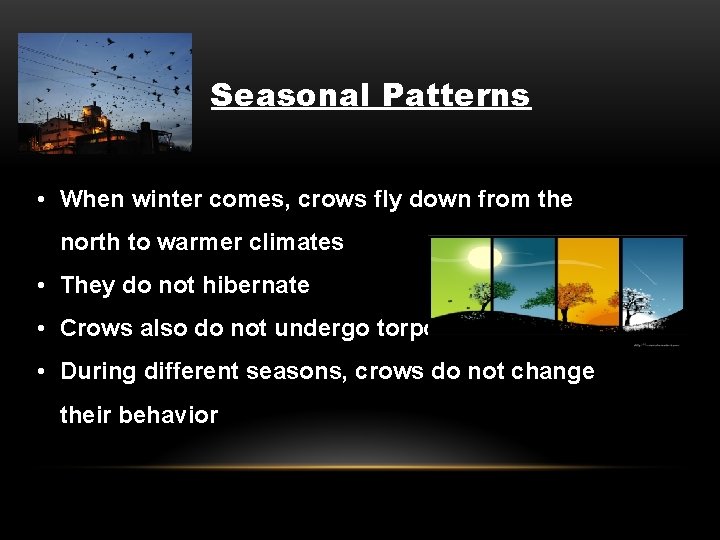
Seasonal Patterns • When winter comes, crows fly down from the north to warmer climates • They do not hibernate • Crows also do not undergo torpor • During different seasons, crows do not change their behavior
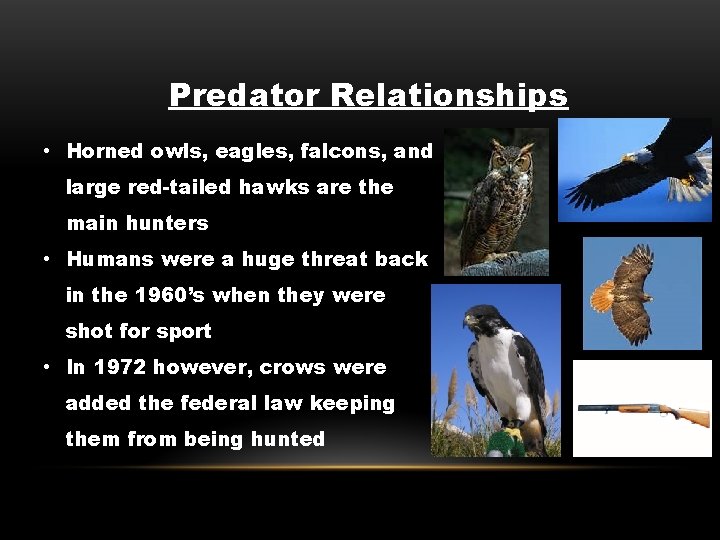
Predator Relationships • Horned owls, eagles, falcons, and large red-tailed hawks are the main hunters • Humans were a huge threat back in the 1960’s when they were shot for sport • In 1972 however, crows were added the federal law keeping them from being hunted
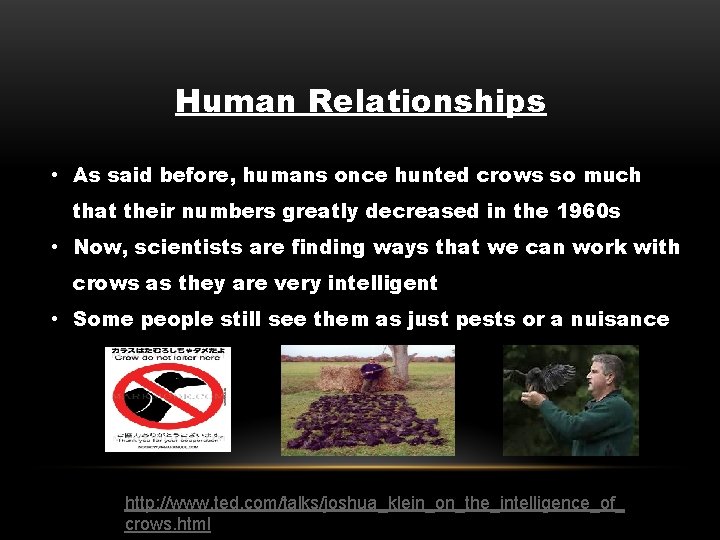
Human Relationships • As said before, humans once hunted crows so much that their numbers greatly decreased in the 1960 s • Now, scientists are finding ways that we can work with crows as they are very intelligent • Some people still see them as just pests or a nuisance http: //www. ted. com/talks/joshua_klein_on_the_intelligence_of_ crows. html
INTERESTING FACTS • Groups of crows are called “murders”. The reason for this is that when a crow is dying of sickness, old age, or injury, the rest of the murder will often kill that crow in order to end it’s suffering. • Crows have the biggest brain based on body size out of all birds. • Crows have the ability to judge the character of people by reading their faces and expressions. • Just like parrots, crows can imitate human voice. • Crows are a lot smarter than other birds, like owls, which is one of the crows predators. Furthermore, they also exceed the intelligence of parrots.
Works Cited All About Birds. N. p. , n. d. Web. 26 Feb. 2013. <http: //allaboutbirds. org/guide/American_Crow/id>. Angell, Tony. Ravens, Crows, Magpies and Jays. Seatlle and London: UOWP, 1978. Print. Animal Diversity Web. UOM, n. d. Web. 24 Mar. 2013. <http: //animaldiversity. ummz. umich. edu/accounts/Corvus_brachyrhynchos/>. Crow Busters. N. p. , 1999. Web. 26 Feb. 2013. <http: //www. crowbusters. com/facts. htm>. Crow Facts. N. p. , n. d. Web. 24 Mar. 2013. <http: //www. shades-ofnight. com/aviary/crowdoc. html>. FREQUENTLY ASKED QUESTIONS ABOUT CROWS. Dr. Kevin J. Mc. Gowan, n. d. Web. 24 Mar. 2013. <http: //www. birds. cornell. edu/crows/crowfaq. htm#roost>. Johnson, Sylvia. Crows. N. p. : Carolrhoda Books, 2005. Print. Joshua Klein: The Intelligence of Crows. TED Ideas worth Spreading. TED Confrences, n. d. Web. 24 Mar. 2013. <http: //www. ted. com/talks/joshua_klein_on_the_intelligence_of_crows. html>.
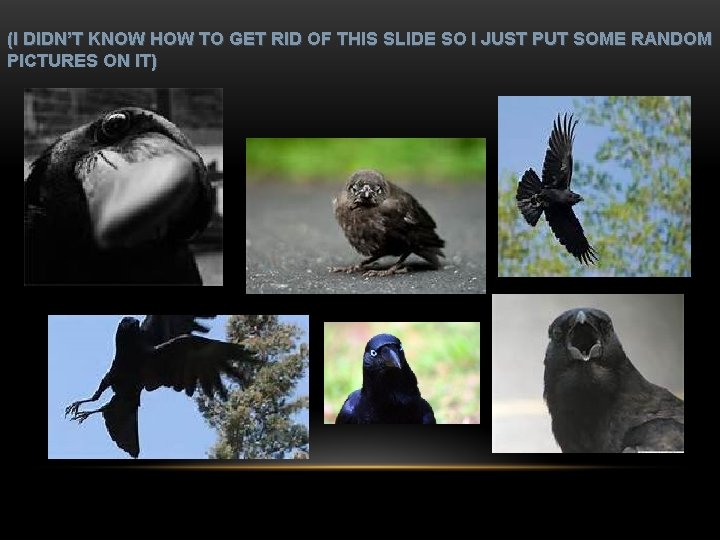
(I DIDN’T KNOW HOW TO GET RID OF THIS SLIDE SO I JUST PUT SOME RANDOM PICTURES ON IT)
- Slides: 16