
The American Civil War 1861 1865 Causes There
- Slides: 37
The American Civil War 1861– 1865
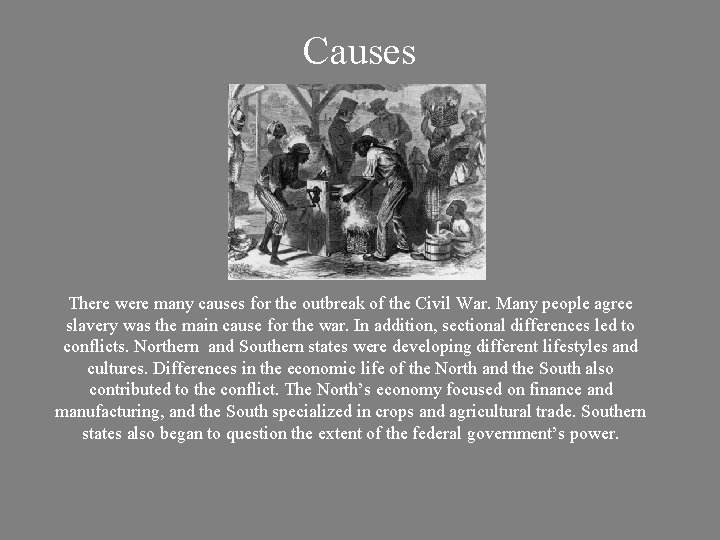
Causes There were many causes for the outbreak of the Civil War. Many people agree slavery was the main cause for the war. In addition, sectional differences led to conflicts. Northern and Southern states were developing different lifestyles and cultures. Differences in the economic life of the North and the South also contributed to the conflict. The North’s economy focused on finance and manufacturing, and the South specialized in crops and agricultural trade. Southern states also began to question the extent of the federal government’s power.
Old wounds • Tensions between North and South began with the signing of the Declaration of Independence, when the writers could not agree on the wording. • The Civil War was a slow build up of actions and events, the ended up with the most costly conflict in American history • «All men are created equal» .
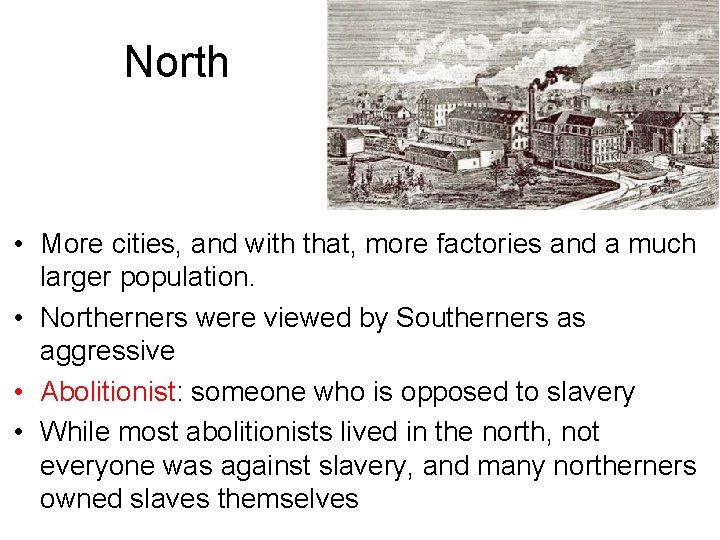
North • More cities, and with that, more factories and a much larger population. • Northerners were viewed by Southerners as aggressive • Abolitionist: someone who is opposed to slavery • While most abolitionists lived in the north, not everyone was against slavery, and many northerners owned slaves themselves
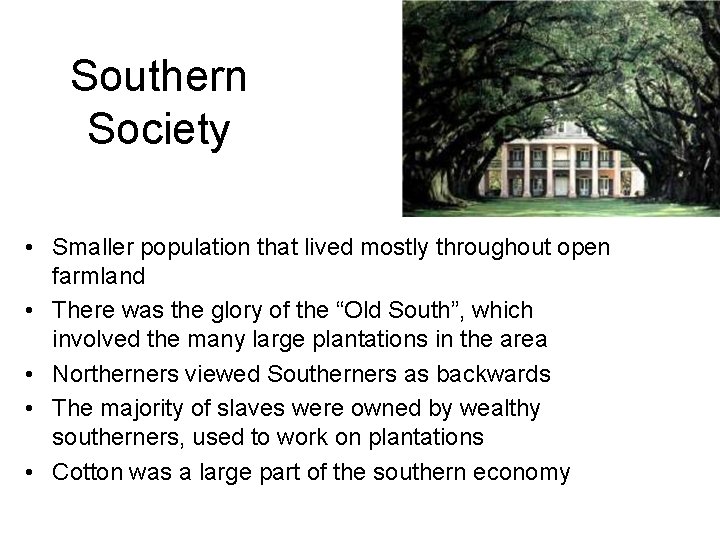
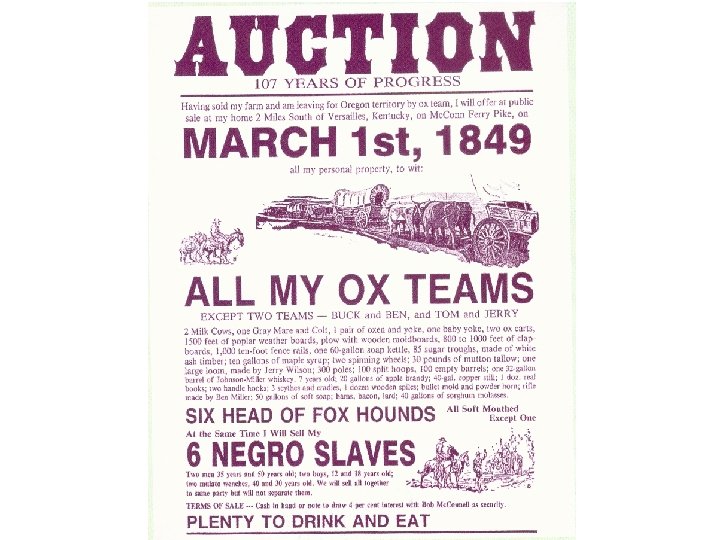
Southern Society • Smaller population that lived mostly throughout open farmland • There was the glory of the “Old South”, which involved the many large plantations in the area • Northerners viewed Southerners as backwards • The majority of slaves were owned by wealthy southerners, used to work on plantations • Cotton was a large part of the southern economy
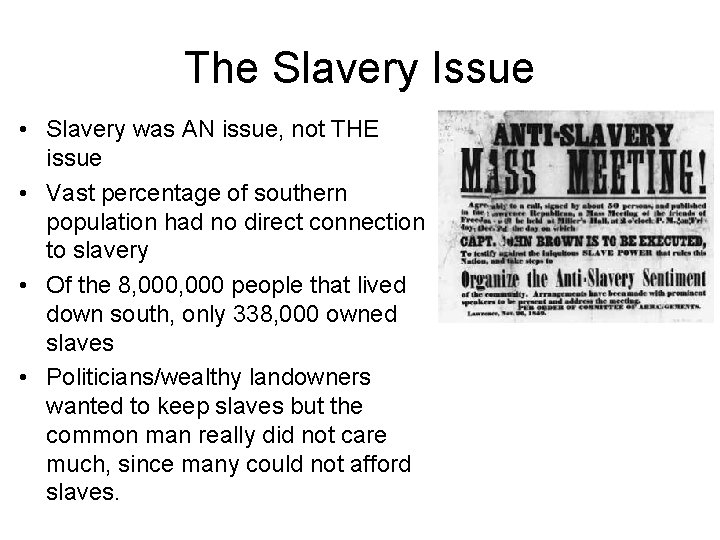
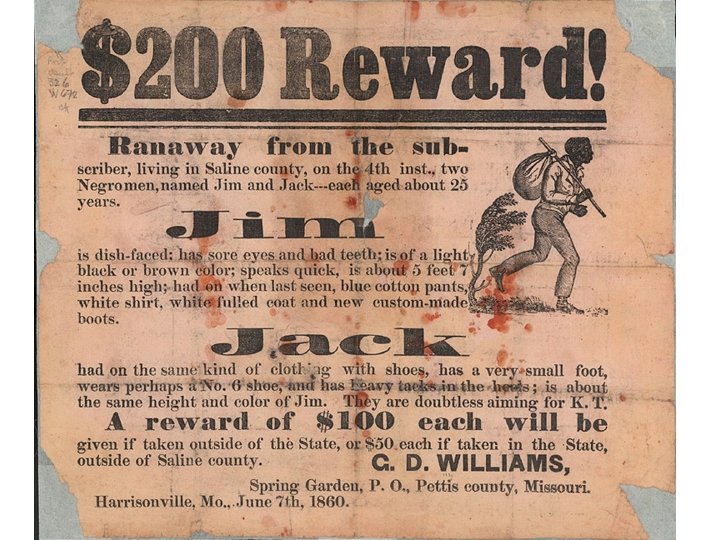
The Slavery Issue • Slavery was AN issue, not THE issue • Vast percentage of southern population had no direct connection to slavery • Of the 8, 000 people that lived down south, only 338, 000 owned slaves • Politicians/wealthy landowners wanted to keep slaves but the common man really did not care much, since many could not afford slaves.
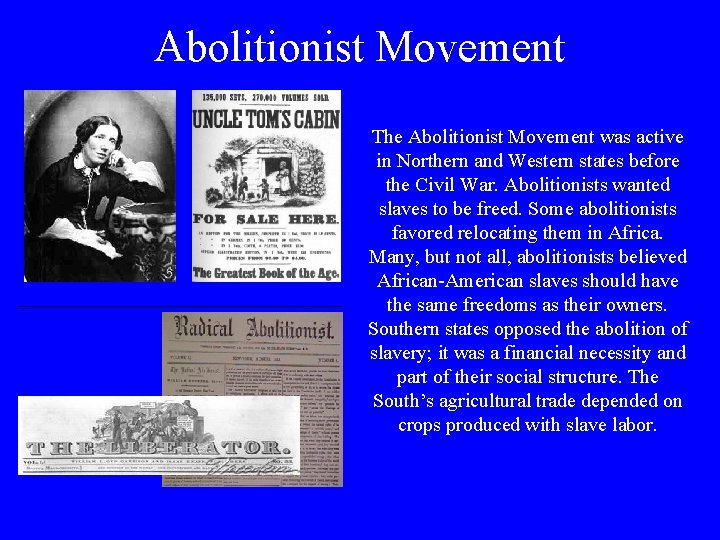
Abolitionist Movement The Abolitionist Movement was active in Northern and Western states before the Civil War. Abolitionists wanted slaves to be freed. Some abolitionists favored relocating them in Africa. Many, but not all, abolitionists believed African-American slaves should have the same freedoms as their owners. Southern states opposed the abolition of slavery; it was a financial necessity and part of their social structure. The South’s agricultural trade depended on crops produced with slave labor.
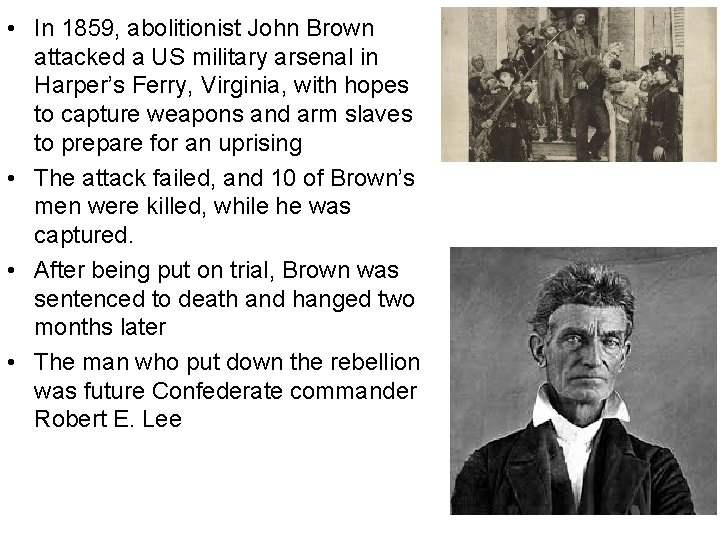
• In 1859, abolitionist John Brown attacked a US military arsenal in Harper’s Ferry, Virginia, with hopes to capture weapons and arm slaves to prepare for an uprising • The attack failed, and 10 of Brown’s men were killed, while he was captured. • After being put on trial, Brown was sentenced to death and hanged two months later • The man who put down the rebellion was future Confederate commander Robert E. Lee
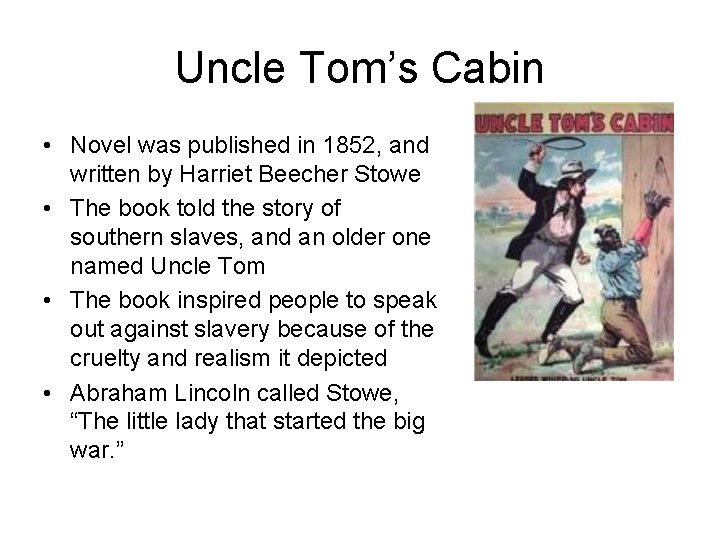
Uncle Tom’s Cabin • Novel was published in 1852, and written by Harriet Beecher Stowe • The book told the story of southern slaves, and an older one named Uncle Tom • The book inspired people to speak out against slavery because of the cruelty and realism it depicted • Abraham Lincoln called Stowe, “The little lady that started the big war. ”
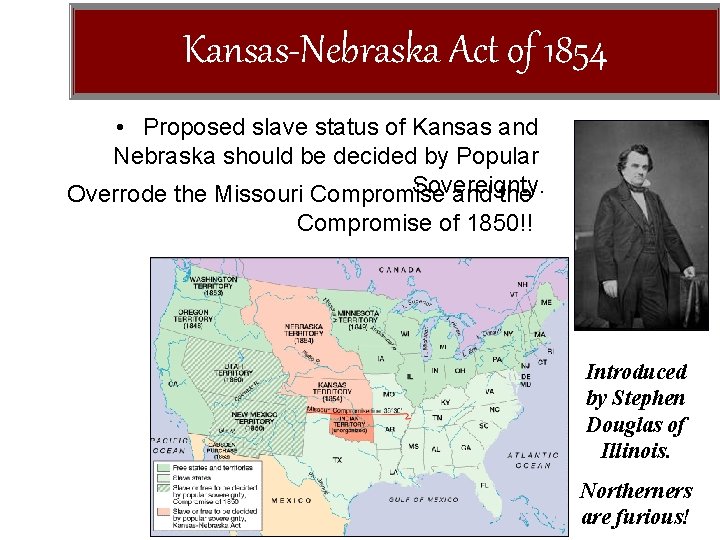
Kansas-Nebraska Act of 1854 • Proposed slave status of Kansas and Nebraska should be decided by Popular Sovereignty. Overrode the Missouri Compromise and the Compromise of 1850!! Introduced by Stephen Douglas of Illinois. Northerners are furious!
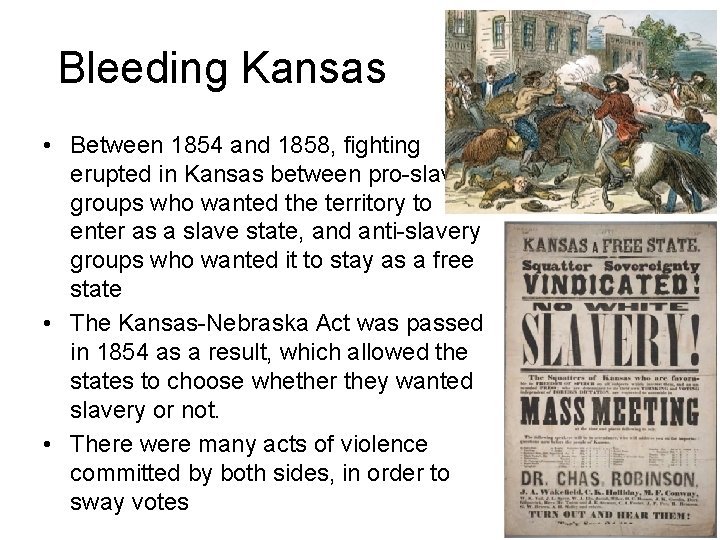
Bleeding Kansas • Between 1854 and 1858, fighting erupted in Kansas between pro-slavery groups who wanted the territory to enter as a slave state, and anti-slavery groups who wanted it to stay as a free state • The Kansas-Nebraska Act was passed in 1854 as a result, which allowed the states to choose whether they wanted slavery or not. • There were many acts of violence committed by both sides, in order to sway votes
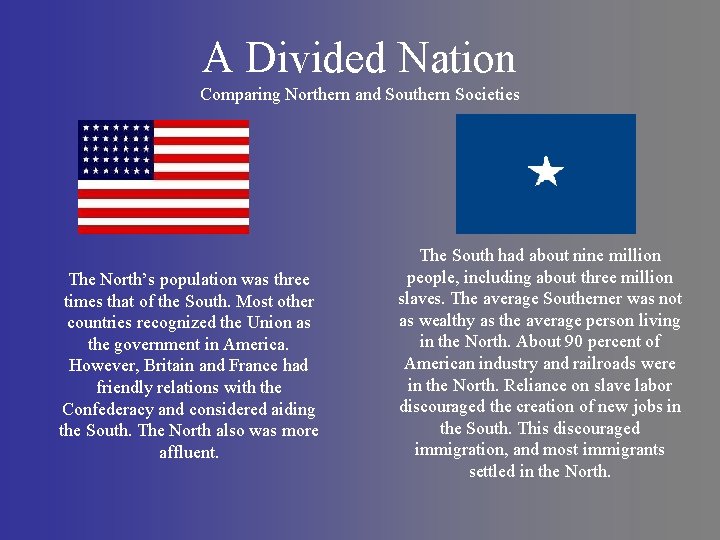
A Divided Nation Comparing Northern and Southern Societies The North’s population was three times that of the South. Most other countries recognized the Union as the government in America. However, Britain and France had friendly relations with the Confederacy and considered aiding the South. The North also was more affluent. The South had about nine million people, including about three million slaves. The average Southerner was not as wealthy as the average person living in the North. About 90 percent of American industry and railroads were in the North. Reliance on slave labor discouraged the creation of new jobs in the South. This discouraged immigration, and most immigrants settled in the North.
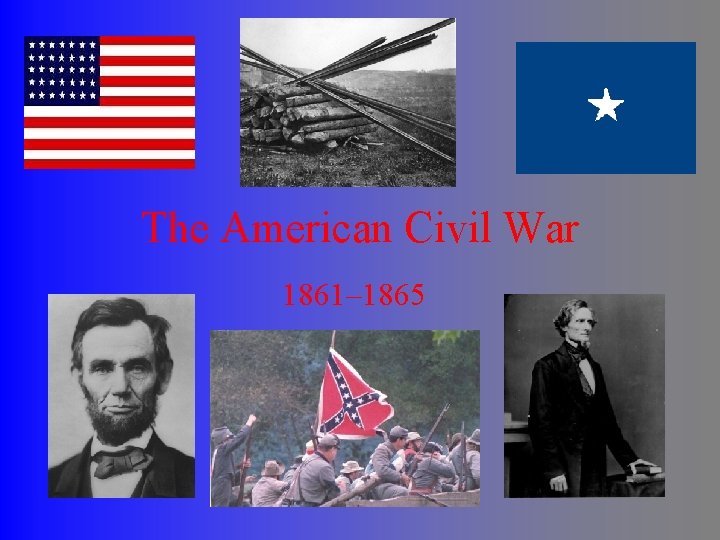
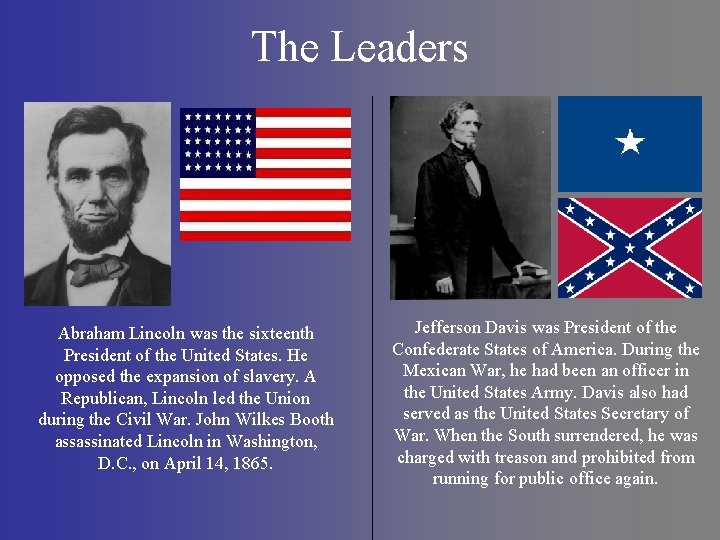
The Leaders Abraham Lincoln was the sixteenth President of the United States. He opposed the expansion of slavery. A Republican, Lincoln led the Union during the Civil War. John Wilkes Booth assassinated Lincoln in Washington, D. C. , on April 14, 1865. Jefferson Davis was President of the Confederate States of America. During the Mexican War, he had been an officer in the United States Army. Davis also had served as the United States Secretary of War. When the South surrendered, he was charged with treason and prohibited from running for public office again.
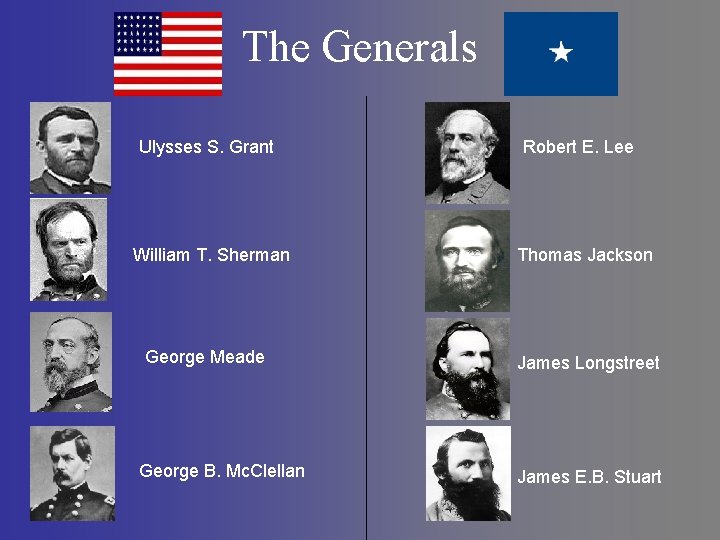
The Generals Ulysses S. Grant William T. Sherman George Meade George B. Mc. Clellan Robert E. Lee Thomas Jackson James Longstreet James E. B. Stuart
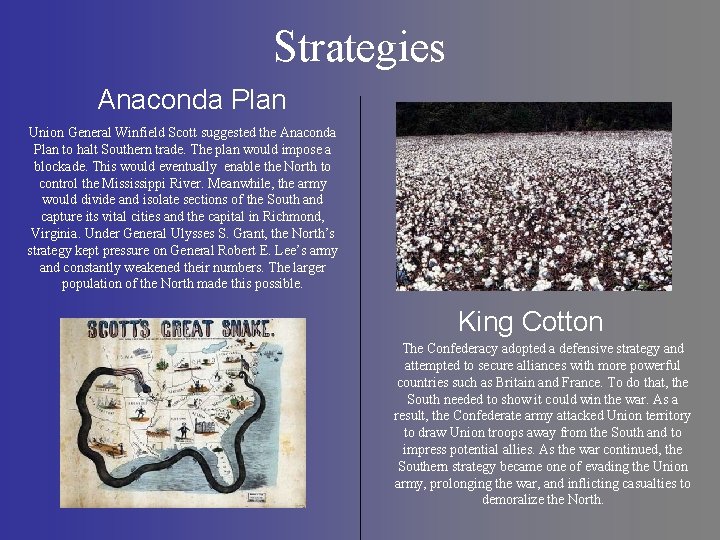
Strategies Anaconda Plan Union General Winfield Scott suggested the Anaconda Plan to halt Southern trade. The plan would impose a blockade. This would eventually enable the North to control the Mississippi River. Meanwhile, the army would divide and isolate sections of the South and capture its vital cities and the capital in Richmond, Virginia. Under General Ulysses S. Grant, the North’s strategy kept pressure on General Robert E. Lee’s army and constantly weakened their numbers. The larger population of the North made this possible. King Cotton The Confederacy adopted a defensive strategy and attempted to secure alliances with more powerful countries such as Britain and France. To do that, the South needed to show it could win the war. As a result, the Confederate army attacked Union territory to draw Union troops away from the South and to impress potential allies. As the war continued, the Southern strategy became one of evading the Union army, prolonging the war, and inflicting casualties to demoralize the North.
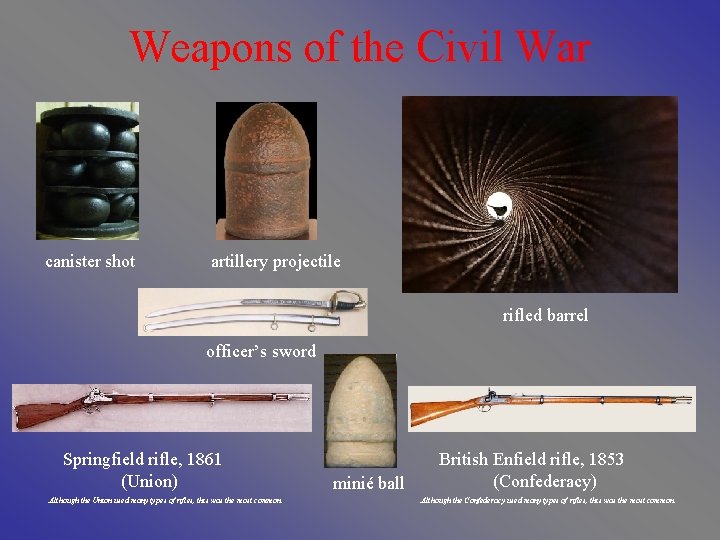
Weapons of the Civil War canister shot artillery projectile rifled barrel officer’s sword Springfield rifle, 1861 (Union) Although the Union used many types of rifles, this was the most common. minié ball British Enfield rifle, 1853 (Confederacy) Although the Confederacy used many types of rifles, this was the most common.
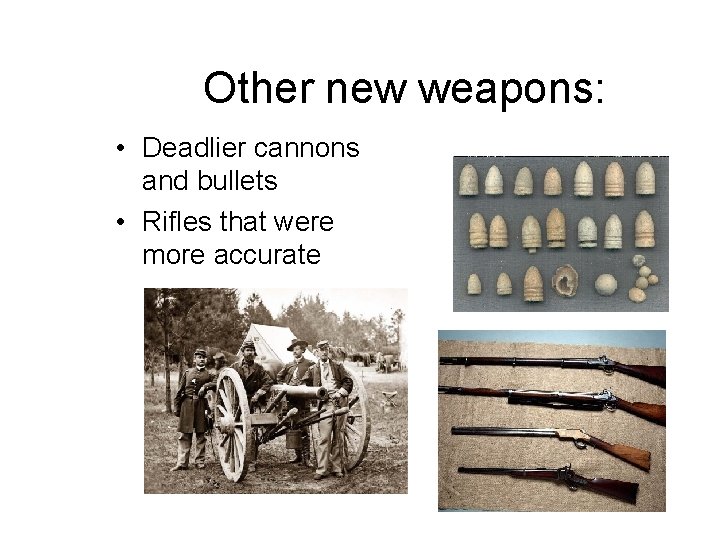
Other new weapons: • Deadlier cannons and bullets • Rifles that were more accurate
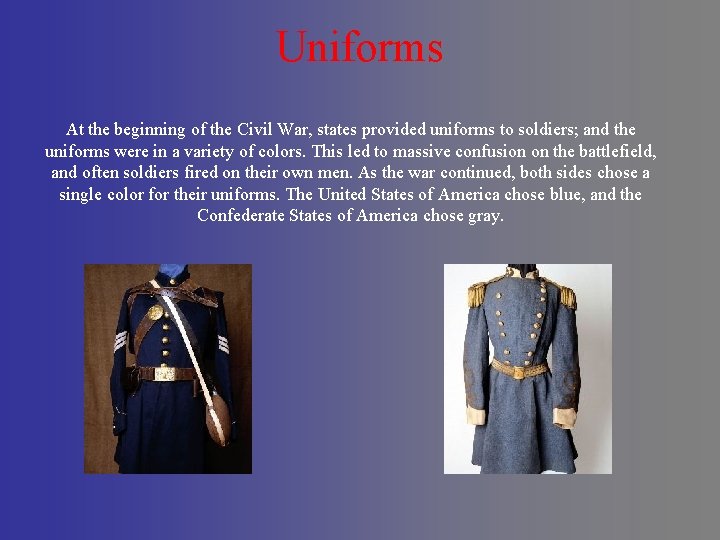
Uniforms At the beginning of the Civil War, states provided uniforms to soldiers; and the uniforms were in a variety of colors. This led to massive confusion on the battlefield, and often soldiers fired on their own men. As the war continued, both sides chose a single color for their uniforms. The United States of America chose blue, and the Confederate States of America chose gray.
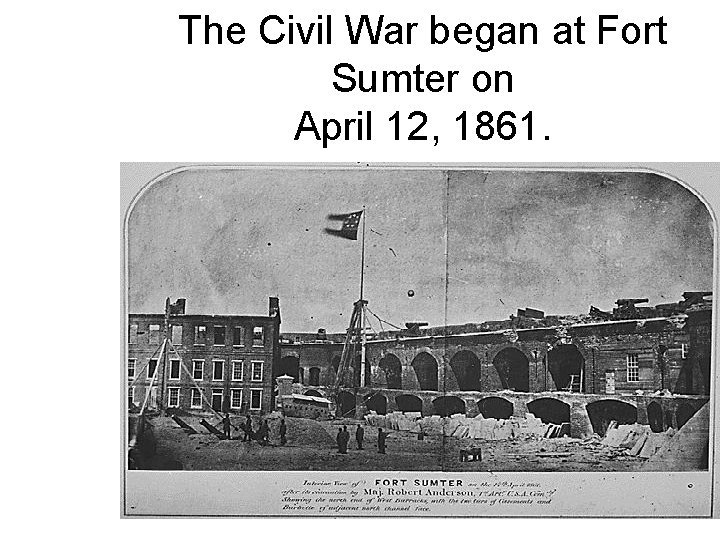
The Civil War began at Fort Sumter on April 12, 1861.
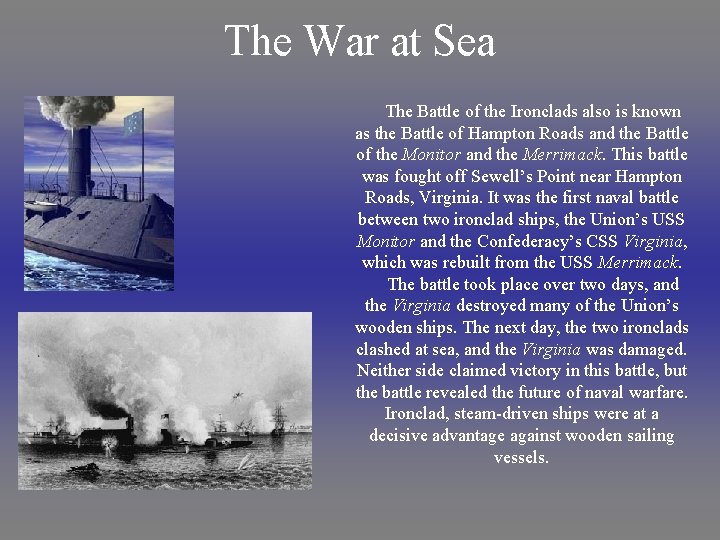
The War at Sea The Battle of the Ironclads also is known as the Battle of Hampton Roads and the Battle of the Monitor and the Merrimack. This battle was fought off Sewell’s Point near Hampton Roads, Virginia. It was the first naval battle between two ironclad ships, the Union’s USS Monitor and the Confederacy’s CSS Virginia, which was rebuilt from the USS Merrimack. The battle took place over two days, and the Virginia destroyed many of the Union’s wooden ships. The next day, the two ironclads clashed at sea, and the Virginia was damaged. Neither side claimed victory in this battle, but the battle revealed the future of naval warfare. Ironclad, steam-driven ships were at a decisive advantage against wooden sailing vessels.
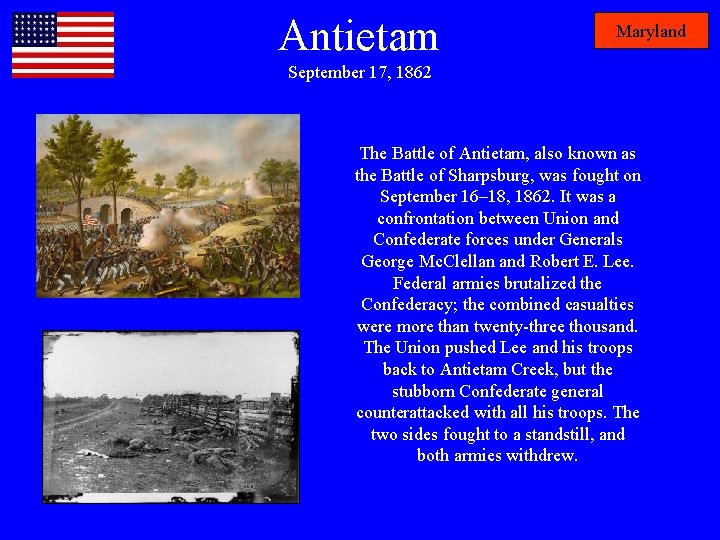
Antietam Maryland September 17, 1862 The Battle of Antietam, also known as the Battle of Sharpsburg, was fought on September 16– 18, 1862. It was a confrontation between Union and Confederate forces under Generals George Mc. Clellan and Robert E. Lee. Federal armies brutalized the Confederacy; the combined casualties were more than twenty-three thousand. The Union pushed Lee and his troops back to Antietam Creek, but the stubborn Confederate general counterattacked with all his troops. The two sides fought to a standstill, and both armies withdrew.
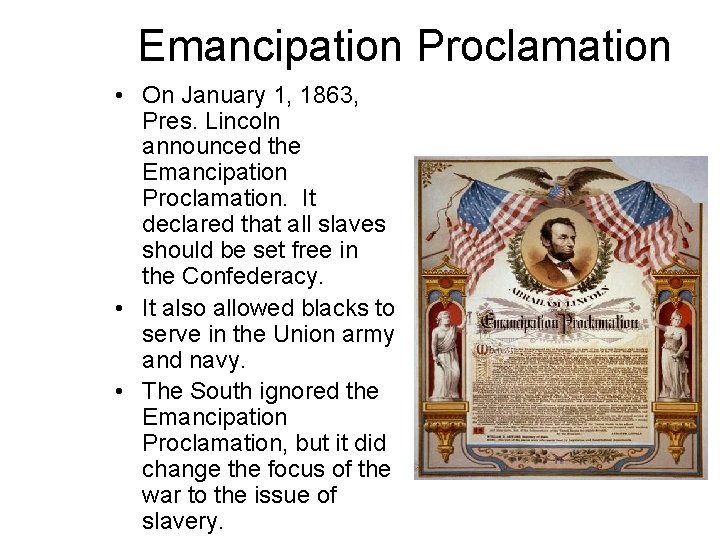
Emancipation Proclamation • On January 1, 1863, Pres. Lincoln announced the Emancipation Proclamation. It declared that all slaves should be set free in the Confederacy. • It also allowed blacks to serve in the Union army and navy. • The South ignored the Emancipation Proclamation, but it did change the focus of the war to the issue of slavery.
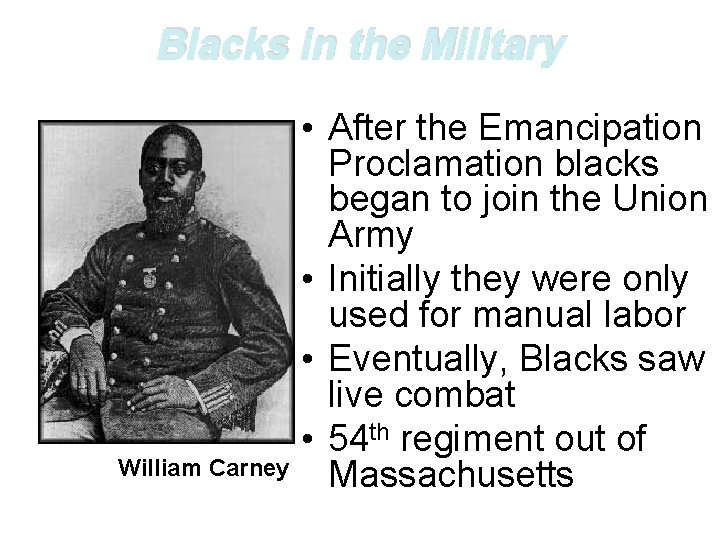
Blacks in the Military William Carney • After the Emancipation Proclamation blacks began to join the Union Army • Initially they were only used for manual labor • Eventually, Blacks saw live combat • 54 th regiment out of Massachusetts
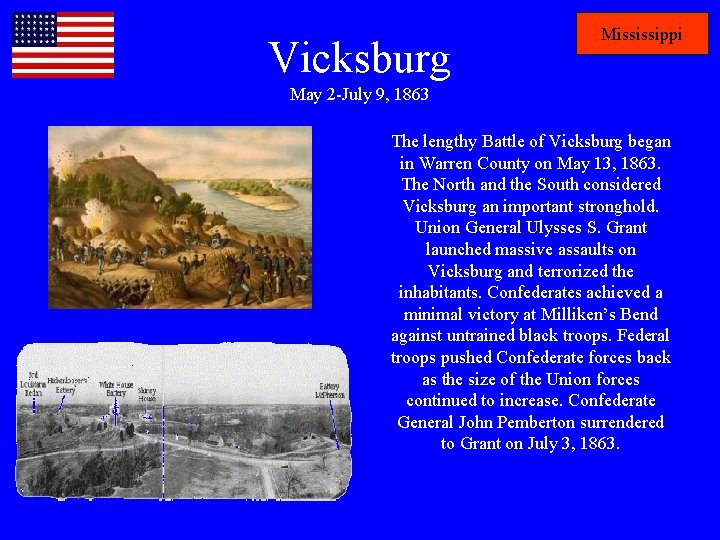
Vicksburg Mississippi May 2 -July 9, 1863 The lengthy Battle of Vicksburg began in Warren County on May 13, 1863. The North and the South considered Vicksburg an important stronghold. Union General Ulysses S. Grant launched massive assaults on Vicksburg and terrorized the inhabitants. Confederates achieved a minimal victory at Milliken’s Bend against untrained black troops. Federal troops pushed Confederate forces back as the size of the Union forces continued to increase. Confederate General John Pemberton surrendered to Grant on July 3, 1863.
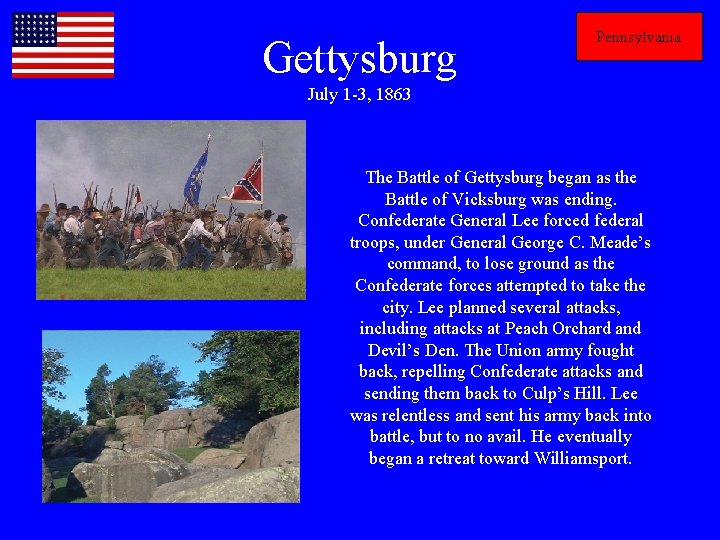
Gettysburg Pennsylvania July 1 -3, 1863 The Battle of Gettysburg began as the Battle of Vicksburg was ending. Confederate General Lee forced federal troops, under General George C. Meade’s command, to lose ground as the Confederate forces attempted to take the city. Lee planned several attacks, including attacks at Peach Orchard and Devil’s Den. The Union army fought back, repelling Confederate attacks and sending them back to Culp’s Hill. Lee was relentless and sent his army back into battle, but to no avail. He eventually began a retreat toward Williamsport.
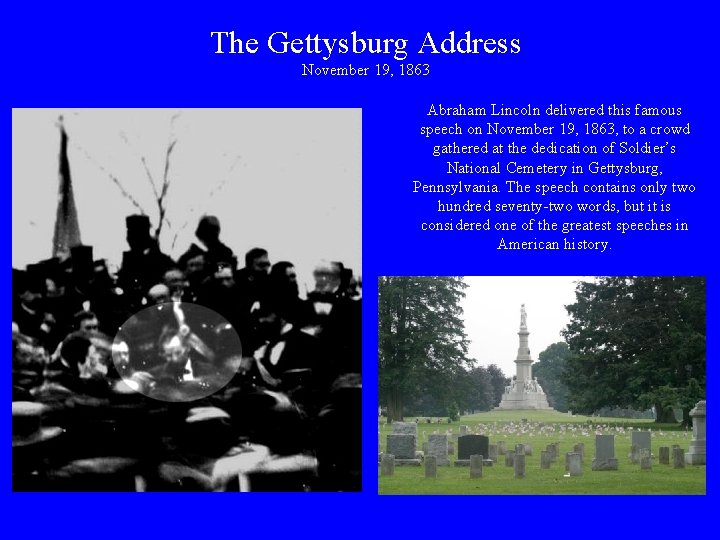
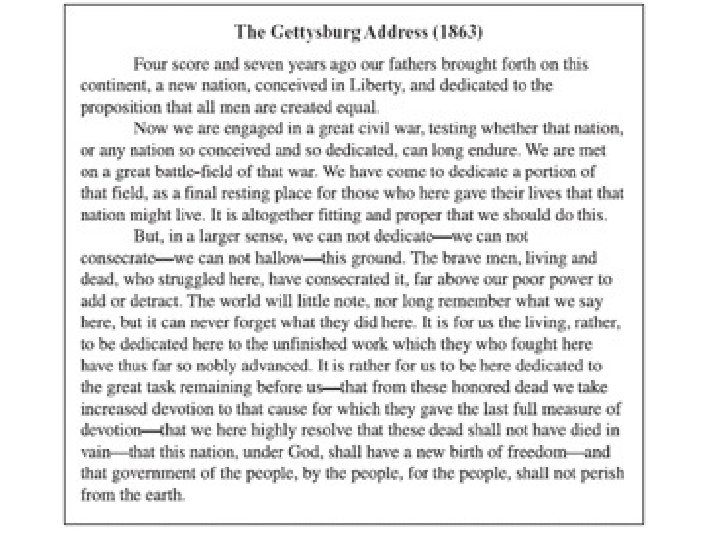
The Gettysburg Address November 19, 1863 Abraham Lincoln delivered this famous speech on November 19, 1863, to a crowd gathered at the dedication of Soldier’s National Cemetery in Gettysburg, Pennsylvania. The speech contains only two hundred seventy-two words, but it is considered one of the greatest speeches in American history.
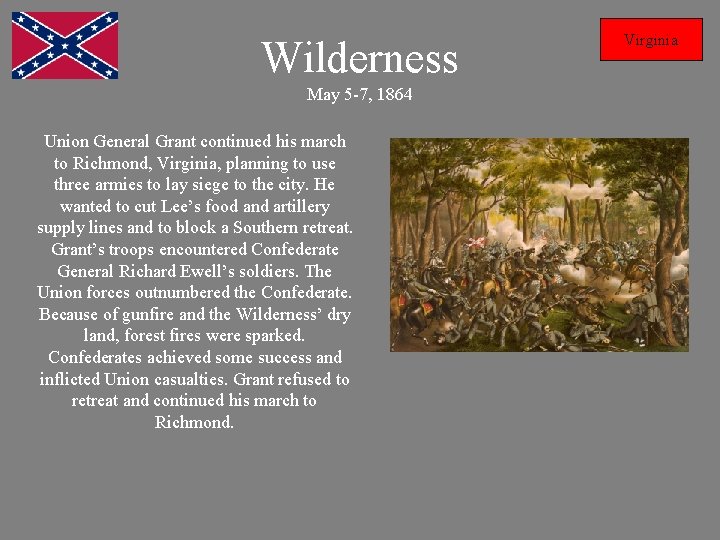
Wilderness May 5 -7, 1864 Union General Grant continued his march to Richmond, Virginia, planning to use three armies to lay siege to the city. He wanted to cut Lee’s food and artillery supply lines and to block a Southern retreat. Grant’s troops encountered Confederate General Richard Ewell’s soldiers. The Union forces outnumbered the Confederate. Because of gunfire and the Wilderness’ dry land, forest fires were sparked. Confederates achieved some success and inflicted Union casualties. Grant refused to retreat and continued his march to Richmond. Virginia
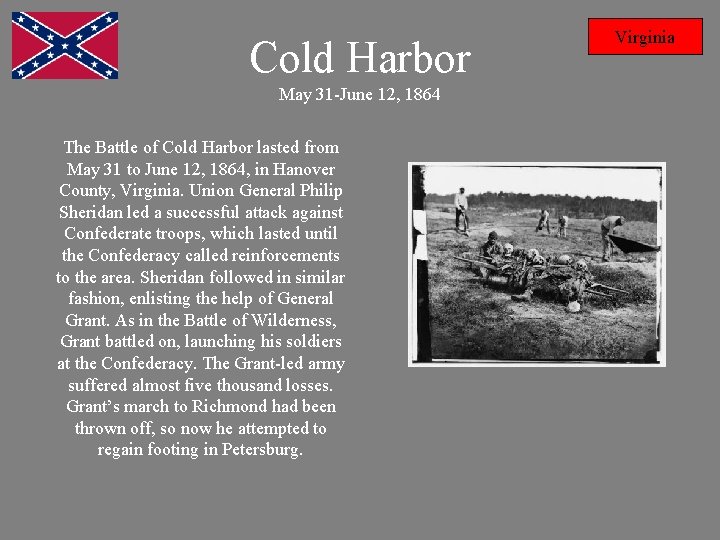
Cold Harbor May 31 -June 12, 1864 The Battle of Cold Harbor lasted from May 31 to June 12, 1864, in Hanover County, Virginia. Union General Philip Sheridan led a successful attack against Confederate troops, which lasted until the Confederacy called reinforcements to the area. Sheridan followed in similar fashion, enlisting the help of General Grant. As in the Battle of Wilderness, Grant battled on, launching his soldiers at the Confederacy. The Grant-led army suffered almost five thousand losses. Grant’s march to Richmond had been thrown off, so now he attempted to regain footing in Petersburg. Virginia
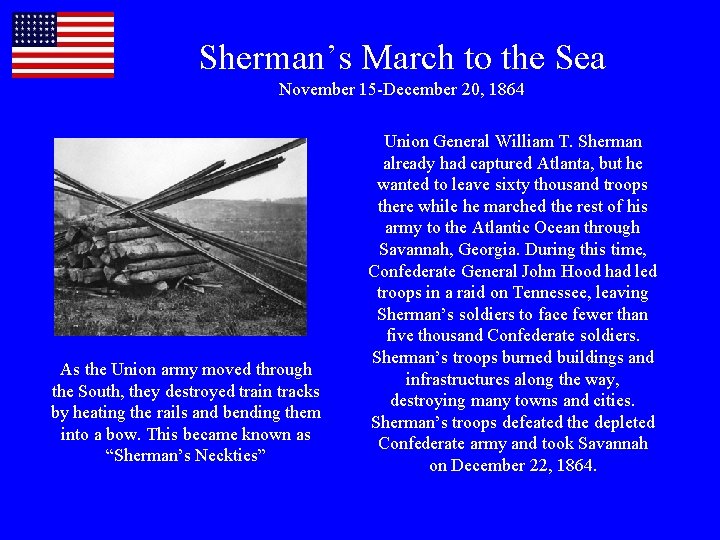
Sherman’s March to the Sea November 15 -December 20, 1864 As the Union army moved through the South, they destroyed train tracks by heating the rails and bending them into a bow. This became known as “Sherman’s Neckties” Union General William T. Sherman already had captured Atlanta, but he wanted to leave sixty thousand troops there while he marched the rest of his army to the Atlantic Ocean through Savannah, Georgia. During this time, Confederate General John Hood had led troops in a raid on Tennessee, leaving Sherman’s soldiers to face fewer than five thousand Confederate soldiers. Sherman’s troops burned buildings and infrastructures along the way, destroying many towns and cities. Sherman’s troops defeated the depleted Confederate army and took Savannah on December 22, 1864.
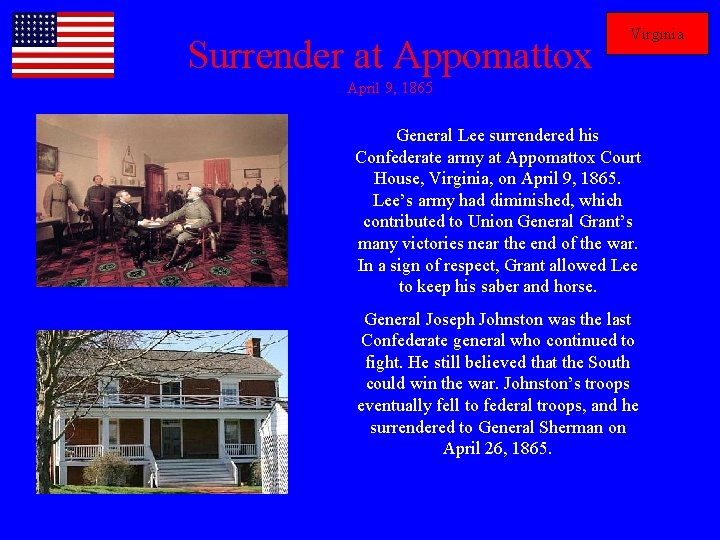
Surrender at Appomattox Virginia April 9, 1865 General Lee surrendered his Confederate army at Appomattox Court House, Virginia, on April 9, 1865. Lee’s army had diminished, which contributed to Union General Grant’s many victories near the end of the war. In a sign of respect, Grant allowed Lee to keep his saber and horse. General Joseph Johnston was the last Confederate general who continued to fight. He still believed that the South could win the war. Johnston’s troops eventually fell to federal troops, and he surrendered to General Sherman on April 26, 1865.
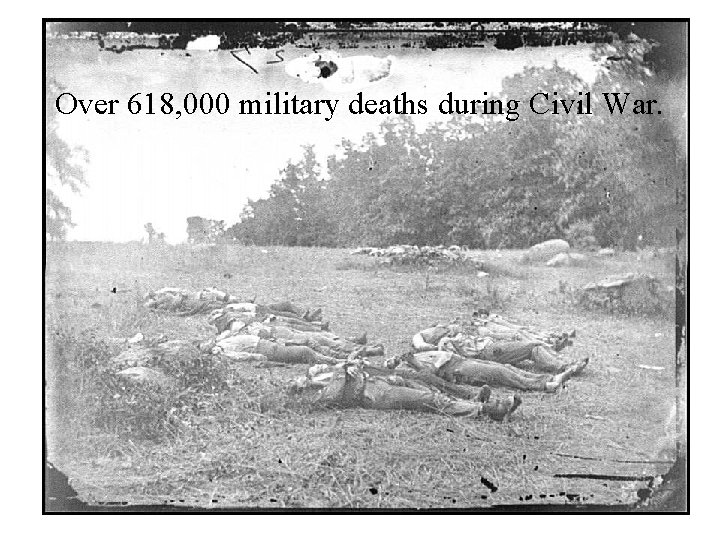
Over 618, 000 military deaths during Civil War.
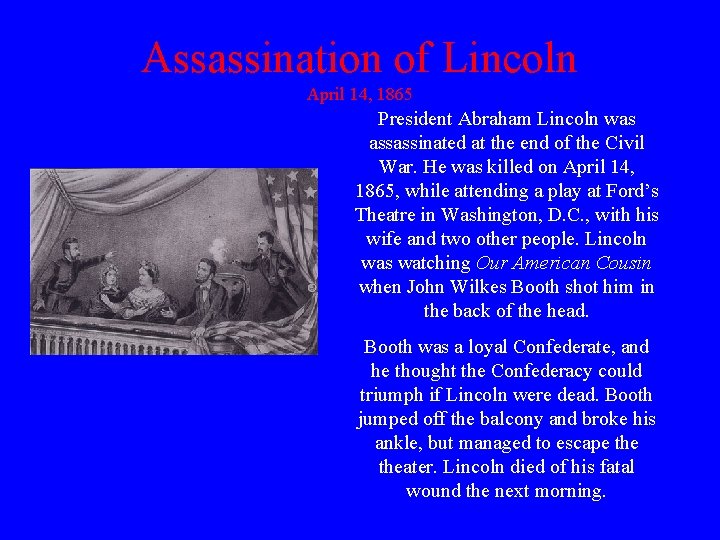
Assassination of Lincoln April 14, 1865 President Abraham Lincoln was assassinated at the end of the Civil War. He was killed on April 14, 1865, while attending a play at Ford’s Theatre in Washington, D. C. , with his wife and two other people. Lincoln was watching Our American Cousin when John Wilkes Booth shot him in the back of the head. Booth was a loyal Confederate, and he thought the Confederacy could triumph if Lincoln were dead. Booth jumped off the balcony and broke his ankle, but managed to escape theater. Lincoln died of his fatal wound the next morning.
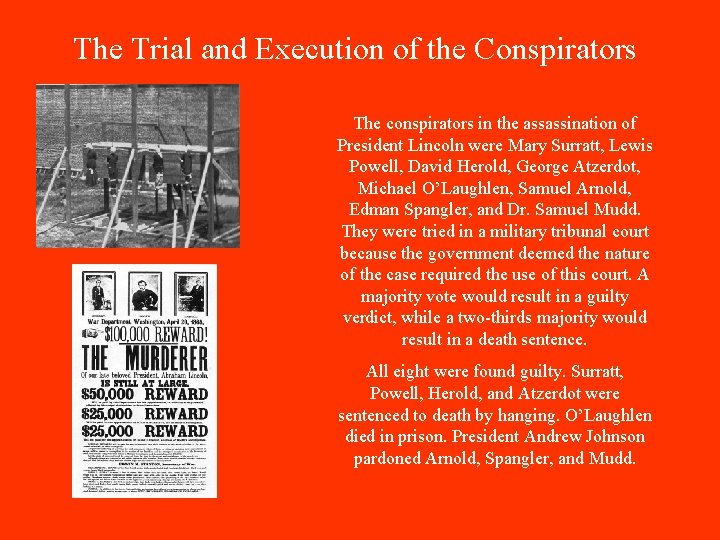
The Trial and Execution of the Conspirators The conspirators in the assassination of President Lincoln were Mary Surratt, Lewis Powell, David Herold, George Atzerdot, Michael O’Laughlen, Samuel Arnold, Edman Spangler, and Dr. Samuel Mudd. They were tried in a military tribunal court because the government deemed the nature of the case required the use of this court. A majority vote would result in a guilty verdict, while a two-thirds majority would result in a death sentence. All eight were found guilty. Surratt, Powell, Herold, and Atzerdot were sentenced to death by hanging. O’Laughlen died in prison. President Andrew Johnson pardoned Arnold, Spangler, and Mudd.
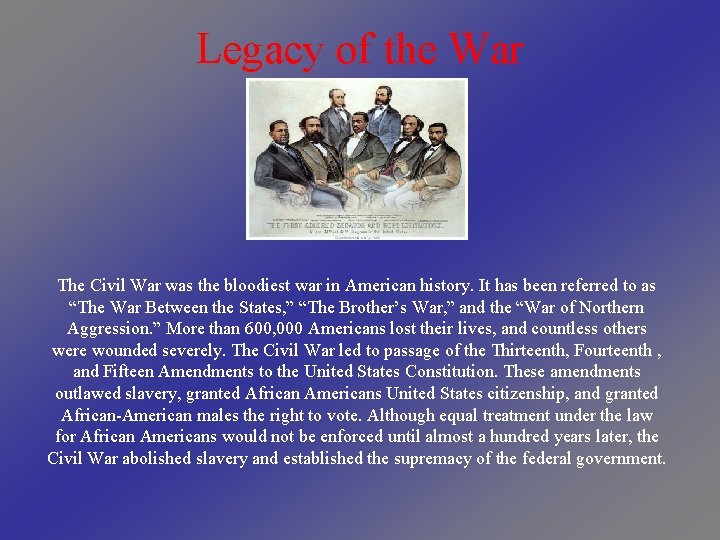
Legacy of the War The Civil War was the bloodiest war in American history. It has been referred to as “The War Between the States, ” “The Brother’s War, ” and the “War of Northern Aggression. ” More than 600, 000 Americans lost their lives, and countless others were wounded severely. The Civil War led to passage of the Thirteenth, Fourteenth , and Fifteen Amendments to the United States Constitution. These amendments outlawed slavery, granted African Americans United States citizenship, and granted African-American males the right to vote. Although equal treatment under the law for African Americans would not be enforced until almost a hundred years later, the Civil War abolished slavery and established the supremacy of the federal government.