
The altered solar wind magnetosphere interaction at low
![Observation of magnetosheath flow jets See also: Rosenqvist et al. [2007] dusk Sheath Cluster](https://slidetodoc.com/presentation_image_h2/555e2ba214dbfb85edcb1909b0d710bb/image-9.jpg "Observation of magnetosheath flow jets See also: Rosenqvist et al. [2007] dusk Sheath Cluster")
- Slides: 18
The altered solar wind – magnetosphere interaction at low Mach numbers: Magnetosheath and magnetopause Benoit Lavraud CESR/CNRS, Toulouse, France Uppsala, May 2008
OUTLINE • Introduction and motivation • Magnetosheath β properties • Asymmetric flows in the magnetosheath • Asymmetric magnetopause shape • Kelvin-Helmholtz instability • Other expected effects • Occurrence distribution of solar wind MA • Conclusions Note: we primarily use global MHD simulations here
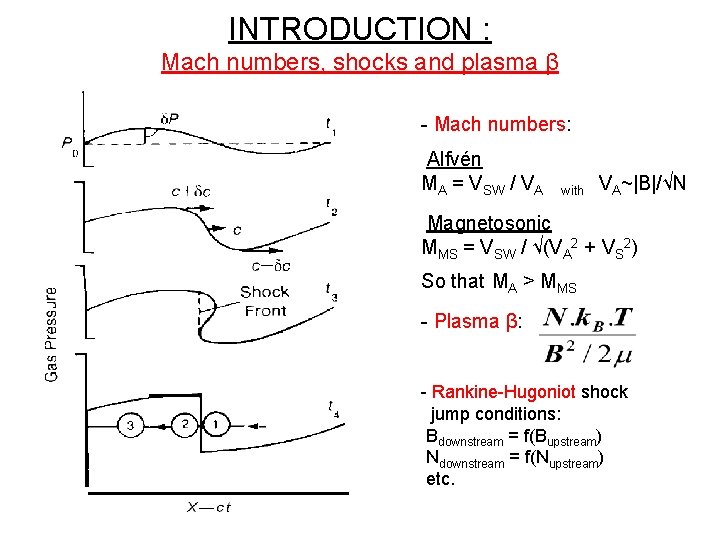
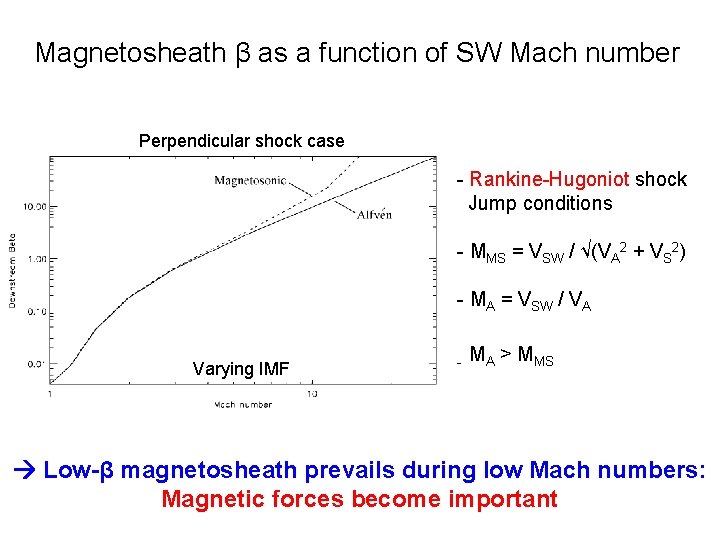
INTRODUCTION : Mach numbers, shocks and plasma β - Mach numbers: Alfvén MA = VSW / VA with VA~|B|/√N Magnetosonic MMS = VSW / √(VA 2 + VS 2) So that MA > MMS - Plasma β: - Rankine-Hugoniot shock jump conditions: Bdownstream = f(Bupstream) Ndownstream = f(Nupstream) etc.
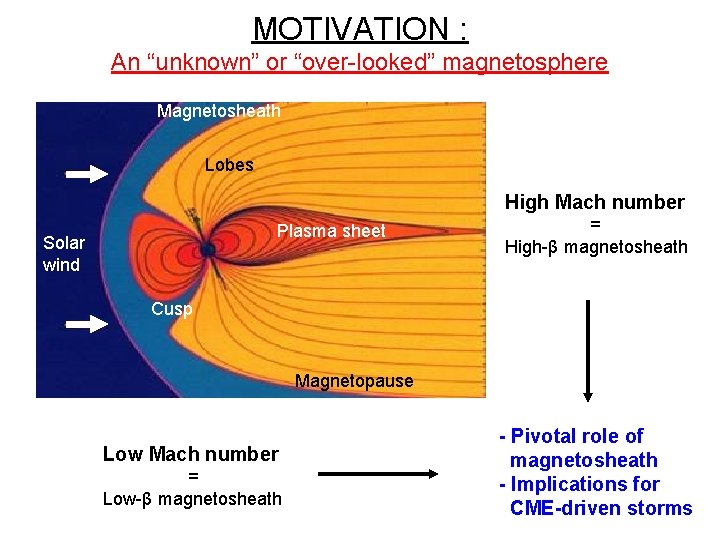
MOTIVATION : An “unknown” or “over-looked” magnetosphere Magnetosheath Lobes High Mach number Plasma sheet Solar wind = High-β magnetosheath Cusp Magnetopause Low Mach number = Low-β magnetosheath - Pivotal role of magnetosheath - Implications for CME-driven storms
Magnetosheath β as a function of SW Mach number Perpendicular shock case - Rankine-Hugoniot shock Jump conditions - MMS = VSW / √(VA 2 + VS 2) - MA = VSW / VA Varying IMF - MA > MMS Low-β magnetosheath prevails during low Mach numbers: Magnetic forces become important
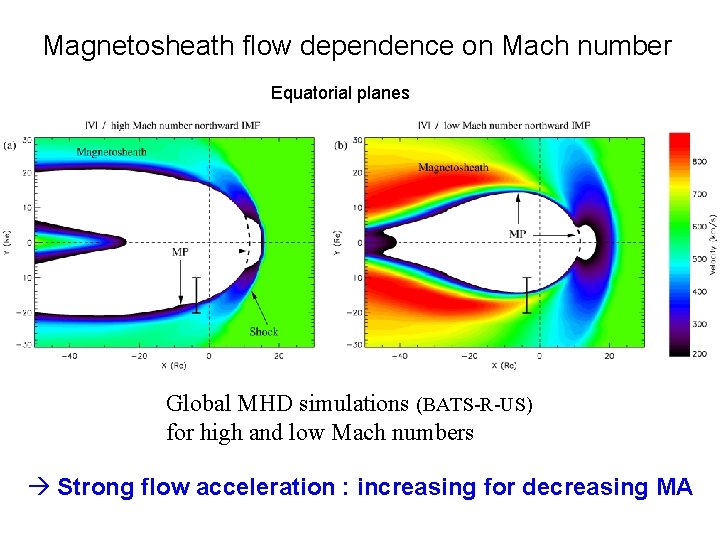
Magnetosheath flow dependence on Mach number Equatorial planes Global MHD simulations (BATS-R-US) for high and low Mach numbers Strong flow acceleration : increasing for decreasing MA
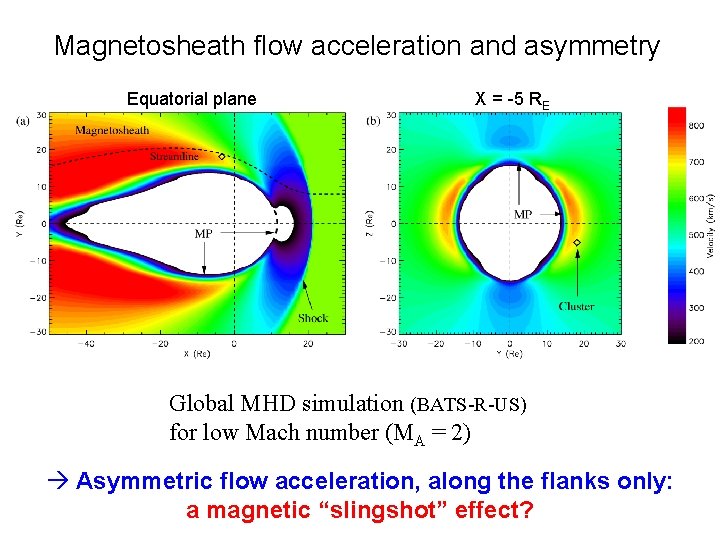
Magnetosheath flow acceleration and asymmetry Equatorial plane X = -5 RE Global MHD simulation (BATS-R-US) for low Mach number (MA = 2) Asymmetric flow acceleration, along the flanks only: a magnetic “slingshot” effect?
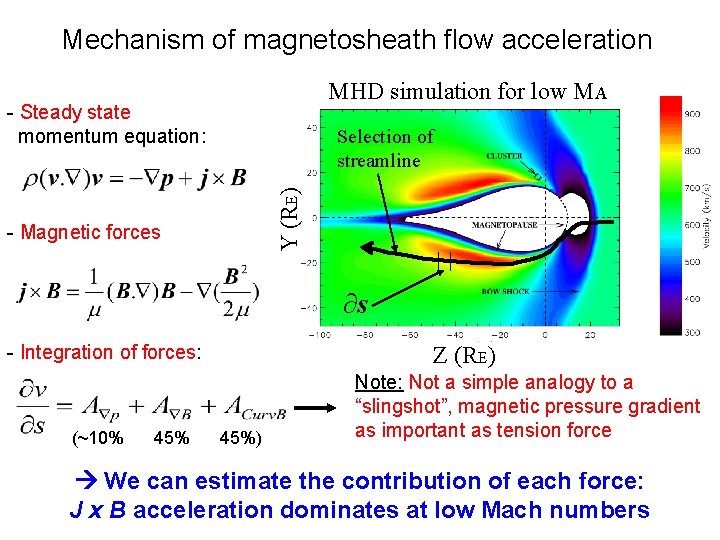
Mechanism of magnetosheath flow acceleration MHD simulation for low MA - Steady state momentum equation: Y (RE) Selection of streamline - Magnetic forces ∂s - Integration of forces: (~10% 45% Z (RE) 45%) Note: Not a simple analogy to a “slingshot”, magnetic pressure gradient as important as tension force We can estimate the contribution of each force: J x B acceleration dominates at low Mach numbers
Observation of magnetosheath flow jets See also: Rosenqvist et al. [2007] dusk Sheath Cluster Electrons shock sheath Ions - Solar wind observations: IMF large and north SW density low - Cluster observations: Flows B field outside MP Up to 1040 km/s while SW is only 650 km/s SW speed Magnetopause Flows not associated with reconnection and 60% > SW
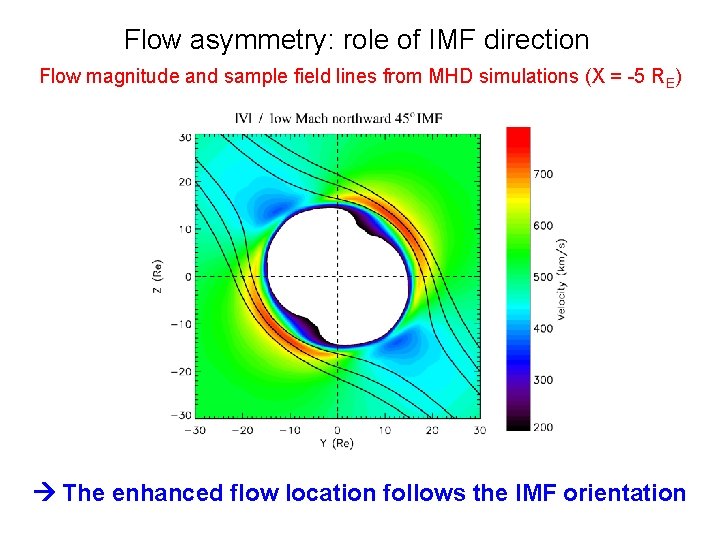
Flow asymmetry: role of IMF direction Flow magnitude and sample field lines from MHD simulations (X = -5 RE) The enhanced flow location follows the IMF orientation
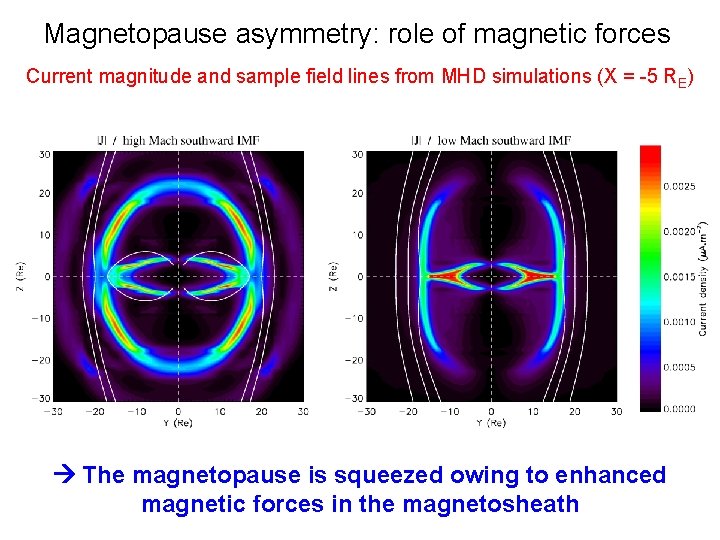
Magnetopause asymmetry: role of magnetic forces Current magnitude and sample field lines from MHD simulations (X = -5 RE) The magnetopause is squeezed owing to enhanced magnetic forces in the magnetosheath
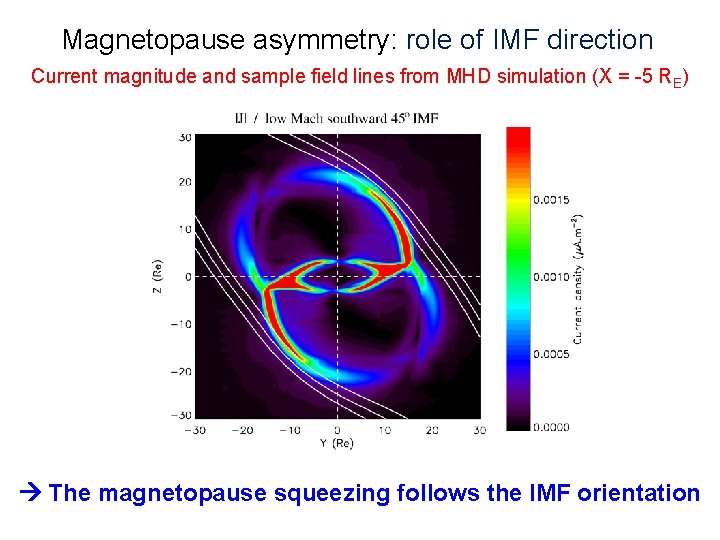
Magnetopause asymmetry: role of IMF direction Current magnitude and sample field lines from MHD simulation (X = -5 RE) The magnetopause squeezing follows the IMF orientation
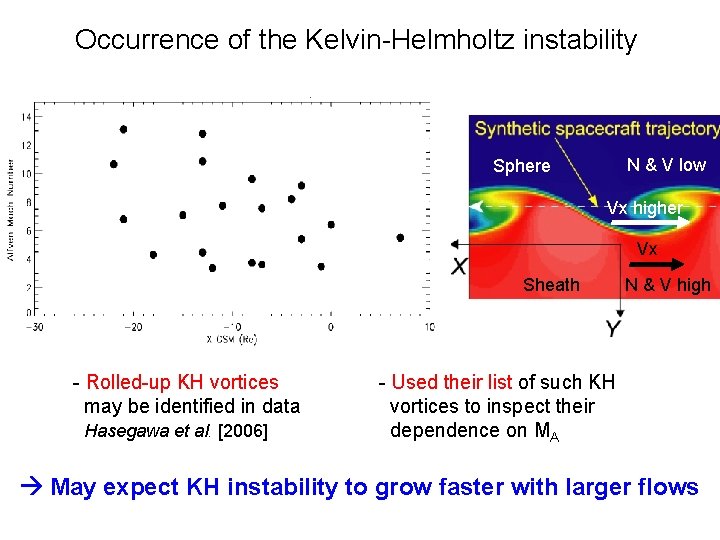
Occurrence of the Kelvin-Helmholtz instability N & V low Sphere Vx higher Vx Sheath - Rolled-up KH vortices may be identified in data Hasegawa et al. [2006] N & V high - Used their list of such KH vortices to inspect their dependence on MA May expect KH instability to grow faster with larger flows
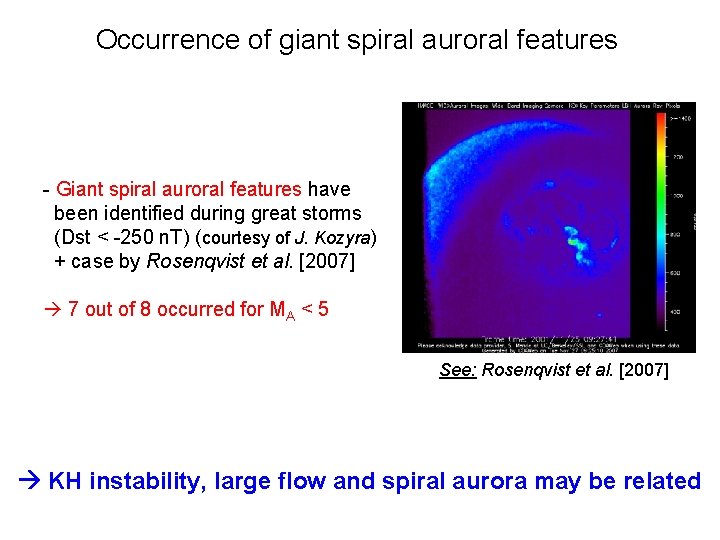
Occurrence of giant spiral auroral features - Giant spiral auroral features have been identified during great storms (Dst < -250 n. T) (courtesy of J. Kozyra) + case by Rosenqvist et al. [2007] 7 out of 8 occurred for MA < 5 See: Rosenqvist et al. [2007] KH instability, large flow and spiral aurora may be related
SOME OTHER LOW MA EFFECTS • Changes in dayside reconnection rate • Cross-polar cap potential saturation • Sawtooth oscillations • Plasma depletion layer (disappears at high MA) • Heating at bow shock (Ti/Te and tracing) • Drifts and losses to the magnetopause (radiation belts and ring current) • Alfvén wings in sub-Alfvénic flow • Bow shock acceleration and reflection else …?
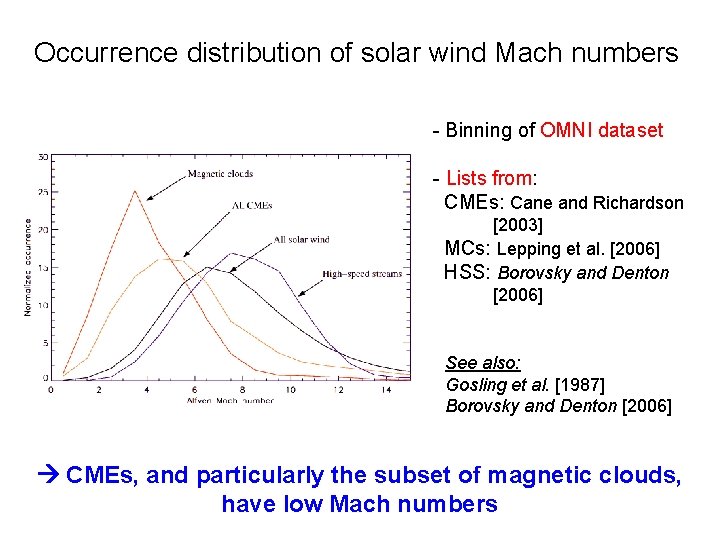
Occurrence distribution of solar wind Mach numbers - Binning of OMNI dataset - Lists from: CMEs: Cane and Richardson [2003] MCs: Lepping et al. [2006] HSS: Borovsky and Denton [2006] See also: Gosling et al. [1987] Borovsky and Denton [2006] CMEs, and particularly the subset of magnetic clouds, have low Mach numbers
CONCLUSIONS • SW – magnetosphere interaction is significantly altered during low Mach number • All these effects are thus important during CME-driven storms • They must occur at other magnetospheres (Mercury: low MA and no ionosphere Moons, e. g. , like Io in sub-Alfvenic flows)
Acknowledgments Joseph E. Borovsky (Los Alamos, USA) Aaron J. Ridley (Univ. Michigan, USA) Janet Kozyra (Univ. Michigan, USA) Maria M. Kuznetsova and CCMC (NASA GSFC, USA) and Cluster teams