
The Alphabet Soup of Drones Brandon Stark Director
The Alphabet Soup of Drones Brandon Stark, Director Unmanned Aircraft System Safety Center of Excellence University of California New Directions in Risk and Safety
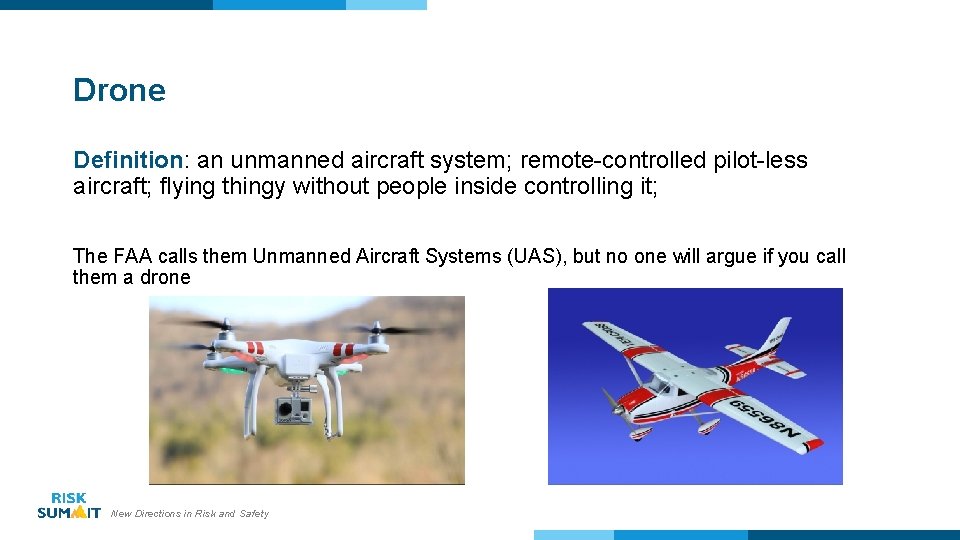
Drone Definition: an unmanned aircraft system; remote-controlled pilot-less aircraft; flying thingy without people inside controlling it; The FAA calls them Unmanned Aircraft Systems (UAS), but no one will argue if you call them a drone New Directions in Risk and Safety
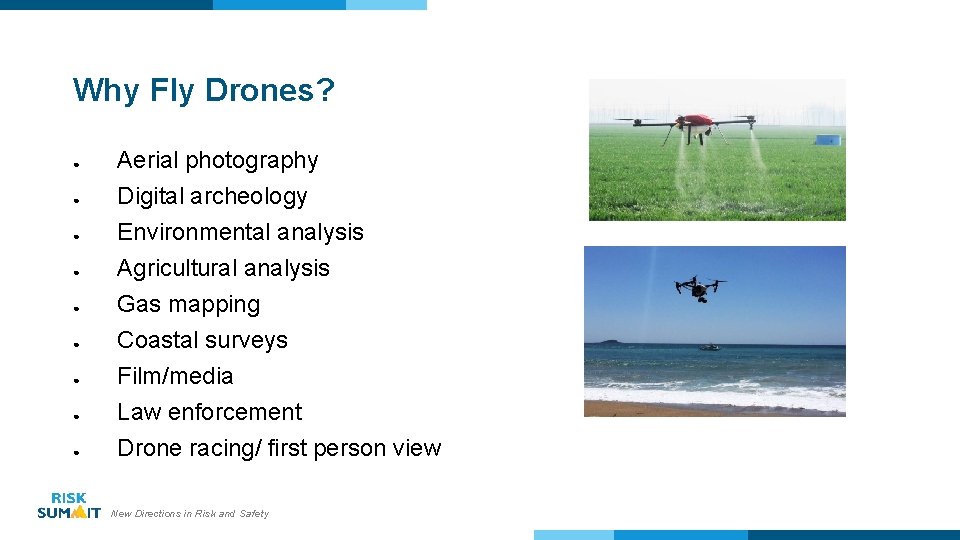
Why Fly Drones? ● ● ● ● ● Aerial photography Digital archeology Environmental analysis Agricultural analysis Gas mapping Coastal surveys Film/media Law enforcement Drone racing/ first person view New Directions in Risk and Safety
Why Fly Drones? New Directions in Risk and Safety
Where Did the Term “Drone” come from? New Directions in Risk and Safety
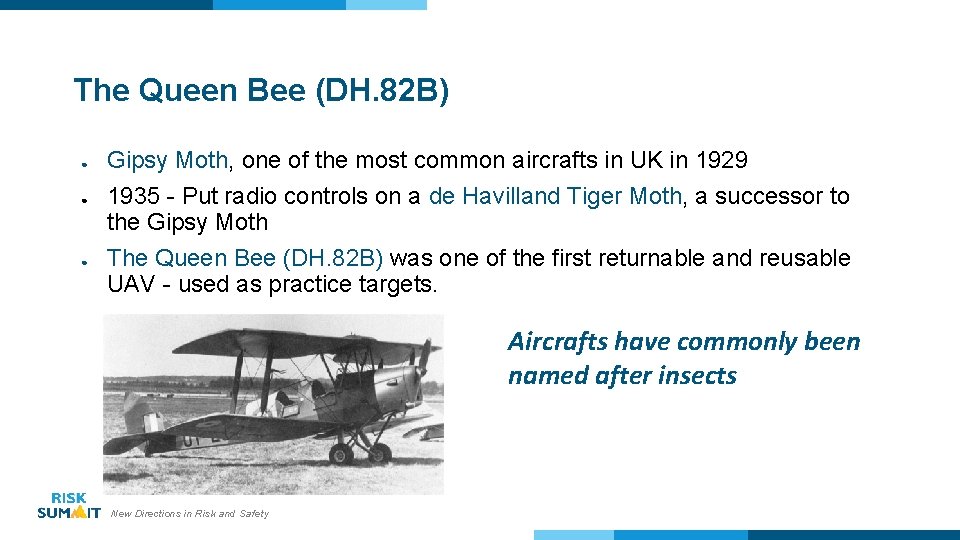
The Queen Bee (DH. 82 B) ● ● ● Gipsy Moth, one of the most common aircrafts in UK in 1929 1935 - Put radio controls on a de Havilland Tiger Moth, a successor to the Gipsy Moth The Queen Bee (DH. 82 B) was one of the first returnable and reusable UAV - used as practice targets. Aircrafts have commonly been named after insects New Directions in Risk and Safety
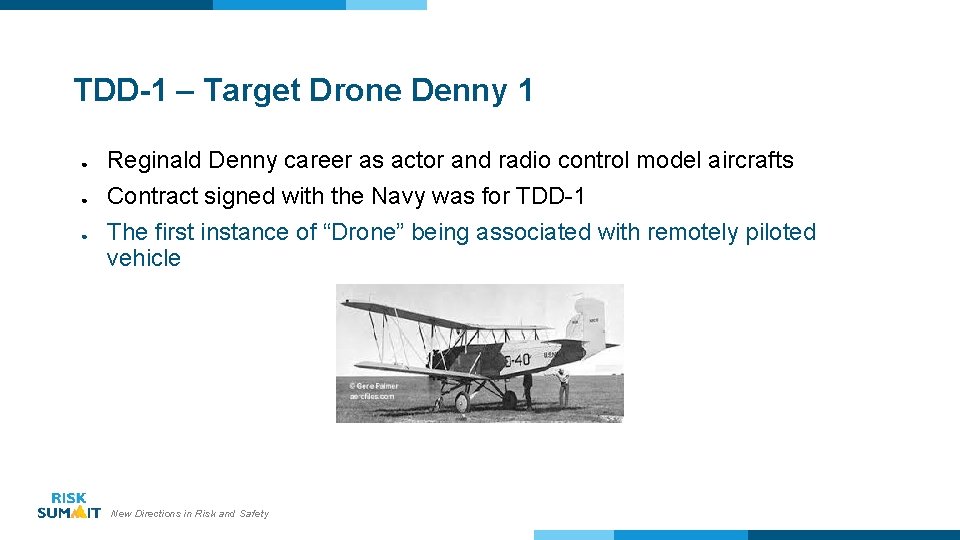
TDD-1 – Target Drone Denny 1 ● ● ● Reginald Denny career as actor and radio control model aircrafts Contract signed with the Navy was for TDD-1 The first instance of “Drone” being associated with remotely piloted vehicle New Directions in Risk and Safety
What are Some Other Names of Drones? New Directions in Risk and Safety
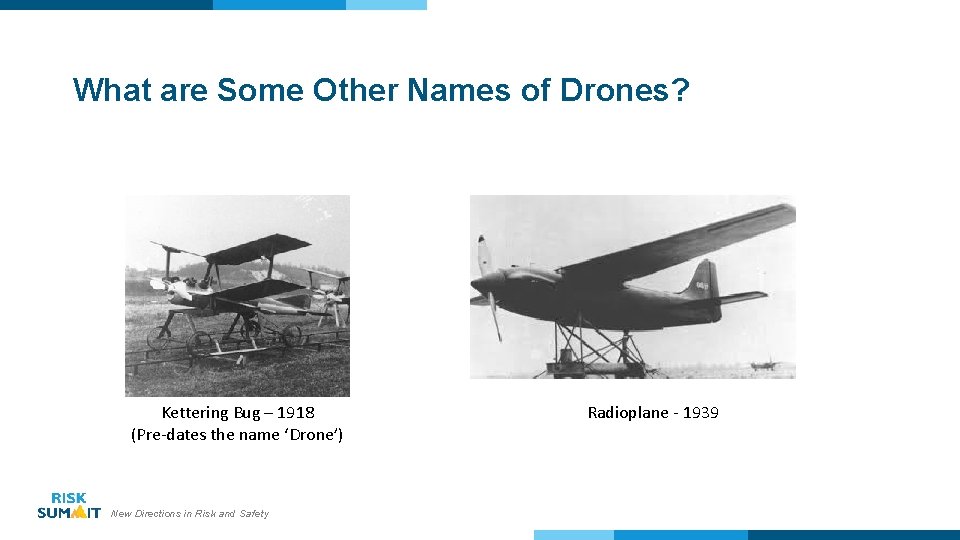
What are Some Other Names of Drones? Kettering Bug – 1918 (Pre-dates the name ‘Drone’) New Directions in Risk and Safety Radioplane - 1939
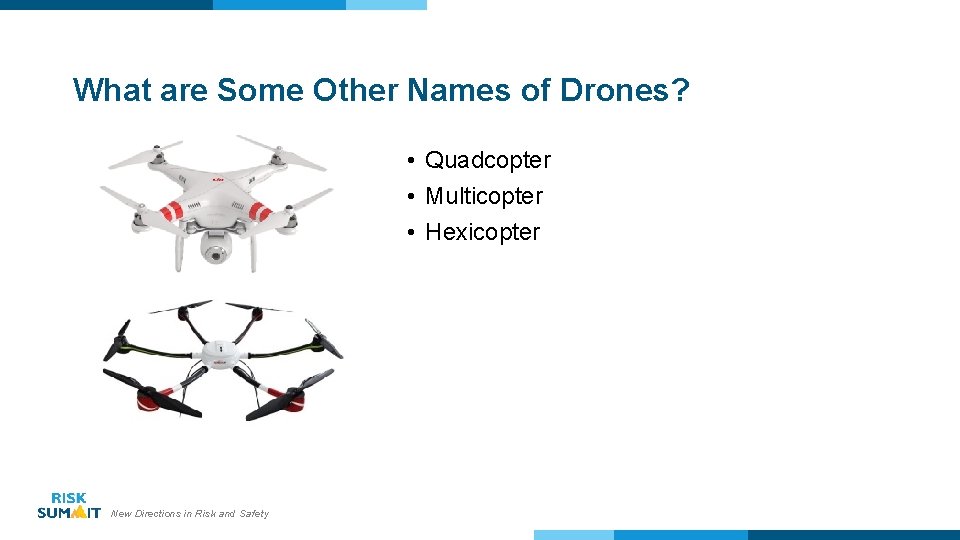
What are Some Other Names of Drones? • Quadcopter • Multicopter • Hexicopter New Directions in Risk and Safety
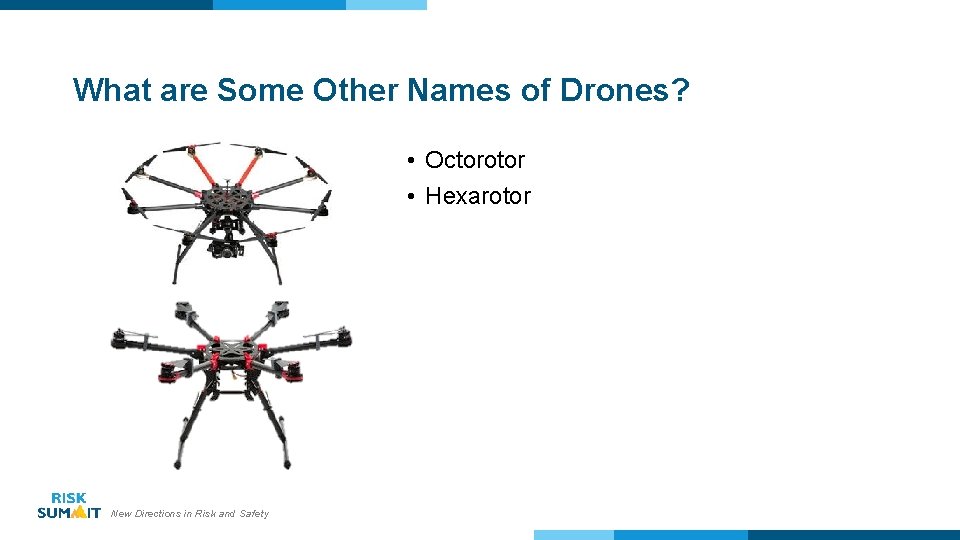
What are Some Other Names of Drones? • Octorotor • Hexarotor New Directions in Risk and Safety
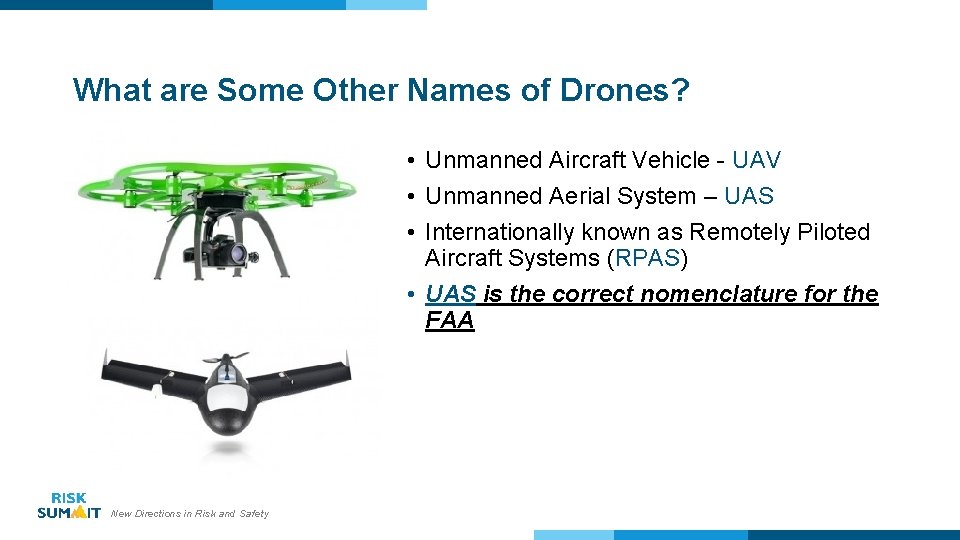
What are Some Other Names of Drones? • Unmanned Aircraft Vehicle - UAV • Unmanned Aerial System – UAS • Internationally known as Remotely Piloted Aircraft Systems (RPAS) • UAS is the correct nomenclature for the FAA New Directions in Risk and Safety
Classification of Drones New Directions in Risk and Safety
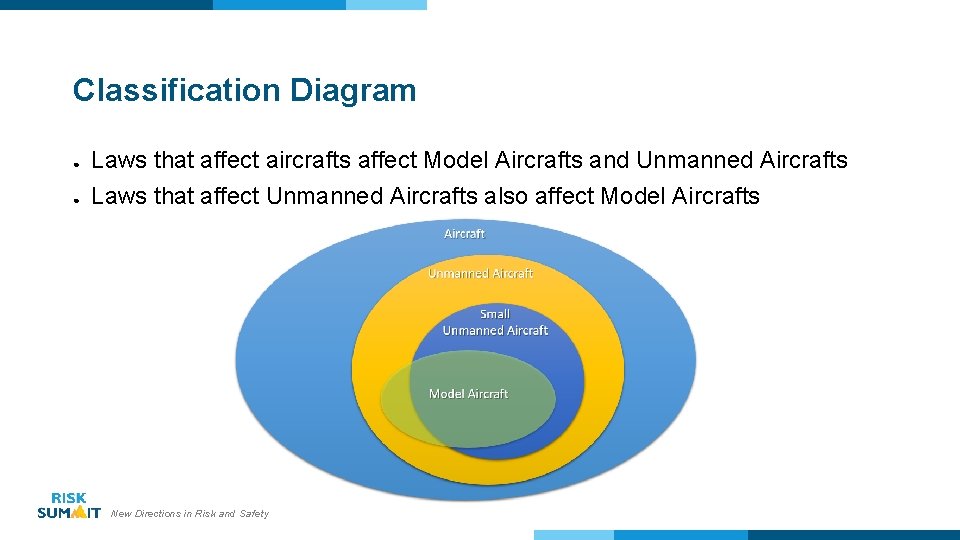
Classification Diagram ● ● Laws that affect aircrafts affect Model Aircrafts and Unmanned Aircrafts Laws that affect Unmanned Aircrafts also affect Model Aircrafts New Directions in Risk and Safety

Classification of Drones ● Drones classified by weight ● ● ● Small Unmanned Aircraft System < 55 lbs “micro” < 4. 4 lbs Model Aircrafts classified by the purpose of only recreational ● Drone racing drones classified by size New Directions in Risk and Safety
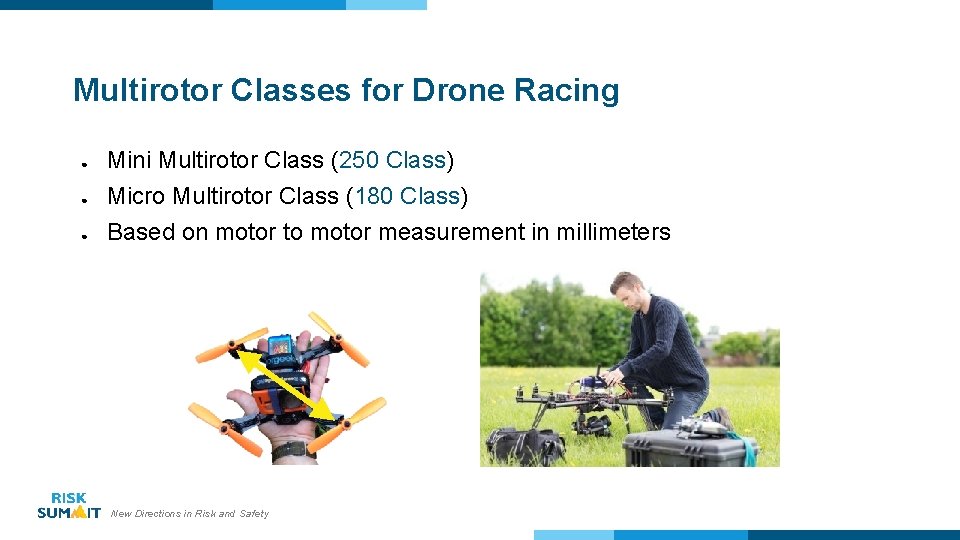
Multirotor Classes for Drone Racing ● ● ● Mini Multirotor Class (250 Class) Micro Multirotor Class (180 Class) Based on motor to motor measurement in millimeters New Directions in Risk and Safety
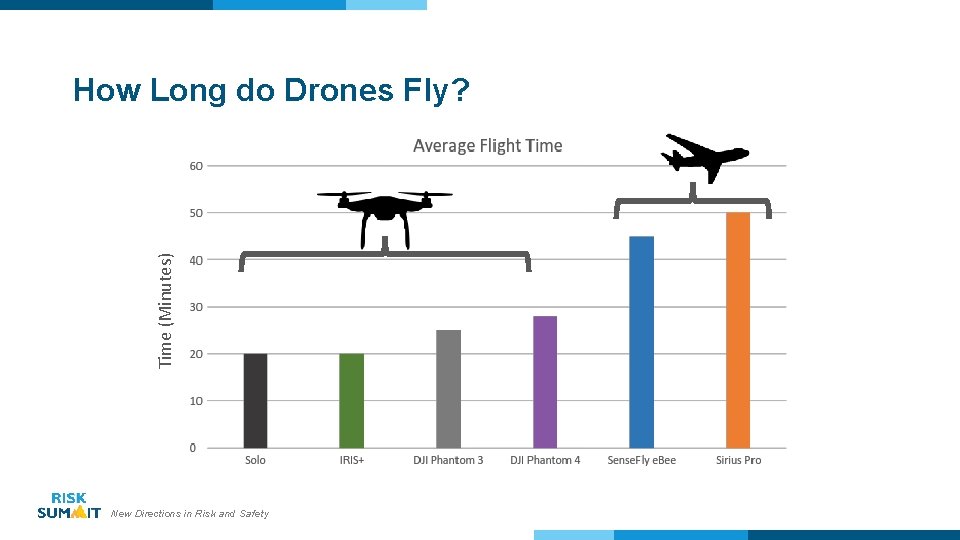
Time (Minutes) How Long do Drones Fly? New Directions in Risk and Safety
Flying Drones! New Directions in Risk and Safety
What Permissions are Needed to Legally Fly? • • Federal Aviation Administration (FAA) - must register vehicle with FAA and have authorization to fly Section 333 – any aircraft operation in national airspace requires a certificated and registered aircraft, a licensed pilot, and operational approval Certificate of Waiver or Authorization (COA) - authorization by Air Traffic Organization for specific UA activity Part 107 (Proposed Law) - simplifies current laws, will be announced by end of JUNE 2016 New Directions in Risk and Safety
What Items Do You Need To Legally Fly? • Recreational • • License number registered with FAA displayed on aircrafts Registration fee $5 person New Directions in Risk and Safety
What Items Do You Need To Legally Fly? • Commercial • • • Section 333 Exception or Aircraft Certification Certificate of Authorization (COA) Aircraft Registrations and Markings Pilot Certificate Registration $5 per aircraft New Directions in Risk and Safety
What Items Do You Need To Legally Fly? • As a public Agency • • • Certificate of Authorization (COA) Aircraft Registration and Markings Registration $5 per aircraft New Directions in Risk and Safety
What Items Do You Need To Legally Fly? • As a UC Agent • • Depending on purpose, either commercial or public Best to assume commercial, unless under specific purposes Common Public Purposes • Law Enforcement or Search and Rescue • Publically funded research on: • Aerospace • Biological resource management • Geological resource management Legal permissions to fly a UAS is not a trivial situation. Please contact UAS Safety for guidance! New Directions in Risk and Safety
Recreational/Class Curriculum Recreational Education • Cannot receive money or compensation • Cannot be used in furtherance with a business or official duty • Must be operated within a community-based set of safety guidelines and within the programming of a nationwide community-based organization • Students may build and fly a UAS as a component of a course curriculum or senior project • UAS flights by students must be in accordance with Campus oversight. • UAS flights in pursuit of research projects or university business are not considered recreational New Directions in Risk and Safety 24
Examples • A student club is considered recreational • A student that flies a UAS as part of a class on remote sensing techniques is considered recreational • A student building and flying a UAS as part of a class on aerodynamics is considered recreational • A student building and flying a UAS for a senior project is considered recreational • A student club that is paid to perform at an event is not recreational • A student flying a UAS under the direction of a faculty’s research is not recreational. • A course where the primary objective is learning how to fly is not considered recreational. • A student conducting sponsored research (faculty, company, student gov’t) is not recreational Campus should still provide oversight! New Directions in Risk and Safety 25
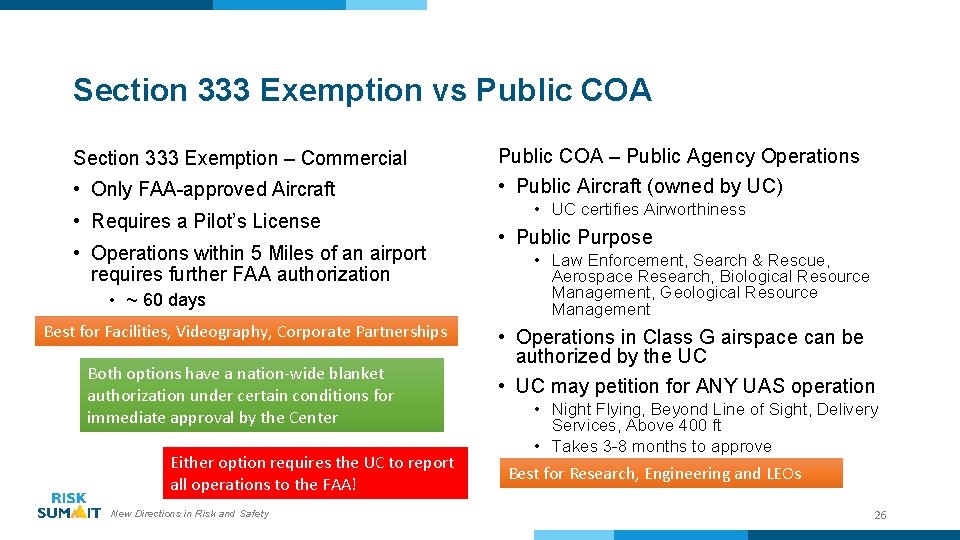
Section 333 Exemption vs Public COA Section 333 Exemption – Commercial • Only FAA-approved Aircraft • Requires a Pilot’s License • Operations within 5 Miles of an airport requires further FAA authorization • ~ 60 days Best for Facilities, Videography, Corporate Partnerships Both options have a nation-wide blanket authorization under certain conditions for immediate approval by the Center Either option requires the UC to report all operations to the FAA! New Directions in Risk and Safety Public COA – Public Agency Operations • Public Aircraft (owned by UC) • UC certifies Airworthiness • Public Purpose • Law Enforcement, Search & Rescue, Aerospace Research, Biological Resource Management, Geological Resource Management • Operations in Class G airspace can be authorized by the UC • UC may petition for ANY UAS operation • Night Flying, Beyond Line of Sight, Delivery Services, Above 400 ft • Takes 3 -8 months to approve Best for Research, Engineering and LEOs 26
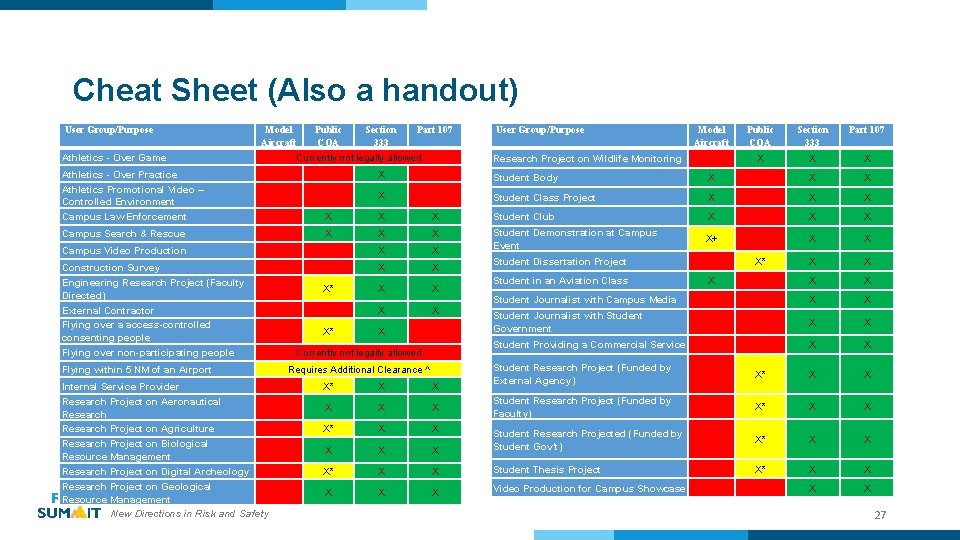
Cheat Sheet (Also a handout) User Group/Purpose Athletics - Over Game Model Public Section Part 107 Aircraft COA 333 Currently not legally allowed Athletics - Over Practice Athletics Promotional Video – Controlled Environment Campus Law Enforcement X X Campus Search & Rescue X User Group/Purpose Model Aircraft Research Project on Wildlife Monitoring Public COA Section 333 Part 107 X X Student Body X X Student Class Project X X Student Club X X X+ X X Campus Video Production X X Student Demonstration at Campus Event Construction Survey Engineering Research Project (Faculty Directed) External Contractor Flying over a access-controlled consenting people Flying over non-participating people X X X X X Student Journalist with Campus Media X X Student Journalist with Student Government X X Student Providing a Commercial Service X X Flying within 5 NM of an Airport Internal Service Provider Research Project on Aeronautical Research Project on Agriculture Research Project on Biological Resource Management Research Project on Digital Archeology Research Project on Geological Resource Management New Directions in Risk and Safety X* X* X Currently not legally allowed Requires Additional Clearance ^ Student Dissertation Project Student in an Aviation Class X* X Student Research Project (Funded by External Agency) X* X X Student Research Project (Funded by Faculty) X* X X X X X X* X X X Student Research Projected (Funded by Student Gov’t) X* X X Student Thesis Project X X X Video Production for Campus Showcase 27
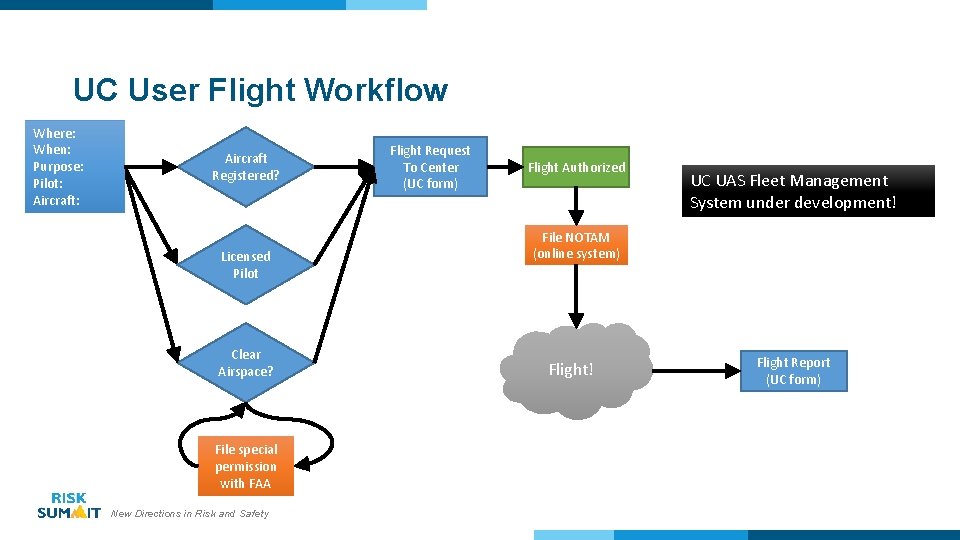
UC User Flight Workflow Where: When: Purpose: Pilot: Aircraft: Aircraft Registered? Licensed Pilot Clear Airspace? File special permission with FAA New Directions in Risk and Safety Flight Request To Center (UC form) Flight Authorized UC UAS Fleet Management System under development! File NOTAM (online system) Flight! Flight Report (UC form)
Where can we fly? New Directions in Risk and Safety
Where is it legal to fly? Where is it safe to fly? Legal • Class G airspace • Under 400 ft altitude • Within Line of Sight • Outside of 5 NM of an airport • Other locations will require additional FAA authorization Safe • No flying over non-participants • Area should be secured or very likely to have no incursions • Spectators should be • 65 ft away for planes • 25 ft away for multirotors (quadrotors) Airspace mapping solution www. airmap. com New Directions in Risk and Safety
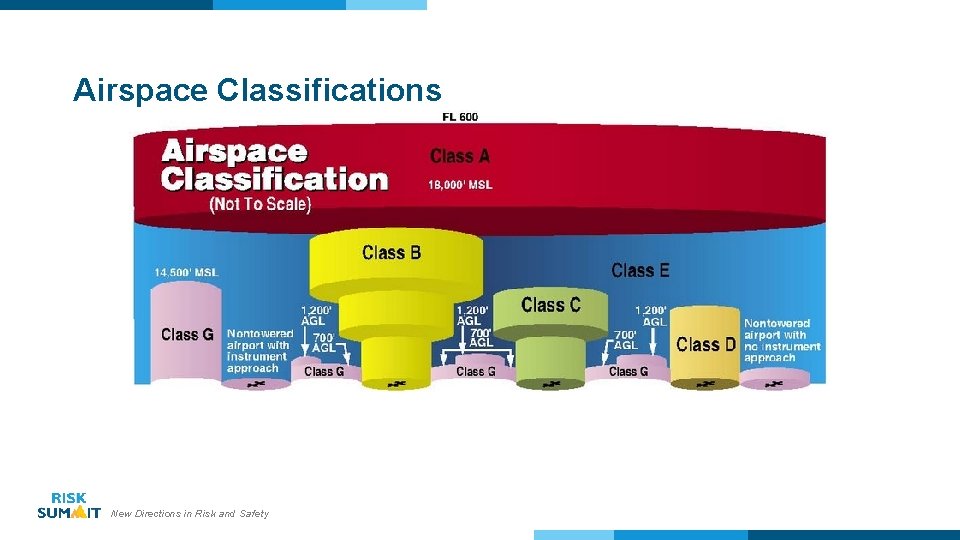
Airspace Classifications New Directions in Risk and Safety
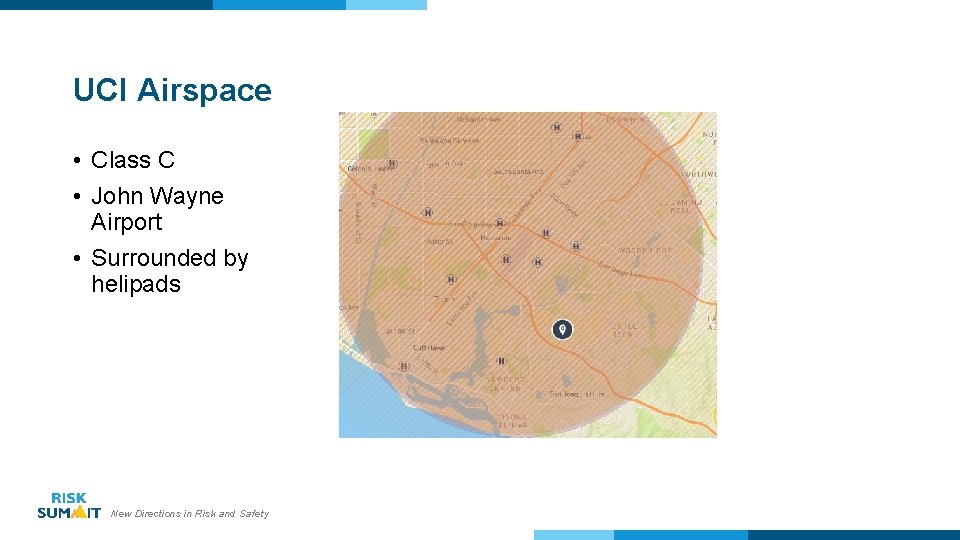
UCI Airspace • Class C • John Wayne Airport • Surrounded by helipads New Directions in Risk and Safety
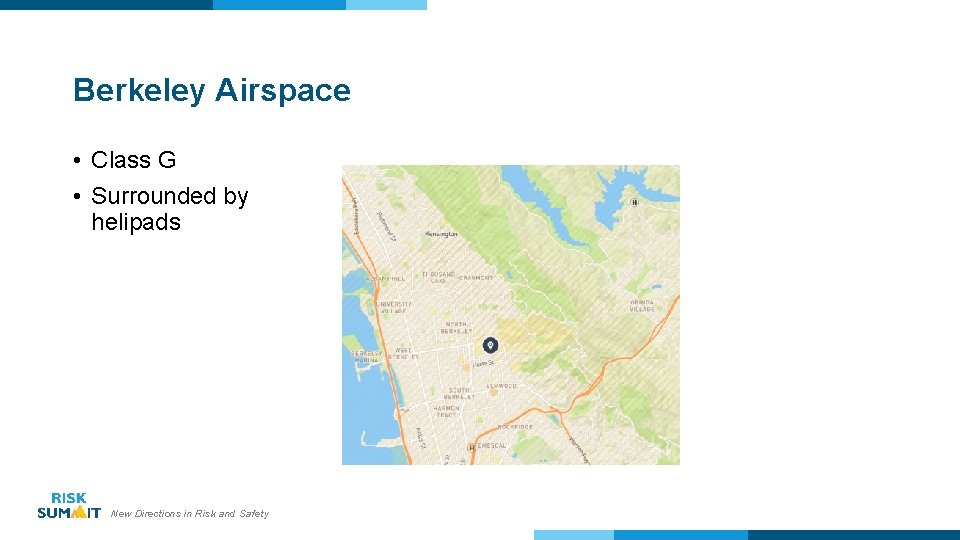
Berkeley Airspace • Class G • Surrounded by helipads New Directions in Risk and Safety
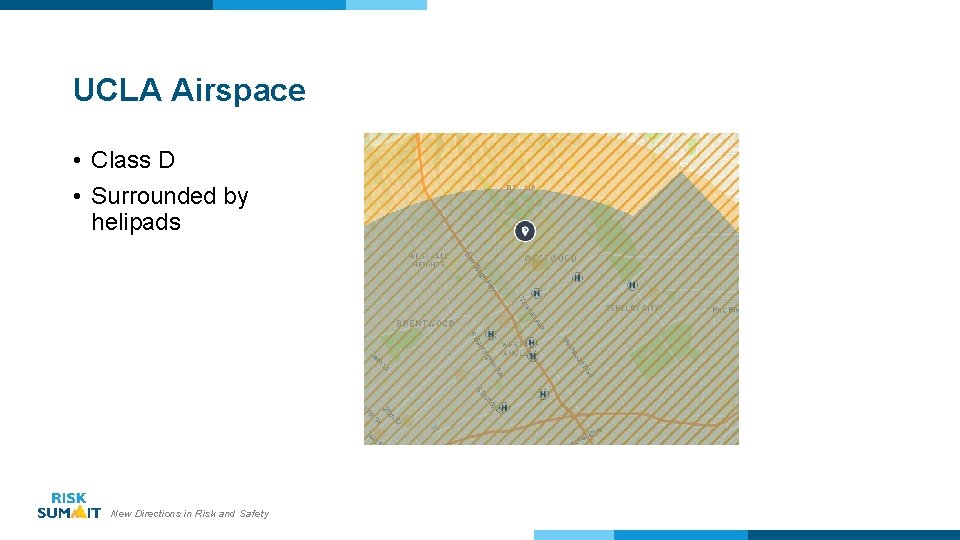
UCLA Airspace • Class D • Surrounded by helipads New Directions in Risk and Safety
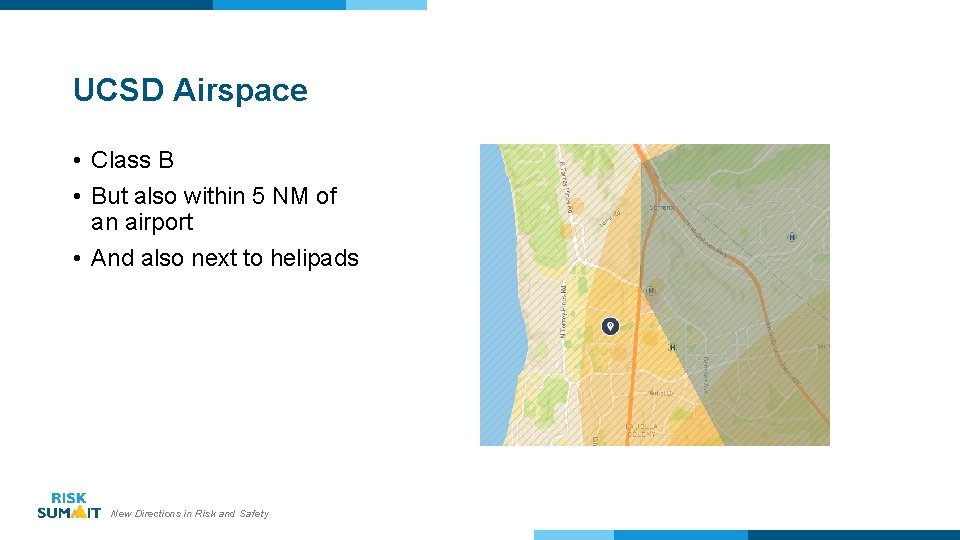
UCSD Airspace • Class B • But also within 5 NM of an airport • And also next to helipads New Directions in Risk and Safety
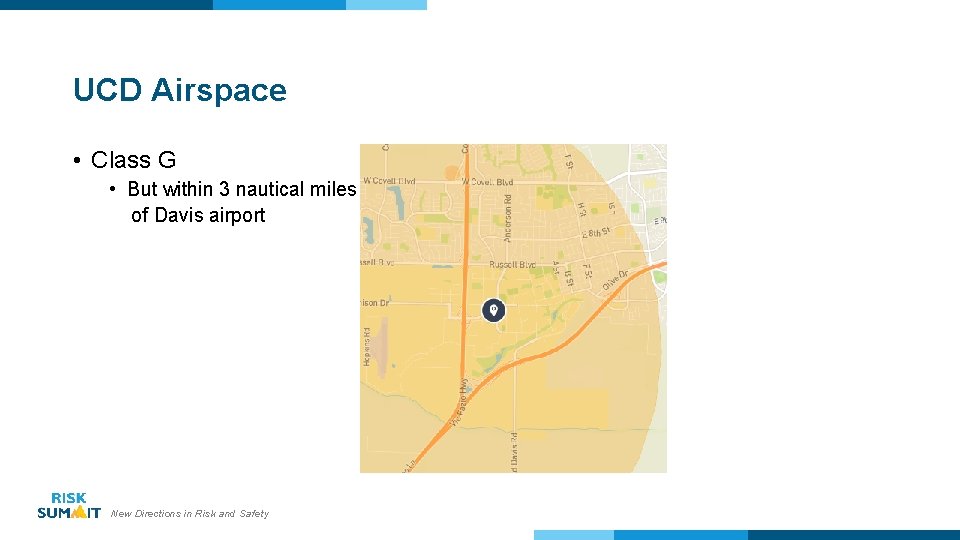
UCD Airspace • Class G • But within 3 nautical miles of Davis airport New Directions in Risk and Safety
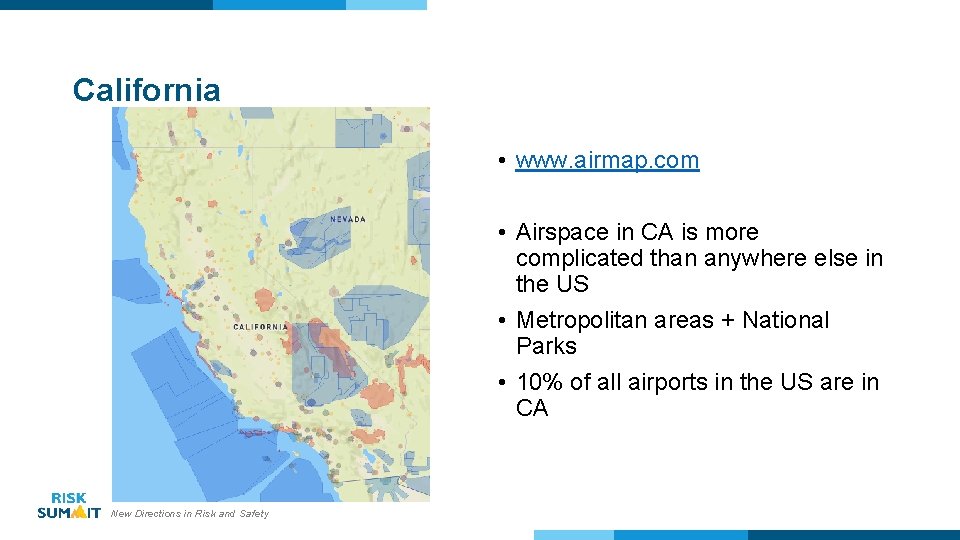
California • www. airmap. com • Airspace in CA is more complicated than anywhere else in the US • Metropolitan areas + National Parks • 10% of all airports in the US are in CA New Directions in Risk and Safety
So what do you need to know about drones? New Directions in Risk and Safety
Quadcopter Anatomy (the simplest of the drone family) New Directions in Risk and Safety
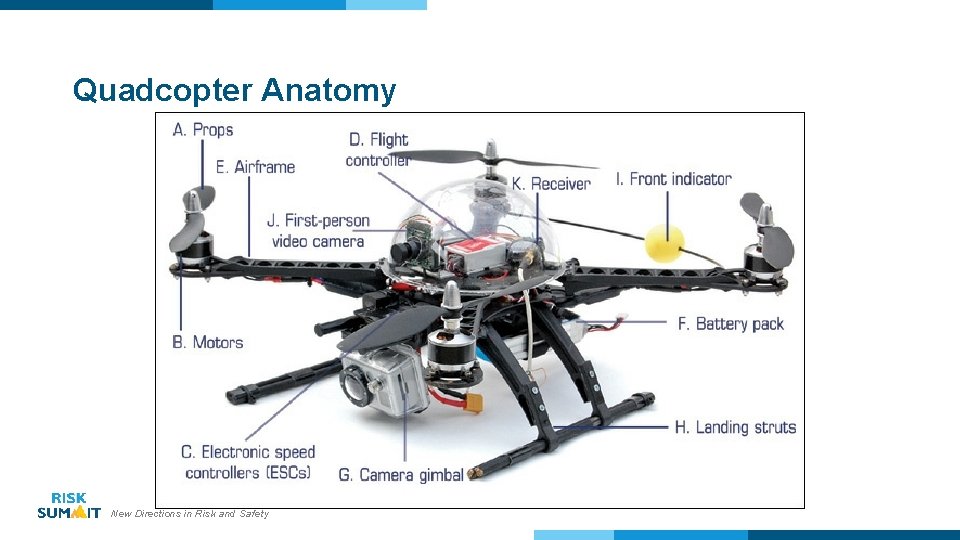
Quadcopter Anatomy New Directions in Risk and Safety
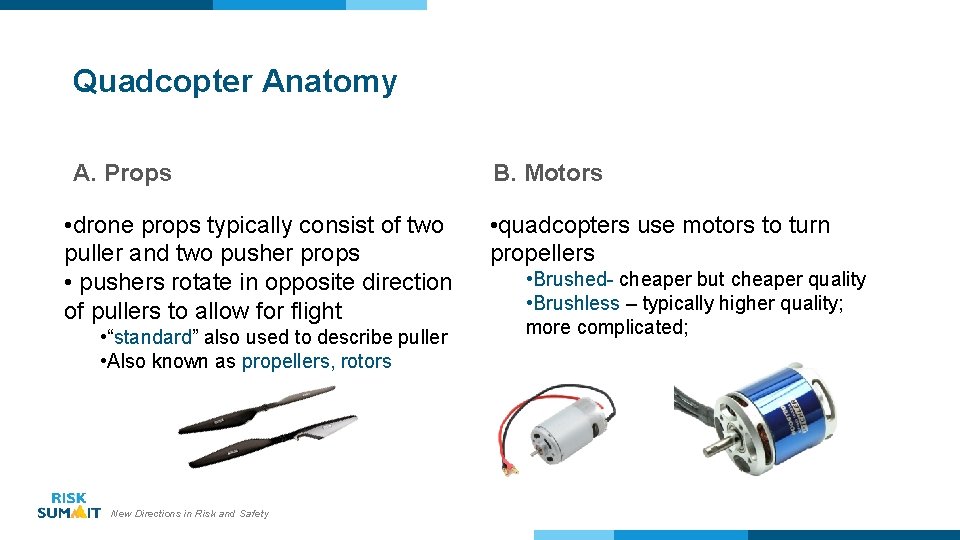
Quadcopter Anatomy A. Props • drone props typically consist of two puller and two pusher props • pushers rotate in opposite direction of pullers to allow for flight • “standard” also used to describe puller • Also known as propellers, rotors New Directions in Risk and Safety B. Motors • quadcopters use motors to turn propellers • Brushed- cheaper but cheaper quality • Brushless – typically higher quality; more complicated;
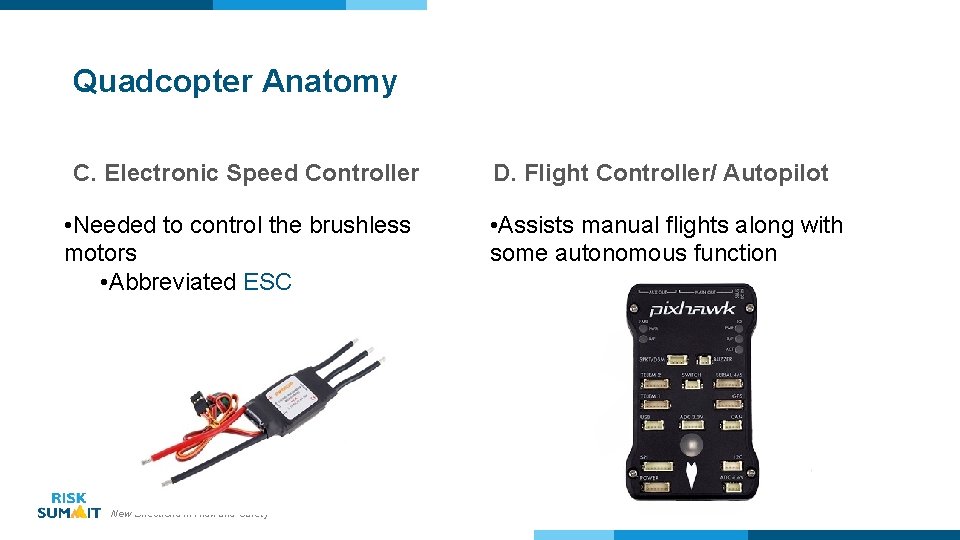
Quadcopter Anatomy C. Electronic Speed Controller • Needed to control the brushless motors • Abbreviated ESC New Directions in Risk and Safety D. Flight Controller/ Autopilot • Assists manual flights along with some autonomous function
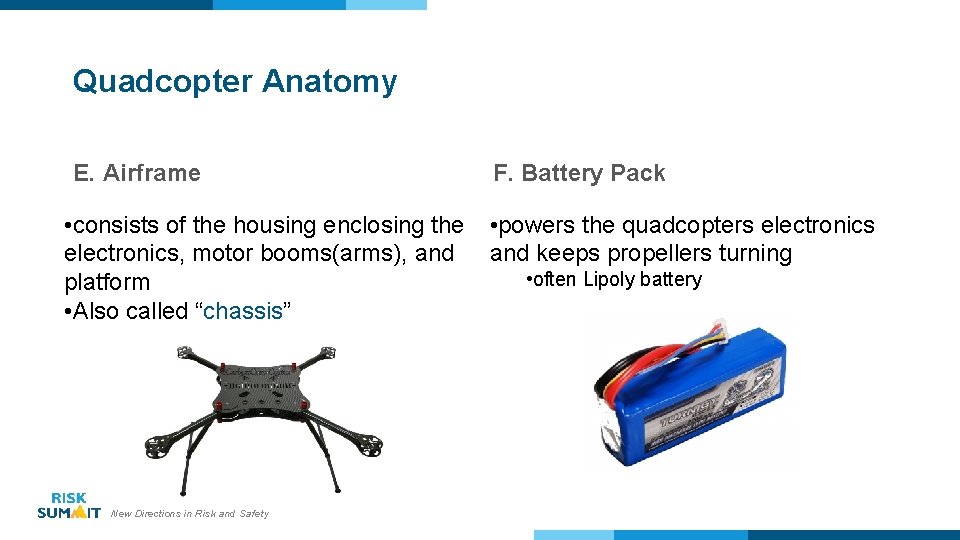
Quadcopter Anatomy E. Airframe • consists of the housing enclosing the electronics, motor booms(arms), and platform • Also called “chassis” New Directions in Risk and Safety F. Battery Pack • powers the quadcopters electronics and keeps propellers turning • often Lipoly battery
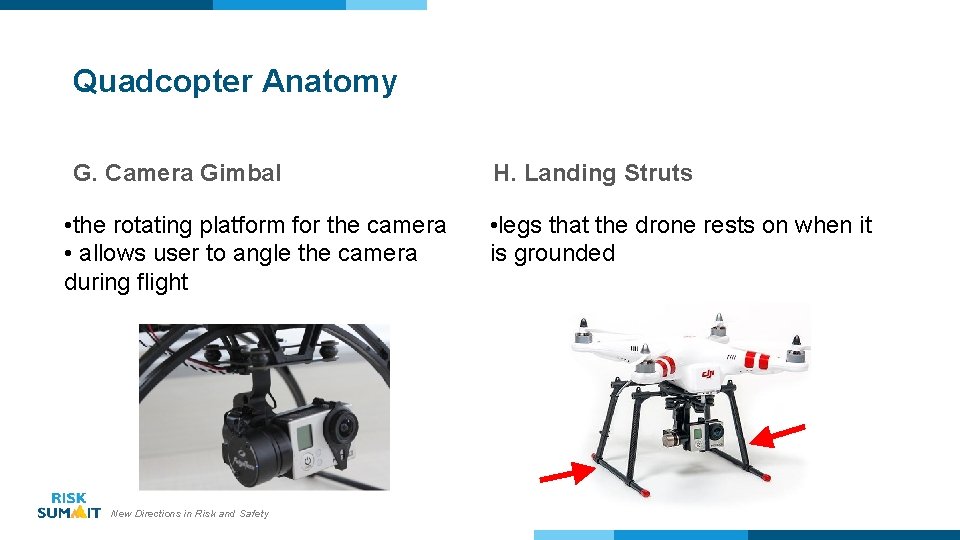
Quadcopter Anatomy G. Camera Gimbal • the rotating platform for the camera • allows user to angle the camera during flight New Directions in Risk and Safety H. Landing Struts • legs that the drone rests on when it is grounded
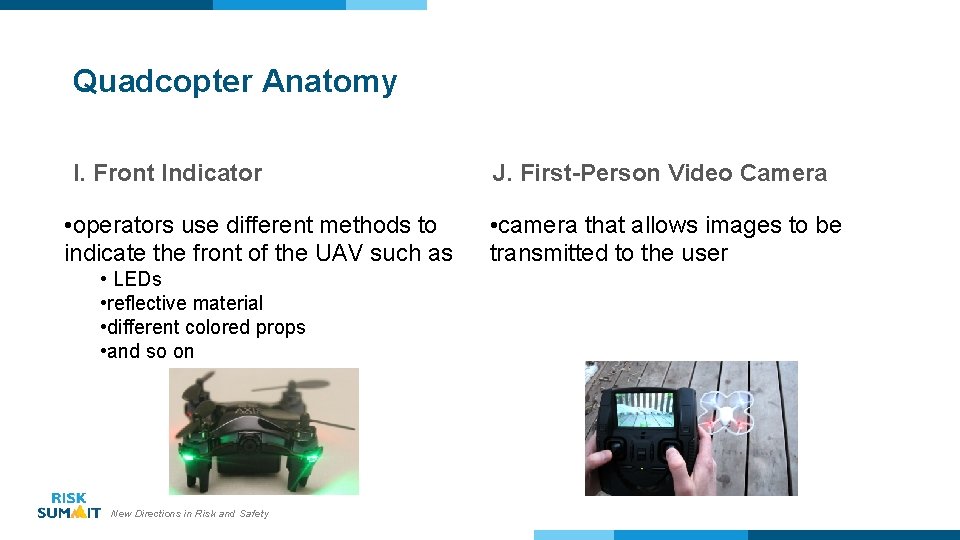
Quadcopter Anatomy I. Front Indicator • operators use different methods to indicate the front of the UAV such as • LEDs • reflective material • different colored props • and so on New Directions in Risk and Safety J. First-Person Video Camera • camera that allows images to be transmitted to the user
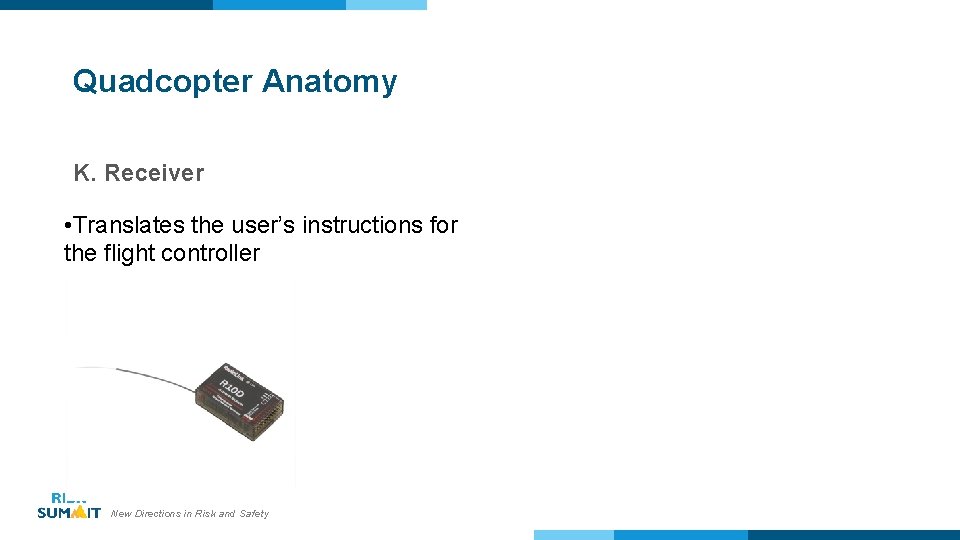
Quadcopter Anatomy K. Receiver • Translates the user’s instructions for the flight controller New Directions in Risk and Safety
Quick Review! • Many drones can be built from a kit of different motors and airframes • Li. Po batteries can explode and pose a minor fire risk • The cost of the drone is fairly split between the • • Batteries ($150 for a good one) Motors ($30 x 4) Flight controller ($60 -$300) Camera gimbal ($60 -250) New Directions in Risk and Safety Kits make it easy to replace parts. Great for the end-user, challenging to keep track of
Inner Electronics of a Drone (What makes the Flight Controller Work) New Directions in Risk and Safety
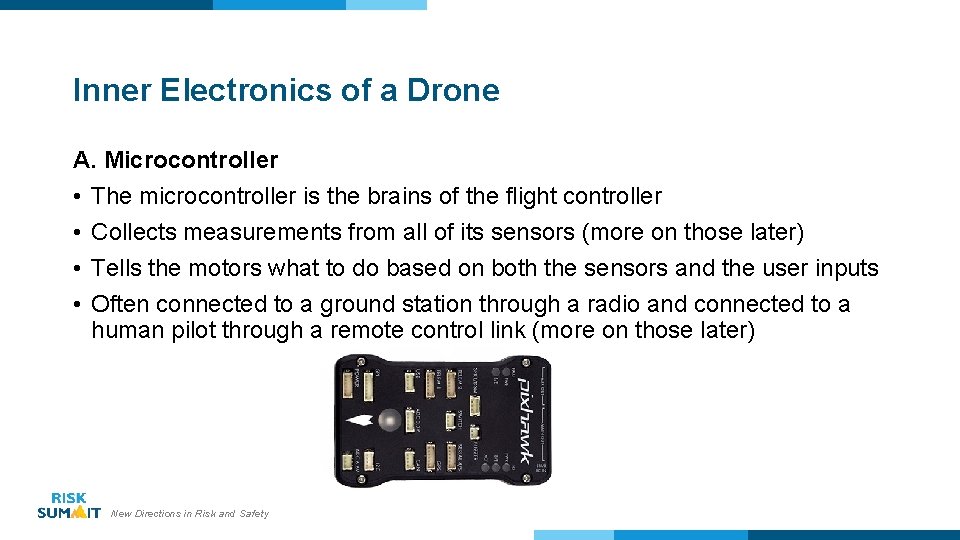
Inner Electronics of a Drone A. Microcontroller • The microcontroller is the brains of the flight controller • Collects measurements from all of its sensors (more on those later) • Tells the motors what to do based on both the sensors and the user inputs • Often connected to a ground station through a radio and connected to a human pilot through a remote control link (more on those later) New Directions in Risk and Safety
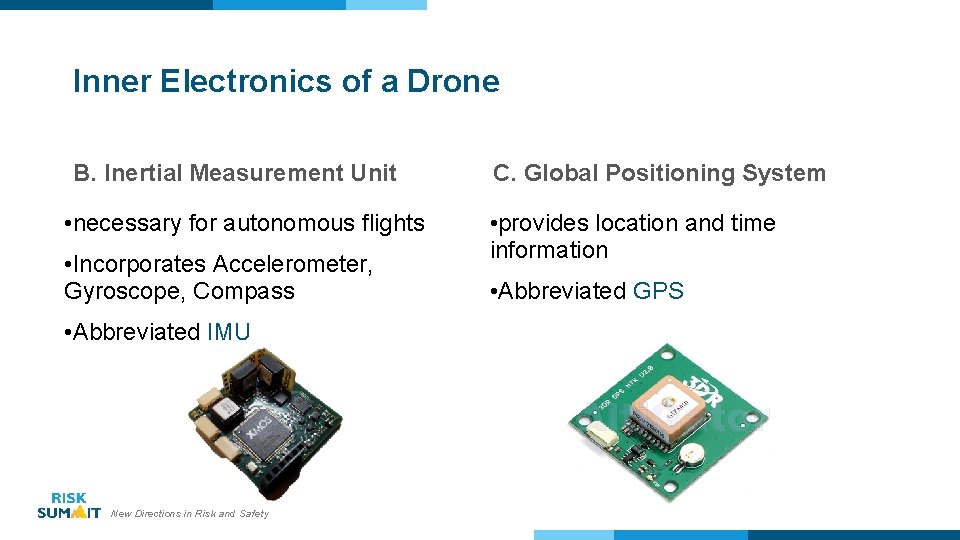
Inner Electronics of a Drone B. Inertial Measurement Unit • necessary for autonomous flights • Incorporates Accelerometer, Gyroscope, Compass • Abbreviated IMU New Directions in Risk and Safety C. Global Positioning System • provides location and time information • Abbreviated GPS
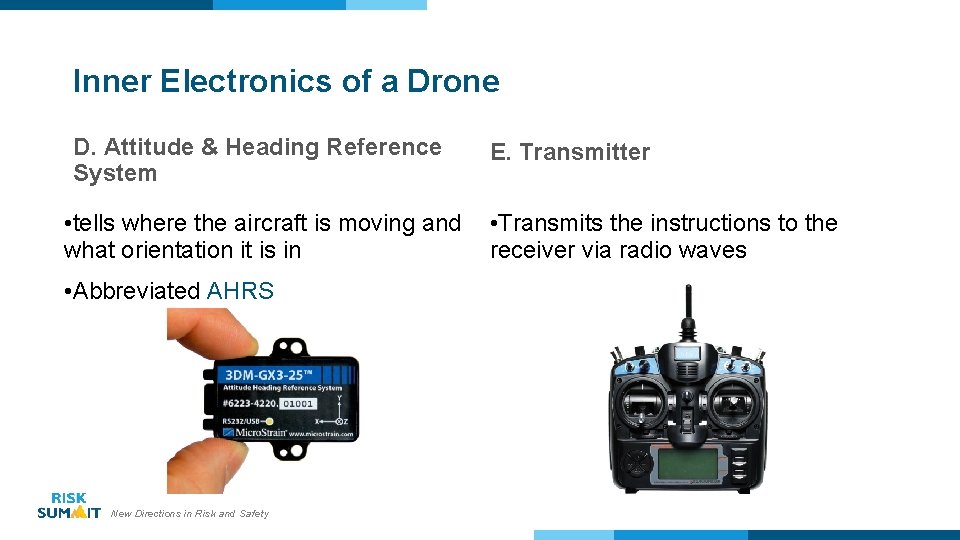
Inner Electronics of a Drone D. Attitude & Heading Reference System • tells where the aircraft is moving and what orientation it is in • Abbreviated AHRS New Directions in Risk and Safety E. Transmitter • Transmits the instructions to the receiver via radio waves
How to Operate a Drone New Directions in Risk and Safety
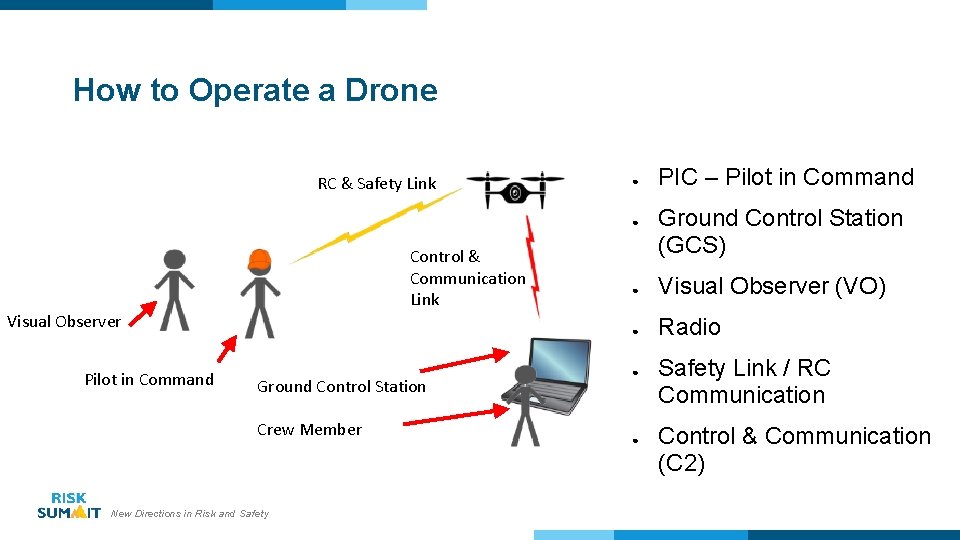
How to Operate a Drone RC & Safety Link ● ● Control & Communication Link Visual Observer Pilot in Command Ground Control Station Crew Member New Directions in Risk and Safety PIC – Pilot in Command Ground Control Station (GCS) ● Visual Observer (VO) ● Radio ● ● Safety Link / RC Communication Control & Communication (C 2)
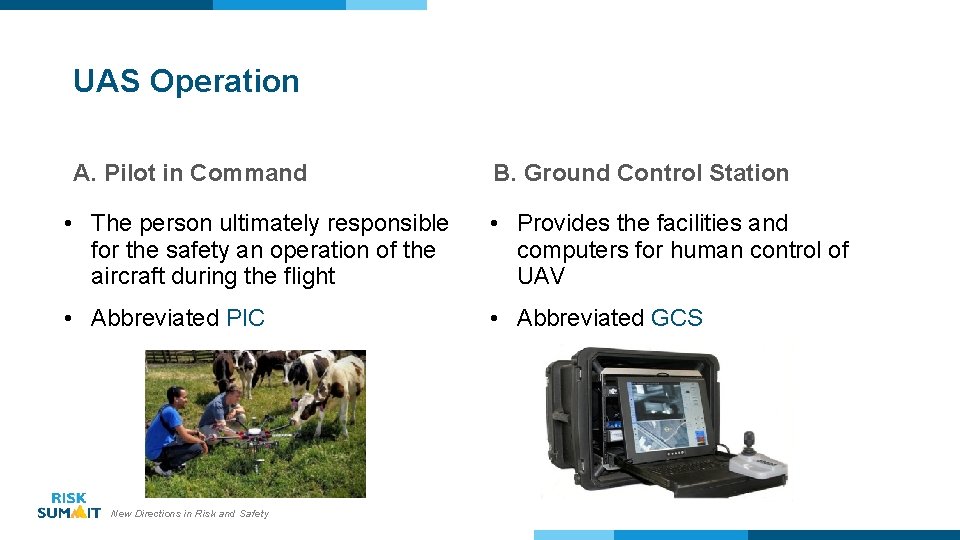
UAS Operation A. Pilot in Command B. Ground Control Station • The person ultimately responsible for the safety an operation of the aircraft during the flight • Provides the facilities and computers for human control of UAV • Abbreviated PIC • Abbreviated GCS New Directions in Risk and Safety
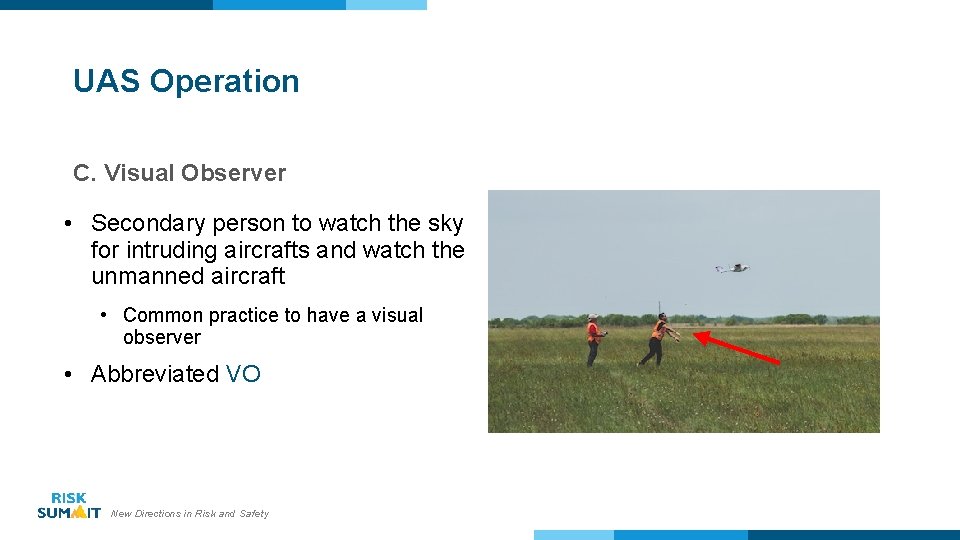
UAS Operation C. Visual Observer • Secondary person to watch the sky for intruding aircrafts and watch the unmanned aircraft • Common practice to have a visual observer • Abbreviated VO New Directions in Risk and Safety
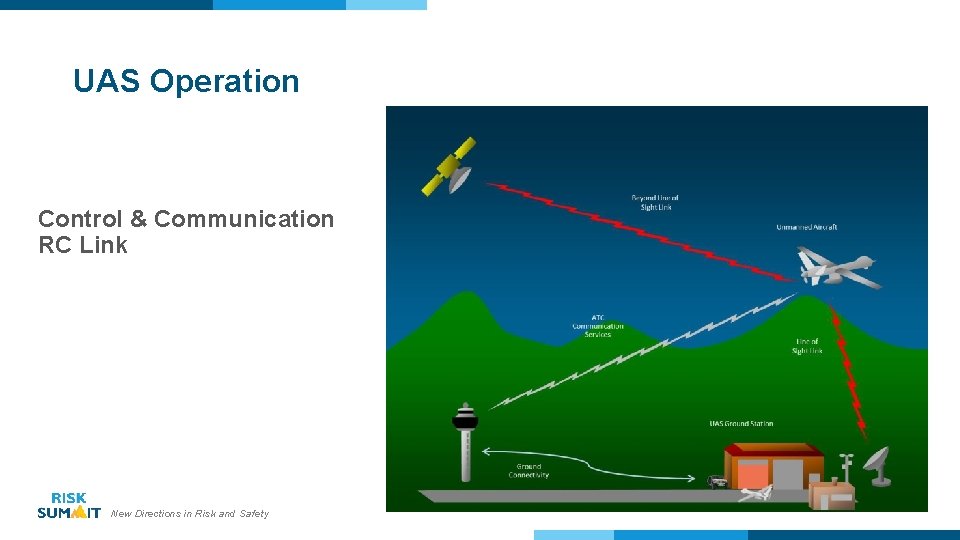
UAS Operation Control & Communication RC Link New Directions in Risk and Safety
UAS Operation E. Control & Communication • Flight controller used for control • Communication between flight controller and ground station typically done by radio • Abbreviated C 2 New Directions in Risk and Safety F. Safety Link & RC Communication • Safety Link typically RC transmitter link • Could also be a different process, such as • Radio signal • Digital wifi • Linked to RC Communication
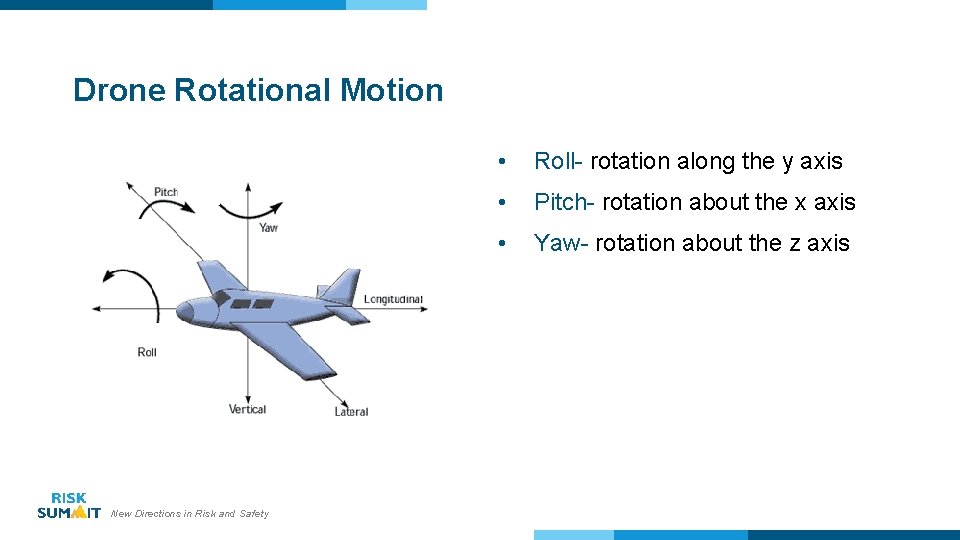
Drone Rotational Motion New Directions in Risk and Safety • Roll- rotation along the y axis • Pitch- rotation about the x axis • Yaw- rotation about the z axis
Common UAS Key Terms (Marketing terms, special features, add-ons) New Directions in Risk and Safety
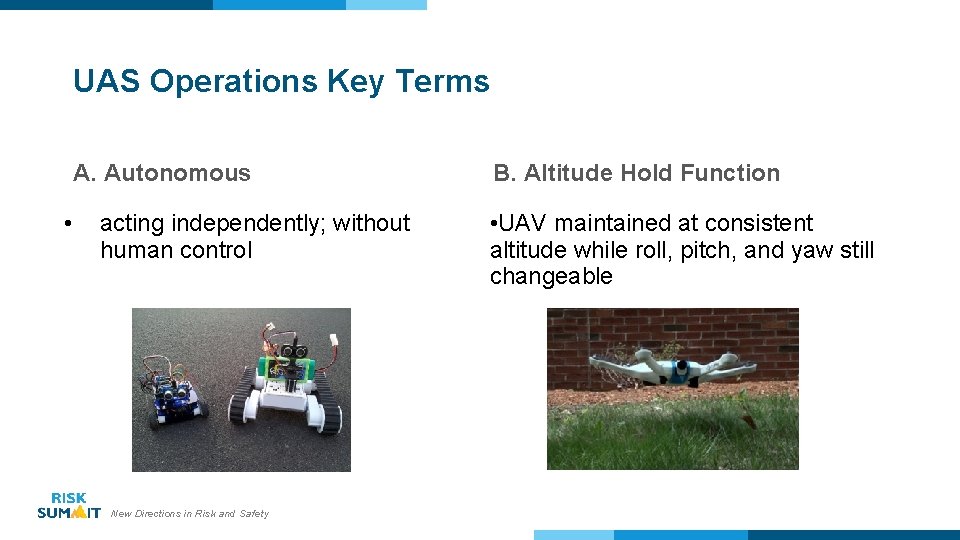
UAS Operations Key Terms A. Autonomous • acting independently; without human control New Directions in Risk and Safety B. Altitude Hold Function • UAV maintained at consistent altitude while roll, pitch, and yaw still changeable
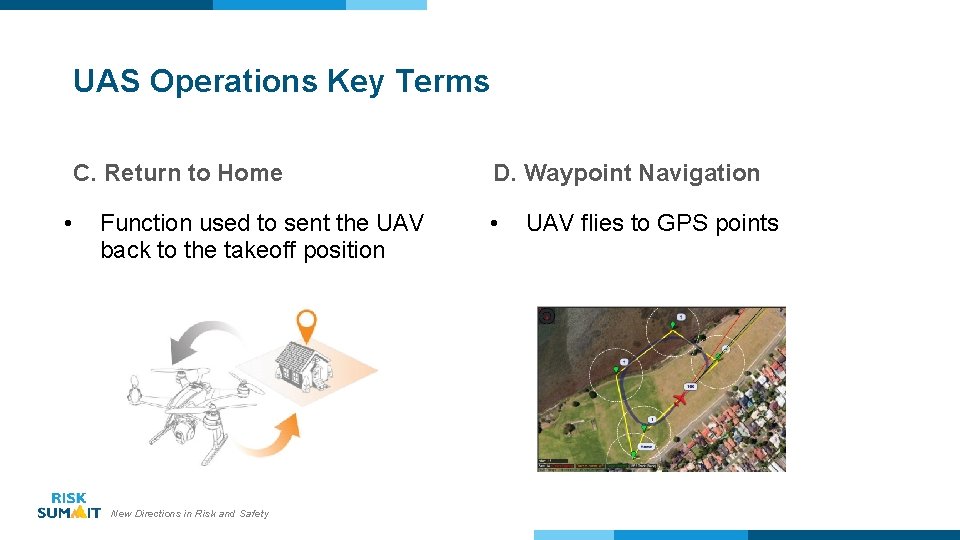
UAS Operations Key Terms C. Return to Home • Function used to sent the UAV back to the takeoff position New Directions in Risk and Safety D. Waypoint Navigation • UAV flies to GPS points
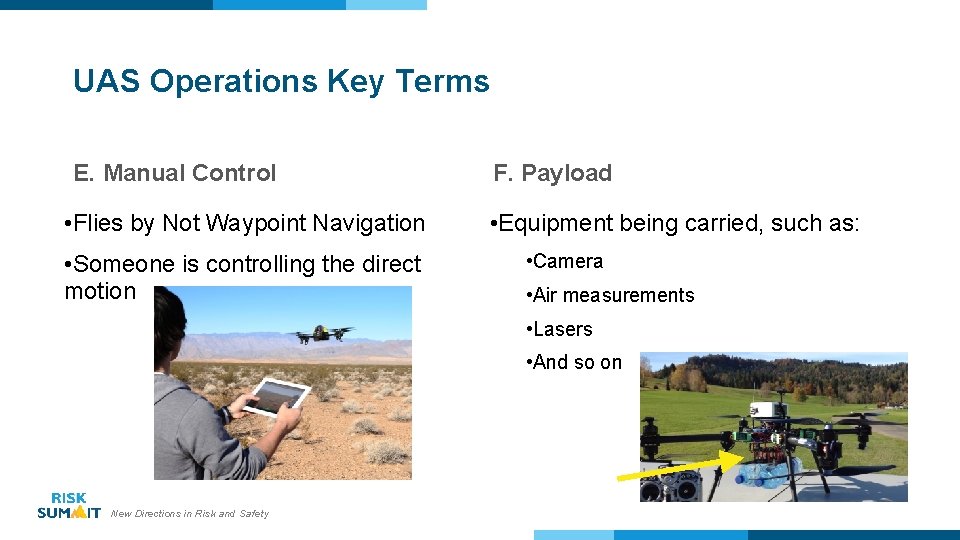
UAS Operations Key Terms E. Manual Control • Flies by Not Waypoint Navigation • Someone is controlling the direct motion F. Payload • Equipment being carried, such as: • Camera • Air measurements • Lasers • And so on New Directions in Risk and Safety
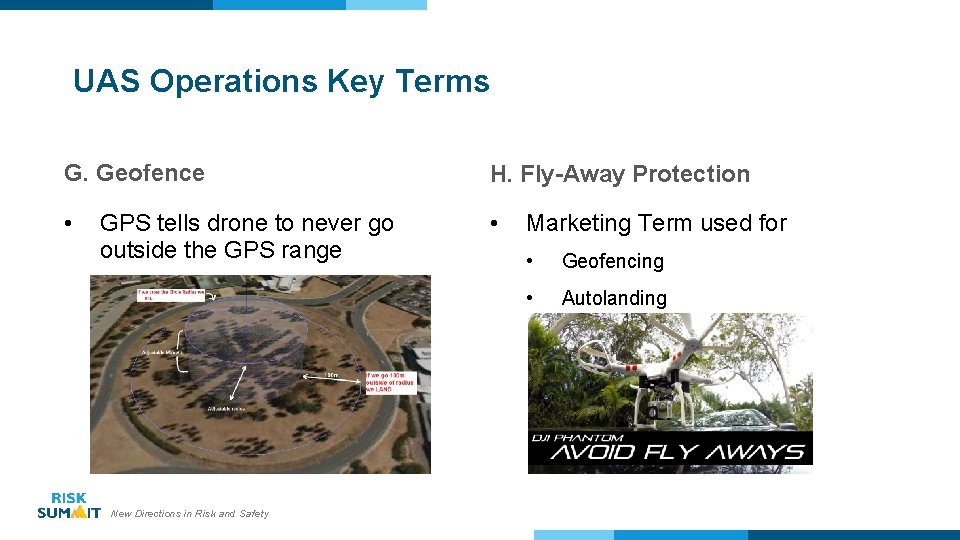
UAS Operations Key Terms G. Geofence H. Fly-Away Protection • • GPS tells drone to never go outside the GPS range New Directions in Risk and Safety Marketing Term used for • Geofencing • Autolanding
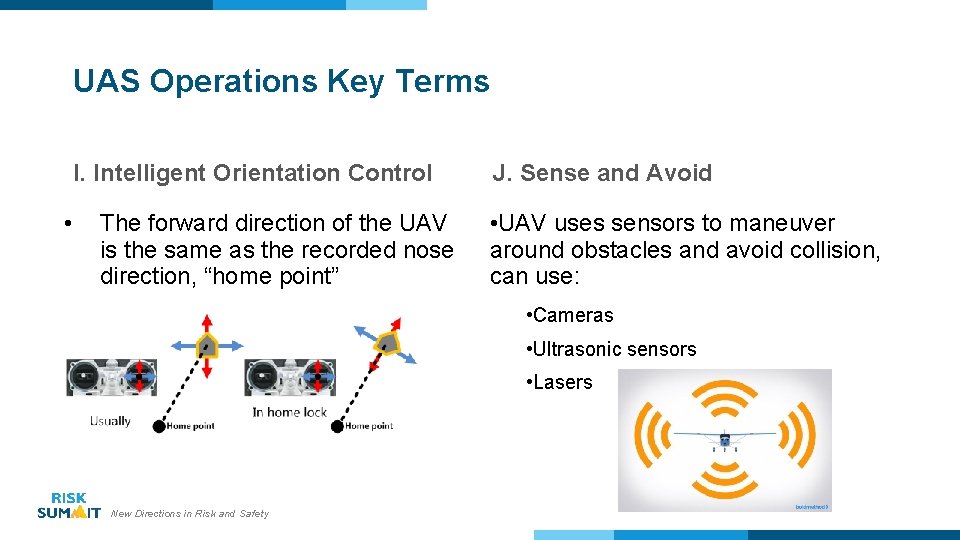
UAS Operations Key Terms I. Intelligent Orientation Control • The forward direction of the UAV is the same as the recorded nose direction, “home point” J. Sense and Avoid • UAV uses sensors to maneuver around obstacles and avoid collision, can use: • Cameras • Ultrasonic sensors • Lasers New Directions in Risk and Safety
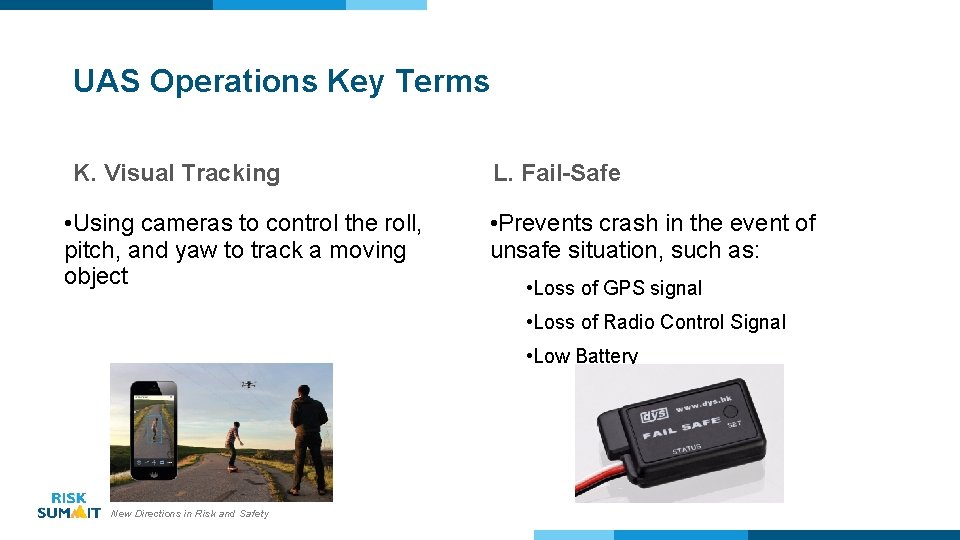
UAS Operations Key Terms K. Visual Tracking • Using cameras to control the roll, pitch, and yaw to track a moving object L. Fail-Safe • Prevents crash in the event of unsafe situation, such as: • Loss of GPS signal • Loss of Radio Control Signal • Low Battery New Directions in Risk and Safety
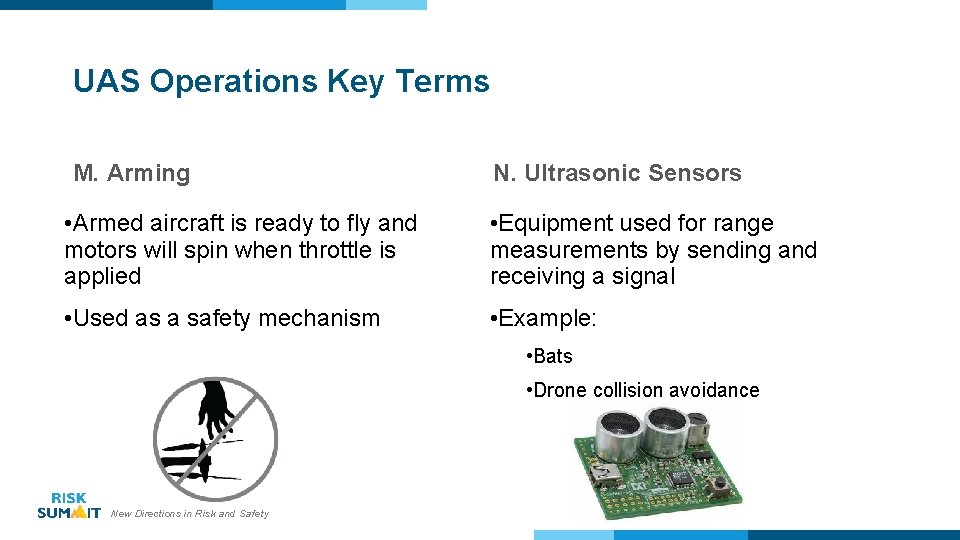
UAS Operations Key Terms M. Arming N. Ultrasonic Sensors • Armed aircraft is ready to fly and motors will spin when throttle is applied • Equipment used for range measurements by sending and receiving a signal • Used as a safety mechanism • Example: • Bats • Drone collision avoidance New Directions in Risk and Safety
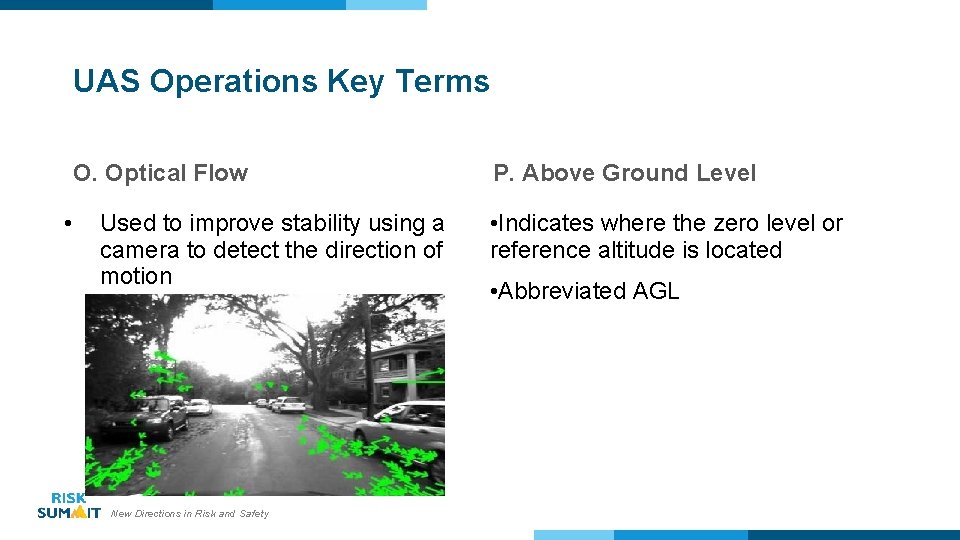
UAS Operations Key Terms O. Optical Flow • Used to improve stability using a camera to detect the direction of motion New Directions in Risk and Safety P. Above Ground Level • Indicates where the zero level or reference altitude is located • Abbreviated AGL
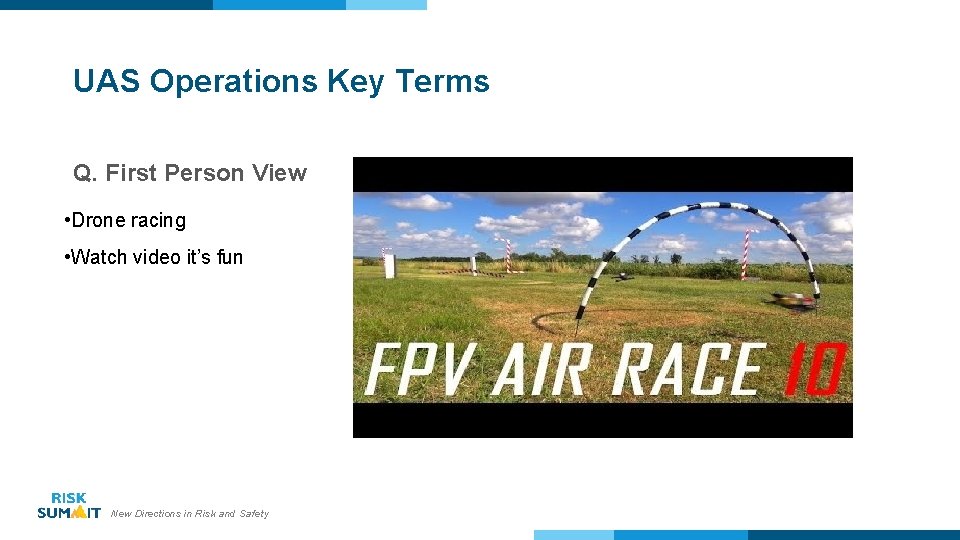
UAS Operations Key Terms Q. First Person View • Drone racing • Watch video it’s fun New Directions in Risk and Safety
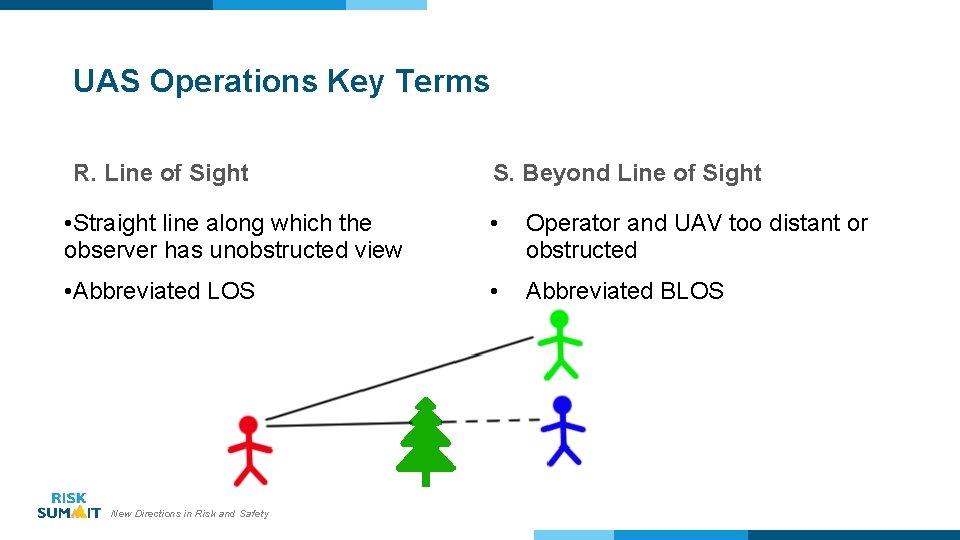
UAS Operations Key Terms R. Line of Sight S. Beyond Line of Sight • Straight line along which the observer has unobstructed view • Operator and UAV too distant or obstructed • Abbreviated LOS • Abbreviated BLOS New Directions in Risk and Safety
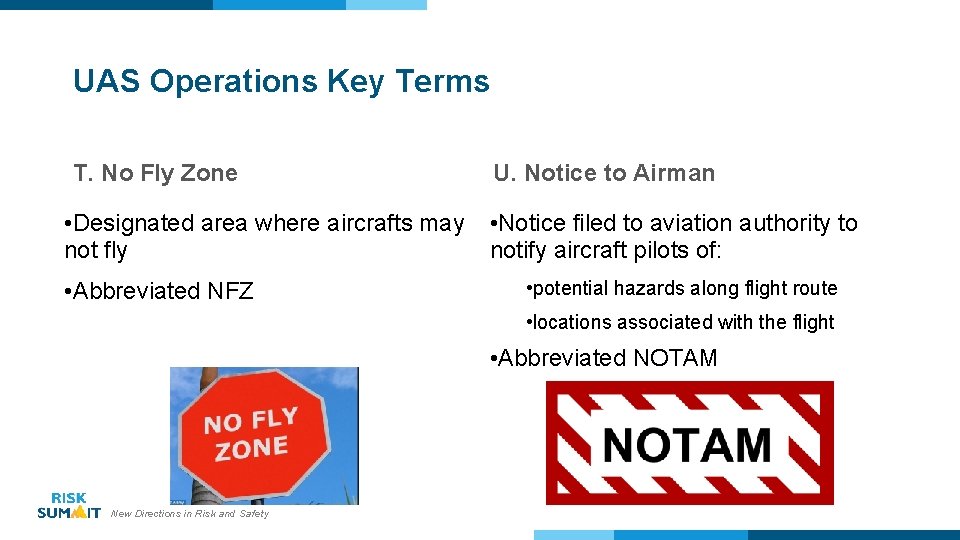
UAS Operations Key Terms T. No Fly Zone • Designated area where aircrafts may not fly • Abbreviated NFZ U. Notice to Airman • Notice filed to aviation authority to notify aircraft pilots of: • potential hazards along flight route • locations associated with the flight • Abbreviated NOTAM New Directions in Risk and Safety
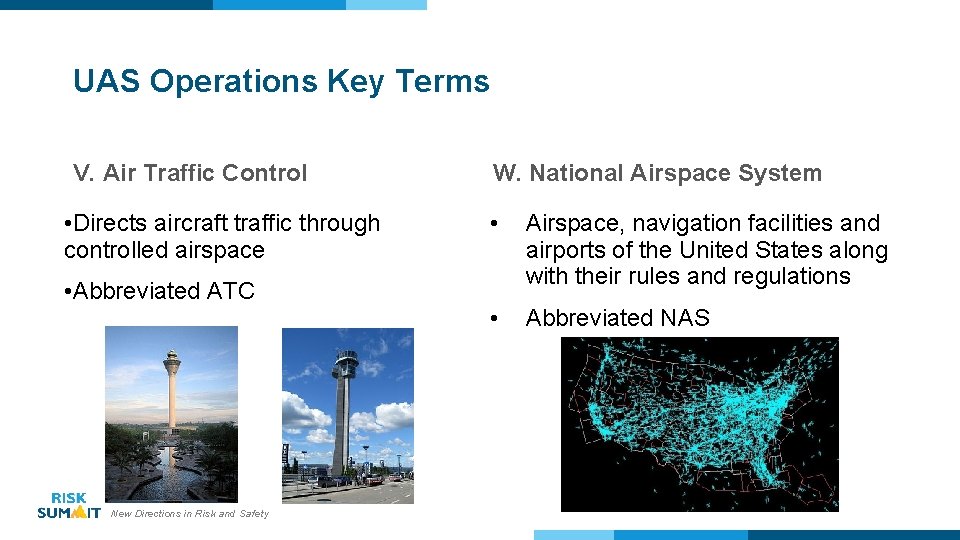
UAS Operations Key Terms V. Air Traffic Control • Directs aircraft traffic through controlled airspace • Abbreviated ATC New Directions in Risk and Safety W. National Airspace System • Airspace, navigation facilities and airports of the United States along with their rules and regulations • Abbreviated NAS
UAS Operations Key Terms X. Total Flight Restriction • Occurs when the FAA shuts down airspace • Announced by FAA • Cannot be requested • Can occur at times of • Large stadium events • President arriving in a city • And so forth New Directions in Risk and Safety

What Can Go Wrong? New Directions in Risk and Safety
Things That Go Wrong • Pilot Error! • Too windy • Loss of communication • Fly-away – Automated system error • Loss of GPS • Loss of Altitude (IMU failure) New Directions in Risk and Safety
Videos of Drones Crashing! New Directions in Risk and Safety
Contact Page Email: bstark 2@ucmerced. edu UASSafety@ucmerced. edu http: //tinyurl. com/UC-UAS-COE http: //uassafety. ucmerced. edu/ Phone: (209) 201 - 2051 New Directions in Risk and Safety Facebook page: TBA Twitter account: TBA
- Slides: 76