
The Alliance for Child Protection in Humanitarian Action
- Slides: 14
The Alliance for Child Protection in Humanitarian Action STRENGTHENING COMMUNITY BASED CHILD PROTECTION IN HUMANITARIAN SETTINGS AN INITIATIVE FROM THE CBCP IN EMERGENCIES TASK FORCE February 2 0 18 | Webinar
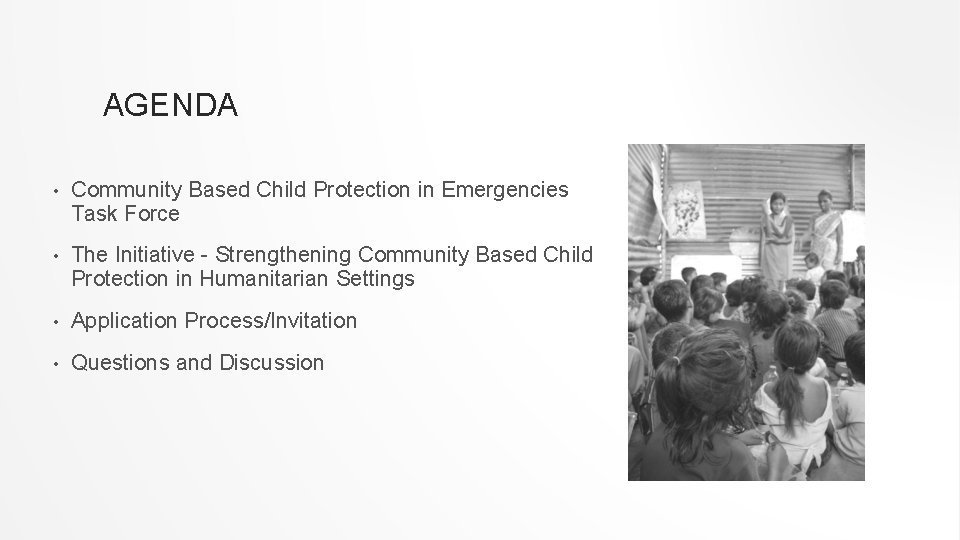
AGENDA • Community Based Child Protection in Emergencies Task Force • The Initiative - Strengthening Community Based Child Protection in Humanitarian Settings • Application Process/Invitation • Questions and Discussion
COMMUNITY BASED CHILD PROTECTION IN EMERGENCIES TASK FORCE (CBCP TF) In 2015, an annual face to face meeting of the Child Protection Working Group (what has now evolved into two entities: the Alliance for Child Protection in Humanitarian Action and Child Protection Area of Responsibility). At this meeting, the following aspects of CBCP was discussed at length: • An evaluation of current practices across contexts in 2009 and 2012 confirmed that humanitarian actors often use a top down approach (ex: Child Protection Committees) which break down after the agency leaves or funding is gone • Practitioners expressed a lack of access to guidance and tools to improve practices • The need for more coordinated interagency efforts towards strengthening CBCP work was recognized
COMMUNITY BASED CHILD PROTECTION IN EMERGENCIES TASK FORCE (CBCP TF) • In 2016, the Community-Based Child Protection in Emergencies Task Force (CBCP TF) was formed to address this gap. • The CBCP TF is co-led by Plan International, World Vision International, and UNICEF and has over 20 members organizations* • The main objectives of the CBCP TF remain to collect evidence and lessons learned, develop guidance and facilitate research, and to strengthen learning and knowledge-sharing among practitioners, donors, academics, other initiatives
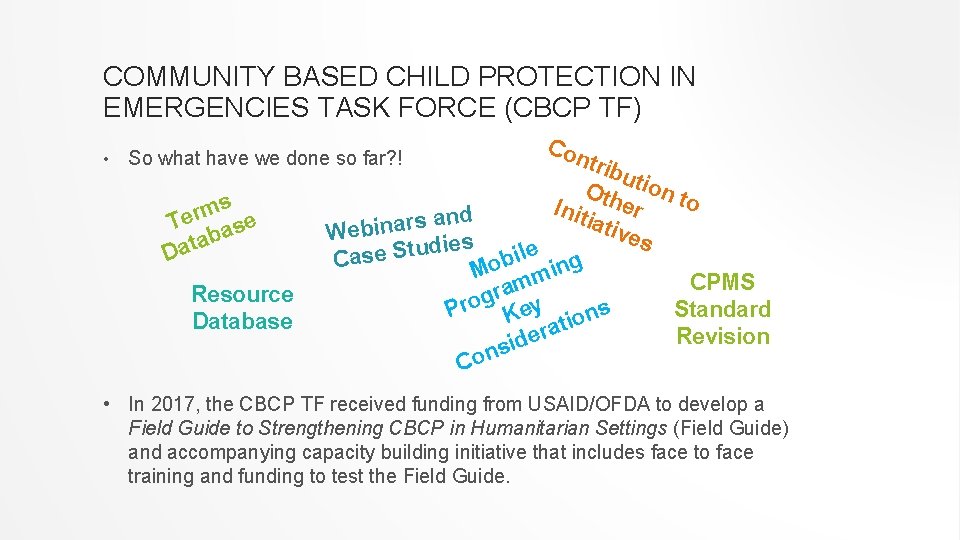
COMMUNITY BASED CHILD PROTECTION IN EMERGENCIES TASK FORCE (CBCP TF) • Con trib utio Oth n to e Init r d n a i ativ s Webinar ies es d u le g i b Case St Mo min CPMS m a r g Standard Pro Key ions t era Revision d i s Con So what have we done so far? ! s m Ter ase ab t a D Resource Database • In 2017, the CBCP TF received funding from USAID/OFDA to develop a Field Guide to Strengthening CBCP in Humanitarian Settings (Field Guide) and accompanying capacity building initiative that includes face to face training and funding to test the Field Guide.
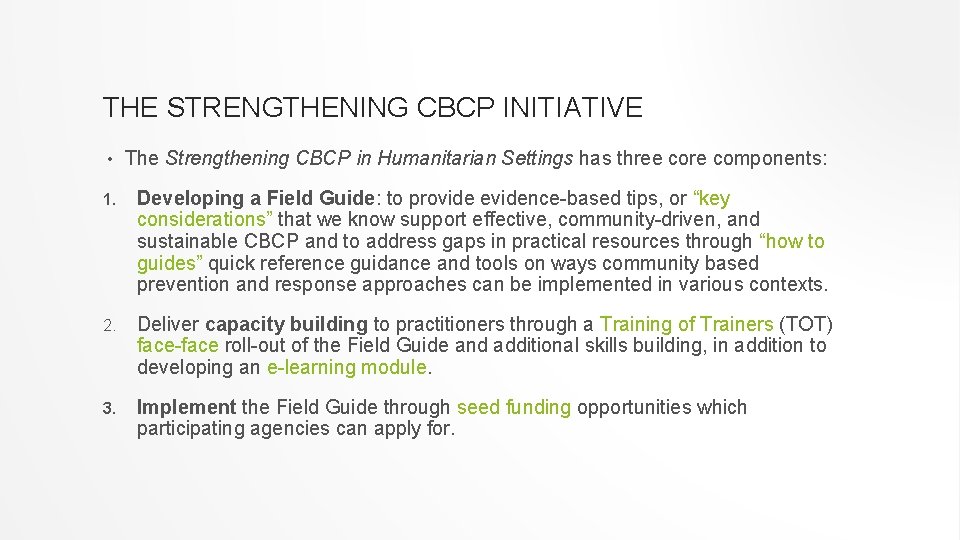
THE STRENGTHENING CBCP INITIATIVE • The Strengthening CBCP in Humanitarian Settings has three core components: 1. Developing a Field Guide: to provide evidence-based tips, or “key considerations” that we know support effective, community-driven, and sustainable CBCP and to address gaps in practical resources through “how to guides” quick reference guidance and tools on ways community based prevention and response approaches can be implemented in various contexts. 2. Deliver capacity building to practitioners through a Training of Trainers (TOT) face-face roll-out of the Field Guide and additional skills building, in addition to developing an e-learning module. 3. Implement the Field Guide through seed funding opportunities which participating agencies can apply for.
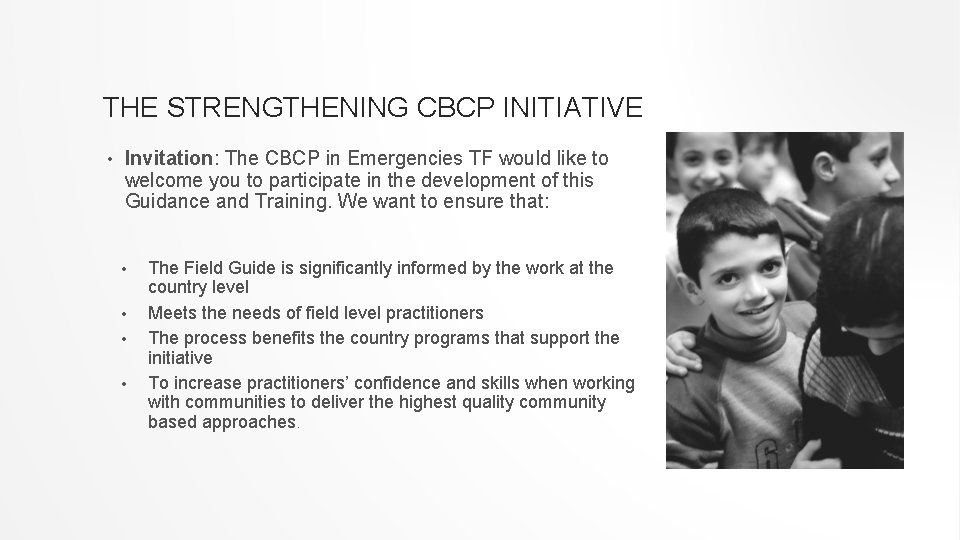
THE STRENGTHENING CBCP INITIATIVE • Invitation: The CBCP in Emergencies TF would like to welcome you to participate in the development of this Guidance and Training. We want to ensure that: • • The Field Guide is significantly informed by the work at the country level Meets the needs of field level practitioners The process benefits the country programs that support the initiative To increase practitioners’ confidence and skills when working with communities to deliver the highest quality community based approaches.
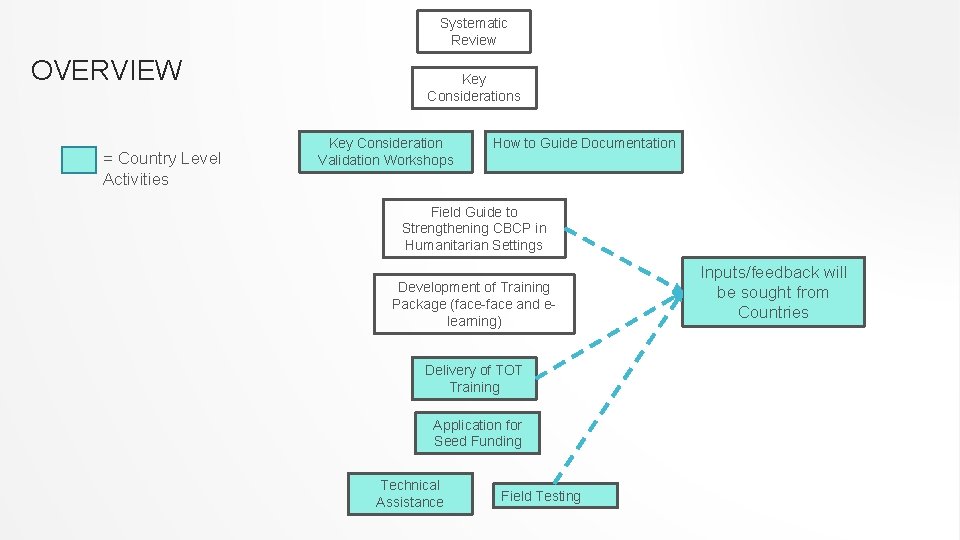
Systematic Review OVERVIEW = Country Level Activities Key Consideration Validation Workshops How to Guide Documentation Field Guide to Strengthening CBCP in Humanitarian Settings Development of Training Package (face-face and elearning) Delivery of TOT Training Application for Seed Funding Technical Assistance Field Testing Inputs/feedback will be sought from Countries
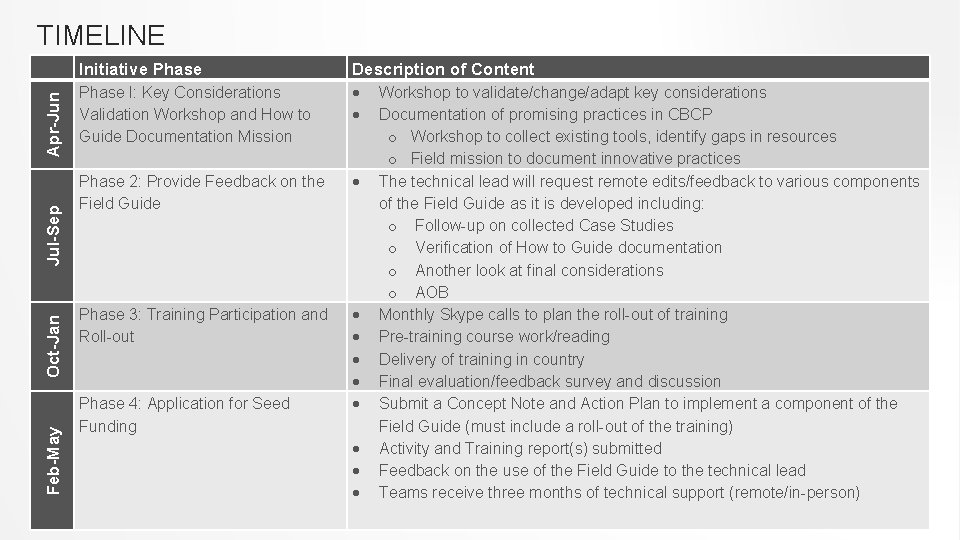
TIMELINE Feb-May Oct-Jan Jul-Sep Apr-Jun Initiative Phase I: Key Considerations Validation Workshop and How to Guide Documentation Mission Phase 2: Provide Feedback on the Field Guide Phase 3: Training Participation and Roll-out Phase 4: Application for Seed Funding Description of Content Workshop to validate/change/adapt key considerations Documentation of promising practices in CBCP o Workshop to collect existing tools, identify gaps in resources o Field mission to document innovative practices The technical lead will request remote edits/feedback to various components of the Field Guide as it is developed including: o Follow-up on collected Case Studies o Verification of How to Guide documentation o Another look at final considerations o AOB Monthly Skype calls to plan the roll-out of training Pre-training course work/reading Delivery of training in country Final evaluation/feedback survey and discussion Submit a Concept Note and Action Plan to implement a component of the Field Guide (must include a roll-out of the training) Activity and Training report(s) submitted Feedback on the use of the Field Guide to the technical lead Teams receive three months of technical support (remote/in-person)
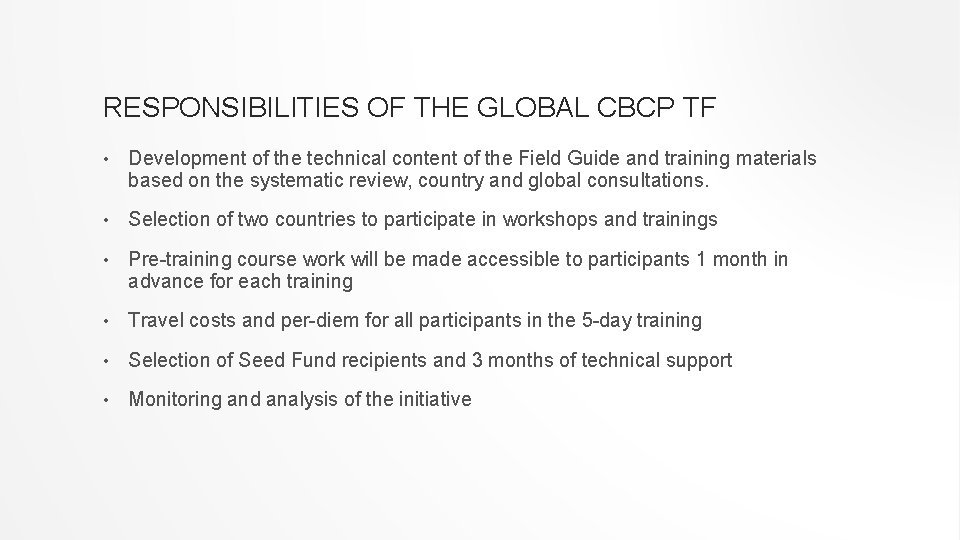
RESPONSIBILITIES OF THE GLOBAL CBCP TF • Development of the technical content of the Field Guide and training materials based on the systematic review, country and global consultations. • Selection of two countries to participate in workshops and trainings • Pre-training course work will be made accessible to participants 1 month in advance for each training • Travel costs and per-diem for all participants in the 5 -day training • Selection of Seed Fund recipients and 3 months of technical support • Monitoring and analysis of the initiative
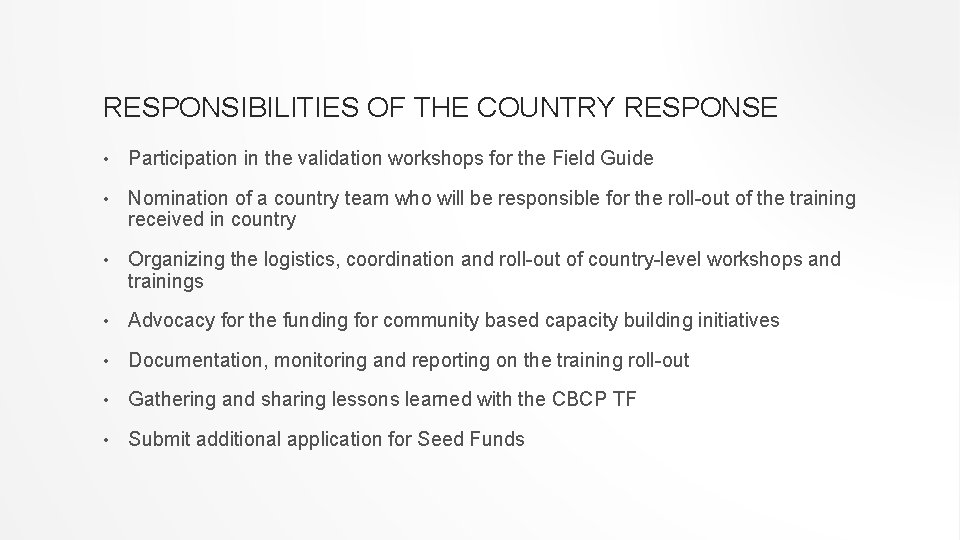
RESPONSIBILITIES OF THE COUNTRY RESPONSE • Participation in the validation workshops for the Field Guide • Nomination of a country team who will be responsible for the roll-out of the training received in country • Organizing the logistics, coordination and roll-out of country-level workshops and trainings • Advocacy for the funding for community based capacity building initiatives • Documentation, monitoring and reporting on the training roll-out • Gathering and sharing lessons learned with the CBCP TF • Submit additional application for Seed Funds
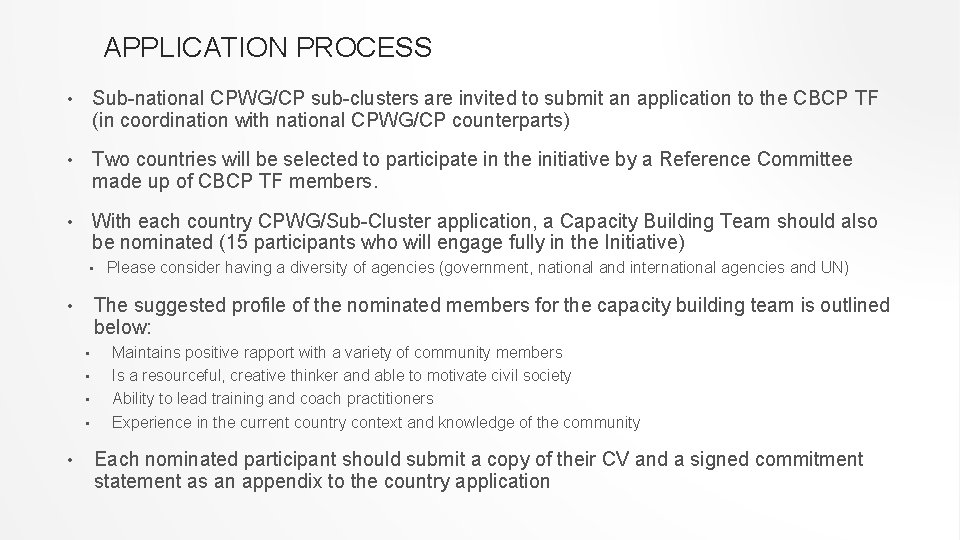
APPLICATION PROCESS • Sub-national CPWG/CP sub-clusters are invited to submit an application to the CBCP TF (in coordination with national CPWG/CP counterparts) • Two countries will be selected to participate in the initiative by a Reference Committee made up of CBCP TF members. • With each country CPWG/Sub-Cluster application, a Capacity Building Team should also be nominated (15 participants who will engage fully in the Initiative) • The suggested profile of the nominated members for the capacity building team is outlined below: • • • Please consider having a diversity of agencies (government, national and international agencies and UN) Maintains positive rapport with a variety of community members Is a resourceful, creative thinker and able to motivate civil society Ability to lead training and coach practitioners Experience in the current country context and knowledge of the community Each nominated participant should submit a copy of their CV and a signed commitment statement as an appendix to the country application
ELIGIBILITY CRITERIA Required: • Have active sub-national groups that: 1) meet once/month, 2) have at least 10 organizations that attend regularly 3) have strong leadership 4) 50% of membership are national civil society groups/government • The availability of a host agency, who has the interest, staff capacity and time to fulfill the planned activities • Can demonstrate the existence of effective or impactful Community-based Child Protection interventions • Child Protection Working Group/Sub-Cluster has prioritized CBCP in the strategy/work plan and/or there is a clear interest in investing further in community engagement/services in their country response Preferred: • Existence of innovative CBCP interventions and/or tools and resources that have been developed or adapted • Have an existing Task Force/Sub-Group on CBCP
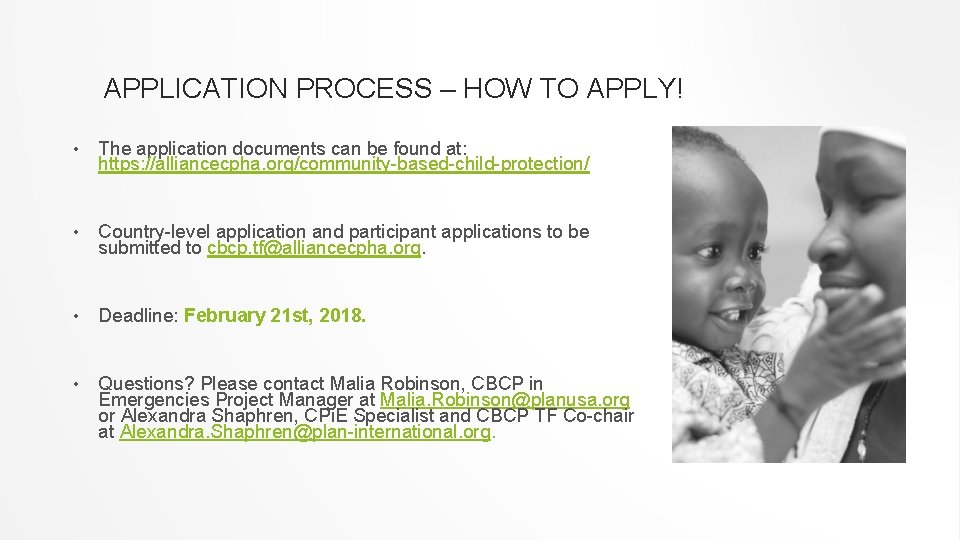
APPLICATION PROCESS – HOW TO APPLY! • The application documents can be found at: https: //alliancecpha. org/community-based-child-protection/ • Country-level application and participant applications to be submitted to cbcp. tf@alliancecpha. org. • Deadline: February 21 st, 2018. • Questions? Please contact Malia Robinson, CBCP in Emergencies Project Manager at Malia. Robinson@planusa. org or Alexandra Shaphren, CPi. E Specialist and CBCP TF Co-chair at Alexandra. Shaphren@plan-international. org.