
The ALICE Time Projection Chamber the Worlds largest
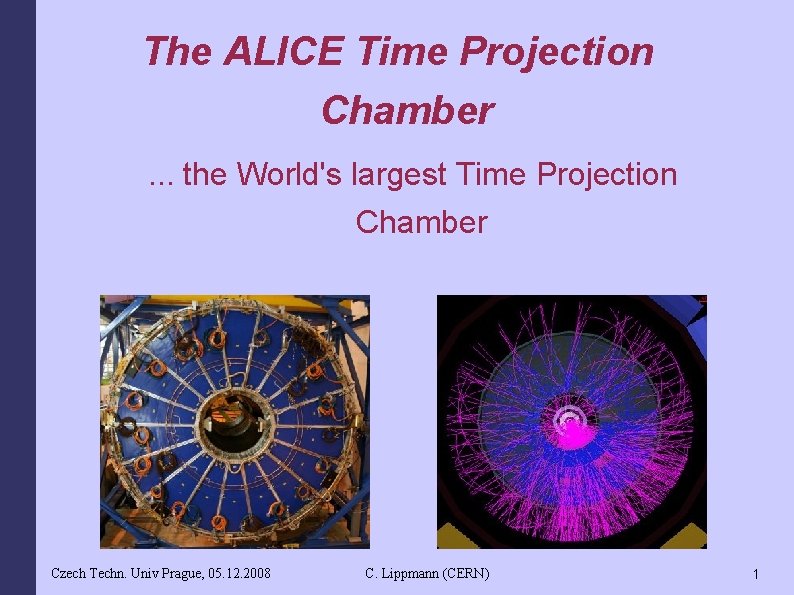
The ALICE Time Projection Chamber. . . the World's largest Time Projection Chamber Czech Techn. Univ Prague, 05. 12. 2008 C. Lippmann (CERN) 1

Outline § Time Projection Chambers § Introduction § Coordinate Measurement and Limitations § Particle Identification (d. E/dx) § TPCs for Heavy Ion Experiments § The ALICE TPC § ALICE Experiment § Construction § Gas Choice § Read Out Electronics § Calibration § Performance § Summary Czech Techn. Univ Prague, 05. 12. 2008 C. Lippmann (CERN) 2
Detector Physics for TPCs 1) Gas Ionisation by Charged Particles, 2) Electron Drift and Diffusion in Gases, 3) Ionisation Amplification (at Anode Wires), 4) Signal Creation (Induction), 5) Signal Processing in Readout Electronics, 6) Coordinate Measurement, 7) Ion gates. 8) All points are described in great detail in e. g. 9) [Blum, Riegler, Rolandi, Particle Detection with Drift Chambers, 10) Second Edition, Springer, 2008] Czech Techn. Univ Prague, 05. 12. 2008 C. Lippmann (CERN) 3
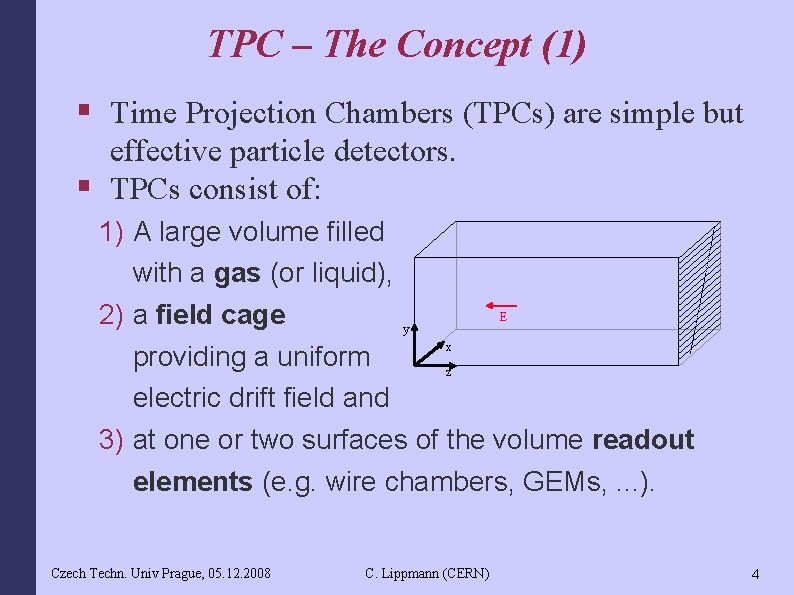
TPC – The Concept (1) § Time Projection Chambers (TPCs) are simple but effective particle detectors. § TPCs consist of: 1) A large volume filled with a gas (or liquid), E 2) a field cage y x providing a uniform z electric drift field and 3) at one or two surfaces of the volume readout elements (e. g. wire chambers, GEMs, . . . ). Czech Techn. Univ Prague, 05. 12. 2008 C. Lippmann (CERN) 4
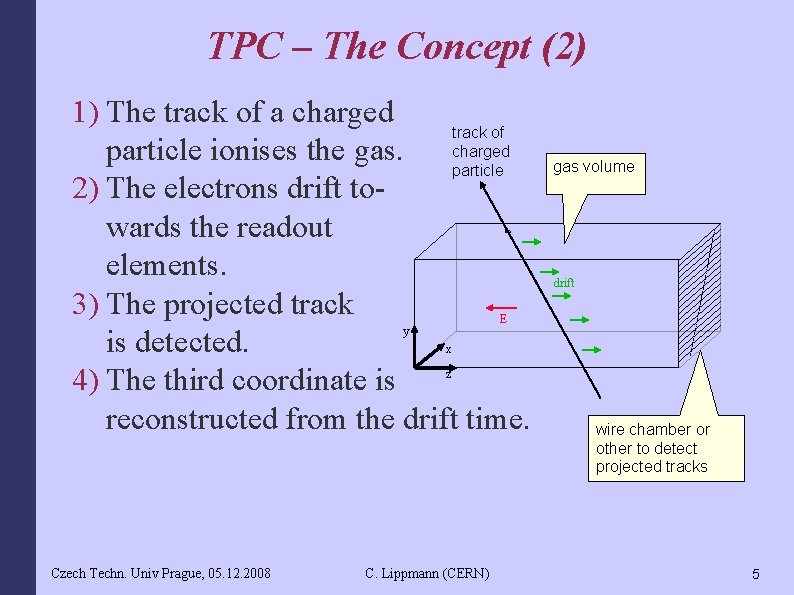
TPC – The Concept (2) 1) The track of a charged track of charged particle ionises the gas. particle 2) The electrons drift towards the readout elements. 3) The projected track is detected. 4) The third coordinate is reconstructed from the drift time. gas volume drift E y x z Czech Techn. Univ Prague, 05. 12. 2008 C. Lippmann (CERN) wire chamber or other to detect projected tracks 5
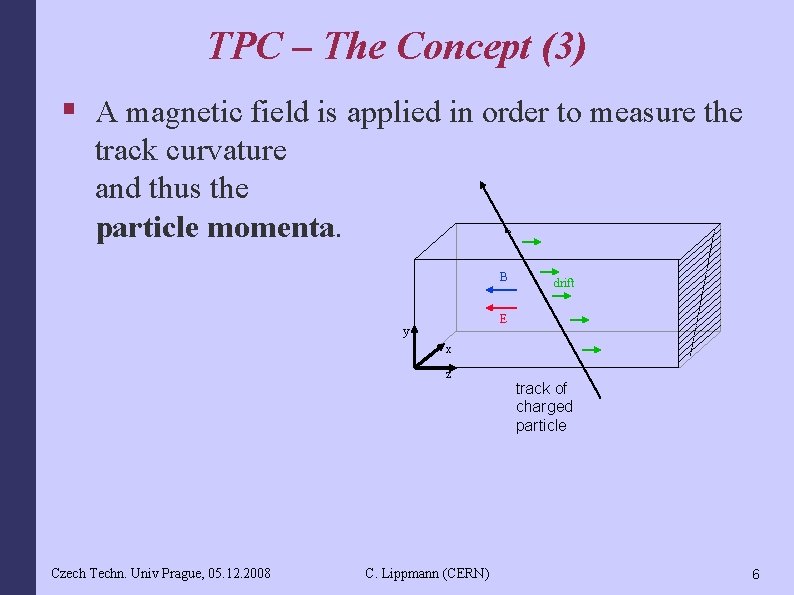
TPC – The Concept (3) § A magnetic field is applied in order to measure the track curvature and thus the particle momenta. B drift E y x z Czech Techn. Univ Prague, 05. 12. 2008 C. Lippmann (CERN) track of charged particle 6
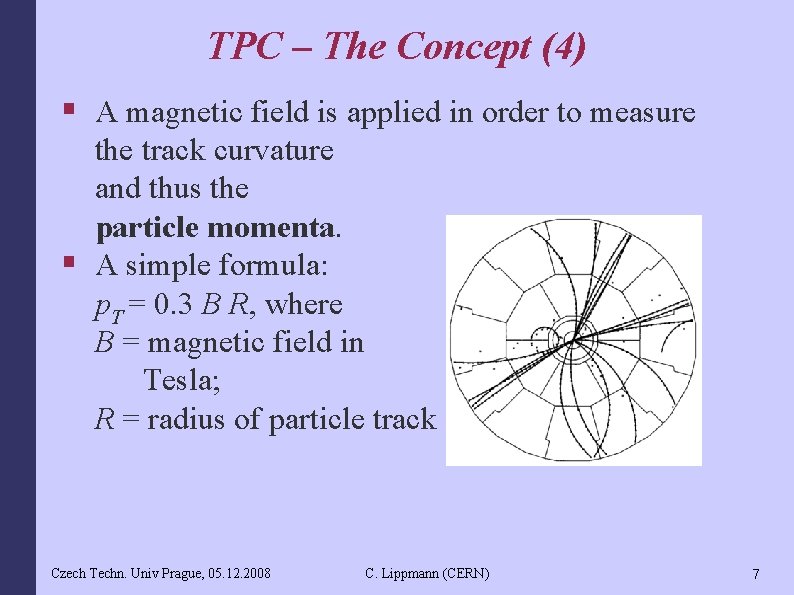
TPC – The Concept (4) § A magnetic field is applied in order to measure the track curvature and thus the particle momenta. § A simple formula: p. T = 0. 3 B R, where B = magnetic field in Tesla; R = radius of particle track in m. Czech Techn. Univ Prague, 05. 12. 2008 C. Lippmann (CERN) 7
What is special about TPCs? § Abilities: § 3 D coordinate measurement: Tracking of charged particles in high track density environments and § PID: Particle Identification through their ionisation energy loss (d. E/dx). § Advantages: § Low amount of material leads to low multiple scattering of particles. § Easy pattern recognition (continuous tracks). Czech Techn. Univ Prague, 05. 12. 2008 C. Lippmann (CERN) 8
Coordinate Measurement with TPCs Czech Techn. Univ Prague, 05. 12. 2008 C. Lippmann (CERN) 9
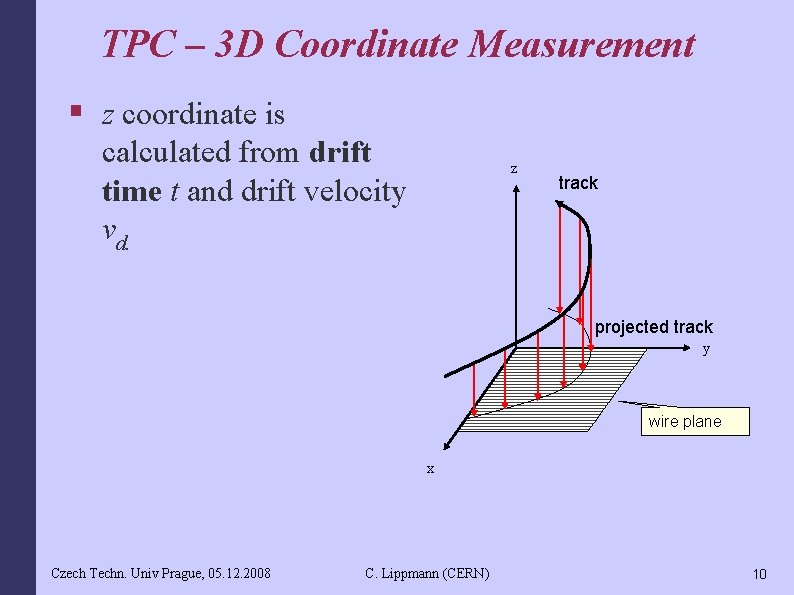
TPC – 3 D Coordinate Measurement § z coordinate is calculated from drift time t and drift velocity vd. z track projected track y wire plane x Czech Techn. Univ Prague, 05. 12. 2008 C. Lippmann (CERN) 10
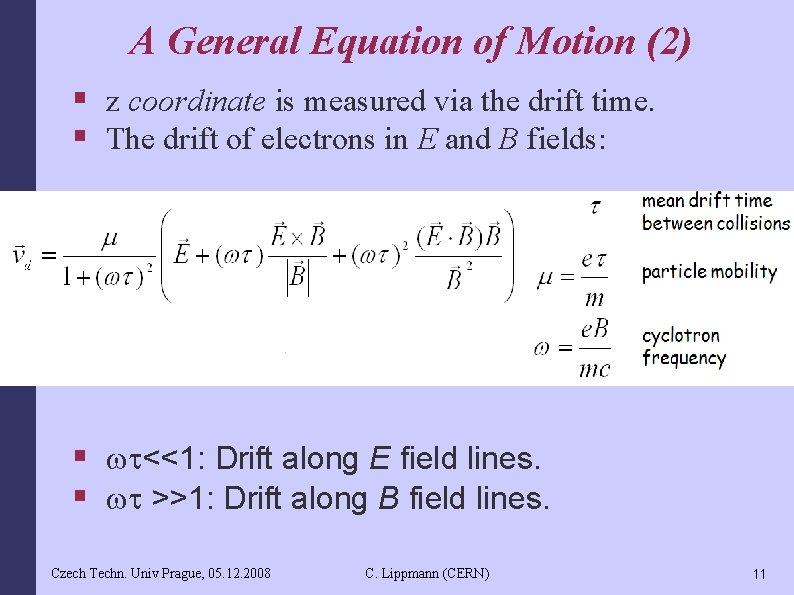
A General Equation of Motion (2) § z coordinate is measured via the drift time. § The drift of electrons in E and B fields: § <<1: Drift along E field lines. § >>1: Drift along B field lines. Czech Techn. Univ Prague, 05. 12. 2008 C. Lippmann (CERN) 11
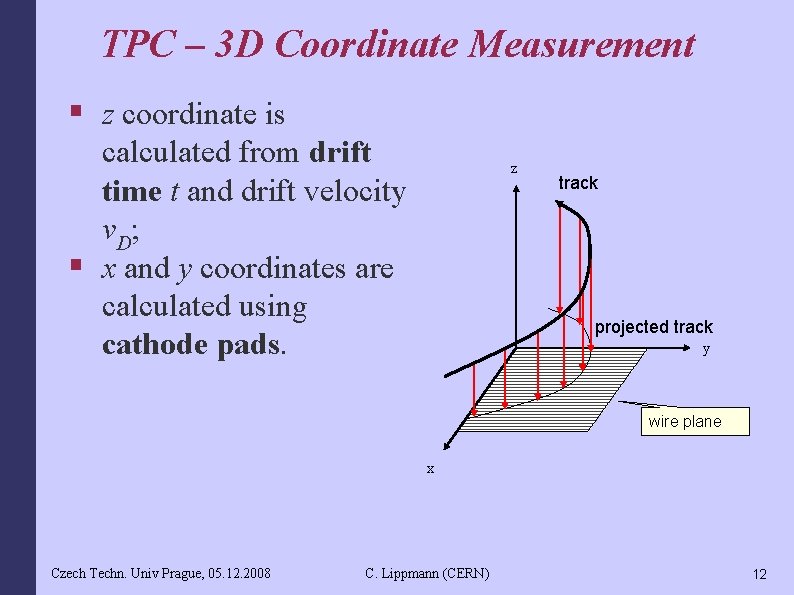
TPC – 3 D Coordinate Measurement § z coordinate is calculated from drift time t and drift velocity v D; § x and y coordinates are calculated using cathode pads. z track projected track y wire plane x Czech Techn. Univ Prague, 05. 12. 2008 C. Lippmann (CERN) 12
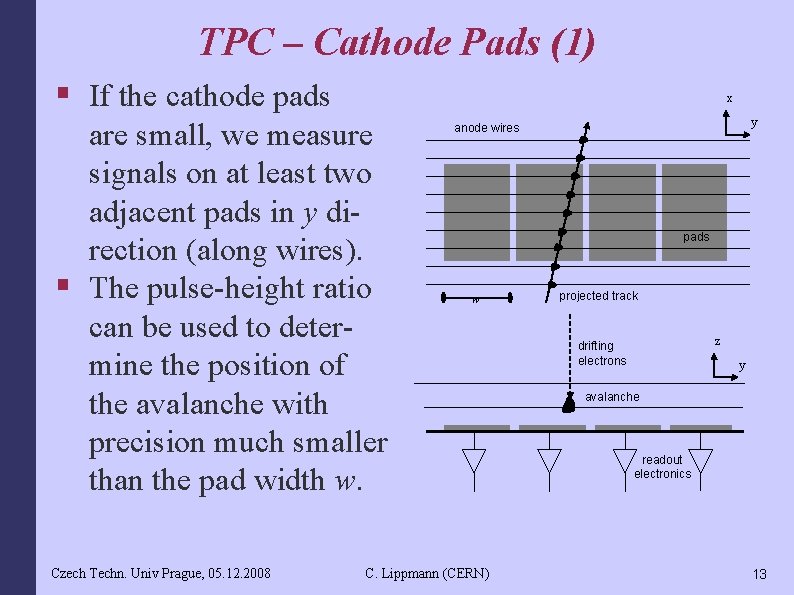
TPC – Cathode Pads (1) § If the cathode pads x are small, we measure signals on at least two adjacent pads in y direction (along wires). § The pulse-height ratio can be used to determine the position of the avalanche with precision much smaller than the pad width w. Czech Techn. Univ Prague, 05. 12. 2008 y anode wires pads w C. Lippmann (CERN) projected track z drifting electrons y avalanche readout electronics 13
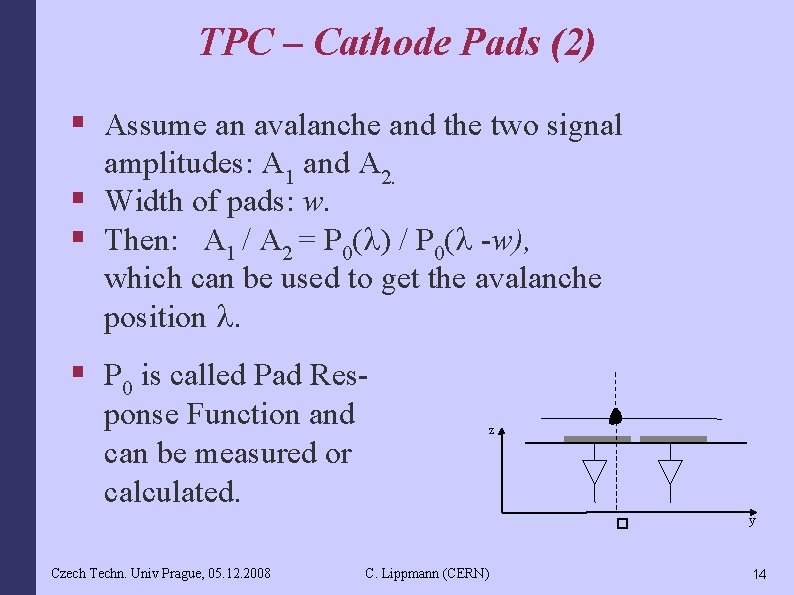
TPC – Cathode Pads (2) § Assume an avalanche and the two signal amplitudes: A 1 and A 2. § Width of pads: w. § Then: A 1 / A 2 = P 0( ) / P 0( -w), which can be used to get the avalanche position . § P 0 is called Pad Response Function and can be measured or calculated. z � Czech Techn. Univ Prague, 05. 12. 2008 C. Lippmann (CERN) y 14
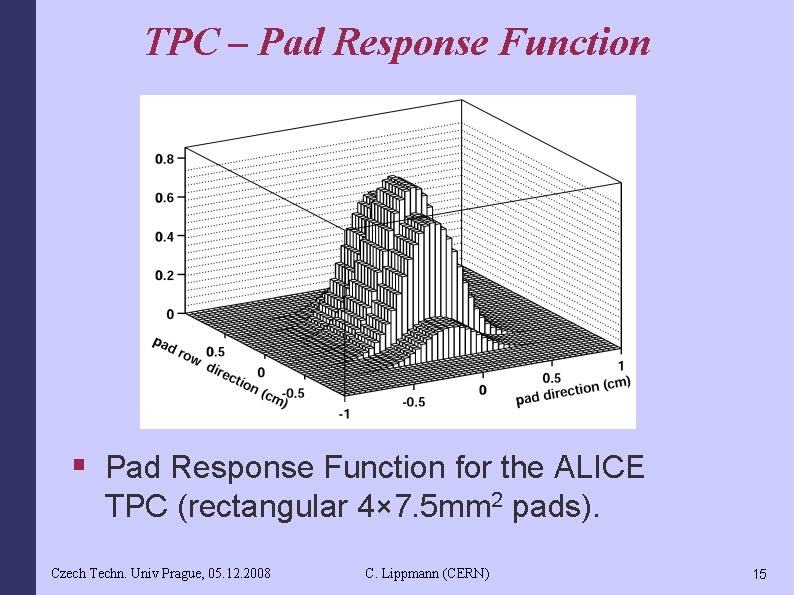
TPC – Pad Response Function § Pad Response Function for the ALICE TPC (rectangular 4× 7. 5 mm 2 pads). Czech Techn. Univ Prague, 05. 12. 2008 C. Lippmann (CERN) 15
Limitations for Coordinate Measurement 1) Diffusion displaces the charge clusters during the long drift. 2) Attachment of drifting electrons leads to loss of signal amplitude. 3) Ex. B effects: Small misalignment (E and B not perfectly parallel) displaces the charge clusters during the long drift. 4) Field distortions due to space charge in the drift volume. Czech Techn. Univ Prague, 05. 12. 2008 C. Lippmann (CERN) 16
Limitation 1: Diffusion (1) § Electrons are drifting along z and scatter on gas molecules. § As a consequence, their drift velocity deviates from the average due to the random nature of the collisions. § The diffusion is Gaussian with (z)=D z, where § z = drift length and § D = diffusion coefficient [ m/ cm]. § Longitudinal (in drift direction) and transverse diffusion can differ. Czech Techn. Univ Prague, 05. 12. 2008 C. Lippmann (CERN) 17
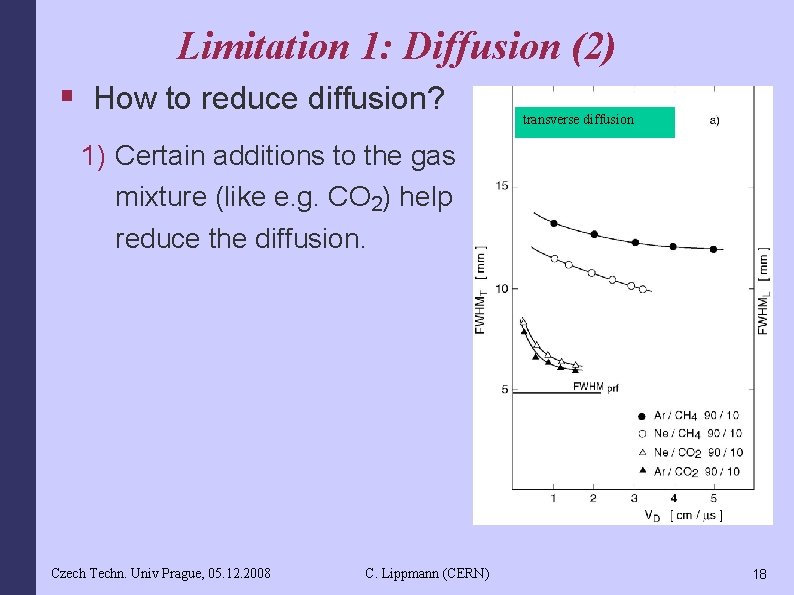
Limitation 1: Diffusion (2) § How to reduce diffusion? transverse diffusion 1) Certain additions to the gas mixture (like e. g. CO 2) help reduce the diffusion. Czech Techn. Univ Prague, 05. 12. 2008 C. Lippmann (CERN) 18
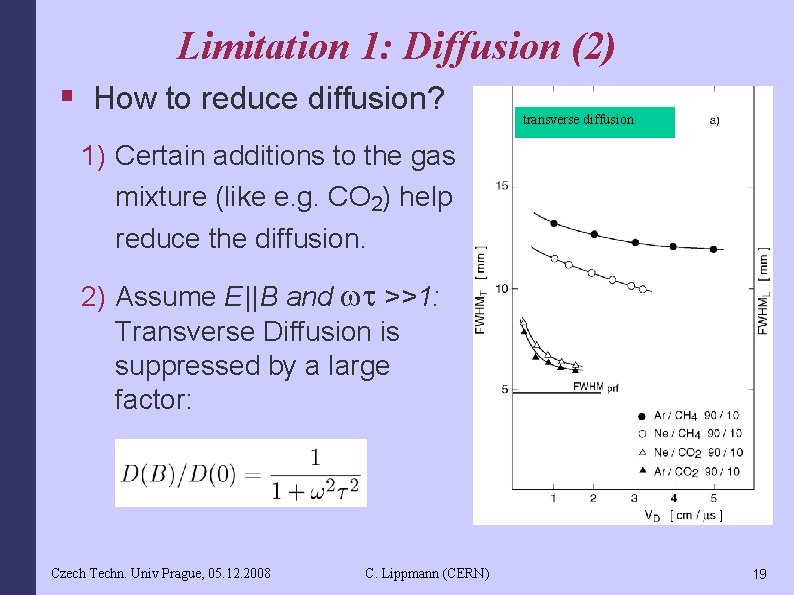
Limitation 1: Diffusion (2) § How to reduce diffusion? transverse diffusion 1) Certain additions to the gas mixture (like e. g. CO 2) help reduce the diffusion. 2) Assume E ||B and >>1: Transverse Diffusion is suppressed by a large factor: Czech Techn. Univ Prague, 05. 12. 2008 C. Lippmann (CERN) 19
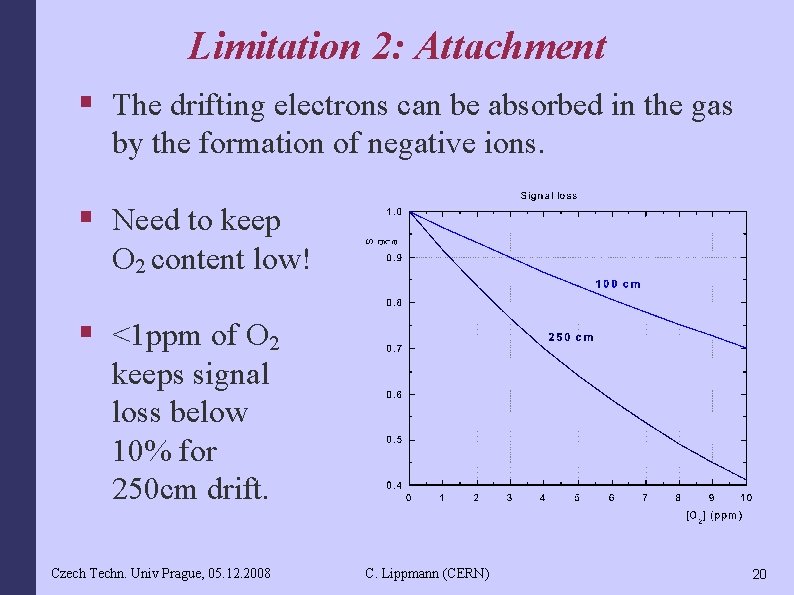
Limitation 2: Attachment § The drifting electrons can be absorbed in the gas by the formation of negative ions. § Need to keep O 2 content low! § <1 ppm of O 2 keeps signal loss below 10% for 250 cm drift. Czech Techn. Univ Prague, 05. 12. 2008 C. Lippmann (CERN) 20
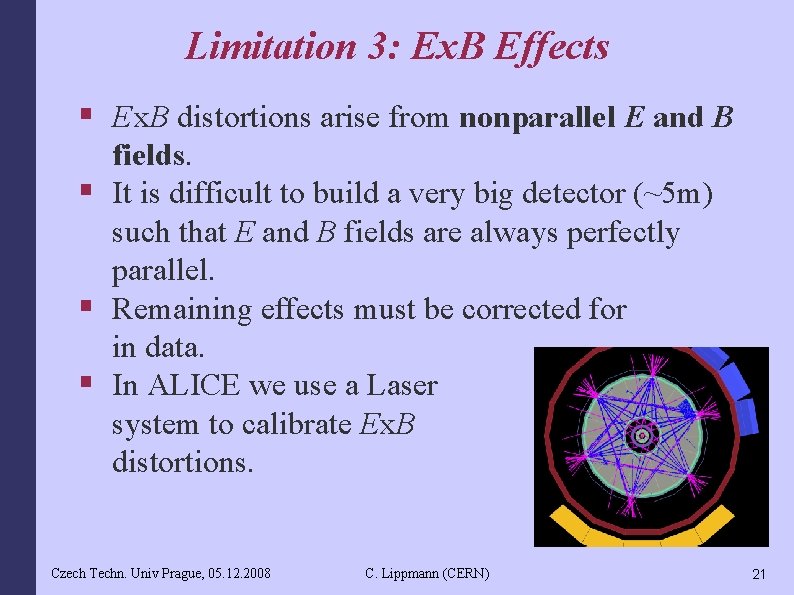
Limitation 3: Ex. B Effects § E x. B distortions arise from nonparallel E and B fields. § It is difficult to build a very big detector (~5 m) such that E and B fields are always perfectly parallel. § Remaining effects must be corrected for in data. § In ALICE we use a Laser system to calibrate Ex. B distortions. Czech Techn. Univ Prague, 05. 12. 2008 C. Lippmann (CERN) 21
Limitation 4: Space Charge § In high-rate environments charges distort the electric field. Czech Techn. Univ Prague, 05. 12. 2008 C. Lippmann (CERN) 22
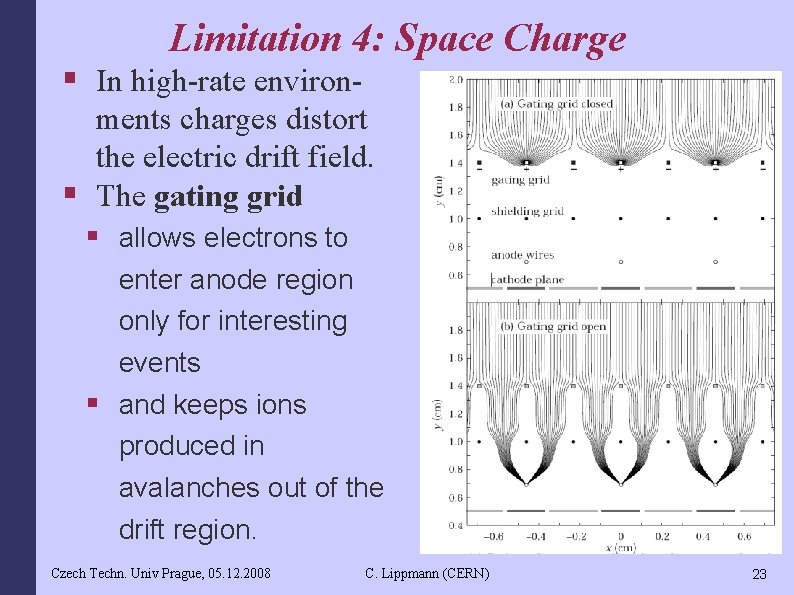
Limitation 4: Space Charge § In high-rate environ- ments charges distort the electric drift field. § The gating grid § allows electrons to enter anode region only for interesting events § and keeps ions produced in avalanches out of the drift region. Czech Techn. Univ Prague, 05. 12. 2008 C. Lippmann (CERN) 23

Particle Identification with TPCs Czech Techn. Univ Prague, 05. 12. 2008 C. Lippmann (CERN) 24
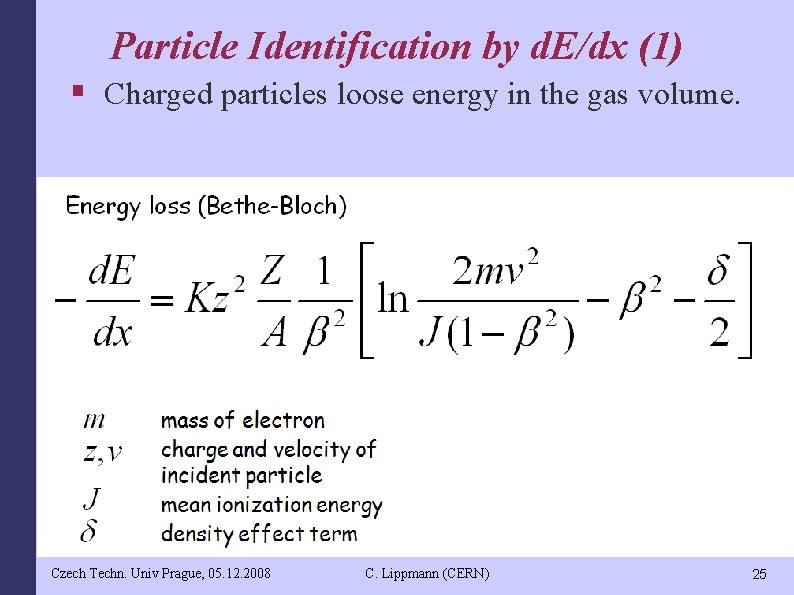
Particle Identification by d. E/dx (1) § Charged particles loose energy in the gas volume. Czech Techn. Univ Prague, 05. 12. 2008 C. Lippmann (CERN) 25
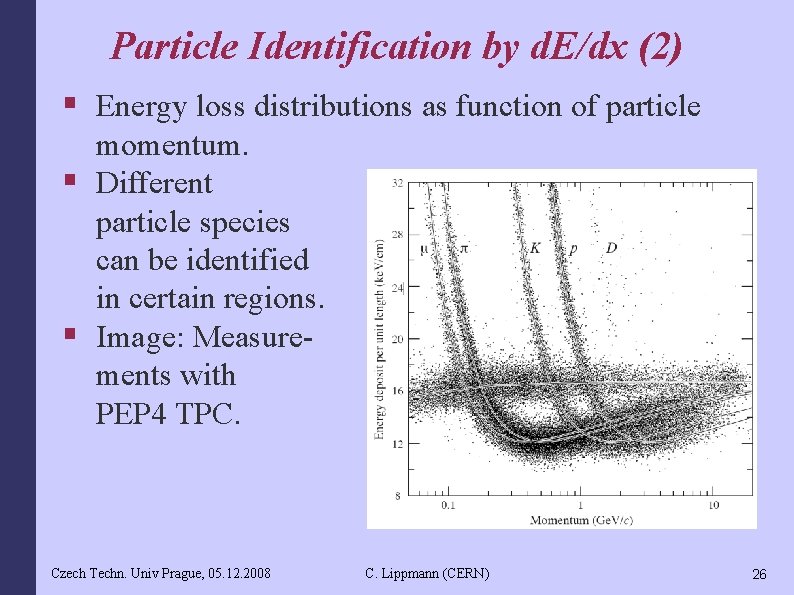
Particle Identification by d. E/dx (2) § Energy loss distributions as function of particle momentum. § Different particle species can be identified in certain regions. § Image: Measurements with PEP 4 TPC. Czech Techn. Univ Prague, 05. 12. 2008 C. Lippmann (CERN) 26
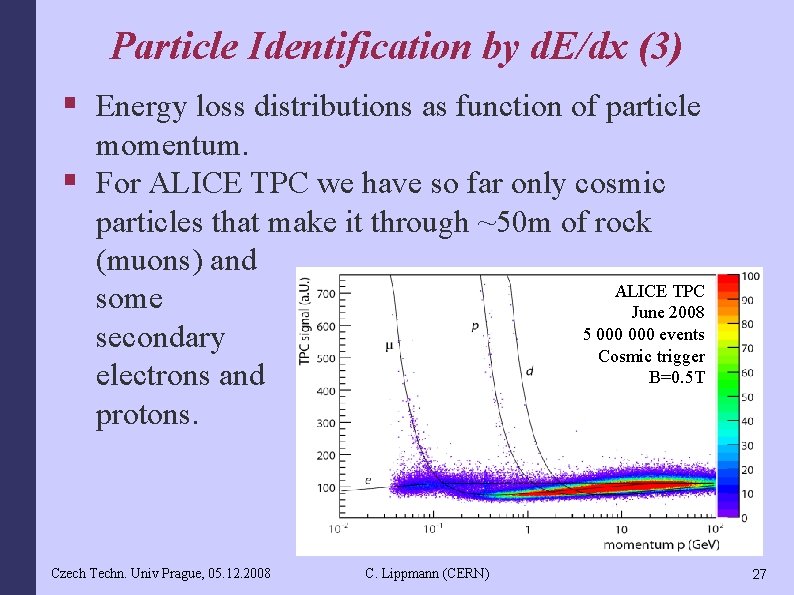
Particle Identification by d. E/dx (3) § Energy loss distributions as function of particle momentum. § For ALICE TPC we have so far only cosmic particles that make it through ~50 m of rock (muons) and ALICE TPC some June 2008 5 000 events secondary Cosmic trigger B=0. 5 T electrons and protons. Czech Techn. Univ Prague, 05. 12. 2008 C. Lippmann (CERN) 27
TPCs for Heavy Ion Experiments Czech Techn. Univ Prague, 05. 12. 2008 C. Lippmann (CERN) 28
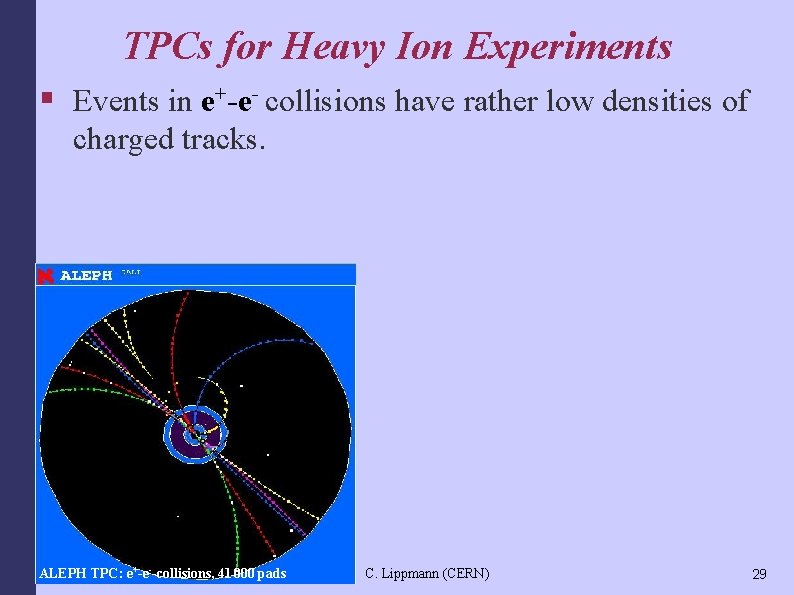
TPCs for Heavy Ion Experiments § Events in e+-e- collisions have rather low densities of charged tracks. +-e--collisions, Czech Techn. Prague, 05. 12. 2008 ALEPH TPC: e. Univ 41 000 pads C. Lippmann (CERN) 29
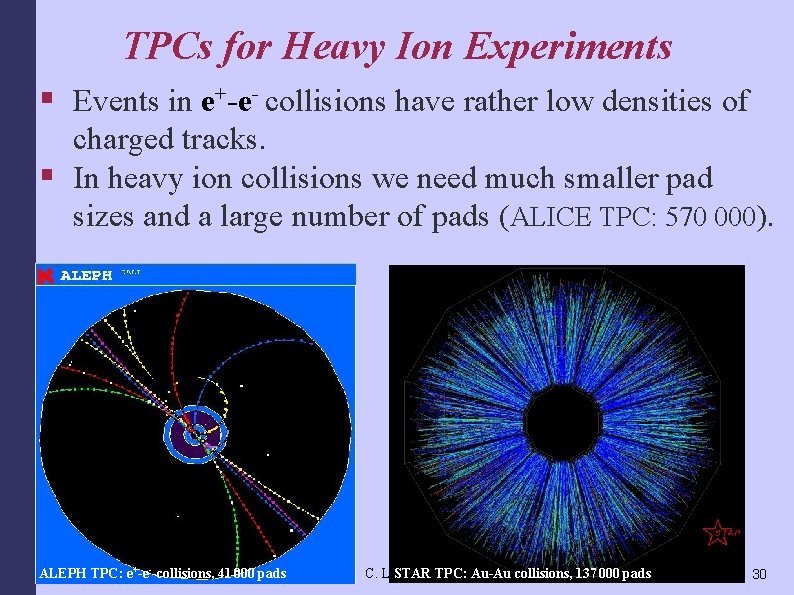
TPCs for Heavy Ion Experiments § Events in e+-e- collisions have rather low densities of charged tracks. § In heavy ion collisions we need much smaller pad sizes and a large number of pads (ALICE TPC: 570 000). +-e--collisions, Czech Techn. Prague, 05. 12. 2008 ALEPH TPC: e. Univ 41 000 pads C. Lippmann (CERN) STAR TPC: Au-Au collisions, 137 000 pads 30

The ALICE TPC A rapid 3 -dimensional tracking device for ultra-high multiplicity events. Czech Techn. Univ Prague, 05. 12. 2008 C. Lippmann (CERN) 31
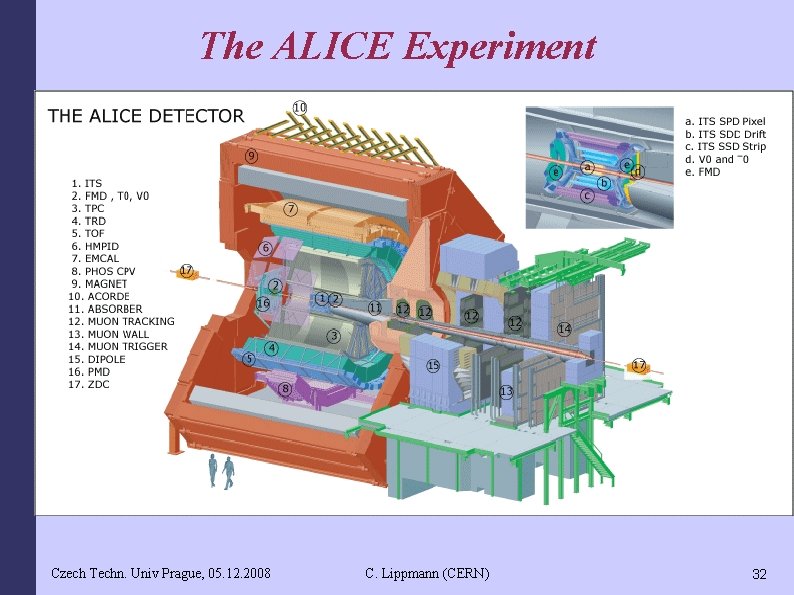
The ALICE Experiment Czech Techn. Univ Prague, 05. 12. 2008 C. Lippmann (CERN) 32
A Large Ion Collider Experiment § Search for evidence of quark-gluon plasma in Pb. Pb collisions at the LHC (5. 5 Te. V per nucleon pair). § Study properties of p-p collisions (14 Te. V). § Trajectories of thousands of particles (~20 000) produced in central collisions have to be measured and the particles have to be identified. § To serve these tasks, the largest TPC in the world was built. Czech Techn. Univ Prague, 05. 12. 2008 C. Lippmann (CERN) 33
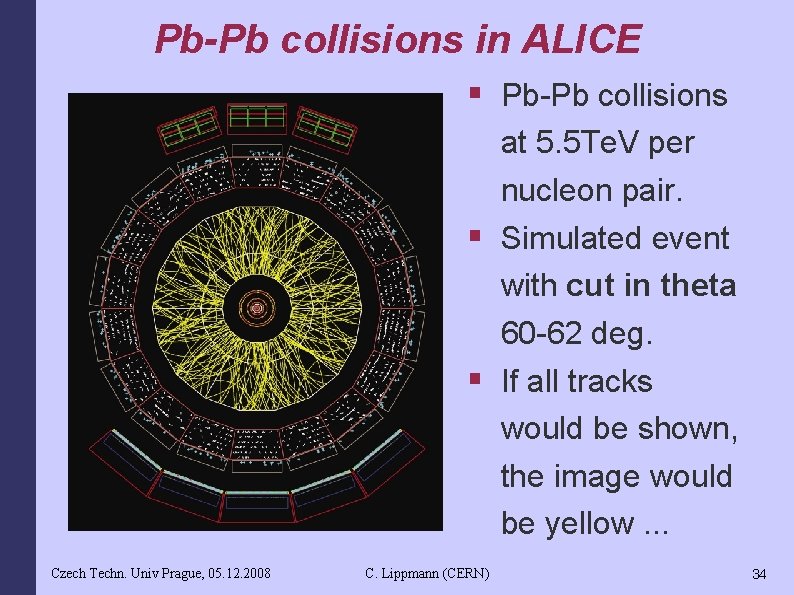
Pb-Pb collisions in ALICE § Pb-Pb collisions at 5. 5 Te. V per nucleon pair. § Simulated event with cut in theta 60 -62 deg. § If all tracks would be shown, the image would be yellow. . . Czech Techn. Univ Prague, 05. 12. 2008 C. Lippmann (CERN) 34
The ALICE TPC: Tasks § Track finding, § momentum measurement and § particle identification § at transverse momenta 0. 1 < p. T < 100 Ge. V/c. § Rate capability: § 200 Hz for central Pb-Pb collsions and § 1 k. Hz for p-p collisions. Czech Techn. Univ Prague, 05. 12. 2008 C. Lippmann (CERN) 35
The ALICE TPC Collaboration Bergen CERN Darmstadt TU GSI Darmstadt Heidelberg PI Lund Czech Techn. Univ Prague, 05. 12. 2008 Bratislava Copenhagen Frankfurt Heidelberg KIP Krakow C. Lippmann (CERN) 36
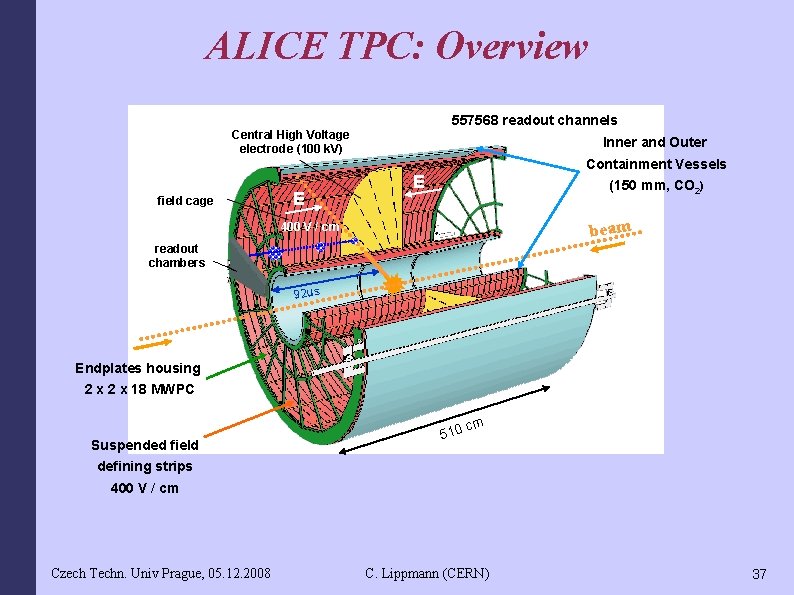
ALICE TPC: Overview 557568 readout channels Central High Voltage electrode (100 k. V) field cage E Inner and Outer Containment Vessels E (150 mm, CO 2) beam 400 V / cm readout chambers High Voltage electrode 92 us (100 k. V) Endplates housing 2 x 18 MWPC Suspended field 510 cm defining strips 400 V / cm Czech Techn. Univ Prague, 05. 12. 2008 C. Lippmann (CERN) 37
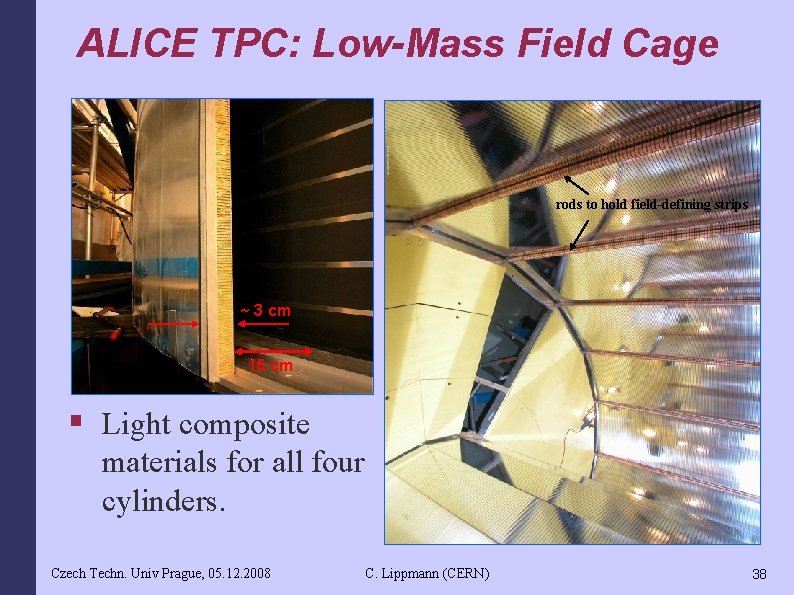
ALICE TPC: Low-Mass Field Cage rods to hold field-defining strips ~ 3 cm 15 cm § Light composite materials for all four cylinders. Czech Techn. Univ Prague, 05. 12. 2008 C. Lippmann (CERN) 38
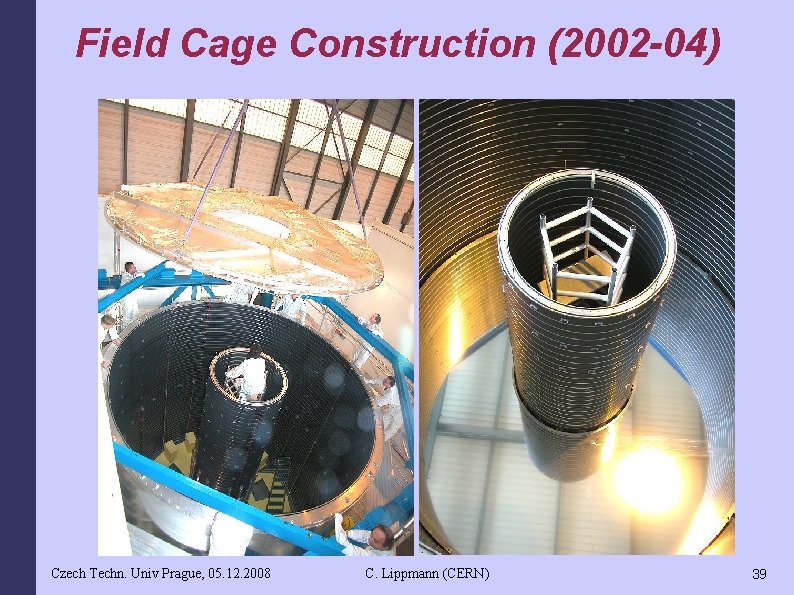
Field Cage Construction (2002 -04) Czech Techn. Univ Prague, 05. 12. 2008 C. Lippmann (CERN) 39
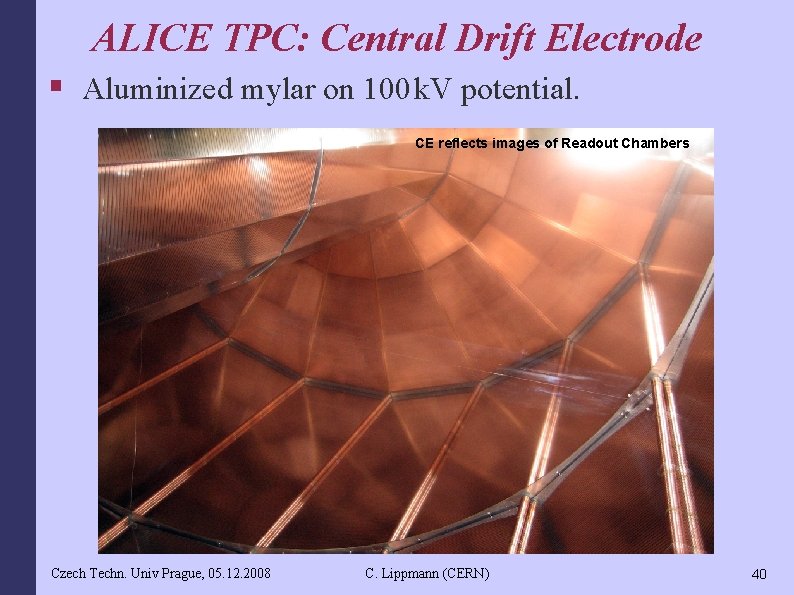
ALICE TPC: Central Drift Electrode § Aluminized mylar on 100 k. V potential. CE reflects images of Readout Chambers Czech Techn. Univ Prague, 05. 12. 2008 C. Lippmann (CERN) 40
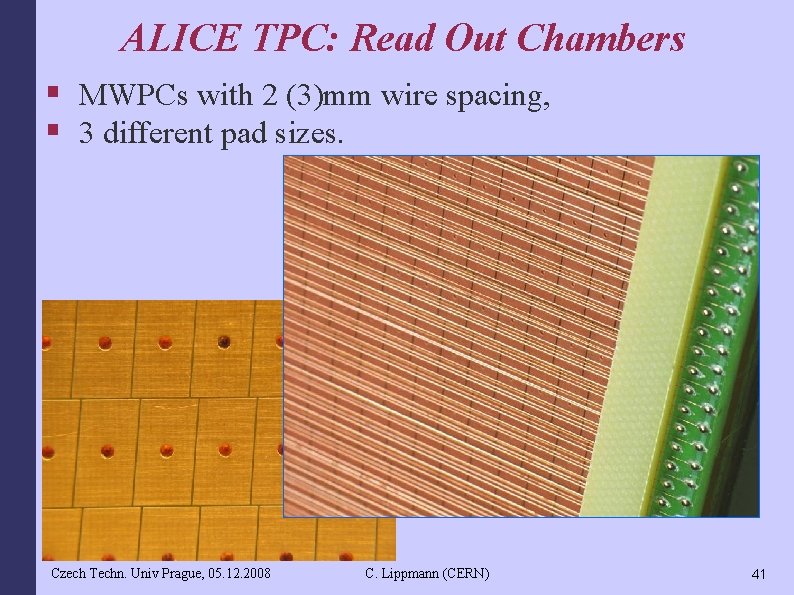
ALICE TPC: Read Out Chambers § MWPCs with 2 (3)mm wire spacing, § 3 different pad sizes. Czech Techn. Univ Prague, 05. 12. 2008 C. Lippmann (CERN) 41
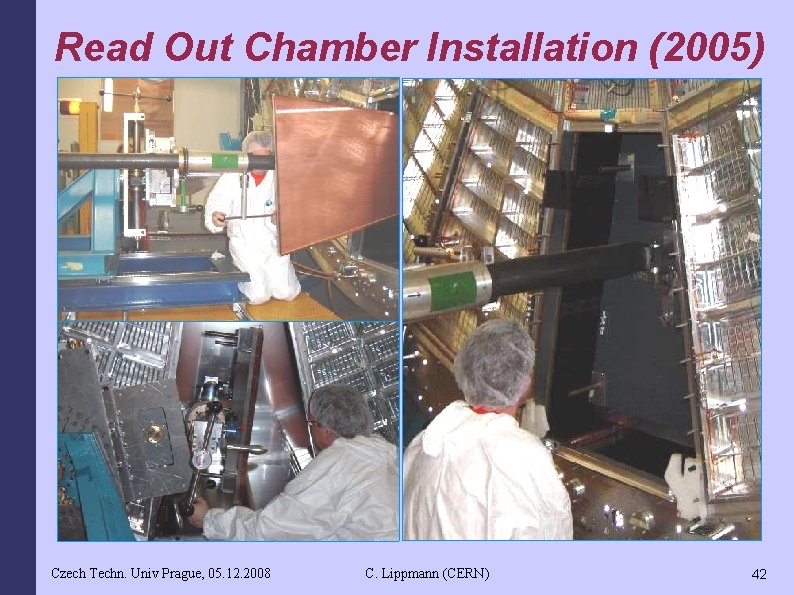
Read Out Chamber Installation (2005) Czech Techn. Univ Prague, 05. 12. 2008 C. Lippmann (CERN) 42
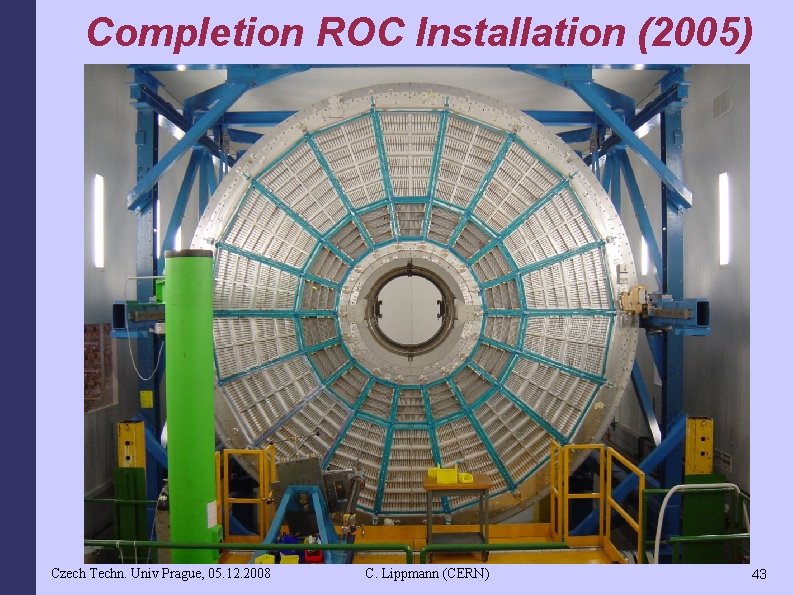
Completion ROC Installation (2005) Czech Techn. Univ Prague, 05. 12. 2008 C. Lippmann (CERN) 43

The gas mixture for the ALICE TPC Czech Techn. Univ Prague, 05. 12. 2008 C. Lippmann (CERN) 44
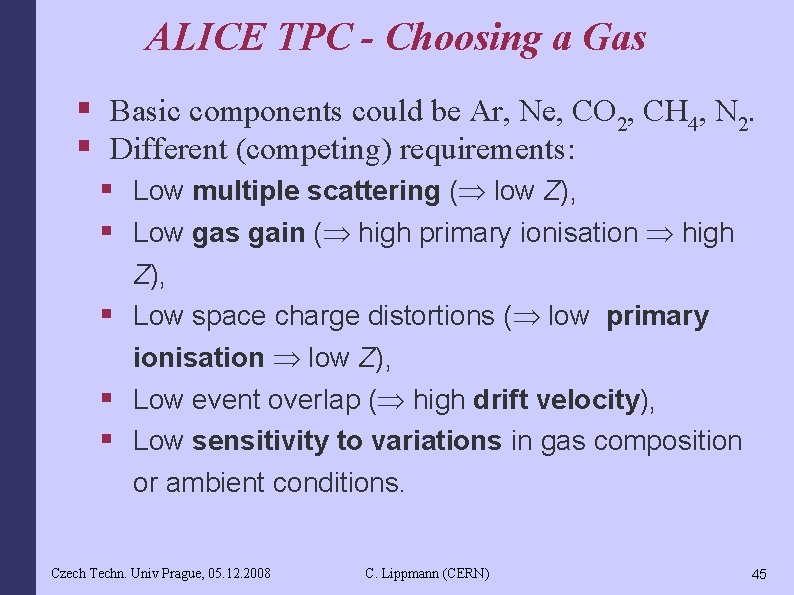
ALICE TPC - Choosing a Gas § Basic components could be Ar, Ne, CO 2, CH 4, N 2. § Different (competing) requirements: § Low multiple scattering ( low Z), § Low gas gain ( high primary ionisation high Z), § Low space charge distortions ( low primary ionisation low Z), § Low event overlap ( high drift velocity), § Low sensitivity to variations in gas composition or ambient conditions. Czech Techn. Univ Prague, 05. 12. 2008 C. Lippmann (CERN) 45
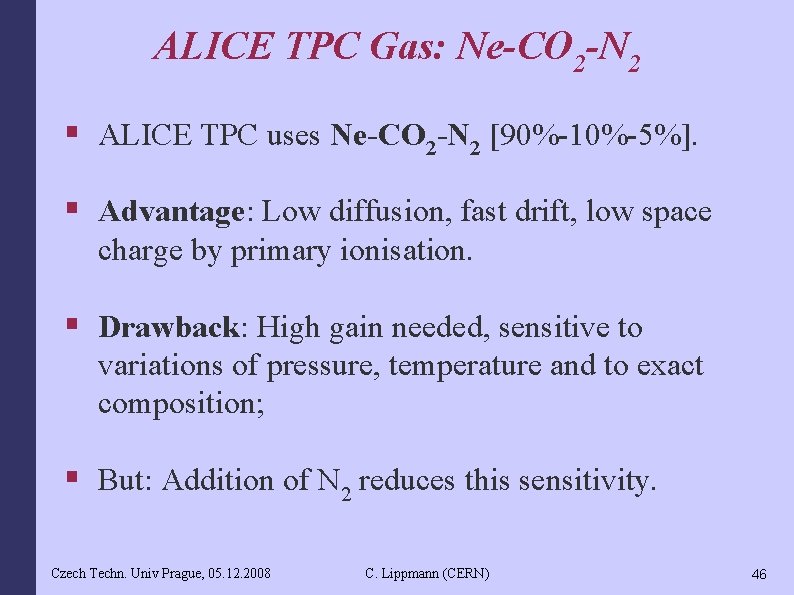
ALICE TPC Gas: Ne-CO 2 -N 2 § ALICE TPC uses Ne-CO 2 -N 2 [90%-10%-5%]. § Advantage: Low diffusion, fast drift, low space charge by primary ionisation. § Drawback: High gain needed, sensitive to variations of pressure, temperature and to exact composition; § But: Addition of N 2 reduces this sensitivity. Czech Techn. Univ Prague, 05. 12. 2008 C. Lippmann (CERN) 46

The ALICE TPC Read Out Electronics Czech Techn. Univ Prague, 05. 12. 2008 C. Lippmann (CERN) 47
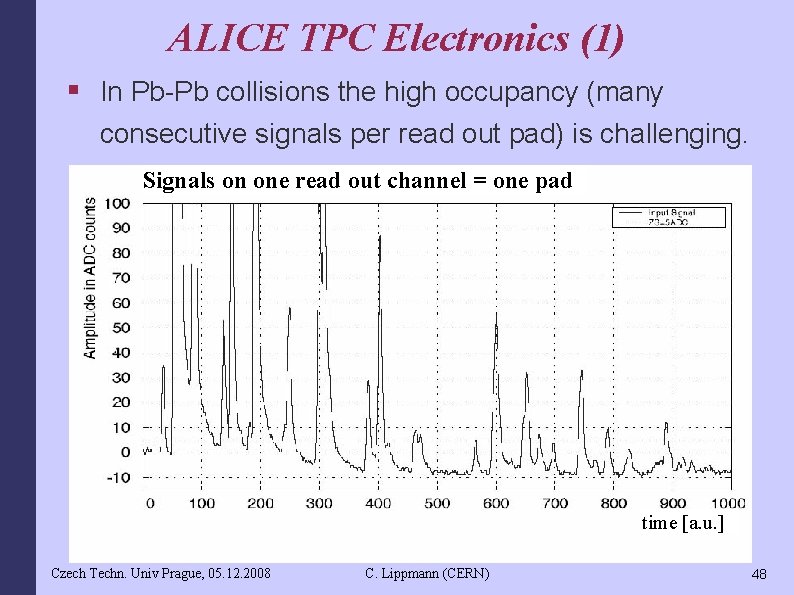
ALICE TPC Electronics (1) § In Pb-Pb collisions the high occupancy (many consecutive signals per read out pad) is challenging. Signals on one read out channel = one pad time [a. u. ] Czech Techn. Univ Prague, 05. 12. 2008 C. Lippmann (CERN) 48
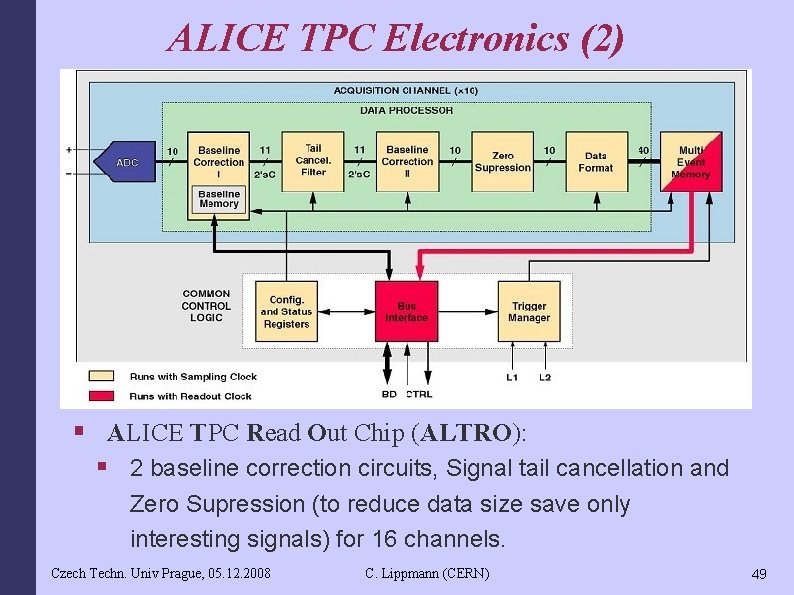
ALICE TPC Electronics (2) § ALICE TPC Read Out Chip (ALTRO): § 2 baseline correction circuits, Signal tail cancellation and Zero Supression (to reduce data size save only interesting signals) for 16 channels. Czech Techn. Univ Prague, 05. 12. 2008 C. Lippmann (CERN) 49
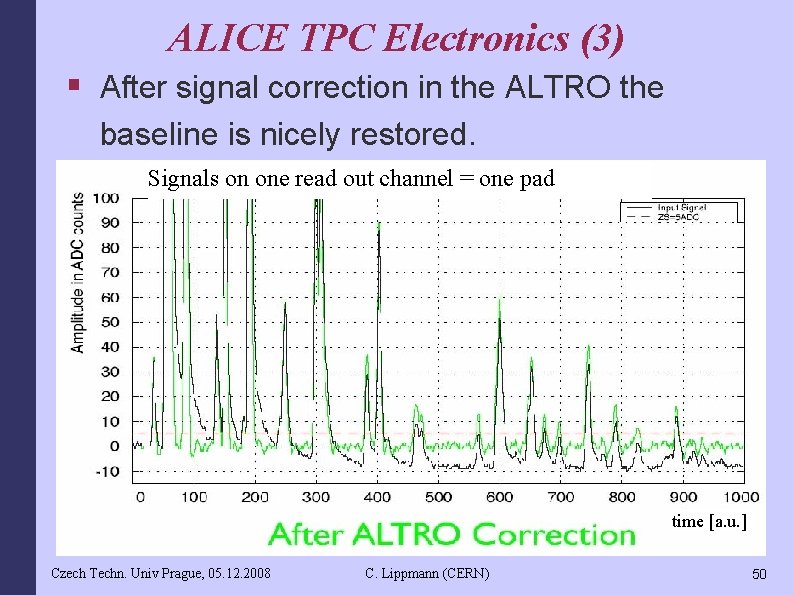
ALICE TPC Electronics (3) § After signal correction in the ALTRO the baseline is nicely restored. Signals on one read out channel = one pad time [a. u. ] Czech Techn. Univ Prague, 05. 12. 2008 C. Lippmann (CERN) 50
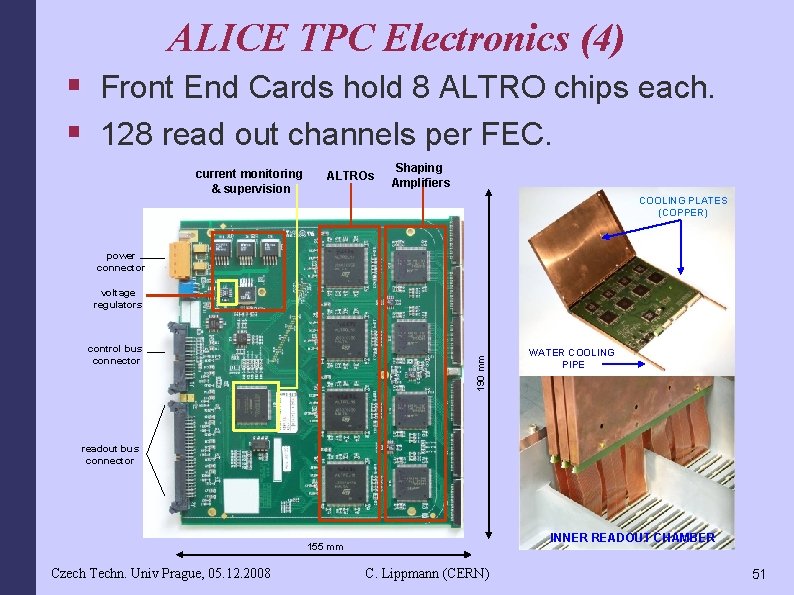
ALICE TPC Electronics (4) § Front End Cards hold 8 ALTRO chips each. § 128 read out channels per FEC. current monitoring & supervision ALTROs Shaping Amplifiers COOLING PLATES (COPPER) power connector voltage regulators 190 mm control bus connector WATER COOLING PIPE readout bus connector INNER READOUT CHAMBER 155 mm Czech Techn. Univ Prague, 05. 12. 2008 C. Lippmann (CERN) 51
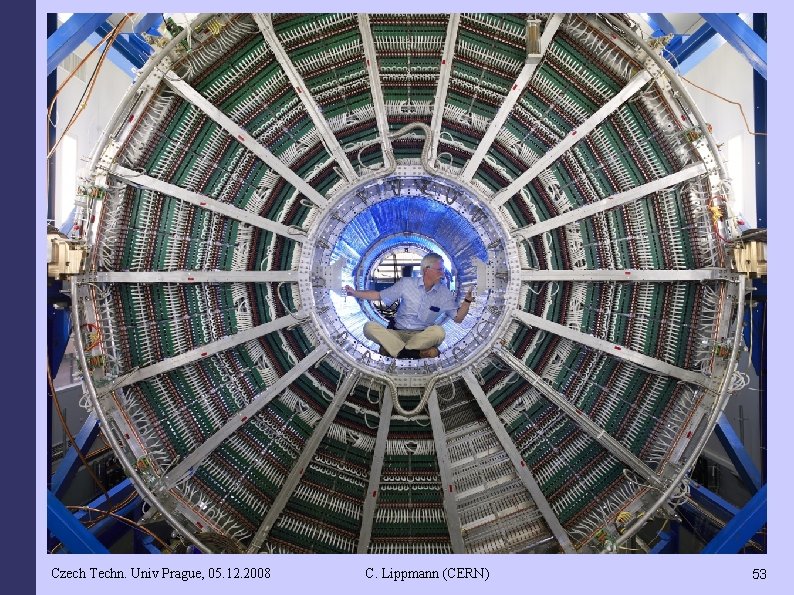
Install. of Read Out Electronics (2006) Czech Techn. Univ Prague, 05. 12. 2008 C. Lippmann (CERN) 52
Czech Techn. Univ Prague, 05. 12. 2008 C. Lippmann (CERN) 53
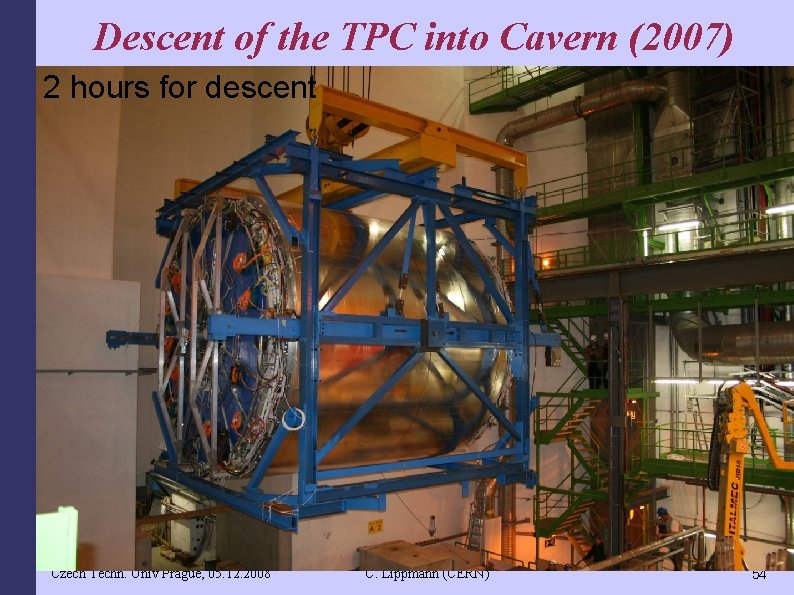
Descent of the TPC into Cavern (2007) 2 hours for descent Czech Techn. Univ Prague, 05. 12. 2008 C. Lippmann (CERN) 54
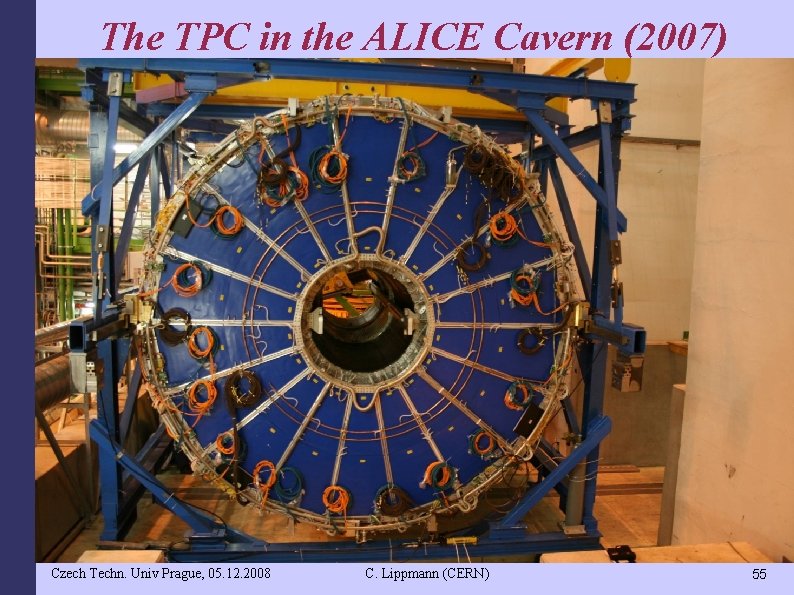
The TPC in the ALICE Cavern (2007) Czech Techn. Univ Prague, 05. 12. 2008 C. Lippmann (CERN) 55
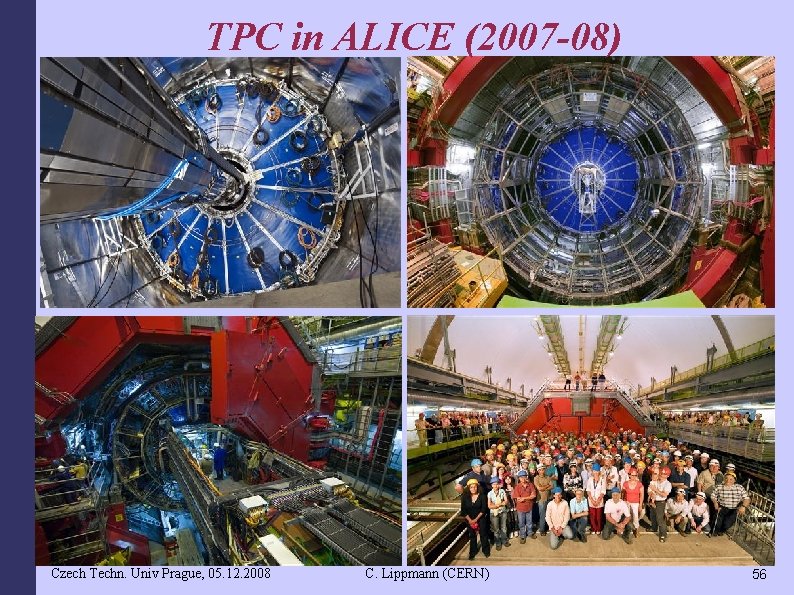
TPC in ALICE (2007 -08) Czech Techn. Univ Prague, 05. 12. 2008 C. Lippmann (CERN) 56

Calibration of the ALICE TPC Czech Techn. Univ Prague, 05. 12. 2008 C. Lippmann (CERN) 57
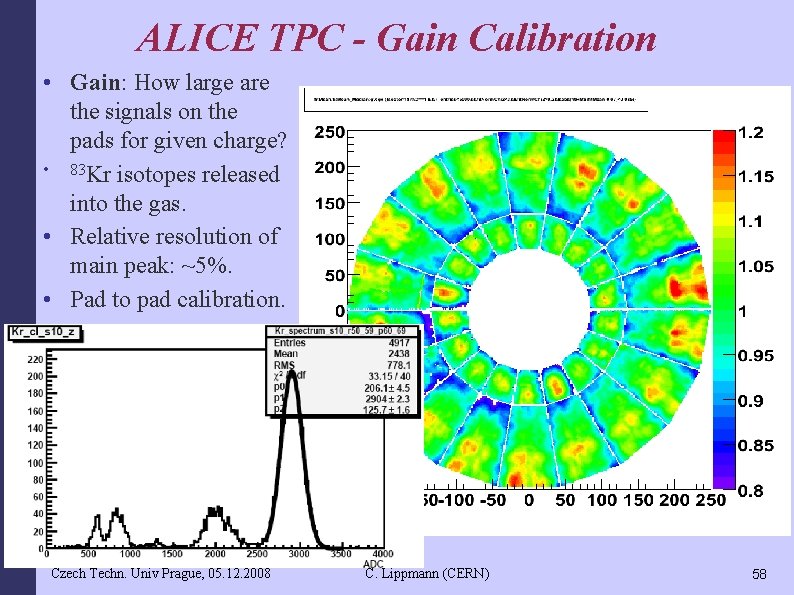
ALICE TPC - Gain Calibration • Gain: How large are the signals on the pads for given charge? • 83 Kr isotopes released into the gas. • Relative resolution of main peak: ~5%. • Pad to pad calibration. Czech Techn. Univ Prague, 05. 12. 2008 C. Lippmann (CERN) 58
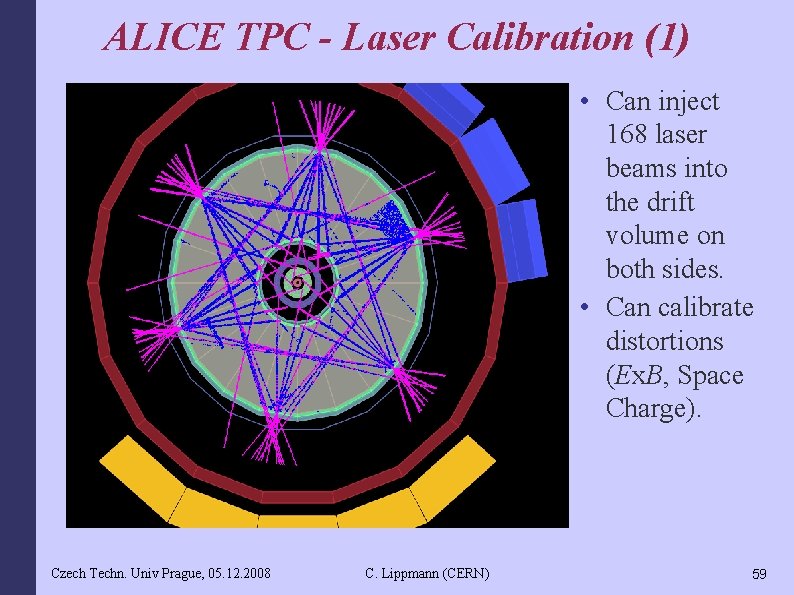
ALICE TPC - Laser Calibration (1) • Can inject 168 laser beams into the drift volume on both sides. • Can calibrate distortions (Ex. B, Space Charge). Czech Techn. Univ Prague, 05. 12. 2008 C. Lippmann (CERN) 59
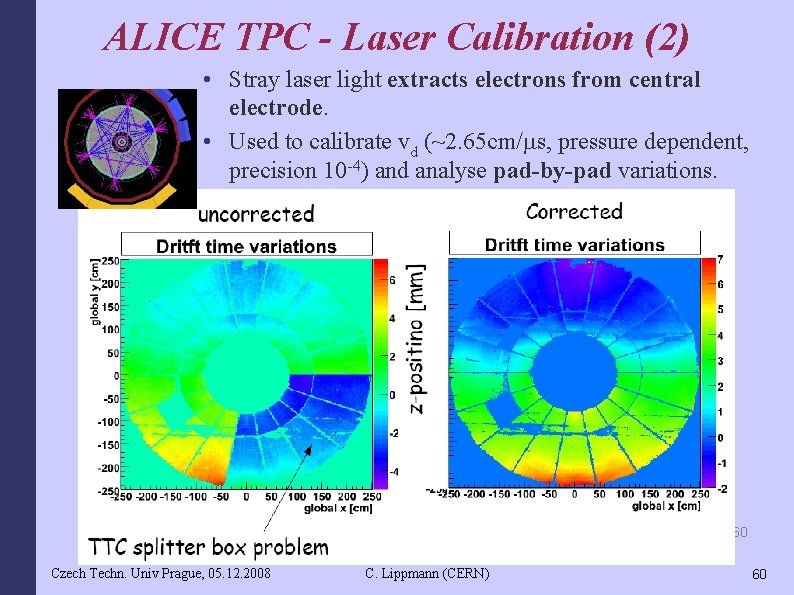
ALICE TPC - Laser Calibration (2) • Stray laser light extracts electrons from central electrode. • Used to calibrate vd (~2. 65 cm/ s, pressure dependent, precision 10 -4) and analyse pad-by-pad variations. C. Garabatos IEEE Dresden 2008 Czech Techn. Univ Prague, 05. 12. 2008 C. Lippmann (CERN) 60 60
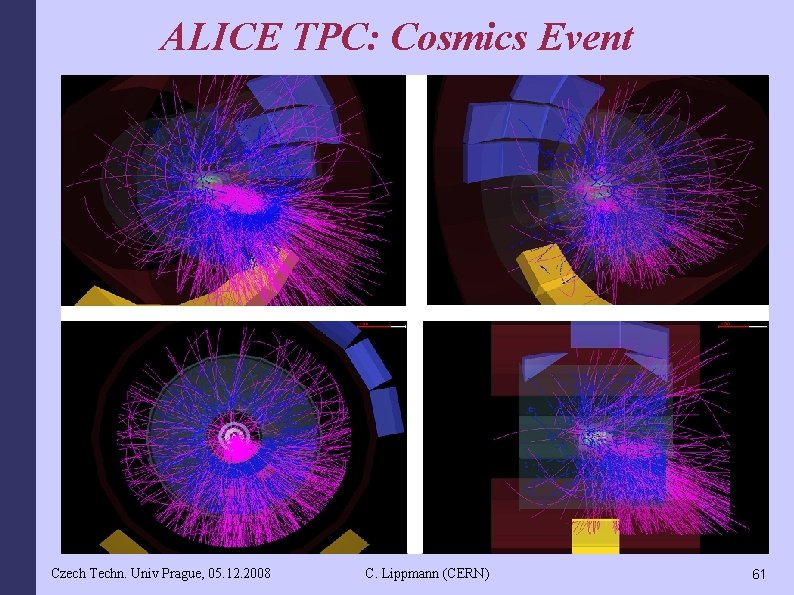
ALICE TPC: Cosmics Event Czech Techn. Univ Prague, 05. 12. 2008 C. Lippmann (CERN) 61
Performance (Preliminary) § Systematic effects on position resolution before (after) calibration: § Ex. B Effects: Δy<3 mm (<0. 3 mm) § Drift velocity: Δz~50 mm (1 mm) § Alignment: y= z=0. 15 mm (0. 1 mm) § Momentum resolution (from cosmic tracks): § (p. T) = 3% at 2 Ge. V/c § (p. T) = 10% at 10 Ge. V/c § d. E/dx Resolution (from cosmic tracks): § (d. E/dx) = 6% Czech Techn. Univ Prague, 05. 12. 2008 C. Lippmann (CERN) 62
Summary § TPCs are quite simple constructions which allow to take “ 3 D § § § photographs” of particle tracks. It also allows particle identification via the characteristic energy loss. A strong magnetic field is used to bend the particle tracks (spectrometer) and on top reduces the diffusion over the long drift paths. The largest existing TPC is installed into the ALICE experiment. A lot of calibration data (Kryton, Laser, Cosmics) was taken in dedicated run periods in 2007 and 08. The start of LHC is now delayed until summer 2009. The ALICE TPC is ready for collisions. Czech Techn. Univ Prague, 05. 12. 2008 C. Lippmann (CERN) 63
- Slides: 63