
The Algorithm of Parallel Programming Using Small Delay
- Slides: 17
The Algorithm of Parallel Programming Using “Small Delay” Natela Archvadze 1, Merab Pkhovelishvili 2, Lia Shetsiruli 3, Otar Ioseliani 4 Department of Computer Sciences Faculty of Exact and Natural Sciences Ivane Javakhishvili Tbilisi State University, Tbilisi, GEORGIA 2 Department of Programming N. Muskhelishvili Computing Mathematic Institute of Georgian Technical University, Tbilisi, GEORGIA 3 Department of Mathematics and Computer Science Shota Rustaveli State University, Batumi, Georgia 4 Georgian-American University, Tbilisi, Georgia 1 South-Caucasus Computing and Technology Workshop SCCTW’ 2016, 3 -7 October, Tbilisi, Georgia 1
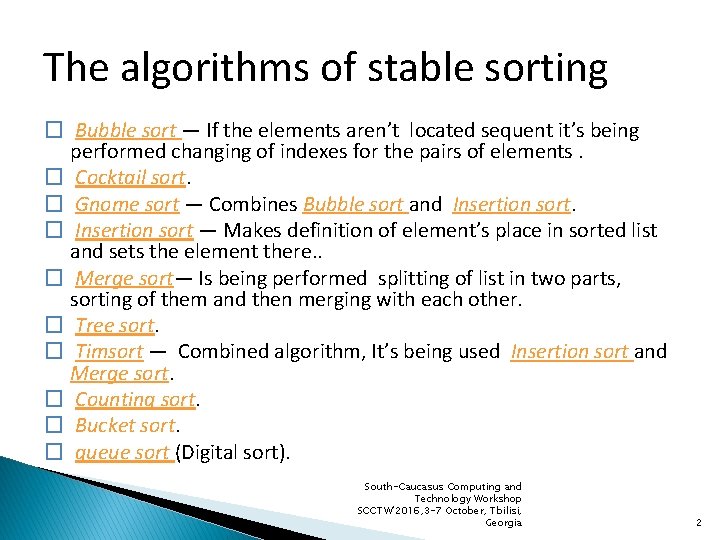
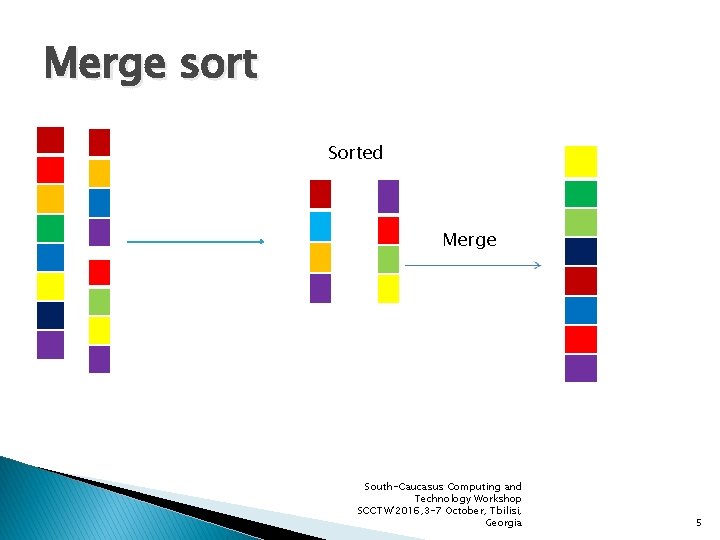
The algorithms of stable sorting � Bubble sort — If the elements aren’t located sequent it’s being performed changing of indexes for the pairs of elements. � Cocktail sort. � Gnome sort — Combines Bubble sort and Insertion sort. � Insertion sort — Makes definition of element’s place in sorted list and sets the element there. . � Merge sort— Is being performed splitting of list in two parts, sorting of them and then merging with each other. � Tree sort. � Timsort — Combined algorithm, It’s being used Insertion sort and Merge sort. � Counting sort. � Bucket sort. � queue sort (Digital sort). South-Caucasus Computing and Technology Workshop SCCTW’ 2016, 3 -7 October, Tbilisi, Georgia 2
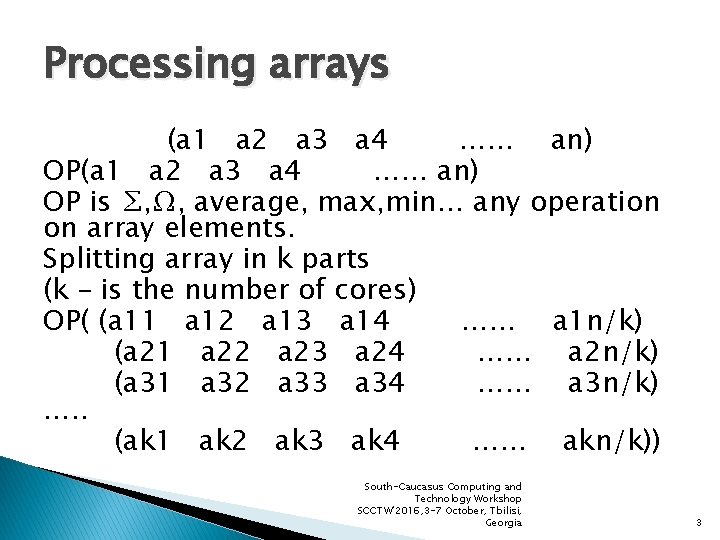
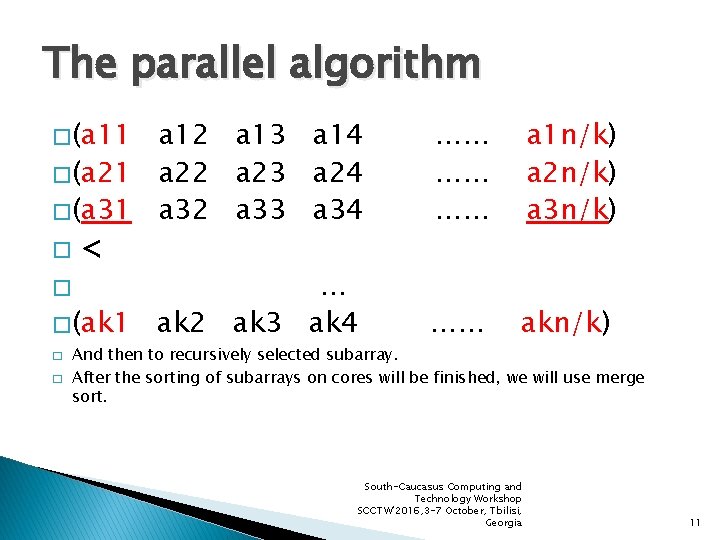
Processing arrays (a 1 a 2 a 3 a 4 …… an) OP is ∑, Ω, average, max, min… any operation on array elements. Splitting array in k parts (k – is the number of cores) OP( (a 11 a 12 a 13 a 14 …… a 1 n/k) (a 21 a 22 a 23 a 24 …… a 2 n/k) (a 31 a 32 a 33 a 34 …… a 3 n/k) …. . (ak 1 ak 2 ak 3 ak 4 …… akn/k)) South-Caucasus Computing and Technology Workshop SCCTW’ 2016, 3 -7 October, Tbilisi, Georgia 3
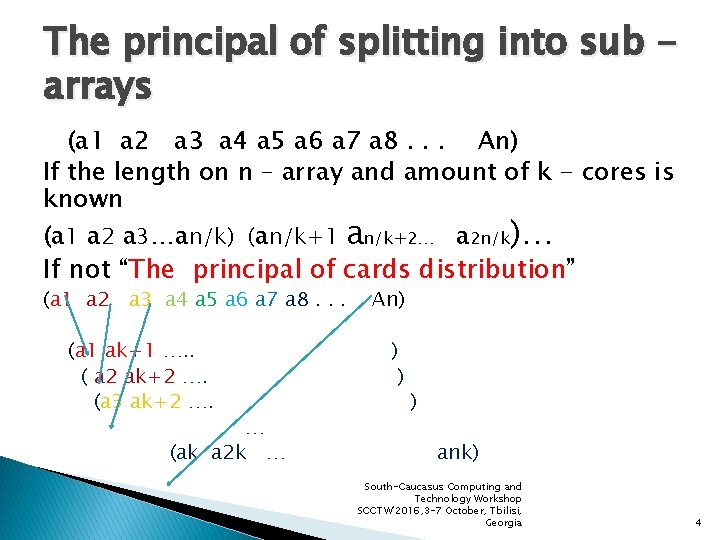
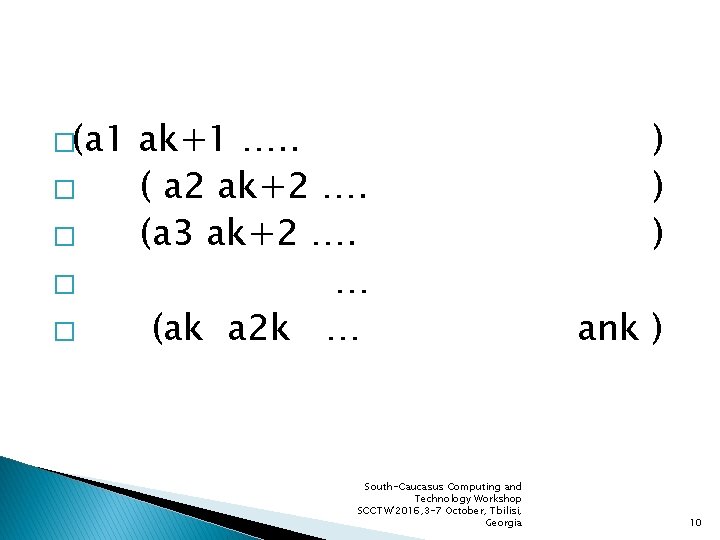
The principal of splitting into sub arrays (a 1 a 2 a 3 a 4 a 5 a 6 a 7 a 8. . . An) If the length on n – array and amount of k - cores is known (a 1 a 2 a 3…an/k) (an/k+1 an/k+2… a 2 n/k)… If not “The principal of cards distribution” (a 1 a 2 a 3 a 4 a 5 a 6 a 7 a 8. . . (a 1 ak+1 …. . ( a 2 ak+2 …. (a 3 ak+2 …. … (ak a 2 k … An) ) ank) South-Caucasus Computing and Technology Workshop SCCTW’ 2016, 3 -7 October, Tbilisi, Georgia 4
Merge sort Sorted Merge South-Caucasus Computing and Technology Workshop SCCTW’ 2016, 3 -7 October, Tbilisi, Georgia 5
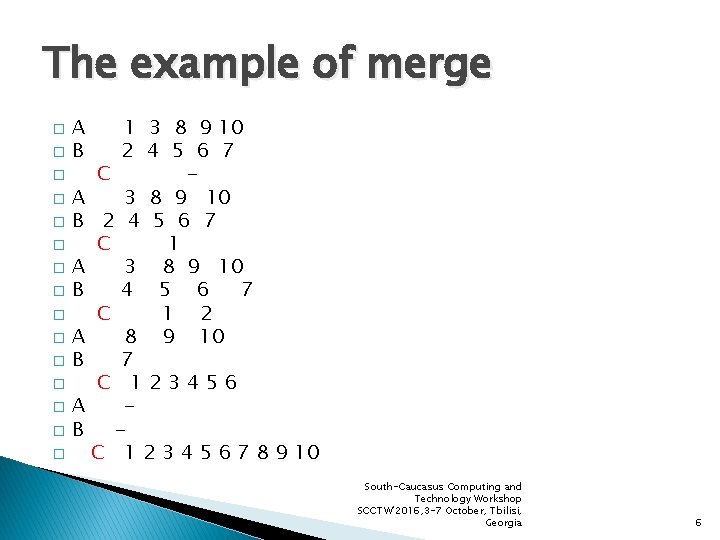
The example of merge � � � � A B 1 3 8 9 10 2 4 5 6 7 C A 3 8 9 10 B 2 4 5 6 7 C 1 A 3 8 9 10 B 4 5 6 7 C 1 2 A 8 9 10 B 7 C 123456 A B C 1 2 3 4 5 6 7 8 9 10 South-Caucasus Computing and Technology Workshop SCCTW’ 2016, 3 -7 October, Tbilisi, Georgia 6
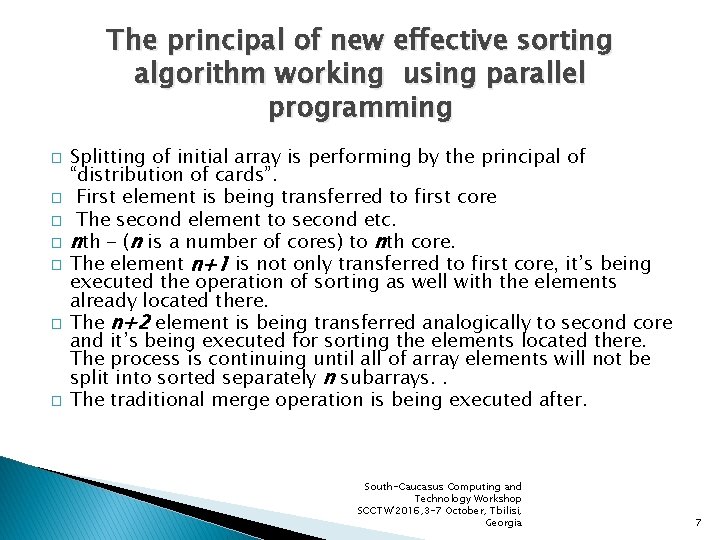
The principal of new effective sorting algorithm working using parallel programming � � � � Splitting of initial array is performing by the principal of “distribution of cards”. First element is being transferred to first core The second element to second etc. nth - (n is a number of cores) to nth core. The element n+1 is not only transferred to first core, it’s being executed the operation of sorting as well with the elements already located there. The n+2 element is being transferred analogically to second core and it’s being executed for sorting the elements located there. The process is continuing until all of array elements will not be split into sorted separately n subarrays. . The traditional merge operation is being executed after. South-Caucasus Computing and Technology Workshop SCCTW’ 2016, 3 -7 October, Tbilisi, Georgia 7
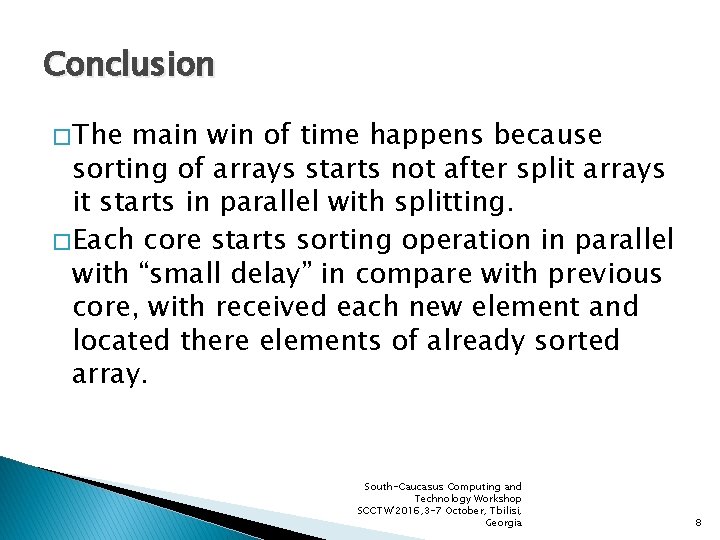
Conclusion � The main win of time happens because sorting of arrays starts not after split arrays it starts in parallel with splitting. � Each core starts sorting operation in parallel with “small delay” in compare with previous core, with received each new element and located there elements of already sorted array. South-Caucasus Computing and Technology Workshop SCCTW’ 2016, 3 -7 October, Tbilisi, Georgia 8
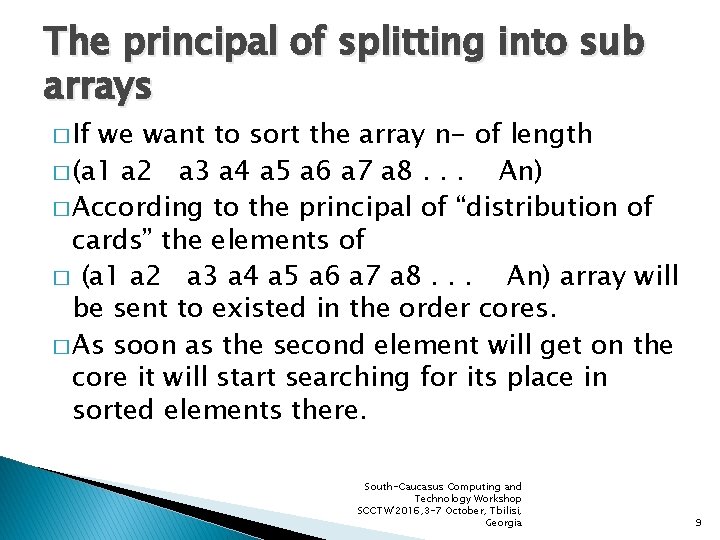
The principal of splitting into sub arrays � If we want to sort the array n- of length � (a 1 a 2 a 3 a 4 a 5 a 6 a 7 a 8. . . An) � According to the principal of “distribution of cards” the elements of � (a 1 a 2 a 3 a 4 a 5 a 6 a 7 a 8. . . An) array will be sent to existed in the order cores. � As soon as the second element will get on the core it will start searching for its place in sorted elements there. South-Caucasus Computing and Technology Workshop SCCTW’ 2016, 3 -7 October, Tbilisi, Georgia 9
�(a 1 � � ak+1 …. . ( a 2 ak+2 …. (a 3 ak+2 …. … (ak a 2 k … South-Caucasus Computing and Technology Workshop SCCTW’ 2016, 3 -7 October, Tbilisi, Georgia ) ) ) ank ) 10
The parallel algorithm � (a 11 a 12 a 13 a 14 � (a 21 a 22 a 23 a 24 � (a 31 a 32 a 33 a 34 � < � … � (ak 1 ak 2 ak 3 ak 4 � � …… …… …… a 1 n/k) a 2 n/k) a 3 n/k) …… akn/k) And then to recursively selected subarray. After the sorting of subarrays on cores will be finished, we will use merge sort. South-Caucasus Computing and Technology Workshop SCCTW’ 2016, 3 -7 October, Tbilisi, Georgia 11
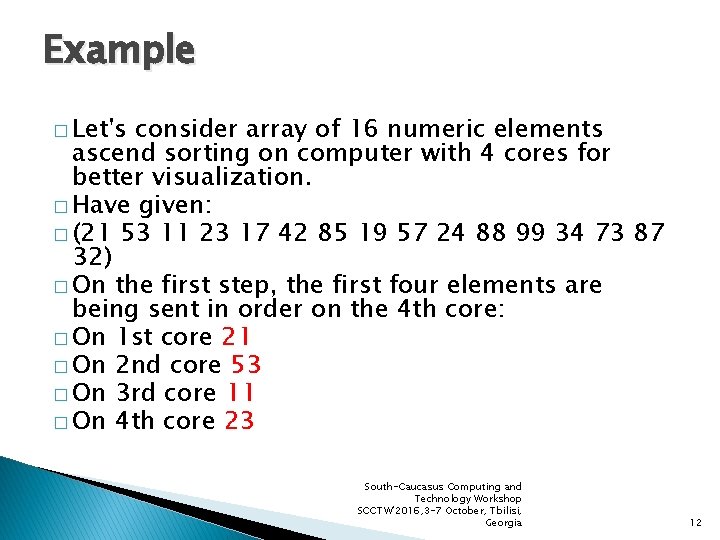
Example � Let's consider array of 16 numeric elements ascend sorting on computer with 4 cores for better visualization. � Have given: � (21 53 11 23 17 42 85 19 57 24 88 99 34 73 87 32) � On the first step, the first four elements are being sent in order on the 4 th core: � On 1 st core 21 � On 2 nd core 53 � On 3 rd core 11 � On 4 th core 23 South-Caucasus Computing and Technology Workshop SCCTW’ 2016, 3 -7 October, Tbilisi, Georgia 12
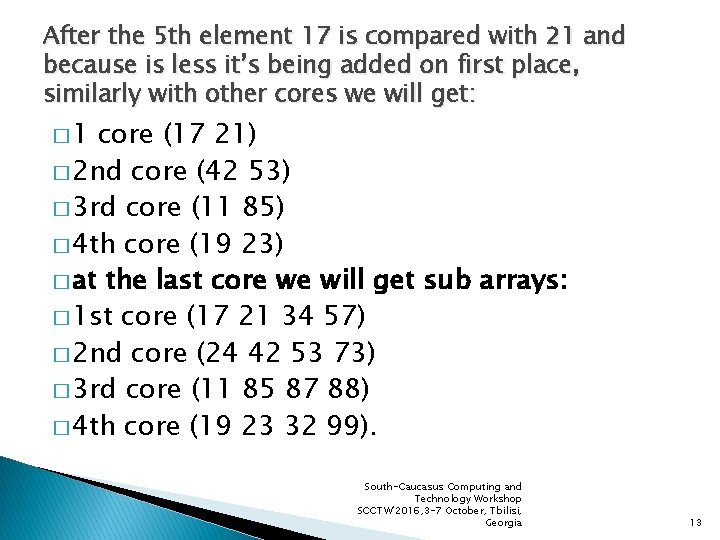
After the 5 th element 17 is compared with 21 and because is less it’s being added on first place, similarly with other cores we will get: � 1 core (17 21) � 2 nd core (42 53) � 3 rd core (11 85) � 4 th core (19 23) � at the last core we will get sub arrays: � 1 st core (17 21 34 57) � 2 nd core (24 42 53 73) � 3 rd core (11 85 87 88) � 4 th core (19 23 32 99). South-Caucasus Computing and Technology Workshop SCCTW’ 2016, 3 -7 October, Tbilisi, Georgia 13
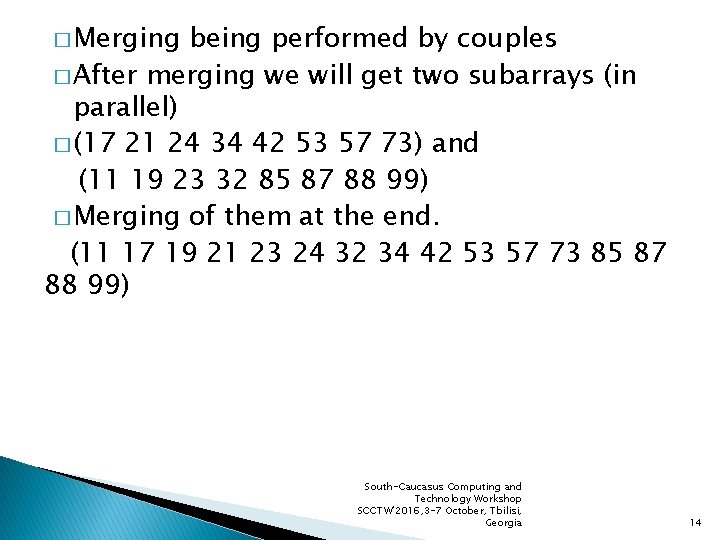
� Merging being performed by couples � After merging we will get two subarrays (in parallel) � (17 21 24 34 42 53 57 73) and (11 19 23 32 85 87 88 99) � Merging of them at the end. (11 17 19 21 23 24 32 34 42 53 57 73 85 87 88 99) South-Caucasus Computing and Technology Workshop SCCTW’ 2016, 3 -7 October, Tbilisi, Georgia 14
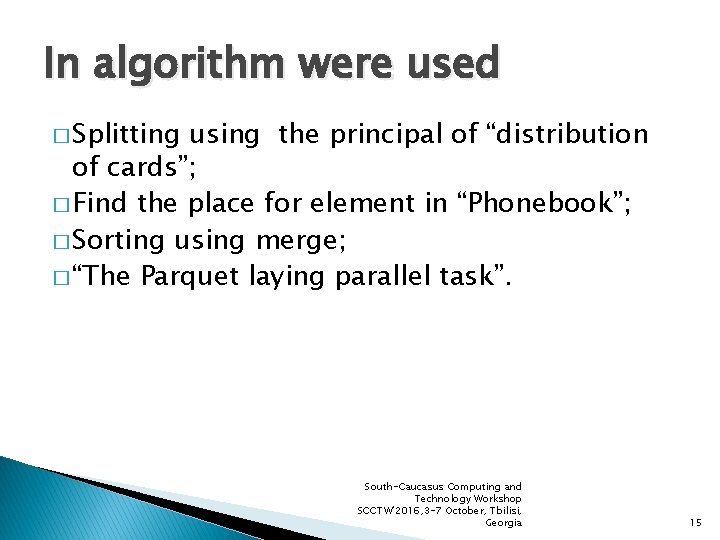
In algorithm were used � Splitting using the principal of “distribution of cards”; � Find the place for element in “Phonebook”; � Sorting using merge; � “The Parquet laying parallel task”. South-Caucasus Computing and Technology Workshop SCCTW’ 2016, 3 -7 October, Tbilisi, Georgia 15
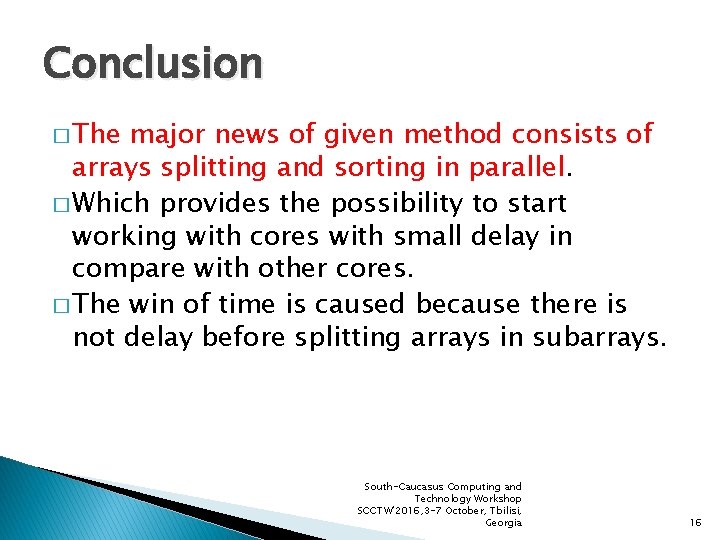
Conclusion � The major news of given method consists of arrays splitting and sorting in parallel. � Which provides the possibility to start working with cores with small delay in compare with other cores. � The win of time is caused because there is not delay before splitting arrays in subarrays. South-Caucasus Computing and Technology Workshop SCCTW’ 2016, 3 -7 October, Tbilisi, Georgia 16
Literature: 1. 2. 3. Simon Marlow. Parallel and Concurrent Programming in Haskell. 2014. R. Miller, L. Boxer. Algorithms Sequential & Parallel: A Unified Approach. M Binom 2015. N. Archvadze, M. Pkhovelishvili, L. Shetsiruli, O. Ioseliani. Usage of Logic for Parallel Verification of Haskel Programs. “Computer Sciences and Telecommunications”. 2016 | No. 3(41). http: //gesj. internet-academy. org. ge � South-Caucasus Computing and Technology Workshop SCCTW’ 2016, 3 -7 October, Tbilisi, Georgia 17