
The Aleph Time Projection Chamber Ron Settles MPIMunichDESY
The Aleph Time Projection Chamber Ron Settles, MPI-Munich/DESY TPC Symposium@LBNL 17 October 2003 TPC Symposium@LBNL ALEPH TPC Ron Settles, MPI-Munich/DESY 1
Summary u TPC is a 3 -D imaging chamber – Large volume, small amount of material. – Slow device (~50 ms) – 3 -D ‘continuous’ tracking ( xy 170 mm, z 600 mm for Aleph) u u Review some of the main ingredients History – – First proposed in 1976 (PEP 4 -TPC) Used in many experiments Aleph as an example here Now a well-established detection technique that is still in the process of evolution… 17 October 2003 TPC Symposium@LBNL ALEPH TPC Ron Settles, MPI-Munich/DESY 2

Outline u Examples u TPC principles of operation u TPC hardware ingredients – Drift velocity, Coordinates, d. E/dx – Field cage, gas system, wire chambers, gating, laser calibration system, electronics u The Aleph TPC u From the drawing board to the gadget u Performance u Some ‘features’ (i. e. trouble shooting…) u Conclusion 17 October 2003 TPC Symposium@LBNL ALEPH TPC Ron Settles, MPI-Munich/DESY 3
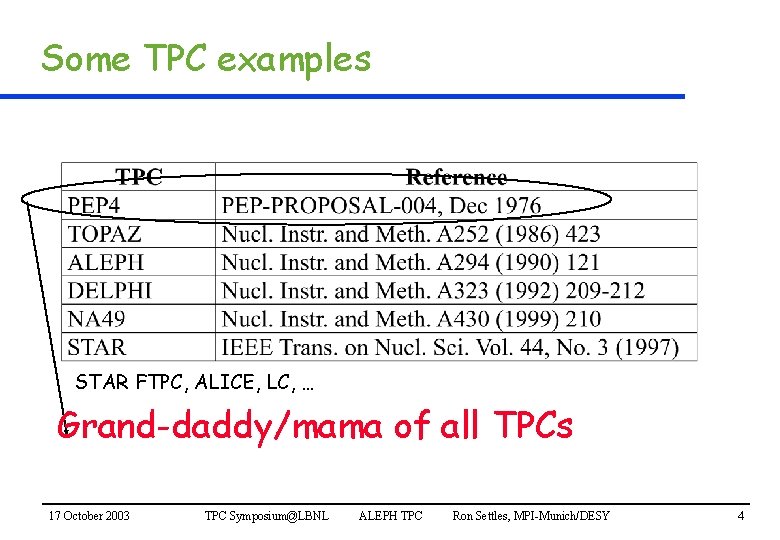
Some TPC examples STAR FTPC, ALICE, LC, … Grand-daddy/mama of all TPCs 17 October 2003 TPC Symposium@LBNL ALEPH TPC Ron Settles, MPI-Munich/DESY 4
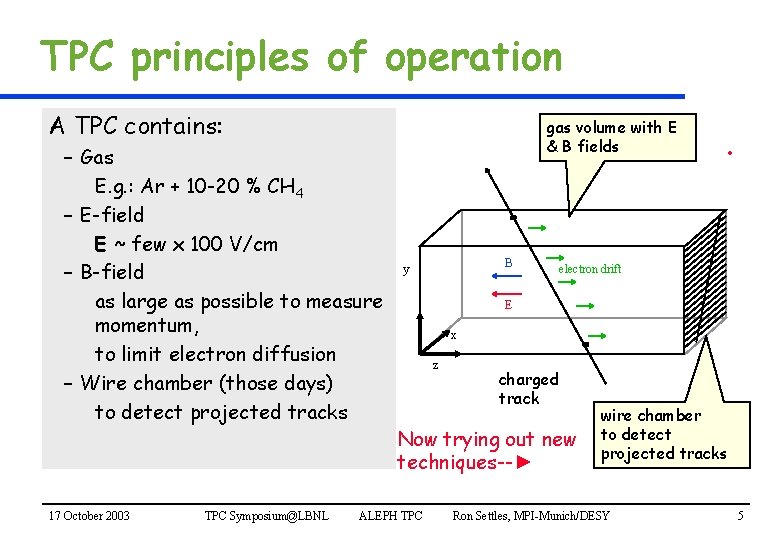
TPC principles of operation A TPC contains: – Gas E. g. : Ar + 10 -20 % CH 4 – E-field E ~ few x 100 V/cm – B-field as large as possible to measure momentum, to limit electron diffusion – Wire chamber (those days) to detect projected tracks 17 October 2003 TPC Symposium@LBNL gas volume with E & B fields B y • electron drift E x z charged track Now trying out new techniques--► ALEPH TPC wire chamber to detect projected tracks Ron Settles, MPI-Munich/DESY 5
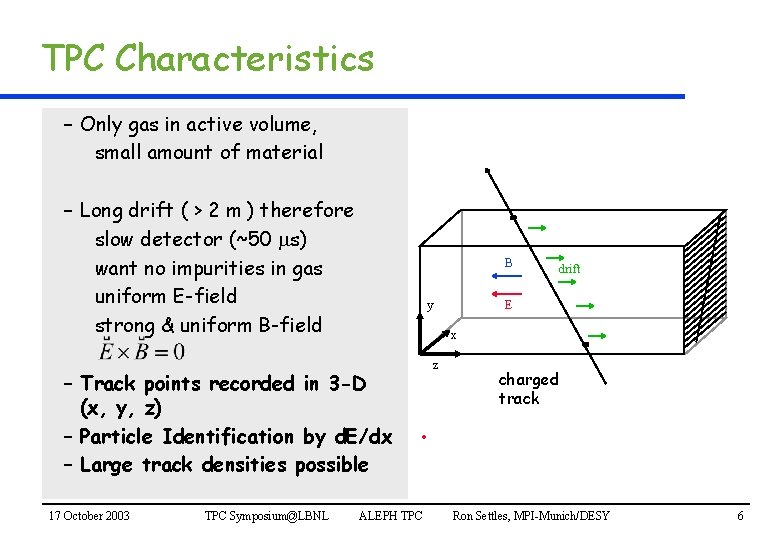
TPC Characteristics – Only gas in active volume, small amount of material – Long drift ( > 2 m ) therefore slow detector (~50 ms) want no impurities in gas uniform E-field strong & uniform B-field B y TPC Symposium@LBNL E x – Track points recorded in 3 -D (x, y, z) – Particle Identification by d. E/dx – Large track densities possible 17 October 2003 drift z charged track • ALEPH TPC Ron Settles, MPI-Munich/DESY 6
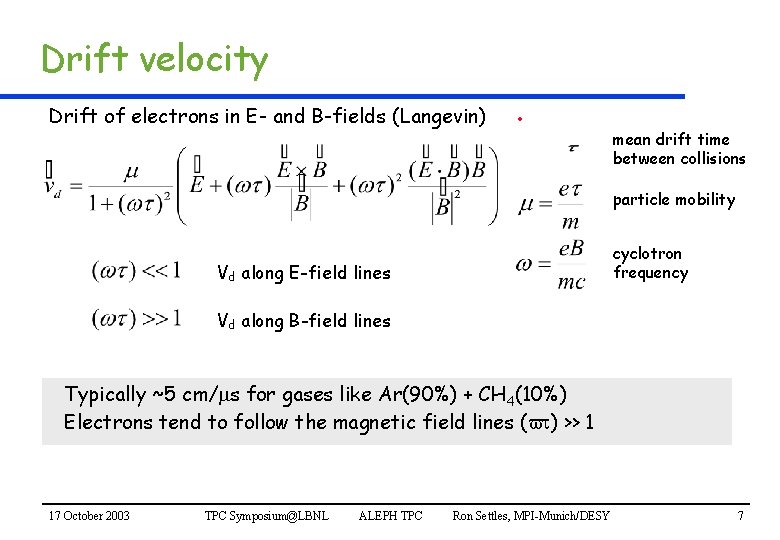
Drift velocity Drift of electrons in E- and B-fields (Langevin) • mean drift time between collisions particle mobility cyclotron frequency Vd along E-field lines Vd along B-field lines Typically ~5 cm/ms for gases like Ar(90%) + CH 4(10%) Electrons tend to follow the magnetic field lines (vt) >> 1 17 October 2003 TPC Symposium@LBNL ALEPH TPC Ron Settles, MPI-Munich/DESY 7
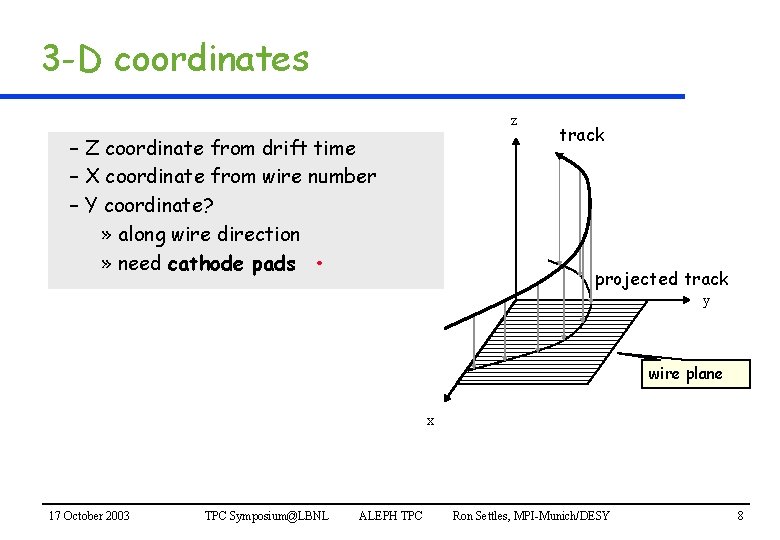
3 -D coordinates z – Z coordinate from drift time – X coordinate from wire number – Y coordinate? » along wire direction » need cathode pads • track projected track y wire plane x 17 October 2003 TPC Symposium@LBNL ALEPH TPC Ron Settles, MPI-Munich/DESY 8
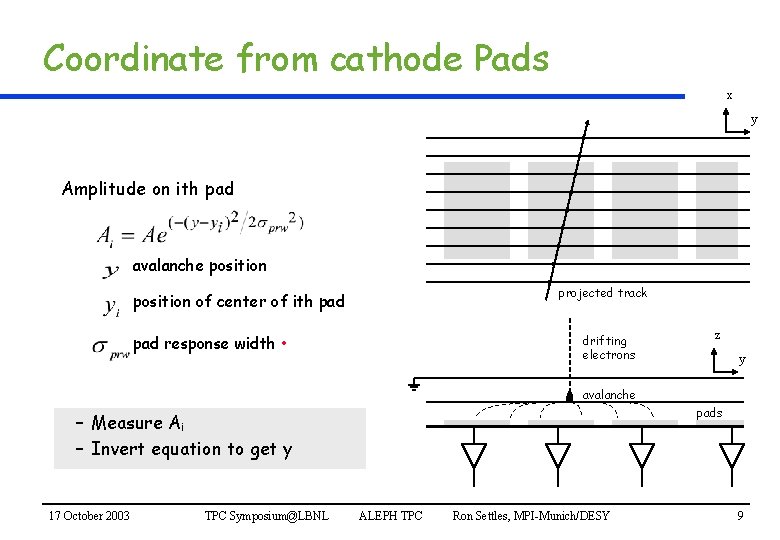
Coordinate from cathode Pads x y Amplitude on ith pad avalanche position projected track position of center of ith pad response width • drifting electrons z y avalanche pads – Measure Ai – Invert equation to get y 17 October 2003 TPC Symposium@LBNL ALEPH TPC Ron Settles, MPI-Munich/DESY 9
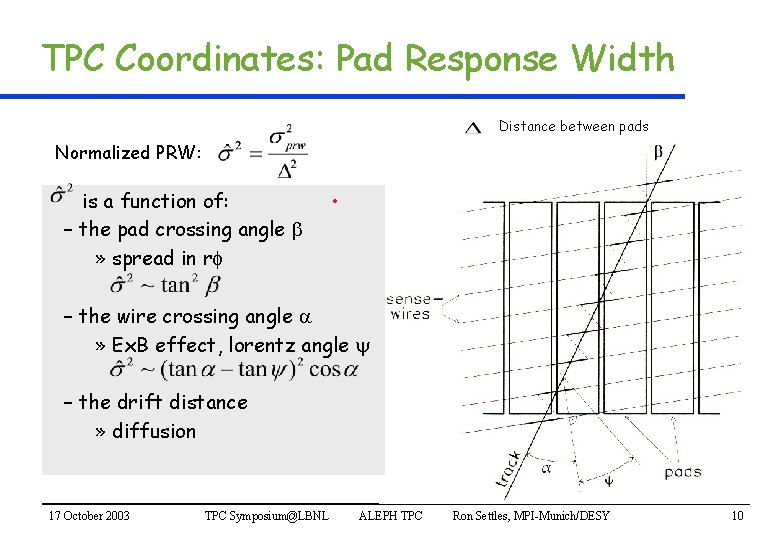
TPC Coordinates: Pad Response Width Distance between pads Normalized PRW: is a function of: – the pad crossing angle b » spread in rf • – the wire crossing angle a » Ex. B effect, lorentz angle – the drift distance » diffusion 17 October 2003 TPC Symposium@LBNL ALEPH TPC Ron Settles, MPI-Munich/DESY 10
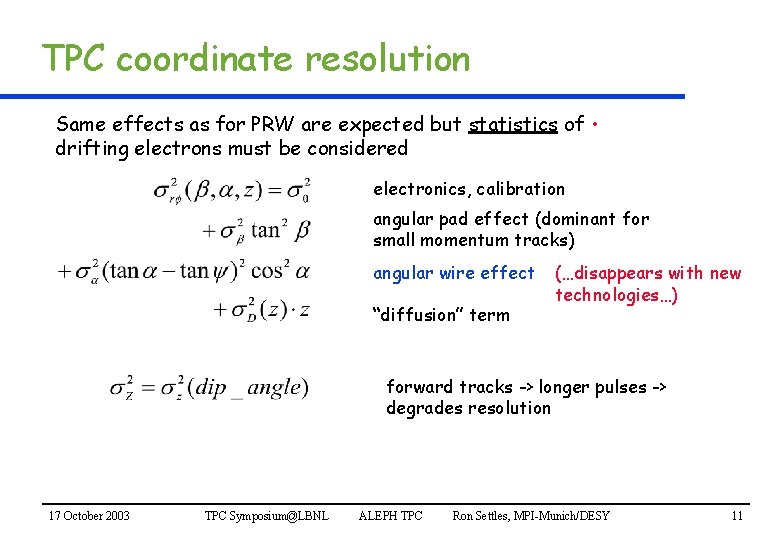
TPC coordinate resolution Same effects as for PRW are expected but statistics of • drifting electrons must be considered electronics, calibration angular pad effect (dominant for small momentum tracks) angular wire effect “diffusion” term (…disappears with new technologies…) forward tracks -> longer pulses -> degrades resolution 17 October 2003 TPC Symposium@LBNL ALEPH TPC Ron Settles, MPI-Munich/DESY 11
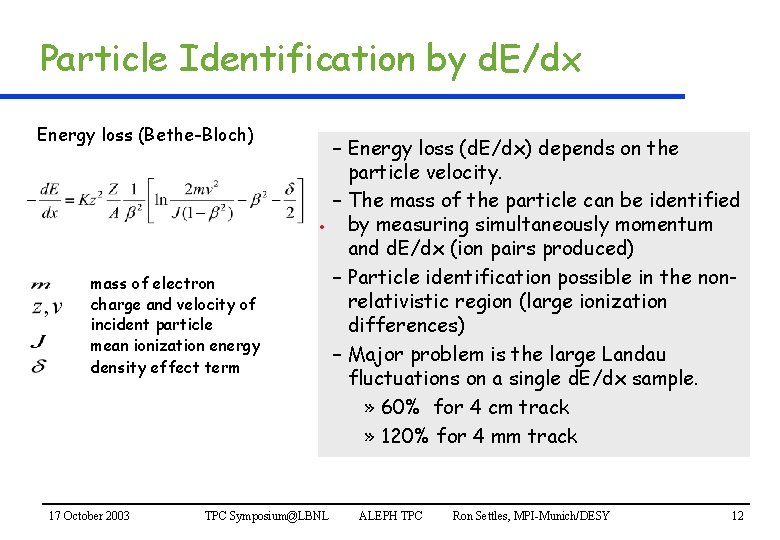
Particle Identification by d. E/dx Energy loss (Bethe-Bloch) mass of electron charge and velocity of incident particle mean ionization energy density effect term 17 October 2003 – Energy loss (d. E/dx) depends on the particle velocity. – The mass of the particle can be identified • by measuring simultaneously momentum and d. E/dx (ion pairs produced) – Particle identification possible in the nonrelativistic region (large ionization differences) – Major problem is the large Landau fluctuations on a single d. E/dx sample. » 60% for 4 cm track » 120% for 4 mm track TPC Symposium@LBNL ALEPH TPC Ron Settles, MPI-Munich/DESY 12
TPC ingredients (Aleph example) u Wire chambers – Gating – Cooling – Mechanics u u Field cage Gas system Laser system Electronics 17 October 2003 TPC Symposium@LBNL ALEPH TPC Ron Settles, MPI-Munich/DESY 13
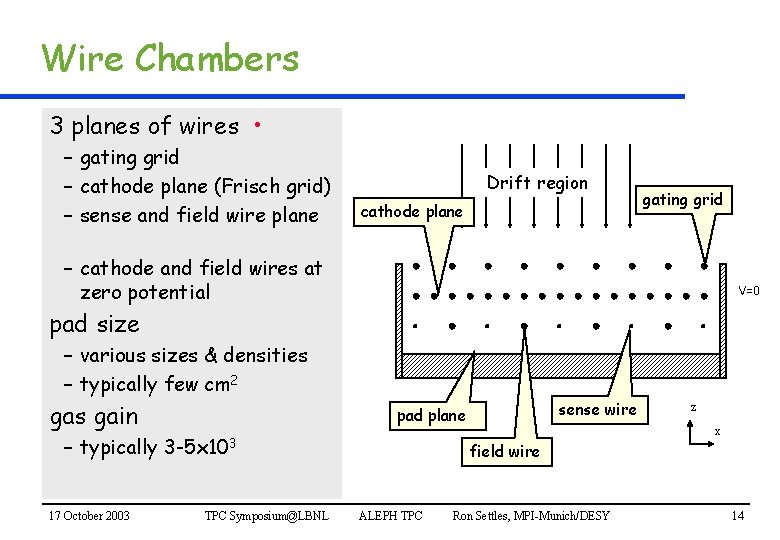
Wire Chambers 3 planes of wires • – gating grid – cathode plane (Frisch grid) – sense and field wire plane Drift region cathode plane gating grid – cathode and field wires at zero potential V=0 pad size – various sizes & densities – typically few cm 2 gas gain – typically 3 -5 x 10³ 17 October 2003 sense wire pad plane TPC Symposium@LBNL z x field wire ALEPH TPC Ron Settles, MPI-Munich/DESY 14
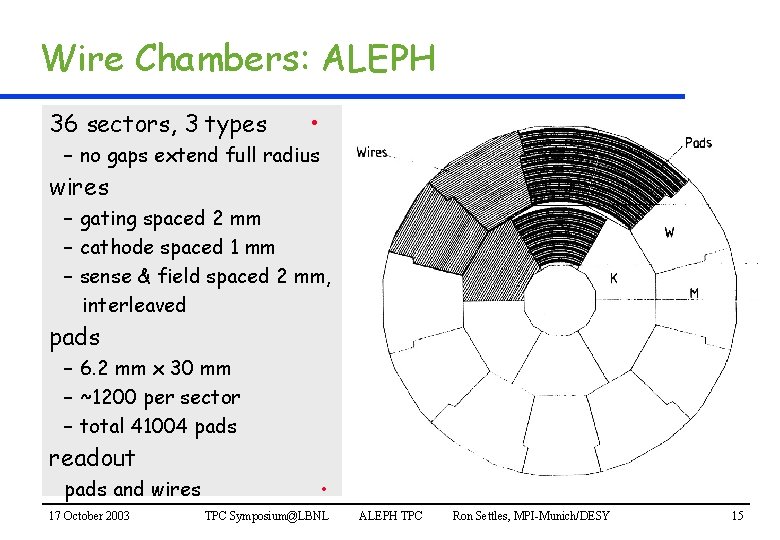
Wire Chambers: ALEPH 36 sectors, 3 types • – no gaps extend full radius wires – gating spaced 2 mm – cathode spaced 1 mm – sense & field spaced 2 mm, interleaved pads – 6. 2 mm x 30 mm – ~1200 per sector – total 41004 pads readout pads and wires 17 October 2003 • TPC Symposium@LBNL ALEPH TPC Ron Settles, MPI-Munich/DESY 15
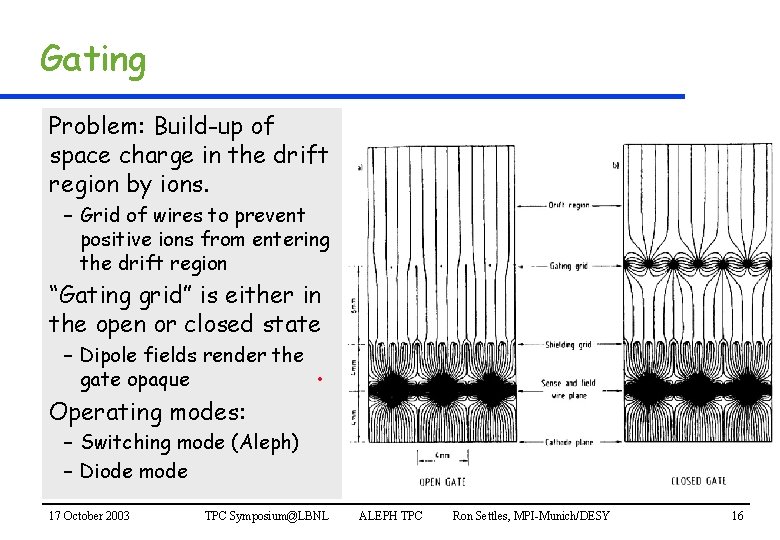
Gating Problem: Build-up of space charge in the drift region by ions. – Grid of wires to prevent positive ions from entering the drift region “Gating grid” is either in the open or closed state – Dipole fields render the gate opaque • Operating modes: – Switching mode (Aleph) – Diode mode 17 October 2003 TPC Symposium@LBNL ALEPH TPC Ron Settles, MPI-Munich/DESY 16
Cooling, Mechanics u u u Terribly mundane but terribly important (everything is important) Cooling: – Combined air and water cooling to completely insulate the gas volume Mechanics: – 25% X_0 for sectors, preamps, cooling (but before cables) 17 October 2003 TPC Symposium@LBNL ALEPH TPC Ron Settles, MPI-Munich/DESY 17
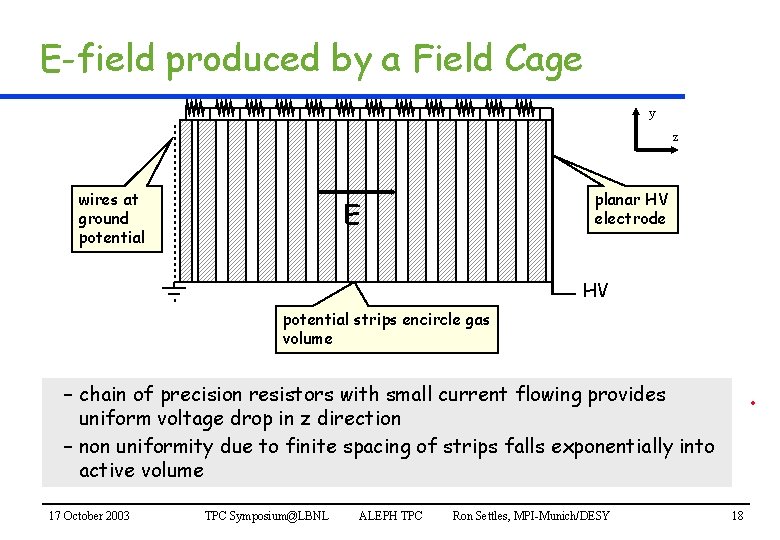
E-field produced by a Field Cage y z wires at ground potential planar HV electrode E HV potential strips encircle gas volume – chain of precision resistors with small current flowing provides uniform voltage drop in z direction – non uniformity due to finite spacing of strips falls exponentially into active volume 17 October 2003 TPC Symposium@LBNL ALEPH TPC Ron Settles, MPI-Munich/DESY • 18
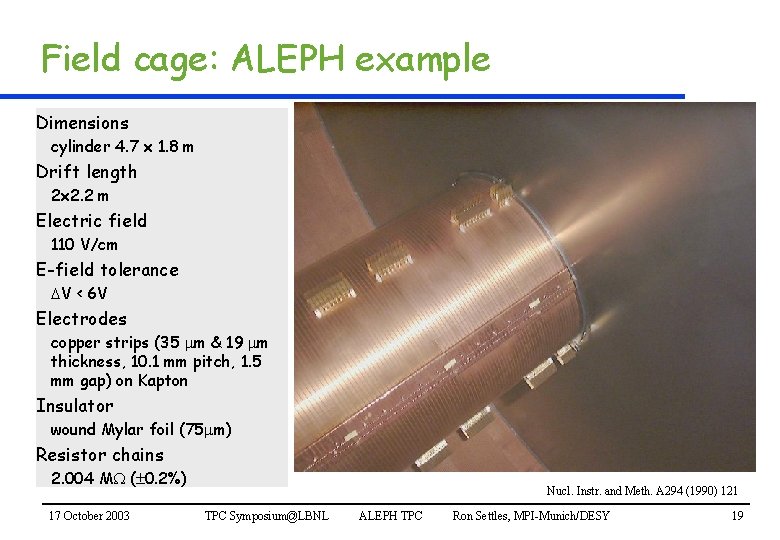
Field cage: ALEPH example Dimensions cylinder 4. 7 x 1. 8 m Drift length 2 x 2. 2 m Electric field 110 V/cm E-field tolerance V < 6 V Electrodes copper strips (35 mm & 19 mm thickness, 10. 1 mm pitch, 1. 5 mm gap) on Kapton Insulator wound Mylar foil (75 mm) Resistor chains 2. 004 M ( 0. 2%) 17 October 2003 Nucl. Instr. and Meth. A 294 (1990) 121 TPC Symposium@LBNL ALEPH TPC Ron Settles, MPI-Munich/DESY 19
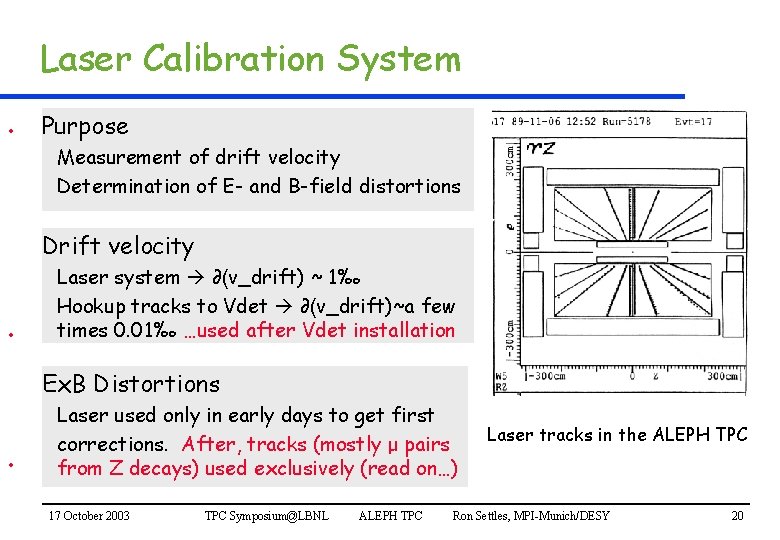
Laser Calibration System • Purpose Measurement of drift velocity Determination of E- and B-field distortions Drift velocity • Laser system ∂(v_drift) ~ 1‰ Hookup tracks to Vdet ∂(v_drift)~a few times 0. 01‰ …used after Vdet installation Ex. B Distortions • Laser used only in early days to get first corrections. After, tracks (mostly μ pairs from Z decays) used exclusively (read on…) 17 October 2003 TPC Symposium@LBNL ALEPH TPC Laser tracks in the ALEPH TPC Ron Settles, MPI-Munich/DESY 20
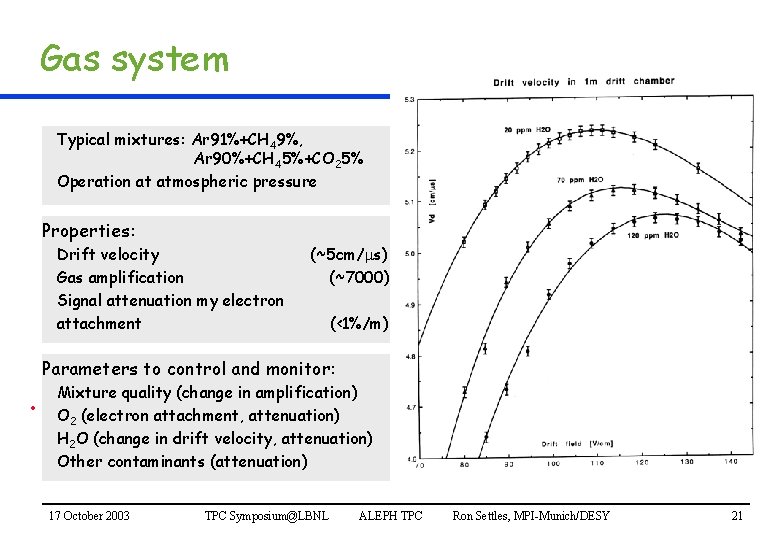
Gas system Typical mixtures: Ar 91%+CH 49%, Ar 90%+CH 45%+CO 25% Operation at atmospheric pressure Properties: Drift velocity Gas amplification Signal attenuation my electron attachment (~5 cm/ms) (~7000) (<1%/m) Parameters to control and monitor: • Mixture quality (change in amplification) O 2 (electron attachment, attenuation) H 2 O (change in drift velocity, attenuation) Other contaminants (attenuation) 17 October 2003 TPC Symposium@LBNL ALEPH TPC Ron Settles, MPI-Munich/DESY 21
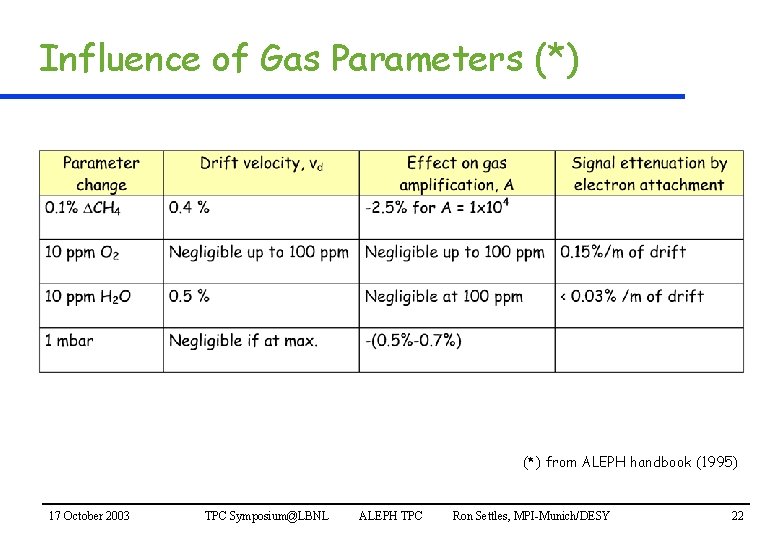
Influence of Gas Parameters (*) from ALEPH handbook (1995) 17 October 2003 TPC Symposium@LBNL ALEPH TPC Ron Settles, MPI-Munich/DESY 22
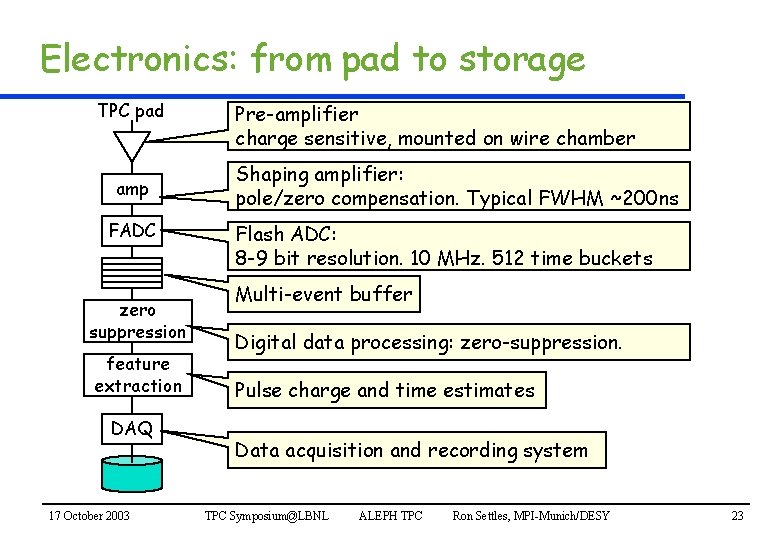
Electronics: from pad to storage TPC pad amp FADC zero suppression feature extraction DAQ 17 October 2003 Pre-amplifier charge sensitive, mounted on wire chamber Shaping amplifier: pole/zero compensation. Typical FWHM ~200 ns Flash ADC: 8 -9 bit resolution. 10 MHz. 512 time buckets Multi-event buffer Digital data processing: zero-suppression. Pulse charge and time estimates Data acquisition and recording system TPC Symposium@LBNL ALEPH TPC Ron Settles, MPI-Munich/DESY 23
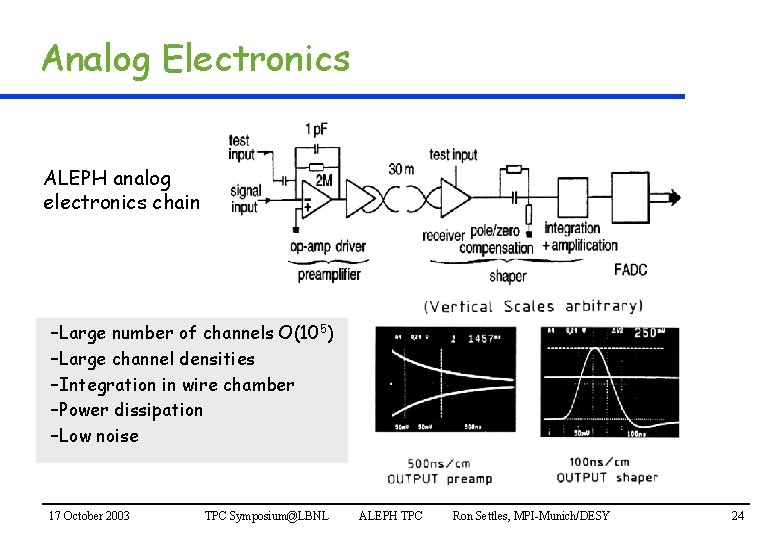
Analog Electronics ALEPH analog electronics chain –Large number of channels O(105) –Large channel densities –Integration in wire chamber –Power dissipation –Low noise 17 October 2003 TPC Symposium@LBNL ALEPH TPC Ron Settles, MPI-Munich/DESY 24
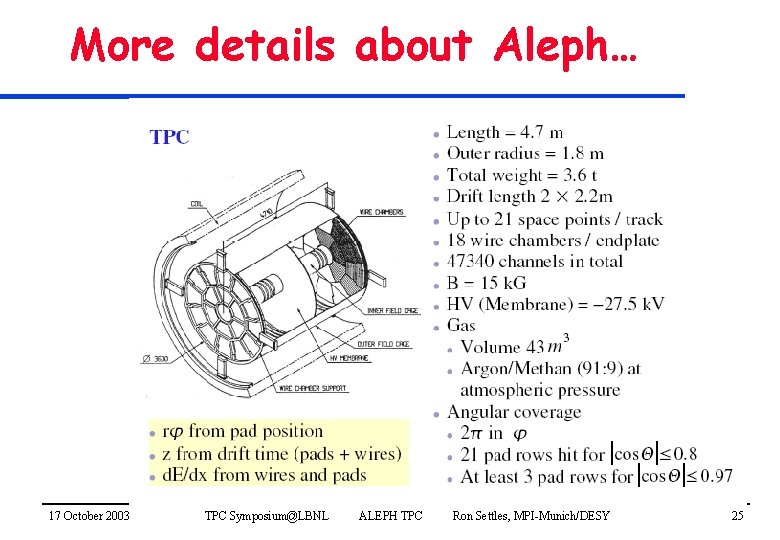
More details about Aleph… 17 October 2003 TPC Symposium@LBNL ALEPH TPC Ron Settles, MPI-Munich/DESY 25
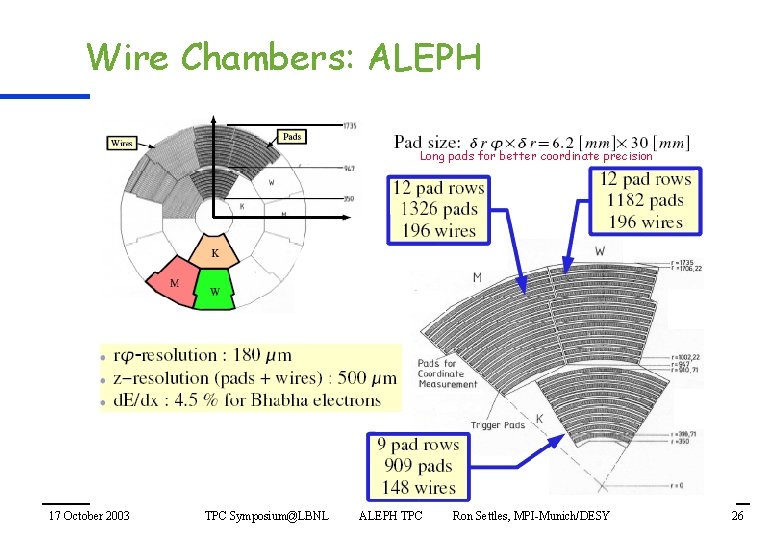
Wire Chambers: ALEPH Long pads for better coordinate precision 17 October 2003 TPC Symposium@LBNL ALEPH TPC Ron Settles, MPI-Munich/DESY 26
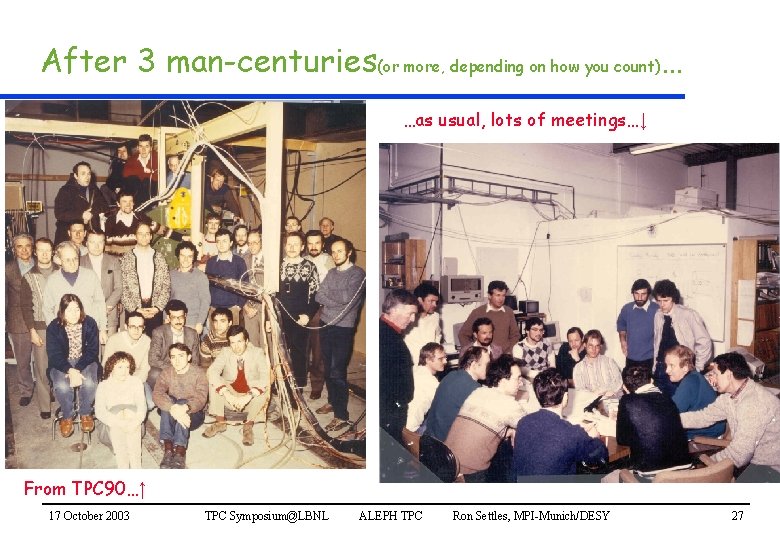
After 3 man-centuries(or more, depending on how you count)… …as usual, lots of meetings…↓ From TPC 90…↑ 17 October 2003 TPC Symposium@LBNL ALEPH TPC Ron Settles, MPI-Munich/DESY 27
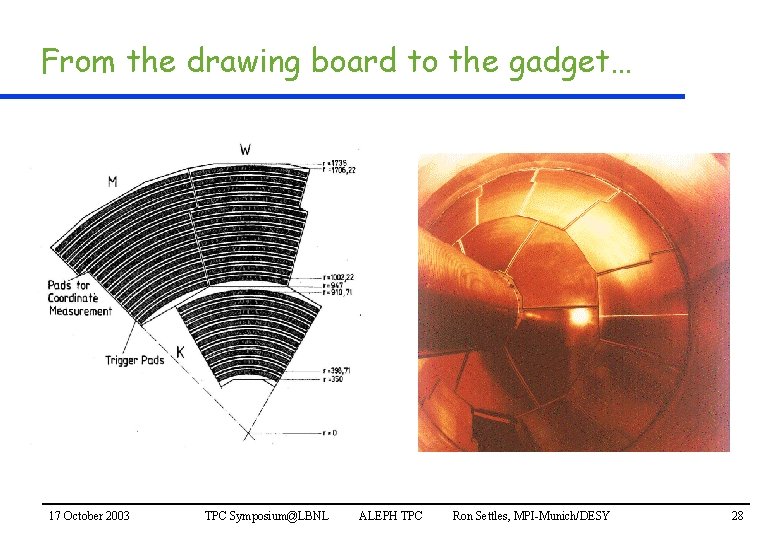
From the drawing board to the gadget… 17 October 2003 TPC Symposium@LBNL ALEPH TPC Ron Settles, MPI-Munich/DESY 28
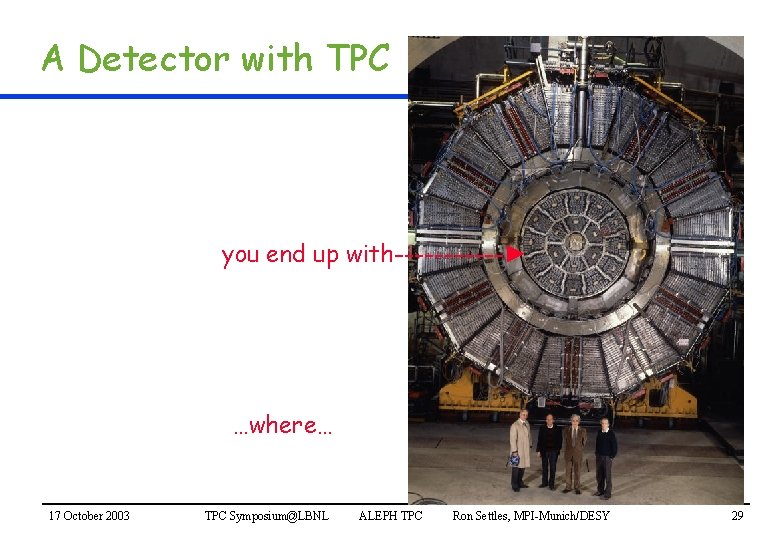
A Detector with TPC you end up with------► …where… 17 October 2003 TPC Symposium@LBNL ALEPH TPC Ron Settles, MPI-Munich/DESY 29
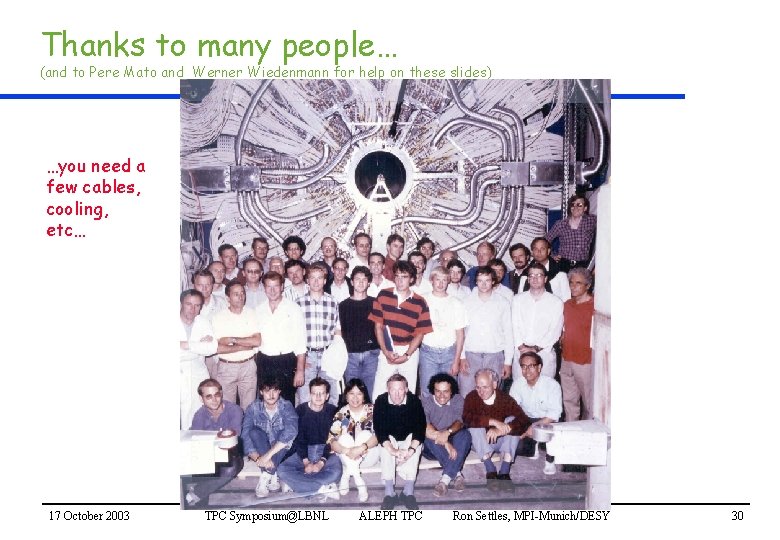
Thanks to many people… (and to Pere Mato and Werner Wiedenmann for help on these slides) …you need a few cables, cooling, etc… 17 October 2003 TPC Symposium@LBNL ALEPH TPC Ron Settles, MPI-Munich/DESY 30
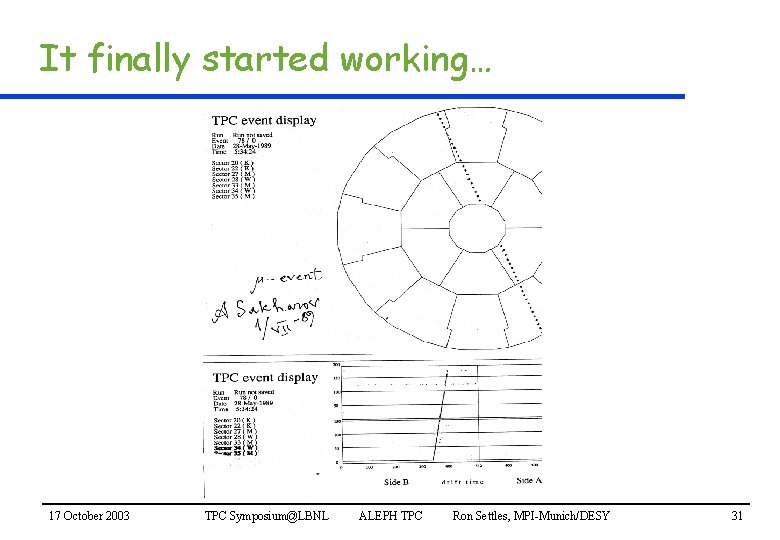
It finally started working… 17 October 2003 TPC Symposium@LBNL ALEPH TPC Ron Settles, MPI-Munich/DESY 31
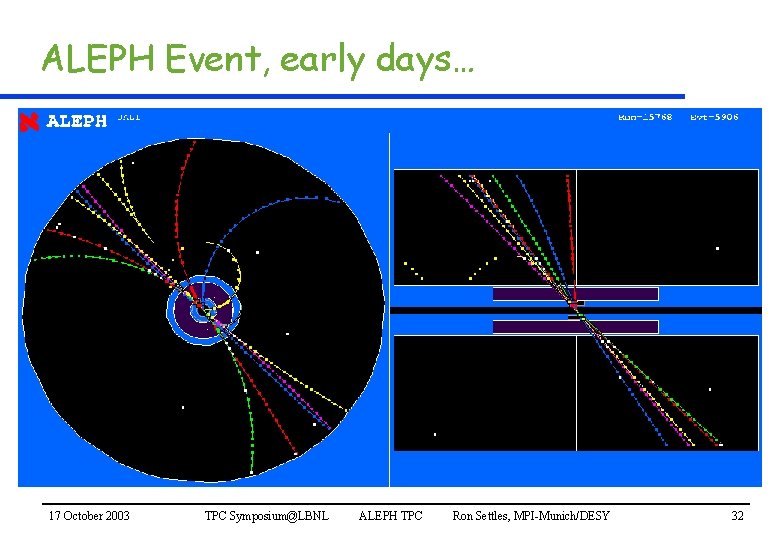
ALEPH Event, early days… 17 October 2003 TPC Symposium@LBNL ALEPH TPC Ron Settles, MPI-Munich/DESY 32
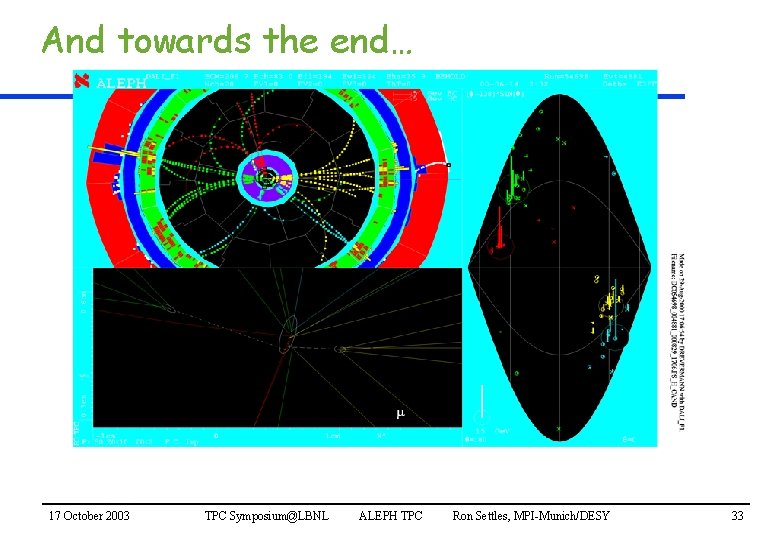
And towards the end… 17 October 2003 TPC Symposium@LBNL ALEPH TPC Ron Settles, MPI-Munich/DESY 33
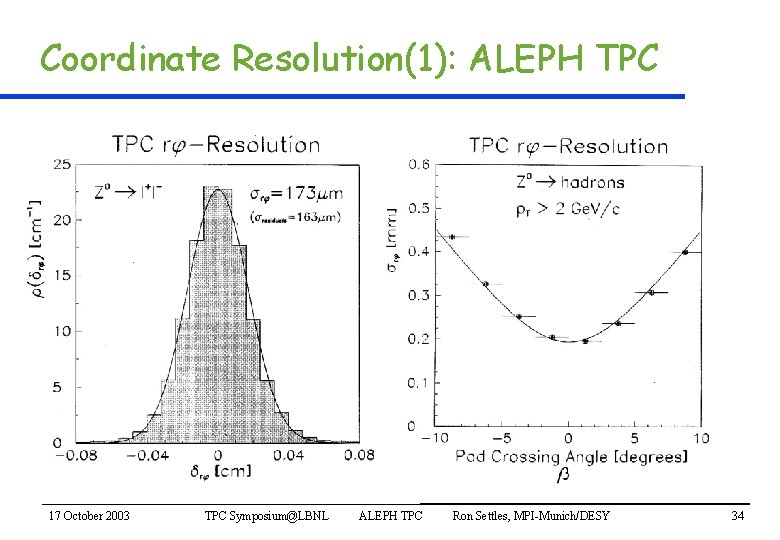
Coordinate Resolution(1): ALEPH TPC 17 October 2003 TPC Symposium@LBNL ALEPH TPC Ron Settles, MPI-Munich/DESY 34
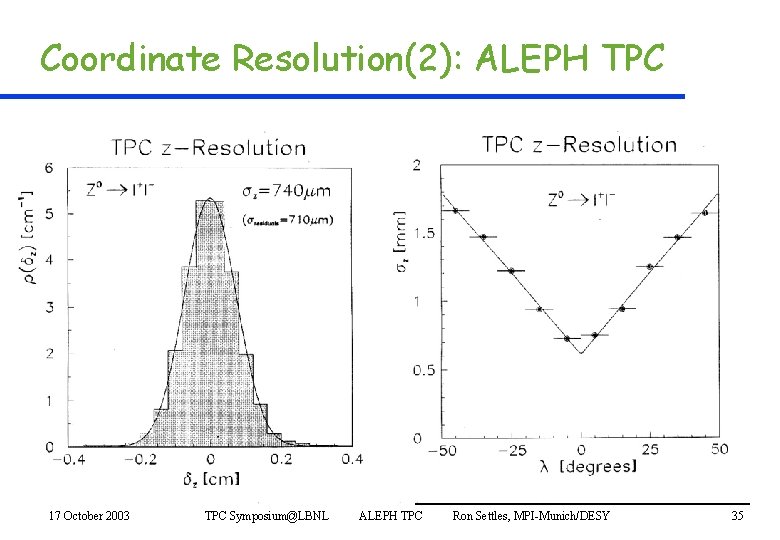
Coordinate Resolution(2): ALEPH TPC 17 October 2003 TPC Symposium@LBNL ALEPH TPC Ron Settles, MPI-Munich/DESY 35
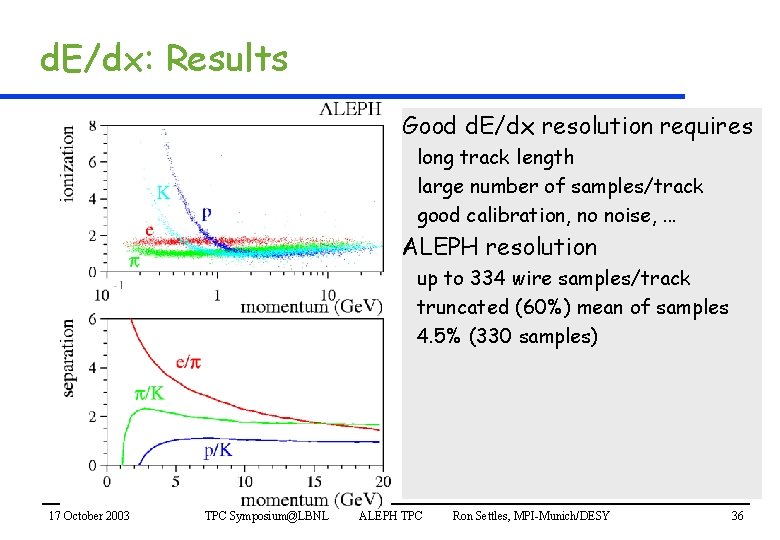
d. E/dx: Results Good d. E/dx resolution requires long track length large number of samples/track good calibration, no noise, . . . ALEPH resolution up to 334 wire samples/track truncated (60%) mean of samples 4. 5% (330 samples) 17 October 2003 TPC Symposium@LBNL ALEPH TPC Ron Settles, MPI-Munich/DESY 36
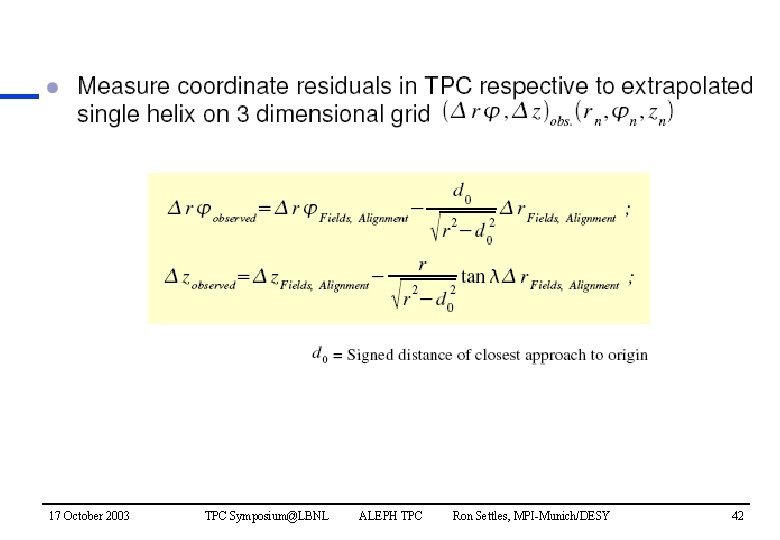
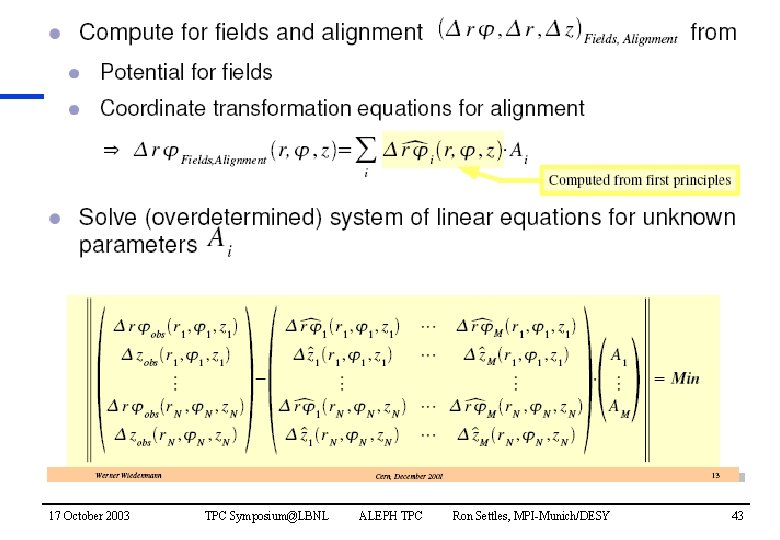
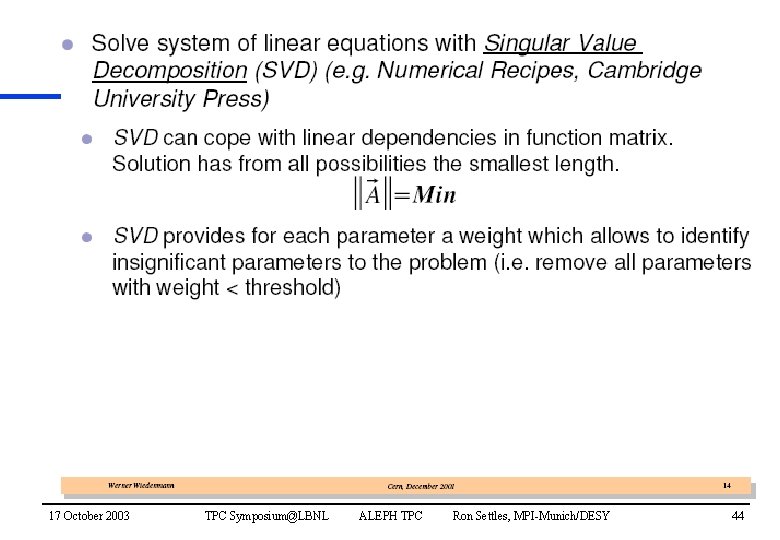
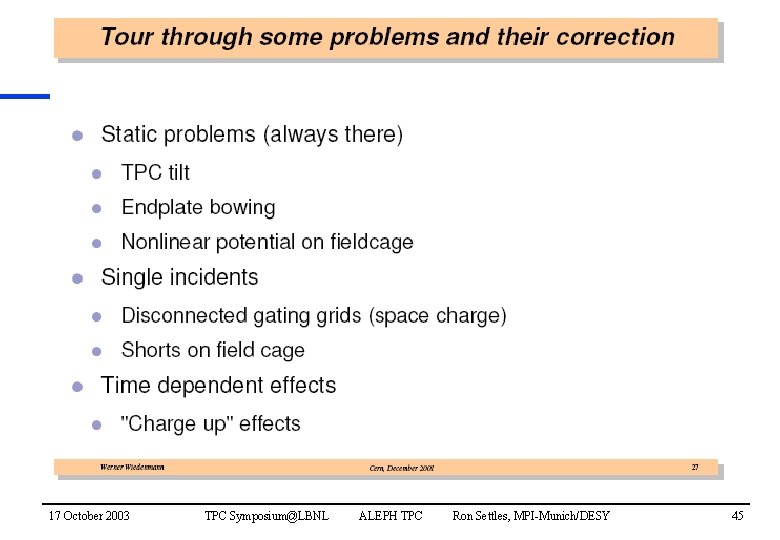
But, there were ‘FEATURES’… Werner’s talk contains many details, see alephwww. mppmu. mpg. de/~settles/tpc • here a few examples… 17 October 2003 TPC Symposium@LBNL ALEPH TPC Ron Settles, MPI-Munich/DESY 37
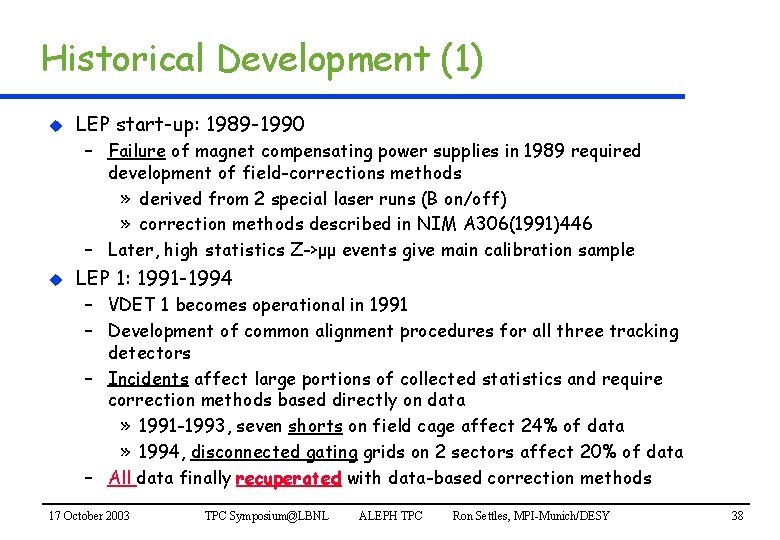
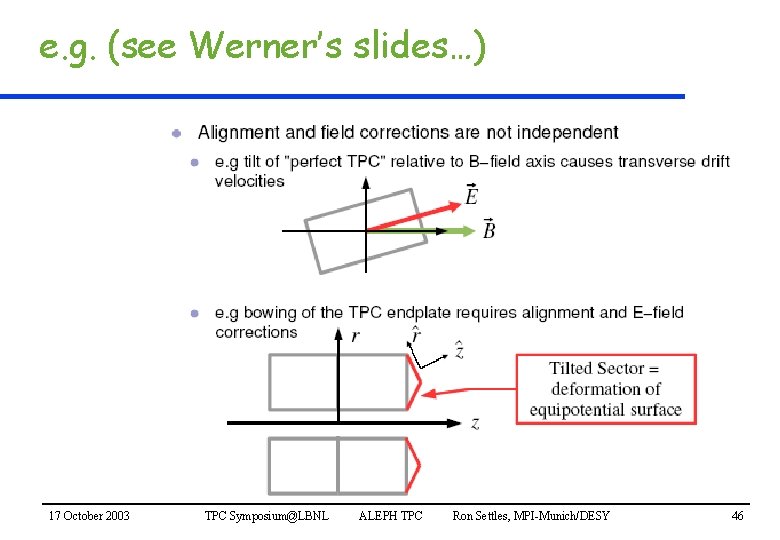
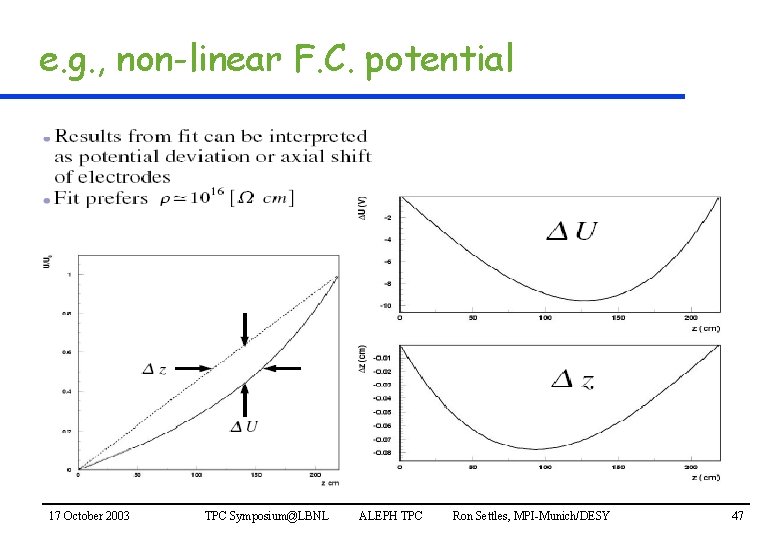
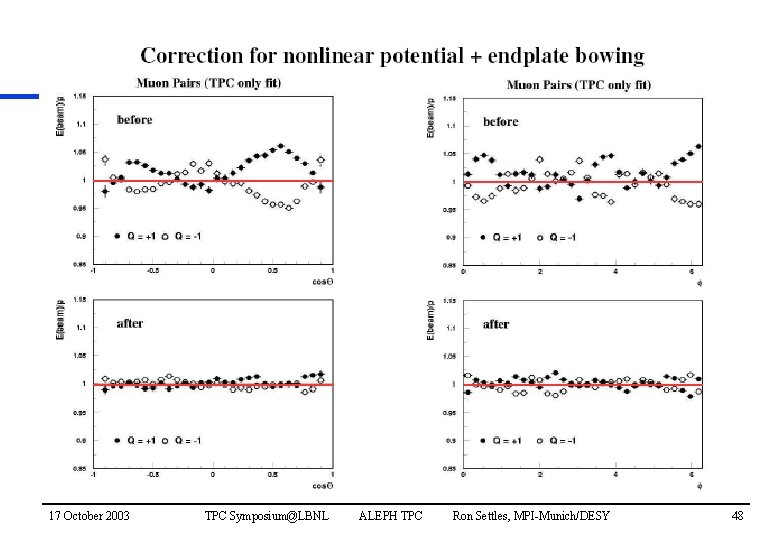
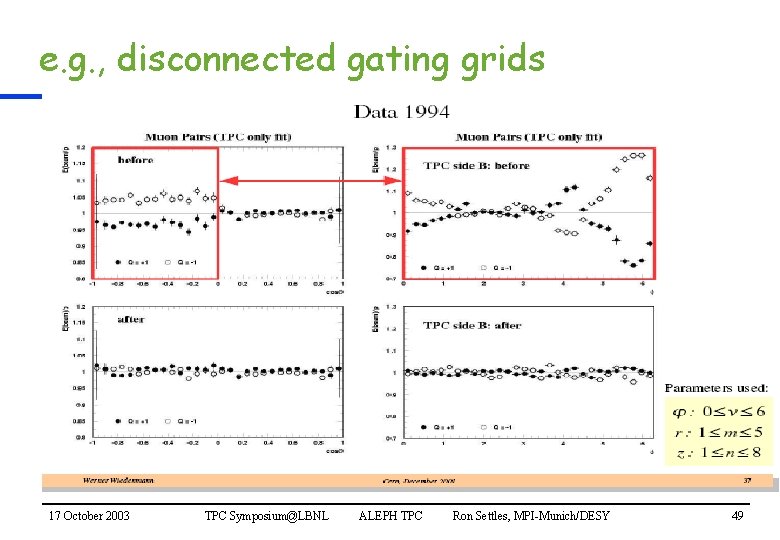
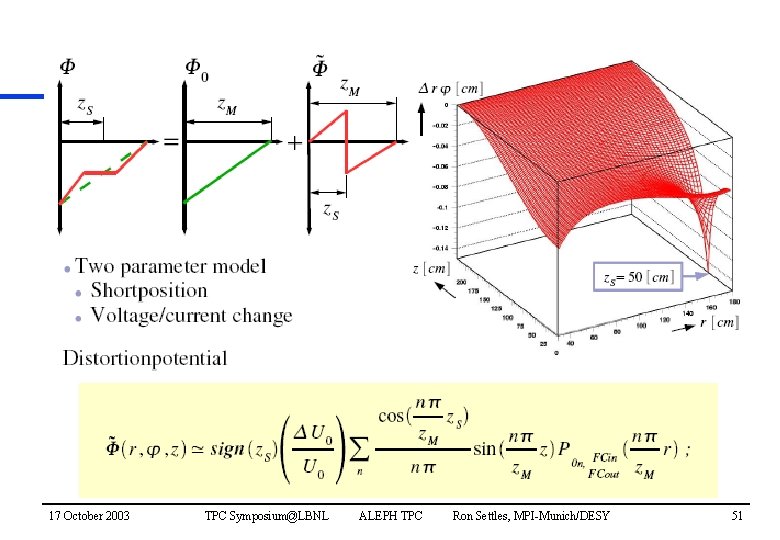
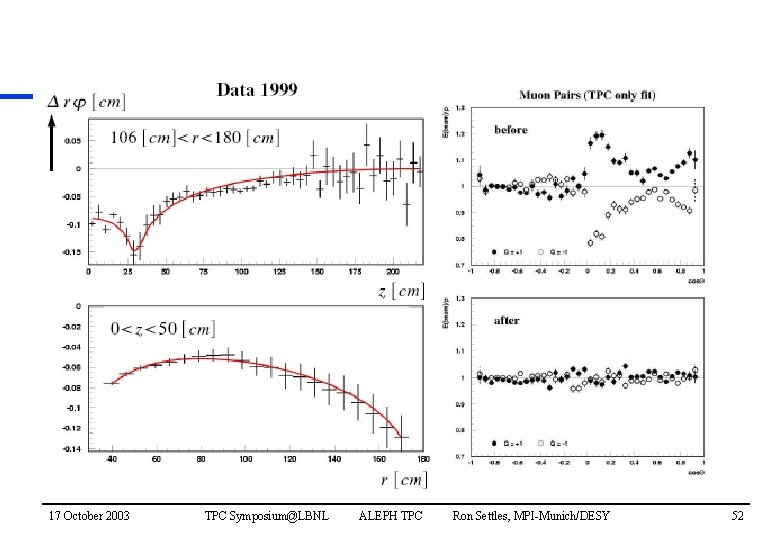
Historical Development (1) u LEP start-up: 1989 -1990 – Failure of magnet compensating power supplies in 1989 required development of field-corrections methods » derived from 2 special laser runs (B on/off) » correction methods described in NIM A 306(1991)446 – Later, high statistics Z->μμ events give main calibration sample u LEP 1: 1991 -1994 – VDET 1 becomes operational in 1991 – Development of common alignment procedures for all three tracking detectors – Incidents affect large portions of collected statistics and require correction methods based directly on data » 1991 -1993, seven shorts on field cage affect 24% of data » 1994, disconnected gating grids on 2 sectors affect 20% of data – All data finally recuperated with data-based correction methods 17 October 2003 TPC Symposium@LBNL ALEPH TPC Ron Settles, MPI-Munich/DESY 38
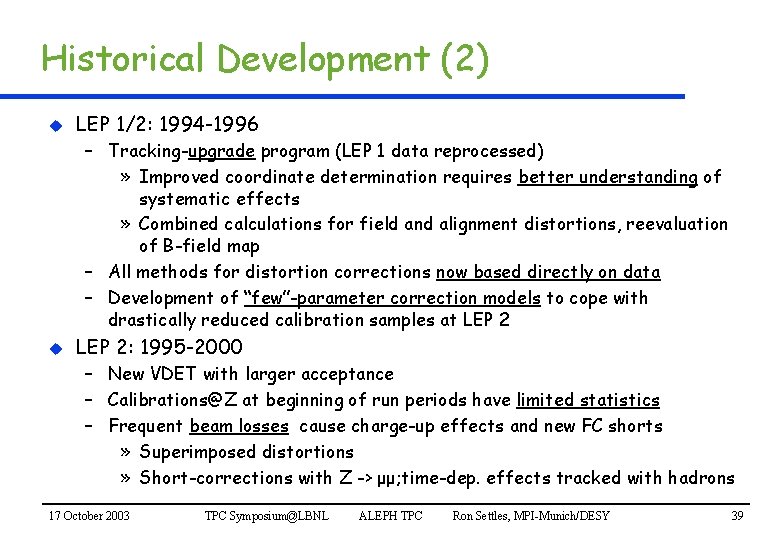
Historical Development (2) u LEP 1/2: 1994 -1996 – Tracking-upgrade program (LEP 1 data reprocessed) » Improved coordinate determination requires better understanding of systematic effects » Combined calculations for field and alignment distortions, reevaluation of B-field map – All methods for distortion corrections now based directly on data – Development of “few”-parameter correction models to cope with drastically reduced calibration samples at LEP 2 u LEP 2: 1995 -2000 – New VDET with larger acceptance – Calibrations@Z at beginning of run periods have limited statistics – Frequent beam losses cause charge-up effects and new FC shorts » Superimposed distortions » Short-corrections with Z -> μμ; time-dep. effects tracked with hadrons 17 October 2003 TPC Symposium@LBNL ALEPH TPC Ron Settles, MPI-Munich/DESY 39
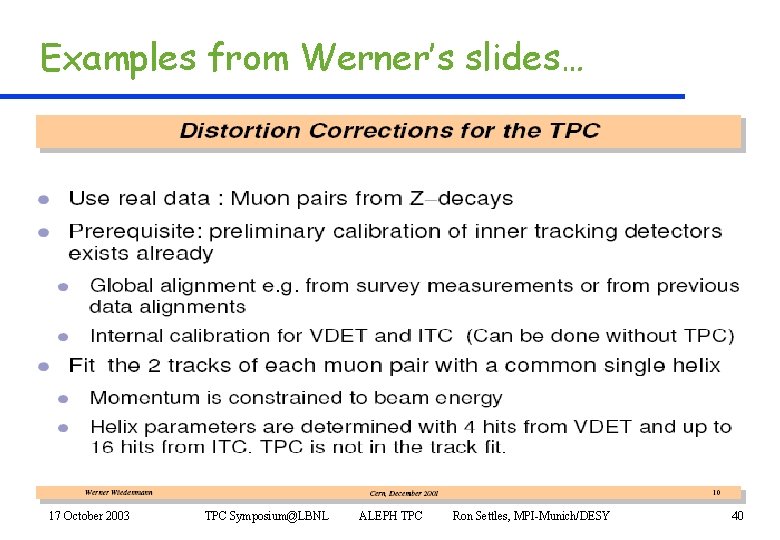
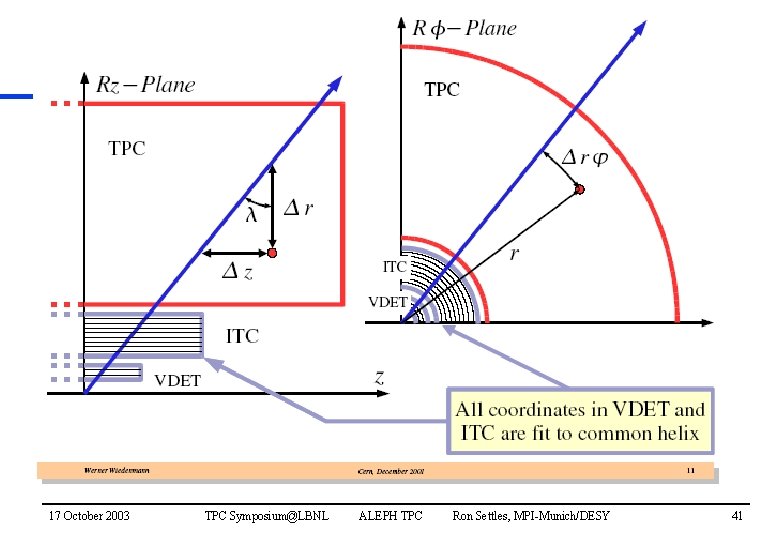
Examples from Werner’s slides… 17 October 2003 TPC Symposium@LBNL ALEPH TPC Ron Settles, MPI-Munich/DESY 40
17 October 2003 TPC Symposium@LBNL ALEPH TPC Ron Settles, MPI-Munich/DESY 41
17 October 2003 TPC Symposium@LBNL ALEPH TPC Ron Settles, MPI-Munich/DESY 42
17 October 2003 TPC Symposium@LBNL ALEPH TPC Ron Settles, MPI-Munich/DESY 43
17 October 2003 TPC Symposium@LBNL ALEPH TPC Ron Settles, MPI-Munich/DESY 44
17 October 2003 TPC Symposium@LBNL ALEPH TPC Ron Settles, MPI-Munich/DESY 45
e. g. (see Werner’s slides…) 17 October 2003 TPC Symposium@LBNL ALEPH TPC Ron Settles, MPI-Munich/DESY 46
e. g. , non-linear F. C. potential 17 October 2003 TPC Symposium@LBNL ALEPH TPC Ron Settles, MPI-Munich/DESY 47
17 October 2003 TPC Symposium@LBNL ALEPH TPC Ron Settles, MPI-Munich/DESY 48
e. g. , disconnected gating grids 17 October 2003 TPC Symposium@LBNL ALEPH TPC Ron Settles, MPI-Munich/DESY 49
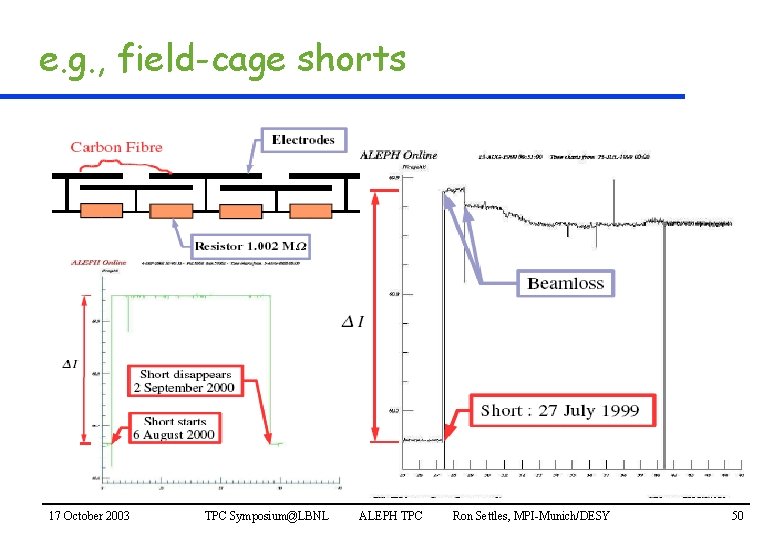
e. g. , field-cage shorts 17 October 2003 TPC Symposium@LBNL ALEPH TPC Ron Settles, MPI-Munich/DESY 50
17 October 2003 TPC Symposium@LBNL ALEPH TPC Ron Settles, MPI-Munich/DESY 51
17 October 2003 TPC Symposium@LBNL ALEPH TPC Ron Settles, MPI-Munich/DESY 52
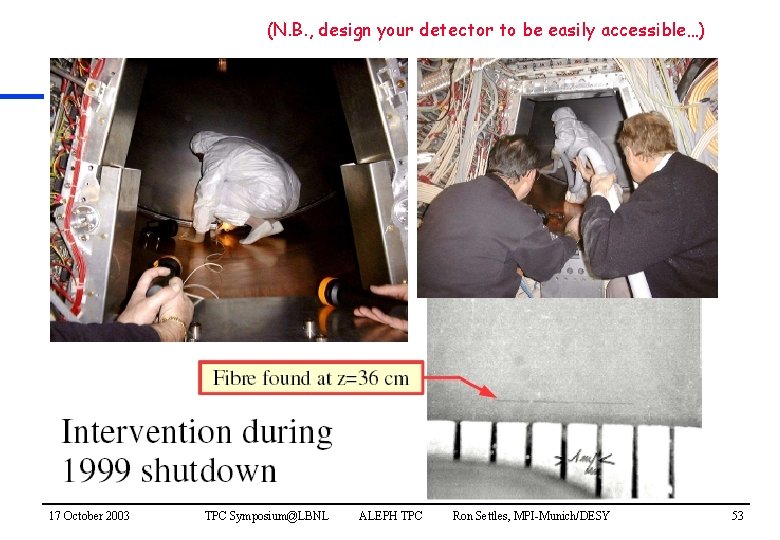
(N. B. , design your detector to be easily accessible…) 17 October 2003 TPC Symposium@LBNL ALEPH TPC Ron Settles, MPI-Munich/DESY 53
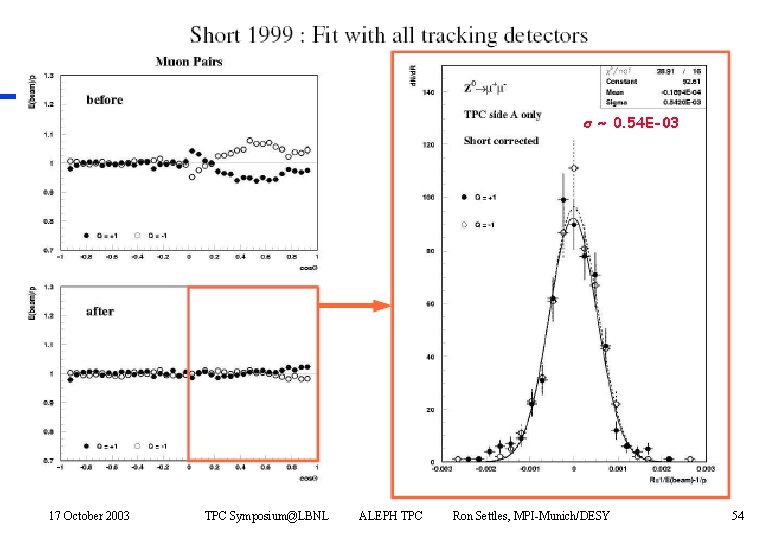
σ ~ 0. 54 E-03 17 October 2003 TPC Symposium@LBNL ALEPH TPC Ron Settles, MPI-Munich/DESY 54
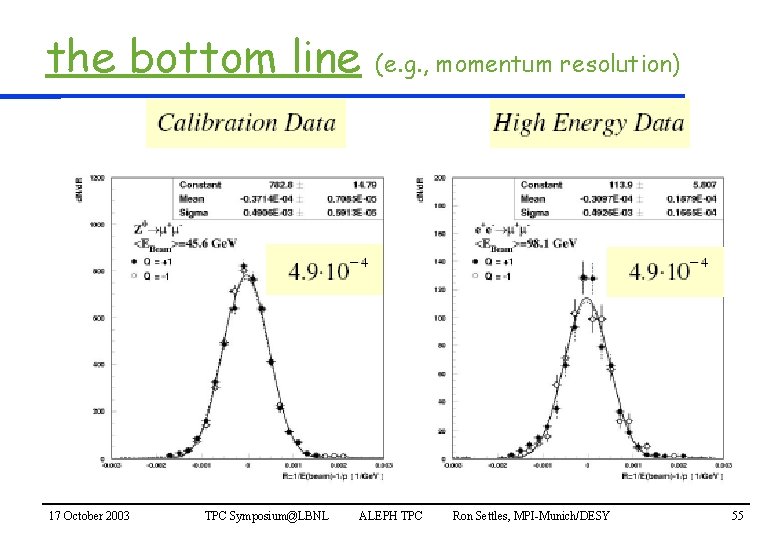
the bottom line 17 October 2003 TPC Symposium@LBNL (e. g. , momentum resolution) ALEPH TPC Ron Settles, MPI-Munich/DESY 55
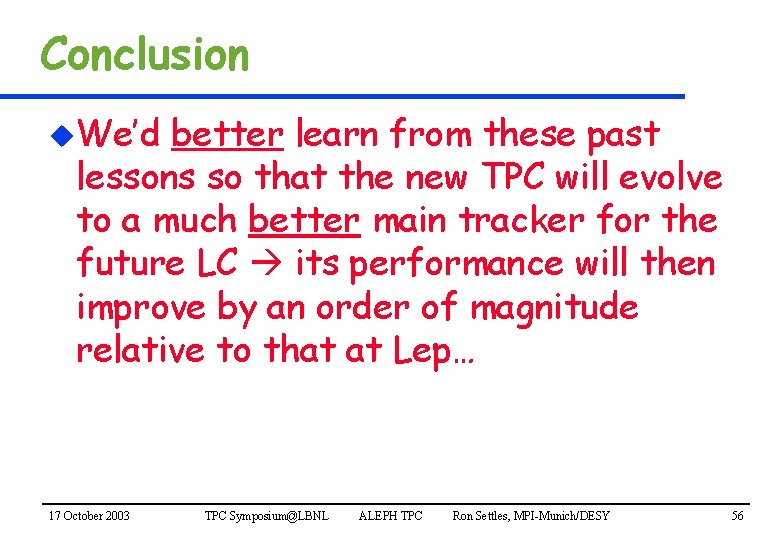
Conclusion u. We’d better learn from these past lessons so that the new TPC will evolve to a much better main tracker for the future LC its performance will then improve by an order of magnitude relative to that at Lep… 17 October 2003 TPC Symposium@LBNL ALEPH TPC Ron Settles, MPI-Munich/DESY 56
Extra slides on LCTPC 17 October 2003 TPC Symposium@LBNL ALEPH TPC Ron Settles, MPI-Munich/DESY 57
Goal To design and build an ultra-high performance Time Projection Chamber …as central tracker for the LC detector …where excellent vertex, momentum and jet energy precision are wanted… 17 October 2003 TPC Symposium@LBNL ALEPH TPC Ron Settles, MPI-Munich/DESY 59
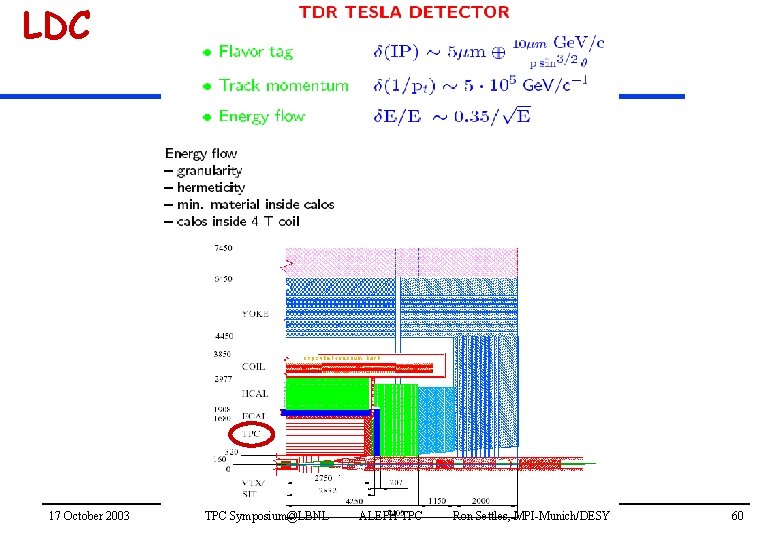
LDC 17 October 2003 TPC Symposium@LBNL ALEPH TPC Ron Settles, MPI-Munich/DESY 60
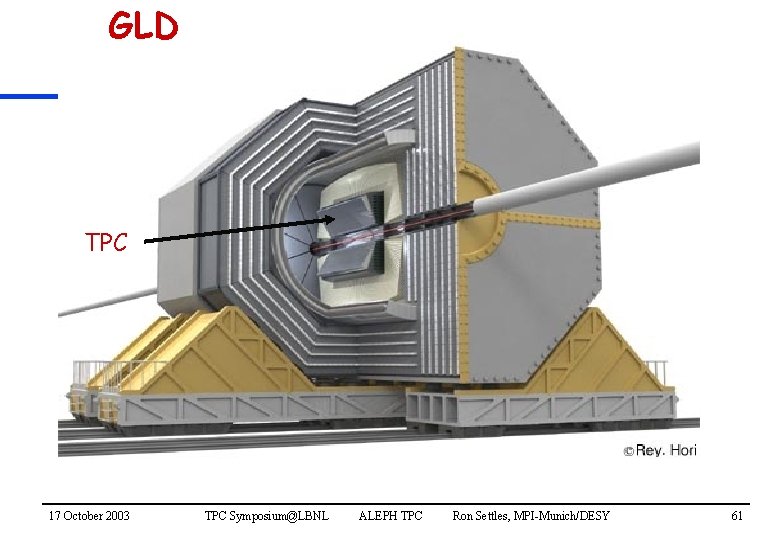
GLD TPC 17 October 2003 TPC Symposium@LBNL ALEPH TPC Ron Settles, MPI-Munich/DESY 61
The basic idea… u u u Cost-effective way of instrumenting a large volume With continuous tracking and a minimum of material Want the largest possible granularity -- i. e. ~ 2. 109 voxels -- the best possible σ resolution -- the best possible 2 -track resolution point 17 October 2003 TPC Symposium@LBNL ALEPH TPC Ron Settles, MPI-Munich/DESY 62
Why… u u High granularity to ensure robust operation in presence of large backgrounds Continuous tracking to ensure good momentum-measuring precision and >98% pattern-recognition eff. in jets 17 October 2003 TPC Symposium@LBNL ALEPH TPC Ron Settles, MPI-Munich/DESY 63
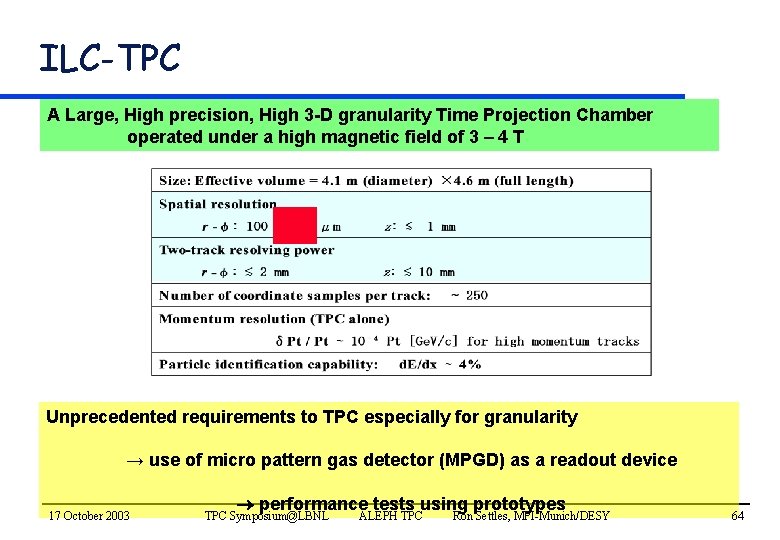
ILC-TPC A Large, High precision, High 3 -D granularity Time Projection Chamber operated under a high magnetic field of 3 – 4 T Unprecedented requirements to TPC especially for granularity → use of micro pattern gas detector (MPGD) as a readout device 17 October 2003 performance tests using prototypes TPC Symposium@LBNL ALEPH TPC Ron Settles, MPI-Munich/DESY 64
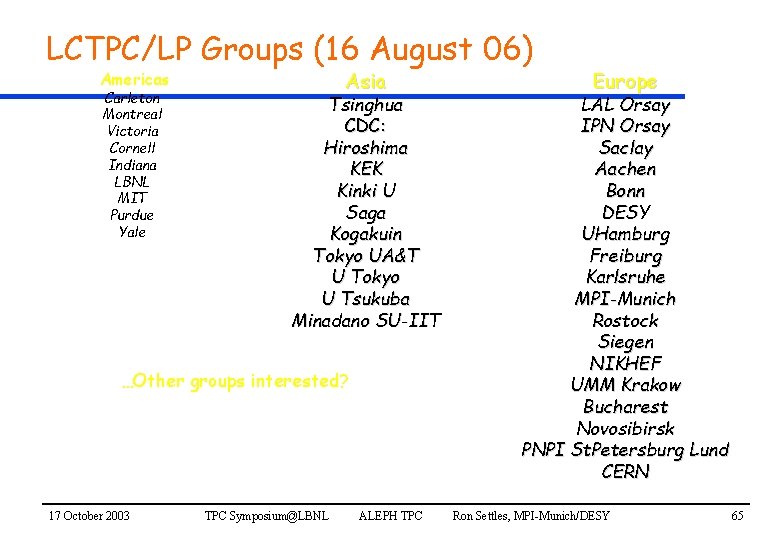
LCTPC/LP Groups (16 August 06) Asia Americas Carleton Montreal Victoria Cornell Indiana LBNL MIT Purdue Yale Tsinghua CDC: Hiroshima KEK Kinki U Saga Kogakuin Tokyo UA&T U Tokyo U Tsukuba Minadano SU-IIT …Other groups interested? 17 October 2003 TPC Symposium@LBNL ALEPH TPC Europe LAL Orsay IPN Orsay Saclay Aachen Bonn DESY UHamburg Freiburg Karlsruhe MPI-Munich Rostock Siegen NIKHEF UMM Krakow Bucharest Novosibirsk PNPI St. Petersburg Lund CERN Ron Settles, MPI-Munich/DESY 65
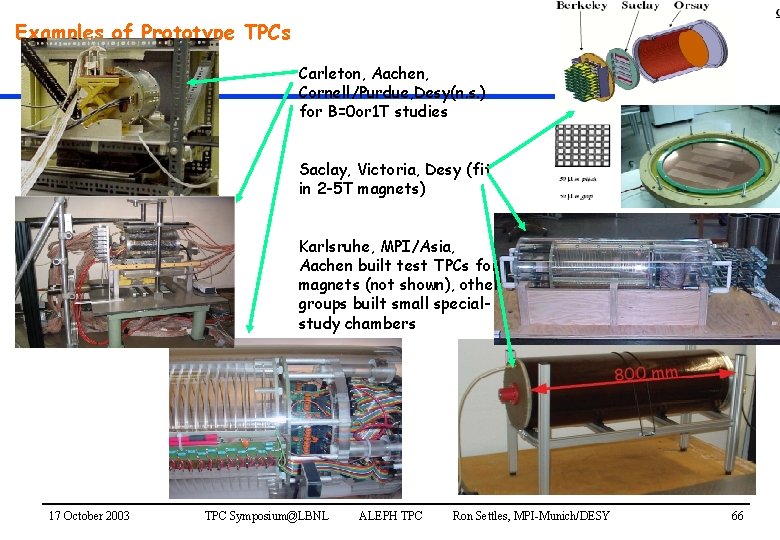
Examples of Prototype TPCs Carleton, Aachen, Cornell/Purdue, Desy(n. s. ) for B=0 or 1 T studies Saclay, Victoria, Desy (fit in 2 -5 T magnets) Karlsruhe, MPI/Asia, Aachen built test TPCs for magnets (not shown), other groups built small specialstudy chambers 17 October 2003 TPC Symposium@LBNL ALEPH TPC Ron Settles, MPI-Munich/DESY 66
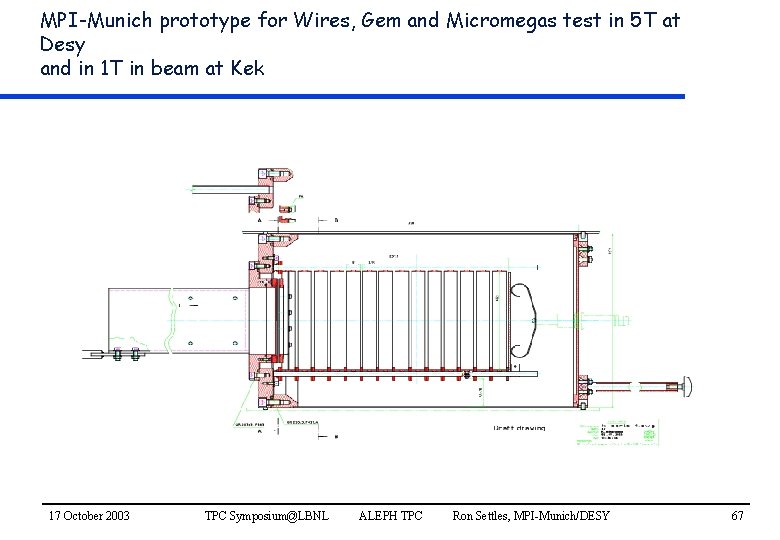
MPI-Munich prototype for Wires, Gem and Micromegas test in 5 T at Desy and in 1 T in beam at Kek 17 October 2003 TPC Symposium@LBNL ALEPH TPC Ron Settles, MPI-Munich/DESY 67
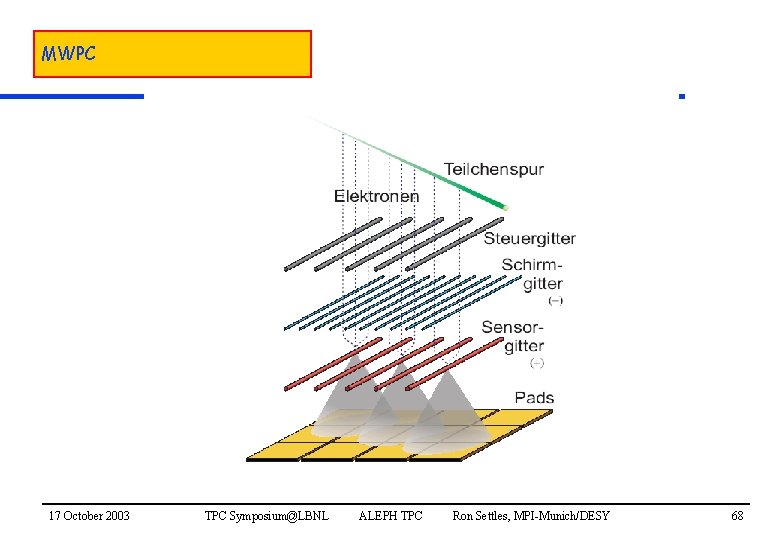
MWPC 17 October 2003 TPC Symposium@LBNL ALEPH TPC Ron Settles, MPI-Munich/DESY 68
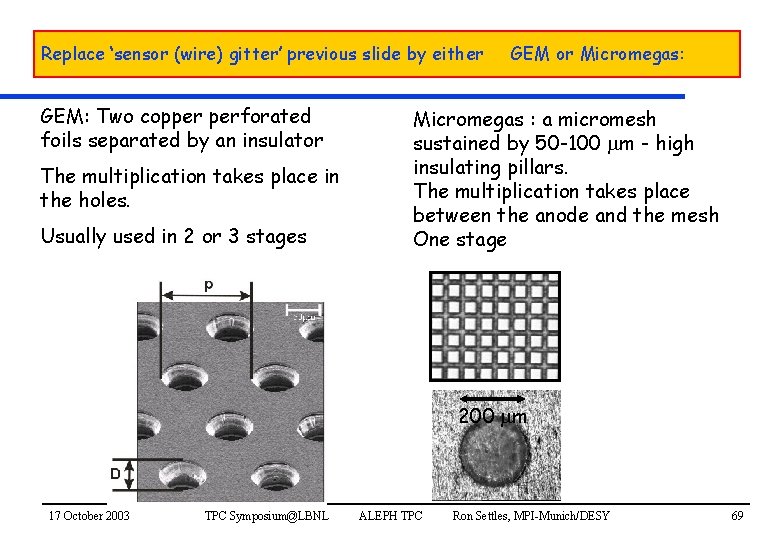
Replace ‘sensor (wire) gitter’ previous slide by either GEM: Two copper perforated foils separated by an insulator The multiplication takes place in the holes. Usually used in 2 or 3 stages GEM or Micromegas: Micromegas : a micromesh sustained by 50 -100 mm - high insulating pillars. The multiplication takes place between the anode and the mesh One stage 200 mm 17 October 2003 TPC Symposium@LBNL ALEPH TPC Ron Settles, MPI-Munich/DESY 69
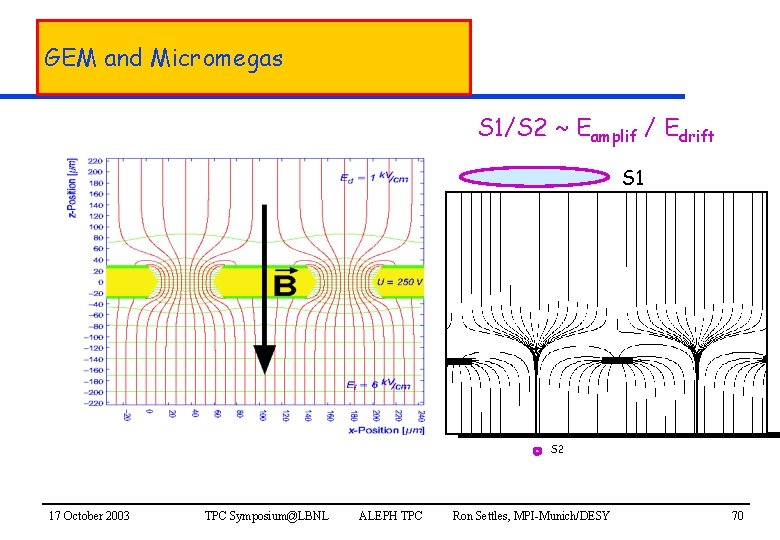
GEM and Micromegas S 1/S 2 ~ Eamplif / Edrift S 1 S 2 17 October 2003 TPC Symposium@LBNL ALEPH TPC Ron Settles, MPI-Munich/DESY 70
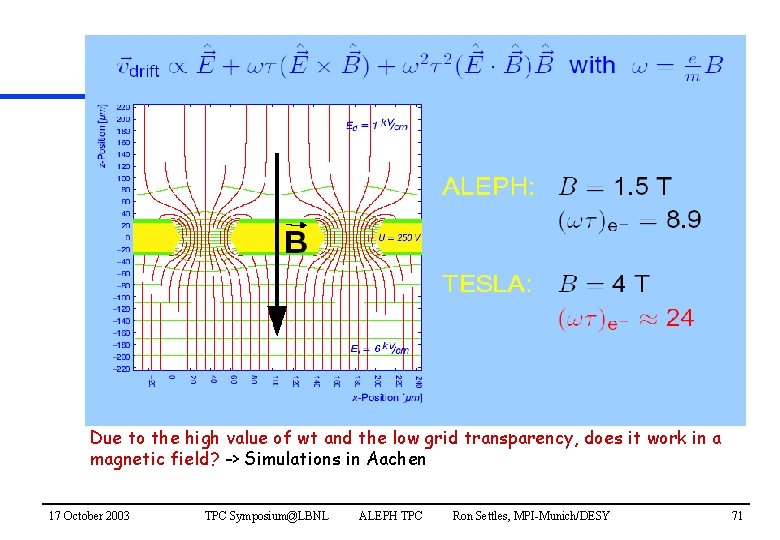
Due to the high value of wt and the low grid transparency, does it work in a magnetic field? -> Simulations in Aachen 17 October 2003 TPC Symposium@LBNL ALEPH TPC Ron Settles, MPI-Munich/DESY 71
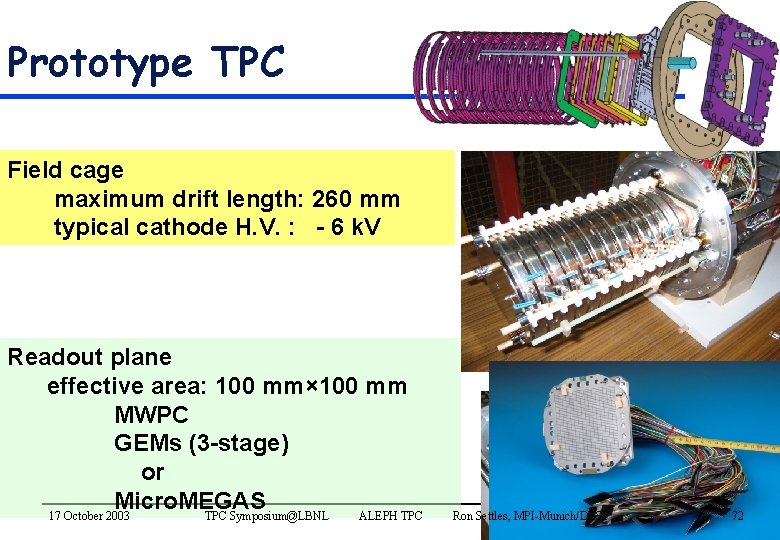
Prototype TPC Field cage maximum drift length: 260 mm typical cathode H. V. : - 6 k. V Readout plane effective area: 100 mm× 100 mm MWPC GEMs (3 -stage) or Micro. MEGAS 17 October 2003 TPC Symposium@LBNL ALEPH TPC Ron Settles, MPI-Munich/DESY 72
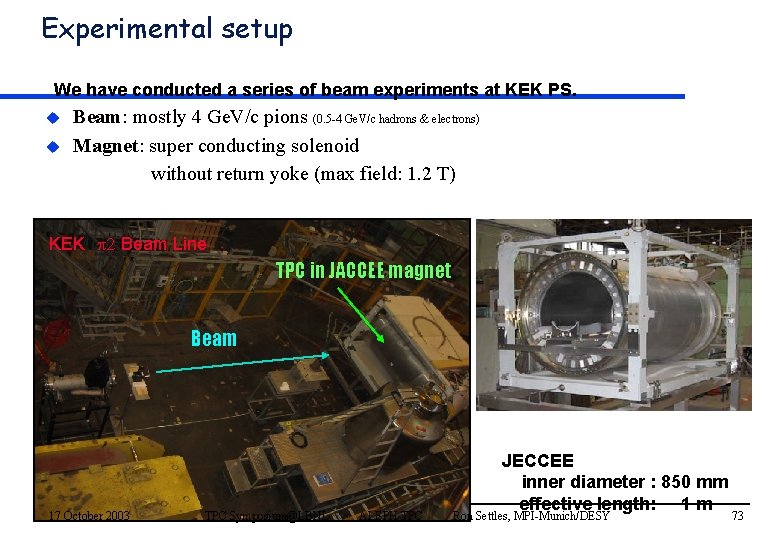
Experimental setup We have conducted a series of beam experiments at KEK PS. u u Beam: mostly 4 Ge. V/c pions (0. 5 -4 Ge. V/c hadrons & electrons) Magnet: super conducting solenoid without return yoke (max field: 1. 2 T) KEK p 2 Beam Line TPC in JACCEE magnet Beam 17 October 2003 TPC Symposium@LBNL ALEPH TPC JECCEE inner diameter : 850 mm effective length: 1 m Ron Settles, MPI-Munich/DESY 73
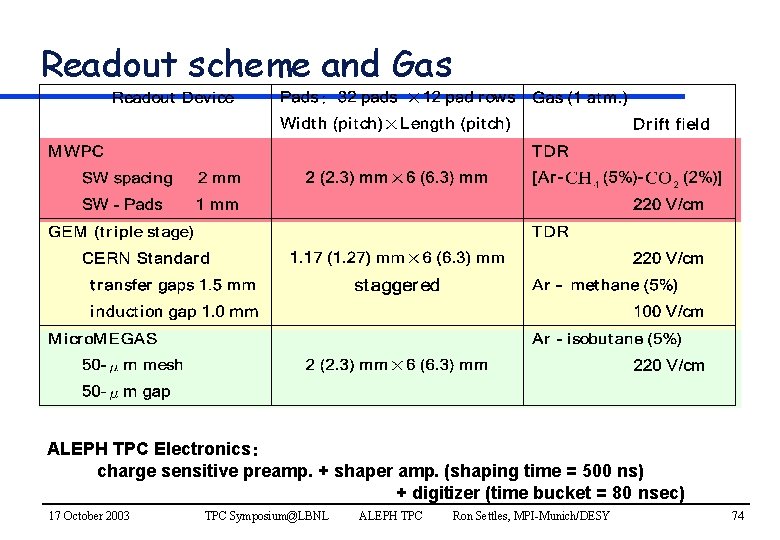
Readout scheme and Gas ALEPH TPC Electronics: charge sensitive preamp. + shaper amp. (shaping time = 500 ns) + digitizer (time bucket = 80 nsec) 17 October 2003 TPC Symposium@LBNL ALEPH TPC Ron Settles, MPI-Munich/DESY 74
- Slides: 73