
The AISL Program FY 18 19 20 Overview

- Slides: 39
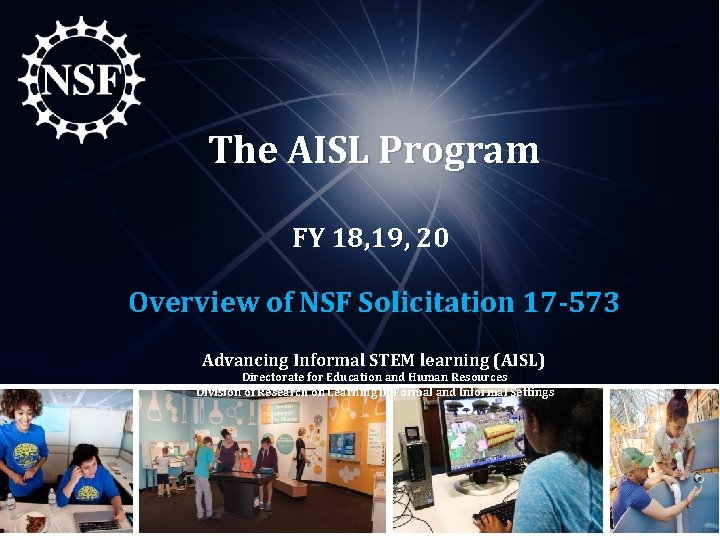
The AISL Program FY 18, 19, 20 Overview of NSF Solicitation 17 -573 Advancing Informal STEM learning (AISL) Directorate for Education and Human Resources Division of Research on Learning in Formal and Informal Settings
Contents § Program Priorities § Audiences for AISL projects § Program Solicitation § Revisions & Additions § Project Types § Research & Evaluation § Review Criteria • Proposal Review Process § Resources § Contact Information 2
AISL Program • Advancing– Innovative projects that advance the field through building knowledge via innovative approaches and research. • Informal – Learning that is lifelong, life wide, & life deep. Learning that occurs outside formal schooling systems. • STEM – Not just focused on science, but all of NSF-funded STEM, including social and behavioral sciences. • Learning – Learning outcomes typically include: interest, engagement, motivation, behavior, identity, persistence, understanding, awareness, knowledge, and use of STEM content and practices, and 21 st century skills. 3
AISL Program Overview 4
AISL PRIORITIES 5
Maximizing Strategic Impact How does the project address important areas for continued development and advances the informal STEM learning field overall, not simply the project impact for the target audiences or communities? 6
Enhancing Knowledge Building How does the project advance the knowledge base of the informal STEM learning field? • Knowledge generation may focus on developing, testing, and/or implementing innovative research, models, resources, and tools for informal learning environments. • The theoretical and empirical justification for the proposed project must be clearly articulated. 7
Promoting Innovation In a manner similar to NSF programs that fund the frontiers of STEM research, AISL seeks to fund projects at the frontiers of STEM learning in informal environments that will advance the state-of-the-art. 8
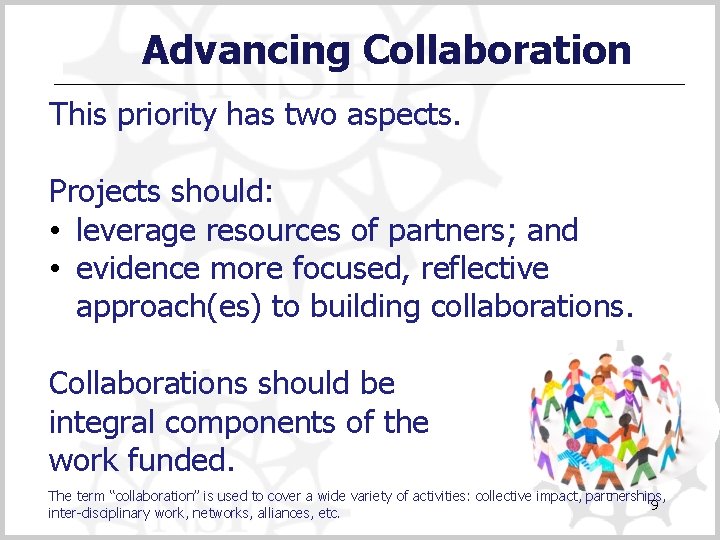
Advancing Collaboration This priority has two aspects. Projects should: • leverage resources of partners; and • evidence more focused, reflective approach(es) to building collaborations. Collaborations should be integral components of the work funded. The term “collaboration” is used to cover a wide variety of activities: collective impact, partnerships, 9 inter-disciplinary work, networks, alliances, etc.
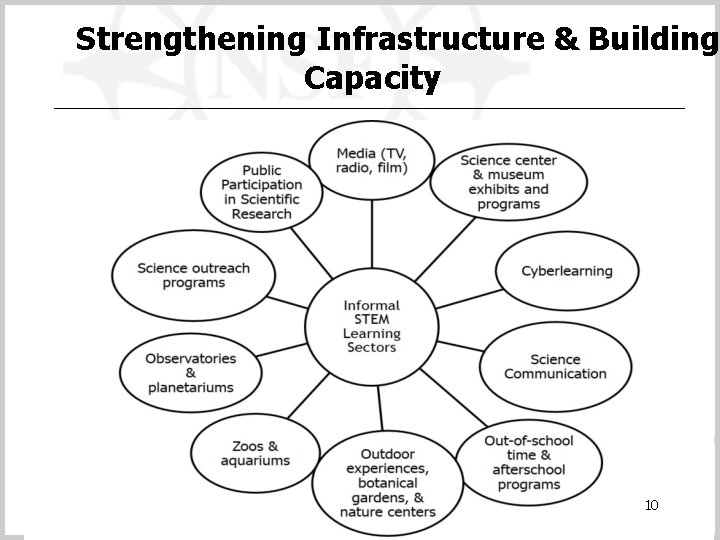
Strengthening Infrastructure & Building Capacity 10
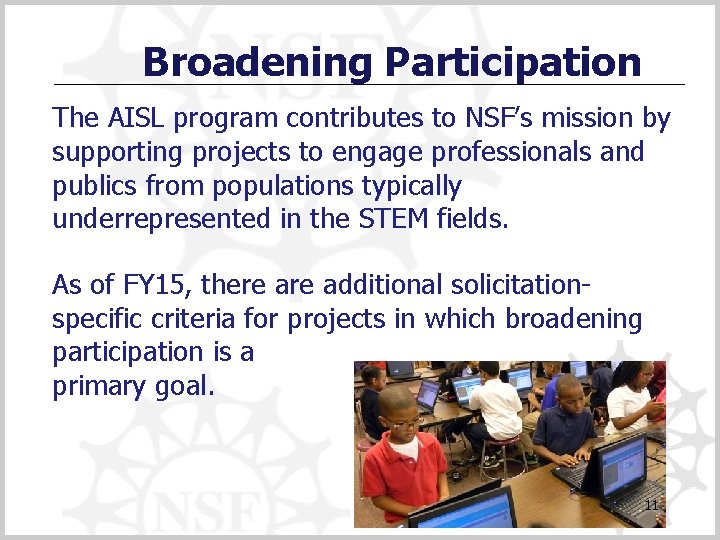
Broadening Participation The AISL program contributes to NSF’s mission by supporting projects to engage professionals and publics from populations typically underrepresented in the STEM fields. As of FY 15, there additional solicitationspecific criteria for projects in which broadening participation is a primary goal. 11
AISL AUDIENCES 12
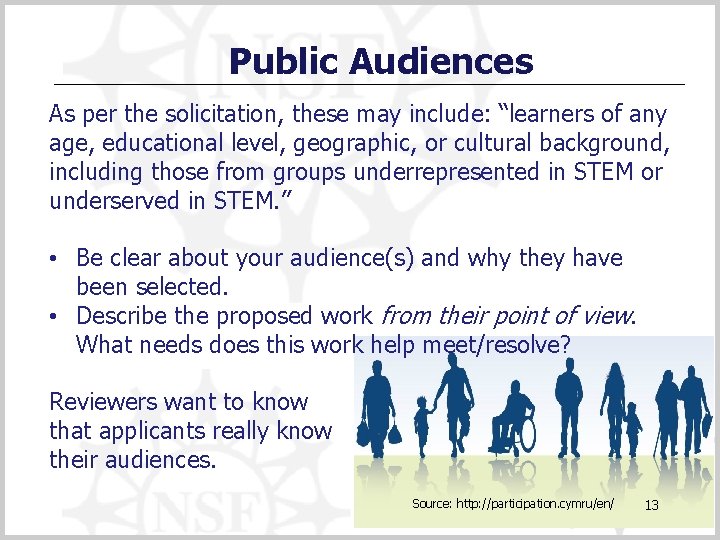
Public Audiences As per the solicitation, these may include: “learners of any age, educational level, geographic, or cultural background, including those from groups underrepresented in STEM or underserved in STEM. ” • Be clear about your audience(s) and why they have been selected. • Describe the proposed work from their point of view. What needs does this work help meet/resolve? Reviewers want to know that applicants really know their audiences. Source: http: //participation. cymru/en/ 13
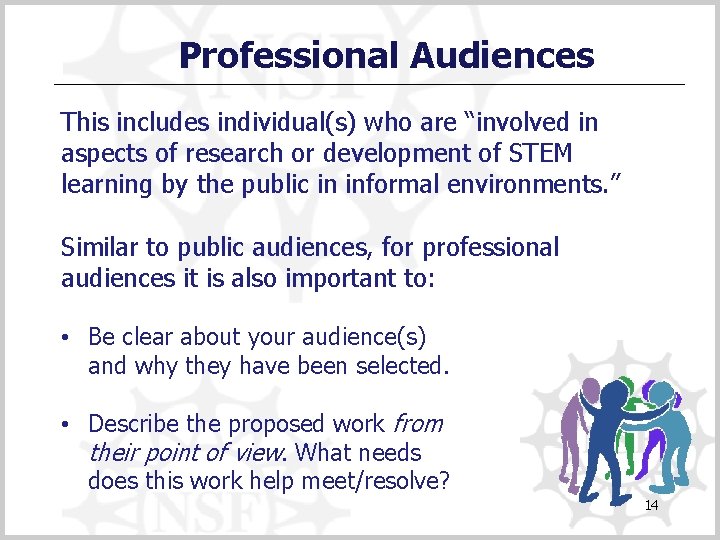
Professional Audiences This includes individual(s) who are “involved in aspects of research or development of STEM learning by the public in informal environments. ” Similar to public audiences, for professional audiences it is also important to: • Be clear about your audience(s) and why they have been selected. • Describe the proposed work from their point of view. What needs does this work help meet/resolve? 14
AISL Program Solicitation NSF 17 -573 15
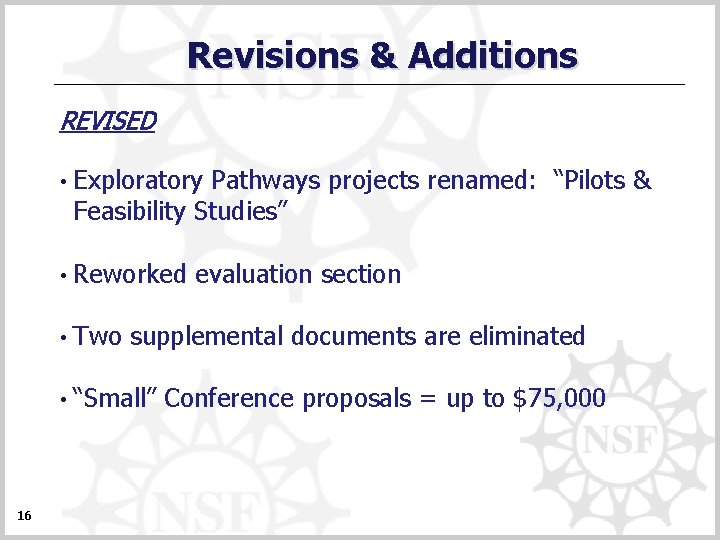
Revisions & Additions REVISED • Exploratory Pathways projects renamed: “Pilots & Feasibility Studies” • Reworked evaluation section • Two supplemental documents are eliminated • “Small” Conference proposals = up to $75, 000 16
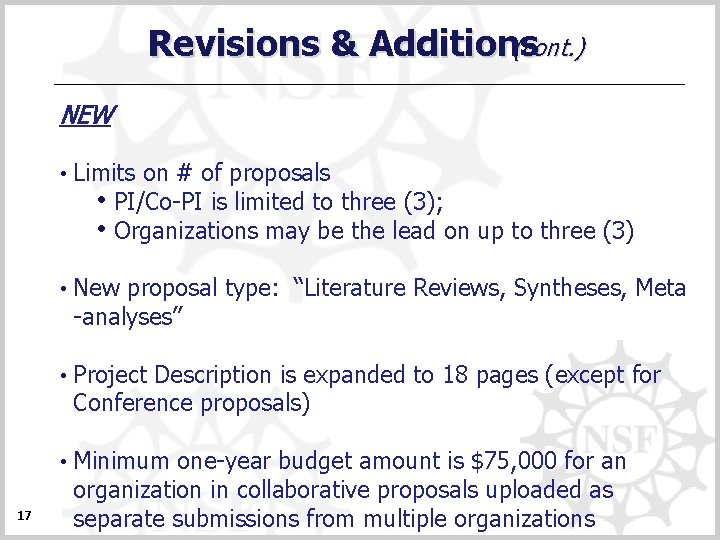
Revisions & Additions (cont. ) NEW 17 • Limits on # of proposals • PI/Co-PI is limited to three (3); • Organizations may be the lead on up to three (3) • New proposal type: “Literature Reviews, Syntheses, Meta -analyses” • Project Description is expanded to 18 pages (except for Conference proposals) • Minimum one-year budget amount is $75, 000 for an organization in collaborative proposals uploaded as separate submissions from multiple organizations
Project Types 18
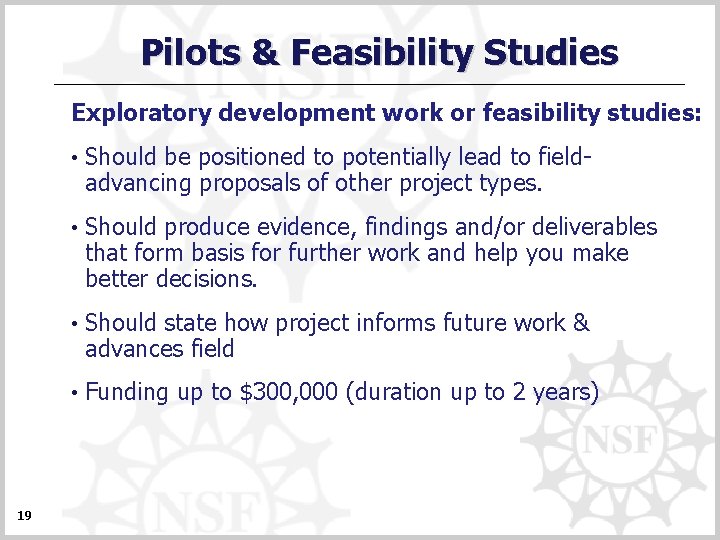
Pilots & Feasibility Studies Exploratory development work or feasibility studies: 19 • Should be positioned to potentially lead to fieldadvancing proposals of other project types. • Should produce evidence, findings and/or deliverables that form basis for further work and help you make better decisions. • Should state how project informs future work & advances field • Funding up to $300, 000 (duration up to 2 years)
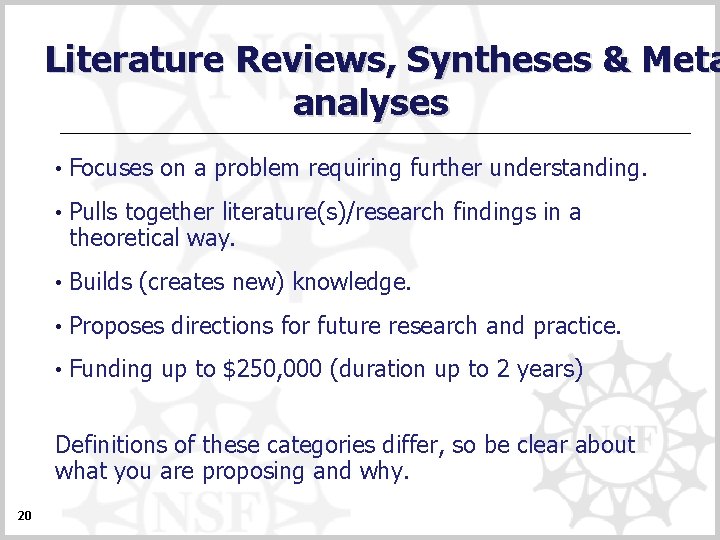
Literature Reviews, Syntheses & Meta analyses • Focuses on a problem requiring further understanding. • Pulls together literature(s)/research findings in a theoretical way. • Builds (creates new) knowledge. • Proposes directions for future research and practice. • Funding up to $250, 000 (duration up to 2 years) Definitions of these categories differ, so be clear about what you are proposing and why. 20
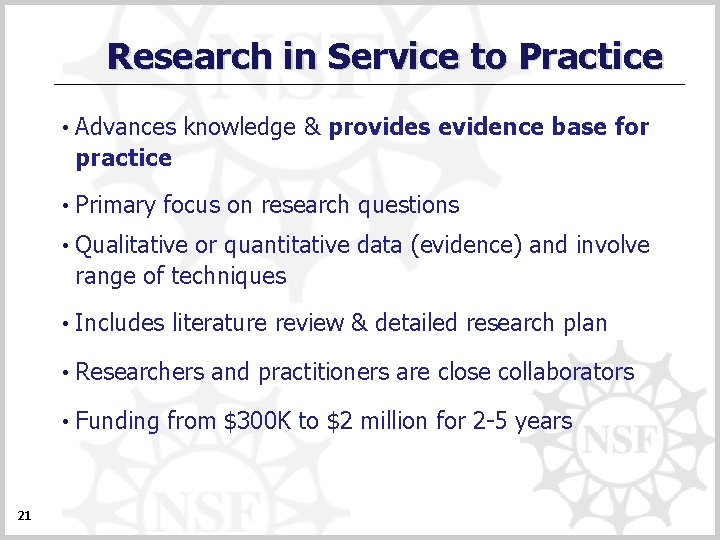
Research in Service to Practice 21 • Advances knowledge & provides evidence base for practice • Primary focus on research questions • Qualitative or quantitative data (evidence) and involve range of techniques • Includes literature review & detailed research plan • Researchers and practitioners are close collaborators • Funding from $300 K to $2 million for 2 -5 years
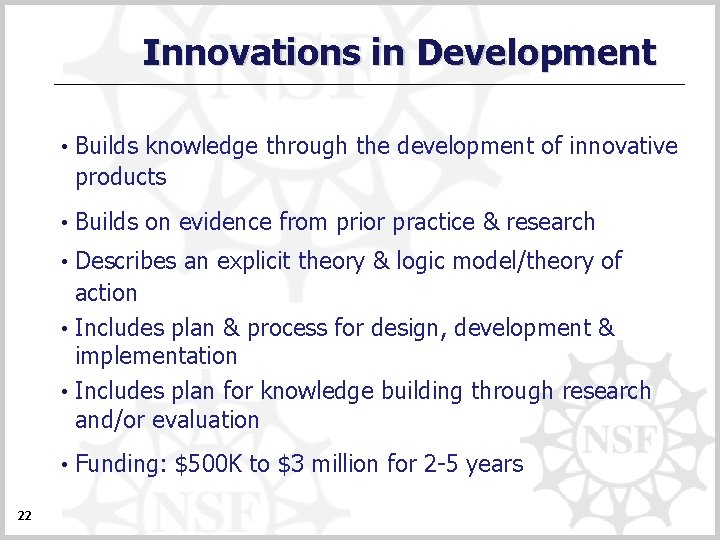
Innovations in Development • Builds knowledge through the development of innovative products • Builds on evidence from prior practice & research Describes an explicit theory & logic model/theory of action • Includes plan & process for design, development & implementation • Includes plan for knowledge building through research and/or evaluation • • 22 Funding: $500 K to $3 million for 2 -5 years
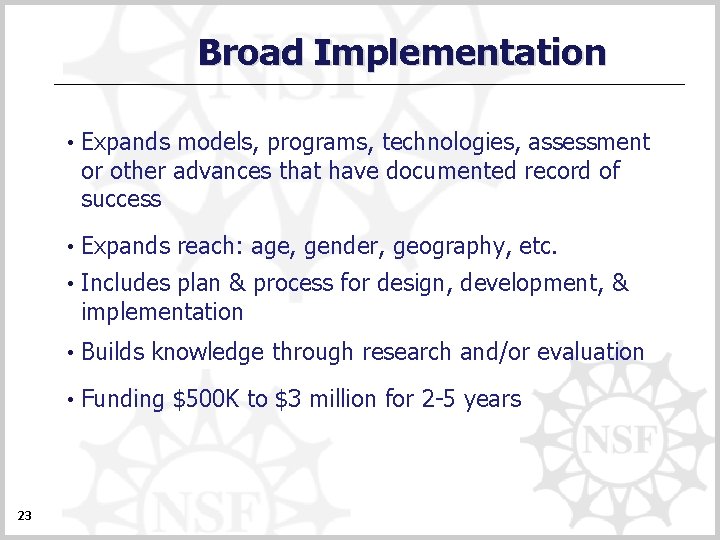
Broad Implementation 23 • Expands models, programs, technologies, assessment or other advances that have documented record of success • Expands reach: age, gender, geography, etc. • Includes plan & process for design, development, & implementation • Builds knowledge through research and/or evaluation • Funding $500 K to $3 million for 2 -5 years
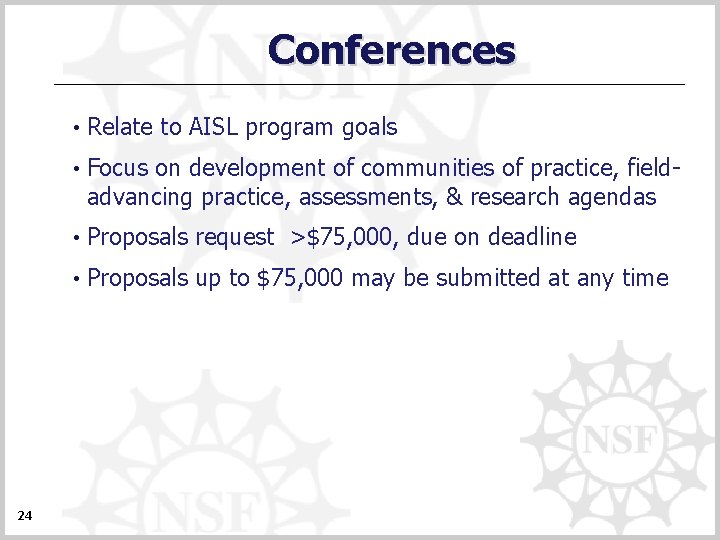
Conferences 24 • Relate to AISL program goals • Focus on development of communities of practice, fieldadvancing practice, assessments, & research agendas • Proposals request >$75, 000, due on deadline • Proposals up to $75, 000 may be submitted at any time
Research & Evaluation 25
Research in AISL Projects AISL supports research that advances knowledge and the evidence base for practices, assumptions, broadening participation, or emerging educational arrangements in STEM learning in informal environments, including the science of science communication (NAS, 2017). Research can be supported through these mechanisms: • Literature Reviews, Syntheses, Meta-analyses • Feasibility, Pilot Studies • Research in Service to Practice projects • Can be components of Innovations in Development & Broad Implementation projects 26
Evaluation in AISL Projects All AISL project proposals are required to specify the evaluative processes they would employ to achieve the following two goals: 1. Support iterative improvement. Evaluative processes should ensure that a project gets appropriate, rigorous, external input throughout the life of the project. Such input is essential for project monitoring, management, and continuous quality improvement. External feedback should enrich (and potentially challenge) teams’ perspectives. 2. Promote accountability. Evaluative processes should address questions such as: Is the project addressing its stated goals? What is the quality of the work? 27
Merit Review Criteria 28
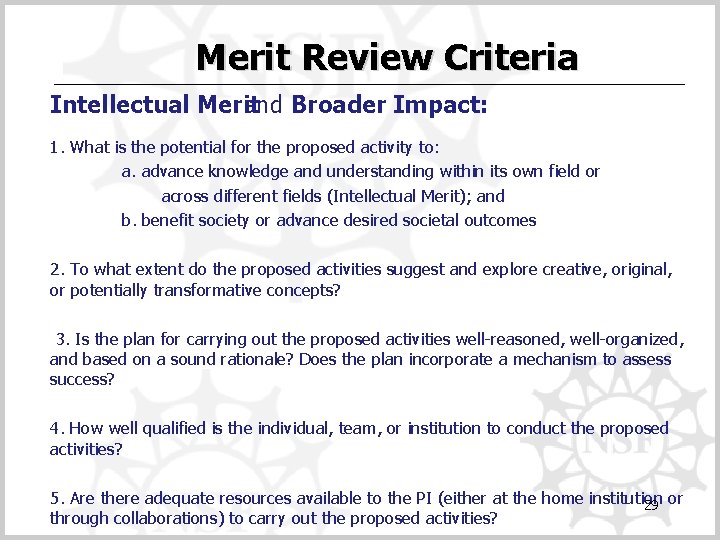
Merit Review Criteria Intellectual Merit and Broader Impact: 1. What is the potential for the proposed activity to: a. advance knowledge and understanding within its own field or across different fields (Intellectual Merit); and b. benefit society or advance desired societal outcomes 2. To what extent do the proposed activities suggest and explore creative, original, or potentially transformative concepts? 3. Is the plan for carrying out the proposed activities well-reasoned, well-organized, and based on a sound rationale? Does the plan incorporate a mechanism to assess success? 4. How well qualified is the individual, team, or institution to conduct the proposed activities? 5. Are there adequate resources available to the PI (either at the home institution or 29 through collaborations) to carry out the proposed activities?
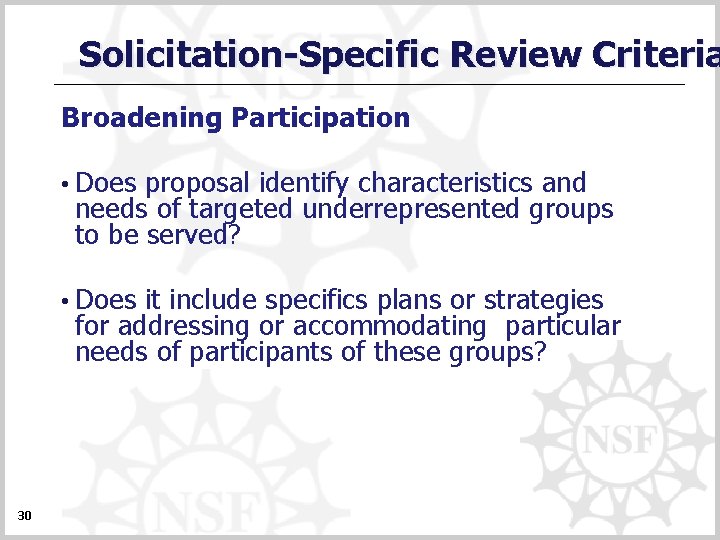
Solicitation-Specific Review Criteria Broadening Participation • Does proposal identify characteristics and needs of targeted underrepresented groups to be served? • Does it include specifics plans or strategies for addressing or accommodating particular needs of participants of these groups? 30
Proposal Review Process 31
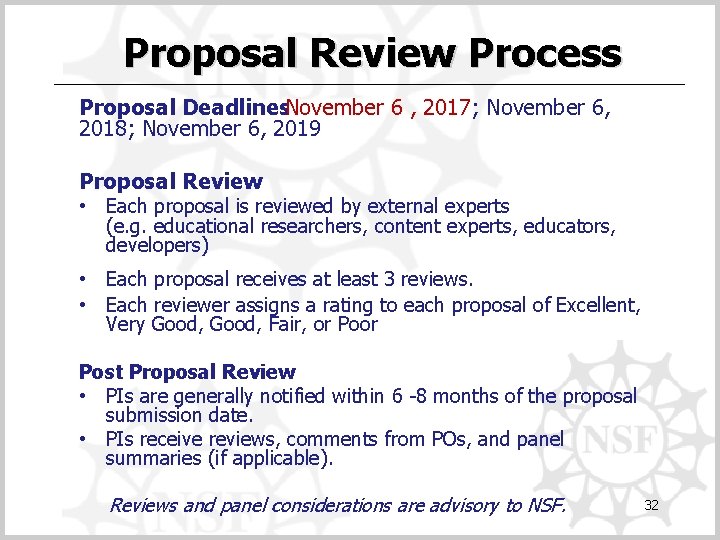
Proposal Review Process Proposal Deadlines : November 6 , 2017; November 6, 2018; November 6, 2019 Proposal Review • Each proposal is reviewed by external experts (e. g. educational researchers, content experts, educators, developers) • Each proposal receives at least 3 reviews. • Each reviewer assigns a rating to each proposal of Excellent, Very Good, Fair, or Post Proposal Review • PIs are generally notified within 6 -8 months of the proposal submission date. • PIs receive reviews, comments from POs, and panel summaries (if applicable). Reviews and panel considerations are advisory to NSF. 32
Resources 33
NSF Resources NSF Proposal & Award Policies & Procedures Guide (PAPPG), NSF 17 -1, is very helpful as are FAQs: http: //www. nsf. gov/bfa/dias/policy/ § IRB and other information is also on this page. AISL-Funded Awards http: //www. nsf. gov/awardsearch/ § Put “AISL” in the search box to obtain a listing of the range of awards OR just click on the link from the AISL webpage: http: //www. nsf. gov/funding/pgm_summ. jsp? pims_id=504793 § Also try key words related to your proposal topic/area; there are many search options to explore 34
CAISE www. informalscience. org The AISL Toolkit http: //www. informalscience. org/projects/funding/nsf-aisl The Knowledge Base (formerly the Evidence Wiki) http: //www. informalscience. org/knowledge-base Developing an Evaluation Plan http: //www. informalscience. org/evaluation/developingevaluation-plan 35
Live Webinars and Webcasts September 14, 2017, 1: 00 -2: 30 pm EDT How to Use informalscience. org to Make Your Case (CAISE) September 19, 2017, 2: 00 -3: 00 pm EDT How to Write a Competitive AISL Proposal September 22, 2017, 2: 00 -3: 00 pm EDT AISL & Broadening Participation = = = = A detailed walk-through of AISL Solicitation 17 -573 can be found under the Events link on the AISL Webpage. Check the AISL & CAISE Webpages for more information about 36 these webinars and other resources.
CONTACT INFORMATION 37
Contact Information General inquiries regarding this program and program solicitation should be made to: DRLAISL@nsf. gov What should you do if you have a specific inquiry regarding your project or proposal? 38 Using the email address above, in the body of the email or as in attachment, send a brief (max 2 pages) summary of the research or R&D you are planning to conduct. The synopsis should include a very brief rationale for the work, how it will contribute to the knowledge base on informal learning, and what you believe the broader impacts to be. Be sure to also include your specific questions.
THANK YOU! ---------- Advancing Informal STEM Learning (AISL) Program https: //www. nsf. gov/funding/pgm_summ. jsp? pims_id=504793 39