
The Aim of Forecasting The aim of forecasting
- Slides: 27
The Aim of Forecasting • The aim of forecasting is to reduce the risk or uncertainty that the firm faces in its short-term operational decision making and in planning for its long term growth. • Forecasting the demand sales of the firm’s product usually begins with macroeconomic forecast of general level of economic activity for the economy as a whole or GNP. • The firm uses the macro-forecasts of general economic activity as inputs for their microforecasts of the industry’s and firm’s demand sales. • The firm’s demand sales are usually forecasted on the basis of its historical market share and its planned marketing strategy (i. e. , forecasting by product line and region). • The firm uses long-term forecasts for the economy and the industry to forecast expenditure on plant and equipment to meet its long-term
What is meant by Forecasting and Why? • Forecasting is the process of estimating a variable, such as the sale of the firm at some future date. • Forecasting is important to business firm, government, and non-profit organization as a method of reducing the risk and
Forecasting Techniques • A wide variety of forecasting methods are available to management. These range from the most naïve methods that require little effort to highly complex approaches that are very costly in terms of time and effort such as econometric systems of simultaneous equations. • Mainly these techniques can break down into two parts: qualitative approaches and quantitative approaches.
Qualitative mtd • Expert opinion mtd • Consumers survey mtd 1) complete enumeration method 2)sample survey method 3) end use method
Expert opinion method Advice is obtained from experienced experts who have long standing experience in the field of enquiry-panel consensus. Delphi method-the panel consensus is individually presented a series of questions pertaining to the forecasting problem. Such responses are analyzed by independent party. Use of simple/weighted average is used
Consumer survey method The most direct method Valid for short term projections Consumers are approached directly To find buyer’s intentions & views about the particular product-interview/questionnaire. Questionnaire has to be simple, complete, Covering all aspects & interesting • •
Consumer survey • • • Complete enumeration Covers all consumers like in data collection ( past, present, & all possible consumers) Sample survey Covers only few representative buyers Very useful in case of new brands & products
Consumer survey • End use method • If the product has several end uses, it has specific demand for each use, its met sag • Consumers in each met segmt convey their potential demand likely in future. • Aggregate demand from all segments taken forecasts
Quantitative methods • • Time series Exponential smoothing Regression analysis Moving averages Index numbers Input-output analysis Econometric models
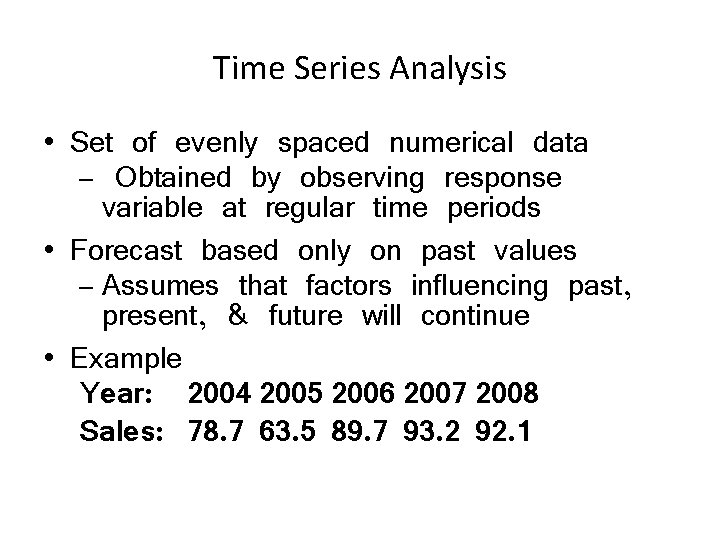
Time Series Analysis • Set of evenly spaced numerical data – Obtained by observing response variable at regular time periods • Forecast based only on past values – Assumes that factors influencing past, present, & future will continue • Example Year: 2004 2005 2006 2007 2008 Sales: 78. 7 63. 5 89. 7 93. 2 92. 1
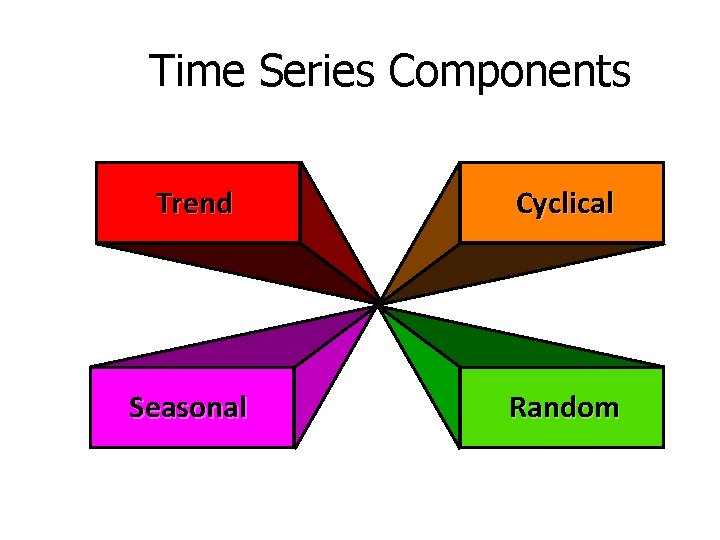
Time Series Components Trend Cyclical Seasonal Random
• Time series analysis-is based on obtaining the historical data regarding the demand for the product. • Moving averages-is most useful when the market is assumed to remain steady overtime. • Exponential smoothing- more weigtage is given to recent observations as they have more impact in future
Quantitative method • Index numbers- it offers a device to measure changes in a group of related variables over time period, usually taking base year 100. • Regression analysis-used to measure the relationship between two variables where correlation exists. This method is based on statistical data. eg-annual repairs expenses of AC’s can be predicted if we know age of AC’s
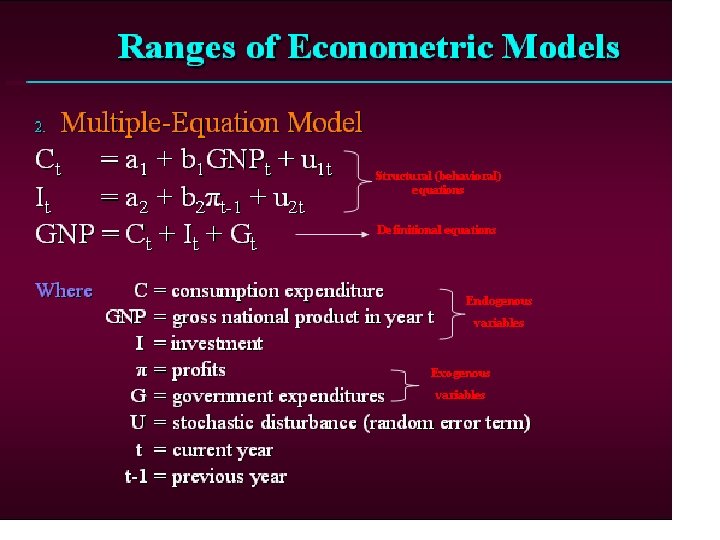
Quantitative method • Econometric models- used to form an equation which seems best to express the most probable interrelation between a set of economic variables. eg- all factors influencing demand need to be determined. • Input-output analysis- based on a set of tables explaining the various components of economy, helpful to understand inter-industry
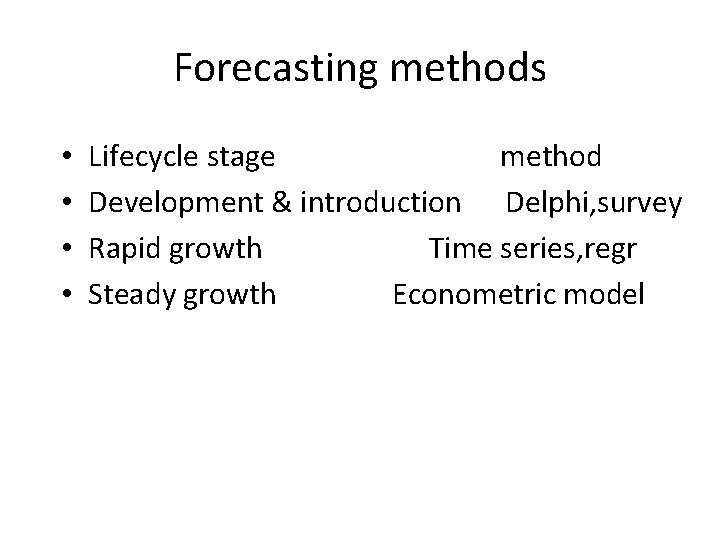
Forecasting methods • • Lifecycle stage method Development & introduction Delphi, survey Rapid growth Time series, regr Steady growth Econometric model
Criteria of good forecast • • • Accuracy Reliability Economical Data avaialibility Flexibility Durability
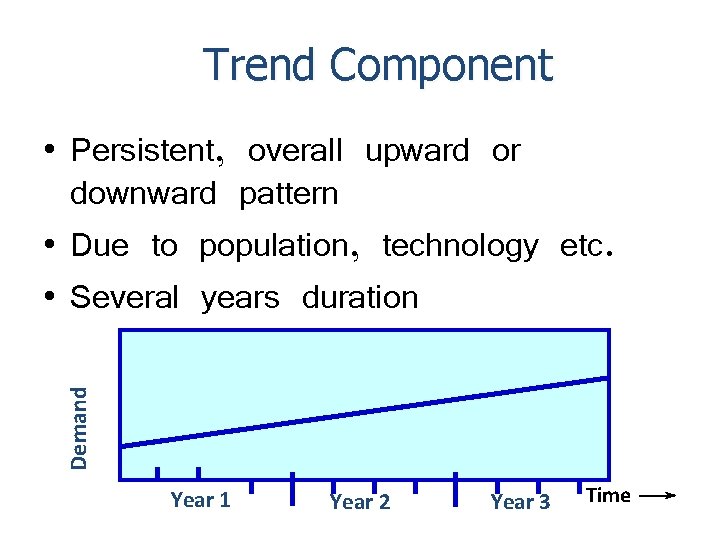
Trend Component Demand • Persistent, overall upward or downward pattern • Due to population, technology etc. • Several years duration Year 1 Year 2 Year 3 Time
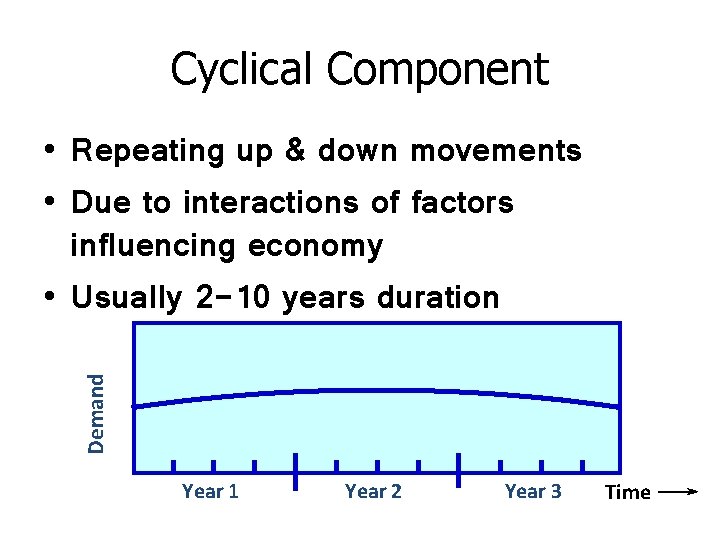
Cyclical Component Demand • Repeating up & down movements • Due to interactions of factors influencing economy • Usually 2 -10 years duration Year 1 Year 2 Year 3 Time
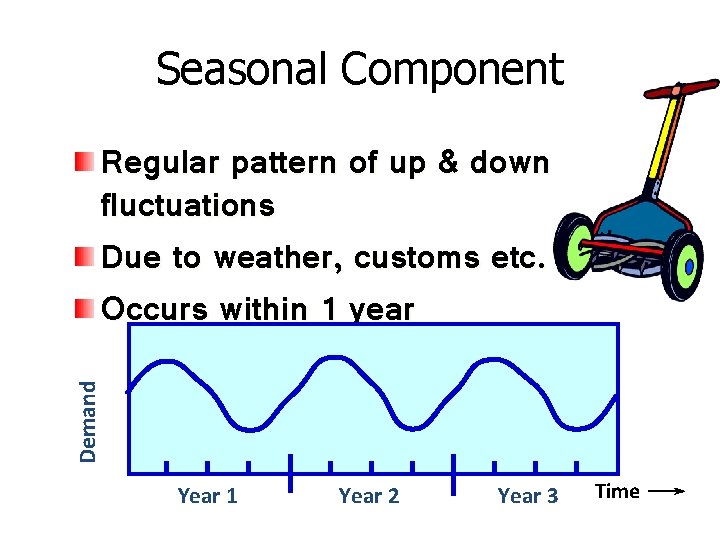
Seasonal Component Demand Regular pattern of up & down fluctuations Due to weather, customs etc. Occurs within 1 year Year 1 Year 2 Year 3 Time
Random Component • Erratic, unsystematic, ‘residual’ fluctuations • Due to random variation or unforeseen events – Union strike – Tornado • Short duration & non-repeating
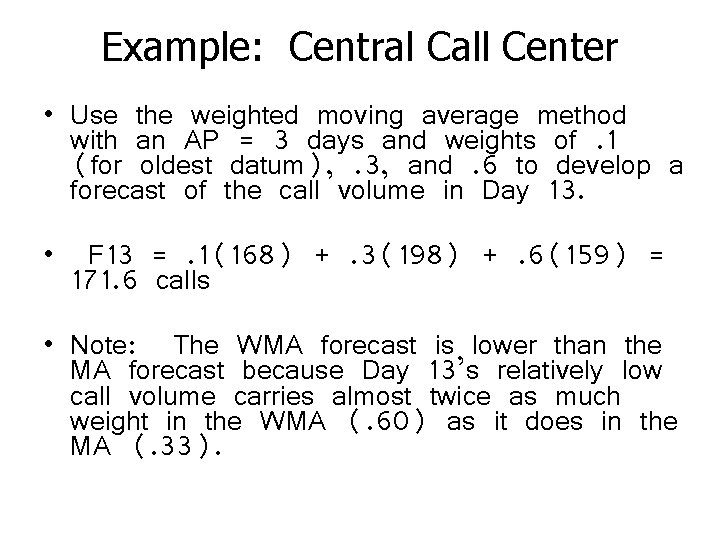
Example: Central Call Center • Use the weighted moving average method with an AP = 3 days and weights of. 1 (for oldest datum), . 3, and. 6 to develop a forecast of the call volume in Day 13. • F 13 =. 1(168) +. 3(198) +. 6(159) = 171. 6 calls • Note: The WMA forecast is lower than the MA forecast because Day 13’s relatively low call volume carries almost twice as much weight in the WMA (. 60) as it does in the MA (. 33).
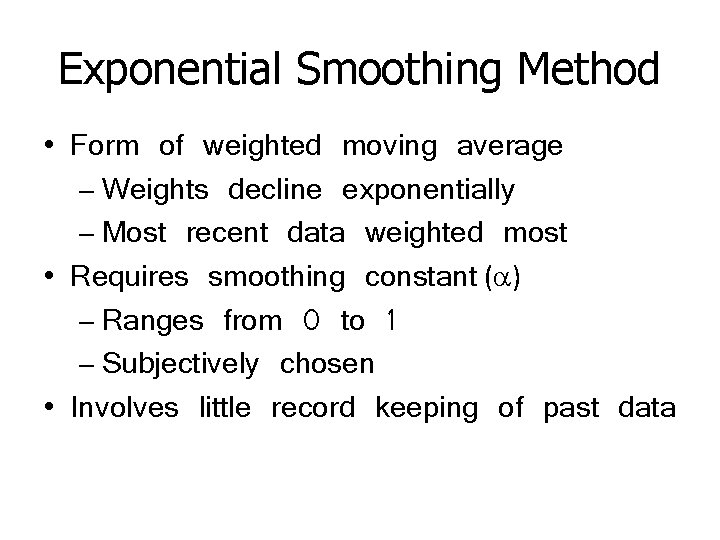
Exponential Smoothing Method • Form of weighted moving average – Weights decline exponentially – Most recent data weighted most • Requires smoothing constant ( ) – Ranges from 0 to 1 – Subjectively chosen • Involves little record keeping of past data
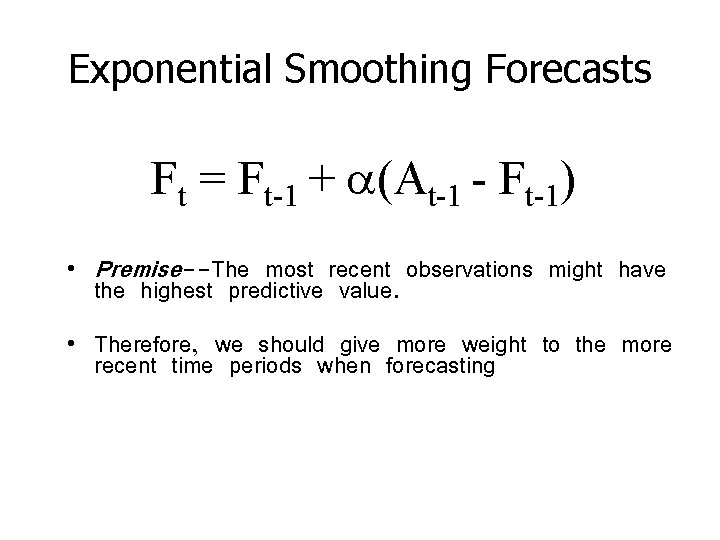
Exponential Smoothing Forecasts Ft = Ft-1 + (At-1 - Ft-1) • Premise--The most recent observations might have the highest predictive value. • Therefore, we should give more weight to the more recent time periods when forecasting
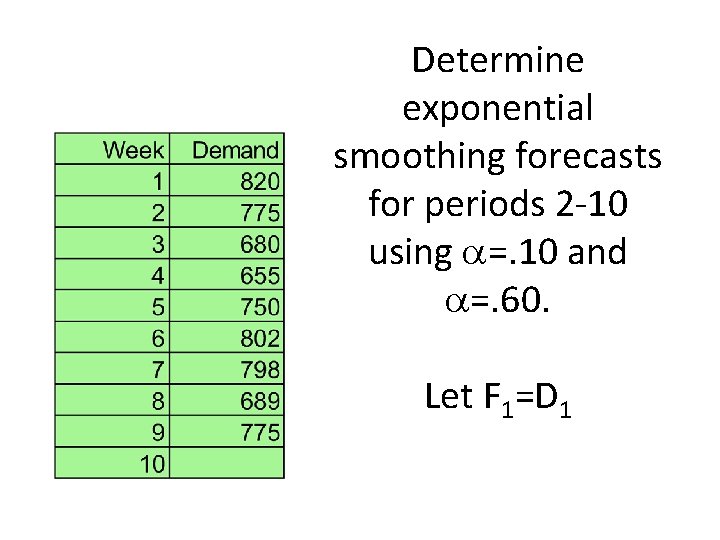
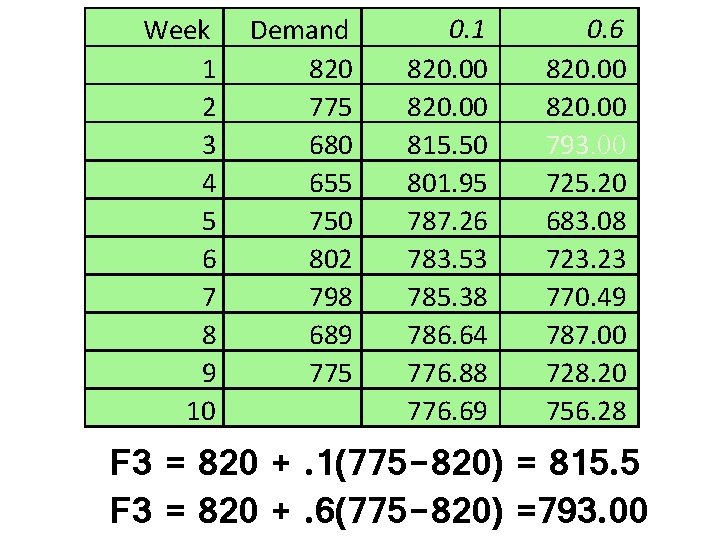
Determine exponential smoothing forecasts for periods 2 -10 using =. 10 and =. 60. Let F 1=D 1
Week 1 2 3 4 5 6 7 8 9 10 Demand 820 775 680 655 750 802 798 689 775 0. 1 820. 00 815. 50 801. 95 787. 26 783. 53 785. 38 786. 64 776. 88 776. 69 0. 6 820. 00 793. 00 725. 20 683. 08 723. 23 770. 49 787. 00 728. 20 756. 28 F 3 = 820 +. 1(775 -820) = 815. 5 F 3 = 820 +. 6(775 -820) =793. 00
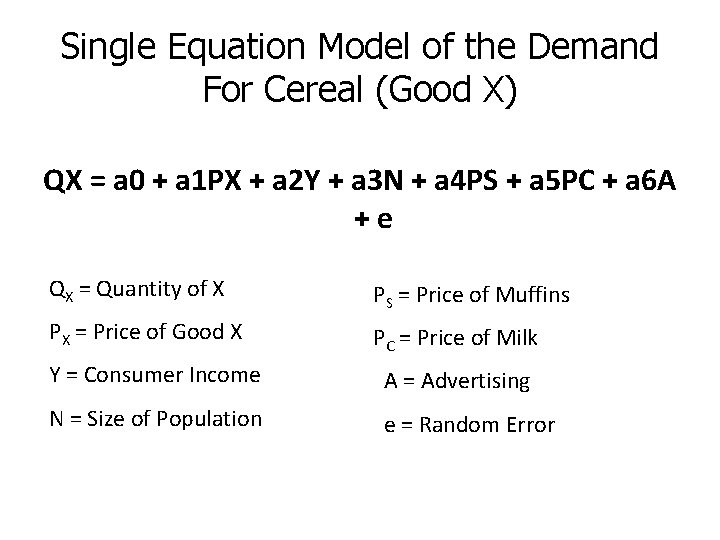
Single Equation Model of the Demand For Cereal (Good X) QX = a 0 + a 1 PX + a 2 Y + a 3 N + a 4 PS + a 5 PC + a 6 A +e QX = Quantity of X PS = Price of Muffins PX = Price of Good X PC = Price of Milk Y = Consumer Income A = Advertising N = Size of Population e = Random Error