
The AHS Learning Plan A whole school approach


- Slides: 41
The AHS Learning Plan A whole school approach to Teaching and Learning Developing Assessment for Learning APD@AHS
Starter With a partner share one thing that has changed the most about your teaching in the last year. share two things that you would like to improve in your own teaching practice.
Aims of the session To provide a brief history of the AHS learning plan. To develop participants understanding of the fundamental principles of the AHS Learning plan model and how to use it. To share ideas of how all teachers can continue to develop their own pedagogical practice through the exploration of the underpinning elements.
Background In 2003 the DFE produced a paper Pedagogy and Practice: Teaching and Learning in Secondary Schools. Although this document primarily referred to AFL a key message was that where schools adopt a cohesive approach to teaching and learning they are more likely to achieve success. Based on this principle the adoption of the whole school learning plan, based on the TEEP cycle, (of which AFL is an underlying principle) has been a significant factor in the sustained improvement of teaching and learning at AHS.
Rationale for a consistent approach to planning: A generic method of planning that all teachers are able to apply whatever their subject. A planning tool through which we can address the key issues identified as key to improving learning and teaching, and pupil progress. It’s infectious, and with individual creativity it really works.
TEEP case study ‘What I am most struck by when meeting other staff who are passionate about TEEP is that there is an almost ‘evangelical zeal’ for the model – they know that it works in their classroom and are keen to share this understanding with other teachers. Not because it makes them look clever but because, as teachers, they inherently delight in helping others to learn, and enjoy the buzz that comes with introducing TEEP to staff new to the model. It is this fervour that needs to be kindled and nurtured in your staff if TEEP is to have any long term impact beyond Level 1 training days. When I reflect back on my own professional development, I recognise that TEEP profoundly affected my own practice. I soon came to realise that TEEP would have a big impact if applied across a whole school; my initial problem was that I was a Head of English with no whole-school responsibility. However, this did mean that I spent numerous years applying the model to my own practice, thereby embedding my own TEEP zeal! ‘As Deputy Headteacher, responsible for Teaching and Learning at Melksham Oak, I am now in a position to promote TEEP as a whole-school teaching model. The first thing that I needed to do was sell TEEP to the staff. I did this initially by delivering CPD sessions that modelled the model. Sessions were planned primarily for engagement, with whole training days given over to ‘Prepare for TEEP Learning’ and also, sharing the session plans with staff so as to explicitly model planning with the TEEP Cycle. This meant that when TEEP Level 1 training took place we were in a position for accelerated learning, as staff were wellversed with the methodology. ‘I’m happy to say that at Melksham Oak we now have lots of teachers who are as evangelical about TEEP as myself! They know that it works because they see it daily in their own classrooms. As one teacher now puts it to visitors, ‘It’s just the way we do things round here’. TEEP is increasingly embedded into whole school practice, and has helped develop the school as a learning community with a shared common language. We are now receiving requests from other schools, LAs and other organisations, both within our local network and further afield, to share how we’ve developed teaching and learning through the TEEP Model.
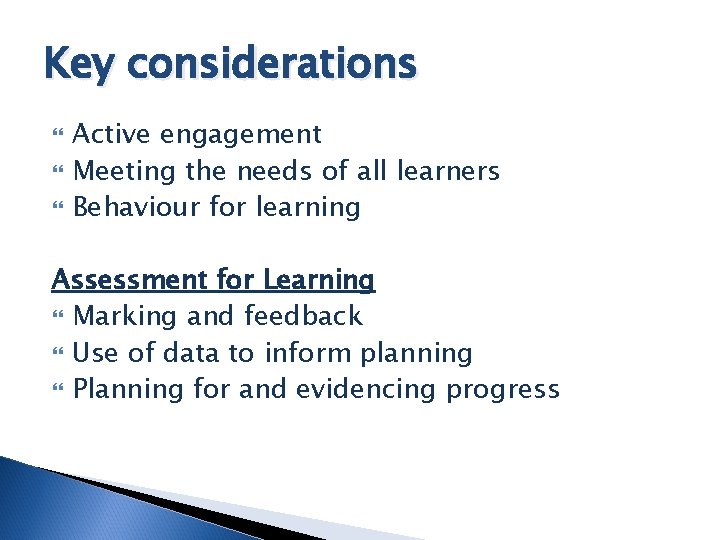
Key considerations Active engagement Meeting the needs of all learners Behaviour for learning Assessment for Learning Marking and feedback Use of data to inform planning Planning for and evidencing progress
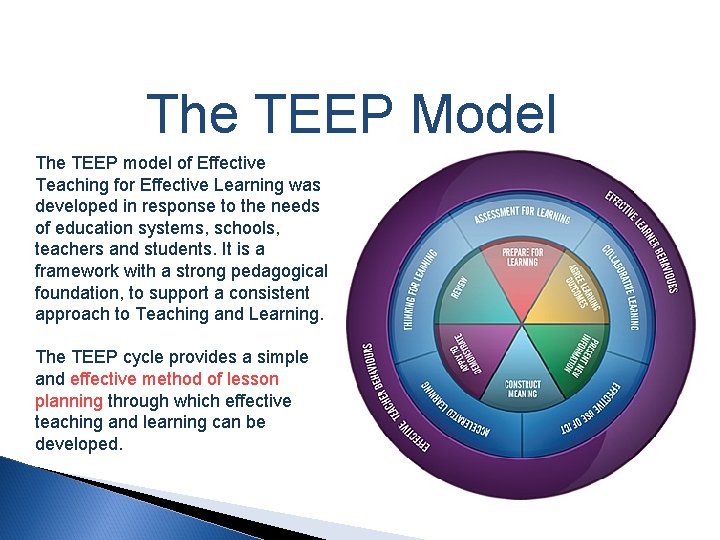
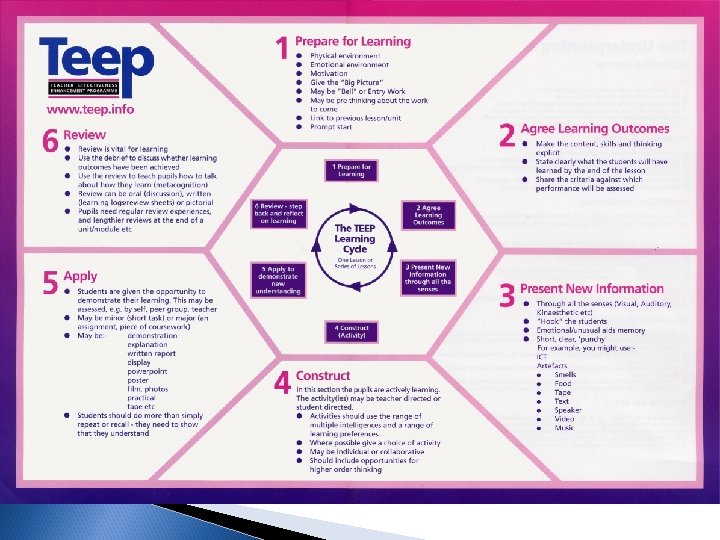
The TEEP Model The TEEP model of Effective Teaching for Effective Learning was developed in response to the needs of education systems, schools, teachers and students. It is a framework with a strong pedagogical foundation, to support a consistent approach to Teaching and Learning. The TEEP cycle provides a simple and effective method of lesson planning through which effective teaching and learning can be developed.
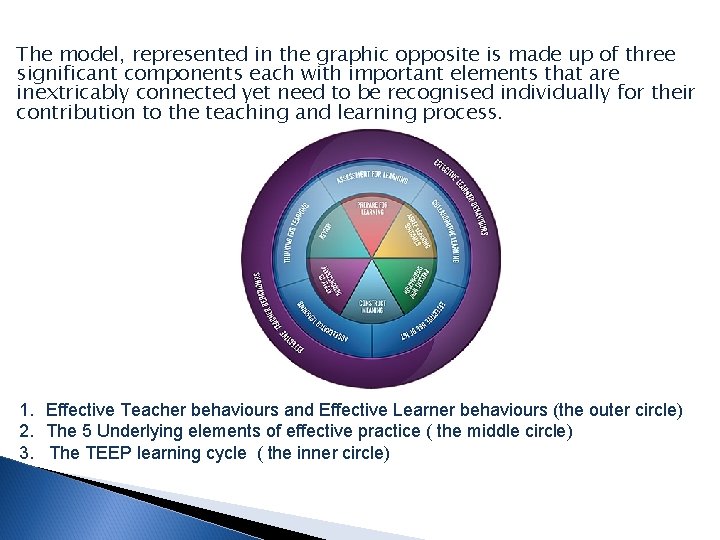
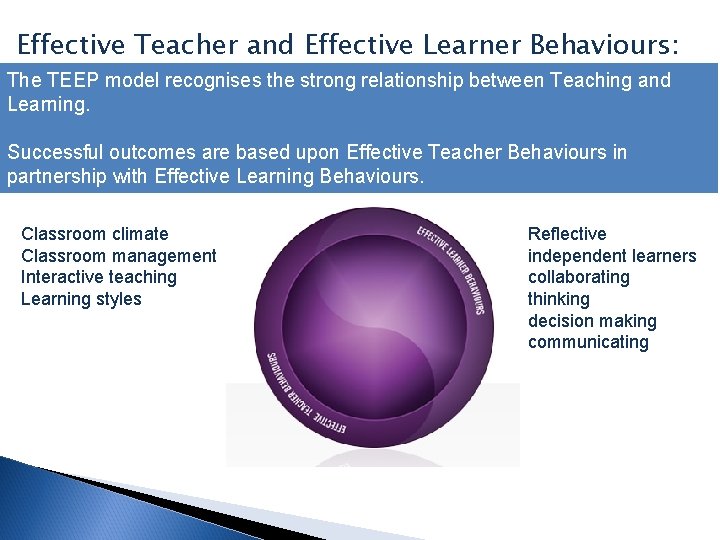
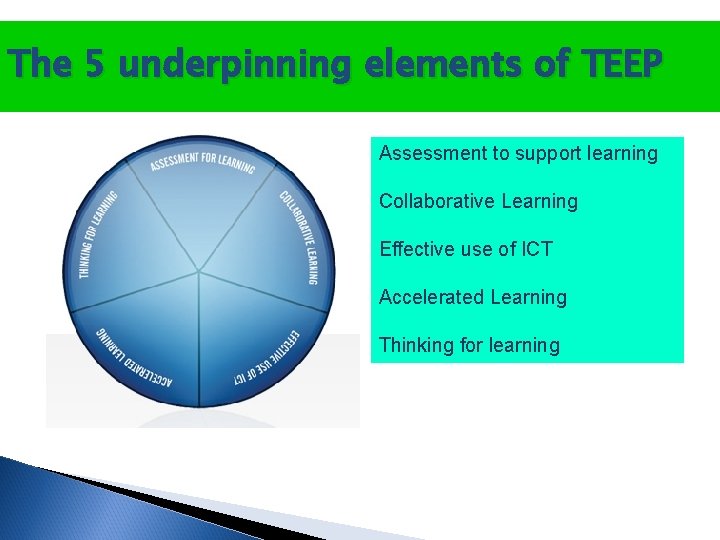
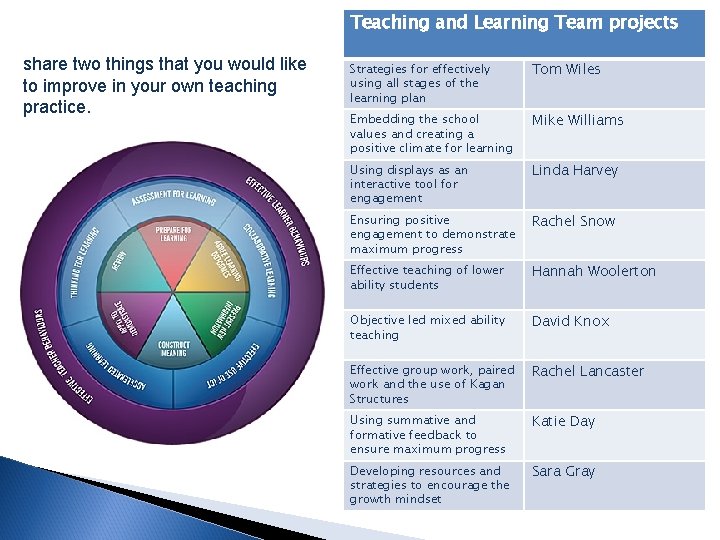
The model, represented in the graphic opposite is made up of three significant components each with important elements that are inextricably connected yet need to be recognised individually for their contribution to the teaching and learning process. 1. Effective Teacher behaviours and Effective Learner behaviours (the outer circle) 2. The 5 Underlying elements of effective practice ( the middle circle) 3. The TEEP learning cycle ( the inner circle)
Effective Teacher and Effective Learner Behaviours: The TEEP model recognises the strong relationship between Teaching and Learning. Successful outcomes are based upon Effective Teacher Behaviours in partnership with Effective Learning Behaviours. Classroom climate Classroom management Interactive teaching Learning styles Reflective independent learners collaborating thinking decision making communicating
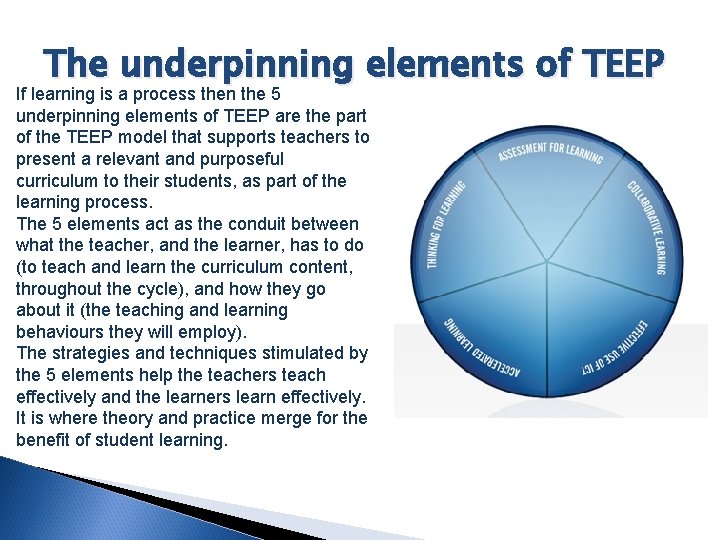
The underpinning elements of TEEP If learning is a process then the 5 underpinning elements of TEEP are the part of the TEEP model that supports teachers to present a relevant and purposeful curriculum to their students, as part of the learning process. The 5 elements act as the conduit between what the teacher, and the learner, has to do (to teach and learn the curriculum content, throughout the cycle), and how they go about it (the teaching and learning behaviours they will employ). The strategies and techniques stimulated by the 5 elements help the teachers teach effectively and the learners learn effectively. It is where theory and practice merge for the benefit of student learning.
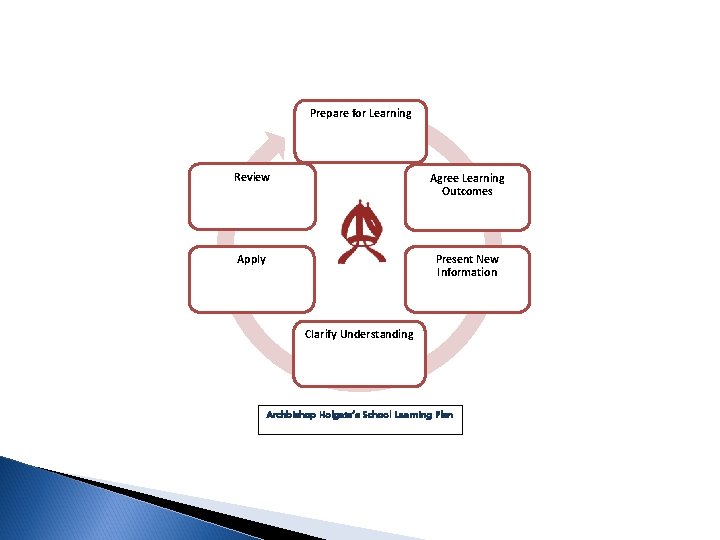
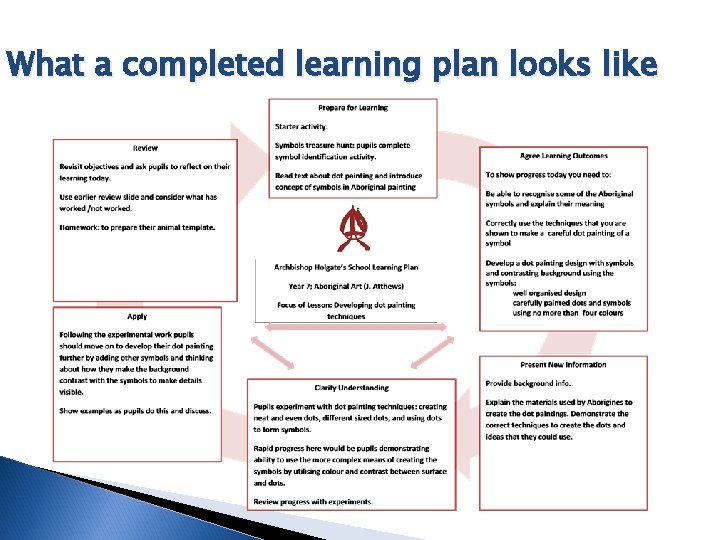
Prepare for Learning Review Agree Learning Outcomes Apply Present New Information Clarify Understanding Archbishop Holgate’s School Learning Plan
What a completed learning plan looks like
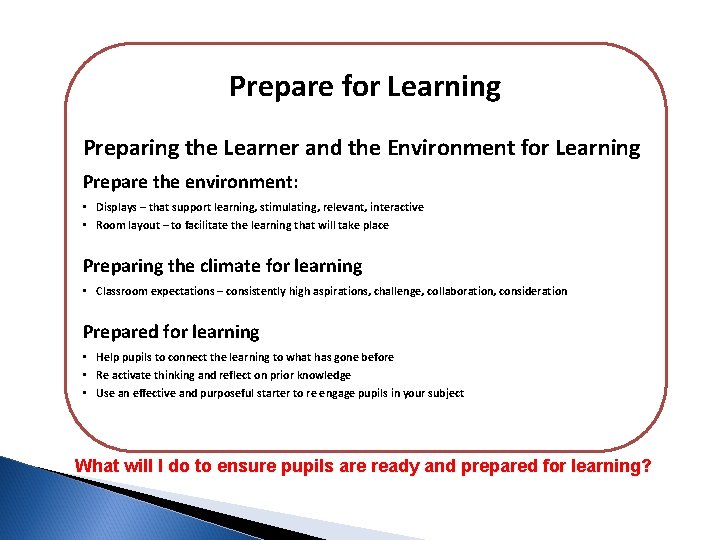
Prepare for Learning Preparing the Learner and the Environment for Learning Prepare the environment: • Displays – that support learning, stimulating, relevant, interactive • Room layout – to facilitate the learning that will take place Preparing the climate for learning • Classroom expectations – consistently high aspirations, challenge, collaboration, consideration Prepared for learning • Help pupils to connect the learning to what has gone before • Re activate thinking and reflect on prior knowledge • Use an effective and purposeful starter to re engage pupils in your subject What will I do to ensure pupils are ready and prepared for learning?
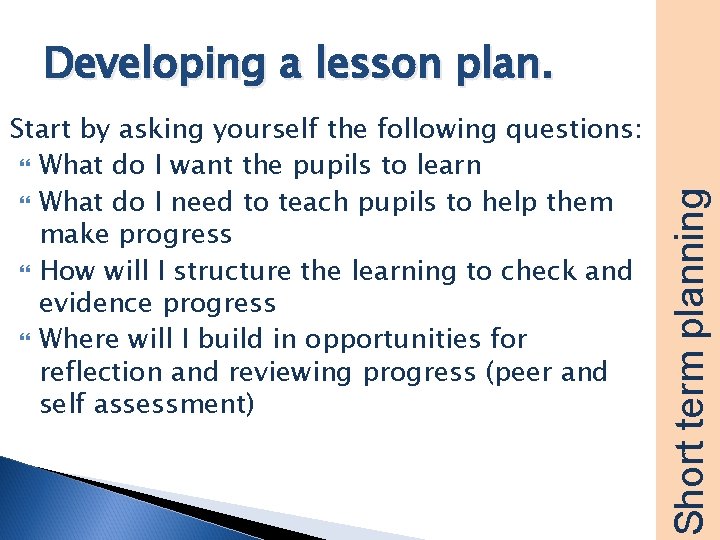
Start by asking yourself the following questions: What do I want the pupils to learn What do I need to teach pupils to help them make progress How will I structure the learning to check and evidence progress Where will I build in opportunities for reflection and reviewing progress (peer and self assessment) Short term planning Developing a lesson plan.
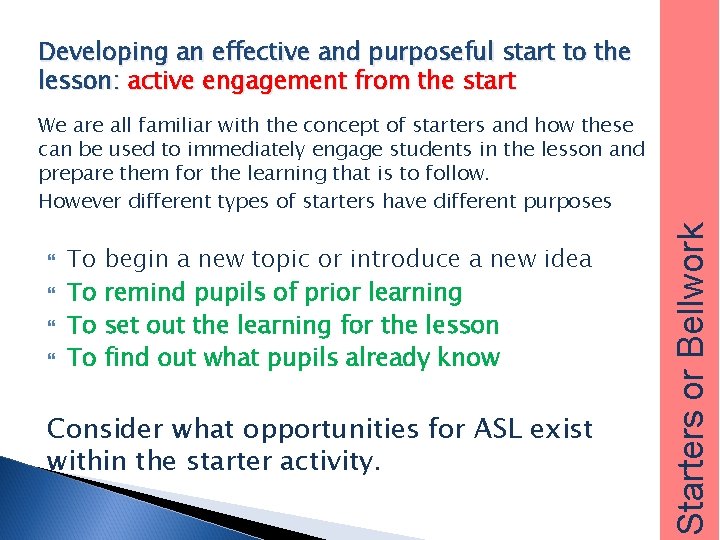
Developing an effective and purposeful start to the lesson: active engagement from the start To To begin a new topic or introduce a new idea remind pupils of prior learning set out the learning for the lesson find out what pupils already know Consider what opportunities for ASL exist within the starter activity. Starters or Bellwork We are all familiar with the concept of starters and how these can be used to immediately engage students in the lesson and prepare them for the learning that is to follow. However different types of starters have different purposes
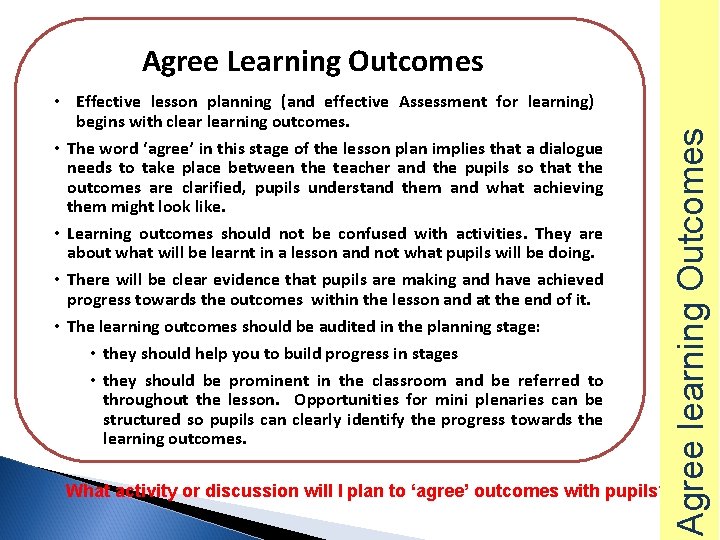
• Effective lesson planning (and effective Assessment for learning) begins with clearning outcomes. • The word ‘agree’ in this stage of the lesson plan implies that a dialogue needs to take place between the teacher and the pupils so that the outcomes are clarified, pupils understand them and what achieving them might look like. • Learning outcomes should not be confused with activities. They are about what will be learnt in a lesson and not what pupils will be doing. • There will be clear evidence that pupils are making and have achieved progress towards the outcomes within the lesson and at the end of it. • The learning outcomes should be audited in the planning stage: • they should help you to build progress in stages • they should be prominent in the classroom and be referred to throughout the lesson. Opportunities for mini plenaries can be structured so pupils can clearly identify the progress towards the learning outcomes. What activity or discussion will I plan to ‘agree’ outcomes with pupils? Agree learning Outcomes Agree Learning Outcomes
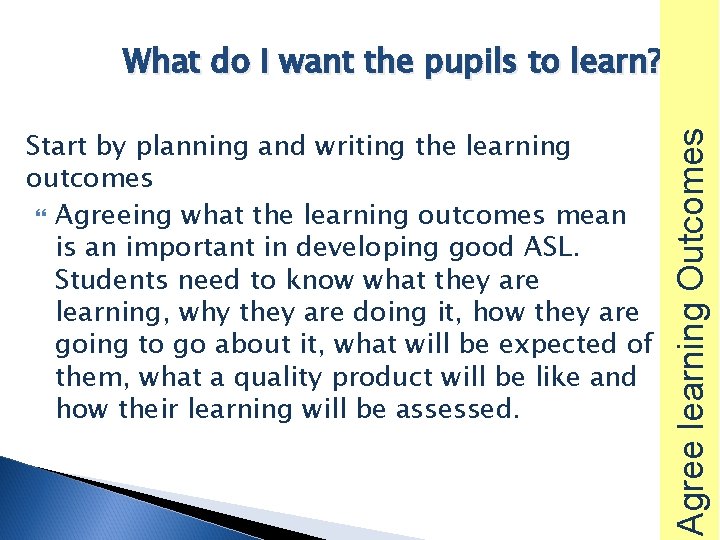
Start by planning and writing the learning outcomes Agreeing what the learning outcomes mean is an important in developing good ASL. Students need to know what they are learning, why they are doing it, how they are going to go about it, what will be expected of them, what a quality product will be like and how their learning will be assessed. Agree learning Outcomes What do I want the pupils to learn?
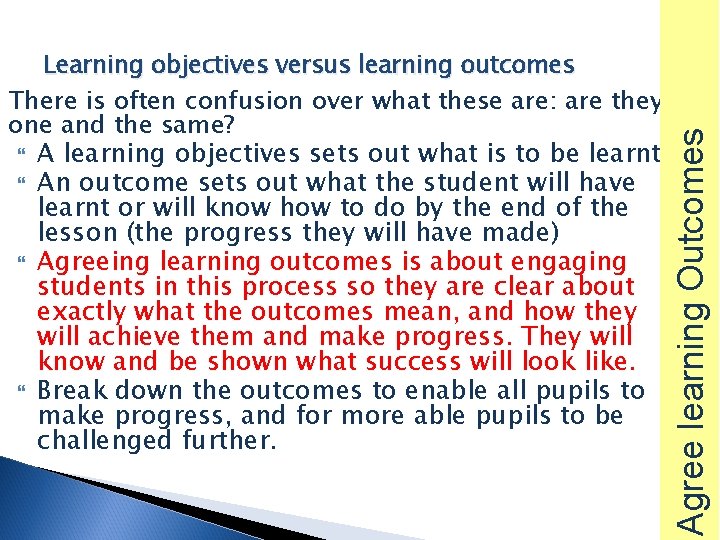
A learning objectives sets out what is to be learnt An outcome sets out what the student will have learnt or will know how to do by the end of the lesson (the progress they will have made) Agreeing learning outcomes is about engaging students in this process so they are clear about exactly what the outcomes mean, and how they will achieve them and make progress. They will know and be shown what success will look like. Break down the outcomes to enable all pupils to make progress, and for more able pupils to be challenged further. Agree learning Outcomes Learning objectives versus learning outcomes There is often confusion over what these are: are they one and the same?
by the end of the lesson you will be able to: Describe the factors of a balanced diet and give reasons why we need a balanced diet, creating a menu for an athlete, a small child, an elderly person You will be able to compare and contrast the characters of Macbeth and Banquo, giving evidence from the text to support your views Agree learning Outcomes Sample learning outcomes
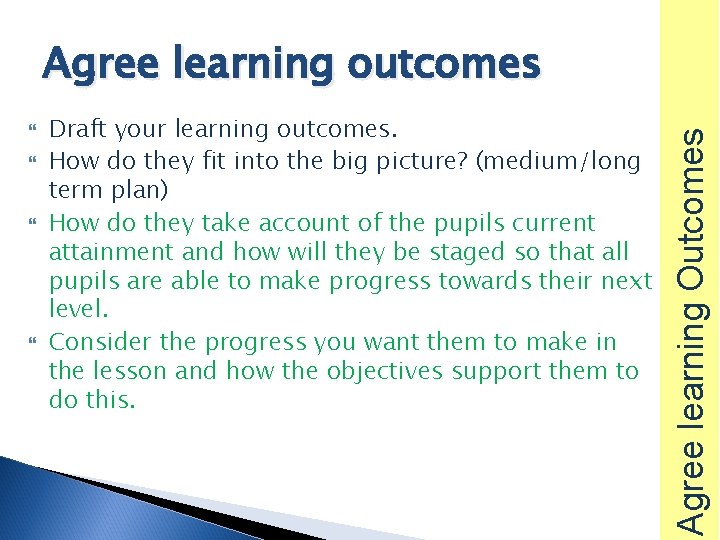
Draft your learning outcomes. How do they fit into the big picture? (medium/long term plan) How do they take account of the pupils current attainment and how will they be staged so that all pupils are able to make progress towards their next level. Consider the progress you want them to make in the lesson and how the objectives support them to do this. Agree learning Outcomes Agree learning outcomes
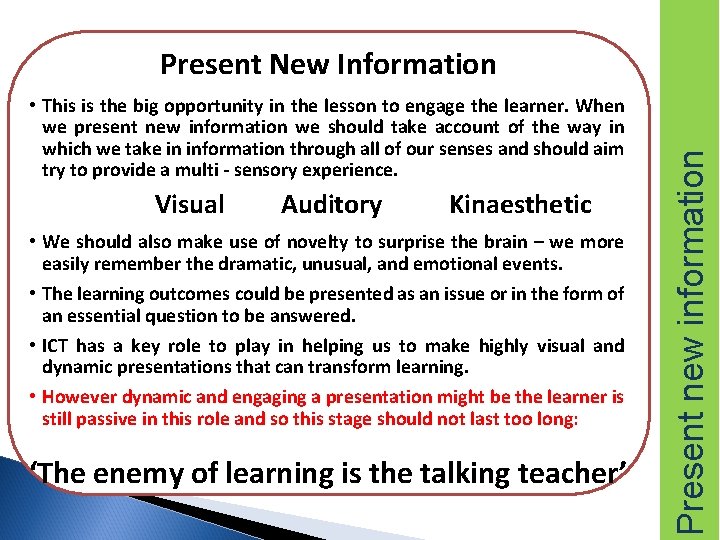
• This is the big opportunity in the lesson to engage the learner. When we present new information we should take account of the way in which we take in information through all of our senses and should aim try to provide a multi - sensory experience. Visual Auditory Kinaesthetic • We should also make use of novelty to surprise the brain – we more easily remember the dramatic, unusual, and emotional events. • The learning outcomes could be presented as an issue or in the form of an essential question to be answered. • ICT has a key role to play in helping us to make highly visual and dynamic presentations that can transform learning. • However dynamic and engaging a presentation might be the learner is still passive in this role and so this stage should not last too long: ‘The enemy of learning is the talking teacher’ Present new information Present New Information
Once the learning outcomes have been agreed the teacher will deliver the part of the lesson where new material is presented to the students. This might take many forms: a demo, a video, a power point but should aim to captivate and motivate the learner. What new information do you want to present and how will you do this? How will what you present help the students to move forward in their learning and make progress? Present new information
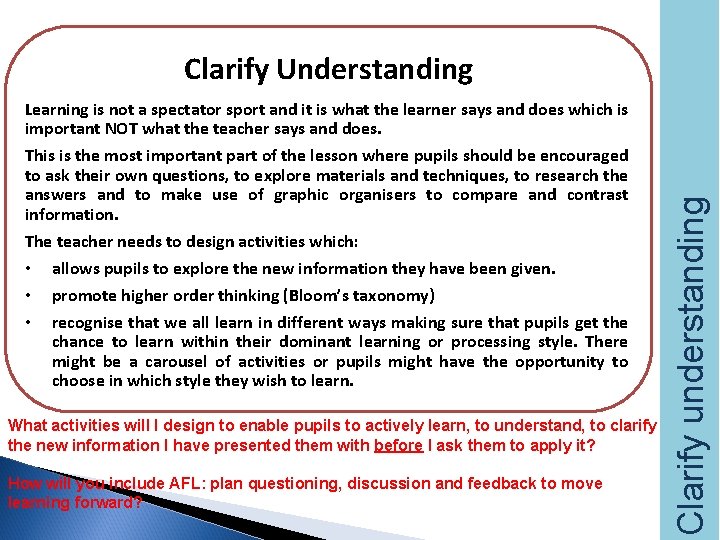
Learning is not a spectator sport and it is what the learner says and does which is important NOT what the teacher says and does. This is the most important part of the lesson where pupils should be encouraged to ask their own questions, to explore materials and techniques, to research the answers and to make use of graphic organisers to compare and contrast information. The teacher needs to design activities which: • allows pupils to explore the new information they have been given. • promote higher order thinking (Bloom’s taxonomy) • recognise that we all learn in different ways making sure that pupils get the chance to learn within their dominant learning or processing style. There might be a carousel of activities or pupils might have the opportunity to choose in which style they wish to learn. What activities will I design to enable pupils to actively learn, to understand, to clarify the new information I have presented them with before I ask them to apply it? How will you include AFL: plan questioning, discussion and feedback to move learning forward? Clarify understanding Clarify Understanding
We all spend a lot of time considering what we are going to present to students and consider this as new learning. However once we have presented the idea, skill or investigation what happens next is crucial. If we expect the student to watch us do something and learn it instantly they may fail. If we are taught something new we need the opportunity to ‘get our head around it’ before we can apply that learning independently to a new situation. Therefore we need to provide students with an opportunity to process the information and make sense of it. We cannot be given new learning: we have to engage actively in activities which allow us to explore and re -state it for ourselves, and in ways which help us to understand new info, concepts and develop skills. Such activities provide sound opportunities for ASL. We can review students understanding of the task, identify misconceptions in their understanding and give them feedback about the next steps they need to take. The way in which the activities are planned can take account of different needs and the tasks differentiated linked to the learning objectives. Clarify understanding
These activities provide opportunities for students to try things out without fear of failure. They allow the teacher time to assess what students have grasped and provide feedback about misconceptions and how they can improve. The Apply section that follows is the ‘real’ attempt and takes place when students are confident that they understand can do. Clarify understanding activities
What clarifying activity will you include to help pupils to process the new information? How will you organise this? How will you differentiate this to meet the needs of all learners. What resources will you need to prepare for this? What will you be expecting to see to be sure that the students understand? What mini review will you plan to check understanding? Clarify understanding Clarifying understanding
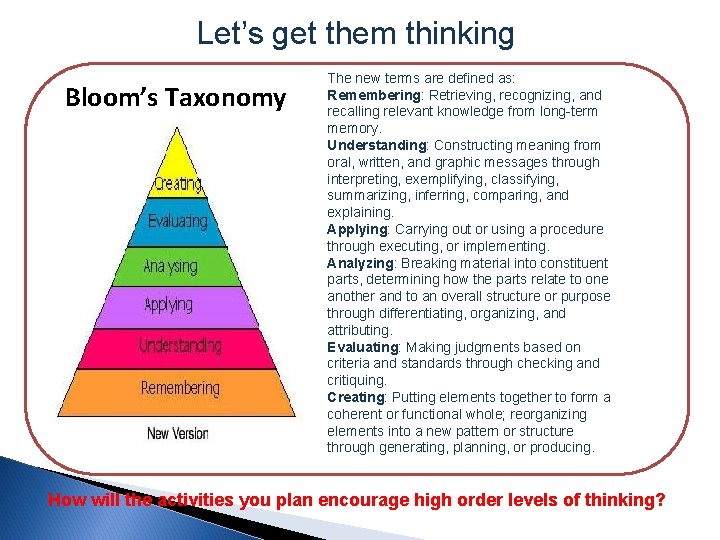
Let’s get them thinking Bloom’s Taxonomy The new terms are defined as: Remembering: Retrieving, recognizing, and recalling relevant knowledge from long-term memory. Understanding: Constructing meaning from oral, written, and graphic messages through interpreting, exemplifying, classifying, summarizing, inferring, comparing, and explaining. Applying: Carrying out or using a procedure through executing, or implementing. Analyzing: Breaking material into constituent parts, determining how the parts relate to one another and to an overall structure or purpose through differentiating, organizing, and attributing. Evaluating: Making judgments based on criteria and standards through checking and critiquing. Creating: Putting elements together to form a coherent or functional whole; reorganizing elements into a new pattern or structure through generating, planning, or producing. How will the activities you plan encourage high order levels of thinking?
In this part of the lesson the learner has the opportunity to apply what they have learnt and to demonstrate their new understanding. The teacher designs situations in which pupils can apply their understanding within a different of less familiar context. It should be more than simply recalling the information. (The lowest rung on the ladder in Bloom’s taxonomy). Pupils could: • Present their learning to others • Prepare resources for others to use and learn from • Provide opportunities for pupils to be questioned by others about what they have learnt • Give them opportunities to defend their position based on an issue they have learnt about. What opportunities are you providing for pupils to Apply their learning? Apply
This is where students have the opportunity to show that they really do understand what they have been learning by applying it. This should be more than just recalling the information. They might be: answering an exam question, preparing questions for others or creating an exam paper, recording a pod cast or presenting a TV show. The teacher should prompt, guide, and provide feedback here that helps students to make progress through effective questioning. The ‘apply’ task can be differentiated, and could be independent or collaborative, Apply to demonstrate understanding
What activity will students complete in order to demonstrate their understanding? Will this activity be completed within one lesson? If not how will you structure the activity so that learning and progress are staged? What opportunities can you build in here for self and peer assessment? What opportunities exist here for sharing what pupils have learnt and to celebrate success. Apply to demonstrate
• The review is one of the most important stages of the lesson but quite often the least well done. The review should be an integral part of the lesson and there should be opportunities to review throughout the lesson and not just at the end of it. Some examples of review activities • The teacher returns to the learning outcomes and re-emphasises the main learning points. • The pupils are active in their own review. For example they might list and discuss three most important things they have learnt and write down questions they want to ask which the teacher can use to develop learning in the next lesson. • Pupils might present the review themselves, analysing their progress against the outcomes and sharing their progress with the class. • The teacher may use this part of the lesson to debrief the learning, carefully unpacking the learning outcomes through skilful questioning techniques. Focus would be on what has been learned but also on how it has been learnt. How will pupils be actively involved in the review? How many review opportunities will you create during the lesson? Review
Review A review should be included in the lesson to allow students time to reflect on their learning. Reviews can be used at different stages throughout the lesson. When will you review progress during the lesson and provide feedback? What kind of a review will you use at the end of the lesson? Review
The 5 underpinning elements of TEEP Assessment to support learning Collaborative Learning Effective use of ICT Accelerated Learning Thinking for learning
Assessment for Learning The TEEP model recognises that assessment is an important tool in the learning process. As the term Assessment for Learning implies, any assessment should lead to improved learning outcomes for students. The TEEP model explores strategies and techniques that support teachers and students to give and receive quality feedback, and use assessment in both formative and Summative ways. It supports a positive approach to learning and is based on the premise that all students can learn. Teachers and students need to understand the purpose of any assessment procedure and how it will lead to improvement in learning outcomes. It requires teachers to understand the indicators of progress and students to know what they are aiming for. Reflective teaching and learning practices are important components of assessment for learning. The TEEP model highlights what teachers need to know and how they can apply this to their practice with the intention of improving students’ learning. The 5 underpinning elements of TEEP
Collaborative Learning Collaborative Problem solving is an approach to teaching and learning that involves groups of students working and learning together to complete a task, solve a problem or create a product. Learning is an active process whereby learners assimilate the information and relate the new knowledge to a framework of prior knowledge. Learning requires a task or problem that requires the learner to engage actively with his/her peers, and to process and synthesise information rather than simply memorise and regurgitate it. Learners benefit from exposure to diverse viewpoints from people with varied backgrounds and experiences. Learning flourishes in a social environment where conversations between learners take place. The skills of effective collaboration should be explicitly taught. The 5 underpinning elements of TEEP
Effective use of ICT Our students are growing up in a world that increasingly uses ICT to communicate knowledge, ideas and information. The digital world is their present and their future. Teachers need to seek for opportunities to use ICT to reflect real world examples that will enhance student learning. A range of technologies such as: cameras, Ipads, game consoles, mp 3 players, mobile phones, computers, and electronic white- boards can be used by students and teachers to: Access and organise information Analyse and evaluate data Create images to represent or present knowledge Motivate and engage Introduce real world applications into the classroom Communicate knowledge and ideas. The 5 underpinning elements of TEEP
Accelerated Learning Accelerated learning is the term that the TEEP model uses to describe the techniques and strategies that we use to actively engage learners in learning. It is based on research of brain function , student motivation and multiple intelligences and provides a platform for life-long learning by promoting the importance of understanding how we learn as much as what we learn. The key ideas can be briefly summarised as: Making connections with prior knowledge and experiences Experiencing the content of the curriculum through the senses Supporting students to take risks in their learning Allowing opportunity for exploratory talk Providing students with relevant and useful feedback Offering learning experiences that are both pleasurable and memorable Regular review of learning The 5 underpinning elements of TEEP
Thinking for learning Thinking is a process that invites the learner to make sense of the information at hand. It is the way to understanding. We know that we can think in different ways and at different levels and the challenge for the teacher is to encourage their students to think deeply rather than on a superficial level so that the learning that takes place is rich and long-lasting. The TEEP model explores strategies and techniques, including ideas from De Bono and ways to use Bloom’s taxonomy of cognitive thinking as a support to develop higher order thinking in the belief that it will deepen understanding and enrich student learning. Teachers need to develop their understanding of different levels of thinking and also how to support students so that they become used to thinking more deeply about what and how they learn. The 5 underpinning elements of TEEP
Teaching and Learning Team projects share two things that you would like to improve in your own teaching practice. Strategies for effectively using all stages of the learning plan Tom Wiles Embedding the school values and creating a positive climate for learning Mike Williams Using displays as an interactive tool for engagement Linda Harvey Ensuring positive engagement to demonstrate maximum progress Rachel Snow Effective teaching of lower ability students Hannah Woolerton Objective led mixed ability teaching David Knox Effective group work, paired work and the use of Kagan Structures Rachel Lancaster Using summative and formative feedback to ensure maximum progress Katie Day Developing resources and strategies to encourage the growth mindset Sara Gray