
The AHRC Peer Review College PRC PRC Induction
- Slides: 38
The AHRC Peer Review College (PRC) PRC Induction Online Training
Course Overview • This course has been designed to provide training and guidance, to ensure best practice in peer review. • The information provided covers the importance of peer review through to detailed information on how to undertake reviews and the format of panel meetings. • There are links within the training to information on the AHRC website. It’s important to use these links, as they link to key information that you will need to follow, or be aware of, as part of your reviewer and panel member roles. • You can navigate randomly to any module from the contents page or work through the modules in order. The course also includes examples of reviewer comments and grading examples to help you with your reviewing activity.
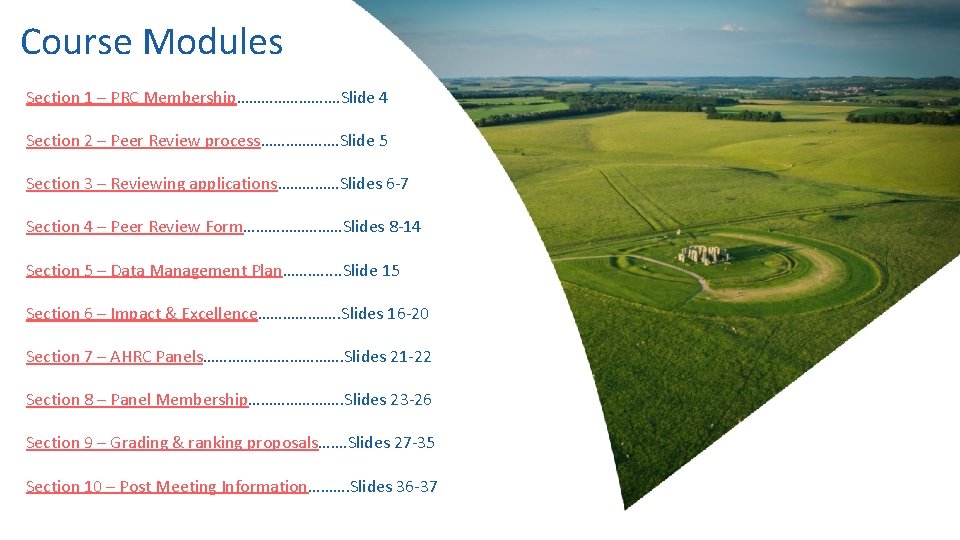
Course Modules Section 1 – PRC Membership…………. Slide 4 Section 2 – Peer Review process………………. Slide 5 Section 3 – Reviewing applications……………Slides 6 -7 Section 4 – Peer Review Form…………Slides 8 -14 Section 5 – Data Management Plan………. . . Slide 15 Section 6 – Impact & Excellence………………. . Slides 16 -20 Section 7 – AHRC Panels………………. Slides 21 -22 Section 8 – Panel Membership…………………. . Slides 23 -26 Section 9 – Grading & ranking proposals……. Slides 27 -35 Section 10 – Post Meeting Information………. Slides 36 -37
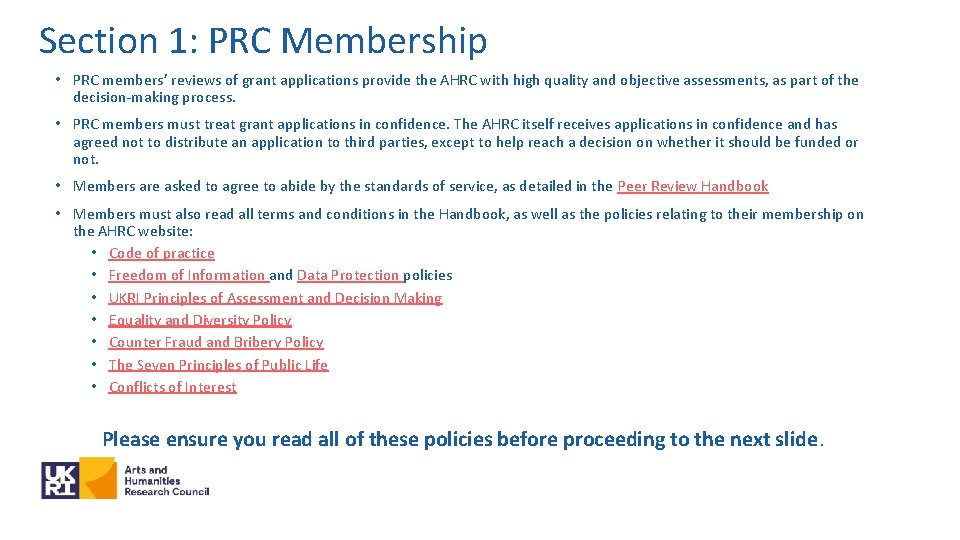
Section 1: PRC Membership • PRC members’ reviews of grant applications provide the AHRC with high quality and objective assessments, as part of the decision-making process. • PRC members must treat grant applications in confidence. The AHRC itself receives applications in confidence and has agreed not to distribute an application to third parties, except to help reach a decision on whether it should be funded or not. • Members are asked to agree to abide by the standards of service, as detailed in the Peer Review Handbook • Members must also read all terms and conditions in the Handbook, as well as the policies relating to their membership on the AHRC website: • Code of practice • Freedom of Information and Data Protection policies • UKRI Principles of Assessment and Decision Making • Equality and Diversity Policy • Counter Fraud and Bribery Policy • The Seven Principles of Public Life • Conflicts of Interest Please ensure you read all of these policies before proceeding to the next slide.
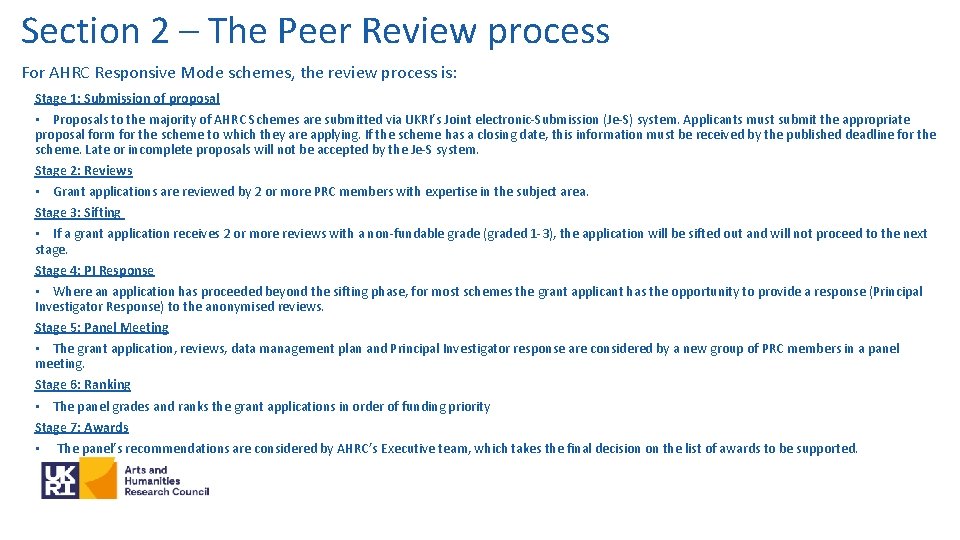
Section 2 – The Peer Review process For AHRC Responsive Mode schemes, the review process is: Stage 1: Submission of proposal • Proposals to the majority of AHRC Schemes are submitted via UKRI’s Joint electronic-Submission (Je-S) system. Applicants must submit the appropriate proposal form for the scheme to which they are applying. If the scheme has a closing date, this information must be received by the published deadline for the scheme. Late or incomplete proposals will not be accepted by the Je-S system. Stage 2: Reviews • Grant applications are reviewed by 2 or more PRC members with expertise in the subject area. Stage 3: Sifting • If a grant application receives 2 or more reviews with a non-fundable grade (graded 1 -3), the application will be sifted out and will not proceed to the next stage. Stage 4: PI Response • Where an application has proceeded beyond the sifting phase, for most schemes the grant applicant has the opportunity to provide a response (Principal Investigator Response) to the anonymised reviews. Stage 5: Panel Meeting • The grant application, reviews, data management plan and Principal Investigator response are considered by a new group of PRC members in a panel meeting. Stage 6: Ranking • The panel grades and ranks the grant applications in order of funding priority Stage 7: Awards • The panel’s recommendations are considered by AHRC’s Executive team, which takes the final decision on the list of awards to be supported.
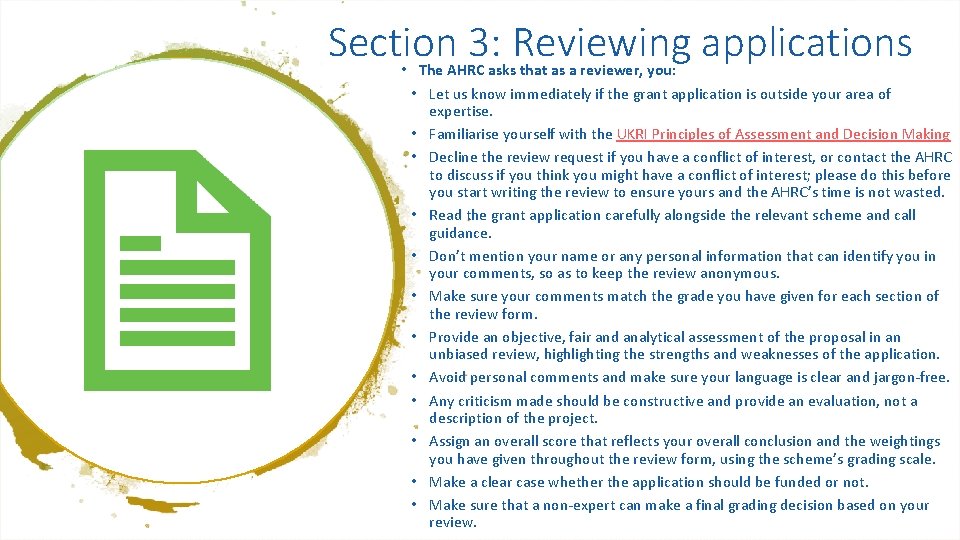
Section 3: Reviewing applications • The AHRC asks that as a reviewer, you: • Let us know immediately if the grant application is outside your area of expertise. • Familiarise yourself with the UKRI Principles of Assessment and Decision Making • Decline the review request if you have a conflict of interest, or contact the AHRC to discuss if you think you might have a conflict of interest; please do this before you start writing the review to ensure yours and the AHRC’s time is not wasted. • Read the grant application carefully alongside the relevant scheme and call guidance. • Don’t mention your name or any personal information that can identify you in your comments, so as to keep the review anonymous. • Make sure your comments match the grade you have given for each section of the review form. • Provide an objective, fair and analytical assessment of the proposal in an unbiased review, highlighting the strengths and weaknesses of the application. • Avoid personal comments and make sure your language is clear and jargon-free. • Any criticism made should be constructive and provide an evaluation, not a description of the project. • Assign an overall score that reflects your overall conclusion and the weightings you have given throughout the review form, using the scheme’s grading scale. • Make a clear case whether the application should be funded or not. • Make sure that a non-expert can make a final grading decision based on your review.
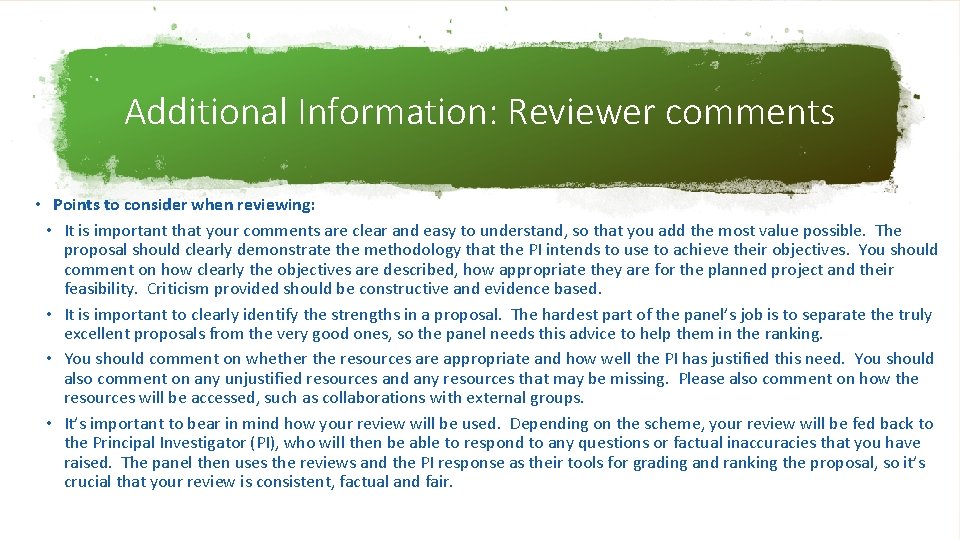
Additional Information: Reviewer comments • Points to consider when reviewing: • It is important that your comments are clear and easy to understand, so that you add the most value possible. The proposal should clearly demonstrate the methodology that the PI intends to use to achieve their objectives. You should comment on how clearly the objectives are described, how appropriate they are for the planned project and their feasibility. Criticism provided should be constructive and evidence based. • It is important to clearly identify the strengths in a proposal. The hardest part of the panel’s job is to separate the truly excellent proposals from the very good ones, so the panel needs this advice to help them in the ranking. • You should comment on whether the resources are appropriate and how well the PI has justified this need. You should also comment on any unjustified resources and any resources that may be missing. Please also comment on how the resources will be accessed, such as collaborations with external groups. • It’s important to bear in mind how your review will be used. Depending on the scheme, your review will be fed back to the Principal Investigator (PI), who will then be able to respond to any questions or factual inaccuracies that you have raised. The panel then uses the reviews and the PI response as their tools for grading and ranking the proposal, so it’s crucial that your review is consistent, factual and fair.
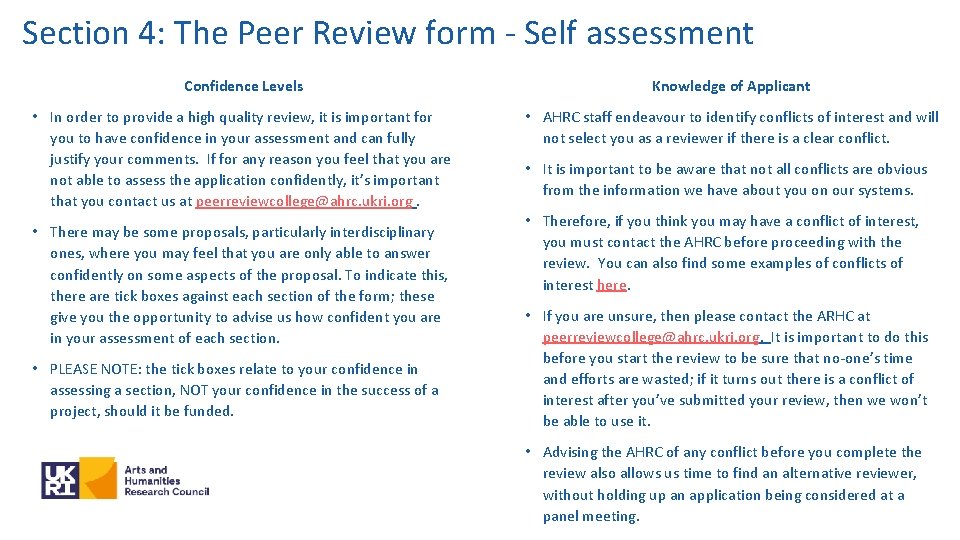
Section 4: The Peer Review form - Self assessment Confidence Levels Knowledge of Applicant • In order to provide a high quality review, it is important for you to have confidence in your assessment and can fully justify your comments. If for any reason you feel that you are not able to assess the application confidently, it’s important that you contact us at peerreviewcollege@ahrc. ukri. org. • AHRC staff endeavour to identify conflicts of interest and will not select you as a reviewer if there is a clear conflict. • There may be some proposals, particularly interdisciplinary ones, where you may feel that you are only able to answer confidently on some aspects of the proposal. To indicate this, there are tick boxes against each section of the form; these give you the opportunity to advise us how confident you are in your assessment of each section. • PLEASE NOTE: the tick boxes relate to your confidence in assessing a section, NOT your confidence in the success of a project, should it be funded. • It is important to be aware that not all conflicts are obvious from the information we have about you on our systems. • Therefore, if you think you may have a conflict of interest, you must contact the AHRC before proceeding with the review. You can also find some examples of conflicts of interest here. • If you are unsure, then please contact the ARHC at peerreviewcollege@ahrc. ukri. org. It is important to do this before you start the review to be sure that no-one’s time and efforts are wasted; if it turns out there is a conflict of interest after you’ve submitted your review, then we won’t be able to use it. • Advising the AHRC of any conflict before you complete the review also allows us time to find an alternative reviewer, without holding up an application being considered at a panel meeting.
The Peer Review form - Quality • When assessing this section, you should • Consider the aims and objectives, the research questions, the research context and the research methods. • Comment on the importance and quality of the proposal, including its contribution to enhancing or developing creativity, insights, knowledge and understanding in the subject area. • Consider if the proposal meets the aims of the funding scheme. • Rate the quality and importance of the project by choosing from the scoring tick boxes.
The Peer Review form - People • In this section, you should assess: • The quality and importance of the PI’s work to date. • The PI’s ability to monitor and complete the project as evidenced in the proposal and in their track record, taking full account of their career stage and experience. • If the proposed level of staffing and balance in terms of level and seniority are appropriate; if the time estimated for their contribution is consistent with the proposed workloads; if the level of involvement is necessary or sufficient for the successful undertaking of the project. • If other named participants have the appropriate experience and expertise to deliver the project.
The Peer Review form Management • In this section, you should assess: • The feasibility of the project. • The timetable and whether it’s realistic that it will be of completed within the proposed timescales. • Any milestones and if they’re appropriate/sufficient to measure the project’s progress. • The project plan, including arrangements for reviewing progress, including the value of any advisory board. • The arrangements for supervising and managing any staff and the career benefits that their involvement in the project will give.
The Peer Review form – Value for Money In this section, you should assess whether: • The overall cost of the proposal represents value for money. • The resources requested, such as equipment, travel and subsistence or consumables are reasonable in the context of the proposed research. • You are not expected to assess whether items such as flight are value for money, rather whether the proportion of budget used for such items is proportionate to the overall budget and the type of activity being undertaken. PLEASE NOTE: It’s not necessary to scrutinise the amount requested as Estates or Indirect costs as these are pre-defined.
The Peer Review form - judging Outputs, Dissemination and Impact • In this section, you should comment on the proposed dissemination strategy and impact plans: • You should consider: • The extent to which the programme of work will result in high quality public output(s). • Whether the plans to increase impact are appropriate and justified. • Whether sufficient attention has been given to potential beneficiaries and appropriate ways to engage with them throughout the project.
The Peer Review form. Overall Assessment • As part of your overall assessment, you should: • Provide your conclusions regarding the complete proposal. • Highlight the proposal’s strengths and weaknesses. • Make any additional comments that you haven’t previously made, to ensure a complete assessment. • Comment on any ethical aspects that have given rise for concern. • Provide a brief justification for your overall grade.
• Data Management Plans (DMP) are mandatory for all schemes except Research Networking. • Applicants are asked to address a number of points relating to the types, handling, storage, sharing and ethical/legal use of data – they should include this information in the Data Management Plan (see page 25 of the Research Funding Guide for more details) Section 5: Data Management Plans • By submitting an application, applicants are confirming their institution has considered and met a number of points listed in our Research Funding Guide. • As a reviewer, you are asked to consider and comment on: • Does the information in the DMP seem appropriate for the research project being proposed? Would you expect to see anything different in your view? • Will the DMP enable the project’s data creation, outputs and storage needs in your opinion? • Are there any other areas that need more attention? • Overall – does the plan for data seem feasible, sensible, appropriate and valid?
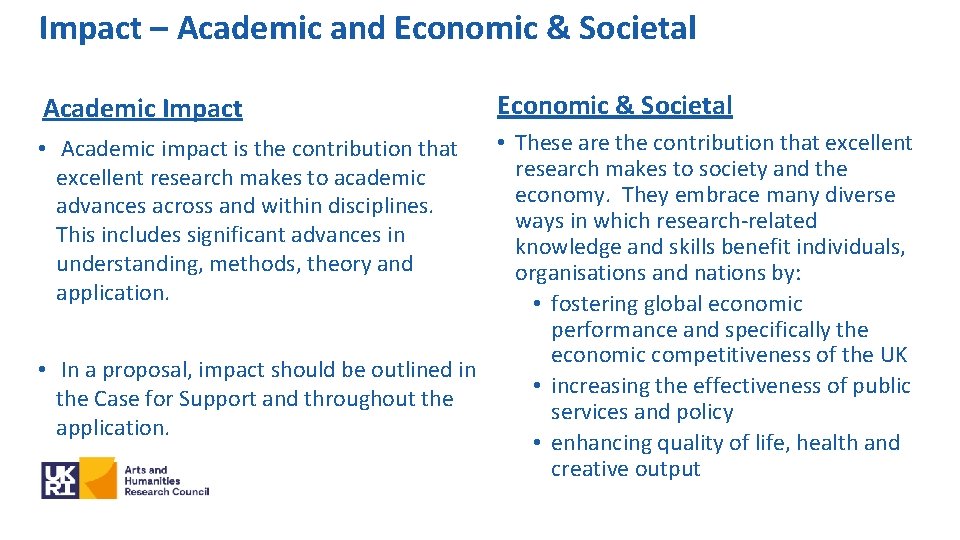
Section 6: Impact UKRI describes impact as the demonstrable contribution that excellent research makes to society and the economy. The AHRC… Believes impact and excellence underpin all the research funded by the council and that both criteria are closely linked. Needs the help of the research community in identifying impact, so that a strong case can be made for the continued funding of arts and humanities research in a competitive environment. Wants to encourage researchers to think about how they will achieve excellence with impact and to explore the pathways for realising impact. Impact is categorised in two ways.
Impact – Academic and Economic & Societal Academic Impact Economic & Societal • These are the contribution that excellent research makes to society and the economy. They embrace many diverse ways in which research-related knowledge and skills benefit individuals, organisations and nations by: • fostering global economic performance and specifically the economic competitiveness of the UK • In a proposal, impact should be outlined in • increasing the effectiveness of public the Case for Support and throughout the services and policy application. • enhancing quality of life, health and creative output • Academic impact is the contribution that excellent research makes to academic advances across and within disciplines. This includes significant advances in understanding, methods, theory and application.
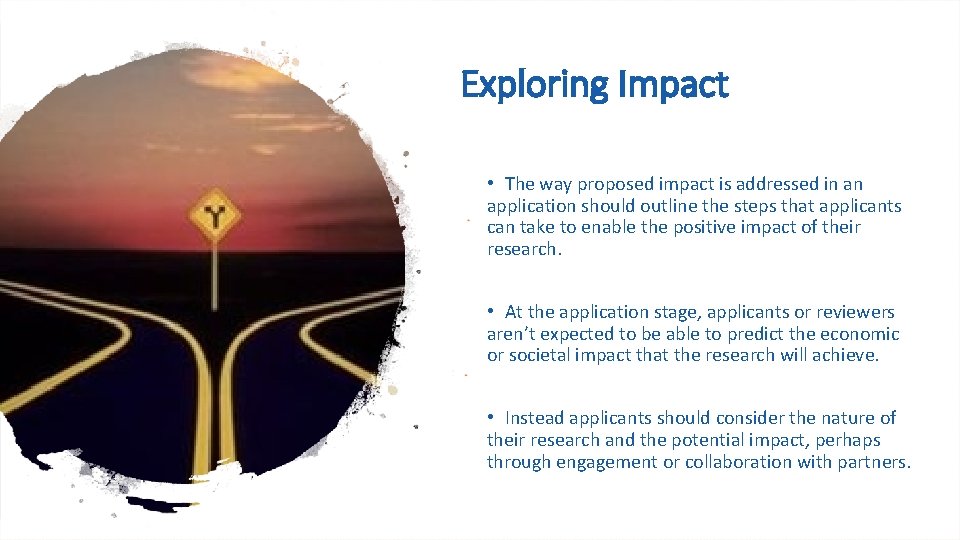
Exploring Impact • The way proposed impact is addressed in an application should outline the steps that applicants can take to enable the positive impact of their research. • At the application stage, applicants or reviewers aren’t expected to be able to predict the economic or societal impact that the research will achieve. • Instead applicants should consider the nature of their research and the potential impact, perhaps through engagement or collaboration with partners.
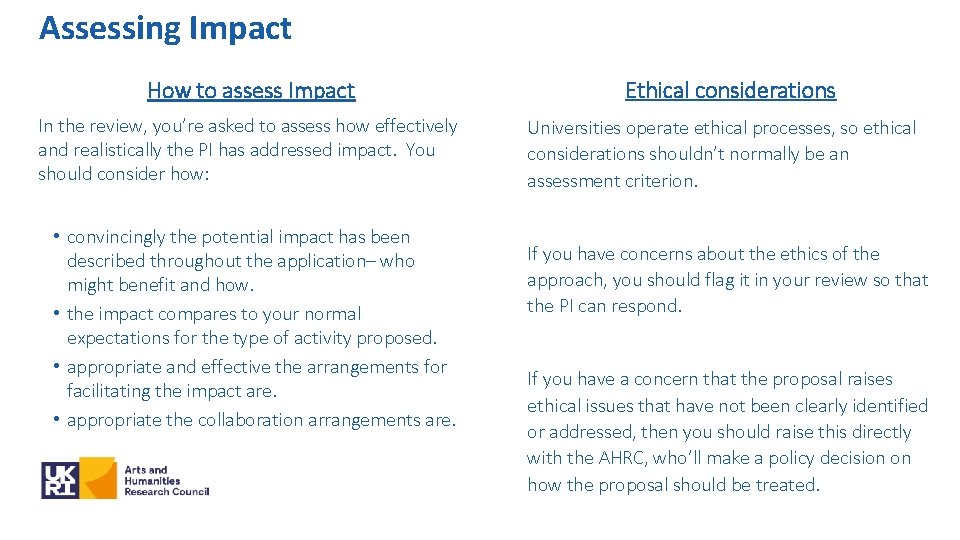
Assessing Impact How to assess Impact In the review, you’re asked to assess how effectively and realistically the PI has addressed impact. You should consider how: • convincingly the potential impact has been described throughout the application– who might benefit and how. • the impact compares to your normal expectations for the type of activity proposed. • appropriate and effective the arrangements for facilitating the impact are. • appropriate the collaboration arrangements are. Ethical considerations Universities operate ethical processes, so ethical considerations shouldn’t normally be an assessment criterion. If you have concerns about the ethics of the approach, you should flag it in your review so that the PI can respond. If you have a concern that the proposal raises ethical issues that have not been clearly identified or addressed, then you should raise this directly with the AHRC, who’ll make a policy decision on how the proposal should be treated.
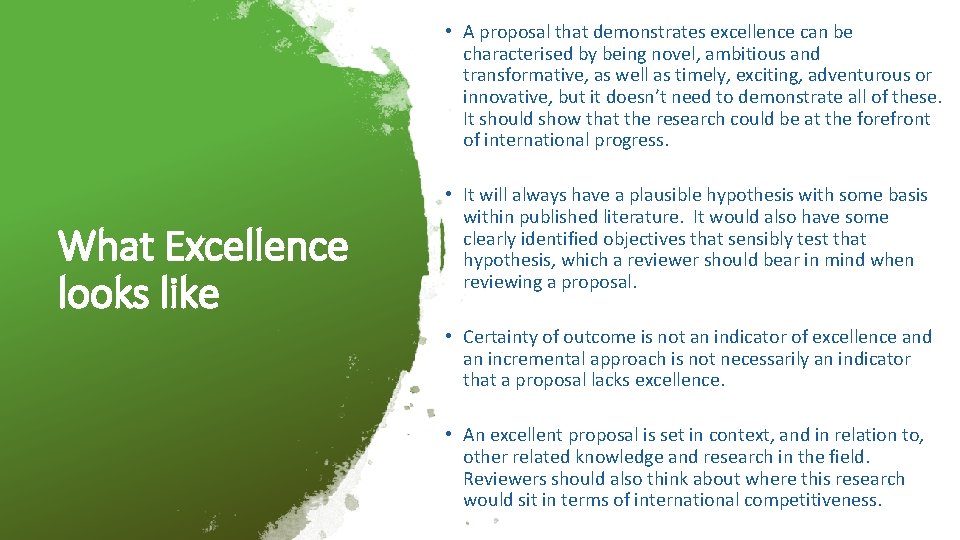
• A proposal that demonstrates excellence can be characterised by being novel, ambitious and transformative, as well as timely, exciting, adventurous or innovative, but it doesn’t need to demonstrate all of these. It should show that the research could be at the forefront of international progress. What Excellence looks like • It will always have a plausible hypothesis with some basis within published literature. It would also have some clearly identified objectives that sensibly test that hypothesis, which a reviewer should bear in mind when reviewing a proposal. • Certainty of outcome is not an indicator of excellence and an incremental approach is not necessarily an indicator that a proposal lacks excellence. • An excellent proposal is set in context, and in relation to, other related knowledge and research in the field. Reviewers should also think about where this research would sit in terms of international competitiveness.
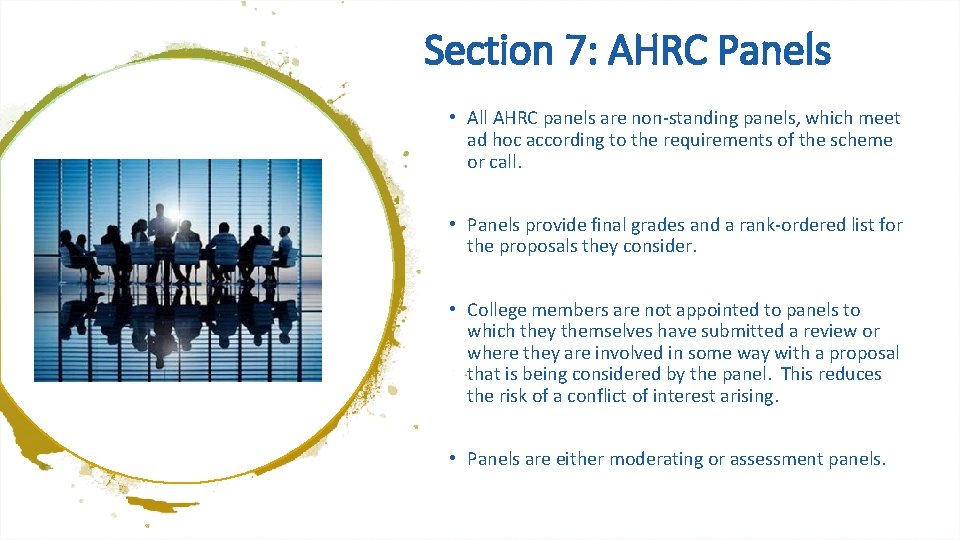
Section 7: AHRC Panels • All AHRC panels are non-standing panels, which meet ad hoc according to the requirements of the scheme or call. • Panels provide final grades and a rank-ordered list for the proposals they consider. • College members are not appointed to panels to which they themselves have submitted a review or where they are involved in some way with a proposal that is being considered by the panel. This reduces the risk of a conflict of interest arising. • Panels are either moderating or assessment panels.
Moderating Panels Assessment Panels • Held for Research Grants/Leadership Fellows/Follow on Fund over £ 30 k and some Strategic Calls. • Used for Follow on Fund applications under £ 30 k. • The role of the moderating panel is to make judgments about the proposals on the basis of the peer reviews and the PI’s response, to establish the relative quality of the proposals for funding. • It is not the panel’s role to re-review applications when deciding upon a final grade, or to make detailed assessments of proposal costings. • The panel assigns final grades to proposals and ranks them in order of priority for funding. The panel’s rank-ordered list forms the funding recommendation for AHRC. • Strategic calls, using PRC members or experienced academics from a particular field of research. • Applications are reviewed by panel members prior to a meeting. • 2 -3 panel members present a critique of each application to remaining panel members, with a suggested grade. • Panel agrees final grades and ranks proposals in order of priority of funding. The panel’s rank-ordered list forms the funding recommendation for AHRC.
Section 8: Panel membership • Wherever possible, panel membership is drawn from the PRC. Not all PRC members will have the opportunity to serve on a panel during their term of membership. When determining panel membership, the AHRC aims to: • have a spread of expertise across the panel, but not all the research areas of all the proposals will potentially be covered. • have only one panel member from any one institution. • ensure a fair balance and an even geographical spread from across the UK, as part of the AHRC’s commitment to equality and diversity. Panel Fees: • Panel members are paid a fee of £ 170 per meeting and panel Chairs receive £ 230 per meeting. This is considered as income from self-employment and is taxable as such. Expenses Claims • Expenses claims are reimbursed by the AHRC for travel and subsistence in relation to a panel meeting.
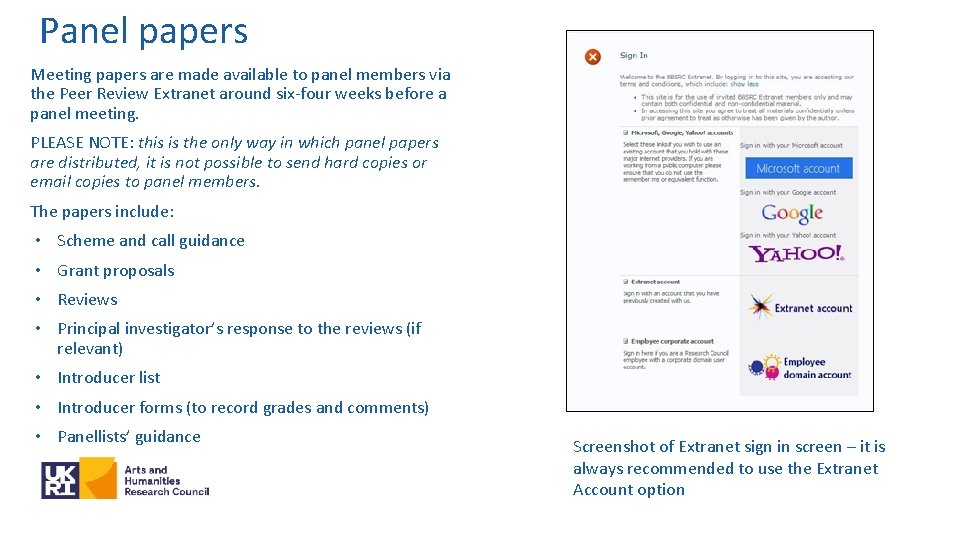
Panel papers Meeting papers are made available to panel members via the Peer Review Extranet around six-four weeks before a panel meeting. PLEASE NOTE: this is the only way in which panel papers are distributed, it is not possible to send hard copies or email copies to panel members. The papers include: • Scheme and call guidance • Grant proposals • Reviews • Principal investigator’s response to the reviews (if relevant) • Introducer list • Introducer forms (to record grades and comments) • Panellists’ guidance Screenshot of Extranet sign in screen – it is always recommended to use the Extranet Account option
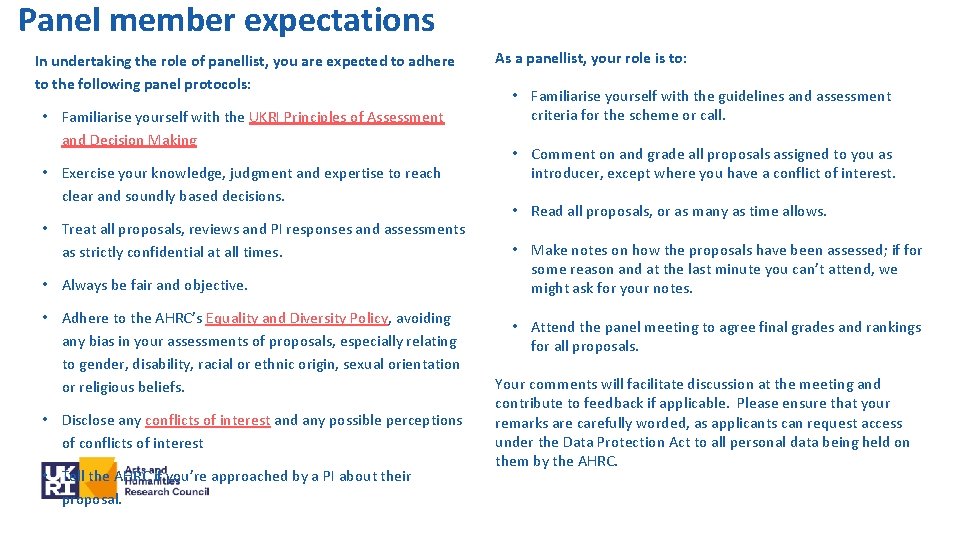
Panel member expectations In undertaking the role of panellist, you are expected to adhere to the following panel protocols: • Familiarise yourself with the UKRI Principles of Assessment and Decision Making • Exercise your knowledge, judgment and expertise to reach clear and soundly based decisions. • Treat all proposals, reviews and PI responses and assessments as strictly confidential at all times. • Always be fair and objective. • Adhere to the AHRC’s Equality and Diversity Policy, avoiding any bias in your assessments of proposals, especially relating to gender, disability, racial or ethnic origin, sexual orientation or religious beliefs. • Disclose any conflicts of interest and any possible perceptions of conflicts of interest • Tell the AHRC if you’re approached by a PI about their proposal. As a panellist, your role is to: • Familiarise yourself with the guidelines and assessment criteria for the scheme or call. • Comment on and grade all proposals assigned to you as introducer, except where you have a conflict of interest. • Read all proposals, or as many as time allows. • Make notes on how the proposals have been assessed; if for some reason and at the last minute you can’t attend, we might ask for your notes. • Attend the panel meeting to agree final grades and rankings for all proposals. Your comments will facilitate discussion at the meeting and contribute to feedback if applicable. Please ensure that your remarks are carefully worded, as applicants can request access under the Data Protection Act to all personal data being held on them by the AHRC.
Introducers • Panel members are assigned the role of first, second or supporting introducer to a number of proposals before the panel meeting. • They are expected to read all their assigned proposals. • They should grade and comment on all their assigned proposals in advance of the panel meeting, taking account of the aims and assessment criteria for the scheme concerned. • Scores should use decimal points to aid final ranking. • Should provide these scores to the AHRC ahead of the meeting, as these drive panel discussion in a logical and structured way. • Helpful tips as an introducer: • Use a compare and contrast approach to highlight any inconsistencies or contradictions in the reviews. • Highlight only specific issues which have been clearly identified by one or more reviewers. • Identify any unhelpful reviewers’ comments or inappropriate comments. • For secondary and supporting introducer roles, only add comments that have not been raised by the Primary Introducer
Section 9: Grading and Ranking proposals • Grading proposals: • The main criterion in determining the score for a proposal is its excellence. • Secondary criteria are impact and the PI’s ability, whilst planning and management also need to be considered. • Reviewers and panels use a grading scale ranging from 6 -1 as per the relevant funding scheme, 6 being the highest grade. • The panel’s decimalised rank is not conveyed to Pis – however unsuccessful applicants are advised of the whole number score. • Grading Scales: • Different funding schemes have different grading scales. • As an example, the following slide shows the Research Grant grading scale but the grading scale for all other schemes can be found in the AHRC Research Funding Guide.
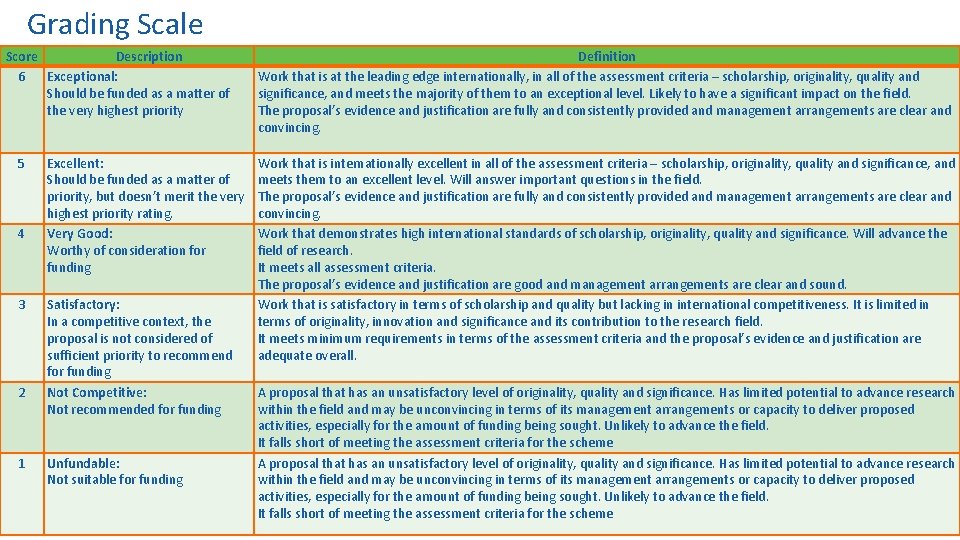
Grading Scale Score Description 6 Exceptional: Should be funded as a matter of the very highest priority 5 4 3 2 1 Excellent: Should be funded as a matter of priority, but doesn’t merit the very highest priority rating. Very Good: Worthy of consideration for funding Satisfactory: In a competitive context, the proposal is not considered of sufficient priority to recommend for funding Not Competitive: Not recommended for funding Unfundable: Not suitable for funding Definition Work that is at the leading edge internationally, in all of the assessment criteria – scholarship, originality, quality and significance, and meets the majority of them to an exceptional level. Likely to have a significant impact on the field. The proposal’s evidence and justification are fully and consistently provided and management arrangements are clear and convincing. Work that is internationally excellent in all of the assessment criteria – scholarship, originality, quality and significance, and meets them to an excellent level. Will answer important questions in the field. The proposal’s evidence and justification are fully and consistently provided and management arrangements are clear and convincing. Work that demonstrates high international standards of scholarship, originality, quality and significance. Will advance the field of research. It meets all assessment criteria. The proposal’s evidence and justification are good and management arrangements are clear and sound. Work that is satisfactory in terms of scholarship and quality but lacking in international competitiveness. It is limited in terms of originality, innovation and significance and its contribution to the research field. It meets minimum requirements in terms of the assessment criteria and the proposal’s evidence and justification are adequate overall. A proposal that has an unsatisfactory level of originality, quality and significance. Has limited potential to advance research within the field and may be unconvincing in terms of its management arrangements or capacity to deliver proposed activities, especially for the amount of funding being sought. Unlikely to advance the field. It falls short of meeting the assessment criteria for the scheme
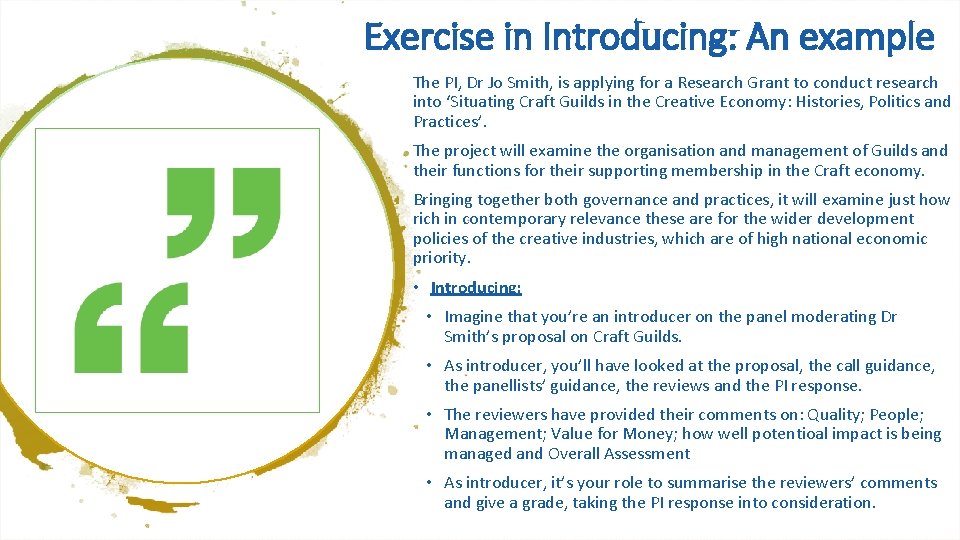
Exercise in Introducing: An example The PI, Dr Jo Smith, is applying for a Research Grant to conduct research into ‘Situating Craft Guilds in the Creative Economy: Histories, Politics and Practices’. The project will examine the organisation and management of Guilds and their functions for their supporting membership in the Craft economy. Bringing together both governance and practices, it will examine just how rich in contemporary relevance these are for the wider development policies of the creative industries, which are of high national economic priority. • Introducing: • Imagine that you’re an introducer on the panel moderating Dr Smith’s proposal on Craft Guilds. • As introducer, you’ll have looked at the proposal, the call guidance, the panellists’ guidance, the reviews and the PI response. • The reviewers have provided their comments on: Quality; People; Management; Value for Money; how well potentioal impact is being managed and Overall Assessment • As introducer, it’s your role to summarise the reviewers’ comments and give a grade, taking the PI response into consideration.
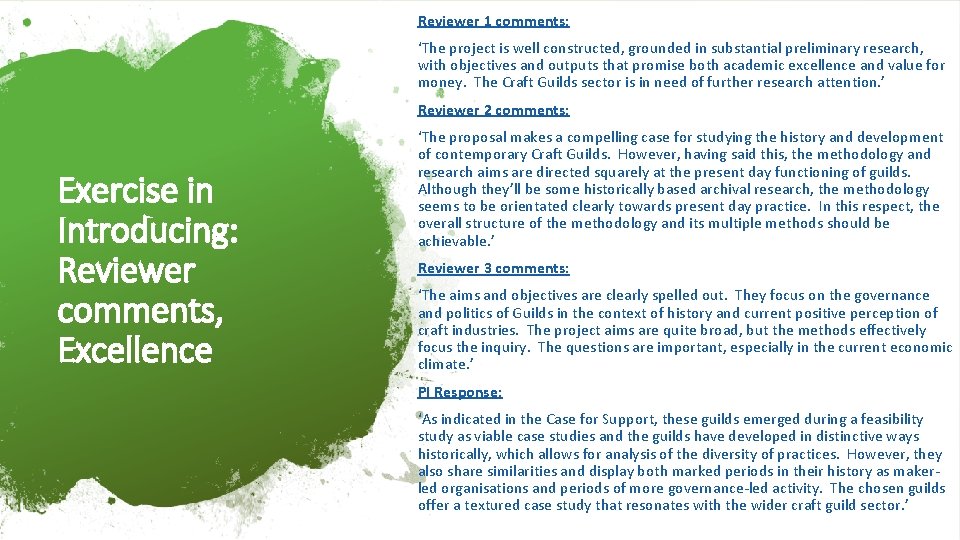
Reviewer 1 comments: ‘The project is well constructed, grounded in substantial preliminary research, with objectives and outputs that promise both academic excellence and value for money. The Craft Guilds sector is in need of further research attention. ’ Reviewer 2 comments: Exercise in Introducing: Reviewer comments, Excellence ‘The proposal makes a compelling case for studying the history and development of contemporary Craft Guilds. However, having said this, the methodology and research aims are directed squarely at the present day functioning of guilds. Although they’ll be some historically based archival research, the methodology seems to be orientated clearly towards present day practice. In this respect, the overall structure of the methodology and its multiple methods should be achievable. ’ Reviewer 3 comments: ‘The aims and objectives are clearly spelled out. They focus on the governance and politics of Guilds in the context of history and current positive perception of craft industries. The project aims are quite broad, but the methods effectively focus the inquiry. The questions are important, especially in the current economic climate. ’ PI Response: ‘As indicated in the Case for Support, these guilds emerged during a feasibility study as viable case studies and the guilds have developed in distinctive ways historically, which allows for analysis of the diversity of practices. However, they also share similarities and display both marked periods in their history as makerled organisations and periods of more governance-led activity. The chosen guilds offer a textured case study that resonates with the wider craft guild sector. ’
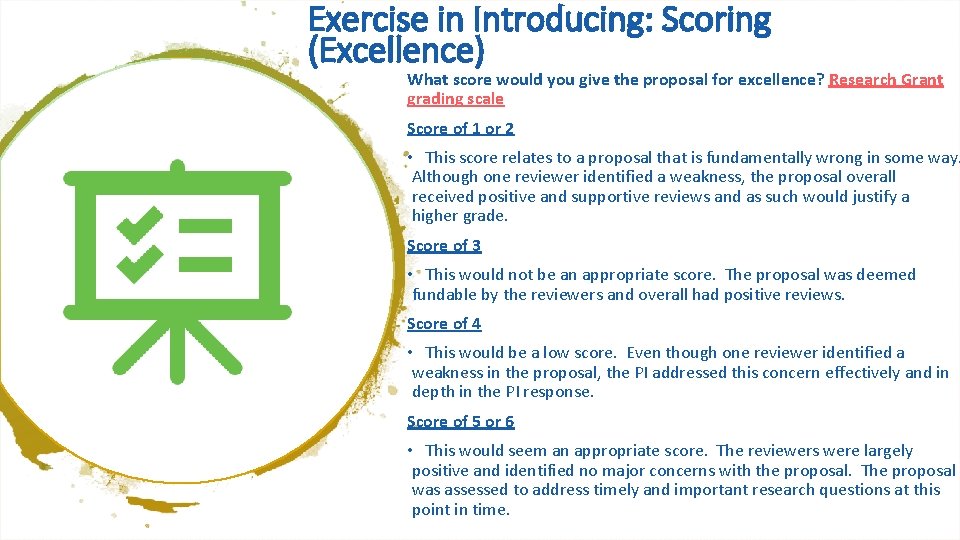
Exercise in Introducing: Scoring (Excellence) What score would you give the proposal for excellence? Research Grant grading scale Score of 1 or 2 • This score relates to a proposal that is fundamentally wrong in some way. Although one reviewer identified a weakness, the proposal overall received positive and supportive reviews and as such would justify a higher grade. Score of 3 • This would not be an appropriate score. The proposal was deemed fundable by the reviewers and overall had positive reviews. Score of 4 • This would be a low score. Even though one reviewer identified a weakness in the proposal, the PI addressed this concern effectively and in depth in the PI response. Score of 5 or 6 • This would seem an appropriate score. The reviewers were largely positive and identified no major concerns with the proposal. The proposal was assessed to address timely and important research questions at this point in time.
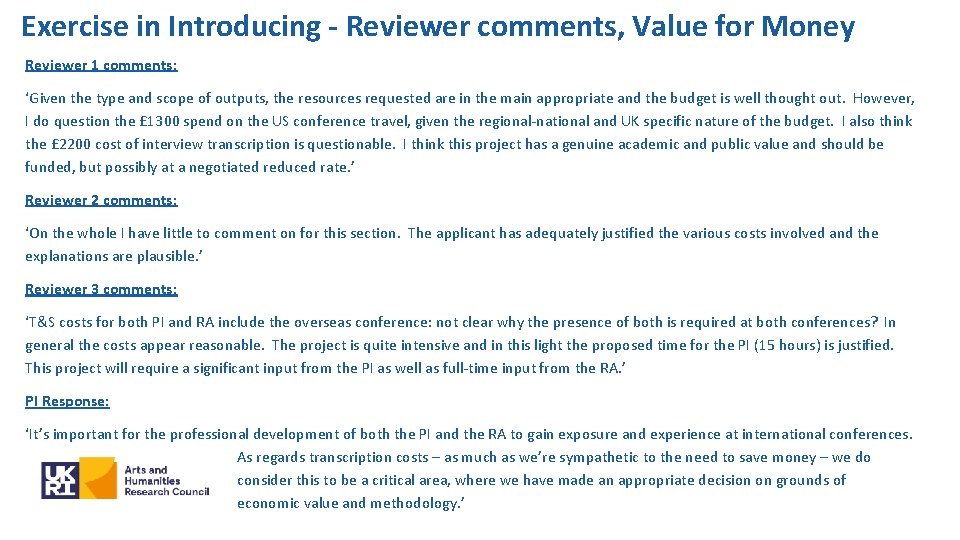
Exercise in Introducing - Reviewer comments, Value for Money Reviewer 1 comments: ‘Given the type and scope of outputs, the resources requested are in the main appropriate and the budget is well thought out. However, I do question the £ 1300 spend on the US conference travel, given the regional-national and UK specific nature of the budget. I also think the £ 2200 cost of interview transcription is questionable. I think this project has a genuine academic and public value and should be funded, but possibly at a negotiated reduced rate. ’ Reviewer 2 comments: ‘On the whole I have little to comment on for this section. The applicant has adequately justified the various costs involved and the explanations are plausible. ’ Reviewer 3 comments: ‘T&S costs for both PI and RA include the overseas conference: not clear why the presence of both is required at both conferences? In general the costs appear reasonable. The project is quite intensive and in this light the proposed time for the PI (15 hours) is justified. This project will require a significant input from the PI as well as full-time input from the RA. ’ PI Response: ‘It’s important for the professional development of both the PI and the RA to gain exposure and experience at international conferences. As regards transcription costs – as much as we’re sympathetic to the need to save money – we do consider this to be a critical area, where we have made an appropriate decision on grounds of economic value and methodology. ’
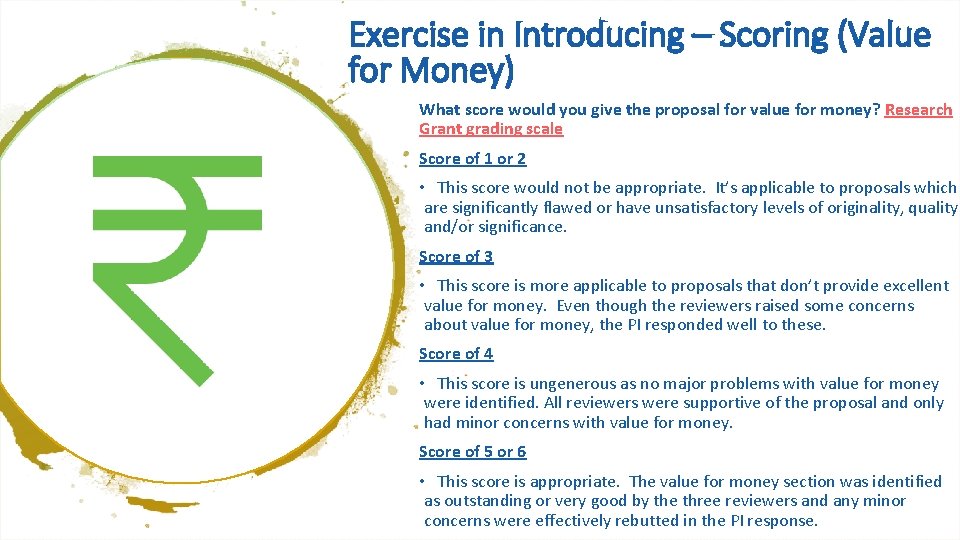
Exercise in Introducing – Scoring (Value for Money) What score would you give the proposal for value for money? Research Grant grading scale Score of 1 or 2 • This score would not be appropriate. It’s applicable to proposals which are significantly flawed or have unsatisfactory levels of originality, quality and/or significance. Score of 3 • This score is more applicable to proposals that don’t provide excellent value for money. Even though the reviewers raised some concerns about value for money, the PI responded well to these. Score of 4 • This score is ungenerous as no major problems with value for money were identified. All reviewers were supportive of the proposal and only had minor concerns with value for money. Score of 5 or 6 • This score is appropriate. The value for money section was identified as outstanding or very good by the three reviewers and any minor concerns were effectively rebutted in the PI response.
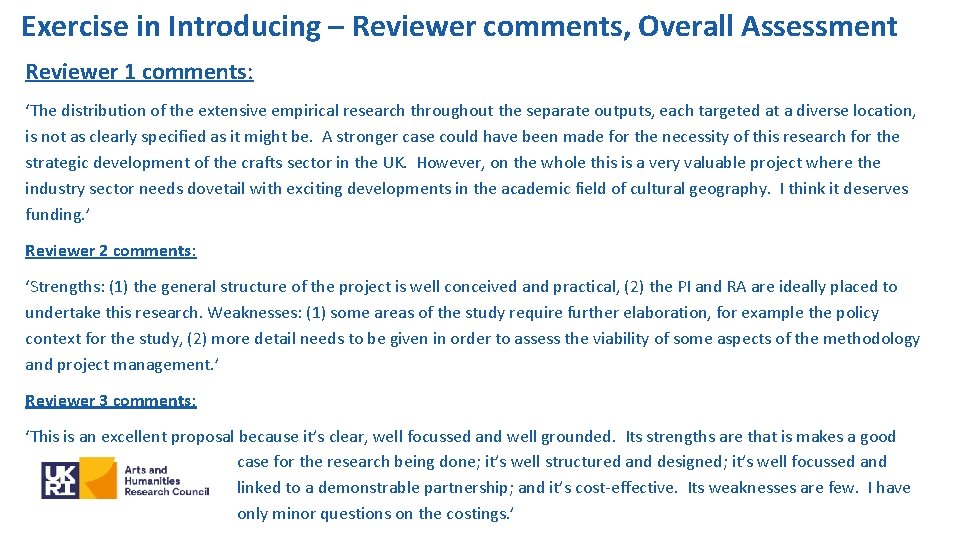
Exercise in Introducing – Reviewer comments, Overall Assessment Reviewer 1 comments: ‘The distribution of the extensive empirical research throughout the separate outputs, each targeted at a diverse location, is not as clearly specified as it might be. A stronger case could have been made for the necessity of this research for the strategic development of the crafts sector in the UK. However, on the whole this is a very valuable project where the industry sector needs dovetail with exciting developments in the academic field of cultural geography. I think it deserves funding. ’ Reviewer 2 comments: ‘Strengths: (1) the general structure of the project is well conceived and practical, (2) the PI and RA are ideally placed to undertake this research. Weaknesses: (1) some areas of the study require further elaboration, for example the policy context for the study, (2) more detail needs to be given in order to assess the viability of some aspects of the methodology and project management. ’ Reviewer 3 comments: ‘This is an excellent proposal because it’s clear, well focussed and well grounded. Its strengths are that is makes a good case for the research being done; it’s well structured and designed; it’s well focussed and linked to a demonstrable partnership; and it’s cost-effective. Its weaknesses are few. I have only minor questions on the costings. ’
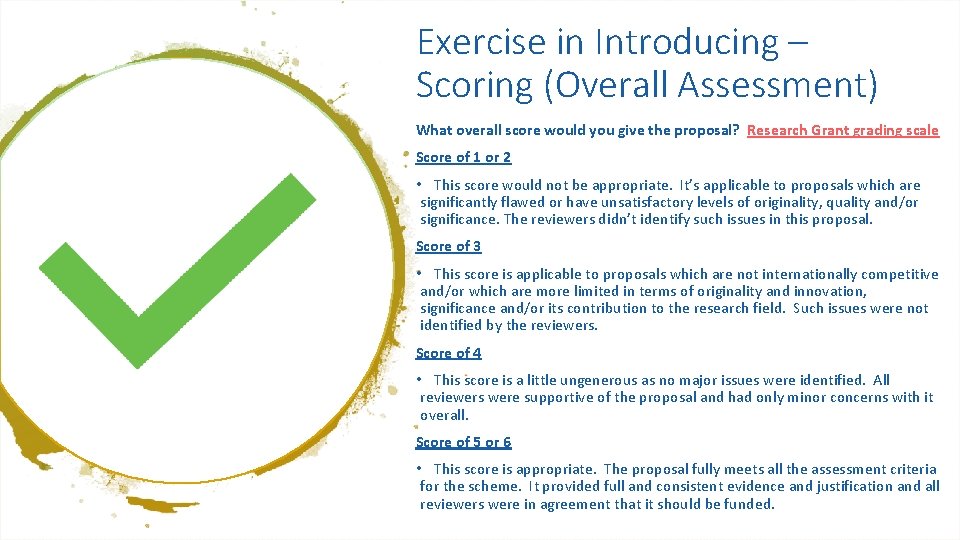
Exercise in Introducing – Scoring (Overall Assessment) What overall score would you give the proposal? Research Grant grading scale Score of 1 or 2 • This score would not be appropriate. It’s applicable to proposals which are significantly flawed or have unsatisfactory levels of originality, quality and/or significance. The reviewers didn’t identify such issues in this proposal. Score of 3 • This score is applicable to proposals which are not internationally competitive and/or which are more limited in terms of originality and innovation, significance and/or its contribution to the research field. Such issues were not identified by the reviewers. Score of 4 • This score is a little ungenerous as no major issues were identified. All reviewers were supportive of the proposal and had only minor concerns with it overall. Score of 5 or 6 • This score is appropriate. The proposal fully meets all the assessment criteria for the scheme. It provided full and consistent evidence and justification and all reviewers were in agreement that it should be funded.
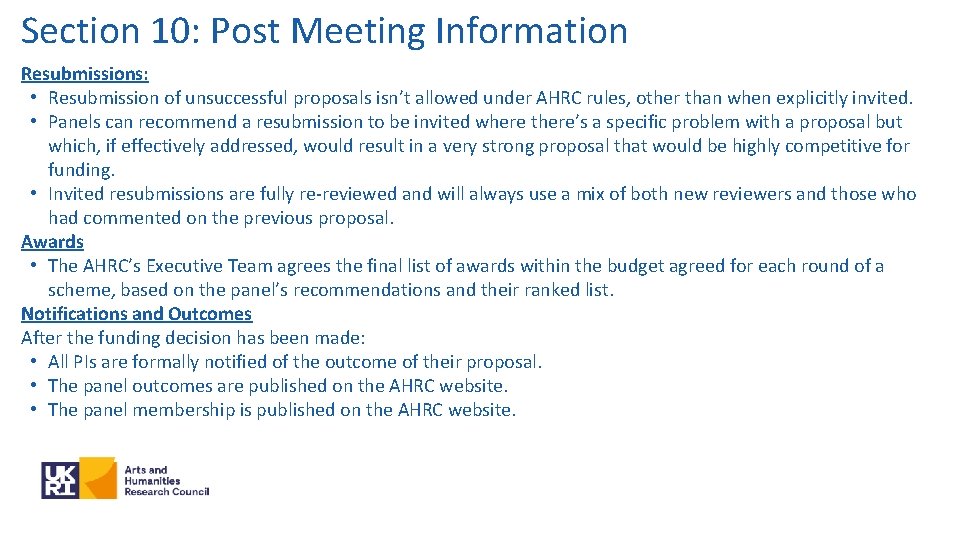
Section 10: Post Meeting Information Resubmissions: • Resubmission of unsuccessful proposals isn’t allowed under AHRC rules, other than when explicitly invited. • Panels can recommend a resubmission to be invited where there’s a specific problem with a proposal but which, if effectively addressed, would result in a very strong proposal that would be highly competitive for funding. • Invited resubmissions are fully re-reviewed and will always use a mix of both new reviewers and those who had commented on the previous proposal. Awards • The AHRC’s Executive Team agrees the final list of awards within the budget agreed for each round of a scheme, based on the panel’s recommendations and their ranked list. Notifications and Outcomes After the funding decision has been made: • All PIs are formally notified of the outcome of their proposal. • The panel outcomes are published on the AHRC website. • The panel membership is published on the AHRC website.
Honoraria & Expenses Panel Fees: • Panel members are paid a fee of £ 170 per meeting and panel Chairs receive £ 230 per meeting. This is considered as income from self-employment and is taxable as such. Expenses Claims • Expenses claims will be reimbursed using the AHRC Expense form that should be submitted to the AHRC within 60 days of the panel meeting. Payment of expenses is normally made within a few weeks of the AHRC receiving the expenses claim.
• This is the end of the online training course. In conjunction with PRC Induction training, at which there is the opportunity to go through a mock review and attend a mock panel meeting, you should have the tools you need to undertake the work of the PRC. • If, however, you need additional information to help with your role, please contact us at peerreviewcollege@ahrc. ukri. org. Thank you for your time.