
The Aha moment is insight a different form
- Slides: 13
The Aha! moment: is insight a different form of problem solving? Stuyck Hans (1, 2), Cleeremans Axel (2) & Van den Bussche Eva (1) 1 Vrije Universiteit Brussel, Brussels, Belgium libre de Bruxelles, Brussels, Belgium 2 Université
STOP! 23 22 21 20 19 18 17 16 15 14 13 12 11 9 8 7 6 5 4 3 2 1 0 10 Compound Remote Associates Problem Glue Day Dream Man Day Break Super Star Day Light ?
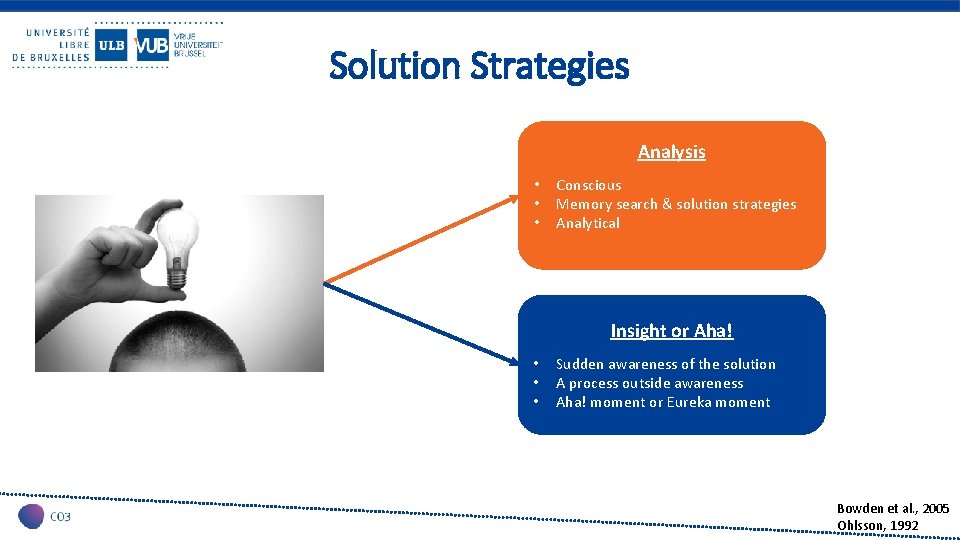
Solution Strategies Analysis • • • Conscious Memory search & solution strategies Analytical Insight or Aha! • • • Sudden awareness of the solution A process outside awareness Aha! moment or Eureka moment Bowden et al. , 2005 Ohlsson, 1992
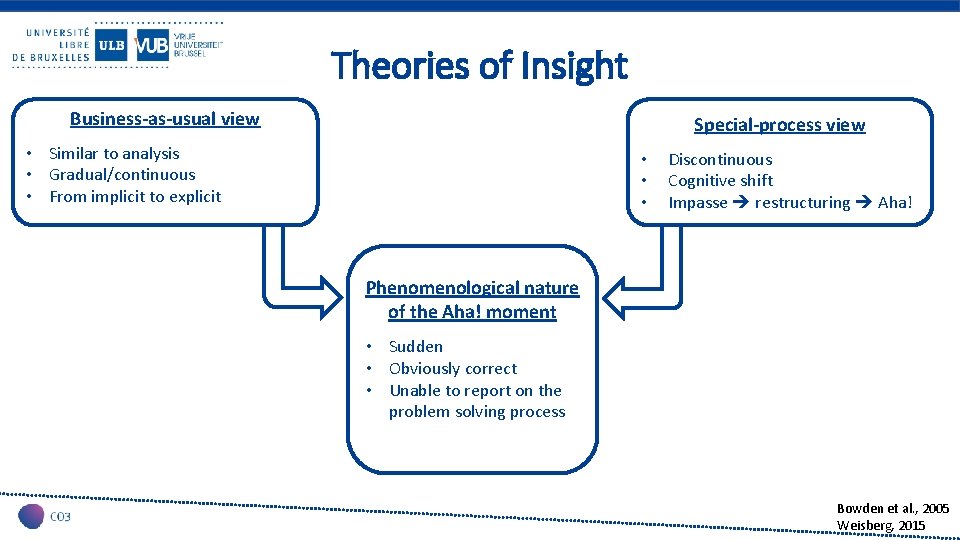
Theories of Insight Business-as-usual view Special-process view • Similar to analysis • Gradual/continuous • From implicit to explicit • • • Discontinuous Cognitive shift Impasse restructuring Aha! Phenomenological nature of the Aha! moment • Sudden • Obviously correct • Unable to report on the problem solving process Bowden et al. , 2005 Weisberg, 2015
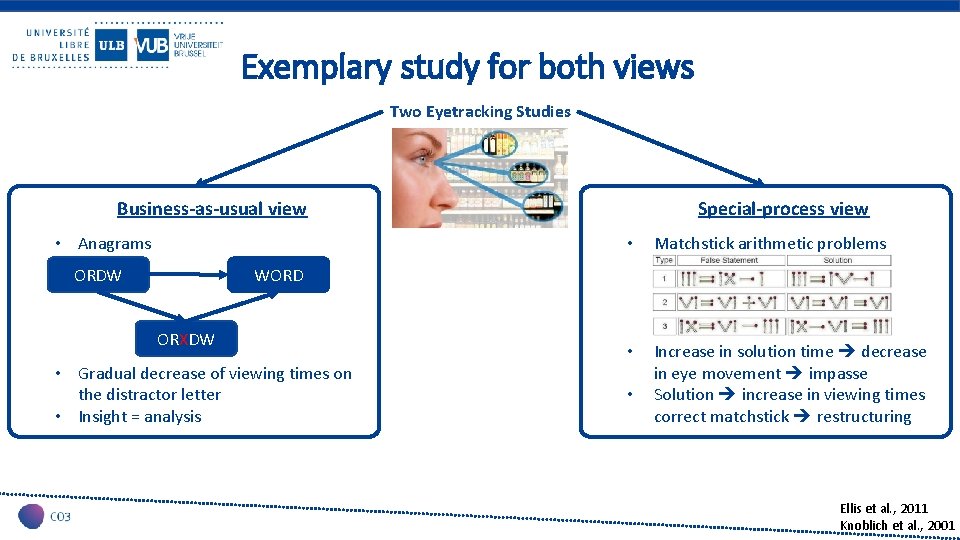
Exemplary study for both views Two Eyetracking Studies Business-as-usual view • Anagrams ORDW Special-process view • Matchstick arithmetic problems • Increase in solution time decrease in eye movement impasse Solution increase in viewing times correct matchstick restructuring WORD ORXDW • Gradual decrease of viewing times on the distractor letter • Insight = analysis • Ellis et al. , 2011 Knoblich et al. , 2001
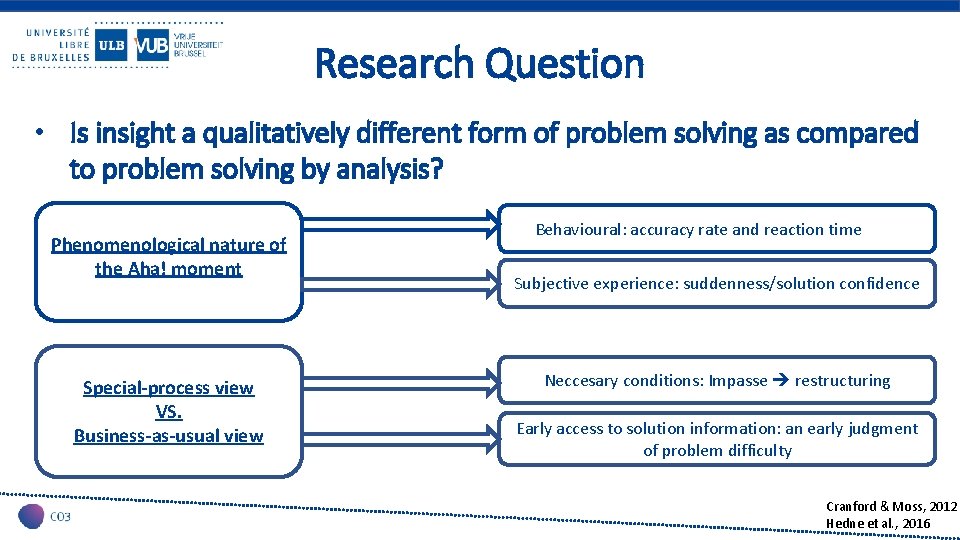
Research Question • Is insight a qualitatively different form of problem solving as compared to problem solving by analysis? Phenomenological nature of the Aha! moment Special-process view VS. Business-as-usual view Behavioural: accuracy rate and reaction time Subjective experience: suddenness/solution confidence Neccesary conditions: Impasse restructuring Early access to solution information: an early judgment of problem difficulty Cranford & Moss, 2012 Hedne et al. , 2016
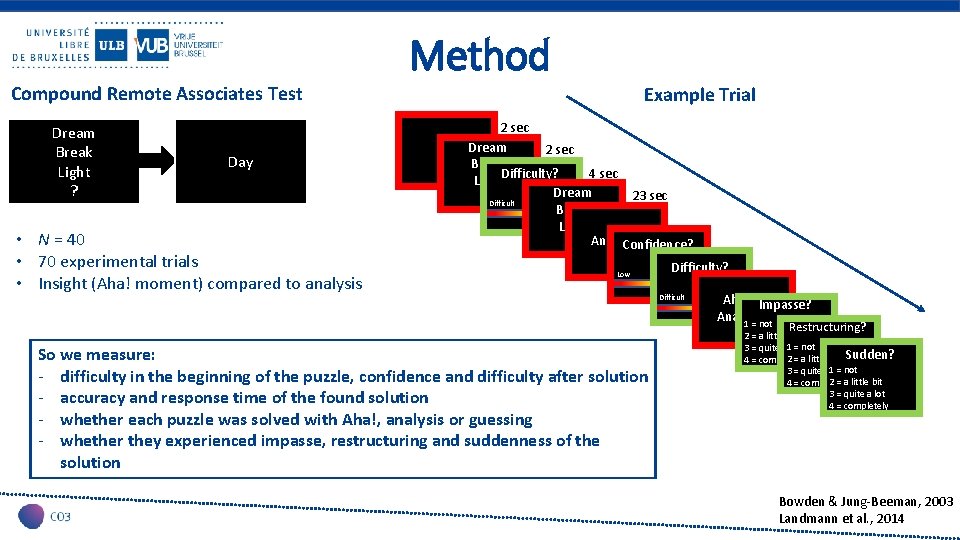
Method Compound Remote Associates Test Dream Break Light ? Day • N = 40 • 70 experimental trials • Insight (Aha! moment) compared to analysis Example Trial + 2 sec Dream 2 sec Break 4 sec Difficulty? Light Dream 23 sec ? Difficult Easy Break Light ? Answer? Confidence? Low Difficulty? High Difficult Easy Aha Or. Impasse? Analysis? 1 = not Restructuring? So we measure: - difficulty in the beginning of the puzzle, confidence and difficulty after solution - accuracy and response time of the found solution - whether each puzzle was solved with Aha!, analysis or guessing - whether they experienced impasse, restructuring and suddenness of the solution 2 = a little bit = not 3 = quite a 1 lot 2 = a little bit Sudden? 4 = completely = not 3 = quite a 1 lot 2 = a little bit 4 = completely 3 = quite a lot 4 = completely Bowden & Jung-Beeman, 2003 Landmann et al. , 2014
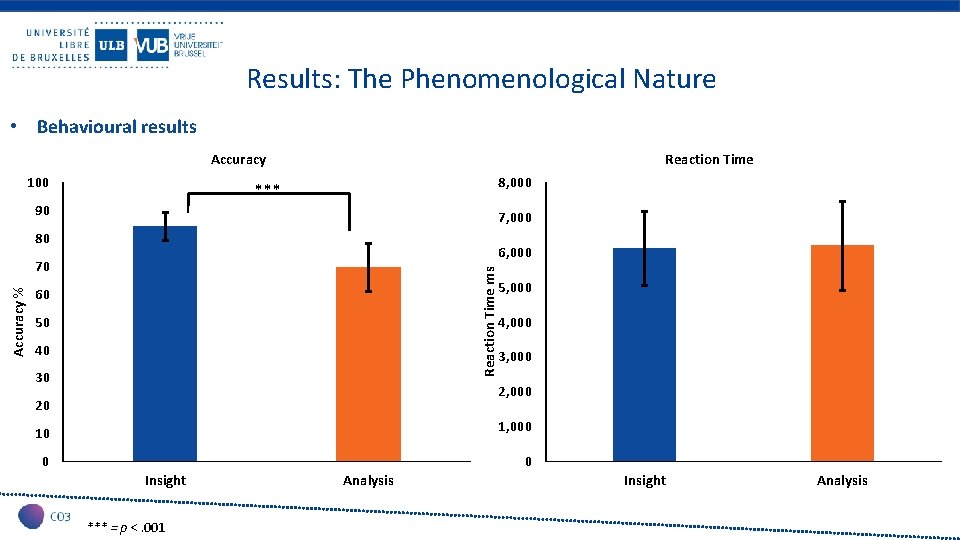
Results: The Phenomenological Nature • Behavioural results Accuracy 100 Reaction Time 8, 000 *** 90 7, 000 80 6, 000 Reaction Time ms Accuracy % 70 60 50 40 30 5, 000 4, 000 3, 000 20 10 1, 000 0 0 Insight *** = p <. 001 Analysis Insight Analysis
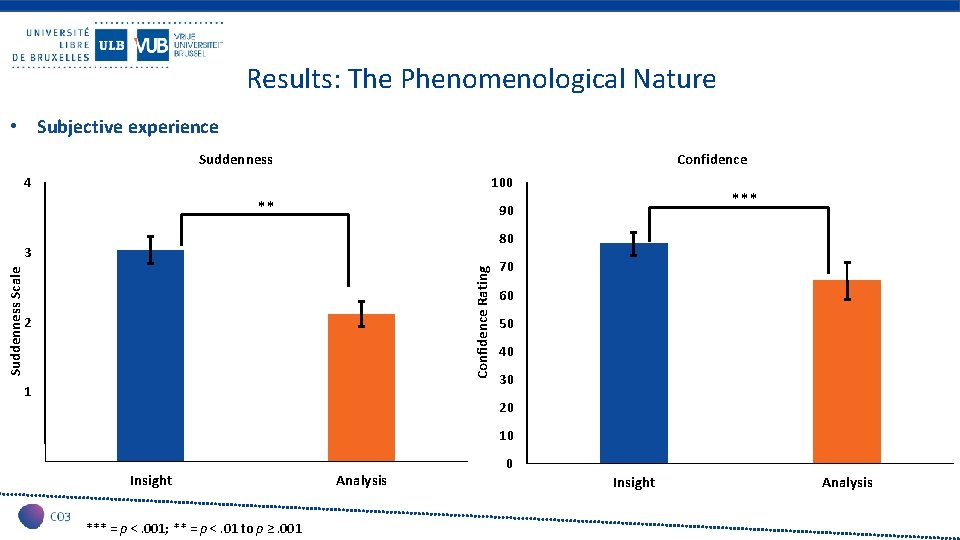
Results: The Phenomenological Nature • Subjective experience Suddenness Confidence 4 100 ** 80 Confidence Rating 3 Suddenness Scale *** 90 2 1 70 60 50 40 30 20 10 0 Insight *** = p <. 001; ** = p <. 01 to p ≥. 001 Analysis 0 Insight Analysis
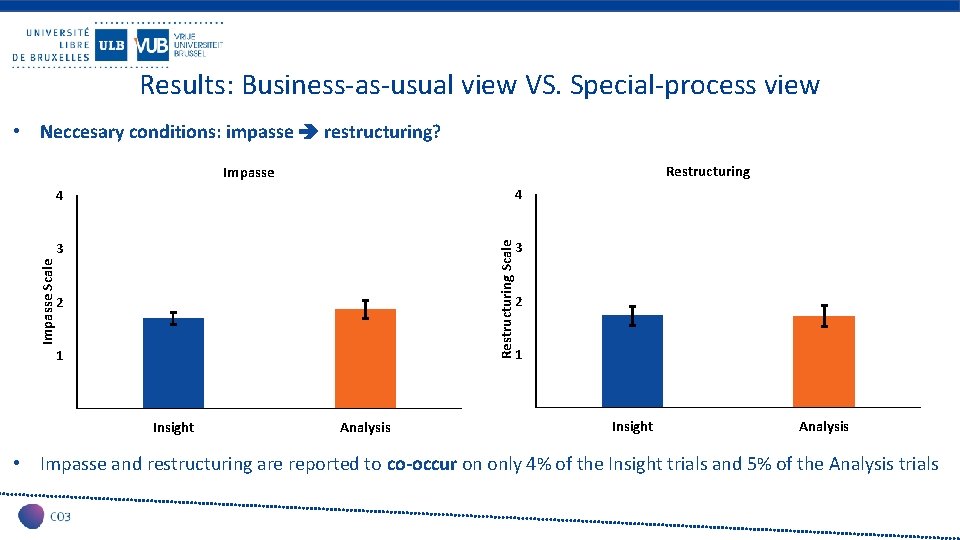
Results: Business-as-usual view VS. Special-process view • Neccesary conditions: impasse restructuring? Restructuring 4 4 3 3 Restructuring Scale Impasse 2 1 0 0 Insight Analysis • Impasse and restructuring are reported to co-occur on only 4% of the Insight trials and 5% of the Analysis trials
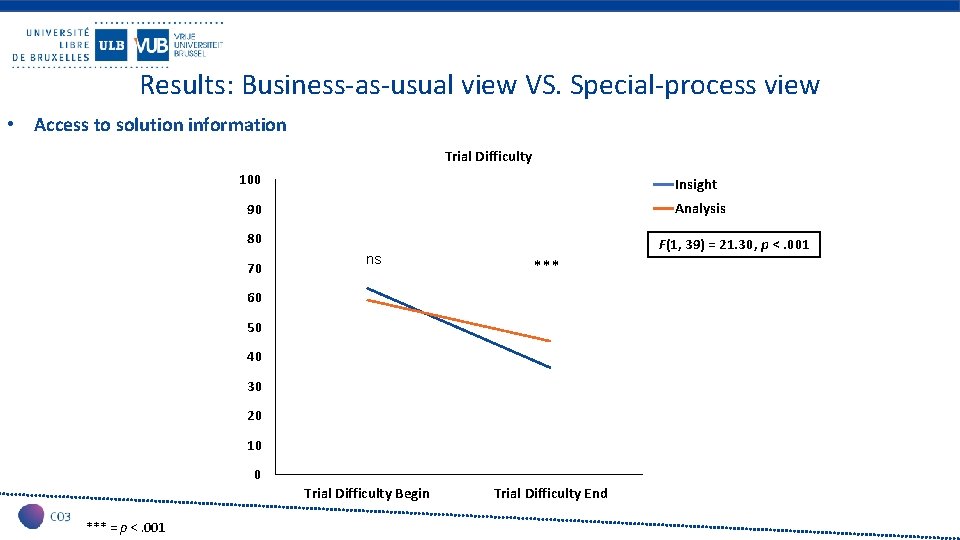
Results: Business-as-usual view VS. Special-process view • Access to solution information Trial Difficulty 100 Insight 90 Analysis 80 70 ns F(1, 39) = 21. 30, p <. 001 *** 60 50 40 30 20 10 0 Trial Difficulty Begin *** = p <. 001 Trial Difficulty End
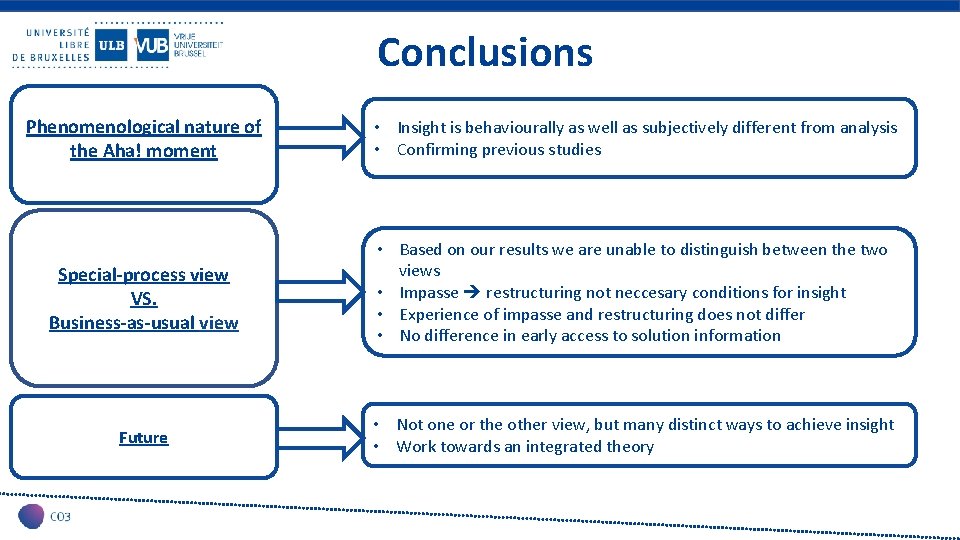
Conclusions Phenomenological nature of the Aha! moment • Insight is behaviourally as well as subjectively different from analysis • Confirming previous studies Special-process view VS. Business-as-usual view • Based on our results we are unable to distinguish between the two views • Impasse restructuring not neccesary conditions for insight • Experience of impasse and restructuring does not differ • No difference in early access to solution information Future • Not one or the other view, but many distinct ways to achieve insight • Work towards an integrated theory
Thank you for listening! Hans Stuyck hans. stuyck@ulb. ac. be