
The Age of Reason Early American Literature and
- Slides: 10
The Age of Reason Early American Literature and Writing
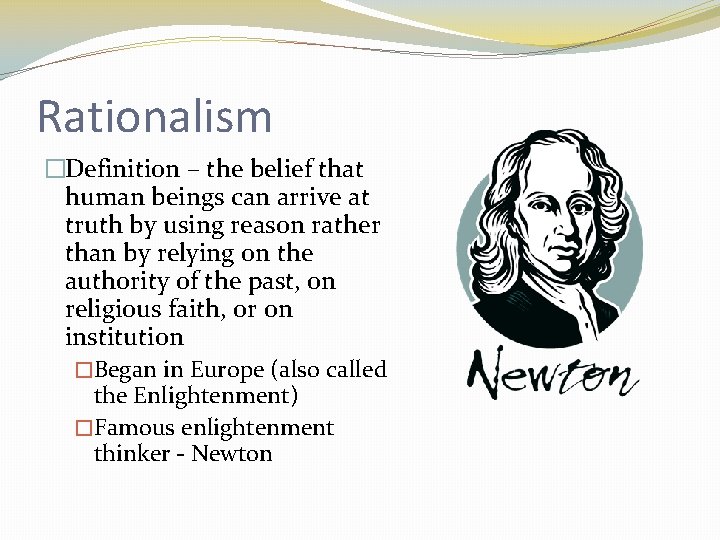
Rationalism �Definition – the belief that human beings can arrive at truth by using reason rather than by relying on the authority of the past, on religious faith, or on institution �Began in Europe (also called the Enlightenment) �Famous enlightenment thinker - Newton
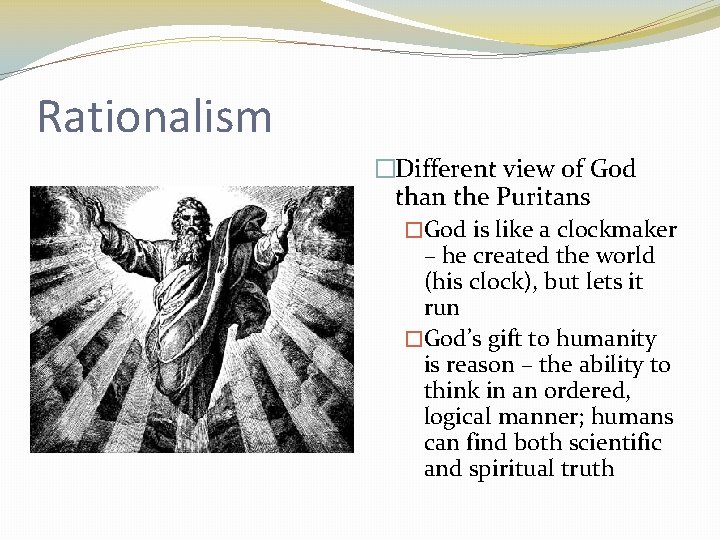
Rationalism �Different view of God than the Puritans �God is like a clockmaker – he created the world (his clock), but lets it run �God’s gift to humanity is reason – the ability to think in an ordered, logical manner; humans can find both scientific and spiritual truth
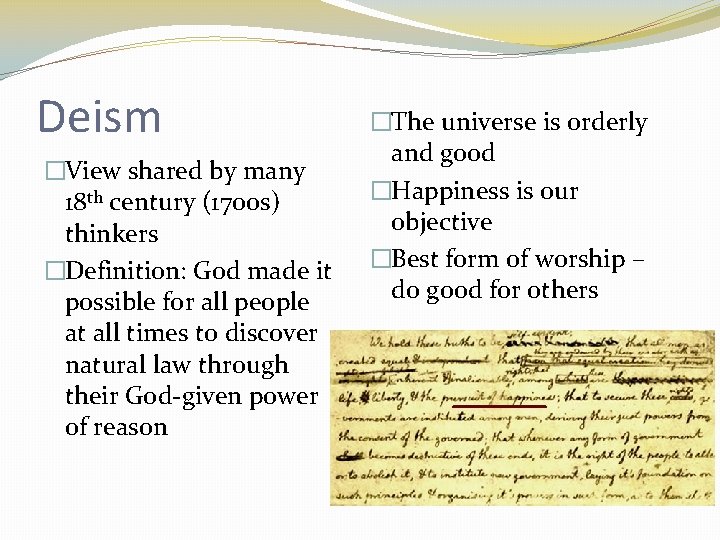
Deism �View shared by many 18 th century (1700 s) thinkers �Definition: God made it possible for all people at all times to discover natural law through their God-given power of reason �The universe is orderly and good �Happiness is our objective �Best form of worship – do good for others
Writing in Early America �Much of the writing in early America was rooted in reality �Lots of pamphlets – political purposes �Solving problems, organizing a new government were priorities �Critics call Ben Franklin’s Autobiography the “unquestioned masterpiece” of this era �A model for later American works, including The Great Gatsby (selfimprovement, American dream, pursuit of happiness)
Changing English �By the late 1700 s, English was changing in America �Visiting Brits thought American English was “nasally” �Words were being used differently as well – rock, guess (instead of suppose) �Americanism was a term to describe a word that originated in America – notify, mad, spell, chunks, once in a while, tote �Called language of democracy – no class levels were distinguished by accents (no dialects at first)
Ben Franklin (1706 -1790) �Born in poverty in Boston; one of seven kids; quit school to work �By the time he was 24, he was very successful (business owner, newspaper publisher) �Also a scientist and inventor – bifocals, harmonica, rocking chair that could swat flies, researched electricity (kite) �He participated in the Constitutional Convention �Very witty writer – Autobiography is his most famous work, the other is Poor Richard’s Almanac. �Poor Richard’s Almanac contained sayings and advice, along with information about weather, tides, and medicine
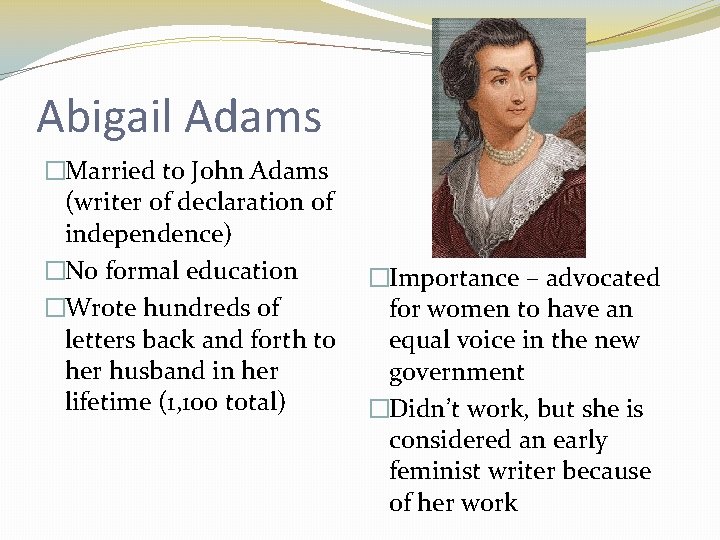
Abigail Adams �Married to John Adams (writer of declaration of independence) �No formal education �Wrote hundreds of letters back and forth to her husband in her lifetime (1, 100 total) �Importance – advocated for women to have an equal voice in the new government �Didn’t work, but she is considered an early feminist writer because of her work
Thomas Paine (1737 -1809) �Poorly educated; son of a corset-maker �Many occupations �Fired once for trying to organize tax collectors for higher wages �Came to America for a new start �Worked as a journalist in America �Wrote Common Sense – a piece meant to persuade his peers to support the American independence �Population of colonies at this time: 2. 25 million �Number of Common Sense copies sold: ½ million
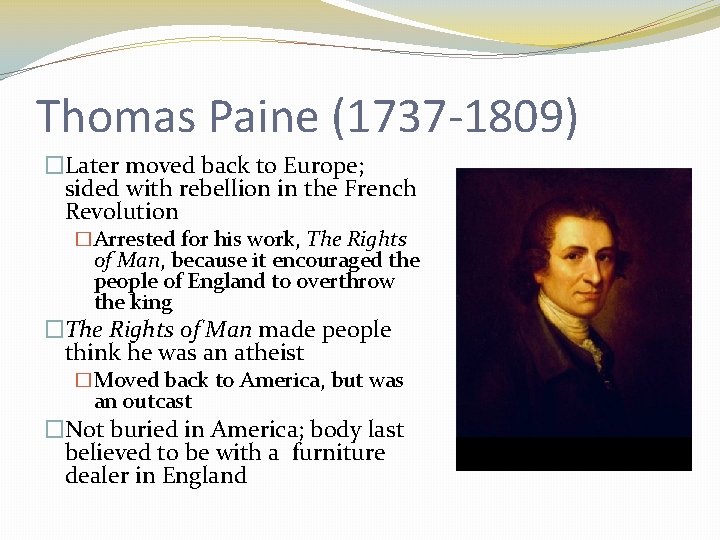
Thomas Paine (1737 -1809) �Later moved back to Europe; sided with rebellion in the French Revolution �Arrested for his work, The Rights of Man, because it encouraged the people of England to overthrow the king �The Rights of Man made people think he was an atheist �Moved back to America, but was an outcast �Not buried in America; body last believed to be with a furniture dealer in England