
The Age of Neoteny The Perception of Childhood
- Slides: 1
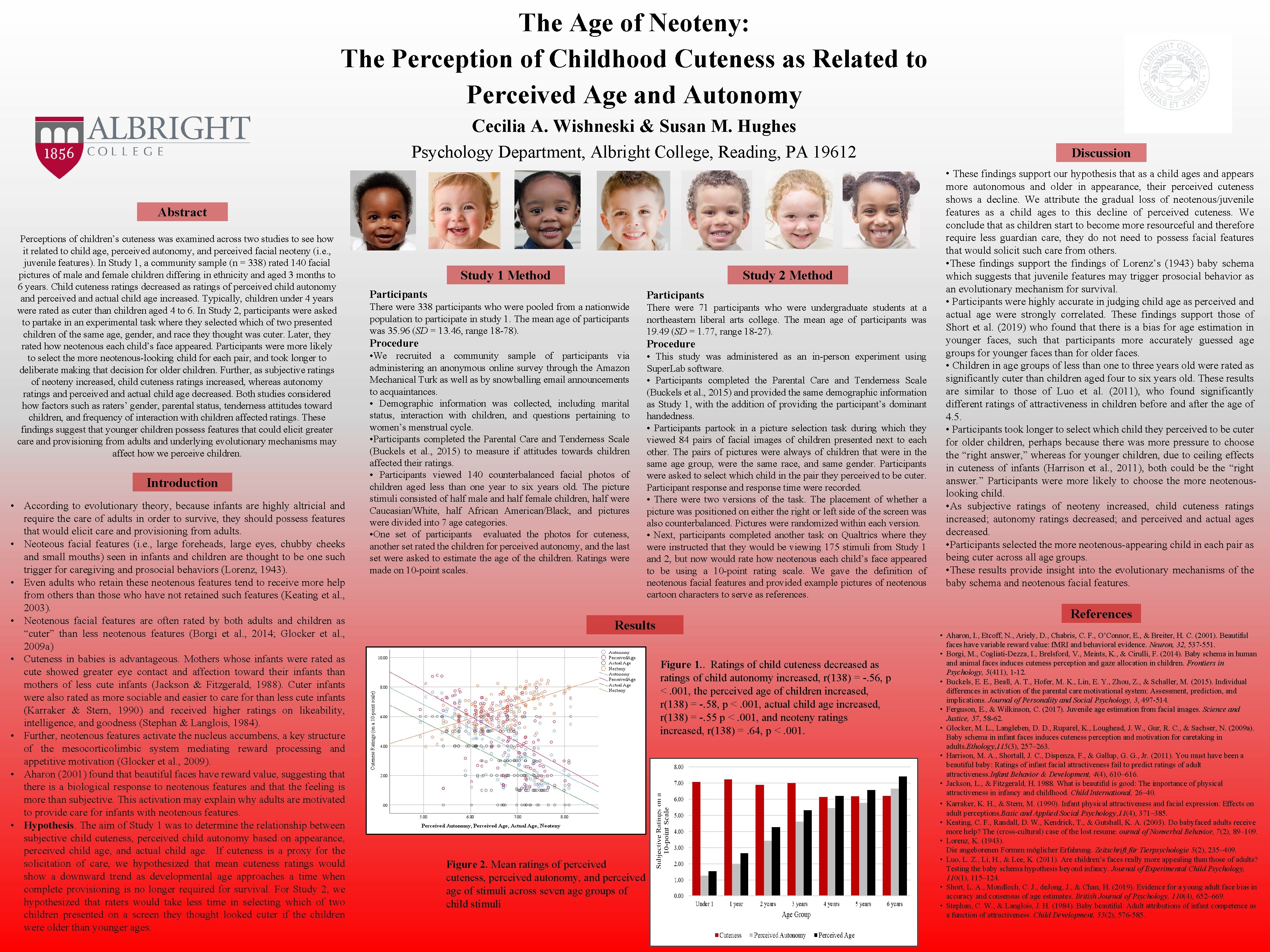
The Age of Neoteny: The Perception of Childhood Cuteness as Related to Perceived Age and Autonomy Cecilia A. Wishneski & Susan M. Hughes Psychology Department, Albright College, Reading, PA 19612 Abstract Introduction • According to evolutionary theory, because infants are highly altricial and require the care of adults in order to survive, they should possess features that would elicit care and provisioning from adults. • Neoteous facial features (i. e. , large foreheads, large eyes, chubby cheeks and small mouths) seen in infants and children are thought to be one such trigger for caregiving and prosocial behaviors (Lorenz, 1943). • Even adults who retain these neotenous features tend to receive more help from others than those who have not retained such features (Keating et al. , 2003). • Neotenous facial features are often rated by both adults and children as “cuter” than less neotenous features (Borgi et al. , 2014; Glocker et al. , 2009 a) • Cuteness in babies is advantageous. Mothers whose infants were rated as cute showed greater eye contact and affection toward their infants than mothers of less cute infants (Jackson & Fitzgerald, 1988). Cuter infants were also rated as more sociable and easier to care for than less cute infants (Karraker & Stern, 1990) and received higher ratings on likeability, intelligence, and goodness (Stephan & Langlois, 1984). • Further, neotenous features activate the nucleus accumbens, a key structure of the mesocorticolimbic system mediating reward processing and appetitive motivation (Glocker et al. , 2009). • Aharon (2001) found that beautiful faces have reward value, suggesting that there is a biological response to neotenous features and that the feeling is more than subjective. This activation may explain why adults are motivated to provide care for infants with neotenous features. • Hypothesis. The aim of Study 1 was to determine the relationship between subjective child cuteness, perceived child autonomy based on appearance, perceived child age, and actual child age. If cuteness is a proxy for the solicitation of care, we hypothesized that mean cuteness ratings would show a downward trend as developmental age approaches a time when complete provisioning is no longer required for survival. For Study 2, we hypothesized that raters would take less time in selecting which of two children presented on a screen they thought looked cuter if the children were older than younger ages. Study 2 Method Study 1 Method Participants There were 338 participants who were pooled from a nationwide population to participate in study 1. The mean age of participants was 35. 96 (SD = 13. 46, range 18 -78). There were 71 participants who were undergraduate students at a northeastern liberal arts college. The mean age of participants was 19. 49 (SD = 1. 77, range 18 -27). Procedure • We recruited a community sample of participants via administering an anonymous online survey through the Amazon Mechanical Turk as well as by snowballing email announcements to acquaintances. • Demographic information was collected, including marital status, interaction with children, and questions pertaining to women’s menstrual cycle. • Participants completed the Parental Care and Tenderness Scale (Buckels et al. , 2015) to measure if attitudes towards children affected their ratings. • Participants viewed 140 counterbalanced facial photos of children aged less than one year to six years old. The picture stimuli consisted of half male and half female children, half were Caucasian/White, half African American/Black, and pictures were divided into 7 age categories. • One set of participants evaluated the photos for cuteness, another set rated the children for perceived autonomy, and the last set were asked to estimate the age of the children. Ratings were made on 10 -point scales. • This study was administered as an in-person experiment using Super. Lab software. • Participants completed the Parental Care and Tenderness Scale (Buckels et al. , 2015) and provided the same demographic information as Study 1, with the addition of providing the participant’s dominant handedness. • Participants partook in a picture selection task during which they viewed 84 pairs of facial images of children presented next to each other. The pairs of pictures were always of children that were in the same age group, were the same race, and same gender. Participants were asked to select which child in the pair they perceived to be cuter. Participant response and response time were recorded. • There were two versions of the task. The placement of whether a picture was positioned on either the right or left side of the screen was also counterbalanced. Pictures were randomized within each version. • Next, participants completed another task on Qualtrics where they were instructed that they would be viewing 175 stimuli from Study 1 and 2, but now would rate how neotenous each child’s face appeared to be using a 10 -point rating scale. We gave the definition of neotenous facial features and provided example pictures of neotenous cartoon characters to serve as references. Figure 1. . Ratings of child cuteness decreased as ratings of child autonomy increased, r(138) = -. 56, p <. 001, the perceived age of children increased, r(138) = -. 58, p <. 001, actual child age increased, r(138) = -. 55 p <. 001, and neoteny ratings increased, r(138) =. 64, p <. 001. Figure 2. Mean ratings of perceived cuteness, perceived autonomy, and perceived age of stimuli across seven age groups of child stimuli • These findings support our hypothesis that as a child ages and appears more autonomous and older in appearance, their perceived cuteness shows a decline. We attribute the gradual loss of neotenous/juvenile features as a child ages to this decline of perceived cuteness. We conclude that as children start to become more resourceful and therefore require less guardian care, they do not need to possess facial features that would solicit such care from others. • These findings support the findings of Lorenz’s (1943) baby schema which suggests that juvenile features may trigger prosocial behavior as an evolutionary mechanism for survival. • Participants were highly accurate in judging child age as perceived and actual age were strongly correlated. These findings support those of Short et al. (2019) who found that there is a bias for age estimation in younger faces, such that participants more accurately guessed age groups for younger faces than for older faces. • Children in age groups of less than one to three years old were rated as significantly cuter than children aged four to six years old. These results are similar to those of Luo et al. (2011), who found significantly different ratings of attractiveness in children before and after the age of 4. 5. • Participants took longer to select which child they perceived to be cuter for older children, perhaps because there was more pressure to choose the “right answer, ” whereas for younger children, due to ceiling effects in cuteness of infants (Harrison et al. , 2011), both could be the “right answer. ” Participants were more likely to choose the more neotenouslooking child. • As subjective ratings of neoteny increased, child cuteness ratings increased; autonomy ratings decreased; and perceived and actual ages decreased. • Participants selected the more neotenous-appearing child in each pair as being cuter across all age groups. • These results provide insight into the evolutionary mechanisms of the baby schema and neotenous facial features. References Results Cuteness Ratings (on a 10 -point scale) Perceptions of children’s cuteness was examined across two studies to see how it related to child age, perceived autonomy, and perceived facial neoteny (i. e. , juvenile features). In Study 1, a community sample (n = 338) rated 140 facial pictures of male and female children differing in ethnicity and aged 3 months to 6 years. Child cuteness ratings decreased as ratings of perceived child autonomy and perceived and actual child age increased. Typically, children under 4 years were rated as cuter than children aged 4 to 6. In Study 2, participants were asked to partake in an experimental task where they selected which of two presented children of the same age, gender, and race they thought was cuter. Later, they rated how neotenous each child’s face appeared. Participants were more likely to select the more neotenous-looking child for each pair, and took longer to deliberate making that decision for older children. Further, as subjective ratings of neoteny increased, child cuteness ratings increased, whereas autonomy ratings and perceived and actual child age decreased. Both studies considered how factors such as raters’ gender, parental status, tenderness attitudes toward children, and frequency of interaction with children affected ratings. These findings suggest that younger children possess features that could elicit greater care and provisioning from adults and underlying evolutionary mechanisms may affect how we perceive children. Discussion • Aharon, I. , Etcoff, N. , Ariely, D. , Chabris, C. F. , O’Connor, E. , & Breiter, H. C. (2001). Beautiful faces have variable reward value: f. MRI and behavioral evidence. Neuron, 32, 537 -551. • Borgi, M. , Cogliati-Dezza, I. , Brelsford, V. , Meints, K. , & Cirulli, F. (2014). Baby schema in human and animal faces induces cuteness perception and gaze allocation in children. Frontiers in Psychology, 5(411), 1 -12. • Buckels, E. E. , Beall, A. T. , Hofer, M. K. , Lin, E. Y. , Zhou, Z. , & Schaller, M. (2015). Individual differences in activation of the parental care motivational system: Assessment, prediction, and implications. Journal of Personality and Social Psychology, 3, 497 -514. • Ferguson, E. , & Wilkinson, C. (2017). Juvenile age estimation from facial images. Science and Justice, 57, 58 -62. • Glocker, M. L. , Langleben, D. D. , Ruparel, K. , Loughead, J. W. , Gur, R. C. , & Sachser, N. (2009 a). Baby schema in infant faces induces cuteness perception and motivation for caretaking in adults. Ethology, 115(3), 257– 263. • Harrison, M. A. , Shortall, J. C. , Dispenza, F. , & Gallup, G. G. , Jr. (2011). You must have been a beautiful baby: Ratings of infant facial attractiveness fail to predict ratings of adult attractiveness. Infant Behavior & Development, 4(4), 610– 616. • Jackson, L. , & Fitzgerald, H. 1988. What is beautiful is good: The importance of physical attractiveness in infancy and childhood. Child International, 26– 40. • Karraker, K. H. , & Stern, M. (1990). Infant physical attractiveness and facial expression: Effects on adult perceptions. Basic and Applied Social Psychology, 11(4), 371– 385. • Keating, C. F. , Randall, D. W. , Kendrick, T. , & Gutshall, K. A. (2003). Do babyfaced adults receive more help? The (cross-cultural) case of the lost resume. ournal of Nonverbal Behavior, 7(2), 89– 109. • Lorenz, K. (1943). Die angeborenen Formen möglicher Erfahrung. Zeitschrift für Tierpsychologie 5(2), 235– 409. • Luo, L. Z. , Li, H. , & Lee, K. (2011). Are children’s faces really more appealing than those of adults? Testing the baby schema hypothesis beyond infancy. Journal of Experimental Child Psychology, 110(1), 115– 124. • Short, L. A. , Mondloch, C. J. , de. Jong, J. , & Chan, H. (2019). Evidence for a young adult face bias in accuracy and consensus of age estimates. British Journal of Psychology, 110(4), 652– 669. • Stephan, C. W. , & Langlois, J. H. (1984). Baby beautiful: Adult attributions of infant competence as a function of attractiveness. Child Development, 55(2), 576 -585.