
The Age of Exploration 1492 1750 Technology Improves
- Slides: 30
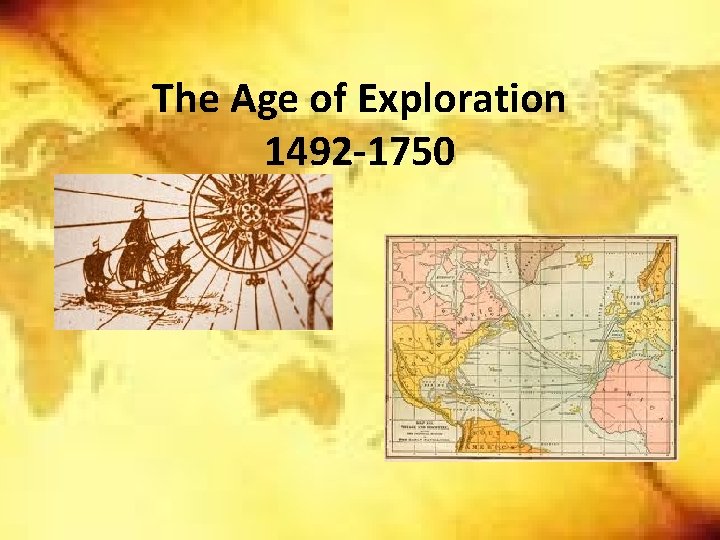
The Age of Exploration 1492 -1750
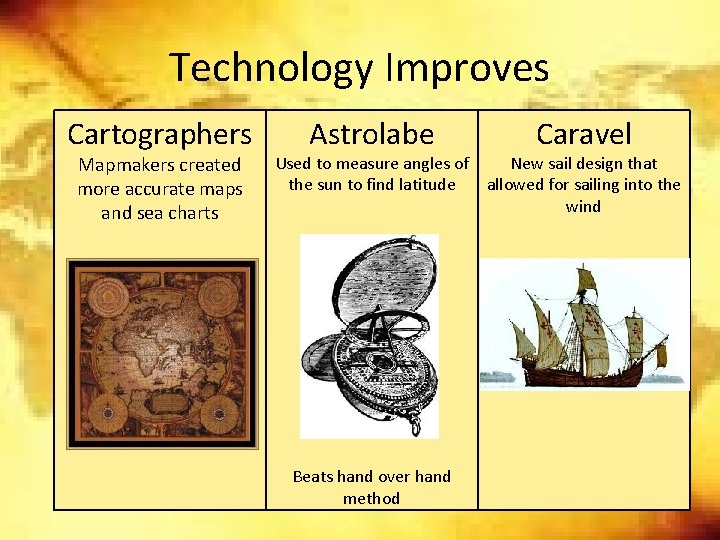
Technology Improves Cartographers Mapmakers created more accurate maps and sea charts Astrolabe Caravel Used to measure angles of New sail design that the sun to find latitude allowed for sailing into the wind Beats hand over hand method
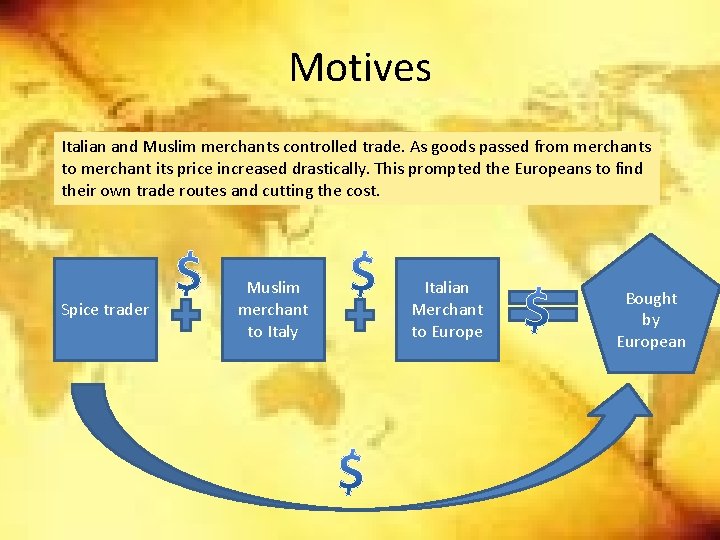
Motives Italian and Muslim merchants controlled trade. As goods passed from merchants to merchant its price increased drastically. This prompted the Europeans to find their own trade routes and cutting the cost. Spice trader Muslim merchant to Italy Italian Merchant to Europe Bought by European
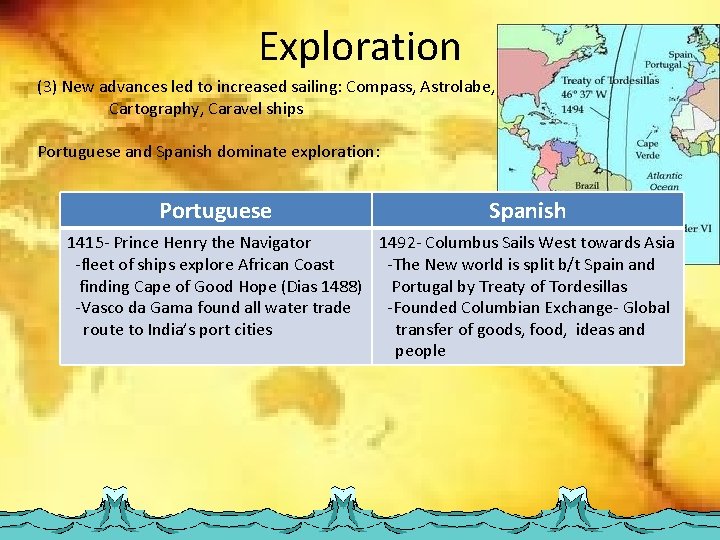
Exploration (3) New advances led to increased sailing: Compass, Astrolabe, Cartography, Caravel ships Portuguese and Spanish dominate exploration: Portuguese Spanish 1415 - Prince Henry the Navigator 1492 - Columbus Sails West towards Asia -fleet of ships explore African Coast -The New world is split b/t Spain and finding Cape of Good Hope (Dias 1488) Portugal by Treaty of Tordesillas -Vasco da Gama found all water trade -Founded Columbian Exchange- Global route to India’s port cities transfer of goods, food, ideas and people
Imperialism A policy of extending a country's power and influence through diplomacy or military force.
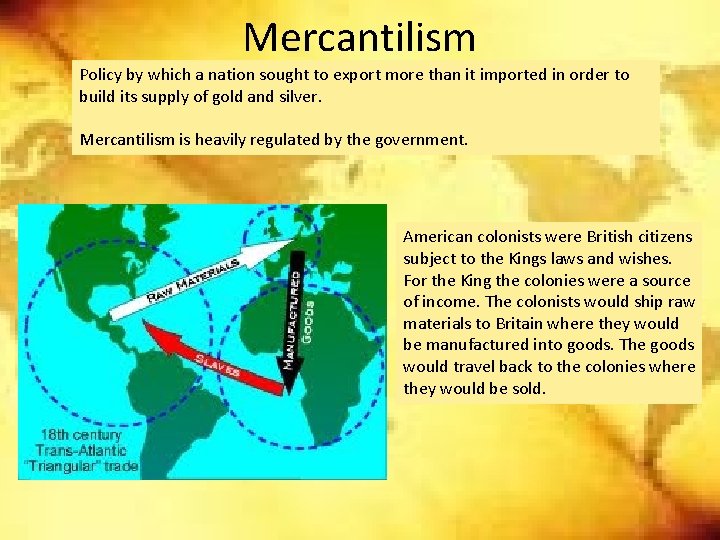
Mercantilism Policy by which a nation sought to export more than it imported in order to build its supply of gold and silver. Mercantilism is heavily regulated by the government. American colonists were British citizens subject to the Kings laws and wishes. For the King the colonies were a source of income. The colonists would ship raw materials to Britain where they would be manufactured into goods. The goods would travel back to the colonies where they would be sold.
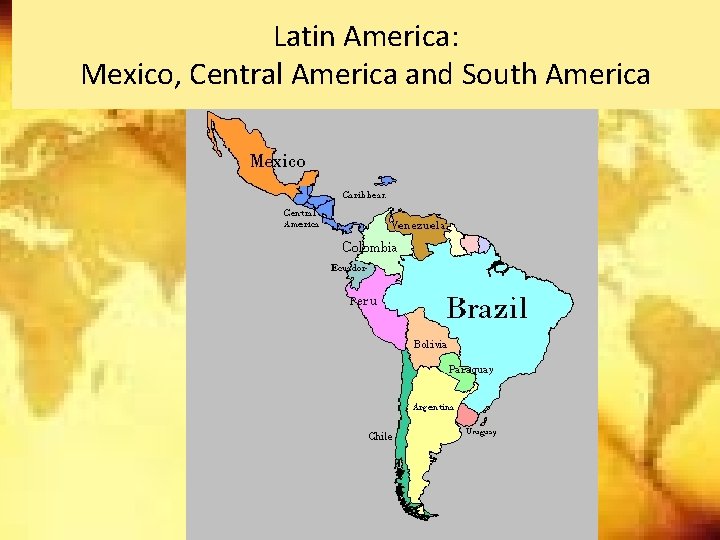
Latin America: Mexico, Central America and South America
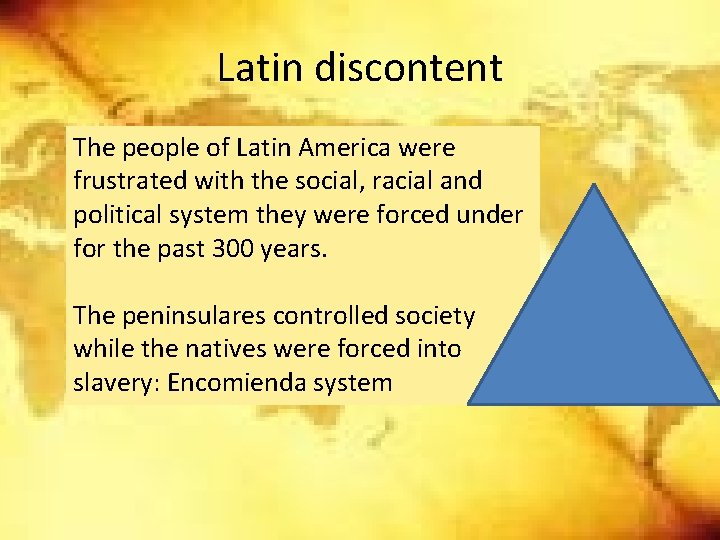
Latin discontent The people of Latin America were frustrated with the social, racial and political system they were forced under for the past 300 years. The peninsulares controlled society while the natives were forced into slavery: Encomienda system
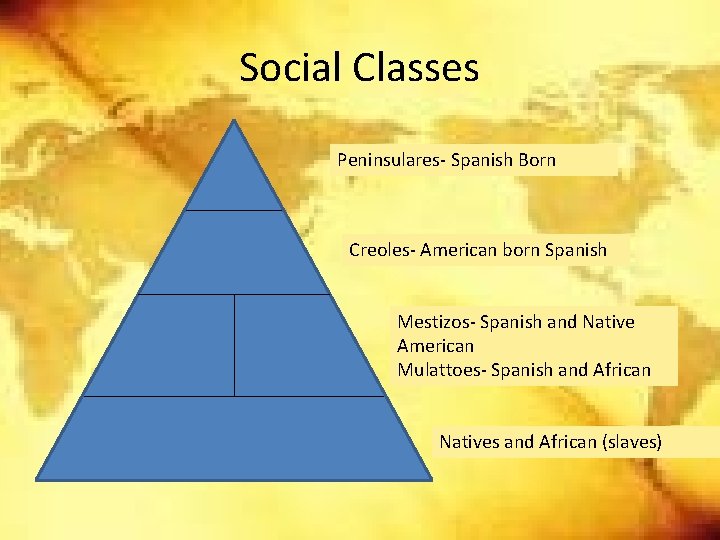
Social Classes Peninsulares- Spanish Born Creoles- American born Spanish Mestizos- Spanish and Native American Mulattoes- Spanish and African Natives and African (slaves)
Catalyst for change When Napoleon Bonaparte invaded Spain in 1808 the people of Spanish controlled Latin America saw it as an opportunity to revolt. Napoleon placed his brother on the throne of Spain. Latin American leaders saw this as a sign of Spain’s weakness. With Spain preoccupied with the French, the opportunity for them to demand independence from colonial rule had arrived.
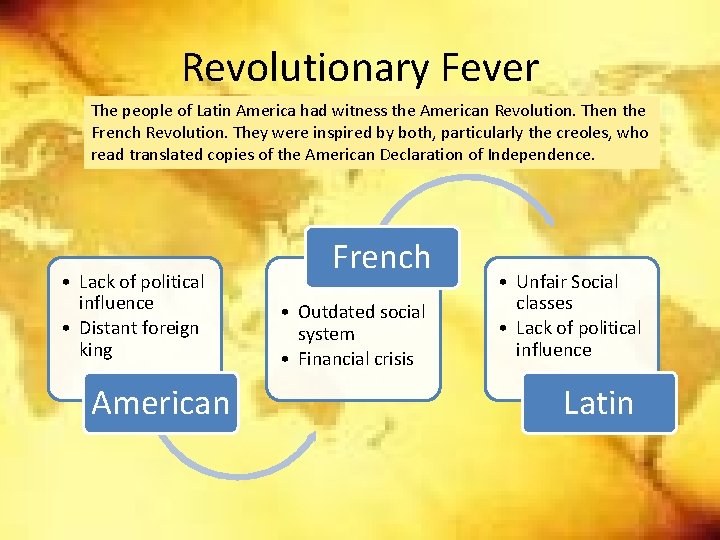
Revolutionary Fever The people of Latin America had witness the American Revolution. Then the French Revolution. They were inspired by both, particularly the creoles, who read translated copies of the American Declaration of Independence. • Lack of political influence • Distant foreign king American French • Outdated social system • Financial crisis • Unfair Social classes • Lack of political influence Latin
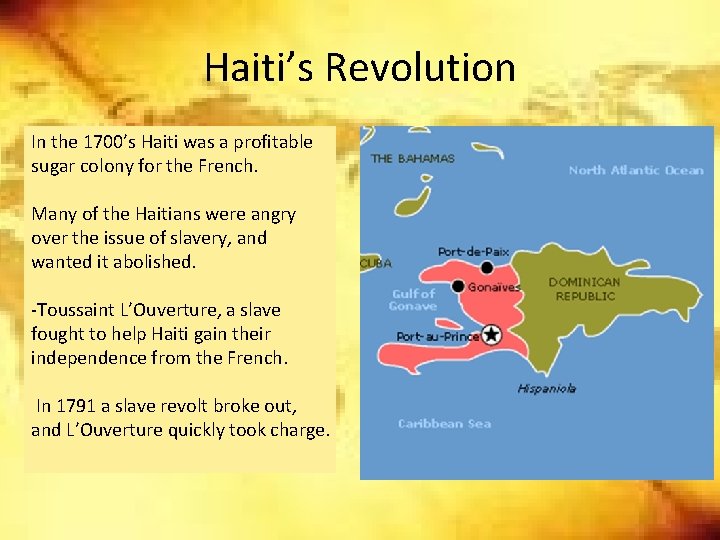
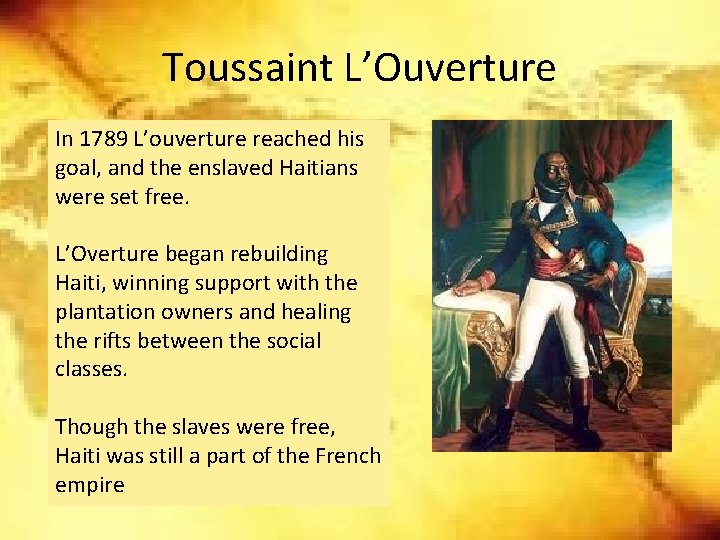
Haiti’s Revolution In the 1700’s Haiti was a profitable sugar colony for the French. Many of the Haitians were angry over the issue of slavery, and wanted it abolished. -Toussaint L’Ouverture, a slave fought to help Haiti gain their independence from the French. In 1791 a slave revolt broke out, and L’Ouverture quickly took charge.
Toussaint L’Ouverture In 1789 L’ouverture reached his goal, and the enslaved Haitians were set free. L’Overture began rebuilding Haiti, winning support with the plantation owners and healing the rifts between the social classes. Though the slaves were free, Haiti was still a part of the French empire
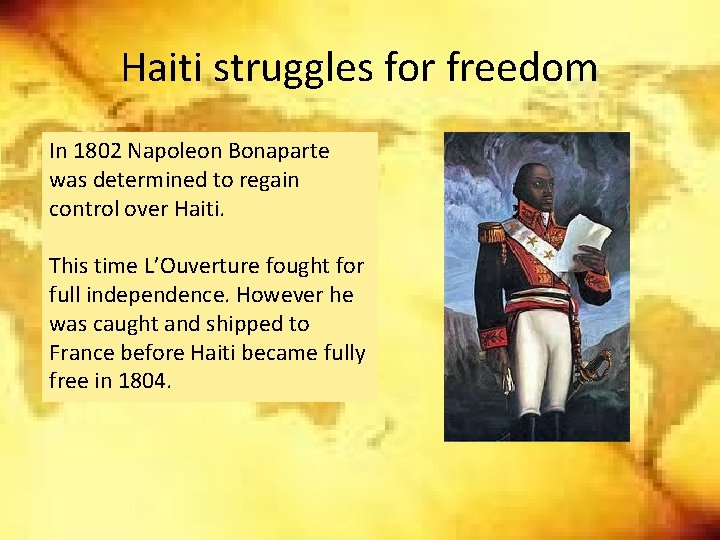
Haiti struggles for freedom In 1802 Napoleon Bonaparte was determined to regain control over Haiti. This time L’Ouverture fought for full independence. However he was caught and shipped to France before Haiti became fully free in 1804.
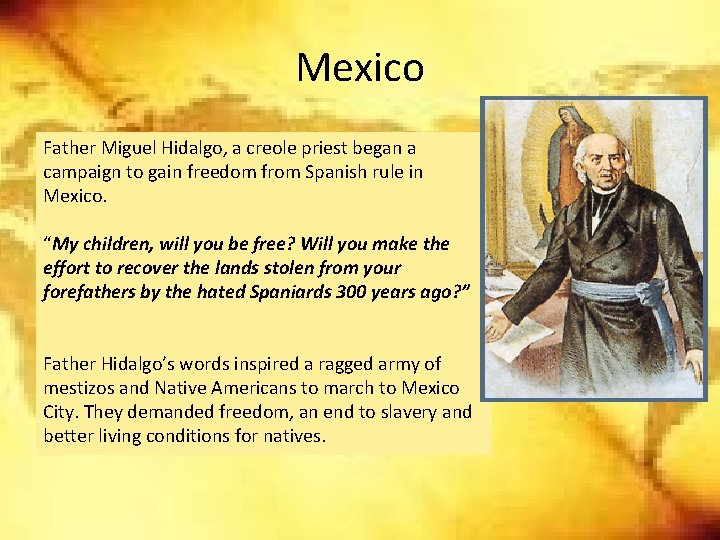
Mexico Father Miguel Hidalgo, a creole priest began a campaign to gain freedom from Spanish rule in Mexico. “My children, will you be free? Will you make the effort to recover the lands stolen from your forefathers by the hated Spaniards 300 years ago? ” Father Hidalgo’s words inspired a ragged army of mestizos and Native Americans to march to Mexico City. They demanded freedom, an end to slavery and better living conditions for natives.
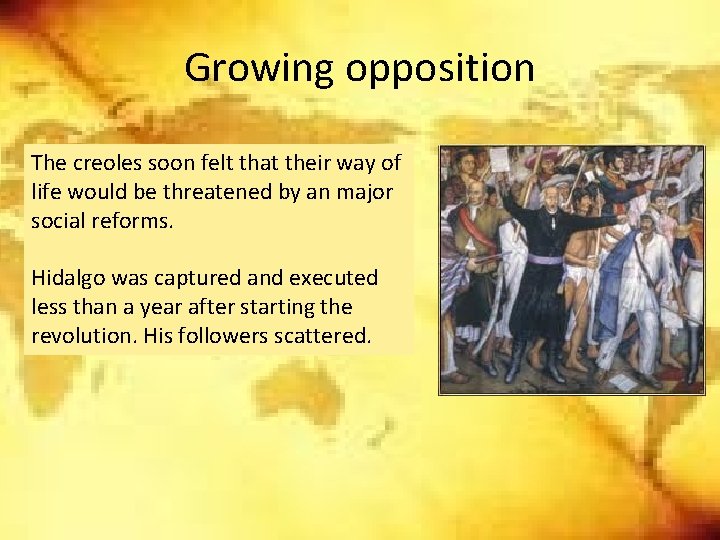
Growing opposition The creoles soon felt that their way of life would be threatened by an major social reforms. Hidalgo was captured and executed less than a year after starting the revolution. His followers scattered.
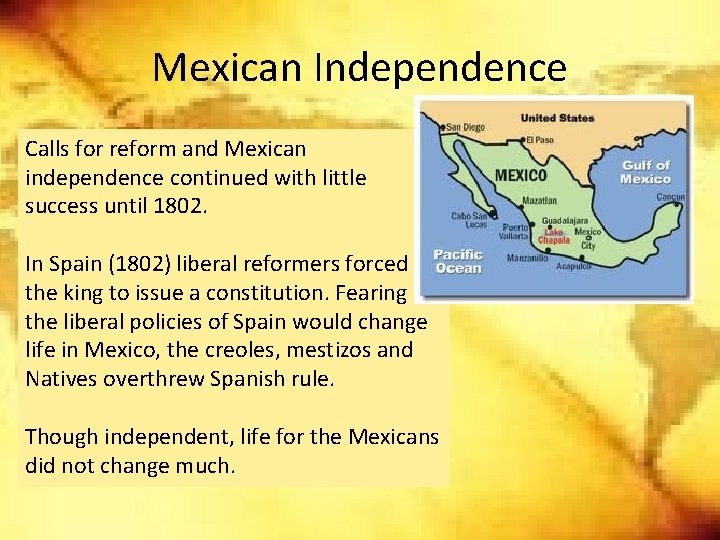
Mexican Independence Calls for reform and Mexican independence continued with little success until 1802. In Spain (1802) liberal reformers forced the king to issue a constitution. Fearing the liberal policies of Spain would change life in Mexico, the creoles, mestizos and Natives overthrew Spanish rule. Though independent, life for the Mexicans did not change much.
Review Simon Bolivar and Miguel Hidalgo, leaders of Latin American independence movements, were inspired by successful revolutions in 1. the United States and France 2. the Soviet Union and China 3. Cuba and Costa Rica 4. Egypt and Kenya
Review During the early 1800’s, which was a major influence on the struggle for political independence in Latin America? 1. poor conditions in urban centers in Latin America 2. the American and French Revolutions 3. the desire of the Roman Catholic Church in Latin America to escape European control 4. demands by Latin American workers to own their own factories
Review 3. One similarity in the leadership of Latin Americas Jose de San Martin, Toussaint L’Ouverture, Bernardo O’Higgins, and Pedro I was that each leader 1. opposed United States intervention in Haiti 2. led a struggle to gain freedom for the people of his nation 3. opposed membership of his nation in the League of Nations 4. established an absolute monarchy in his nation
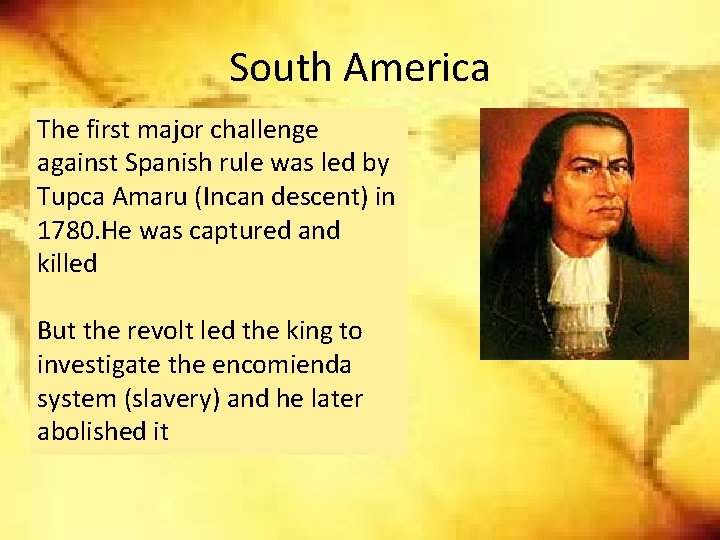
South America The first major challenge against Spanish rule was led by Tupca Amaru (Incan descent) in 1780. He was captured and killed But the revolt led the king to investigate the encomienda system (slavery) and he later abolished it
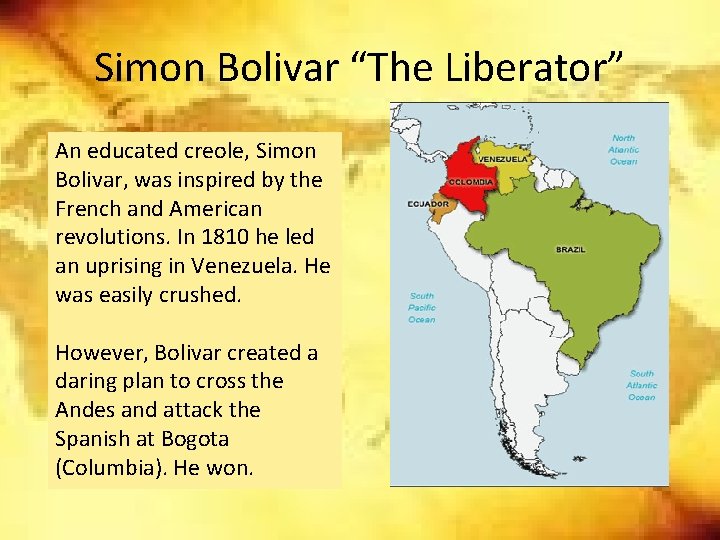
Simon Bolivar “The Liberator” An educated creole, Simon Bolivar, was inspired by the French and American revolutions. In 1810 he led an uprising in Venezuela. He was easily crushed. However, Bolivar created a daring plan to cross the Andes and attack the Spanish at Bogota (Columbia). He won.
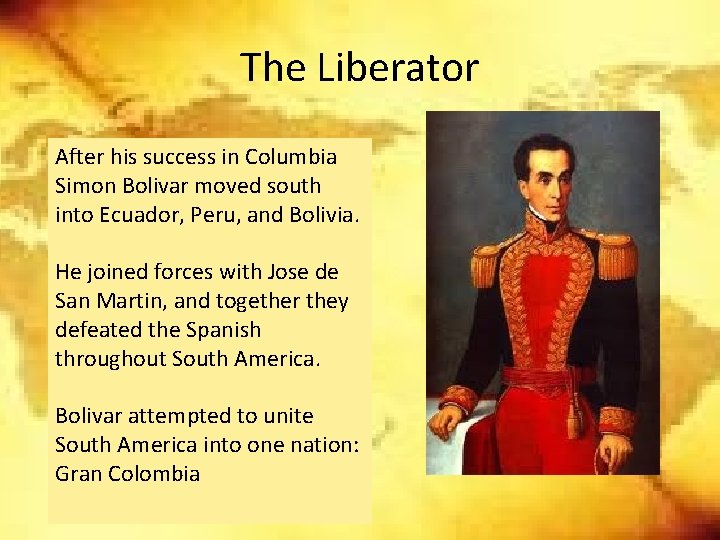
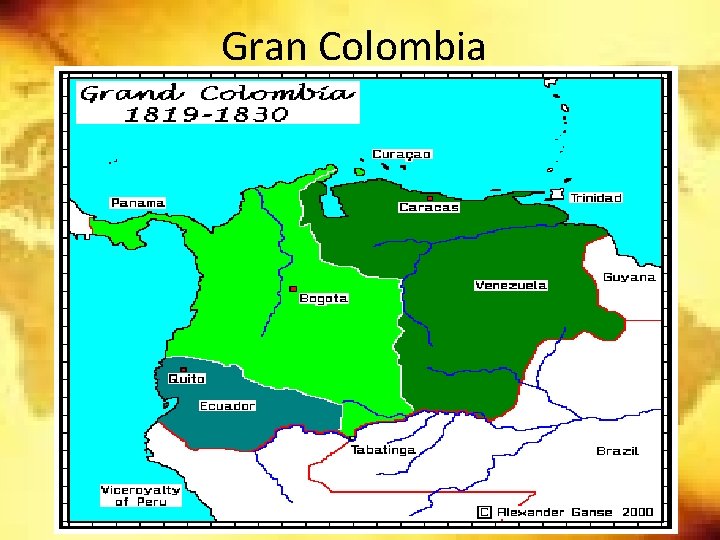
The Liberator After his success in Columbia Simon Bolivar moved south into Ecuador, Peru, and Bolivia. He joined forces with Jose de San Martin, and together they defeated the Spanish throughout South America. Bolivar attempted to unite South America into one nation: Gran Colombia
Gran Colombia
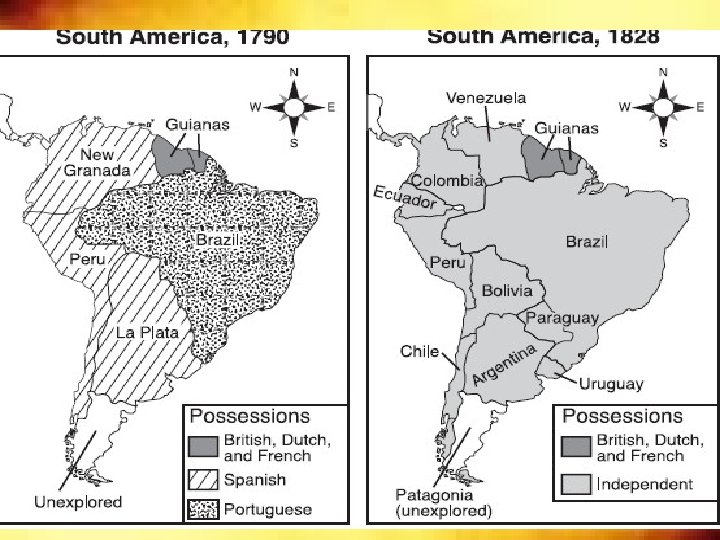
South America Failure Though the South Americans had achieved independence from Spain, it’s common people had simply changed one set of masters for another. It will take decades for the nations of South America to create stable governments
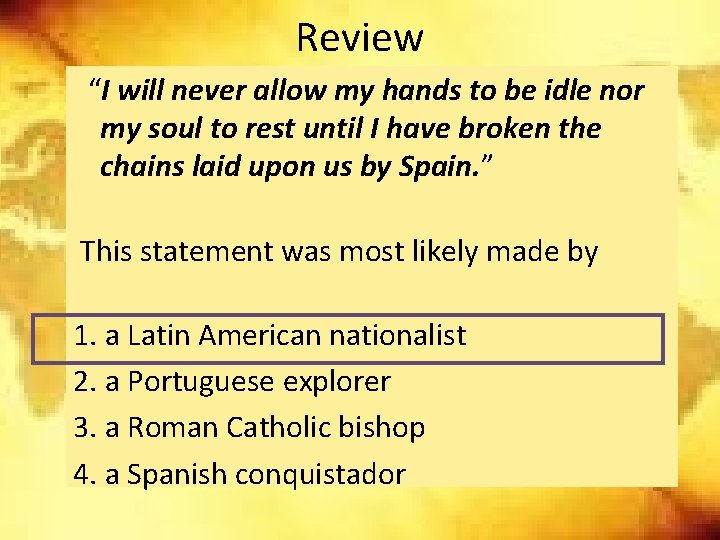
Review “I will never allow my hands to be idle nor my soul to rest until I have broken the chains laid upon us by Spain. ” This statement was most likely made by 1. a Latin American nationalist 2. a Portuguese explorer 3. a Roman Catholic bishop 4. a Spanish conquistador
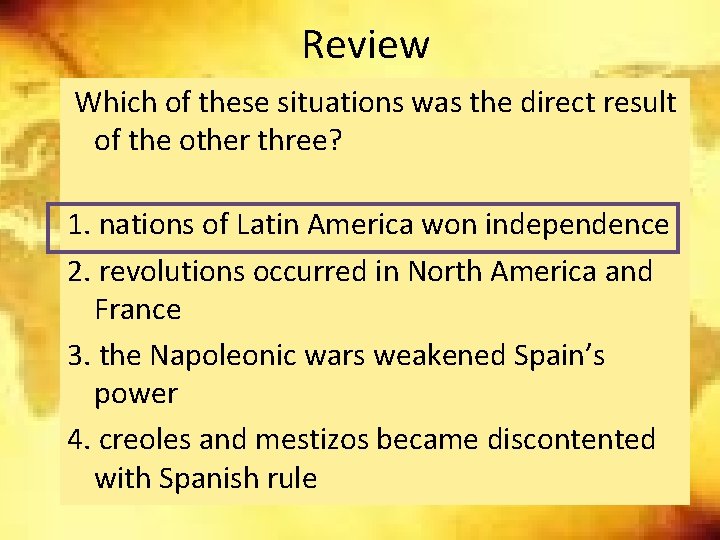
Review Which of these situations was the direct result of the other three? 1. nations of Latin America won independence 2. revolutions occurred in North America and France 3. the Napoleonic wars weakened Spain’s power 4. creoles and mestizos became discontented with Spanish rule
Review The 19 th-century independence movements in Latin America were influenced by 1. Marxist ideology 2. the Aztec wars against Hernando Cortez 3. liberation theology 4. the American and the French Revolutions
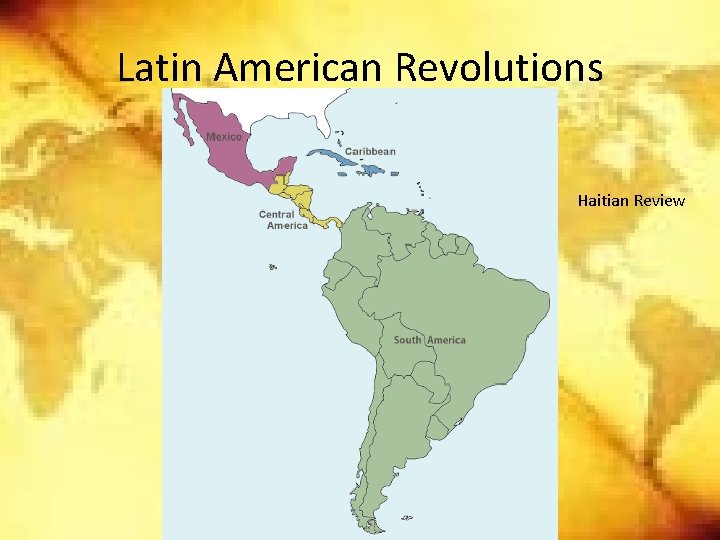
Latin American Revolutions Haitian Review