
The Age of Enlightenment Late 18 th century


- Slides: 48
The Age of Enlightenment Late 18 th century Tremendous advances in science, politics, philosophy, economics, etc. Thomas Jefferson – an American member of the Enlightenment
The Scientific Method Inductive phase : reasoning from the specific to the general (Formulate the hypothesis) deductive phase: reasoning from the general to the specific (test the hypothesis) Example: formulation of the hypothesis of spontaneous generation; Its testing by Louis Pasteur
Hypothesis: An explanation that accounts for a set of observations and can be tested by further investigation
Observation v. s. fact A fact is a “cooked” observation Lawyers talk about “facts” Scientist are more conservativetalk only about observations
Theory A system of ideas used to explain observations
Paradigm A shared perspective within a scientific community Usually expresses as a set of related theories
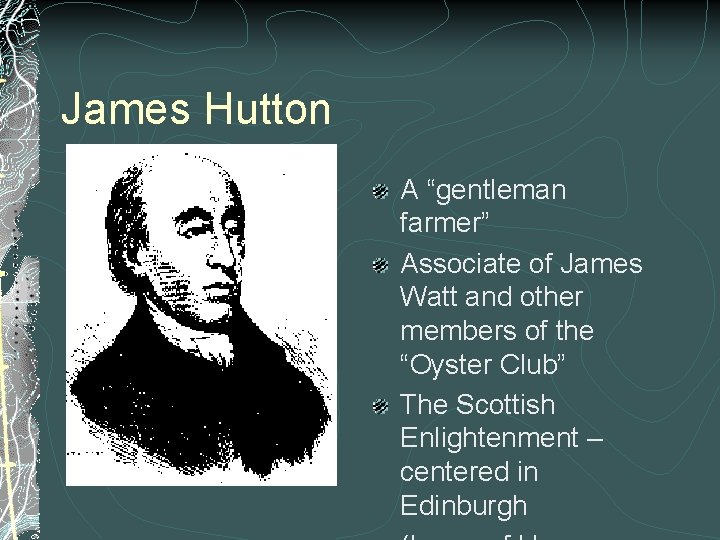
James Hutton A “gentleman farmer” Associate of James Watt and other members of the “Oyster Club” The Scottish Enlightenment – centered in Edinburgh
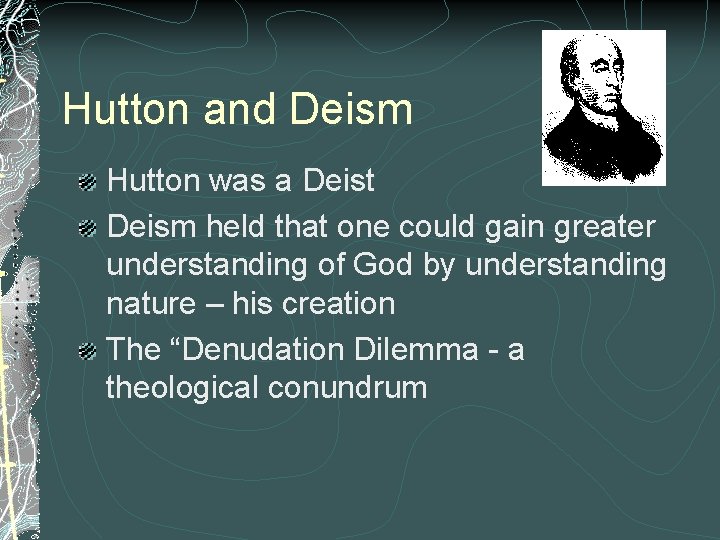
Hutton and Deism Hutton was a Deist Deism held that one could gain greater understanding of God by understanding nature – his creation The “Denudation Dilemma - a theological conundrum
Denudation Dilemma Rock and soil are essential to life Rock is the foundation for where we live Soil is the foundation of agriculture – sustains life To the Deists, this was evidence of God’s beneficence
Denudation Dilemma Rocks decay at Earth’s surface – weathering Soil is washed away from farmlands – erosion Weathering and erosion indicate destruction of the land Martin Luther predicted that the world would end as a result of erosion
The Dilemma How can one reconcile God’s beneficence with the destruction of the land, which is essential for life?
Hutton’s Observations Processes of weathering and erosion are slow Many rocks visible on the land are made up of the products of weathering and erosion These rocks are Sedimentary Rocks Sediments accumulate in the ocean, so these rocks originally formed in the ocean
The Riddle How can rocks that formed below sea level be found on land?
More of Hutton’s Observations Not all rocks form by accumulation of sediment Some rocks are made of crystals These rocks show signs of having formed at very high temperatures from molten material These are Igneous Rocks
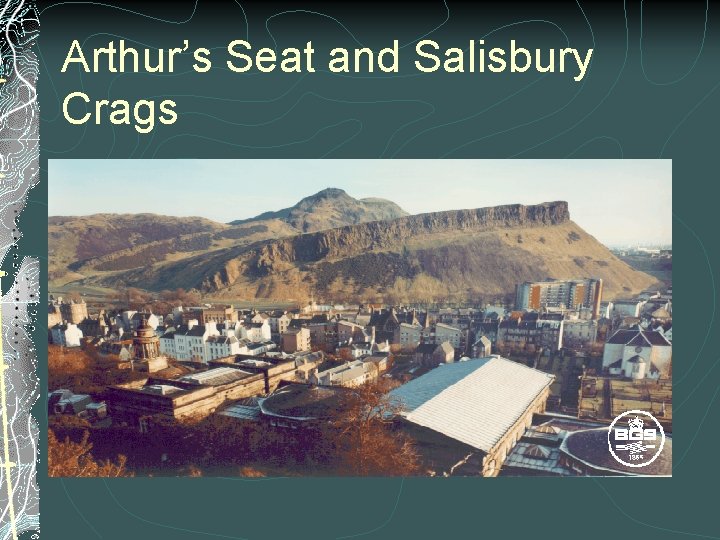
Arthur’s Seat and Salisbury Crags
Hutton’s Solution Igneous rocks provide evidence for heat within the Earth Heat is capable of work (Watt’s influence) Heat within the Earth lifts rocks from the sea and creates new land The dilemma is solved because as erosion destroys land, heat uplifts new land
Implications of Hutton’s Solution Earth processes are slow Great changes can be accomplished with great amounts of time Evidence of great expanses of time recorded by the rocks Conclusion: the Earth must be extremely old
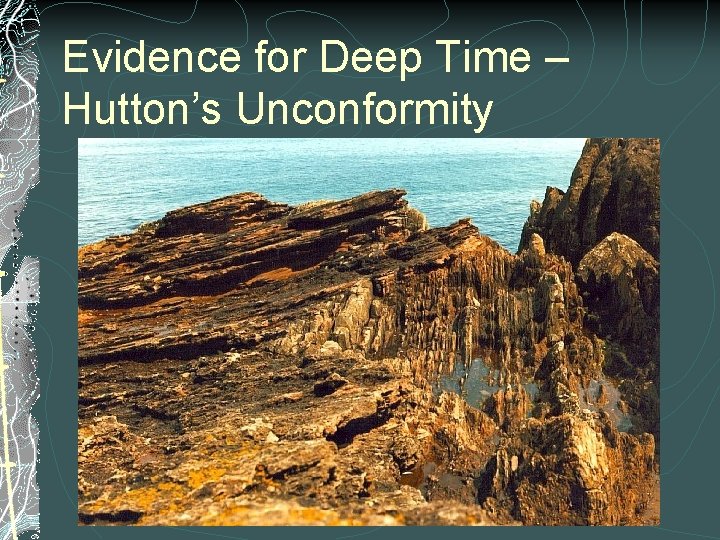
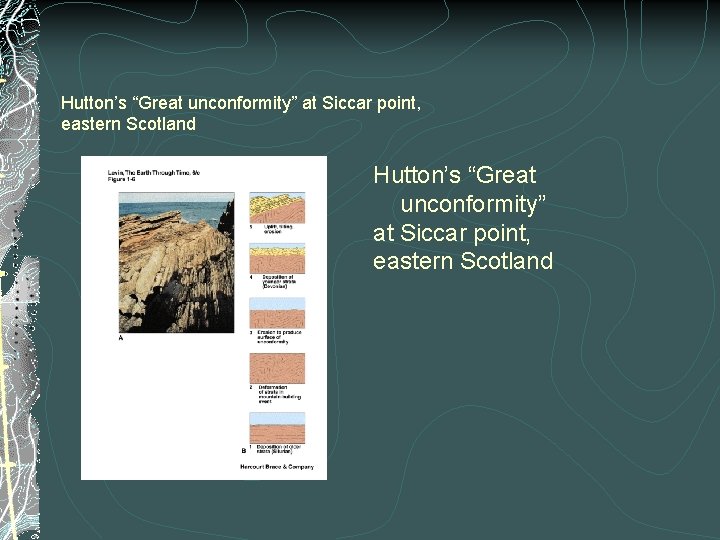
Evidence for Deep Time – Hutton’s Unconformity
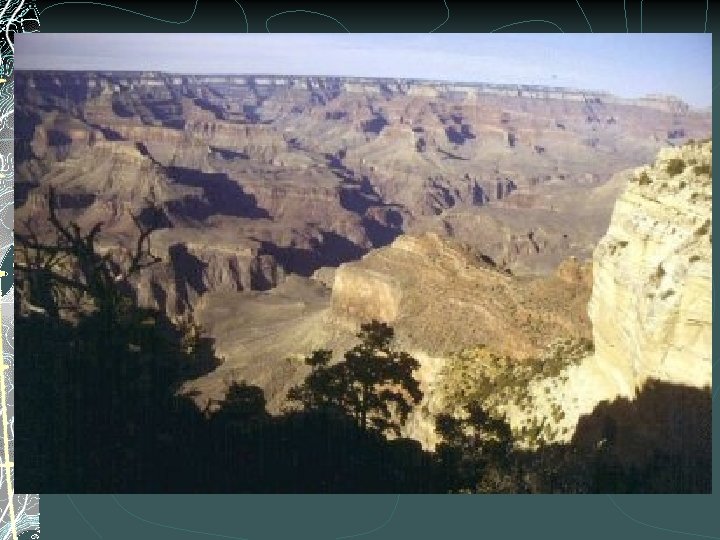
Sedimentary Rocks reflect change in environment on the Earth’s surface. Rises and falls in sea level Climate Change in life forms
UNCONFORMITIES Angular Unconformity a) deposit of sediments b) tectonic event c) erosion d) deposition
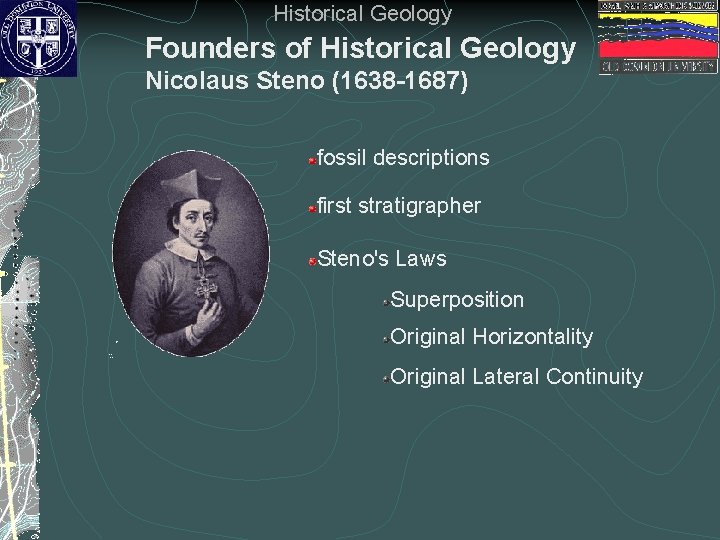
Historical Geology Founders of Historical Geology Nicolaus Steno (1638 -1687) fossil descriptions first stratigrapher Steno's Laws Superposition Original Horizontality Original Lateral Continuity
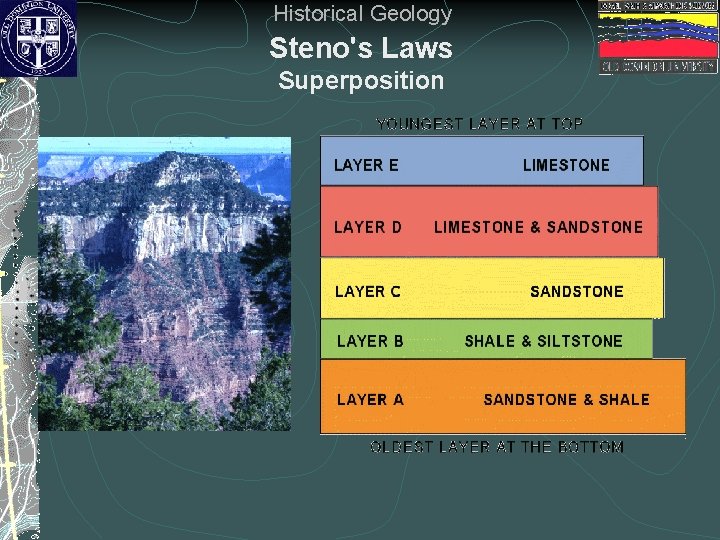
Historical Geology Steno's Laws Superposition
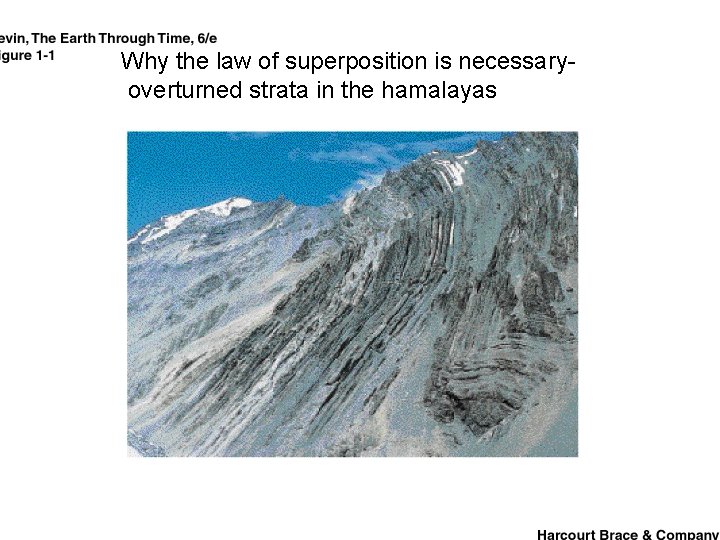
Why the law of superposition is necessaryoverturned strata in the hamalayas
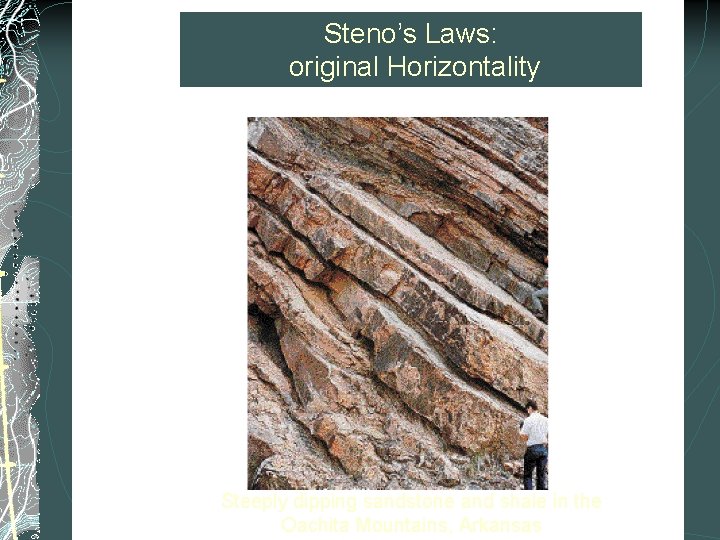
Steno’s Laws: Steno's Laws original Horizontality Original Horizontality Steeply dipping sandstone and shale in the Oachita Mountains, Arkansas
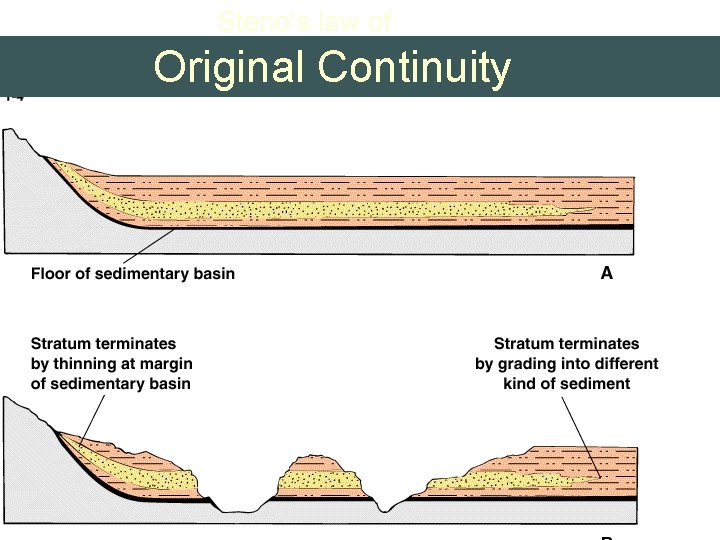
Steno’s law of Original Continuity
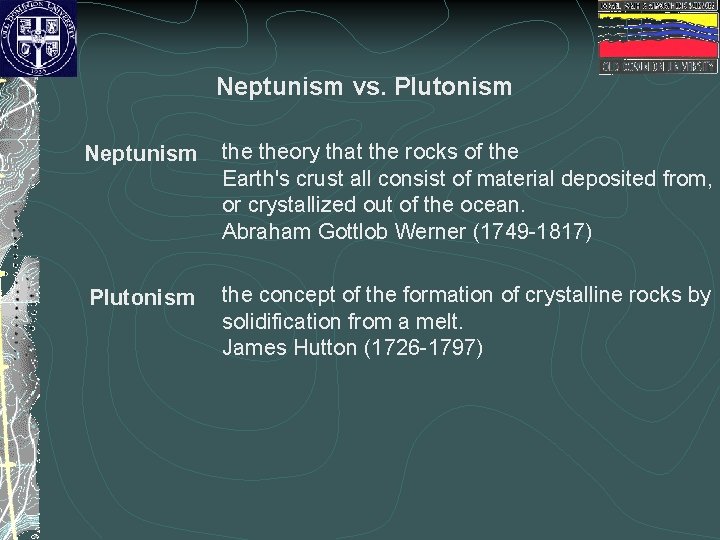
Neptunism vs. Plutonism Neptunism theory that the rocks of the Earth's crust all consist of material deposited from, or crystallized out of the ocean. Abraham Gottlob Werner (1749 -1817) Plutonism the concept of the formation of crystalline rocks by solidification from a melt. James Hutton (1726 -1797)
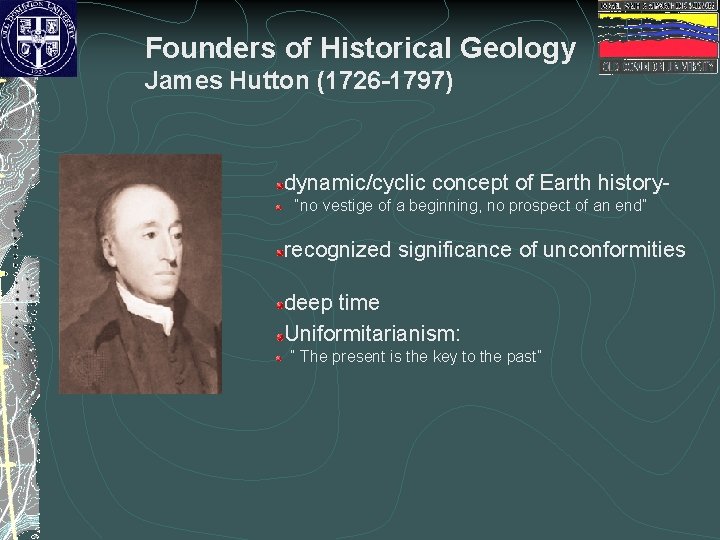
Founders of Historical Geology James Hutton (1726 -1797) dynamic/cyclic concept of Earth history“no vestige of a beginning, no prospect of an end” recognized significance of unconformities deep time Uniformitarianism: “ The present is the key to the past”
Hutton’s “Great unconformity” at Siccar point, eastern Scotland
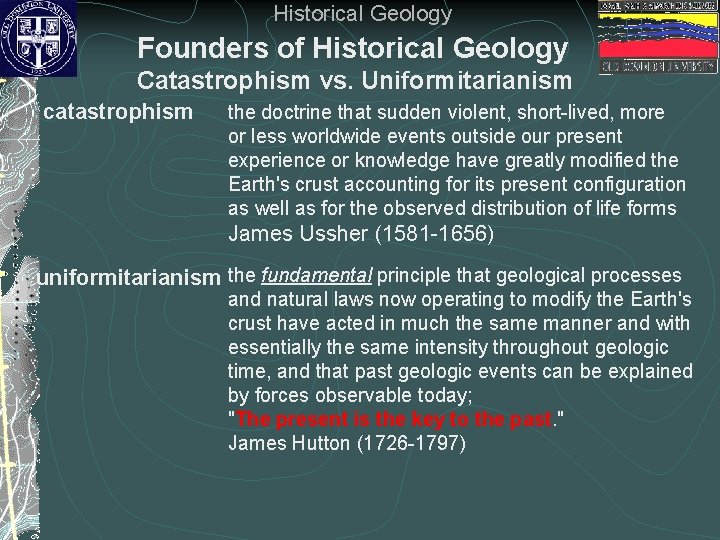
Historical Geology Founders of Historical Geology Catastrophism vs. Uniformitarianism catastrophism the doctrine that sudden violent, short-lived, more or less worldwide events outside our present experience or knowledge have greatly modified the Earth's crust accounting for its present configuration as well as for the observed distribution of life forms James Ussher (1581 -1656) uniformitarianism the fundamental principle that geological processes and natural laws now operating to modify the Earth's crust have acted in much the same manner and with essentially the same intensity throughout geologic time, and that past geologic events can be explained by forces observable today; "The present is the key to the past. " James Hutton (1726 -1797)
Uniformitarianism: The present is the key to the past (Hutton, 1788) The basic physical, chemical and biological laws of the present-day world also operated in the Earth’s past. Implications: 1. Present day geological processes acting at slow rates, but over long time periods, can produce dramatic results. 2. Based on the study of changes that are known to occur gradually (e. g. wearing down of mountains), the Earth must be very old. Misconception: All geologic processes are slow and gradual.
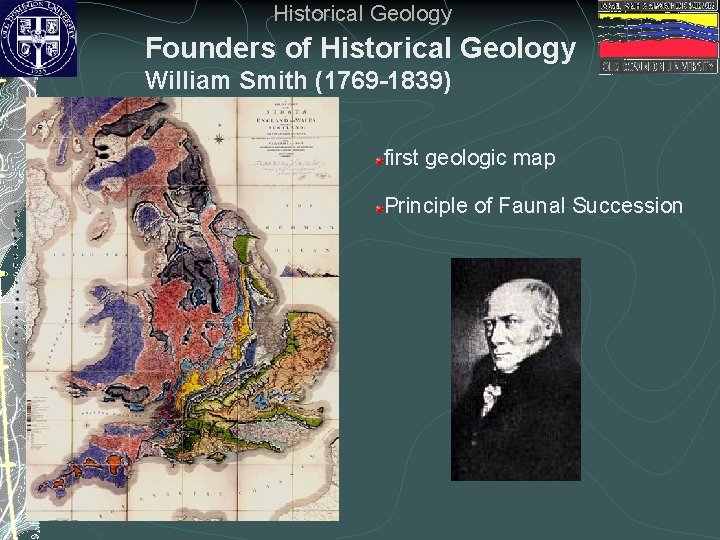
Historical Geology Founders of Historical Geology William Smith (1769 -1839) first geologic map Principle of Faunal Succession
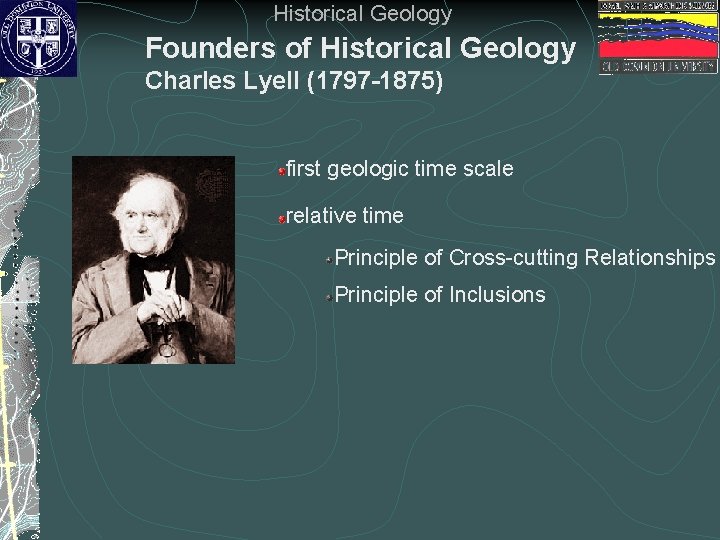
Historical Geology Founders of Historical Geology Charles Lyell (1797 -1875) first geologic time scale relative time Principle of Cross-cutting Relationships Principle of Inclusions
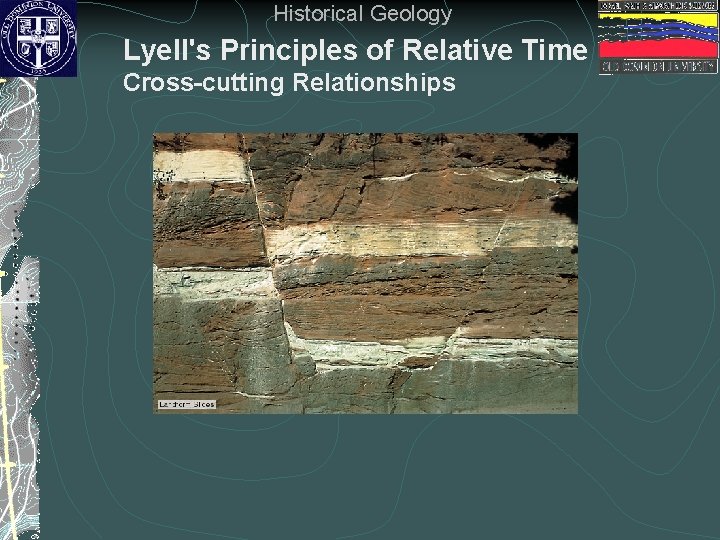
Historical Geology Lyell's Principles of Relative Time Cross-cutting Relationships
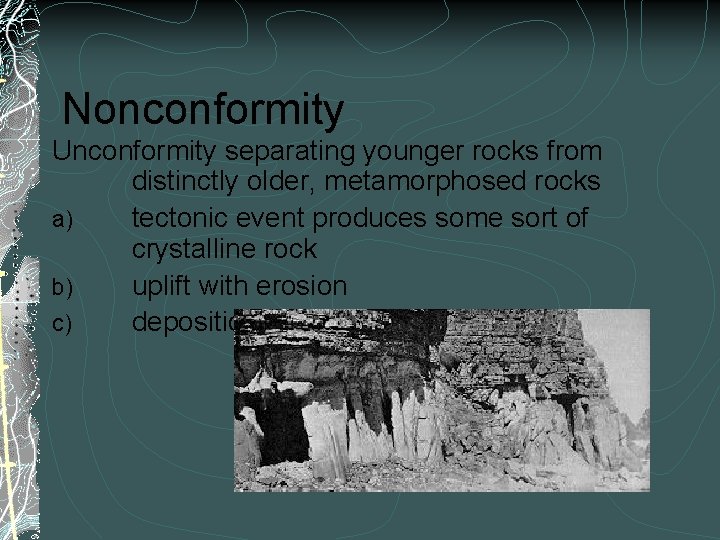
Nonconformity Unconformity separating younger rocks from distinctly older, metamorphosed rocks a) tectonic event produces some sort of crystalline rock b) uplift with erosion c) deposition
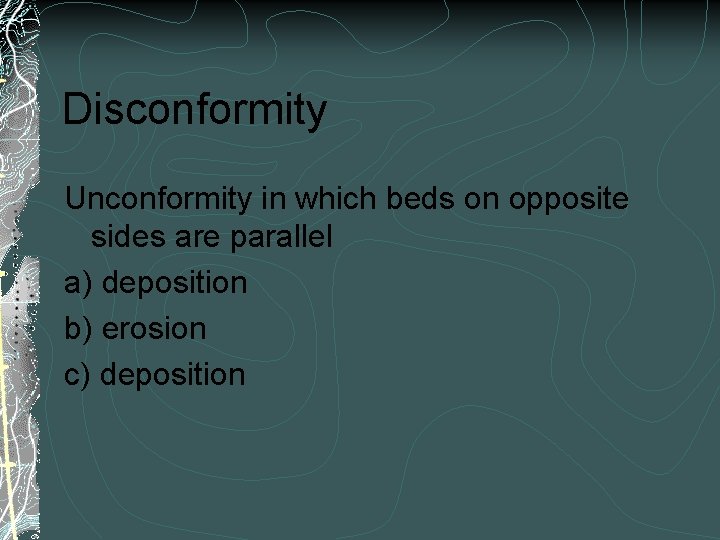
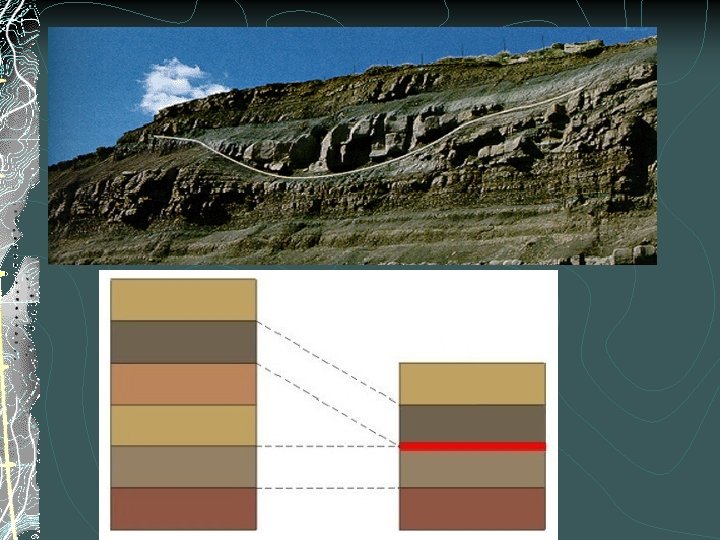
Disconformity Unconformity in which beds on opposite sides are parallel a) deposition b) erosion c) deposition
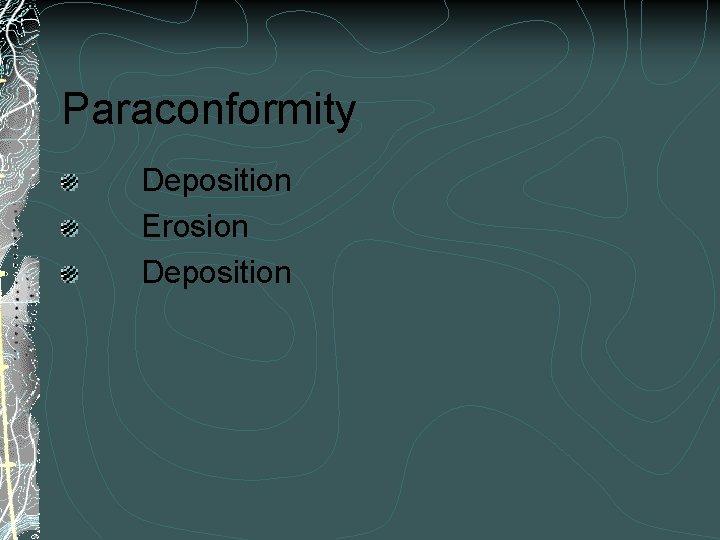
Paraconformity Deposition Erosion Deposition
Uniformitarianism the laws of nature do not change with time. Hutton- first to discover geological time, and the first to state that the Earth is much older than 6000 years. Before Hutton, everyone believed in catastrophism, which states that the shape of the Earth came to be quickly and violently. Catastrophism was a by-product of the fact that religion was in control of most governments.
An old Earth Recycling of Earth materials Evidence for earlier episodes of recycling “No vestige of a beginning… no prospect of an end. ” Hutton’s “Theory of the Earth” - 1785
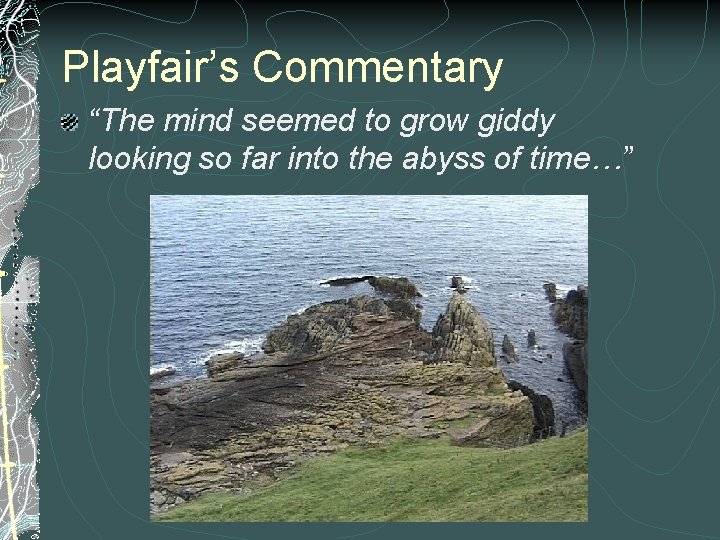
Playfair’s Commentary “The mind seemed to grow giddy looking so far into the abyss of time…”
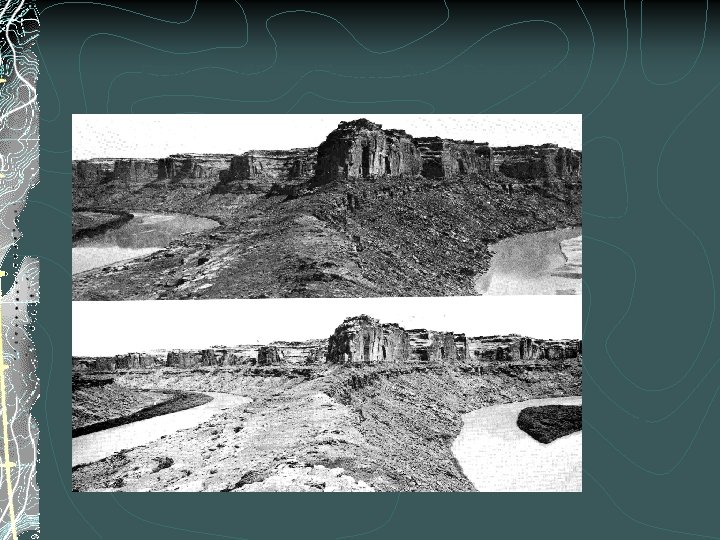
Example of Slow Change: Green River, Utah 1871 1968
Catastrophism: Changes in the Earth are sudden and violent Major changes in the Earth’s state tend to occur in short bursts of activity. Implication: Geologic changes tend to occur as rare events that are short-lived with little change occurring between these events. Misconceptions: 1. All changes that occur on the Earth are catastrophic 2. The Earth and its present day features were produced during a single event, and therefore the Earth must be very young
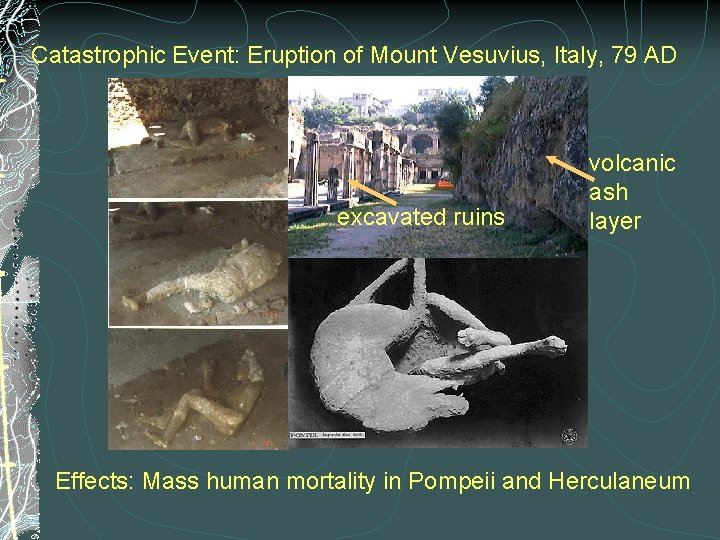
Catastrophic Event: Eruption of Mount Vesuvius, Italy, 79 AD excavated ruins volcanic ash layer Effects: Mass human mortality in Pompeii and Herculaneum
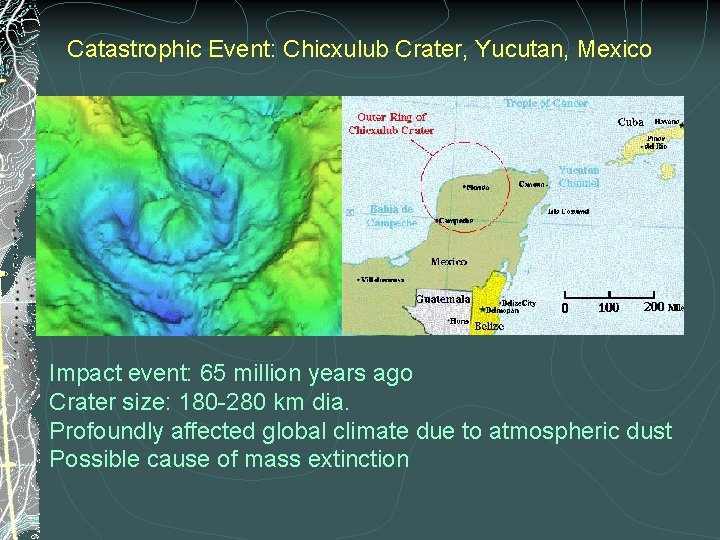
Catastrophic Event: Chicxulub Crater, Yucutan, Mexico Impact event: 65 million years ago Crater size: 180 -280 km dia. Profoundly affected global climate due to atmospheric dust Possible cause of mass extinction
What’s so remarkable about Hutton’s Ideas? Contrary to prevailing views of the time Based on observation – what he saw Hutton drew inferences from his observations Inferences are hypotheses Hypotheses are testable This is an application of the scientific method to study of the Earth