
The Age of Anxiety Prague Street by Otto
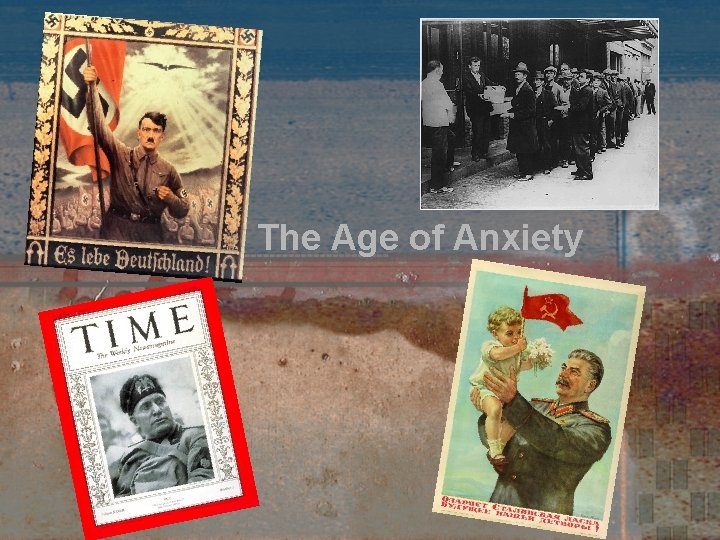
The Age of Anxiety
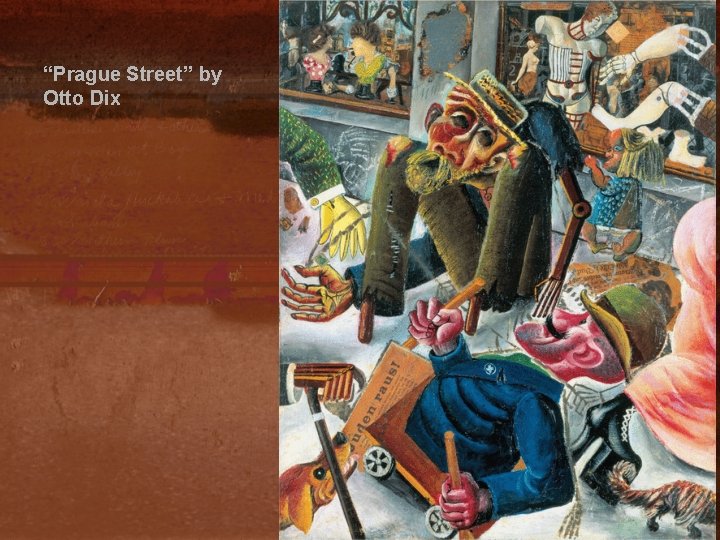
“Prague Street” by Otto Dix
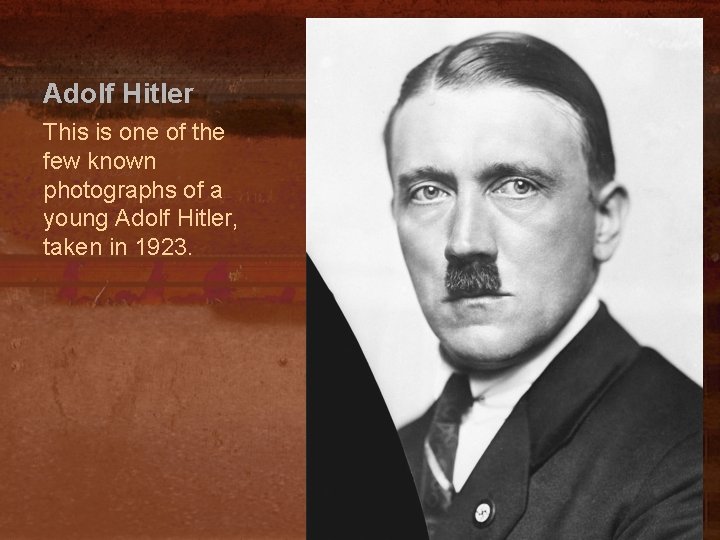
Adolf Hitler This is one of the few known photographs of a young Adolf Hitler, taken in 1923.
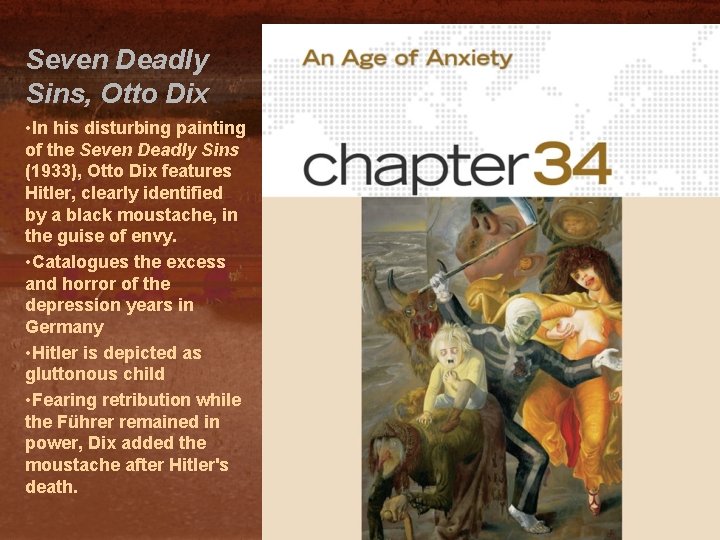
Seven Deadly Sins, Otto Dix • In his disturbing painting of the Seven Deadly Sins (1933), Otto Dix features Hitler, clearly identified by a black moustache, in the guise of envy. • Catalogues the excess and horror of the depression years in Germany • Hitler is depicted as gluttonous child • Fearing retribution while the Führer remained in power, Dix added the moustache after Hitler's death.
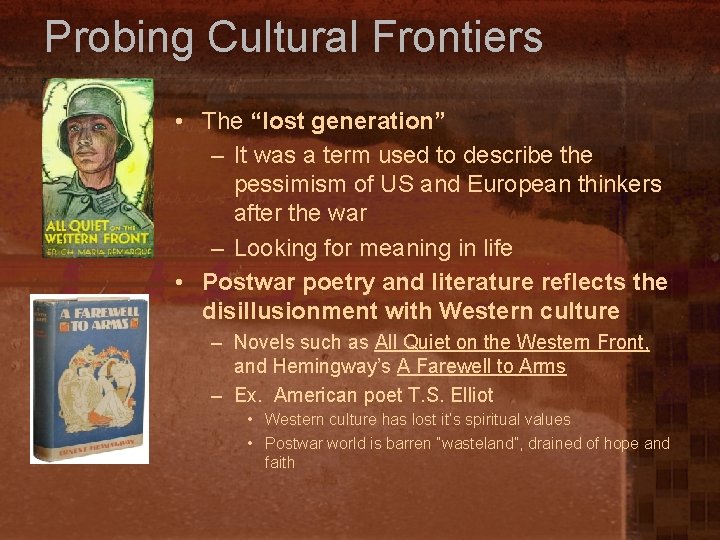
Probing Cultural Frontiers • The “lost generation” – It was a term used to describe the pessimism of US and European thinkers after the war – Looking for meaning in life • Postwar poetry and literature reflects the disillusionment with Western culture – Novels such as All Quiet on the Western Front, and Hemingway’s A Farewell to Arms – Ex. American poet T. S. Elliot • Western culture has lost it’s spiritual values • Postwar world is barren “wasteland”, drained of hope and faith
And as I sat there brooding on the old unknown world, I thought of Gatsby’s wonder when he first picked out the green light at the end of Daisy’s dock. He had come a long way to this blue lawn, and his dream must have seemed so close that he could hardly fail to grasp it. He did not know that it was already behind him, somewhere back in the vast obscurity beyond the city, where the dark fields of the republic rolled under the night. Gatsby believed in the green light, the …future that year by year recedes before us. It eluded us then, but that’s no matter-tomorrow we will run faster, stretch our the arms farther…And on fine morning. So we beat on, boats against the current, borne back ceaselessly into the past. – F. Scott Fitzgerald, The Great Gatsby
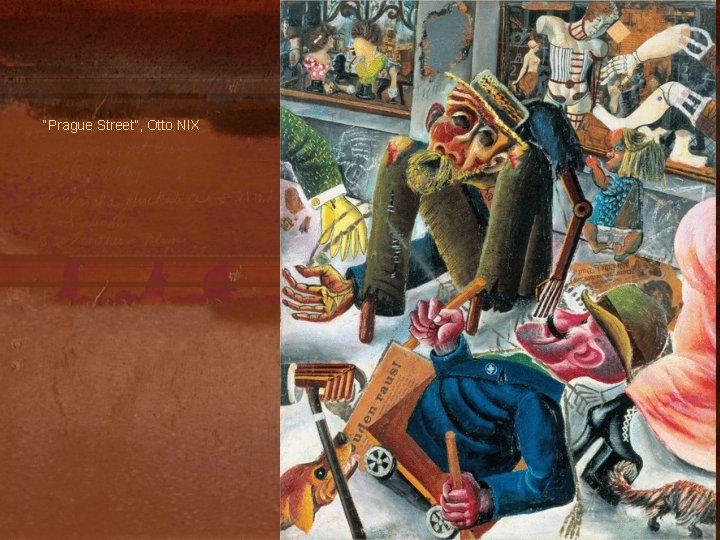
“Prague Street”, Otto NIX
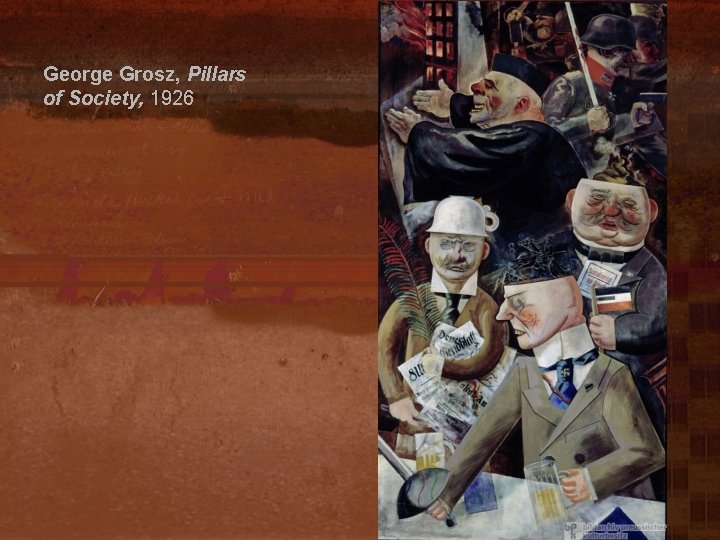
George Grosz, Pillars of Society, 1926
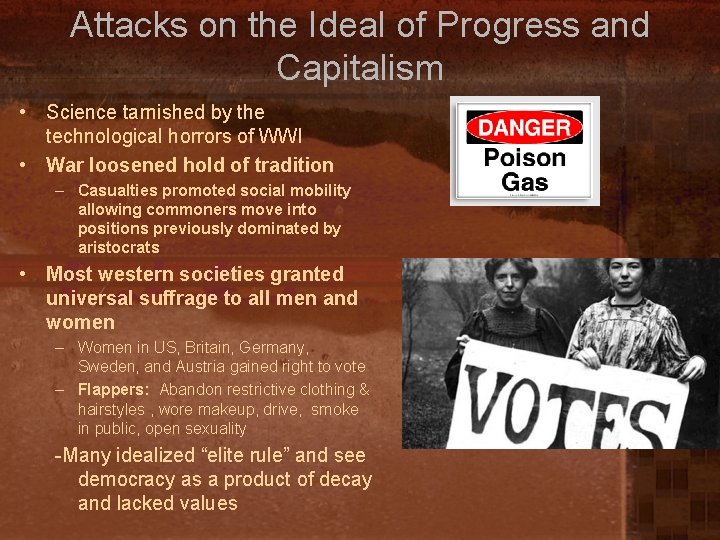
Attacks on the Ideal of Progress and Capitalism • Science tarnished by the technological horrors of WWI • War loosened hold of tradition – Casualties promoted social mobility allowing commoners move into positions previously dominated by aristocrats • Most western societies granted universal suffrage to all men and women – Women in US, Britain, Germany, Sweden, and Austria gained right to vote – Flappers: Abandon restrictive clothing & hairstyles , wore makeup, drive, smoke in public, open sexuality -Many idealized “elite rule” and see democracy as a product of decay and lacked values
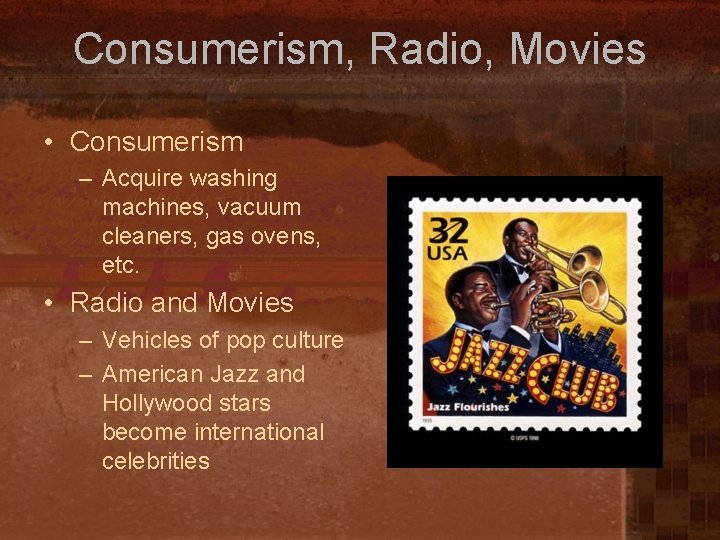
Consumerism, Radio, Movies • Consumerism – Acquire washing machines, vacuum cleaners, gas ovens, etc. • Radio and Movies – Vehicles of pop culture – American Jazz and Hollywood stars become international celebrities
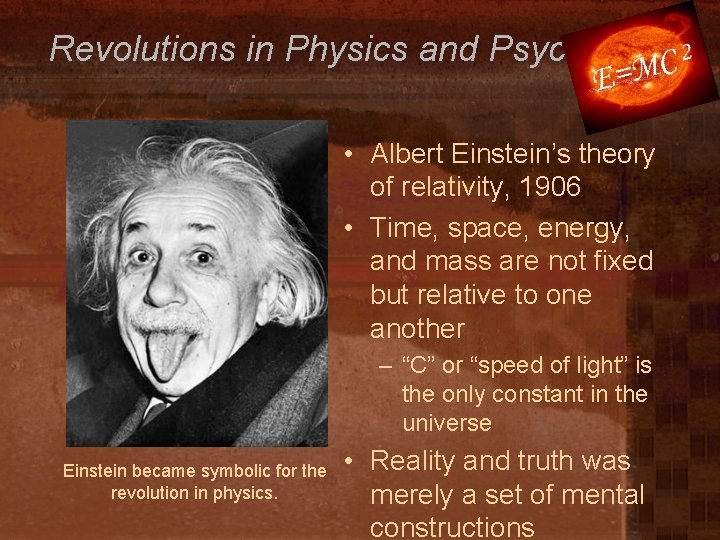
Revolutions in Physics and Psychology • Albert Einstein’s theory of relativity, 1906 • Time, space, energy, and mass are not fixed but relative to one another – “C” or “speed of light” is the only constant in the universe Einstein became symbolic for the revolution in physics. • Reality and truth was merely a set of mental constructions
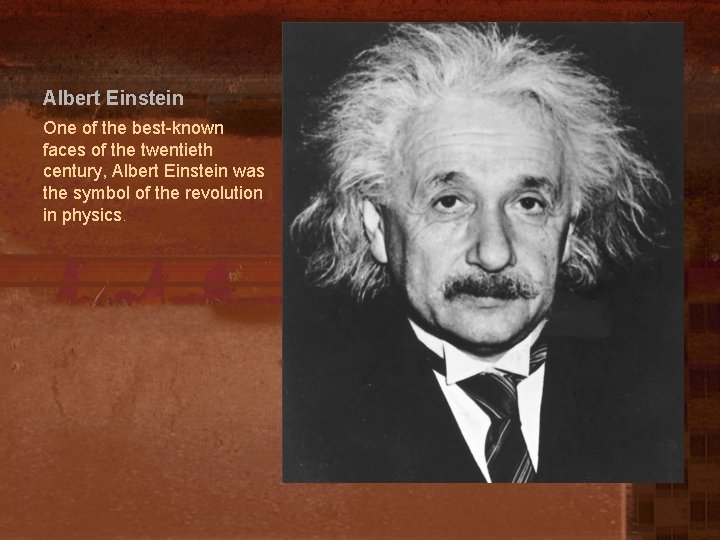
Albert Einstein One of the best-known faces of the twentieth century, Albert Einstein was the symbol of the revolution in physics.
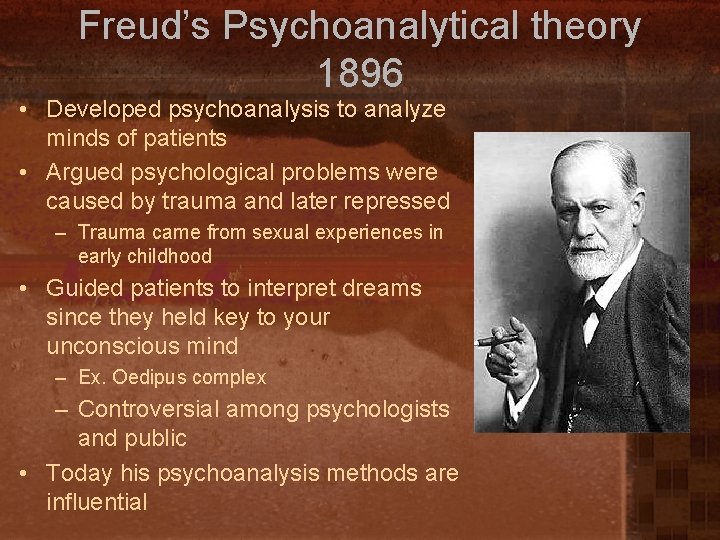
Freud’s Psychoanalytical theory 1896 • Developed psychoanalysis to analyze minds of patients • Argued psychological problems were caused by trauma and later repressed – Trauma came from sexual experiences in early childhood • Guided patients to interpret dreams since they held key to your unconscious mind – Ex. Oedipus complex – Controversial among psychologists and public • Today his psychoanalysis methods are influential
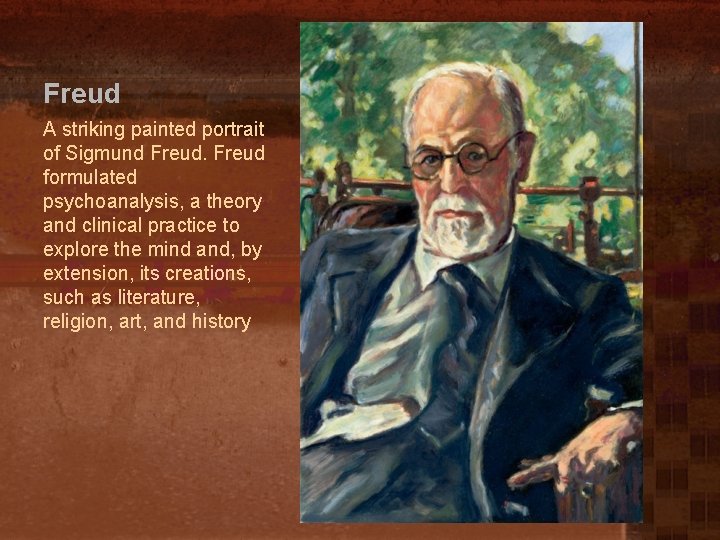
Freud A striking painted portrait of Sigmund Freud formulated psychoanalysis, a theory and clinical practice to explore the mind and, by extension, its creations, such as literature, religion, art, and history
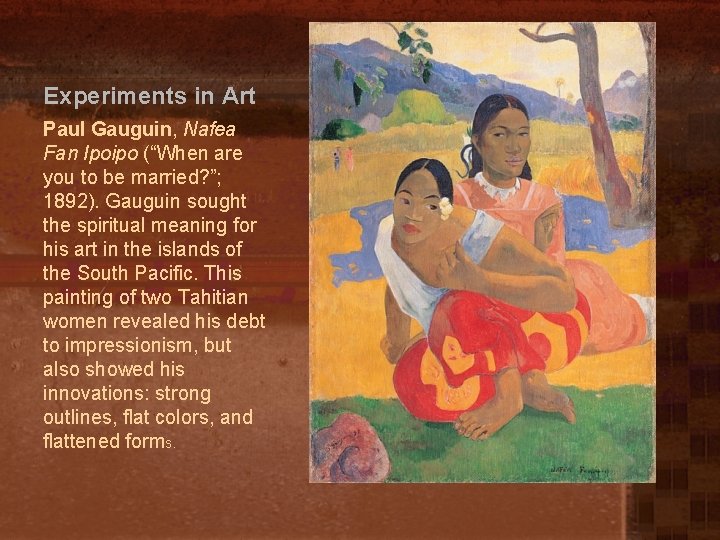
Experiments in Art Paul Gauguin, Nafea Fan Ipoipo (“When are you to be married? ”; 1892). Gauguin sought the spiritual meaning for his art in the islands of the South Pacific. This painting of two Tahitian women revealed his debt to impressionism, but also showed his innovations: strong outlines, flat colors, and flattened forms.
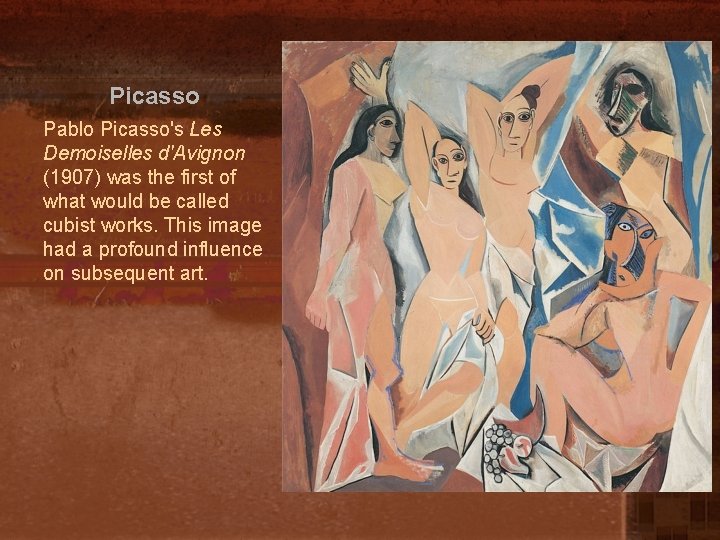
Picasso Pablo Picasso's Les Demoiselles d'Avignon (1907) was the first of what would be called cubist works. This image had a profound influence on subsequent art.

Technology and the Environment • Architecture • Skyscraper transforms the urban environment – Ex. New York and Chicago Detail of the art deco crown of the Chrysler Building Empire State Building, 1932
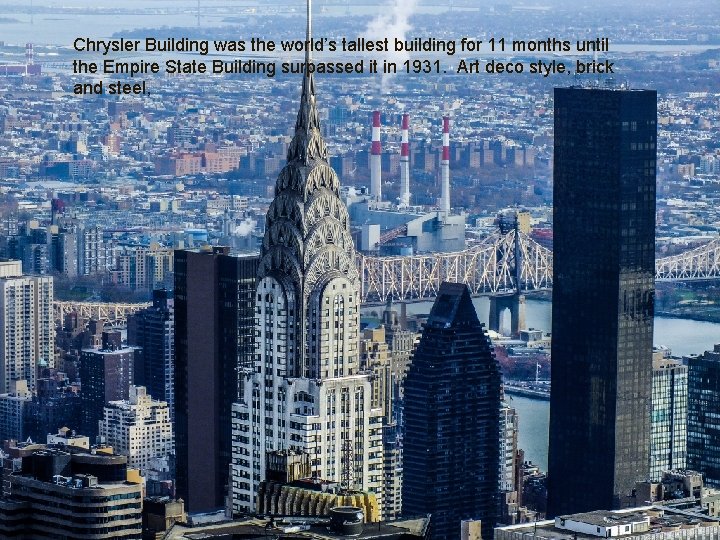
Chrysler Building was the world’s tallest building for 11 months until the Empire State Building surpassed it in 1931. Art deco style, brick and steel,
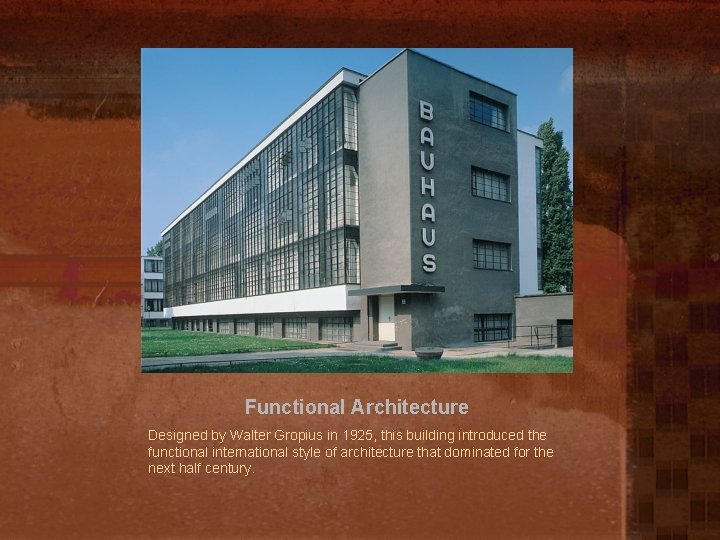
Functional Architecture Designed by Walter Gropius in 1925, this building introduced the functional international style of architecture that dominated for the next half century.
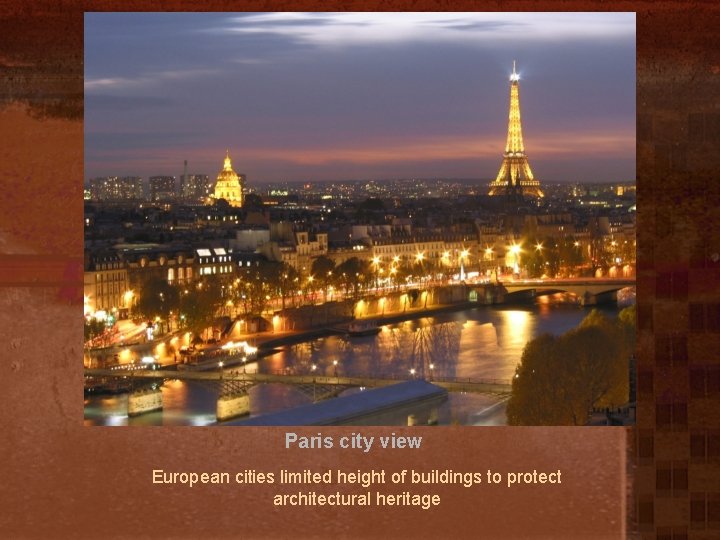
Paris city view European cities limited height of buildings to protect architectural heritage
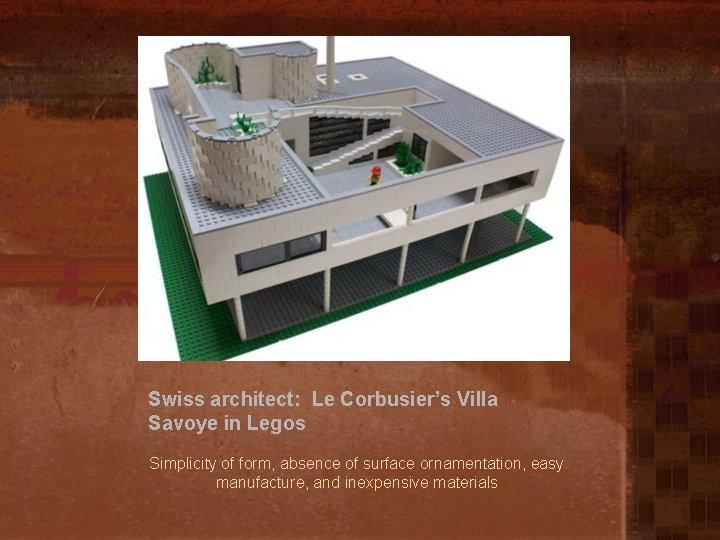
Swiss architect: Le Corbusier’s Villa Savoye in Legos Simplicity of form, absence of surface ornamentation, easy manufacture, and inexpensive materials
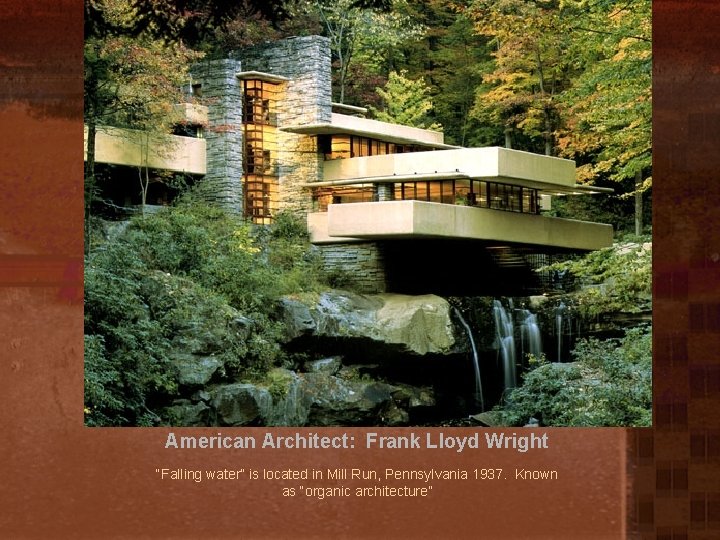
American Architect: Frank Lloyd Wright “Falling water” is located in Mill Run, Pennsylvania 1937. Known as “organic architecture”
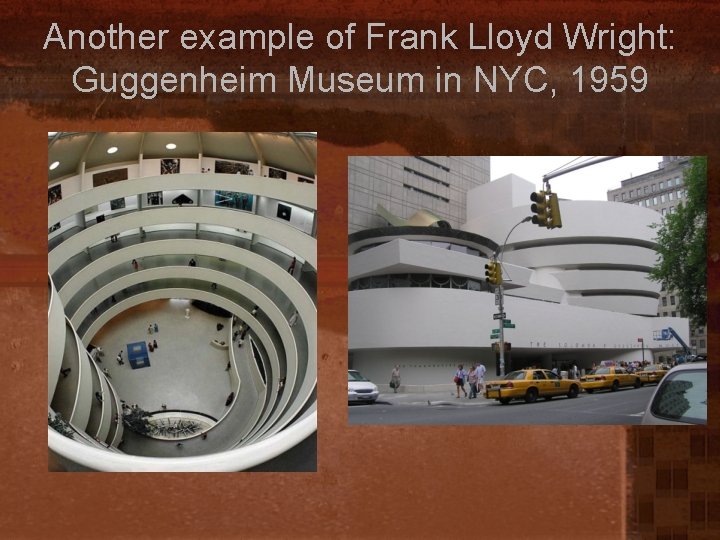
Another example of Frank Lloyd Wright: Guggenheim Museum in NYC, 1959
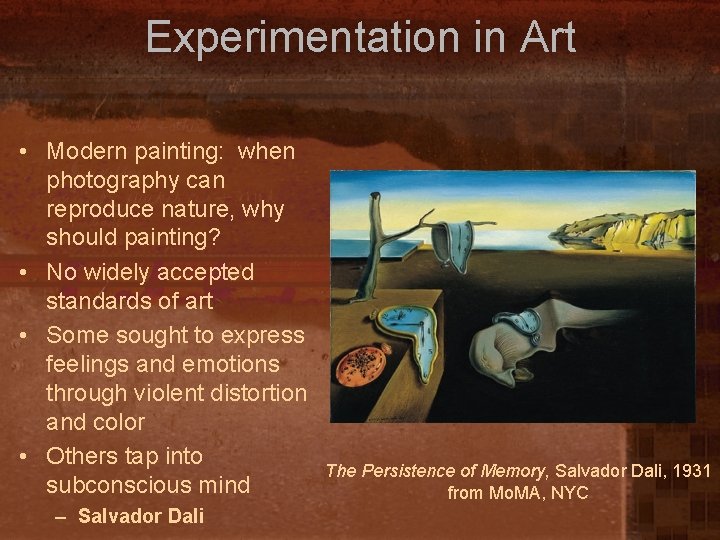
Experimentation in Art • Modern painting: when photography can reproduce nature, why should painting? • No widely accepted standards of art • Some sought to express feelings and emotions through violent distortion and color • Others tap into subconscious mind – Salvador Dali The Persistence of Memory, Salvador Dali, 1931 from Mo. MA, NYC
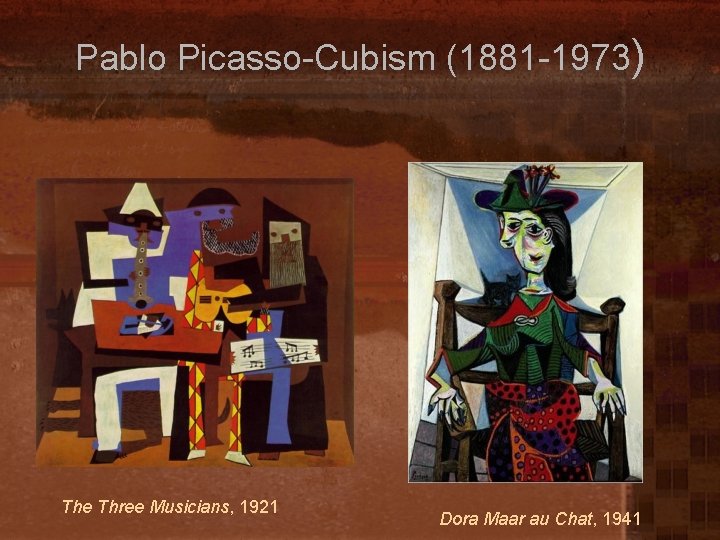
Pablo Picasso-Cubism (1881 -1973) The Three Musicians, 1921 Dora Maar au Chat, 1941
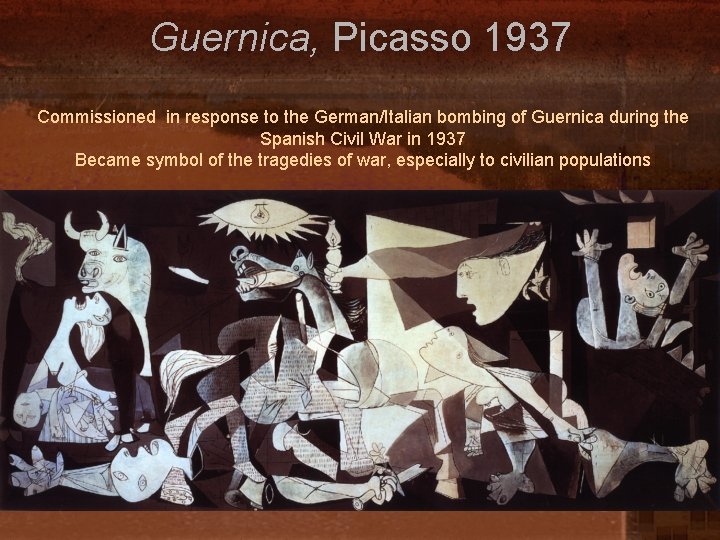
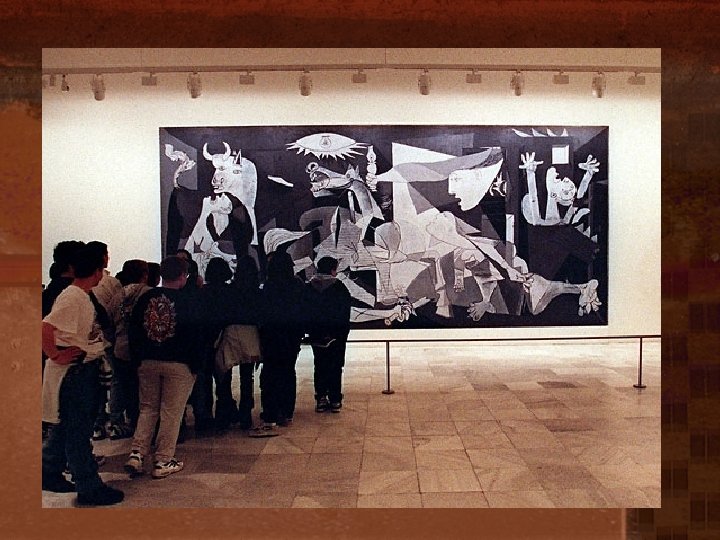
Guernica, Picasso 1937 Commissioned in response to the German/Italian bombing of Guernica during the Spanish Civil War in 1937 Became symbol of the tragedies of war, especially to civilian populations
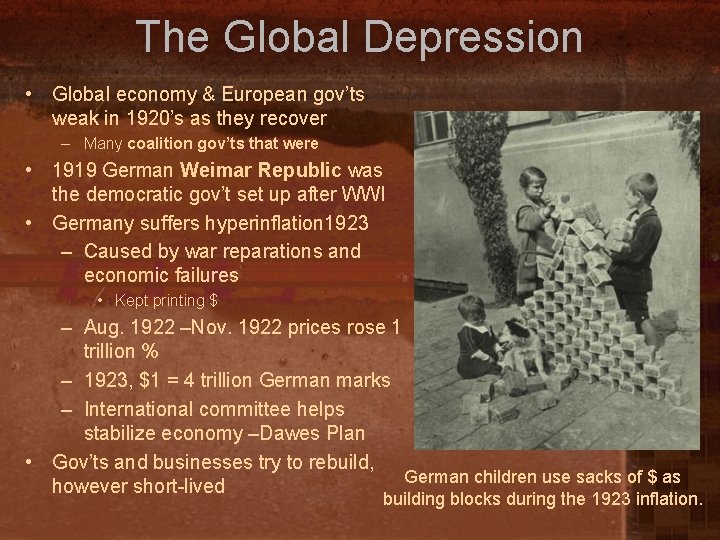
The Global Depression • Global economy & European gov’ts weak in 1920’s as they recover – Many coalition gov’ts that were • 1919 German Weimar Republic was the democratic gov’t set up after WWI • Germany suffers hyperinflation 1923 – Caused by war reparations and economic failures • Kept printing $ – Aug. 1922 –Nov. 1922 prices rose 1 trillion % – 1923, $1 = 4 trillion German marks – International committee helps stabilize economy –Dawes Plan • Gov’ts and businesses try to rebuild, German children use sacks of $ as however short-lived building blocks during the 1923 inflation.
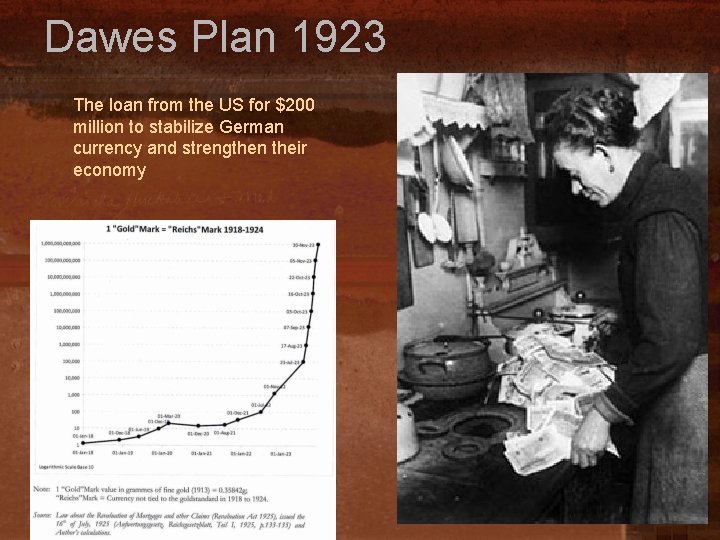
Dawes Plan 1923 The loan from the US for $200 million to stabilize German currency and strengthen their economy
What led to the Great Depression? • Historians find it a complicated task • US economy booms during 20’s and wartime demand had stimulated industrial and agricultural capacity • However: 1. 2. 3. 4. 5. By late 20’s, farms and factories producing more than could be sold Europeans couldn’t afford to buy the products also Germany and Austria made reparation payments with US loans Britain and France were indebt to US, but depended on the reparations to pay their loans US economic boom prompted many to speculate and invest beyond their means 1. Buy stocks on margin
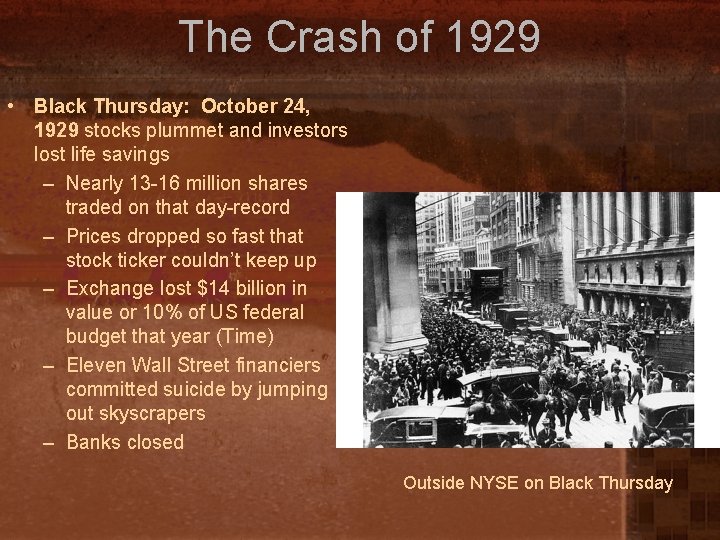
The Crash of 1929 • Black Thursday: October 24, 1929 stocks plummet and investors lost life savings – Nearly 13 -16 million shares traded on that day-record – Prices dropped so fast that stock ticker couldn’t keep up – Exchange lost $14 billion in value or 10% of US federal budget that year (Time) – Eleven Wall Street financiers committed suicide by jumping out skyscrapers – Banks closed Outside NYSE on Black Thursday
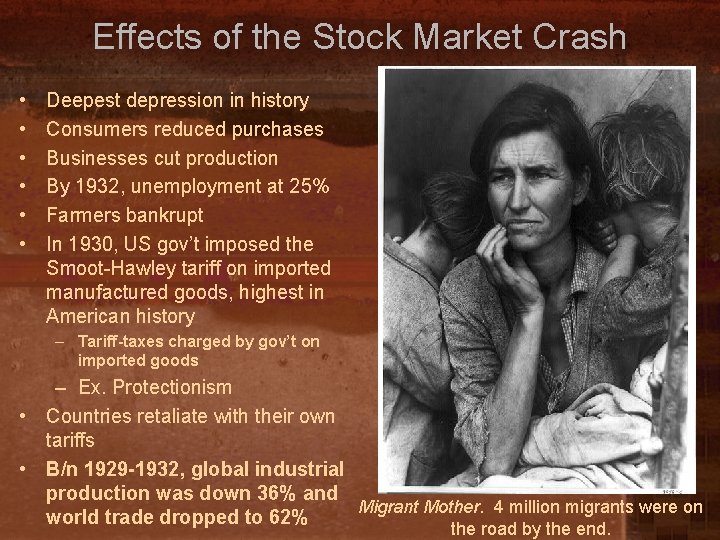
Effects of the Stock Market Crash • • • Deepest depression in history Consumers reduced purchases Businesses cut production By 1932, unemployment at 25% Farmers bankrupt In 1930, US gov’t imposed the Smoot-Hawley tariff on imported manufactured goods, highest in American history – Tariff-taxes charged by gov’t on imported goods – Ex. Protectionism • Countries retaliate with their own tariffs • B/n 1929 -1932, global industrial production was down 36% and Migrant Mother. 4 million migrants were on world trade dropped to 62% the road by the end.
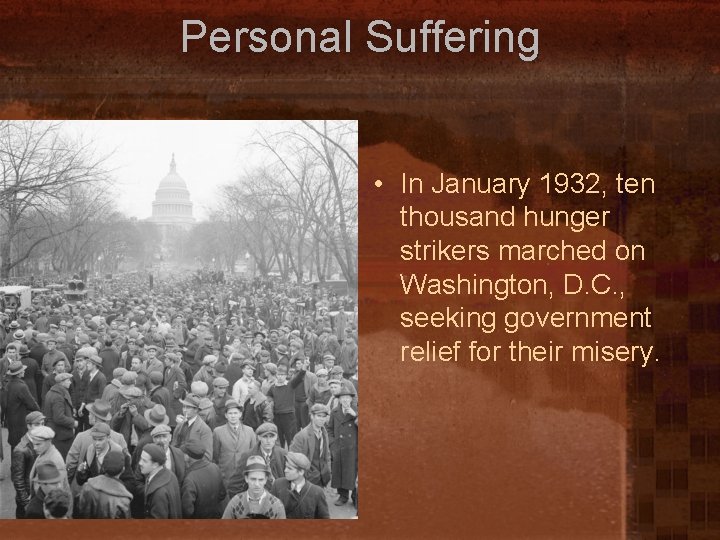
Personal Suffering • In January 1932, ten thousand hunger strikers marched on Washington, D. C. , seeking government relief for their misery.
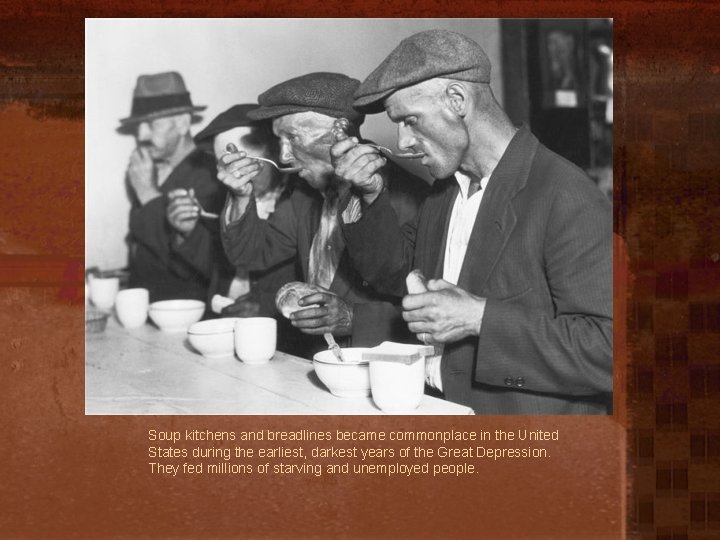
Soup kitchens and breadlines became commonplace in the United States during the earliest, darkest years of the Great Depression. They fed millions of starving and unemployed people.
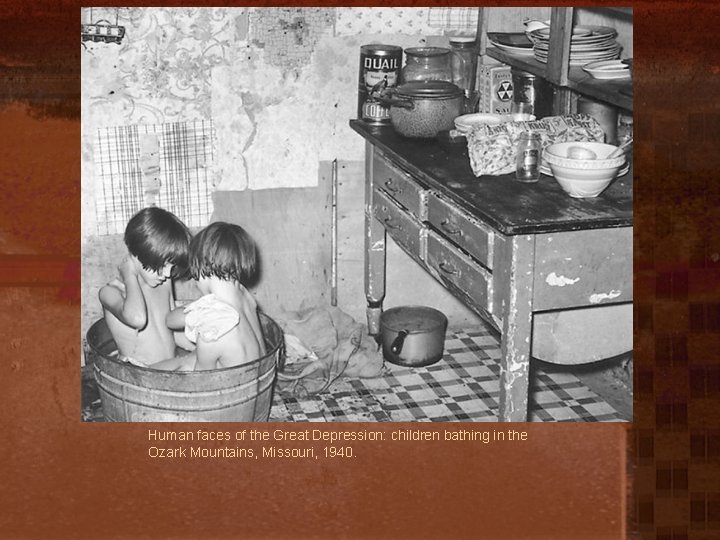
Human faces of the Great Depression: children bathing in the Ozark Mountains, Missouri, 1940.
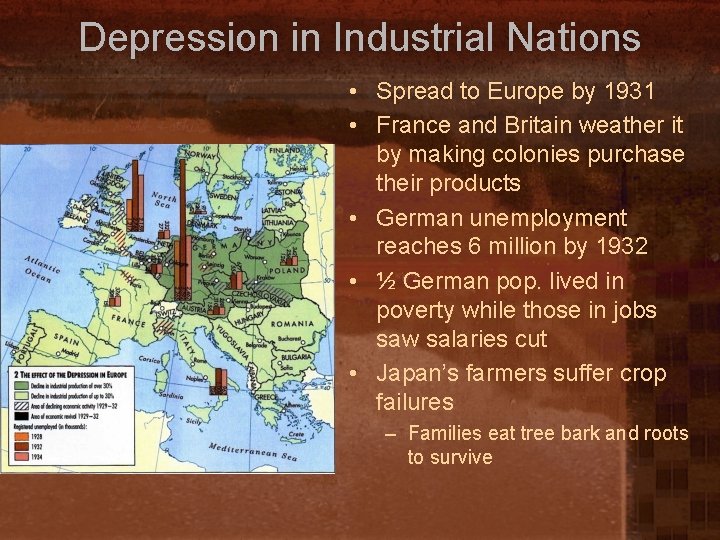
Depression in Industrial Nations • Spread to Europe by 1931 • France and Britain weather it by making colonies purchase their products • German unemployment reaches 6 million by 1932 • ½ German pop. lived in poverty while those in jobs saw salaries cut • Japan’s farmers suffer crop failures – Families eat tree bark and roots to survive
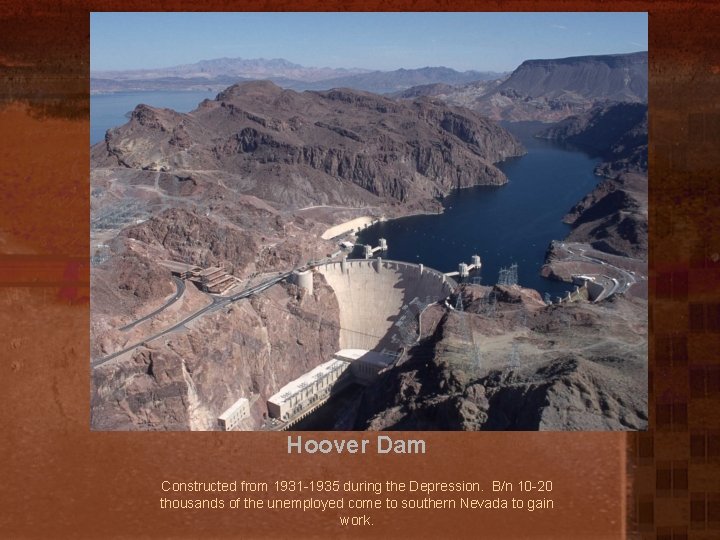
Hoover Dam Constructed from 1931 -1935 during the Depression. B/n 10 -20 thousands of the unemployed come to southern Nevada to gain work.
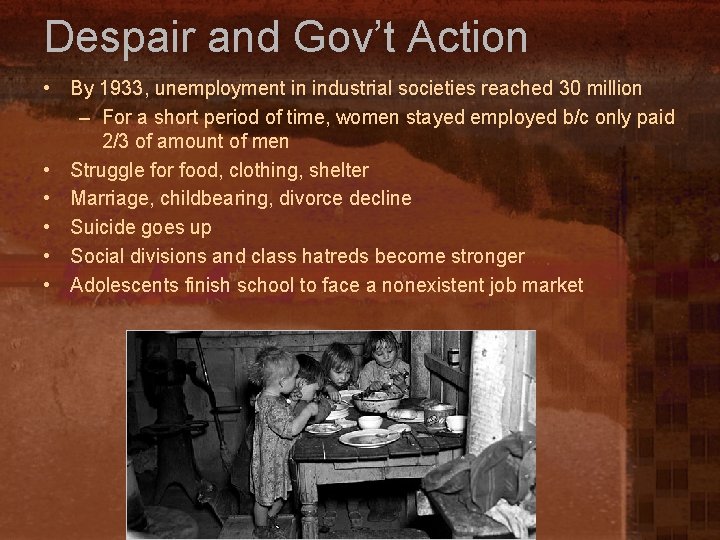
Despair and Gov’t Action • By 1933, unemployment in industrial societies reached 30 million – For a short period of time, women stayed employed b/c only paid 2/3 of amount of men • Struggle for food, clothing, shelter • Marriage, childbearing, divorce decline • Suicide goes up • Social divisions and class hatreds become stronger • Adolescents finish school to face a nonexistent job market
Economic Experimentation • Classic economic thought said that capitalism was a self-correcting system that operated when left to its own • Didn’t necessarily work in the 1930 s
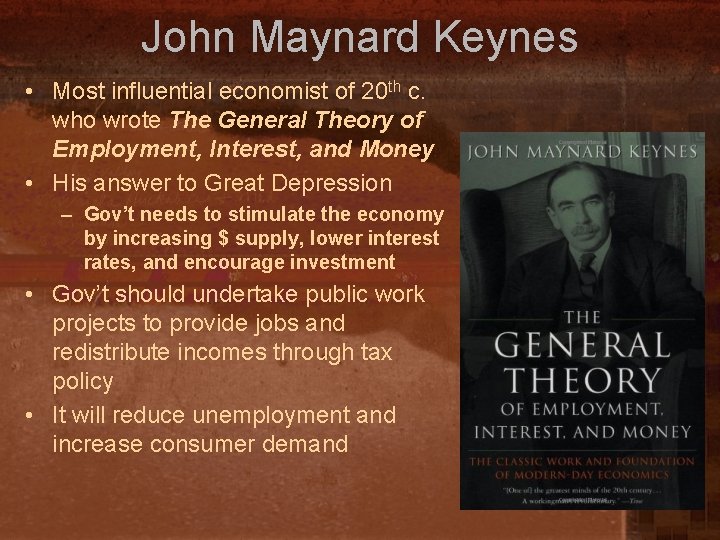
John Maynard Keynes • Most influential economist of 20 th c. who wrote The General Theory of Employment, Interest, and Money • His answer to Great Depression – Gov’t needs to stimulate the economy by increasing $ supply, lower interest rates, and encourage investment • Gov’t should undertake public work projects to provide jobs and redistribute incomes through tax policy • It will reduce unemployment and increase consumer demand
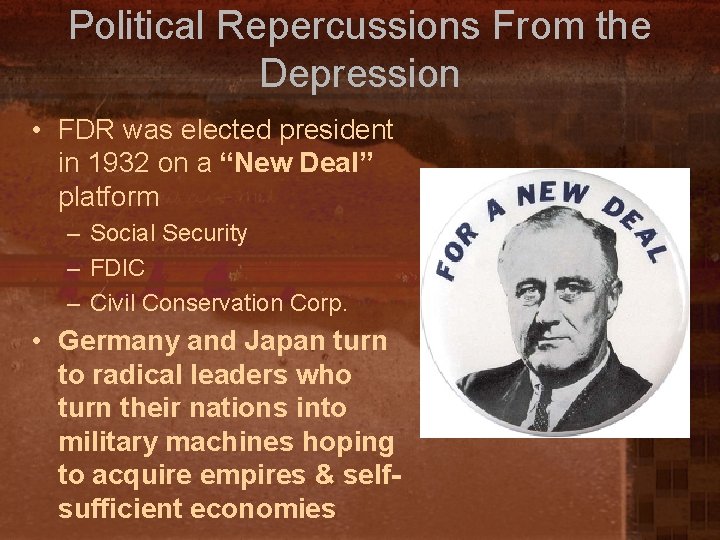
Political Repercussions From the Depression • FDR was elected president in 1932 on a “New Deal” platform – Social Security – FDIC – Civil Conservation Corp. • Germany and Japan turn to radical leaders who turn their nations into military machines hoping to acquire empires & selfsufficient economies
Depression in Asia, Africa and Latin America • China was little affected by trade with other countries b/c of political problems • Latin America saw unemployment, homelessness increase – Military officers seize power – Imitate dictatorships of Europe • Russia not affected b/c of Stalin’s Five Year Plan • Africa – Egypt dependent on cotton exports was hit • Gov’t becomes more autocratic – Southern Africa boomed – Copper deposits cheaper here
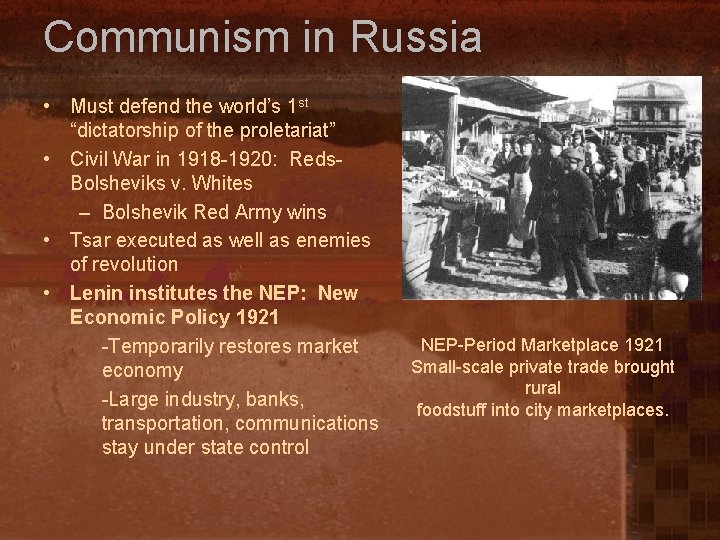
Communism in Russia • Must defend the world’s 1 st “dictatorship of the proletariat” • Civil War in 1918 -1920: Reds. Bolsheviks v. Whites – Bolshevik Red Army wins • Tsar executed as well as enemies of revolution • Lenin institutes the NEP: New Economic Policy 1921 -Temporarily restores market economy -Large industry, banks, transportation, communications stay under state control NEP-Period Marketplace 1921 Small-scale private trade brought rural foodstuff into city marketplaces.
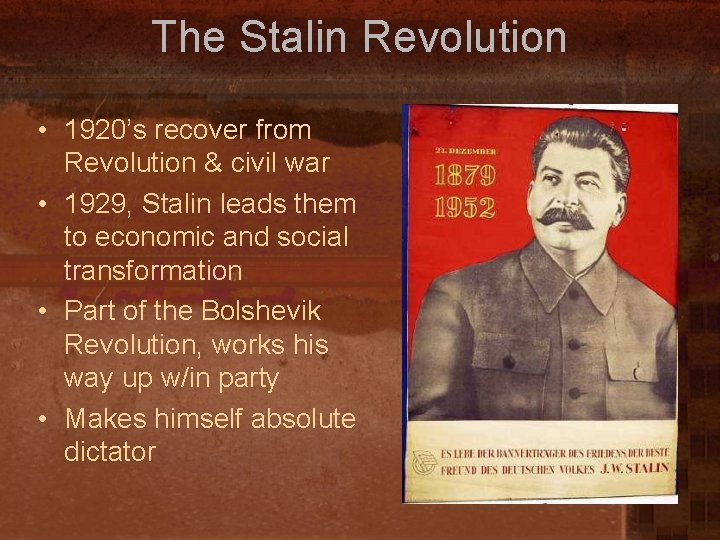
The Stalin Revolution • 1920’s recover from Revolution & civil war • 1929, Stalin leads them to economic and social transformation • Part of the Bolshevik Revolution, works his way up w/in party • Makes himself absolute dictator
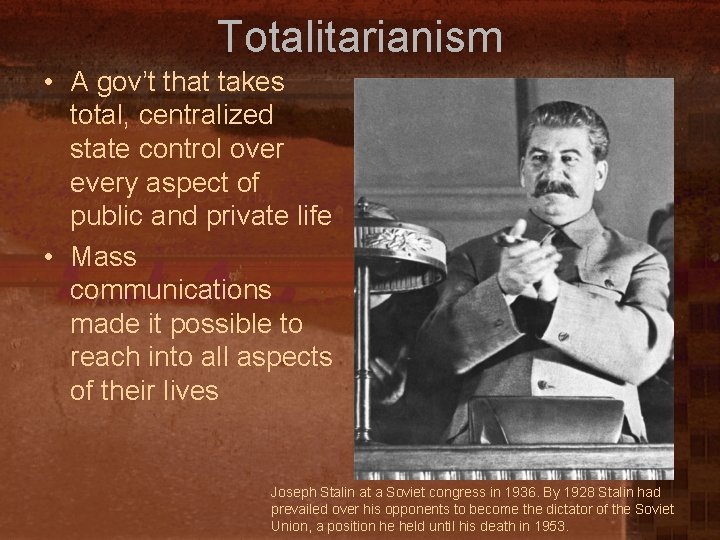
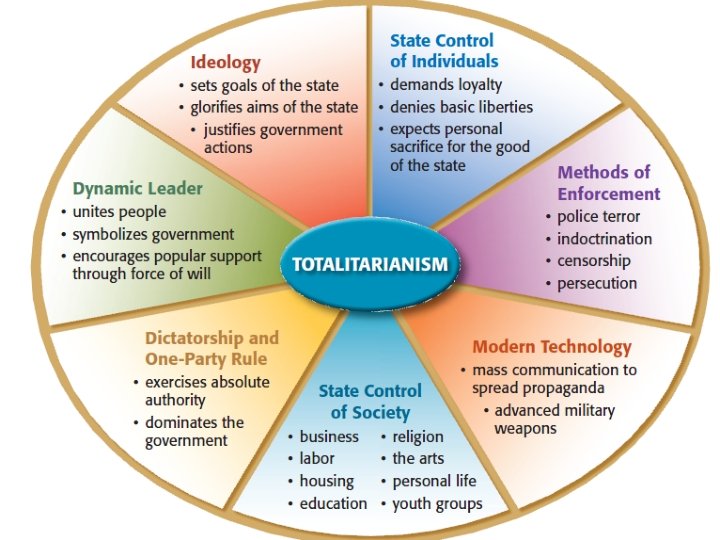
Totalitarianism • A gov’t that takes total, centralized state control over every aspect of public and private life • Mass communications made it possible to reach into all aspects of their lives Joseph Stalin at a Soviet congress in 1936. By 1928 Stalin had prevailed over his opponents to become the dictator of the Soviet Union, a position he held until his death in 1953.
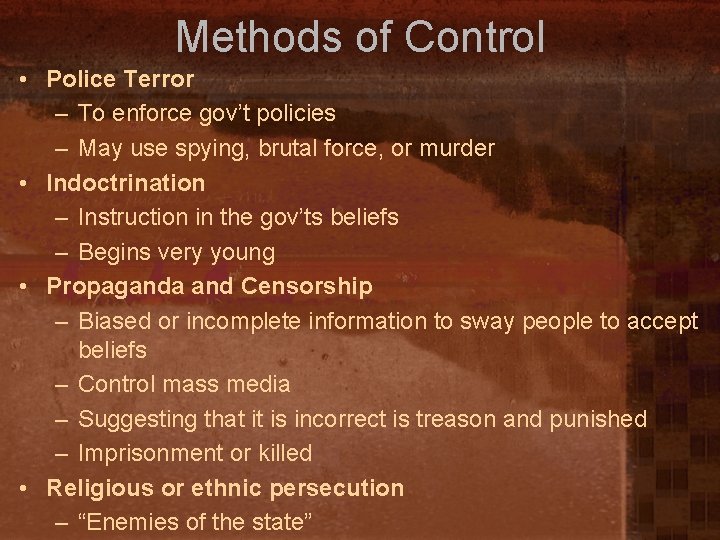
Methods of Control • Police Terror – To enforce gov’t policies – May use spying, brutal force, or murder • Indoctrination – Instruction in the gov’ts beliefs – Begins very young • Propaganda and Censorship – Biased or incomplete information to sway people to accept beliefs – Control mass media – Suggesting that it is incorrect is treason and punished – Imprisonment or killed • Religious or ethnic persecution – “Enemies of the state”
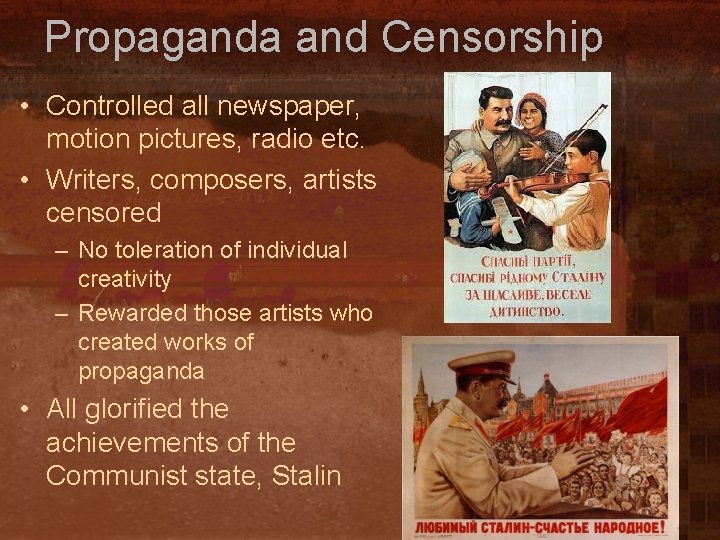
Propaganda and Censorship • Controlled all newspaper, motion pictures, radio etc. • Writers, composers, artists censored – No toleration of individual creativity – Rewarded those artists who created works of propaganda • All glorified the achievements of the Communist state, Stalin
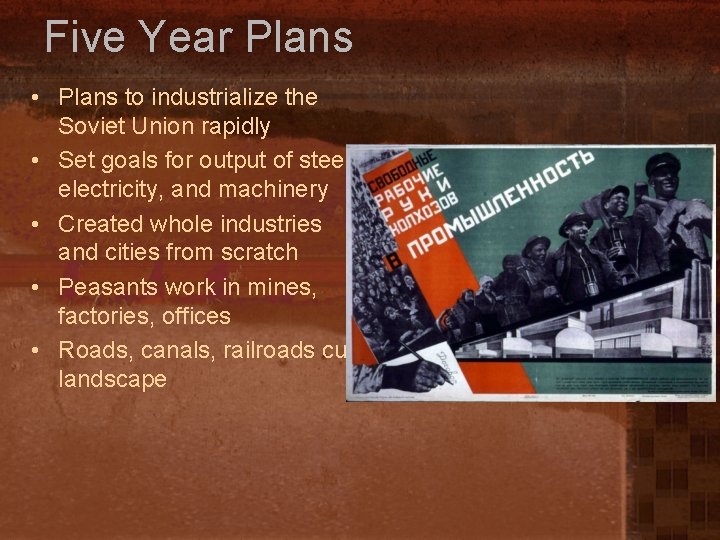
Five Year Plans • Plans to industrialize the Soviet Union rapidly • Set goals for output of steel, electricity, and machinery • Created whole industries and cities from scratch • Peasants work in mines, factories, offices • Roads, canals, railroads cut landscape
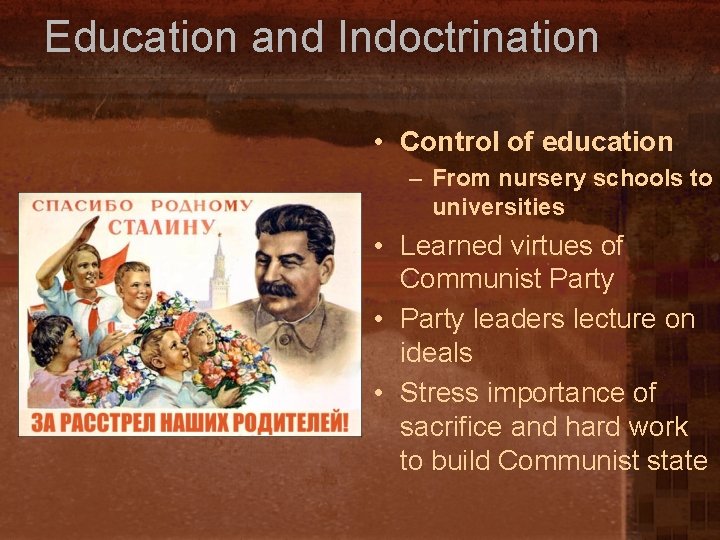
Education and Indoctrination • Control of education – From nursery schools to universities • Learned virtues of Communist Party • Party leaders lecture on ideals • Stress importance of sacrifice and hard work to build Communist state
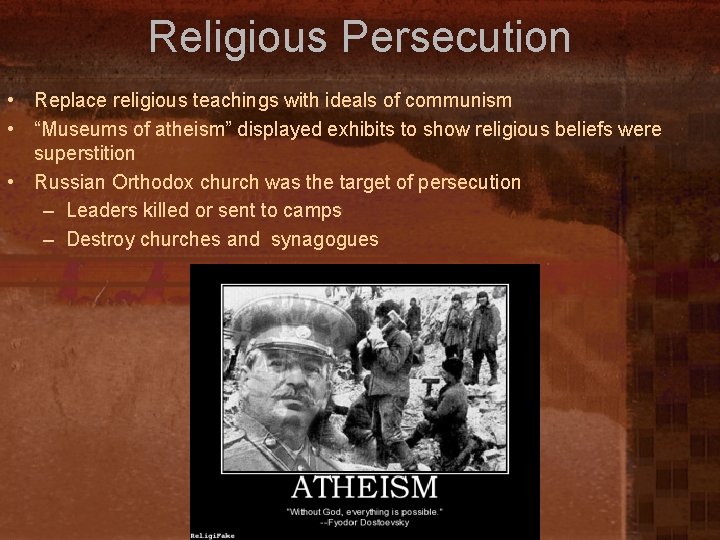
Religious Persecution • Replace religious teachings with ideals of communism • “Museums of atheism” displayed exhibits to show religious beliefs were superstition • Russian Orthodox church was the target of persecution – Leaders killed or sent to camps – Destroy churches and synagogues
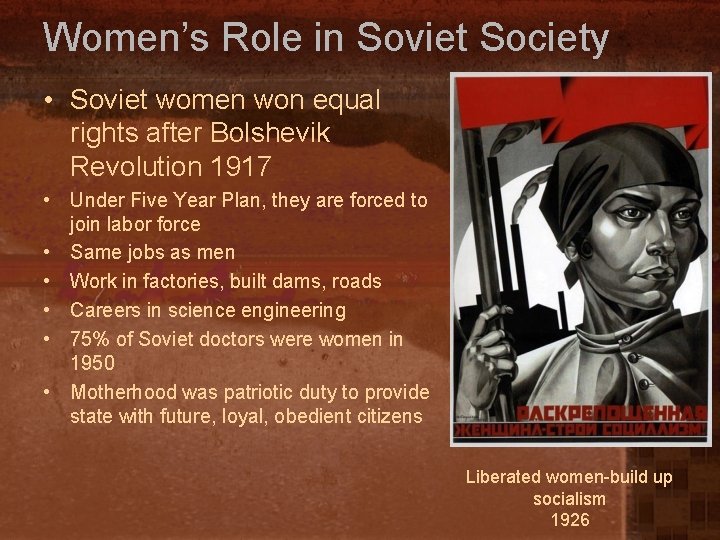
Women’s Role in Soviet Society • Soviet women won equal rights after Bolshevik Revolution 1917 • Under Five Year Plan, they are forced to join labor force • Same jobs as men • Work in factories, built dams, roads • Careers in science engineering • 75% of Soviet doctors were women in 1950 • Motherhood was patriotic duty to provide state with future, loyal, obedient citizens Liberated women-build up socialism 1926
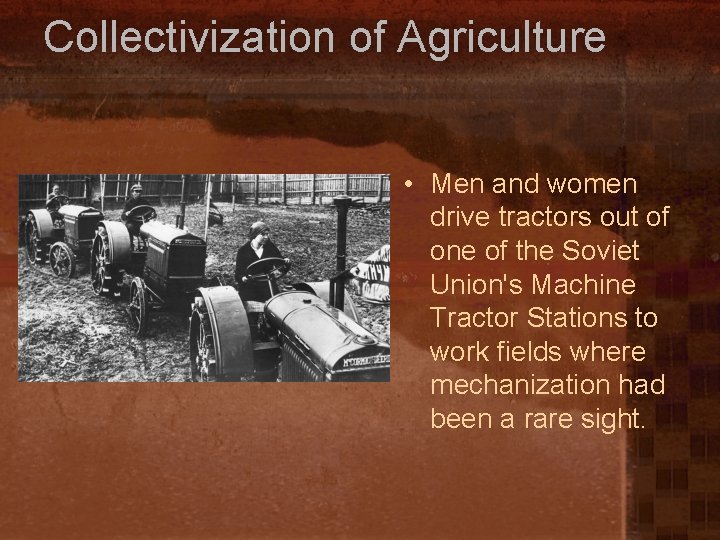
Collectivization of Agriculture • Men and women drive tractors out of one of the Soviet Union's Machine Tractor Stations to work fields where mechanization had been a rare sight.
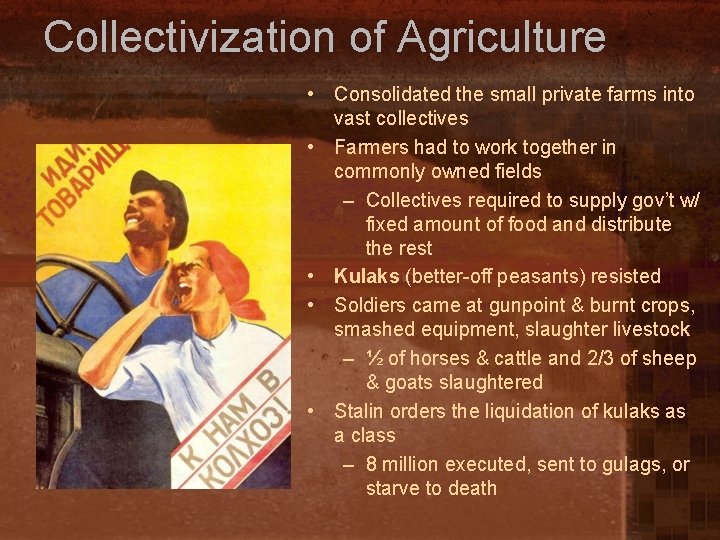
Collectivization of Agriculture • Consolidated the small private farms into vast collectives • Farmers had to work together in commonly owned fields – Collectives required to supply gov’t w/ fixed amount of food and distribute the rest • Kulaks (better-off peasants) resisted • Soldiers came at gunpoint & burnt crops, smashed equipment, slaughter livestock – ½ of horses & cattle and 2/3 of sheep & goats slaughtered • Stalin orders the liquidation of kulaks as a class – 8 million executed, sent to gulags, or starve to death
Famine • Peasants left to farm were least competent • Could not plant or harvest enough to meet demands of cities • Gov’t took everything they found • 1933 -34 famine killed some 5 million people
Stalin’s Second Five Year Plan • Ran from 1933 -37 emphasized heavy industry to produce armaments • Metals and machines increase 14 x over but consumer goods scarce • Leaves Soviets without clothing, food, and housing
The Great Purge • A campaign of terror directed at eliminating anyone who threatened power – Estimate 8 -13 million deaths • Stalin used secret police, the NKVD, to prevent rebellion – Arrested engineers and technicians for fear of counterrevolutionary ideas • Expelled 1 million members of Communist party • Great Purge Trials – Accused Communist party members of treason – Executed or sent to “gulags” or forced labor camps for “crimes against the Soviet state”
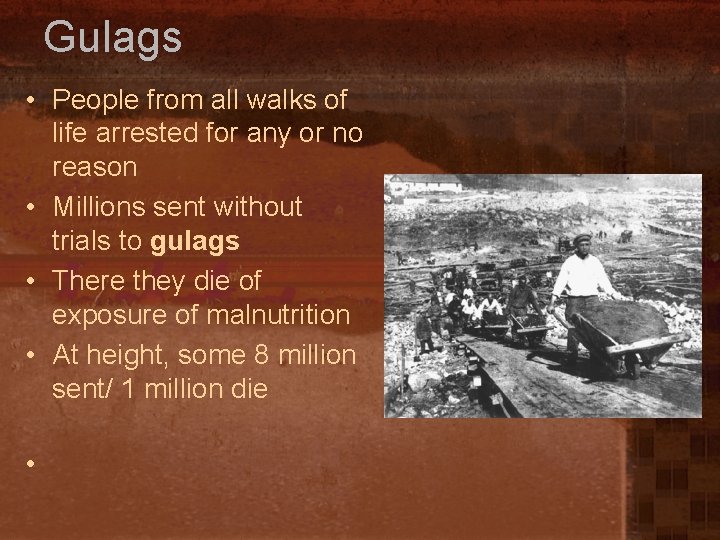
Gulags • People from all walks of life arrested for any or no reason • Millions sent without trials to gulags • There they die of exposure of malnutrition • At height, some 8 million sent/ 1 million die •
Outcome of Stalin’s Regime • Citizens supported his regime with new industries, cities, employment opportunities for everyone • His brutal methods helped them industrialize faster than any country had done • By late 1930’s, USSR was the 3 rd largest industrial power after US and Germany
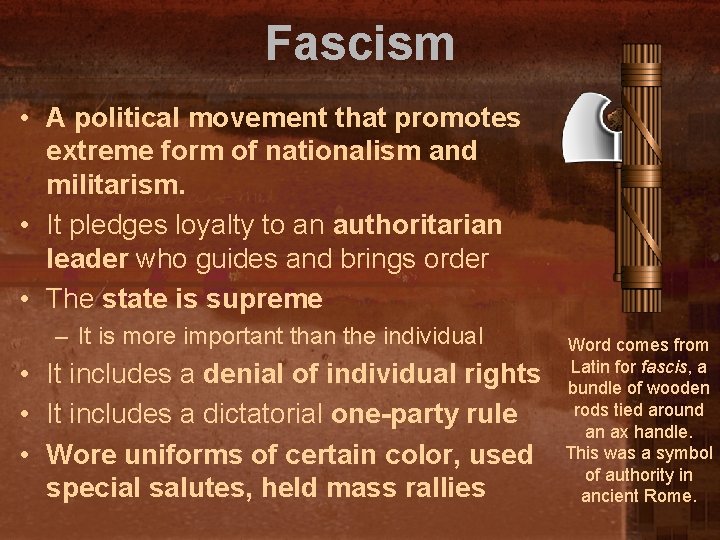
Fascism • A political movement that promotes extreme form of nationalism and militarism. • It pledges loyalty to an authoritarian leader who guides and brings order • The state is supreme – It is more important than the individual • It includes a denial of individual rights • It includes a dictatorial one-party rule • Wore uniforms of certain color, used special salutes, held mass rallies Word comes from Latin for fascis, a bundle of wooden rods tied around an ax handle. This was a symbol of authority in ancient Rome.
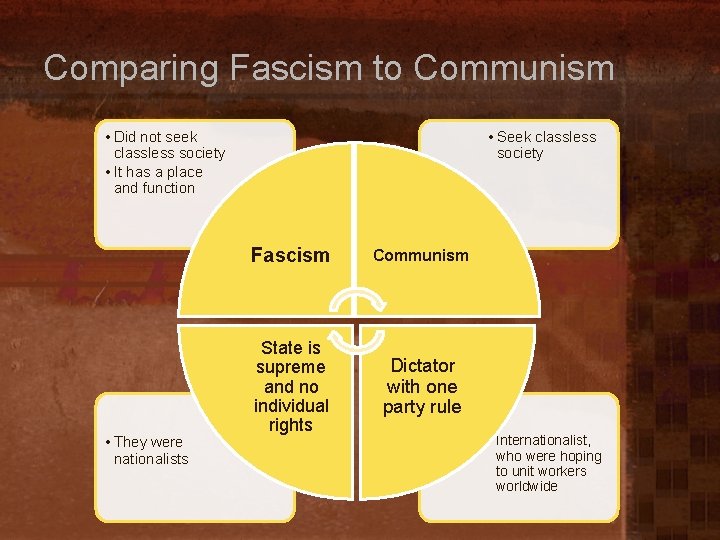
Comparing Fascism to Communism • Did not seek classless society • It has a place and function • They were nationalists • Seek classless society Fascism Communism State is supreme and no individual rights Dictator with one party rule • Internationalist, who were hoping to unit workers worldwide
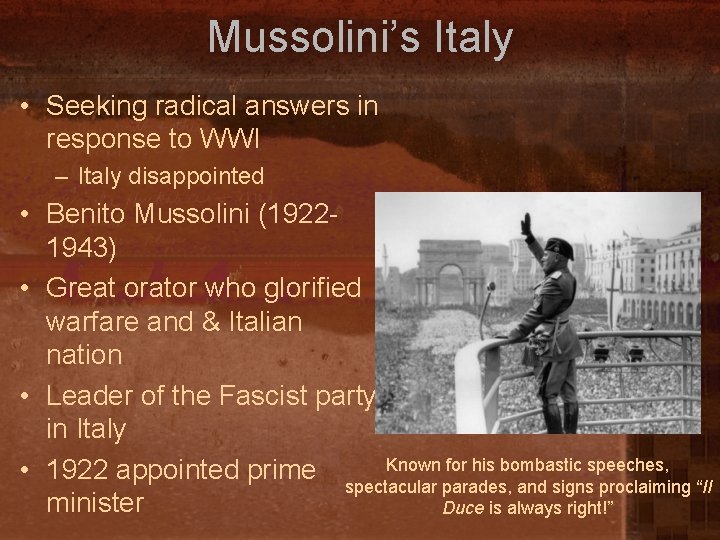
Mussolini’s Italy • Seeking radical answers in response to WWI – Italy disappointed • Benito Mussolini (19221943) • Great orator who glorified warfare and & Italian nation • Leader of the Fascist party in Italy Known for his bombastic speeches, • 1922 appointed prime spectacular parades, and signs proclaiming “Il minister Duce is always right!”
Fascism in Italy • Install Fascist members in all gov’t jobs, crush opposition parties – 1, 000 s imprisoned, exiled, or executed • Take over press, education, youth activities and gave employers control over workers • Mussolini’s genius was how he applied modern mass communications & advertisements to political life • His techniques will be mimicked by others in Europe, Latin America, China, and Japan “…the twentieth century will be • a century of fascism, the century of Italian power. ” Mussolini, 1932 1936 Mussolini forms alliance with Hitler known as the Rome-Berlin Axis-…”world history would revolve around a Rome. Berlin Axis”
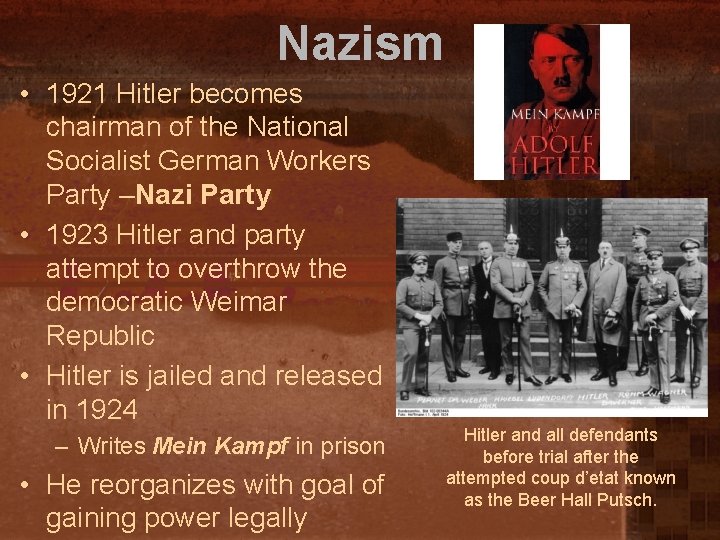
Nazism • 1921 Hitler becomes chairman of the National Socialist German Workers Party –Nazi Party • 1923 Hitler and party attempt to overthrow the democratic Weimar Republic • Hitler is jailed and released in 1924 – Writes Mein Kampf in prison • He reorganizes with goal of gaining power legally Hitler and all defendants before trial after the attempted coup d’etat known as the Beer Hall Putsch.
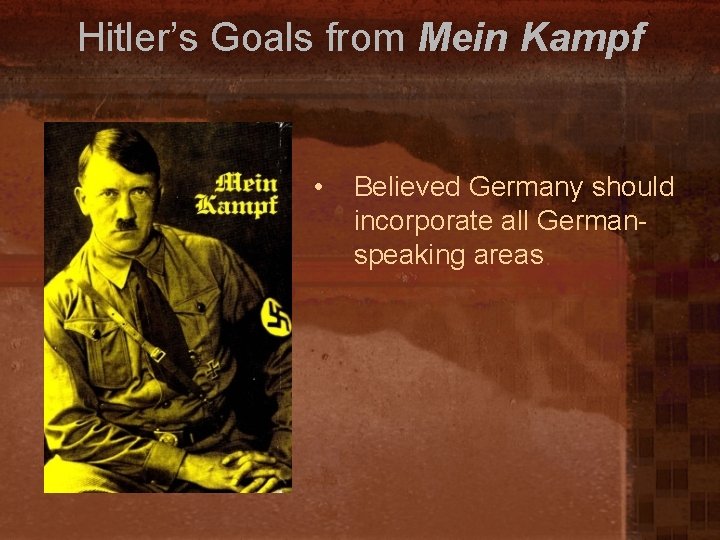
Hitler’s Goals from Mein Kampf • Believed Germany should incorporate all Germanspeaking areas
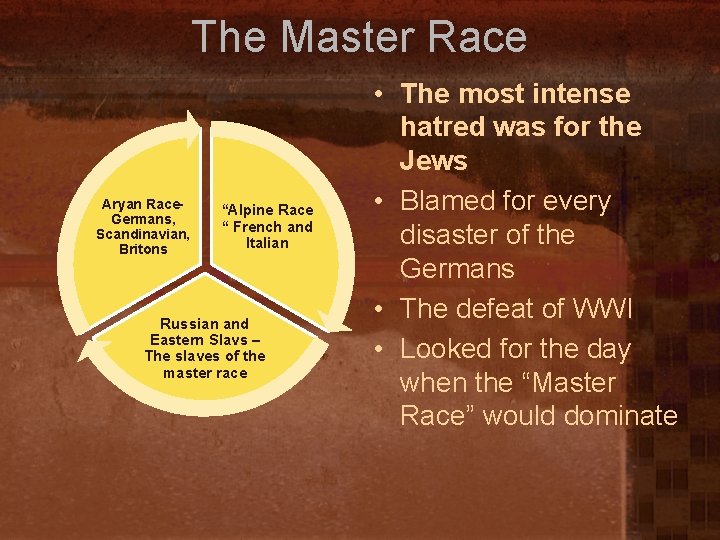
The Master Race Aryan Race. Germans, Scandinavian, Britons “Alpine Race “ French and Italian Russian and Eastern Slavs – The slaves of the master race • The most intense hatred was for the Jews • Blamed for every disaster of the Germans • The defeat of WWI • Looked for the day when the “Master Race” would dominate
Lebensraum • Goal was to repeal the humiliation and military restrictions of Treaty of Versailles • Plan to annex all German-speaking territory to Germany – Living space to the east • Plan to eliminate all Jews
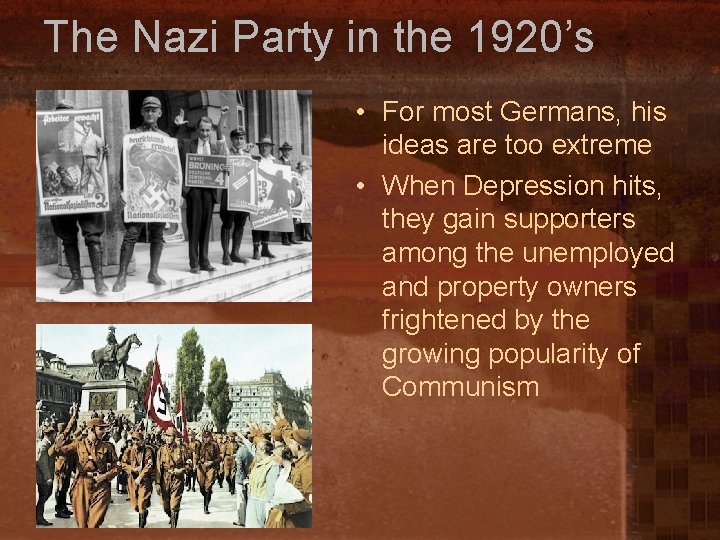
The Nazi Party in the 1920’s • For most Germans, his ideas are too extreme • When Depression hits, they gain supporters among the unemployed and property owners frightened by the growing popularity of Communism
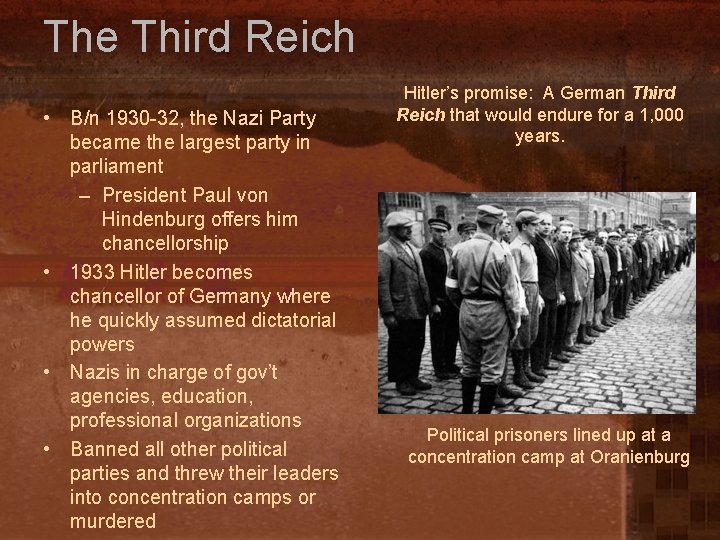
The Third Reich • B/n 1930 -32, the Nazi Party became the largest party in parliament – President Paul von Hindenburg offers him chancellorship • 1933 Hitler becomes chancellor of Germany where he quickly assumed dictatorial powers • Nazis in charge of gov’t agencies, education, professional organizations • Banned all other political parties and threw their leaders into concentration camps or murdered Hitler’s promise: A German Third Reich that would endure for a 1, 000 years. Political prisoners lined up at a concentration camp at Oranienburg
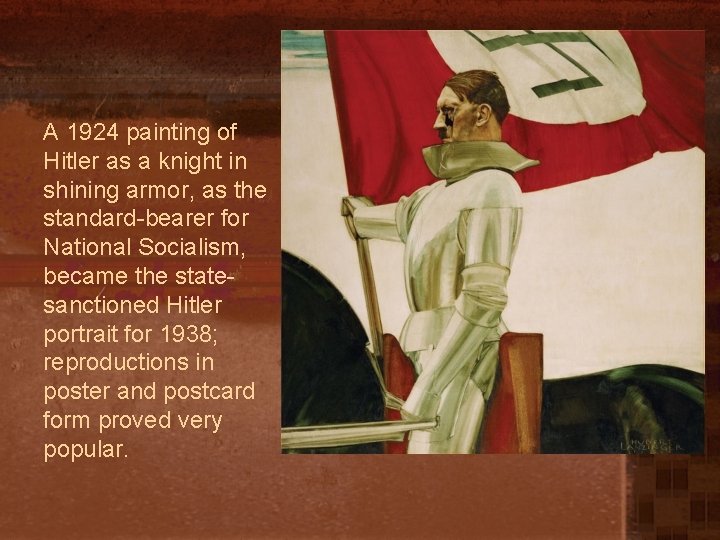
A 1924 painting of Hitler as a knight in shining armor, as the standard-bearer for National Socialism, became the statesanctioned Hitler portrait for 1938; reproductions in poster and postcard form proved very popular.
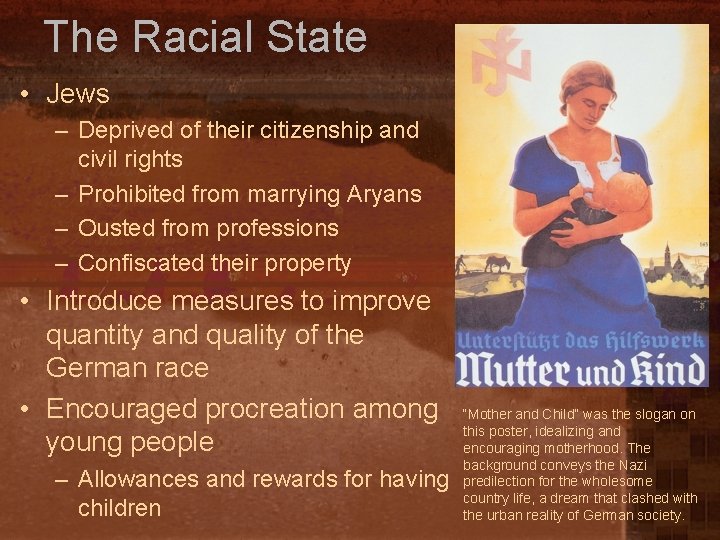
The Racial State • Jews – Deprived of their citizenship and civil rights – Prohibited from marrying Aryans – Ousted from professions – Confiscated their property • Introduce measures to improve quantity and quality of the German race • Encouraged procreation among young people – Allowances and rewards for having children “Mother and Child” was the slogan on this poster, idealizing and encouraging motherhood. The background conveys the Nazi predilection for the wholesome country life, a dream that clashed with the urban reality of German society.
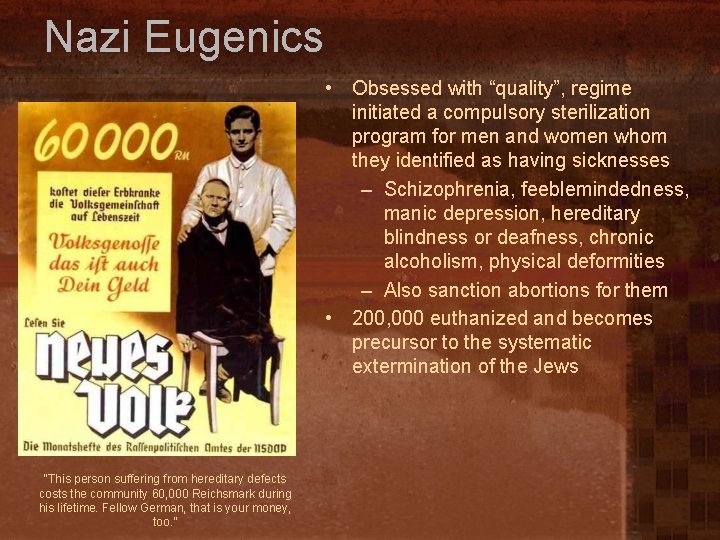
Nazi Eugenics • Obsessed with “quality”, regime initiated a compulsory sterilization program for men and women whom they identified as having sicknesses – Schizophrenia, feeblemindedness, manic depression, hereditary blindness or deafness, chronic alcoholism, physical deformities – Also sanction abortions for them • 200, 000 euthanized and becomes precursor to the systematic extermination of the Jews “This person suffering from hereditary defects costs the community 60, 000 Reichsmark during his lifetime. Fellow German, that is your money, too. ”
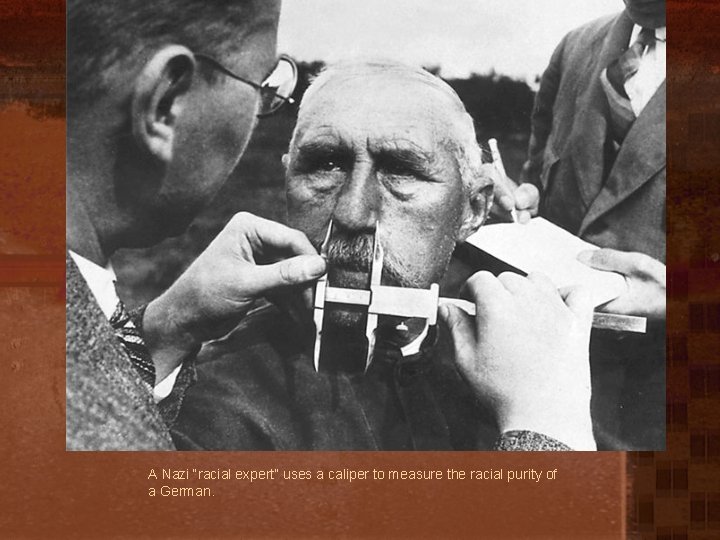
A Nazi “racial expert” uses a caliper to measure the racial purity of a German.
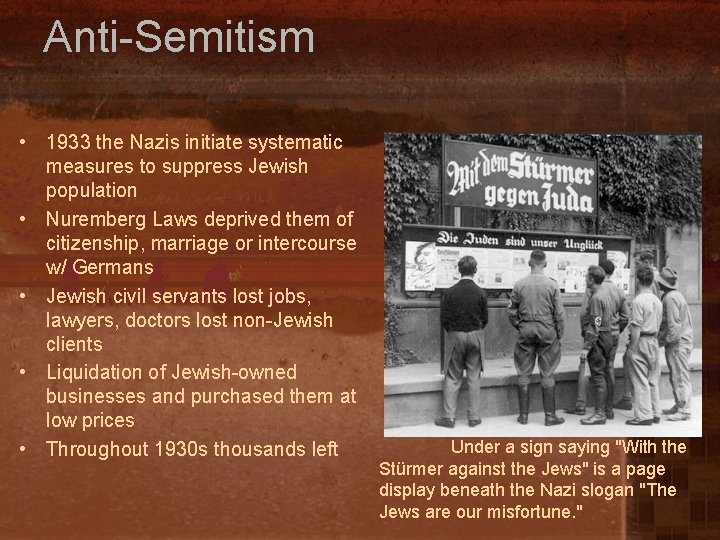
Anti-Semitism • 1933 the Nazis initiate systematic measures to suppress Jewish population • Nuremberg Laws deprived them of citizenship, marriage or intercourse w/ Germans • Jewish civil servants lost jobs, lawyers, doctors lost non-Jewish clients • Liquidation of Jewish-owned businesses and purchased them at low prices • Throughout 1930 s thousands left Under a sign saying "With the Stürmer against the Jews" is a page display beneath the Nazi slogan "The Jews are our misfortune. "
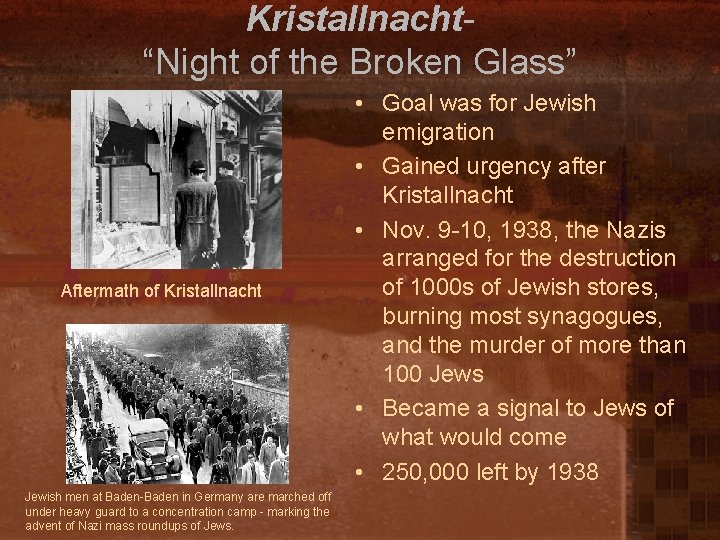
Kristallnacht- “Night of the Broken Glass” Aftermath of Kristallnacht Jewish men at Baden-Baden in Germany are marched off under heavy guard to a concentration camp - marking the advent of Nazi mass roundups of Jews. • Goal was for Jewish emigration • Gained urgency after Kristallnacht • Nov. 9 -10, 1938, the Nazis arranged for the destruction of 1000 s of Jewish stores, burning most synagogues, and the murder of more than 100 Jews • Became a signal to Jews of what would come • 250, 000 left by 1938
- Slides: 75